
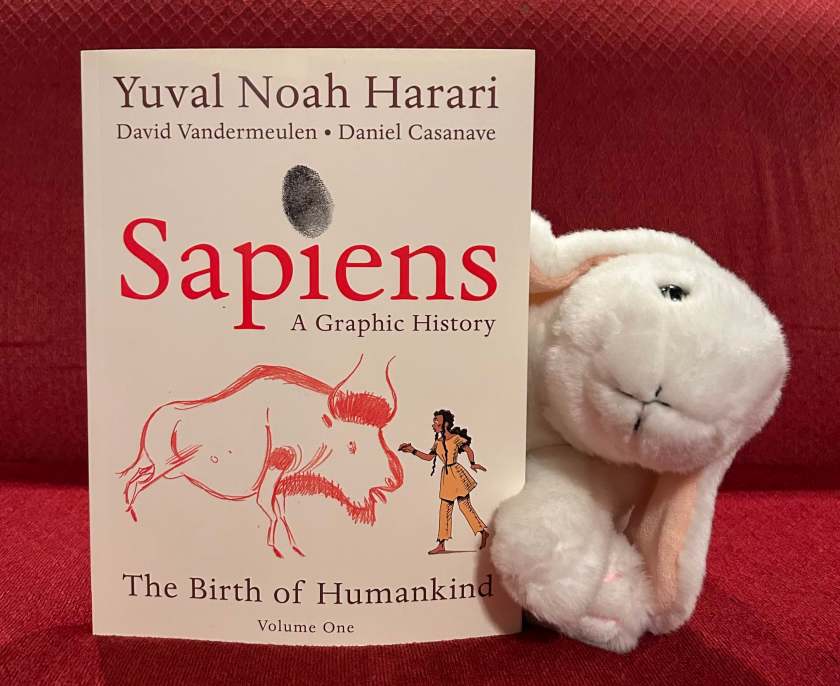
Today Marshmallow reviews Sapiens – A Graphic History: The Birth of Humankind, the first volume, published in 2020, of the multi-volume graphic novelization of Yuval Noah Harari’s 2011 book Sapiens – A Brief History of Humankind. Sprinkles is taking notes and asking questions.
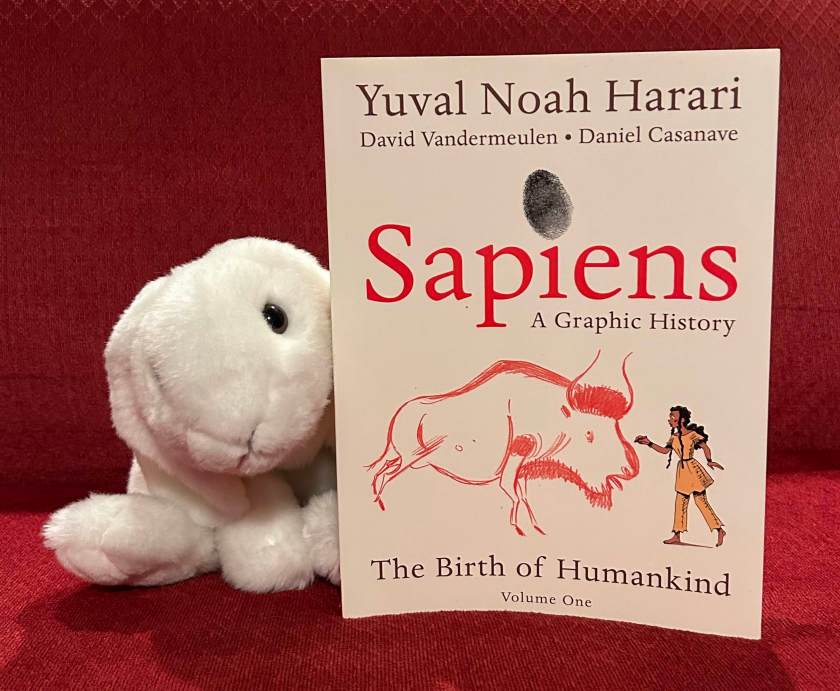
Sprinkles: I know you enjoy graphic novels, just like Caramel does, so I was not too surprised when you decided to pick up this book.
Marshmallow: Yep, and I actually enjoyed reading it too. And I think that, if you like books that ask deep questions or investigate human history, then this is the book for you!
S: Hmm, I see what you did there. You begin all your reviews with this kind of an invitation. I think it works well here too! So what is this book about?
M: It is basically about the entire history of humanity’s origins.
S: That sounds ambitious!
M: It is. So I think this will take him four or five volumes, but he is trying to tell in graphic novel form what he writes in his original book from 2011. It’s pretty novel I’d say.
S: I see. Tell me more.
M: So in this book, human evolution is portrayed as a reality TV show. And mass extinction becomes a crime investigation. We follow the author Yuval and his niece Zoe as they investigate the meaning of labels like “species” and “genus” with Professor Saraswati. Each character is drawn as a little caricature. Then we see Yuval and Zoe watching “The Greatest Show on Earth!”, or “Evolution!” This leads to an investigation of why and how the species of Homo Sapiens dominates the Earth today. After all, there were several other species in the human genus.
S: I can see that you are using some big words, maybe from your biology class?
M: Well, not quite. The book uses them, so I think it makes sense for me to use them too.
S: Makes sense to me.
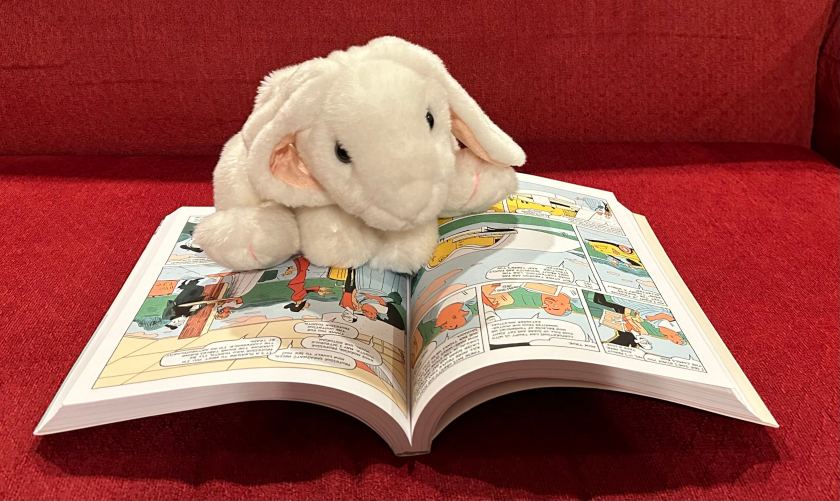
S: So I know that after reading this book, you also followed up with some reviews of it to see how it was received.
M: Yes. Because the author intends to share some possibly controversial ideas about the history of humanity, there was a lot I did not know about in the book, so it was really interesting to read. But I wanted to know if what he was saying was really correct. This is a graphic novel after all, and though some graphic novels have extensive footnotes and such, this one has none, and it has no references. So I wanted to check to see what others who know more about the topic thought.
S: So what did you find out?
M: Well, our readers can start by checking the Wikipedia article on the original book. The original book sold really well and got a lot of great reviews from well-known and highly regarded people. But it seems like some of the more scientific takes on the book are not as complimentary. A lot of them do like it actually, but there are some folks that say that there is not that much that is new in the book and whatever is new and original is not accurate.
S: I see. Now it is not terrible if there is nothing new for scientists, because no matter what they all know, their knowledge is not always accessible to the general audience.
M: Exactly. The graphic novel format is a really good way to reach a lot more people. So some apparently called it “infotainment,” but maybe that is actually not a terrible thing. I think the Lucy & Andy Neanderthal series that I read and reviewed is also kind of infotainment but I still found it extremely educational.
S: I agree with you there. Those books are a lot of fun and teach you a lot too.
M: Even our reviews are probably infotainment – fun yet informative, I hope. The accuracy concern is more difficult to dismiss though. Not being a scientist, I am not great at gauging that. So my advice for curious bunnies is to read this because it is a great story, and you will learn a lot, but still take it with a grain of salt, because if some parts of it feel really out there, maybe they are. So it might be worth double-checking things out on your own.
S: I think that is a very prudent and thoughtful recommendation, Marshmallow.
M: I’m a very prudent and thoughtful bunny. And now we are both using big words!
S: Yep, it must be this book!
M: We must be smarter or something! Maybe we are evolving.
S: Okay, okay, hold it there. Maybe this is a good place to end this review. So if you were to rate this book what would your rating be?
M: I really really enjoyed it, and I’d say 100% but then again the accuracy question makes me say 95%.
S: That’s fair. Okay, thanks for your neat review, Marshmallow. What would you like to tell our readers as we wrap it up?
M: Stay tuned for more amazing reviews from the book bunnies!
 BookBunnies
Evolution is a funny thing. Somewhere along the evolutionary line we lost our tail as it was no longer needed and therefore not an advantage. But, why did we lose our fur? What was the advantage in wearing animal skins over having natural fur?
LikeLiked by 1 person
Sounds like an interesting book!
LikeLiked by 1 person