Marshmallow reviews A Tale of Two Cities by Charles Dickens

Marshmallow has been reading A Tale of Two Cities by Charles Dickens at school and so thought it would be a good idea to review it for the blog. Below are her thoughts on this classic from 1859.
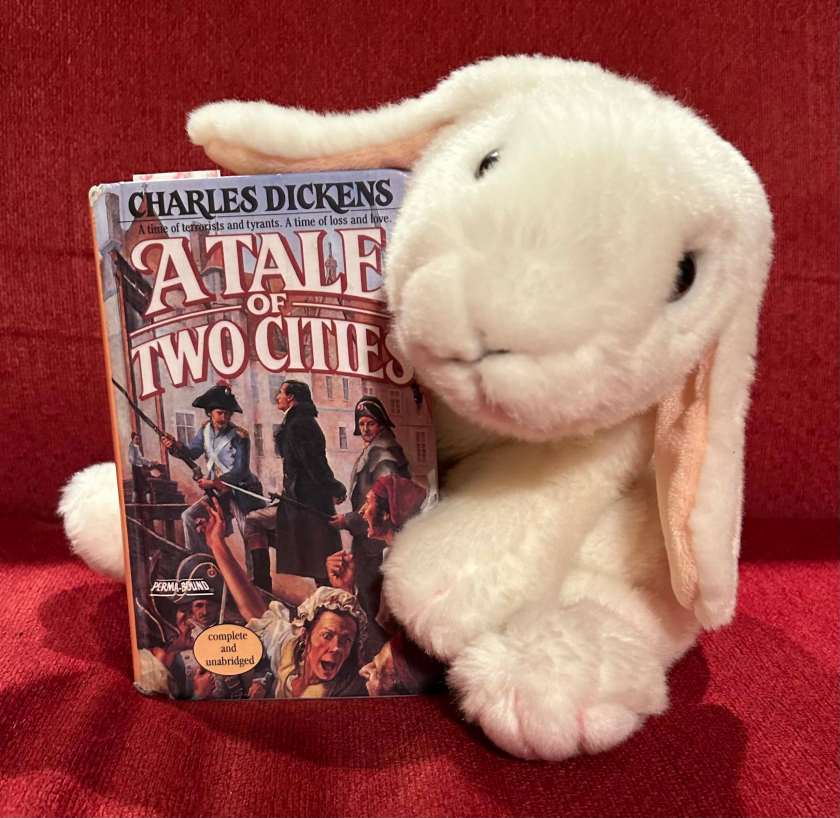
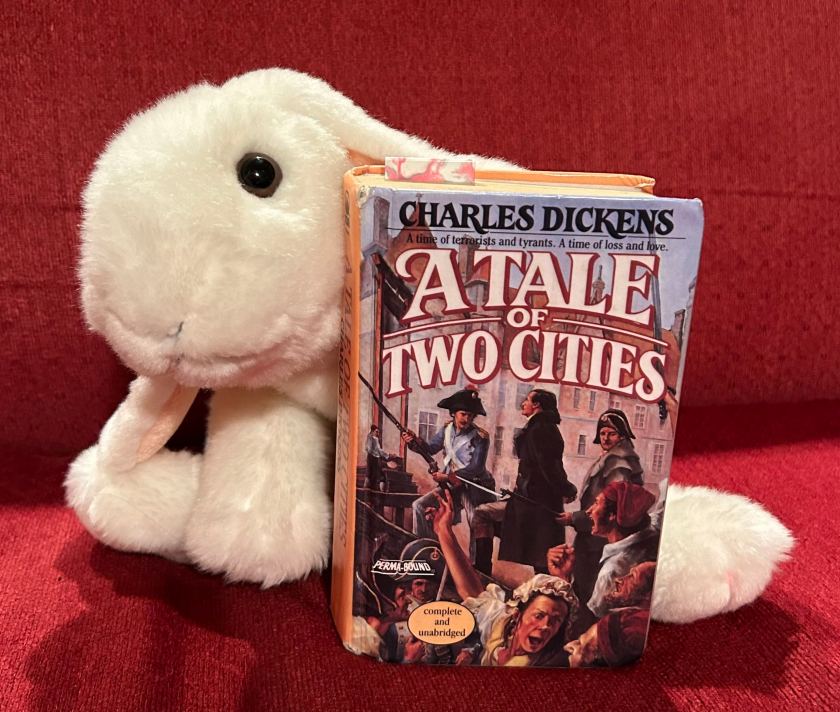
Marshmallow reviews A Tale of Two Cities by Charles Dickens.

Marshmallow’s Quick Take: If you like historical fiction, famous books about the French Revolution, family, and fate, then this is the book for you!

Marshmallow’s Summary (with Spoilers): Set during the years 1775-1792 in London and Paris, this really is a tale of two cities. The book travels between London and Paris, with the French Revolution developing throughout and playing a major role in the storyline.

The book begins with the introduction of both places and the presentation of the plot: Lucie Manette, a seventeen year old French girl living in London, learns from a banker named Mr. Jarvis Lorry that her father Dr. Manette is alive after being imprisoned for eighteen years in the Bastille. She believed him to be dead, but after this shocking revelation, sets out with Mr. Lorry to Paris to find him. They discover that, upon his release, Dr. Manette was taken in by his old servant Monsieur Defarge and his wife Madame Defarge. We learn that Dr. Manette has been driven insane by his time in the Bastille, obsessively making shoes to cope. But Lucie’s love and faithful devotion begins to heal him back to himself. They all travel back to London, and he recovers over the next five years.

Then, in 1780 in London, another character named Charles Darnay is put on trial for treason against England (being a spy). Lucie and her father are called to testify against him. Two witnesses (both English spies) testify against him as well, but Lucie’s pity for Charles begins to sway the jury in his favor. After Sydney Carton, one of Charles’ defense lawyers, points out the striking resemblance between himself and his client, the verdict of not guilty is declared and Charles Darnay and both of his defense lawyers become close family friends of the Manettes and Mr. Lorry.

Sydney Carton is a drunken, unstable man who is subservient to the other defense lawyer. For reasons unknown, he seems to have given up on himself and his potential, wasting away his talents, believing that he is worthless and lacks any ability to be good. The other defense lawyer is Mr. Stryver, an overly-ambitious man whose only goal is furthering his own status in the world.

Mr. Stryver, Carton, and Charles Darnay all begin to fall in love with Lucie, but all in different ways and for different reasons. Mr. Stryver believes that she fulfills his social expectations for a wife and would be beneficial for his life goals, while Carton loves her for being the only person who believes that he has the possibility of good within him (when he himself doesn’t believe so). Mr. Stryver plans to propose, but decides not to after Mr. Lorry (in a very passive-aggressive fashion) tells him that he would be rejected. Carton confesses his love to Lucie (who cares for him in a motherly way), but tells her that he knows she cannot and should not love a man like him who has given up on everything: life, love, himself, and the world; he swears to protect her and everyone she loves when the time comes. But in the end, it is Charles Darnay who wins Lucie’s hand in marriage. He fell for her because of her compassion for him while on trial, her deep love and dedication to her father, and her beauty. After getting her father’s blessing, the two get married.

Charles wants to tell Dr. Manette his real last name before the marriage, but is told by Dr. Manette himself to wait till the wedding day. On that day, Charles in true honesty informs Dr. Manette that he is an Evrémonde, an aristocratic family from France. As a result, Dr. Manette relapses back into his old insanity right after the couple leaves for their honeymoon. Mr. Lorry helps Dr. Manette return to himself before the couple return and the breakdown is kept secret from Lucie.

In 1789, in France, the Defarges lead the famous Storming of the Bastille, and Monsieur Defarge finds a note written by Dr. Manette hidden in his old cell. The French Revolution is becoming increasingly bloody and aristocrats like Marquis St. Evrémonde (Charles’ uncle) are being slaughtered for their past insensitivity and cruelty towards the impoverished. One of the Marquis’ servants is put on trial and sends a letter to Charles (in London), asking for his help. After leaving letters of explanation, Charles secretly leaves his family in London to return to France. He is captured and put on trial, essentially for being an aristocrat, despite the fact that he denounced his family’s immoral behavior and fled from France to London to escape his name Evrémonde.

Mr. Lorry, on business in Paris, unexpectedly meets Lucie and Dr. Manette who came to France right when they read Charles’ letters. Dr. Manette, a former Bastille prisoner and thus a hero of the Revolution, uses his influence to get Charles a trial. But with the revolutionary bloodlust unquenchable, nothing can save Charles from La Guillotine, except for an act of true love. 
Marshmallow is reading A Tale of Two Cities by Charles Dickens.

Marshmallow’s Review: A Tale of Two Cities is an amazing book. It’s really hard to read in the beginning, but after the first couple of chapters, it gets pretty easy to understand. Dickens uses a lot of old language so it is difficult by today’s standards. But I’ve never read a book that has completely changed my view of the world to such an extent.

This book is amazingly written because its plot is touching and exciting, but it also shows the development and the impacts of the French Revolution, a chilling period of human history. Dickens shows us our fragility, through Dr. Manette’s insanity, and the violence that we create when others have wronged us. But Dickens also shows our graces: Lucie’s never-ending compassion, faith, love, kindness, and devotion to others.

I chose to read this book for an English unit, and I’m so glad I did because this book is absolutely beautiful; it is truly a masterpiece. The world the author shows us immerses you as you read and shows you glimmers of a past far behind. However, the past is sometimes the clearest mirror. Throughout this book, the most poignant message I uncovered was this: when destiny mercilessly takes what one loves, those who were hurt can lose their mercy too. This is how the frenzied violence of the French Revolution occurred: the horrific treatment of the lower classes by the elites made the Revolutionaries utterly empty of empathy for the aristocrats when La Guillotine (as they referred to it) descended. The world’s harshness hardens humanity which turns into (perhaps righteous) hatred, something we still see today.

This disturbing reality of human nature is so profoundly portrayed by Dickens that this story is uniquely compelling in a way like no other. A Tale of Two Cities really made me reflect on us and our society as a whole. When we break one another, the broken become capable of breaking others without feeling empathy and perhaps it’s not completely their fault. But if humanity is to become better, if we are to avoid another bloodbath like the French Revolution, if our world is to become brighter and more prosperous for all, we need to learn to fix each other’s humanity, not break one another apart till we become capable of inhumanity. I might just be a bunny, but this book makes it obvious for all. 

Marshmallow’s Rating: 110%.
Marshmallow rates A Tale of Two Cities by Charles Dickens 110%.

Marshmallow reviews Mockingjay by Suzanne Collins

Marshmallow has already reviewed the first two books of the Hunger Games trilogy by Suzanne Collins: The Hunger Games and Catching Fire. Today she reviews the third and last book: Mockingjay, first published in 2010. Sprinkles is taking notes and asking questions.

(Marshmallow wants to warn readers that there may be some spoilers in what follows.)

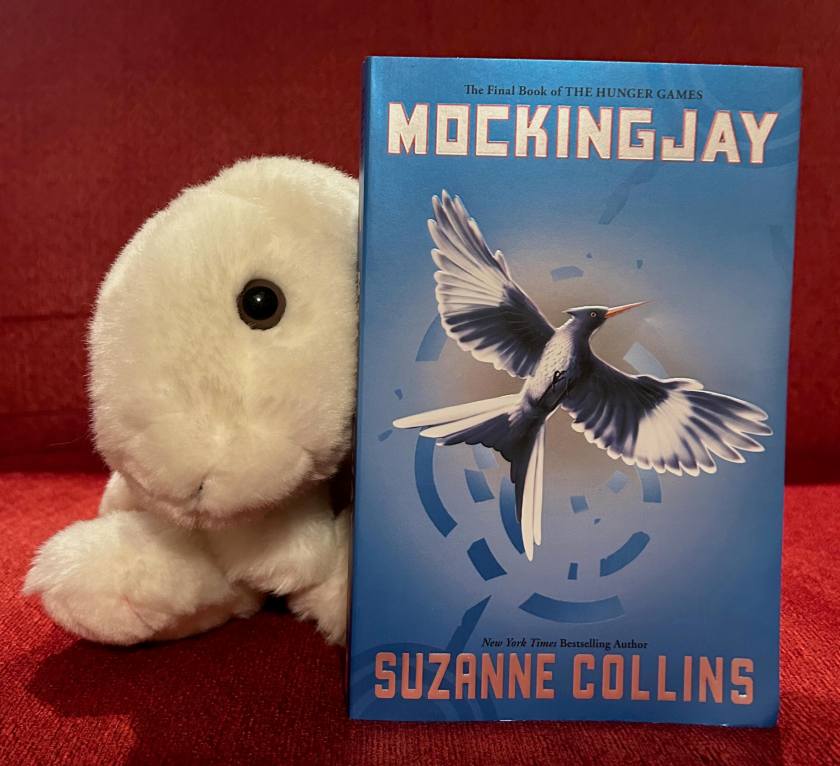
Marshmallow reviews Mockingjay by Suzanne Collins.

Sprinkles: So Marshmallow, as your first post post-summer break, you chose to tell us a bit about Mockingjay. Let’s get started.

Marshmallow: Sure. Mockingjay is the third and final book in Suzanne Collins’s Hunger Games series. And I think it wraps up the story really realistically. It does not simplify or dismiss the bloodiness and complications of revolutions.

S: Okay, let us step back. So being the third book in a series, readers should probably have read the first two books, right?

M: Yes. So they should definitely have read The Hunger Games and Catching Fire. The story begins more or less when the second book ends. So Katniss Everdeen is the champion of District 12 in the seventy-fourth Hunger Games at the end of the first book, and then in the second book, she is forced to take part in the seventy-fifth one. And she and Peeta, her partner from District 12, survive that game too. But at the end of the second book, we are kind of left at a cliffhanger, because it seems that Katniss is taken by rebels, and Peeta is taken by the forces from the Capitol. So when the third book starts, Katniss is with the rebels from District 13. Oh, we should say there may be some spoilers here.

S: Okay, I will add a note to the beginning of the post about that. So wait, District 13. Wasn’t that destroyed in the rebellion against the Capitol seventy-five years ago, before the Games began?

M: So that is what everyone thought, but in reality they had survived and they went underground. Literally they began to live under the ground, and they are pretty strong because they have nuclear power. And they support the rebels. So Katniss learns about all this at the very end of the second book.

S: I see.

M: Then this book is about the rebels trying to take down the Capitol and President Snow, while Katniss has a lot of mixed feelings about being involved.

S: How come?

M: Well, she has suffered a lot of trauma, her entire District was destroyed, and she is seriously injured. She has healed but has many permanent scars, physical and emotional. Also Peeta is in the hands of the Capitol, and she is scared of how they might be torturing him.

S: I see.

Marshmallow is reading Mockingjay by Suzanne Collins.

S: So the narrative is still first person, right? We still see the world and the events through Katniss’ eyes?

M: Yes. And that was one of the reasons why the book shook me so much. The reader is going through all the emotional stuff together with Katniss.

S: I know. I saw how shaken you were by the end of the book.

M: Yes. Even though in some ways the end can be called a happy end, I was very unsettled about everything. Because Collins, the author, does not spare any details. She makes things so realistic. Both sides do terrible things, and there is really no winner. Lots of losers, but even those one could say won have so many permanent scars inside and out…

S: I understand. So all in all, it was a very powerful read it seems like.

M: Yes, I was emotionally very moved. The series, I think, is very important for all bunnies to read, at some point, because it shows how horrific all human suffering is and how violence is never, should never, be the answer. And it also shows how trauma, pain, and violence can shape others to become like the ones who hurt them.

S: Those are some tough lessons Marshmallow. I am guessing you think this book is not very suitable for very young bunnies.

M: I don’t know. I have friends who read this when they were twelve and they loved it. But personally I was affected very strongly by this book, and I think that maybe it is better suited to older bunnies than twelve.

S: That makes sense to me. It is also possible that people of different ages can read the book at different levels. But all in all, did you like this book as the end of the series? Having read all three, are you going to recommend people to do so themselves?

M: Yes. I definitely think so. I’d rate Mockingjay 100%, but also I think this whole series is very important. Not just a good book series to read, but as I said before, it is important for young people to be aware of the horrors of war, violence, human suffering.

S: Thank you, that works for me. So let us wrap up this review then. What would you like to tell our readers?

M: We are back! And stay tuned for more amazing reviews from the book bunnies!

Marshmallow rates Mockingjay by Suzanne Collins 100%.

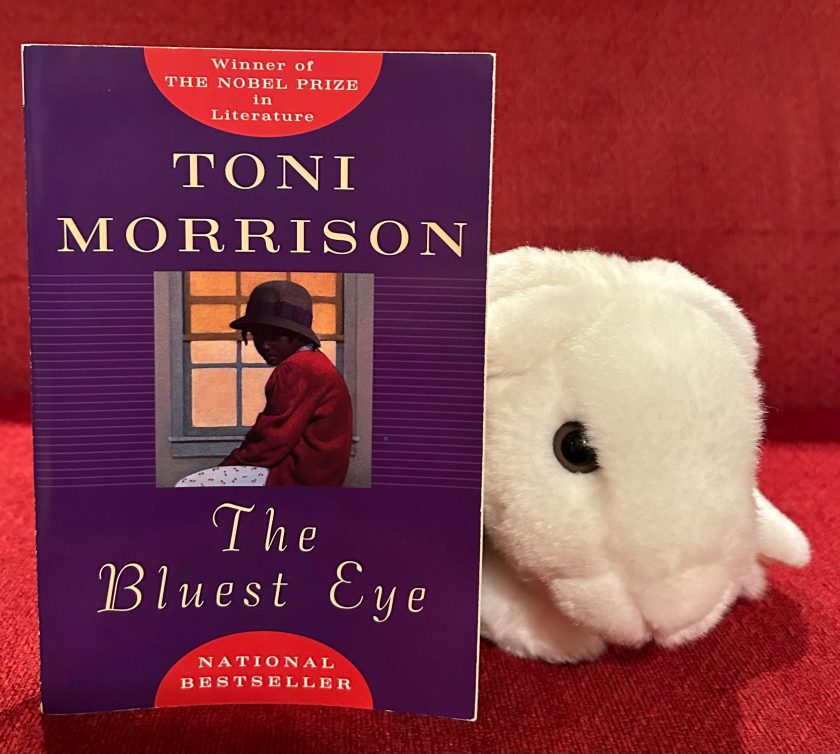
Marshmallow reviews The Bluest Eye by Toni Morrison

Today Marshmallow reviews The Bluest Eye by Toni Morrison, first published in 1970. Sprinkles is taking notes and asking questions.

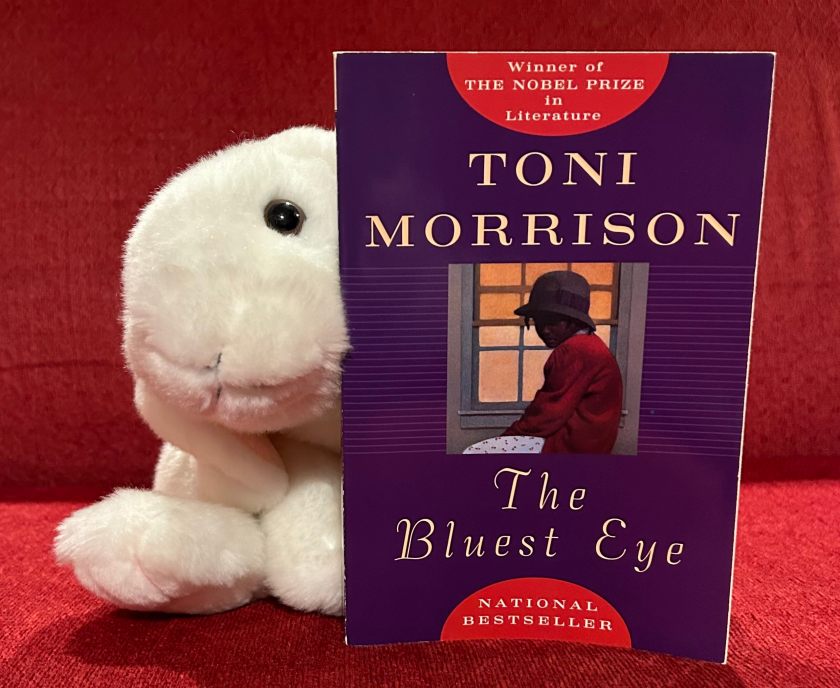
Marshmallow reviews The Bluest Eye by Toni Morrison.

Sprinkles: So Marshmallow, you always start your book reviews with what you call a quick overview. Can you give us one for this book, too?

Marshmallow: If you want to read about three young black girls growing up after the Great Depression and amidst internalized and externalized racism, then this is the book for you.

S: Okay, I think that is a good start. So tell us a bit more. Who are the three girls?

M: The main character is eleven-year-old Pecola Breedlove, and she is a foster sister to the other two girls, Claudia and Frieda MacTeer, who are nine and ten, and live with their parents. Pecola and Claudia are close, and a lot of the book is told from Claudia’s perspective. But we also have flashbacks and so on to events in Pecola’s life that Claudia could not have witnessed.

S: Okay, so tell me more. Why is the title The Bluest Eye?

M: Because Pecola wants to have the bluest eyes in the world. She thinks that she is ugly because a lot of people tell her she is, and she thinks that if she had blue eyes, she would be beautiful too.

S: I see. That must be very hard for a young girl of course.

M: That is not all that is hard in her life though. Her parents are both alive but they are not able to take good care of her. Her father is abusive and violent. Her mother does not support and protect her. The MacTeers on the other hand are a more supportive family for their children and Pecola, too, at least most of the time.

Marshmallow is reading The Bluest Eye by Toni Morrison.

S: I know this book has been banned in some school districts. Do you know why?

M: I think it is mainly because of two very sexually explicit scenes, which are also violent and abusive. And there are other parts where children are sexualized, and so on.

S: Hmm, I can see how those types of scenes would make a lot of people concerned about a book, especially for younger folks. How did you handle them?

M: I think the book is really hard to read, emotionally. When I was reading the book, I had to put it down several times. That is why it took me a really long time to read the book even though it is not very long and the author’s voice is fluid and captivating.

S: And yet you persisted and finished the book.

M: Yes, because I know it is an important book, and I know the author is trying to tell us something important.

S: What do you think she is trying to tell us?

M: I think she is trying to portray the chaos and the evil that results from racism. She says: “I felt compelled to write this mostly because in the 1960s, black male authors published powerful, aggressive, revolutionary fiction or nonfiction, and they had positive racially uplifting rhetoric with them that were stimulating and I thought they would skip over something and thought no one would remember that it wasn’t always beautiful.” So even though black people survived and often thrived despite the terrible oppression of racism they had to face, there were also people who did not survive, who were broken, and Toni Morrison wanted to make sure that we would not forget that.

S: I can see why you persevered Marshmallow. Sometimes we need to read difficult and heart-wrenching text to make sure we do not forget. But from what I am hearing you say, this book is probably not appropriate for young bunnies even though the main characters are young themselves.

M: Yes, definitely. I don’t think Caramel should read it yet for example. But for bunnies who are older and a bit more mature, it might be more appropriate.

S: You have read and reviewed Chains, Forge, and Ashes, the three books of the Seeds of America series, which were also about racism, or maybe more accurately, slavery. I think those books were also hard to read in some ways, but this one seems like it was a lot more challenging.

M: Yes. Possibly because in those books, even though there is a lot of pain and heartbreak, the main characters eventually overcome some of their challenges, and there is some sense of triumph, kind of like the writings Toni Morrison is referring to in the quote above. But in The Bluest Eye, both the life and the identity of Pecola are shattered. She does not survive her challenges. There is no redemption, only pain. Okay, there is some beauty too, in the book; there is solid love and affection, in the lives of Claudia and her family. But what happens to Pecola is traumatizing, and she does not survive the trauma.

S: I get that Marshmallow. Thank you for sharing your thoughts on this book. So do you have some last words to say about it?

M: I think this could be a good book to read for bunnies who are willing to face the full ugliness of racism and how it hurts people’s self-worth.

S: Thank you. So let us wrap this up then. What do you want to tell our readers?

M: Stay tuned for more amazing reviews from the book bunnies!

Marshmallow appreciated reading The Bluest Eye by Toni Morrison, though she thinks that it might be appropriate for only older bunnies.