Marshmallow reviews Teen Innovators: Nine Young People Engineering a Better World with Creative Inventions by Fred Estes

This week Marshmallow is talking about Teen Innovators: Nine Young People Engineering a Better World with Creative Inventions, written by Fred Estes, illustrated by Kavel Rafferty, and published first in 2022.
Marshmallow reviews Teen Innovators: Nine Young People Engineering a Better World with Creative Inventions, written by Fred Estes and illustrated by Kavel Rafferty.

Marshmallow’s Quick Take: If you like non-fiction books that are both informative and inspiring, then this is the book for you!

Marshmallow’s Summary (with Spoilers): This book is composed of several parts. It starts off with a warm, welcoming introduction that matches the tone of the rest of the book. Then there are six chapters in total, which are each around twenty to thirty pages long—they are relatively quick to read due to the large font and highly comprehensible writing. In each chapter, the author presents a young protagonist and the problem that they faced and / or wished to resolve. The author describes their process and the innovations and inventions they made, highlighting the experiences of young people in STEM.

Essentially, each chapter is a story about a young person who invented something successful that helped the world. The six stories are “Jack Adraka and His Improved Cancer Test,” “Gitanjali Rao and Tethys, Her Lead Detection Sensor,” “William Kamkwamba and the Windmill,” “Austin Veseliza and the Talking Glove,” “Deepika Kurup and Purifying Water through Sunlight and Science,” and finally “Cristian Arcega, Lorenzo Santillan, Oscar Vasquez, Luis ARanda, and Stinky, Their Champion Robot.”

I cannot choose one that I liked over the other because I loved reading about all of them! However, William Kamkwamba’s windmill struck me as especially remarkable given how limited his resources were and how he taught himself most of what he knew! (Incidentally, William Kamkwamba is 39 years old today, and his life continues to be impressive. You should definitely check out his two TED talks at https://www.ted.com/speakers/william_kamkwamba.)

These stories show that there are people who are driven to do good at such a young age! I also liked how the book ends with an inspiring call to action. The author describes problems in the world, but says that one can always take action to fix them. I hope to be like them one day!
Marshmallow is reading Teen Innovators: Nine Young People Engineering a Better World with Creative Inventions, written by Fred Estes and illustrated by Kavel Rafferty.

Marshmallow’s Review: I really liked Teen Innovators and I would highly recommend it to any and all readers because it is a fun, fascinating, and fulfilling book!

I read Teen Innovators during a time when I was starting to think about STEM as a career path. I am still not fully decided on a specific path, but this book really shows how STEM can be an extremely powerful force for good. I liked how this book highlighted inventors and innovators who are around the same age as the people who will read the book (most likely!) This is really inspiring.

More specifically I would highly recommend Teen Innovators to all who are worried about the future and feel disappointed in humanity. Even though humans do a lot of bad stuff and there is indeed a lot to worry about, books like this and people like the ones in these true stories show that there is a lot of good in the world, too! 

Marshmallow’s Rating: 100%.
Marshmallow rates Teen Innovators: Nine Young People Engineering a Better World with Creative Inventions, written by Fred Estes and illustrated by Kavel Rafferty, 100%.

Caramel reviews Invented by Animals by Christiane Dorion and Gosia Herba

Every summer the book bunnies take the month of July off. For his last review before the summer break, Caramel chose to talk today about a fun book he read recently: Invented by Animals, written by Christiane Dorion, illustrated by Gosia Herba, and published in 2021. As usual, Sprinkles is taking notes and asking questions.

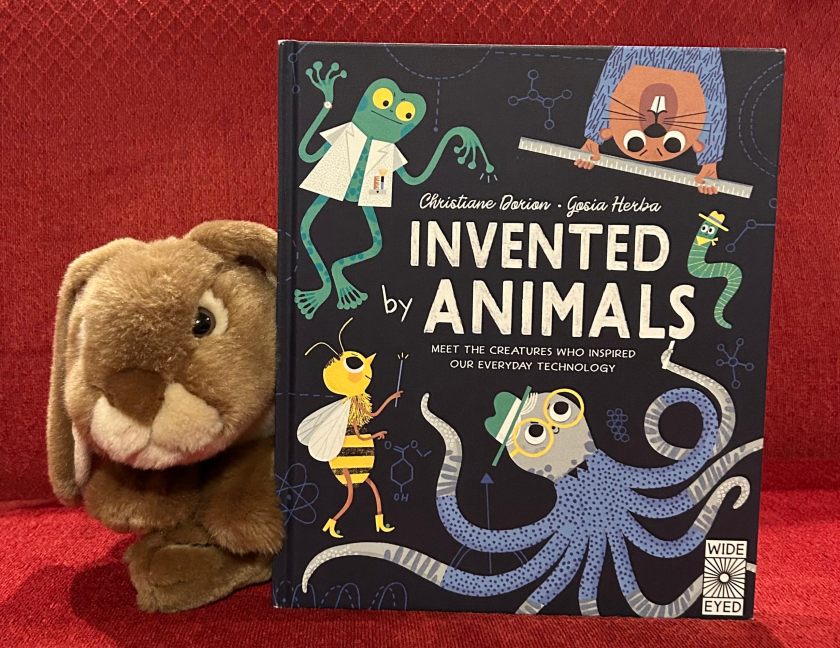
Caramel reviews Invented by Animals, written by Christiane Dorion and illustrated by Gosia Herba.

Sprinkles: So Caramel, tell me a bit about Invented by Animals. It has an inviting subtitle: “Meet the creatures who inspired our everyday technologies.”

Caramel: This book has a lot of different animals telling us about what inventions or ideas for inventions they gave to humans.

S: What is that supposed to mean? Can you give me an example?

C: My favorite is an eagle telling us how his eyeballs work. And how well he sees.

S: Hmm, so it is not that the eagle itself has invented neat eyes, but humans have been inspired by how his eyes work.

C: Yes.

S: That makes sense. Are there any examples of the other kind, where some animal is doing something interesting or has invented something intentionally to solve a problem and the humans are inspired by it to do something themselves?

C: Yes. For example, the paper wasp chews up bark and mixes it with its saliva to create paper. That is one of the ways humans figured out how to make paper themselves. In fact today’s paper is made more or less in that same way.

S: I don’t think humans chew bark to make paper.

C: Nor do bunnies, Sprinkles, I know. But the idea is about the same.

S: I see.

Caramel is reading Invented by Animals, written by Christiane Dorion and illustrated by Gosia Herba.

S: I know you love your facts, Caramel. Did you learn new facts from this book?

C: Yes, a ton! Almost all of the book was new to me.

S: That is awesome, so you must have enjoyed the book immensely.

C: Yes, I did.

S: So give the a three-word description of the book then.

C: Colorful, factful, and nature-ful.

S: Hmm, why don’t we rephrase that and say, full of color, facts, and cool nature?

C: I can work with that!

S: Okay. What else can you tell us about the book?

C: I love the pictures! They are not quite anatomically correct; all animals have mouths on the front of their heads, and eyes and so on, and they are wearing clothes. Some even have shoes.

S: Hmm, so they are anthropomorphized, I suppose.

C: Exactly.

S: So how did that make you feel as a bunny?

C: Well, I have eyes and a mouth in the front of my head, too, so that works for me.

S: I guess those features make the illustrations more friendly and fun, right?

C: Yep. But I wished that they had some things about bunnies. It made me feel kind of excluded.

S: I see. But they could not have something from all animals. The book would be too long.

C: That’s true. But I still kind of wanted a bunny invention there.

S: I can totally sympathize.

C: They had an albatross even. Come on!

S: I understand Caramel. But other than that, you did enjoy the book, right?

C: Yep, very much so. Maybe they can write a second volume, and they can include a bunny or two in that one.

S: We can always hope. Okay, Caramel, this is a good time to wrap up this review. Is there something you want to tell our readers?

C: Stay tuned for more book bunny reviews! We will be back in August!

Caramel loved reading Invented by Animals, written by Christiane Dorion and illustrated by Gosia Herba, and recommends it to all young bunnies interested in learning more about the amazing creativity of nature.

Caramel reviews Robot by Roger Bridgman

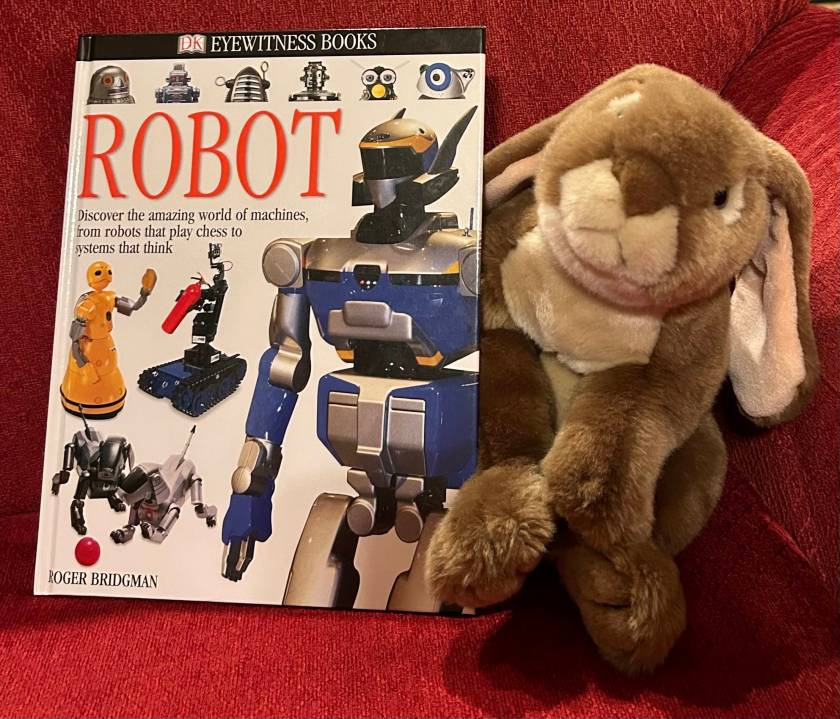
Caramel loves everything about robots, and he loves books about facts. Today, therefore, he wanted to share with our readers a book on robots that he has read: Robot, written by Roger Bridgman. As usual, Sprinkles is taking notes and asking followup questions.

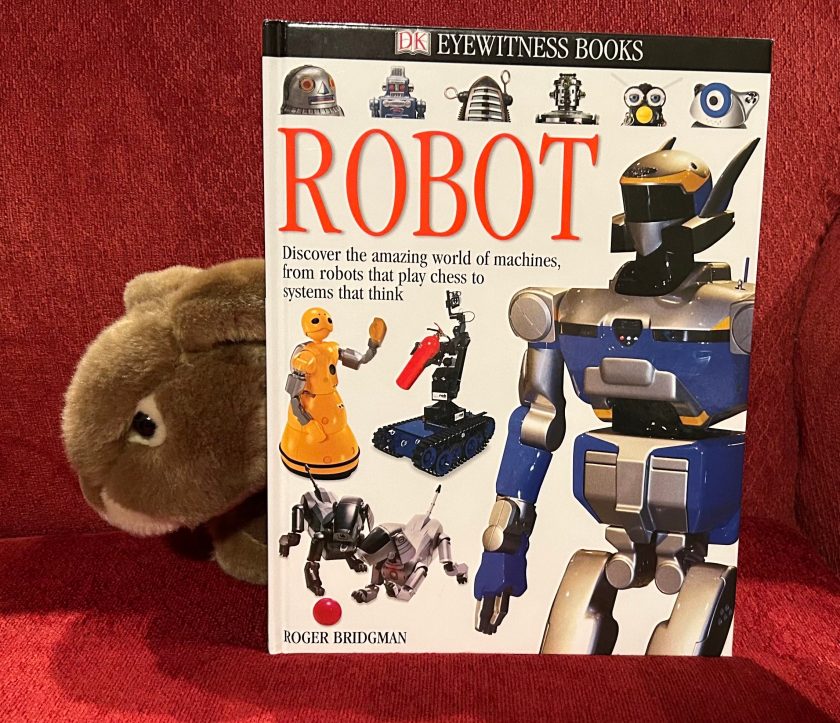
Caramel reviews Robot by Roger Bridgman.

Sprinkles: Caramel, here we are, ready to talk about a whole book about robots!

Caramel: Robots! Yay!

S: I know you like robots.

C: That’s an understatement. I love them!

S: I know! You reviewed a two-book series about a robot and her travels (The Wild Robot and The Wild Robot Escapes by Peter Brown), and you told us that then too. So let us get started. What do you want to tell us about this book?

C: This is a book about robots and tons of good facts about them.

S: Tell me one.

C: Let’s see. Did you know that there is a robot that looks like a shark and researchers use it to study sharks? It helps them “film sharks without disturbing their natural behavior”.

S: That’s pretty cool.

C: And did you know that they have a robot that can climb up on walls and actually walk on the ceiling?

S: That’s cool, too. Kind of like ants and bugs and flies.

C: Yes.

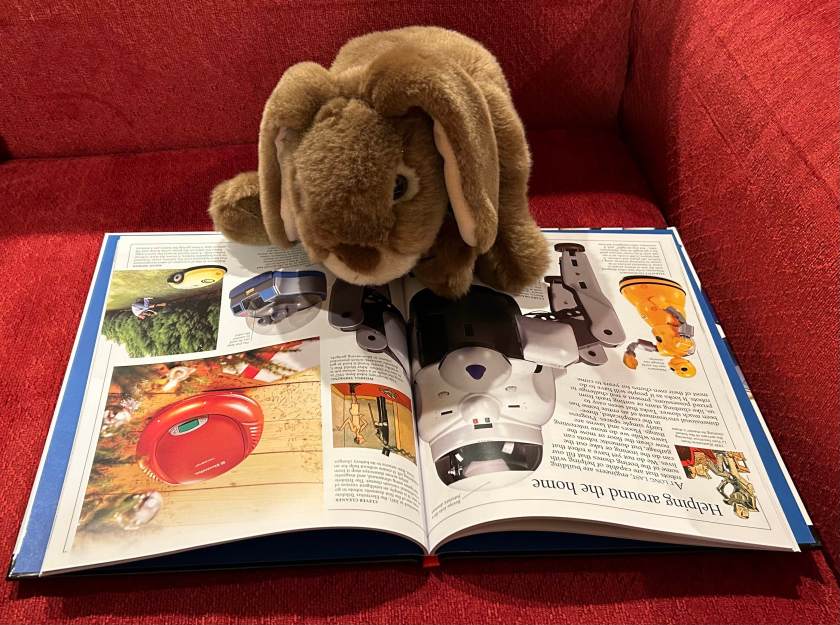
Caramel is reading Robot by Roger Bridgman and learning about robots that can help around the home.

S: So there are a lot of different types of robots in this book, right?

C: Yes. There are robots that can help around the home. Then there is a two-page spread on robots that move, one on robots that sense. And another on artificial intelligence. There is a section on robots in the industry and in space and under water.

S: That is pretty cool.

C: There is also a section on fictional robots and robots in art. Like C3PO from Star Wars. But they also have a mistake there! They put a picture of a Dalek, from the Doctor Who universe, but Dalek are not robots. They do say they are mutants, but they should not have put them in a book on robots!

S: I guess people make robot Dalek to play with, though, right?

C: Yes. I even saw a remote-control Dalek once. So maybe that is why they put a picture in the book.

S: I suppose that makes sense.

C: They also have sections on machines with feelings, which is kind of like that Wild Robot I read about.

S: That is interesting! I’ve always thought the feeling part is quite hard to implement. But also, this is a relatively old book, right? It was first published in 2004. A lot must have changed since then, I’d presume.

C: Yep, I think so. In fact we should probably put here that video about robots which behave like animals. That seemed really new!

S: I agree. That video is brand new, only two weeks old now. So here it is:

“Biophysicist Reacts to Animal Inspired Robotics”, YouTube.

C: I like this video a lot! We should see it again.

S: Sure. Let us finish the review first. I know you knew a lot about robots already. What did you learn from this book Caramel?

C: Well, you are right that I knew a lot of things about robots before, so I knew a lot of the things in the book. But I did not know about the shark-shaped robot. And there were just so many different robots! It is a pretty awesome book and I liked it very much.

S: I can see that! I have been observing you looking carefully at the pages of the book over and over again. You have read it all already, but you still enjoy looking at it.

C: Yes. I like robots! And I told you; these are cool robots!

S: That’s wonderful Caramel. So what three words would you use to describe this book?

C: Factful, colorful, and robotful. There are a lot of facts, a lot of colorful pictures, and lots of robots!

S: I cannot argue with that reasoning! Okay, then let us wrap this review up. What do you want to tell our readers?

C: Stay tuned for more book bunny reviews!

Caramel loved reading and reviewing Robot by Roger Bridgman, and he looks forward to learning more and more about robots as he grows up.

Caramel reviews How Things Work by T. J. Resler

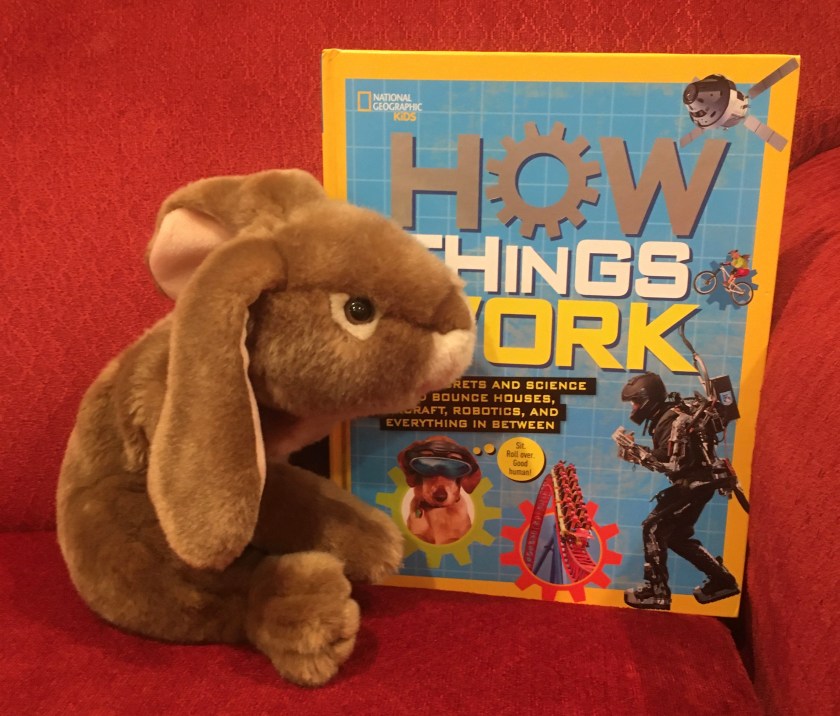
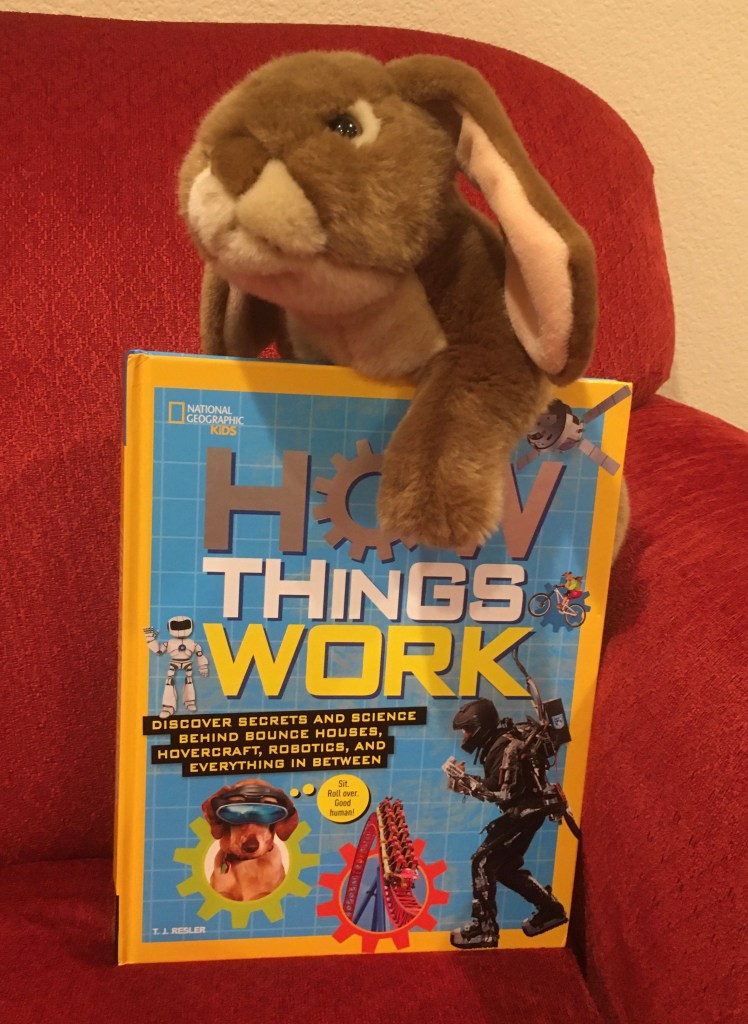
Caramel loves reading books about real things, and he especially loves learning about how things work. Today’s book, from National Geographic Kids, is just up his alley: How Things Work by T. J. Resler. As usual Sprinkles is asking questions and taking notes.

Caramel reviews How Things Work by T. J. Resler.

Sprinkles: So Caramel you got your nose into another big book about real things!

Caramel: Yes, exactly.

S: Tell me what this book is about.

C: It’s about how things work, as you can tell by the cover.

S: Yes. What kinds of things though?

C: Things like hoverbikes and hoverboards. Tablets, bionic arms, thermoses, and invisibility cloaks! Tractor beams…

S: Wait, invisibility cloaks? Tractor beams? Are those things real?

C: No, they are just theoretical. And they are not really invisibility cloaks but cloaking devices.

S: Hmm, so the book is about inventions, both real and fantastical, right?

C: Yes. They are really cool.

S: And I thought the chapter titles were quite fun. Can you tell us some of them?

C: There is one called “Beaming Up”. And another called “Home Where The Fridge Is”. There is “School of Cool”, and “Extreme Fun”, and some others.

S: Which is your favorite thing that you read about in this book?

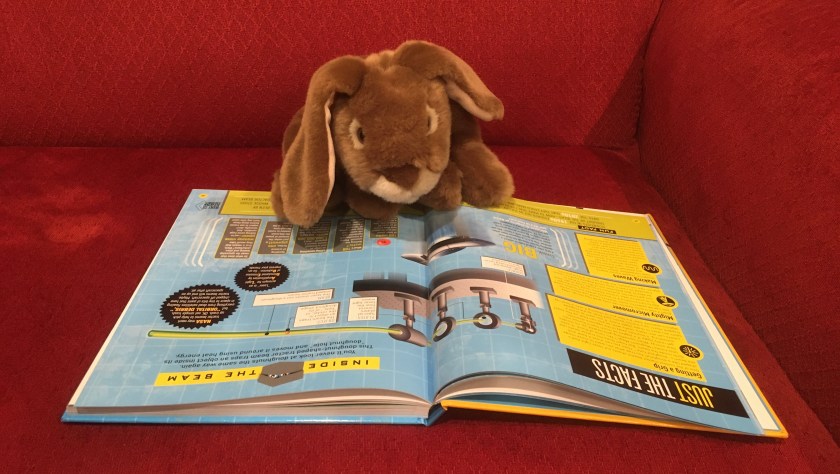
C: My favorite is in the chapter called “Caught in the Tractor!” There is a picture of an alien ship in a section called “Think Big”.

Caramel is reading "Caught in the tractor!" in How Things Work by T. J. Resler.
Caramel is reading “Caught in the tractor!” in How Things Work by T. J. Resler.

S: Is that a real alien ship? I did not know we had alien visitors!

C: No it’s just a picture. An artist’s imagination.

S: Hmm, so what do you like about this particular page?

C: The picture of the alien ship is cool. But the section is about tractor beams, something we see a lot in Star Trek. Apparently a gigawatt in laser energy would totally vaporize a baseball. That’s basically a phaser, like in Star Trek.

S: Okay, how is that related to tractor beams?

C: It would be able to move the thing, but then it would also totally vaporize it too.

S: So there is a lot in this book about Star Trek science?

C: Not exactly, but I like Star Trek so I am telling you things about Star Trek in the book. There are also a lot of real things.

S: Like what?

C: Like fridges, space ships, microwave ovens, thermoses, and photocopy machines. And we learn about Elon Musk. He is an engineer and apparently he read a whole encyclopedia when he was a child.

S: Hmm, do you ever read an encyclopedia Caramel?

C: No, not really.

S: Well, we do often check out Wikipedia, and that is kind of like an encyclopedia, right?

C: I guess so. But I like reading real books with pictures, and learning about how things work.

S: And this book has a lot of pictures. Every one of its two hundred pages has at least one picture and there are pages which have only pictures. So it is a great book to read if you like to see what you are reading about.

C: Yes, there is a full-page picture of a dog drinking from the toilet bowl. The dog says “hmm, that’s the stuff!”

S: So the book is also quite funny, it sounds like.

C: Well kind of, but I like it more for the facts.

S: Okay, so tell me three words or phrases to describe this book.

C: Full of facts, colorful pictures, useful.

S: Great! This is a good place to wrap up this review. What do you want to tell our readers Caramel?

C: Stay tuned for more book bunny adventures!

Caramel loved reading and looking at the pictures in How Things Work by T. J. Resler.