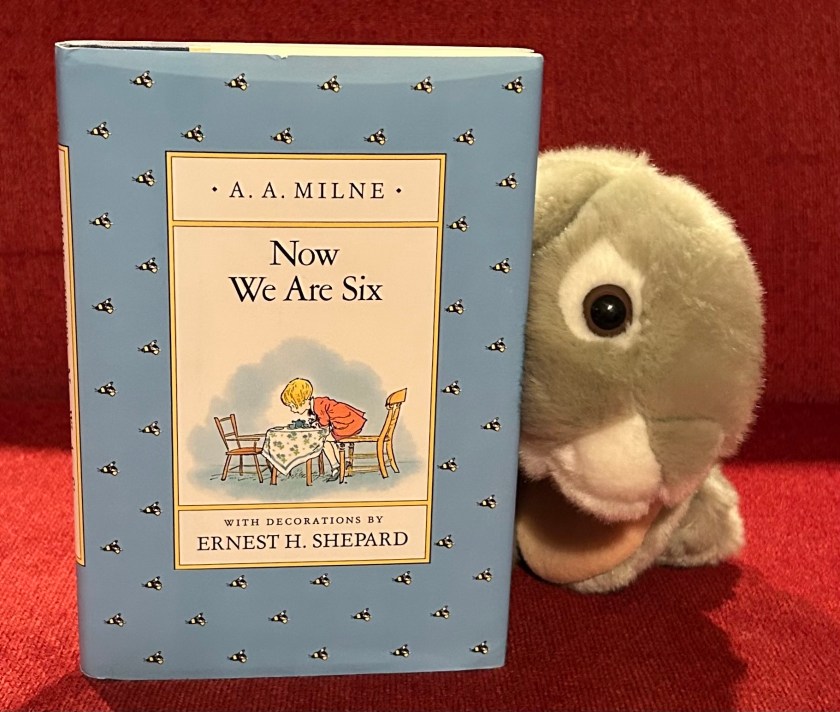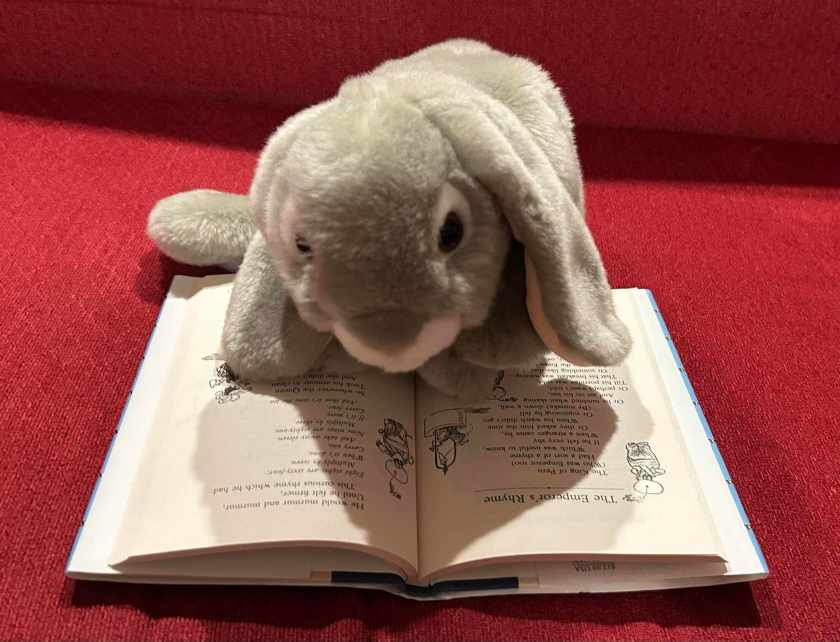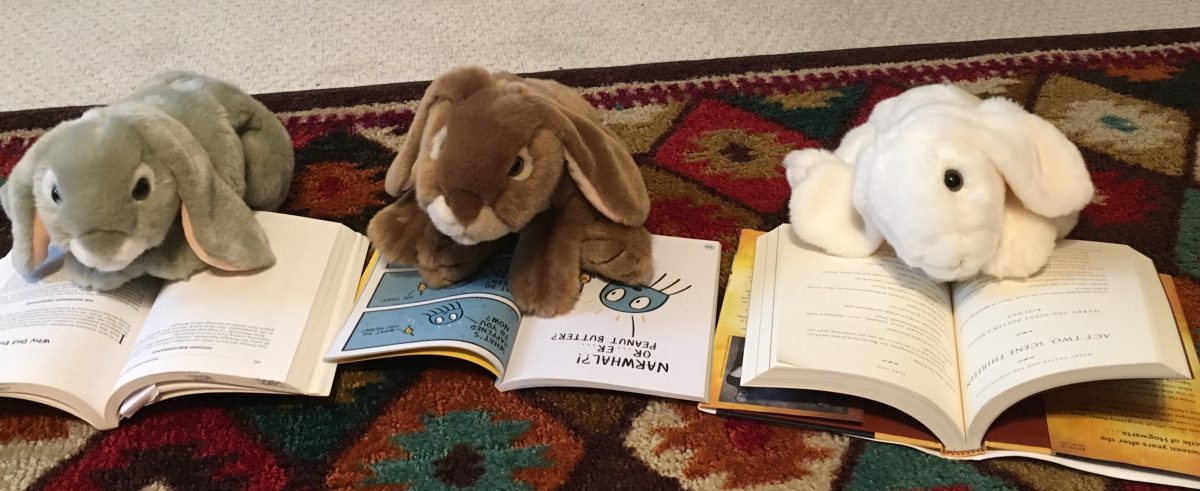
Last week Sprinkles reviewed a sweet little poetry book written by A.A. Milne: When We Were Very Young. Today she reviews Now We Are Six, a sequel if there could be one for a poetry book. First published in 1927, this book was also illustrated by Ernest H. Shepard.
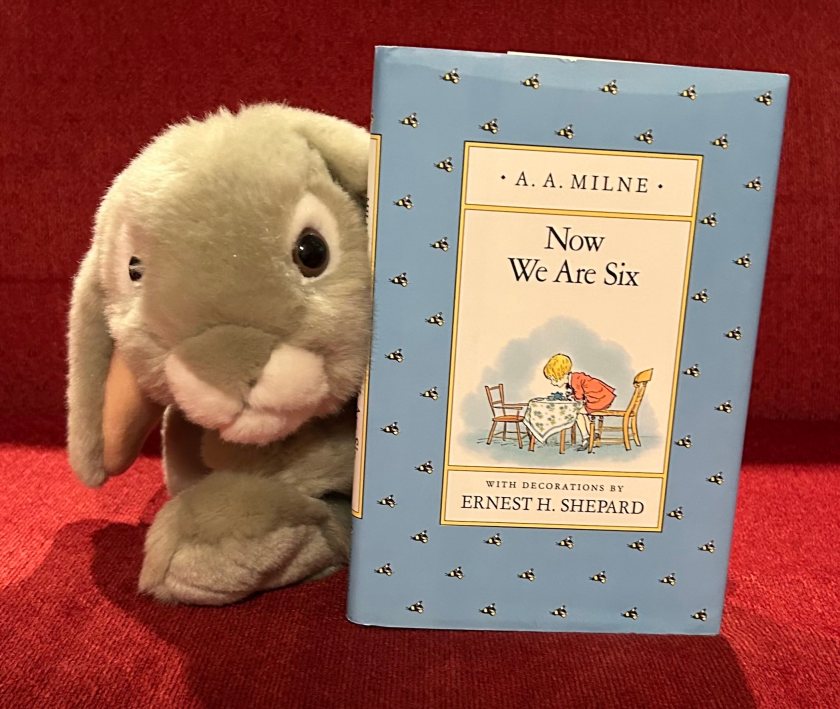
Sprinkles reviews Now We Are Six, written by A.A. Milne and illustrated by Ernest H. Shepard.
Last week I reviewed When We Were Very Young, written over a hundred years ago by A.A. Milne. Today I share with you some thoughts on another little poetry book by Milne that is almost a century old: Now We Are Six.
Now We Are Six is a perfect sequel to When We Were Very Young, and young bunnies who have enjoyed that book would definitely enjoy this book, too. In fact both Marshmallow and Caramel were gifted this book for their sixth birthdays. (Yes it was the same copy, which I think is fine. After all, Marshmallow had already graduated from being six years old when Caramel entered that age…) If you want to see what the book is like, you can see the contents in the Project Gutenberg page for the book here. But once again, I will say that the experience of holding a real copy of the book in your own hands (or paws!) is a lot more pleasant.
Before diving into the poems in the book, let me tell you that Milne’s introductions are really interesting. I am not sure the younger readers would appreciate them, but the adults reading the books definitely will. So please do not skip these; they are so fun to read!) In this introduction, we are also warned that Winnie the Pooh shows up in several of the poems. It is really neat to see Pooh’s evolution from the germ of an idea in one little poem in When We Were Very Little to a fully developed independent character who “walked through [the book] one day, looking for his friend Piglet, and sat down on some of the pages by mistake.”
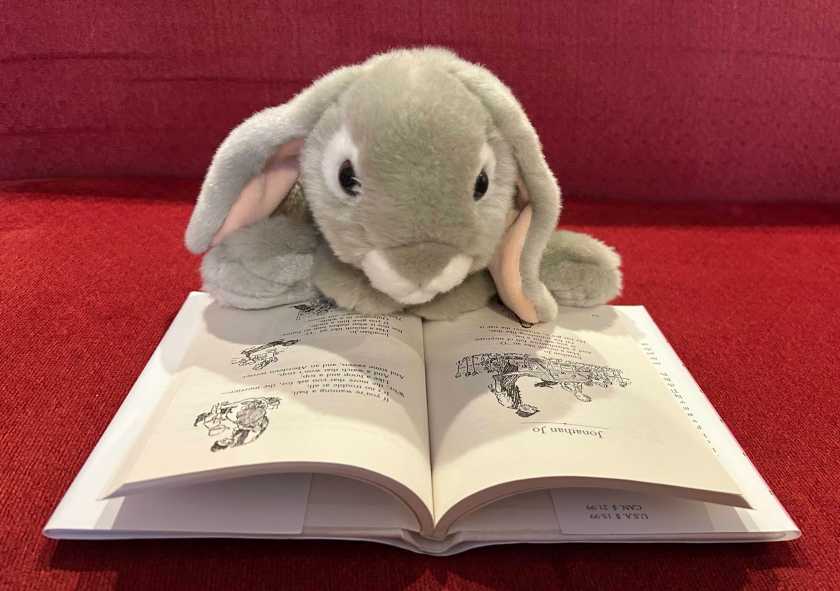
Sprinkles is reading Now We Are Six, written by A.A. Milne and illustrated by Ernest H. Shepard.
Now the poems! There are thirty five in total. And some are indeed about Winnie the Pooh, or at least they include Pooh as one of the main actors. For example, the poem “Us Two” is about a little boy narrating his adventures and conversations with Pooh. But pooh also just happens to show up in the illustrations of poems that do not explicitly mention his name. For example “The Engineer” is about a train the narrator is trying to play with, and Pooh shows up in the illustrations waiting for a ticket and then the train itself. The little bear makes a similar appearance, that is, only in the illustrations, for the last poem of the book, “The End”, where the narrating child is excited to be six years old:
But now I am Six, I'm as clever as clever So I think I'll be six now for ever and ever.
Another one of my favorite poems in this book is “Explained” where a little girl named Elizabeth Ann goes around trying to find out just “how God began”. the question remains unanswered for all those who are reading the poem, even though in the end Elizabeth Ann gets an answer that satisfies her.
Unlike When We Were Very Young, which seemed to be almost exclusively written for a little boy, there are quite a few little girls in this book, or possibly a single little girl, who is sometimes named Elizabeth Ann and sometimes Anne. This makes a lot of sense if you read that the book is dedicated to Anne Darlington, who was a friend of Christopher Robin, Milne’s son. The Darlingtons and the Milnes were family friends, and they seem to have hoped that their two children would perhaps eventually marry each another. But in any case, I believe that the book does benefit from having a little girl in it.
The poems are once more about play and daily life and friendship and big questions. There is also room for big feelings. For example, the very first poem, “Solitude”, reminds the reader that all children are persons of their own rights, and sometimes they too will need some space. And there are a handful of poems which are more fantastical. For example “The Knight Whose Armour Didn’t Squeak” tells the story of a knight, you guessed it, whose armor did not squeak. One day, this knight spots another one whose armor does not squeak and figures out a way to eliminate him from this competition.
The illustrations in the book are once more by Ernest Shepard and complement the book’s quirky and fun feel. All in all, this book is a joy to behold and a joy to read. I recommend it with much enthusiasm to anyone looking to find a poetry book to read or share with a young bunny!
Sprinkles recommends Now We Are Six, written by A.A. Milne and illustrated by Ernest H. Shepard, to anyone looking for a little poetry in their lives.
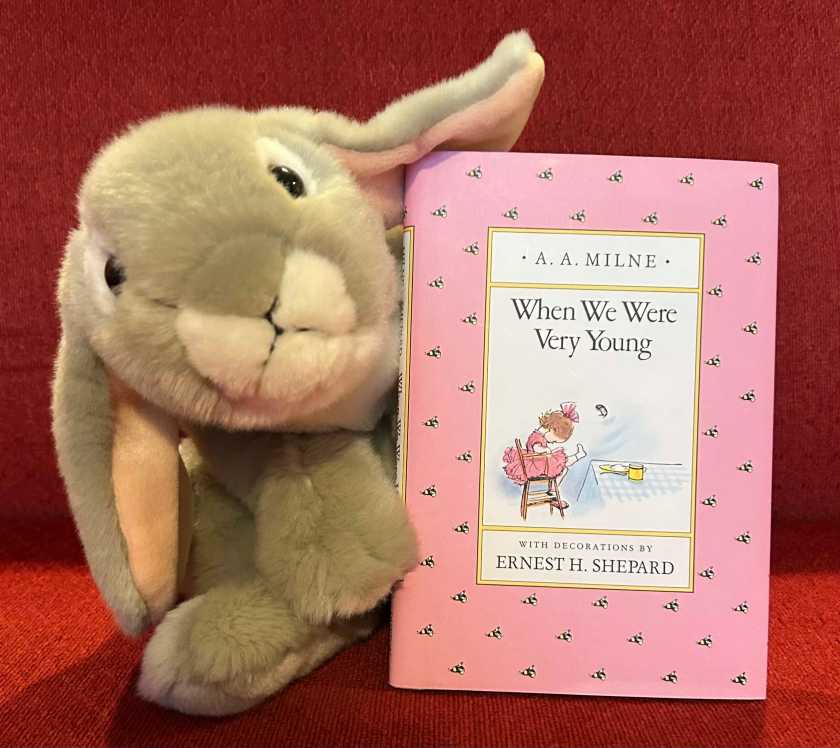
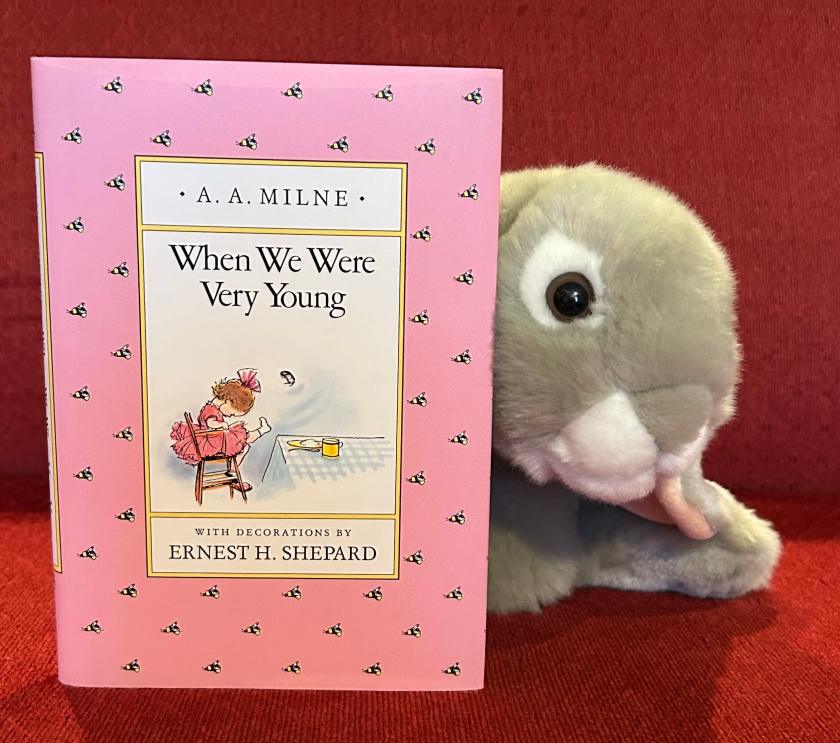
Today Sprinkles reviews a cute little poetry book, When We Were Very Young, written by A.A. Milne, illustrated by Ernest H. Shepard, and originally published in 1924.
Sprinkles reviews When We Were Very Young, written by A.A. Milne and illustrated by Ernest H. Shepard.
Today I am excited to share with the readers of the book bunnies blog a wonderful little book of poetry, written over a hundred years ago, in 1924. If you are curious, you can read the poems in their entirety here in the Project Gutenberg page for the book. But I have to say that holding the book in your hands (or, as in my case, in your paws) is a real pleasure. The illustrations by the estimable Ernest H. Shepard are simple and yet timeless.
A.A. Milne wrote the poems in this book for his son Christopher Robin, who was four at the time. In his introduction he tells us that these verses often should be read as if they are coming from the voice of Christopher Robin or another young child, and when you read them out loud, that is almost always the feeling you get. And so I can imagine a young bunny and an adult one who loves them sitting down to read a few of them at a time and having a really wonderful time together.
There are a total of forty-four poems in the book. Many of them reflect different aspects of a young child’s life or zero in on small moments that loom large. There is a poem about the pleasure of being in the rain with waterproof outerwear (“Happiness”), another about how the four different chairs in the nursery could be different places and make for fun adventures all on their own (“Nursery Chairs”), and yet another about the joys of simply being outside without a purpose to go any particular place (“Spring Morning”). Then there are more playful poems about made-up characters and their stories. There is for example a poem about an elephant who is friends with a lion who is friends with a goat who is friends with a snail (“The Four Friends”), another about a dormouse who loves geraniums and delphiniums but is prescribed by a doctor to grow chrysanthemums instead (“The Dormouse and the Doctor”), and yet another about an alchemist who after years of effort is still unable to get it quite right (“The Alchemist”).
Sprinkles is reading When We Were Very Young, written by A.A. Milne and illustrated by Ernest H. Shepard.
Two of my other favorites in the book were the one about rice pudding (unsurprisingly named “Rice Pudding”) and the one titled “Lines and Squares” about why you should stay in the squares and never step on the lines when walking on a sidewalk–for otherwise a bear will eat you!
And then there is the thirty-eighth poem, “Teddy Bear”, which starts with:
A bear, however hard he tries, Grows tubby without exercise. Our Teddy Bear is short and fat Which is not to be wondered at; He gets what exercise he can By falling off the ottoman, But generally seems to lack The energy to clamber back
And then there are twelve more stanzas with similar rhyme and goofiness. The poem finishes in the way it started, but with a twist:
A bear, however hard he tries, Grows tubby without exercise. Our Teddy Bear is short and fat Which is not to be wondered at. But do you think it worries him To know that he is far from slim? No, just the other way about-- He's proud of being short and stout.
And thus we see the birth of a little creature who would eventually become the world’s most famous bear: Winnie the Pooh! Ernest Shepard was apparently thinking of the teddy bear his son had while drawing the illustrations for the poem. These illustrations and Christopher Robin’s own toys together led to A.A. Milne creating the Winnie the Pooh character in the stories in the next couple years.
But even if you are not intrigued by Winnie the Pooh or his origin story, the poems in this book are lovely. And they are such a pleasure to read! Their simple melodies and sweet themes would also make them wonderful candidates for reading out loud with a younger bunny in your life. In other words, as Marshmallow would put it: if you are searching for a neat book to read out loud with the young bunny in your life or if you are simply looking for a lovely poetry collection about the magic of childhood to bring a smile to your face and a bit of childlike joy into your heart, then this might be the book for you!
Sprinkles recommends When We Were Very Young, written by A.A. Milne and illustrated by Ernest H. Shepard, to all who love the littlest bunnies in their families and want to read poetry with them.
A chapbook is a small book, typically a collection of poems, typically within twenty to forty pages, sometimes organized around a theme, sometimes not. Even though chapbooks have a long and storied past, here at the book bunnies blog, we have not had the occasion to review any till now. And Sleeping With Dogs: A Poetic Memoir is just right for a blog hosted by bunnies!
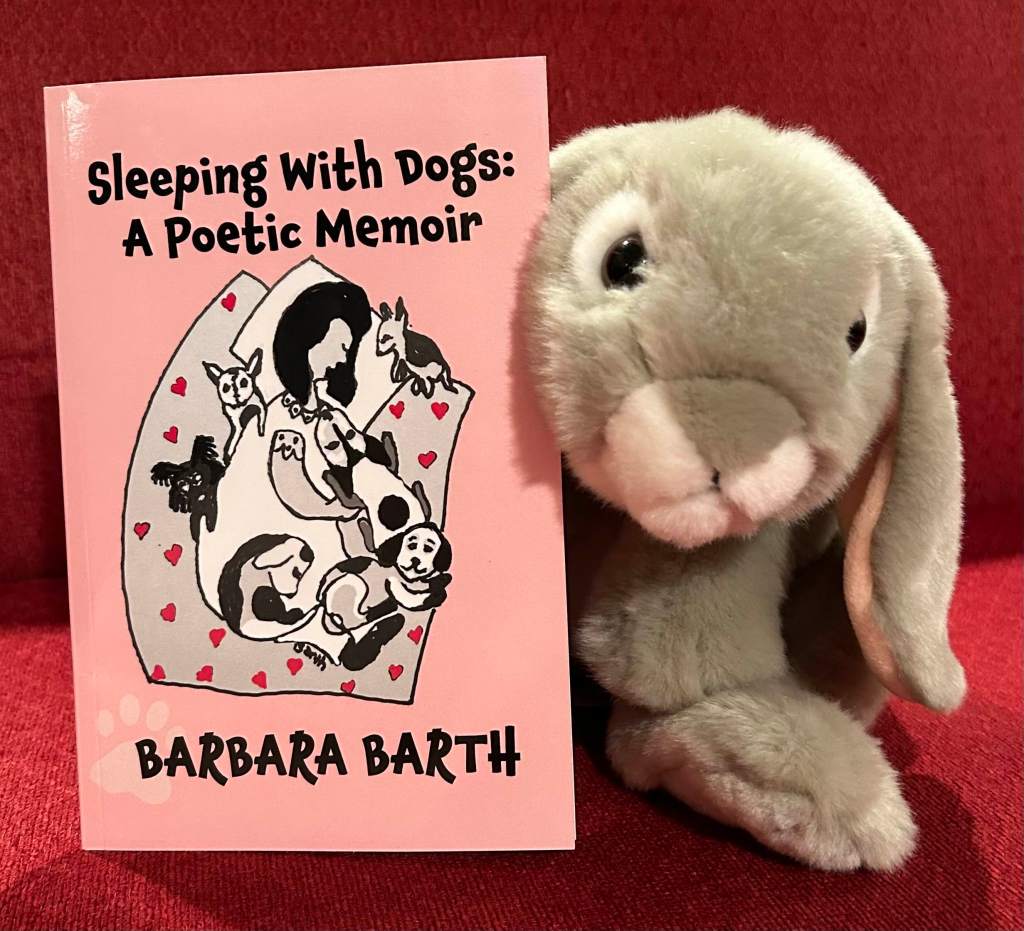
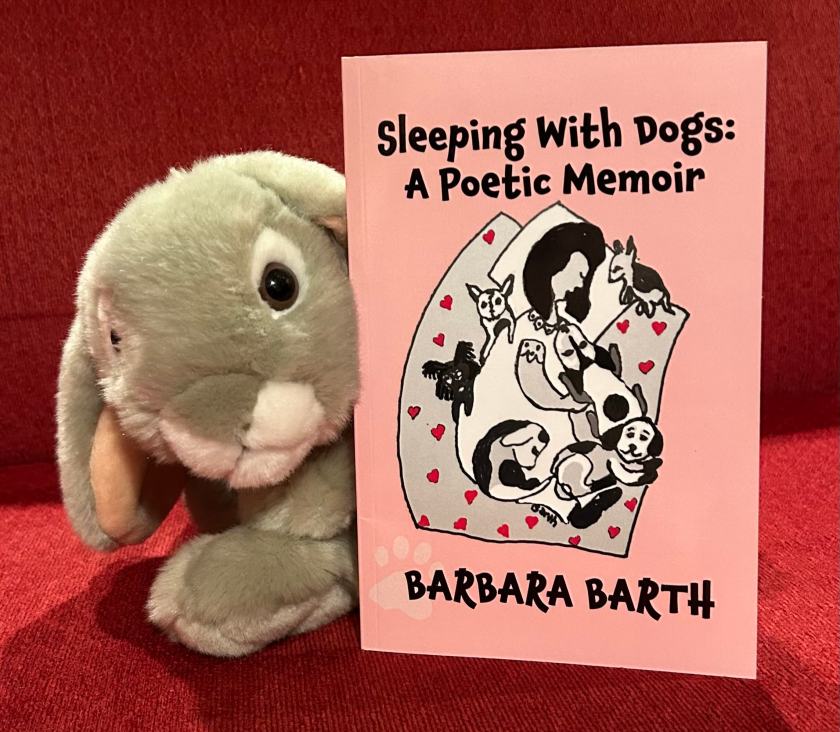
This is indeed a little book of forty pages, with a cute pink cover; on the cover is a stylized image of a woman in a patch of a bed, sleeping surrounded by six little dogs, some curled up, some fully awake and curiously staring at the observer / reader. The patch of bed is covered with little pink hearts. So already you might imagine, this book is not only about dogs (as you probably had already figured out from the title) but it is also very much about love. And indeed love is the overwhelming theme of the book.
Barbara Barth’s writing journey began when she lost her husband in 2008. She began writing but also she began adopting dogs. Words and dogs became her lifelines. This chapbook collects her free verse poetry about her dogs and herself growing into the woman she is today with her dogs. Barth tells us the stories of Foxy-Lady, who knew her husband before he passed away, Bray, the first adoptee after, and many many others, via simple but evocative sentence fragments, which somehow come together into fluid free verse.
Out of the twenty-three poems in the chapbook, ten are written as odes to specific dogs: “Foxy-Lady” (2), “Bray” (5), “Annabelle” (6), “Queen Chloe” (7), “Odette” (10), “A Dog Named Studly” (11), “The Last of the Big Dogs” (12), “The Christmas Gift” (13), “Carmella” (17), “PS. Lucy In The Sky With Diamonds” (23). Each of these ten poems introduces its subject, a dog with their own personal back story, and tells the story of how they came to join Barth and her life. Most of the dogs are rescues, so often the back stories are sad or uncertain at times, but most of these poems end with joy, joy of a once-sad dog having found a new home that welcomes them. (Carmella shows up again in “Morning” (19) as the mischievous main character, crafty and still lovable.)
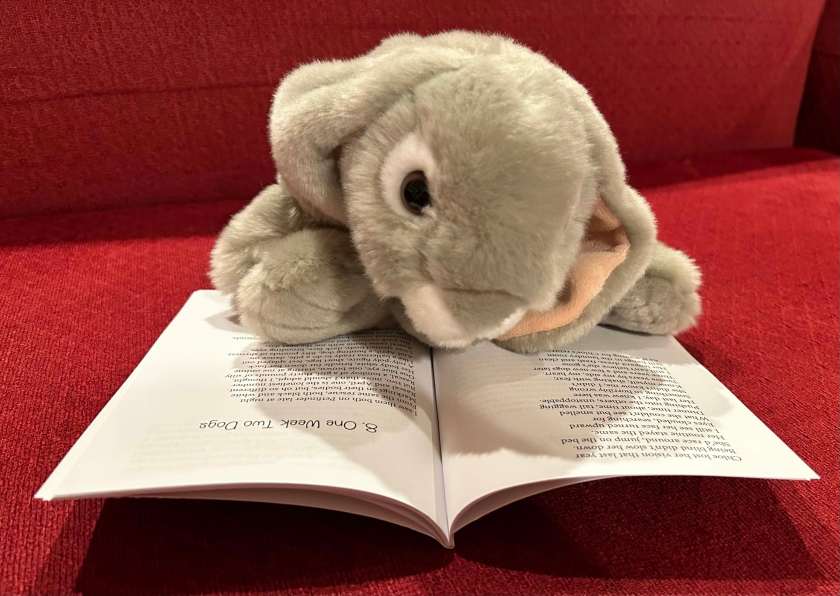
Then there are two poems, about two dogs each, that tell stories of new members joining a big happy family and making it happier. “One Week Two Dogs” (8) tells the story of how Barth first met Rascal and April on the same day, but took them home on two separate days. April immediately becomes Miss April in Paris, and they both find themselves full members of the growing new family Barth has been building around her. “Dumb and Dumber” (14) tells the story of how father-and-son duo Moe and Happy Dog, join the family. The Dumb and Dumber become loving nicknames to them and celebrate their natural silliness as they like to fool around.
The rest of the poems are not focused on individual dogs. Rather they tell the story of Barth’s life today, full with dogs and dog love. The very first poem in the chapbook, “”Why I Write” (1) introduces Barth to us a bit more. After having read the brief prose introduction to the collection, this poem eases us into the poetic form. “Sleeping With Dogs” (3) and “Six-Pack” (4) set the tone early towards the beginning of the chapbook, telling us how the dogs came to Barth’s life and made it whole. “Chihuahua Love” (9) tells us of her transformation from a “dog lady with big dogs” to a “dog lady with chihuahuas”. “Storm” (15) and “After the Rain” (16) tell us what happens in her household during and after a rainstorm. “Night Moves” (18), “Morning” (19), “Patio View” (20), and “Four Seasons” (21) offer more snapshots of her life with her dogs: a full life filled with love and joy and many other intense emotions lived in the moment. Finally “Paint Party” (22) tells us what Barth might just be doing today in her home: painting, with her four-legged friends surrounding her, content.
Being a household of four bunnies we do not have any dogs living with us. We are typically very timid near four-legged creatures who are bigger than ourselves. But Barth makes the best case for inviting dogs into your life. She does not preach or explain. She just tells her own story, in which she happens to find love over and over and over again. (Of course one imagines she is giving a lot of love back. It is impossible for this much love to flow only in one direction.)
All in all, I have very much appreciated the opportunity to read and review Sleeping With Dogs: A Poetic Memoir. And I’d recommend it highly to all sorts of folks, young bunnies and old bunnies, and everyone in between. I know that the little bunnies in my own household will love the book just as much as I did. If you like reading poetry, or if you love dogs, it is probably a no-brainer: you should read this book. Otherwise, if you just happen to have only a little space in your day to read a couple short pages at a time, then this little pink book might just be what you need to fill your heart with some joy.
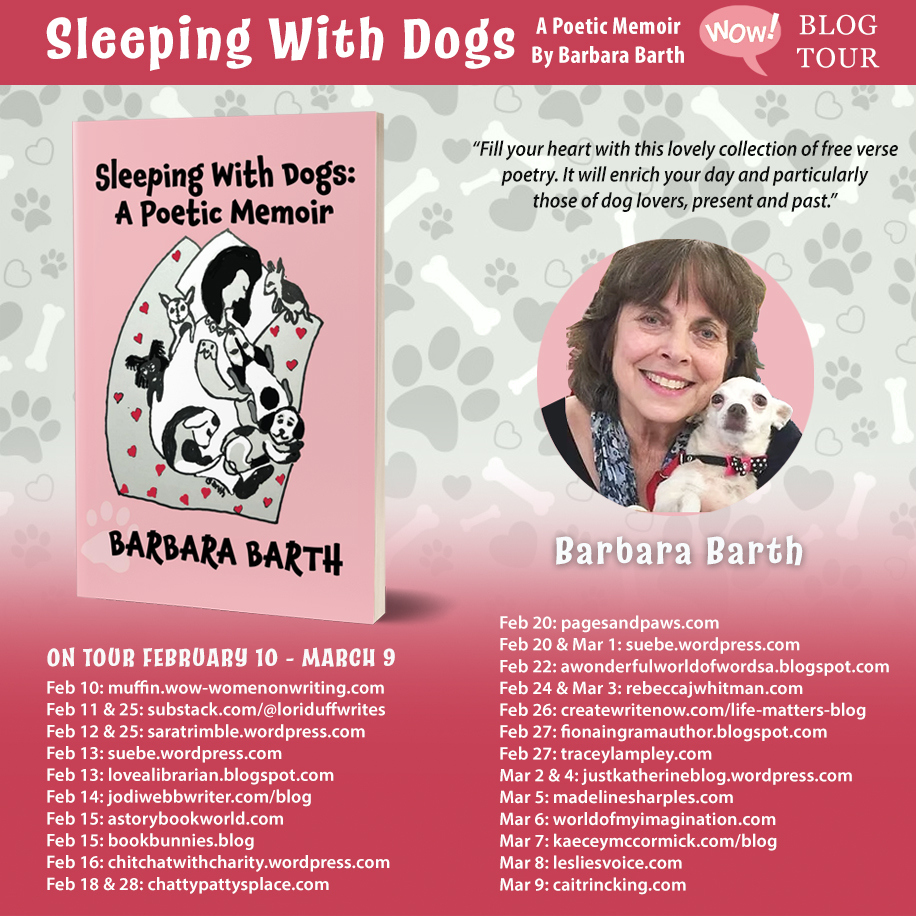
Sprinkles has read Sleeping With Dogs: A Poetic Memoir by Barbara Barth, as part of a blog tour hosted by Women on Writing, and recommends it highly to all bunnies great and small.
Today Sprinkles reviews three poetry anthologies that can help young bunnies get acquainted with a great many wonderful poems all at once: 101 Great American Poems collated by the American Poetry & Literacy Project, Favorite American Poems edited by Paul Negri, and How to Eat A Poem: A Smorgasbord of Tasty and Delicious Poems for Young People edited by the American Poetry & Literacy Project and the Academy of American Poets.
Sprinkles reviews 101 Great American Poems collated by the American Poetry & Literacy Project, Favorite American Poems edited by Paul Negri, and How to Eat A Poem: A Smorgasbord of Tasty and Delicious Poems for Young People edited by the American Poetry & Literacy Project and the Academy of American Poets.
How poetry comes into one’s life will differ from one bunny to another. But hopefully some day you find yourself interested in a poem. A poem that makes you think differently or feel very strongly about something. And that makes you think, hmm, maybe I could enjoy this poetry thing. But there is a whole wide world of poetry out there. Where do you start? Anthologies might help. So today I want to share with you some thoughts about three poetry anthologies that young readers might find of interest.
The first one I will write about is 101 Great American Poems, collated by the American Poetry & Literacy Project, and published originally in 1998 by Dover. Maybe you are aware that Dover is a publisher that specializes in republishing classical works that have been out of print for a while. However, 101 Great American Poems is a new anthology, first published by Dover. In fact all three books I am reviewing today are published by Dover in the same manner. I am glad Dover does publish original works, too, especially because they are often clean books sold at very reasonable prices.
Sprinkles reviews 101 Great American Poems collated by the American Poetry & Literacy Project.
Anyways, let us get back to 101 Great American Poems. As you can tell, the book is a collection of one hundred and one poems from thirty-nine American poets ranging from colonial times to early twentieth century. The poems are organized by their authors, who themselves are organized according to their birth years. So the book starts with a poem “To My Dear and Loving Husband” by Anne Bradstreet, who was born in England in 1612 and was one of the early colonialists in America, and ends with “The Unknown Citizen” by W.H. Auden who was born in England in 1907 and wrote this poem in 1939 soon after he moved to the United States. Each poet is introduced with a couple sentences of biographical context, and then we are offered one to ten poems from each. About seventeen poets have one poem under their names (including one from Abraham Lincoln, who one might or might not have expected to find in a poetry anthology), while two have ten (Emily Dickinson and Robert Frost). Most other folks are represented by two to three poems.
Sprinkles is reading 101 Great American Poems collated by the American Poetry & Literacy Project.
We have here a collection of mainly classical American poetry. Well-known poet names like Ralph Waldo Emerson, Henry Wadsworth Longfellow, Edgar Allan Poe, Walt Whitman, Emily Dickinson, Gertrude Stein, Robert Frost, Carl Sandburg, Wallace Stevens, William Carlos Williams, Ezra Pound, Marianne Moore, T.S. Elliot, E.E. Cummings, and Langston Hughes are accompanied by names that some of us might not be as familiar with. And even from those names that might be familiar, we might get new poems, that might not have shown up in our own studies of poetry in school but will open up whole new worlds for us if we let them.
In the introduction to 101 Great American Poems, the poet Joseph Brodsky is quoted to have said that “Books find their readers, and if not, well, let them lie around, absorb dust, rot, and disintegrate. There is always going to be a child who will fish a book out from the garbage heap.” The introduction ends: “Books wear out. Great poets pass away. But the spirit of poetry is indestructible.” This book is a neat collection that could help a young person reach in and find that one poem (or three) that will bloom new flowers in their heart.
***
Next up, I want to say a few words about Favorite American Poems, edited by Paul Negri. First published in 2002, the version I read is a large-print one, “designed for those who need or prefer large print and meets the standards of the National Association for the Visually Handicapped.” I must say that having quite poor eye sight myself, I find large-print books very much more accessible. And for a poetry book, the format works really well, even if you do not often need large print.
Sprinkles reviews Favorite American Poems edited by Paul Negri.
The book is organized again in terms of the poets, and the poets are listed once more in the order of their birth years. There is much overlap in between these two books, and so you will not be surprised to hear for example that the first poet presented is Anne Bradstreet again, with her “To My Dear and Loving Husband”. This one showcases thirty-four poets, and the big names in the previous book show up all here too. But this book has poems from John Greenleaf Whittier, Jones Very, Henry David Thoreau, Julia Ward Howe (“Battle Hymn of the Republic” had to appear of course!) and James Whitcomb Riley, who did not show up in 101 Great American Poets. On the other hand, we do not get to read poems from Abraham Lincoln, Sara Teasdale, Robinson Jeffers, Marianne Moore, Archibald MacLeish, E.E. Cummings, Jean Toomer, Langston Hughes, Countee Cullen, and W.H. Auden.
Sprinkles is reading Favorite American Poems edited by Paul Negri.
Biographical notes of the overlapping poets are mostly if not all identical. Poem selections also overlap but not completely. For example the same ten poems from Emily Dickinson, the same seven from Walt Whitman, and the same five from Edgar Allan Poe show up in both books, but both Oliver Wendell Holmes and Ell Wheeler Wilcox are represented by two poems in Favorite American Poems while only one per is showcased in 101 Great American Poems. Favorite American Poems seems to showcase more poems for the same poets in general, while 101 Great American Poems perhaps tries to be more selective.
***
The third book I will talk about is How to Eat A Poem: A Smorgasbord of Tasty and Delicious Poems for Young People, edited by the American Poetry & Literacy Project and the Academy of American Poets. First published in 2006, this book is more explicitly directed towards young readers and it shows, not only in the title but also in the way the poems are organized and presented.
Sprinkles reviews How to Eat A Poem: A Smorgasbord of Tasty and Delicious Poems for Young People, edited by the American Poetry & Literacy Project and the Academy of American Poets.
Unlike the first two books I reviewed above, How to Eat a Poem is organized around themes. The seventy poems in the book are categorized into four groups. The first group is titled “Magic Words: Poems about poetry, books, words, and imagination”. This section contains the poem that gives the book its title: “How to Eat a Poem” by Eve Merriam. The second group is collected under the title: “My Heart Leaps Up: Poems about the beauty of the natural world”. This section starts with William Wordsworth’s poem “My Heart Leaps Up When I behold” which gives the section its title. It also contains four simple and beautiful haiku as well as several famous poems like “The Tyger” by William Blake and “When I Heard the Learn’d Astronomer” by Walt Whitman. This is also where “The Desert is My Mother” by Pat Mora appears side by side with its Spanish version.
Sprinkles is reading “The Desert is My Mother,” and its Spanish version, by Pat Mora in How to Eat A Poem: A Smorgasbord of Tasty and Delicious Poems for Young People, edited by the American Poetry & Literacy Project and the Academy of American Poets.
The third section is titled “I Think Over Again My Small Adventures: Poems about travel, adventure, sports, and play”. In here we find the poem that gives the section its title: “I Think Over Again My Small Adventures”. a poem of Native American origin with its original composer unknown. Here we also find a poem by Shel Silverstein (“Sick”), another by Langston Hughes (“Harlem Night Song”) and another by Elizabeth Bishop (“One Art”). The last thematic section is titled “Hope is the Thing With Feathers: Poems about love, friendship, sadness, hope and other emotions,” and as you might imagine, it contains Emily Dickinson’s “Hope is the Thing with Feathers”. It also contains Edgar Allan Poe’s “Annabel Lee”and several others that explore a wild range of emotions. The poets in this book are a lot more diverse, in their national, ethnic, and historical origins. And the goal seems to be to show to the young reader that poetry is fun and worthwhile.
***
Overall I think all three books do well what they set out to do. 101 Great American Poems starts with the poet Joseph Brodsky asserting that “poetry must be available to the public in far greater volume than it is.” In Favorite American Poems, we are told that “we read poetry because at its best, it lives and sings.” And as we are told in the foreword to How to Read A Poem, poet Ted Kooser tells us that poetry “should be fun”. I believe these ideas are very well represented by each of these books.
I think the youngest bunnies may benefit from starting with How to Eat a Poem, and any bunny may decide to pick one or the other between 101 Great American Poems and Favorite American Poems. But make sure you get your paws on at least one of these books, and leave them lying around in the house. The young paws will eventually reach them and start reading. And then their journeys into the world of poetry will really take off.
Sprinkles recommends that readers check out at least one of the three books mentioned here: 101 Great American Poems collated by the American Poetry & Literacy Project, Favorite American Poems edited by Paul Negri, and How to Eat A Poem: A Smorgasbord of Tasty and Delicious Poems for Young People edited by the American Poetry & Literacy Project and the Academy of American Poets.