Caramel reviews physics books for babies by Chris Ferrie

This past week Caramel got his paws on a handful of board books from the Baby University series, written mainly by Chris Ferrie. He is a voracious reader, and these little books, written for tinier bunnies and their adults, were all read within the course of one evening. Then he reread them and reread them again. And for today’s review, he insisted that we should talk about them. So that is what is happening today: Caramel is reviewing six books on physics from the Baby University series, and Sprinkles is taking notes and asking followup questions.
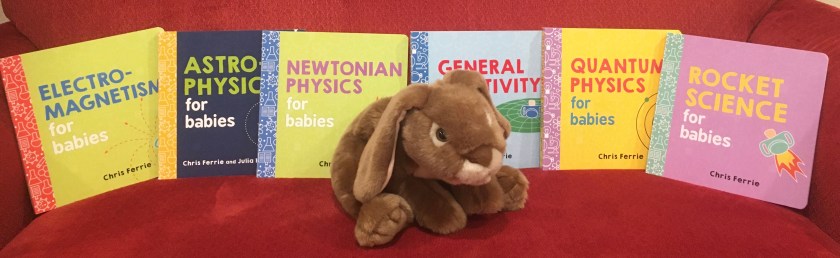
Caramel reviews Electromagnetism for Babies, Astrophysics for Babies, Newtonian Physics for Babies, General Relativity for Babies, Quantum Physics for Babies, and Rocket Science for Babies, almost all written by Chris Ferrie, except the astrophysics one which is coauthored by him and Julia Kregenow.
Caramel reviews Electromagnetism for Babies, Astrophysics for Babies, Newtonian Physics for Babies, General Relativity for Babies, Quantum Physics for Babies, and Rocket Science for Babies, almost all written by Chris Ferrie, except the astrophysics one which is coauthored by Ferrie and Julia Kregenow.

Sprinkles: So Caramel, why did you want to review these books?

Caramel: Well, I liked them. I review only the books I like.

S: But aren’t these books for babies?

C: Yes. So? I don’t care. I liked them!

S: I agree they are cute and fun. But did you find them amusing? Did you find them informative?

C: Both!

S: They do explain some basic physics in simple terms. And even for a little bunny like you, who can read big books, they could teach some basic principles, right?

C: Yes.

S: Okay, let us start from the beginning. The earliest physics these books talks about is Newtonian physics. Can you tell me a bit about what you learn in that book?

C: This book talks about gravity, and mass, and acceleration.

S: Hmm, those are big important words. Do you know what they mean?

C: Yeah. For example the book tells me what gravity is. It says: “We can’t see gravity. It is the force that keeps us on the ground.”

S: I see.

C: There are forces and they make a ball move faster. That is what accelerate means. And when an apple falls from a tree, it “feels the force of gravity, and Sir Isaac Newton feels the force of the apple.”

S: Yes, so in this book we go through Newton’s Three Laws of Motion.

C: I knew only one of them before reading this book, the one that says “for every action there is an equal and opposite reaction”. So I learned two more.

S: That is good! Then let us move to the book on electromagnetism. That is I believe the next one, in terms of the history of science.

C: Hmm, let me quickly read it again… Okay, this one, like all the others, starts with a ball. All of the books start with “This is a ball.”

S: It is a good starting point, especially if you want babies to be interested, right?

C: Yes. I like balls too.

S: I know! So okay, in this book you learn about electric charges and then magnets and then finally that the ideas of electricity and magnetism are related. Right?

C: Yes! I heard that they use big magnets in wind turbines to generate electricity! They are using this idea!

S: That is cool! Here is an article we found about “the critical role of magnets in wind turbines” and read together.
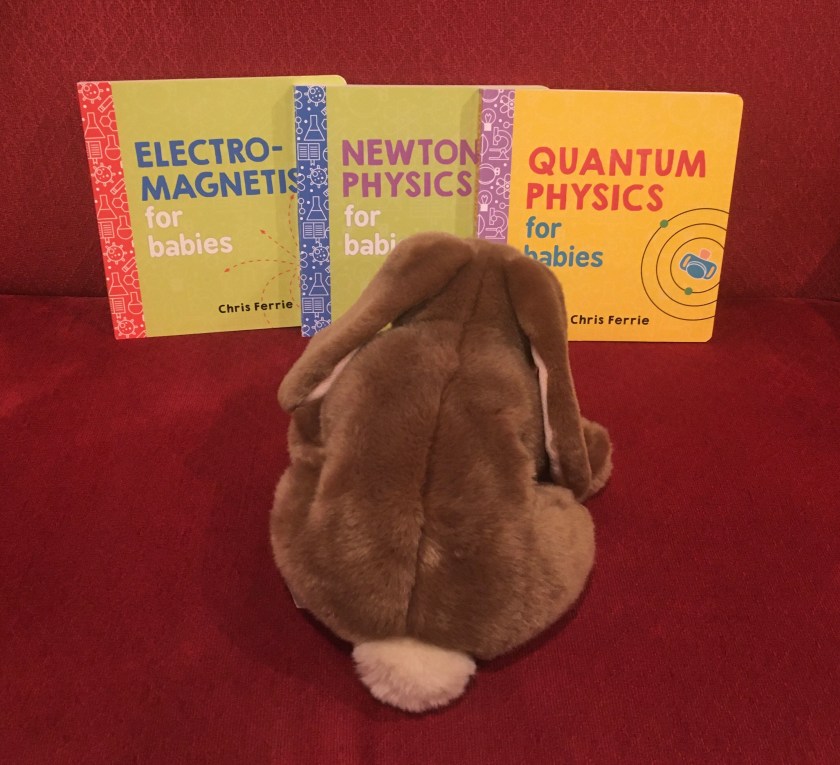
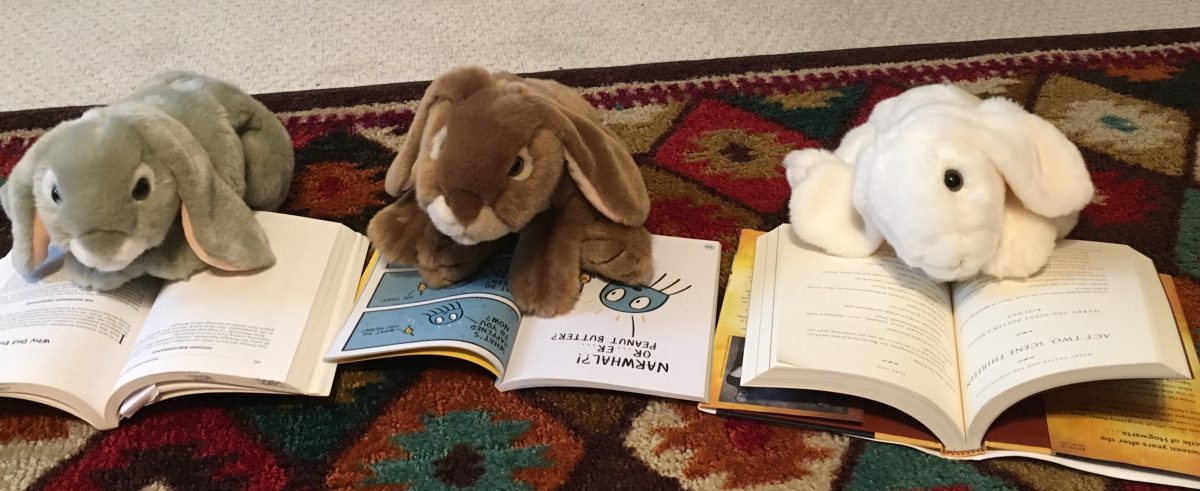
Caramel is looking at Electromagnetism for Babies, Newtonian Physics for Babies, and Quantum Physics for Babies, all written by Chris Ferrie.

S: Next let us talk about the book on quantum physics. Tell me about this one.

C: This also starts with a ball. Then it tells us about atoms and electrons. Electrons have energy. This energy is “quantized”.

S: That means that the energy electrons can have has to be among a few possible values. Not all values are allowed.

C: Yes. I learned that from this book.

S: That is some quite fancy knowledge Caramel. I’m glad you are learning all this already!
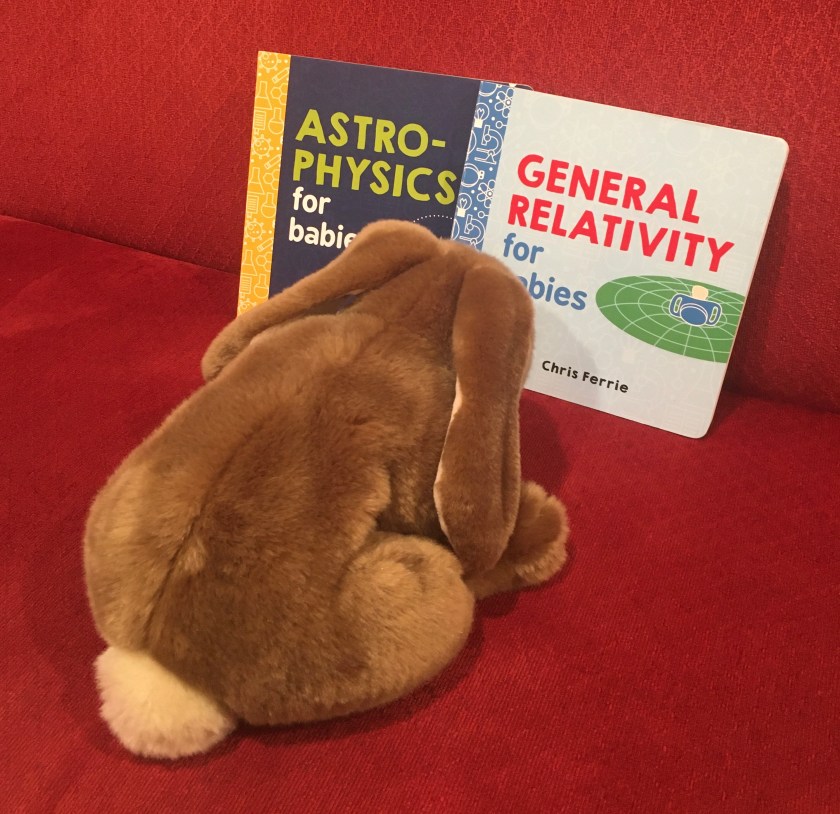
Caramel is looking at Astrophysics for Babies by Ferrie and Kregenow and General Relativity for Babies by Ferrie.

S: Tell me next about the astrophysics one. This is written by Chris Ferrie and Julie Kregenow.

C: This too starts with “This is a ball.” And then it says planets and stars are like balls. Then it talks about elements on the periodic table. They were all created in stars!

S: Yes, that part made me think about that Symphony of Science song we like to listen to. There is a part in that song where Carl Sagan says, “We’re made of star stuff”. He then says “We’re a way for the cosmos to know itself.” I love that!

C: Yeah, let us embed the video here!

S: Sure, why not?

“”We Are All Connected” was made from sampling Carl Sagan’s Cosmos, The History Channel’s Universe series, Richard Feynman’s 1983 interviews, Neil deGrasse Tyson’s cosmic sermon, and Bill Nye’s Eyes of Nye Series, plus added visuals from The Elegant Universe (NOVA), Stephen Hawking’s Universe, Cosmos, the Powers of 10, and more. It is a tribute to great minds of science, intended to spread scientific knowledge and philosophy through the medium of music.”

S: “And there is much to be learned.” I love this song. But let us get back to the books. Next if you want, we can talk about the book about general relativity.

C: This begins with the same sentence: “This is a ball.”

S: Then what happens? What do you learn?

C: I learn about mass and how it warps space, and then about black holes.

S: All pretty cool stuff really…

C: And now let us talk about my favorite one.

S: Yes, let us talk about Rocket Science for Babies.
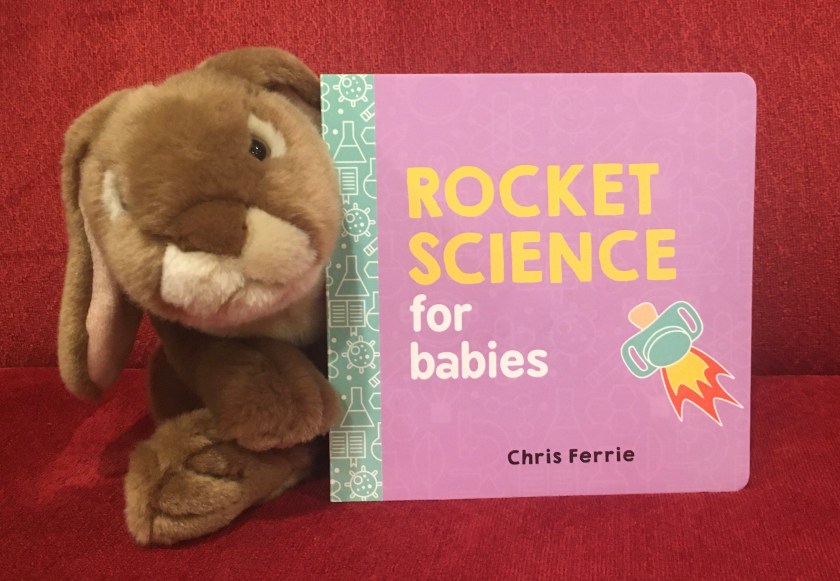
Caramel is posing with Rocket Science for Babies by Chris Ferrie, his favorite so far in this series.

C: This is my favorite! It again starts with “This is a ball.” Like all the other ones. Then it talks about lift and airplane wings and thrust. And rockets.

S: Why is it your favorite?

C: Because I love rocket ships and planes and balls. And the book is all about them.

S: Yes, that is a good reason to like the book. Did you learn something new from this book?

C: Well, not really. I already knew a bit about lift and thrust and such. But it is still a cool book.
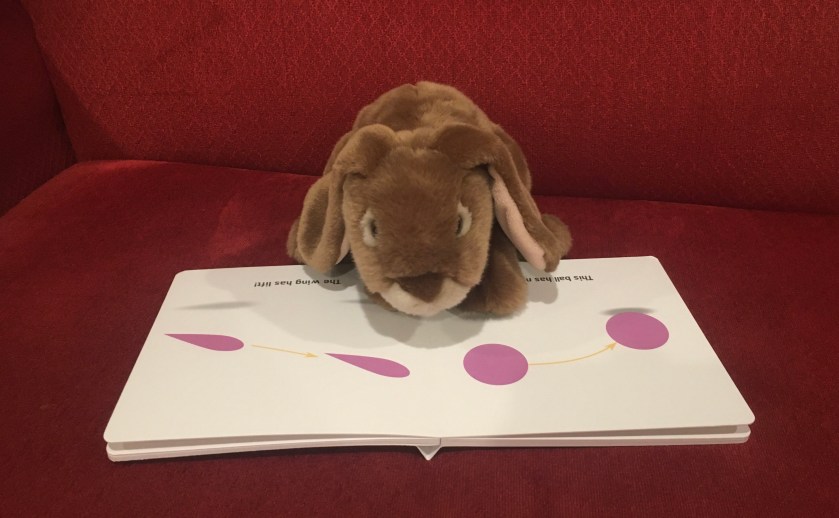
Caramel is reading Rocket Science for Babies by Chris Ferrie, his favorite so far in this series.

S: So do you think it is time to give these books away to a baby bunny?

C: No! I like them and want to read them a lot more times before we do that!

S: Okay, you can read and reread them as many times as you like. I do think they are good ways to set up the fundamental ideas of some of these things. Do you think these books would work well for babies?

C: Yes, I would have loved to have read them with you when I was a baby.

S: So would I! I myself would recommend these books to parents, especially if they are willing to talk to their little ones about the science a bit, even if it has to be with the help of the internet. But we only found out about them this year. Oh well, better late than never, right? Let us wrap this up. What three words would you use to describe these books?

C: Helpful, colorful, fun.

S: I think those work! So what should our readers do?

C: Stay tuned for more book bunny reviews!
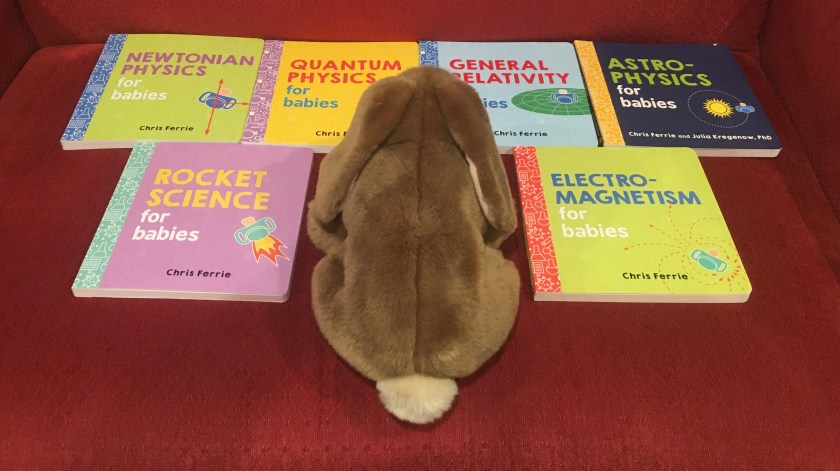
Caramel enjoyed reading and rereading Electromagnetism for Babies, Astrophysics for Babies, Newtonian Physics for Babies, General Relativity for Babies, Quantum Physics for Babies, and Rocket Science for Babies, almost all written by Chris Ferrie, except the astrophysics one which is coauthored by Ferrie and Julia Kregenow.

Caramel reviews Survive! Inside the Human Body: The Nervous System by Hyun-Dong Han

In the past two weeks Caramel reviewed  Survive: The Digestive System and Survive: The Circulatory System, the first two books in the Survive: Inside the Human Body series illustrated by Hyun-Dong Han. This week he is reviewing the third and last book in this series of graphic novels: Survive: The Nervous System. Sprinkles is taking notes and asking questions.

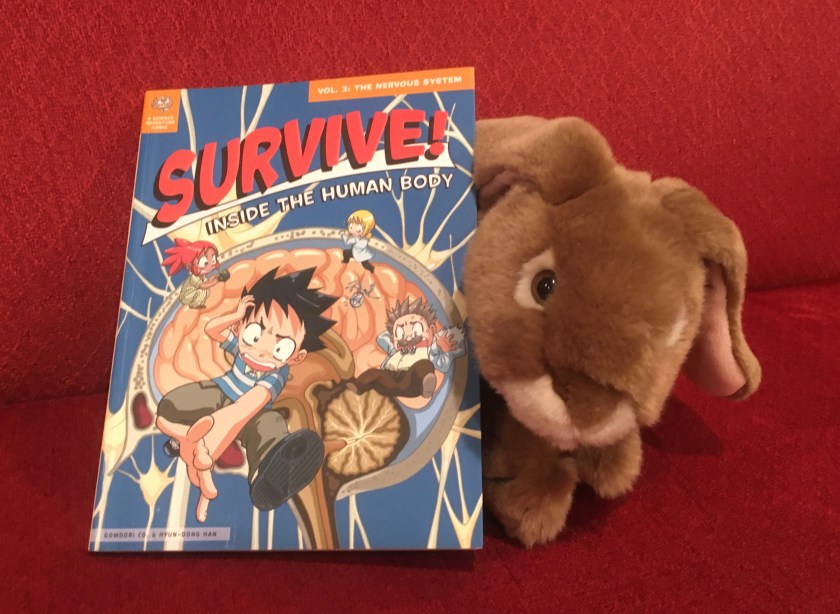
Caramel reviews Survive! Inside the Human Body: The Nervous System by Hyun-Dong Han.

Sprinkles: So after traveling through their friend Phoebe’s digestive system and then her circulatory system, Geo and Doctor Brain are back again! And what are they doing this time?

Caramel: They are in her brain this time. They figure out that there is a tumor in her brain. In her optic nerves.

S: That is scary! But how do they get from the circulatory system to the brain?

C: They went into the ear through the blood system, and then they went to the brain.

S: Okay, I don’t quite get it; I guess I will have to read this book too…

Caramel is reading Survive! Inside the Human Body: The Nervous System by Hyun-Dong Han.

S: Anyways, so Phoebe has a tumor, then?

C: Yes.

S: Is it malignant?

C: No it is benign. That means it is not cancerous and it does not spread fast. It grows slowly.

S: Good, so they have some time. Then do they try to get out or fight the tumor somehow?

C: They get out. They take a sample with them, and then they get out. That is how they find out that it is benign.

S: How do they get out?

C: They go to the eye, and then she cries, and they come out with her tears.

S: That is an adventure!

C: Really weird one!

S: So what did you learn in this book?

C: That there are two different types of tumors. And I learned about REM sleep. That is when you are having dreams and your eyes move. Rapidly. So Rapid Eye Movement = REM.

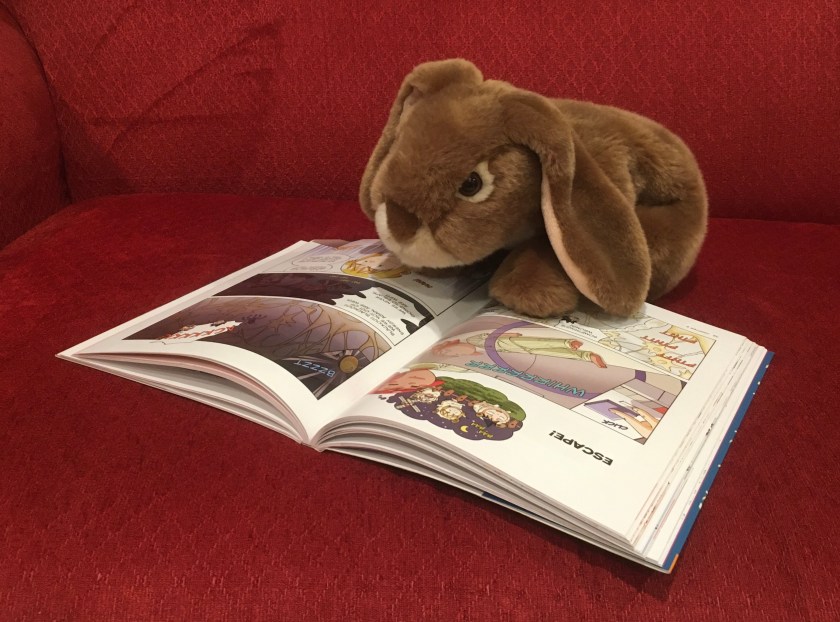
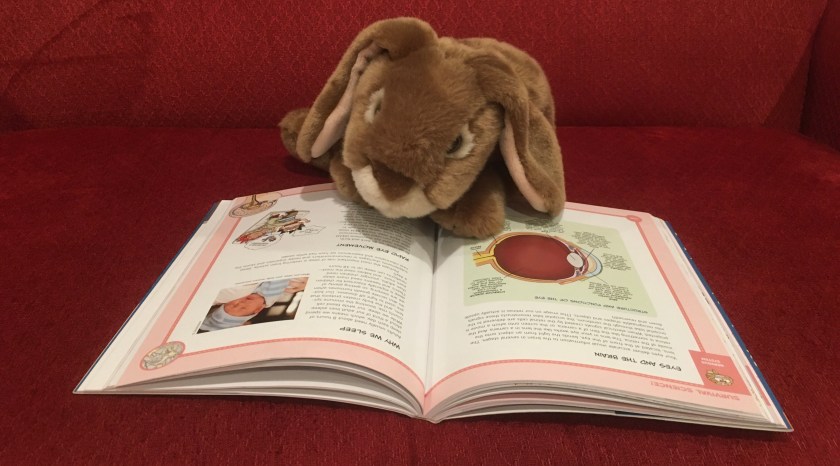
Caramel is reading about why we sleep in Survive! Inside the Human Body: The Nervous System by Hyun-Dong Han.

S: I see you read some of the fact pages! Did you read all of them? I know you like facts.

C: Yes but I did not read all of them this time. I wanted to read the story first.

S: I get that. Maybe you will go back and read the fact pages the next time.

C: Yes, probably.

S: So overall, did you enjoy reading this series?

C: Yes. I really enjoyed it. And I’m glad they got out!

S: Would you like to shrink and travel inside a living body?

C: I don’t think so. I don’t want to face parasites or tumors. And I also like being a normal-size bunny, and bouncing around is fun.

S: Maybe you could bounce around inside someone’s body.

C: Still, I don’t think I would like it.

S: I know. It can be scary. So let us wrap our review up with your three words for this book.

C: Funny, action, and color.

S: Those are good words to describe this book!

C: Yes! And stay tuned or more book bunny reviews!

Caramel has really enjoyed Survive! Inside the Human Body: The Nervous System by Hyun-Dong Han, and recommends the whole series to all little bunnies.

Caramel reviews Survive! Inside the Human Body: The Circulatory System by Hyun-Dong Han

Last week Caramel reviewed Survive: The Digestive System, the first book in the Survive: Inside the Human Body series illustrated by Hyun-Dong Han. This week he wanted to continue talking about this series of graphic novels, so today he will tell us about the second book: Survive! The Circulatory System, once again illustrated by Hyun-Dong Han. As is often the case, Sprinkles is taking notes and asking questions.

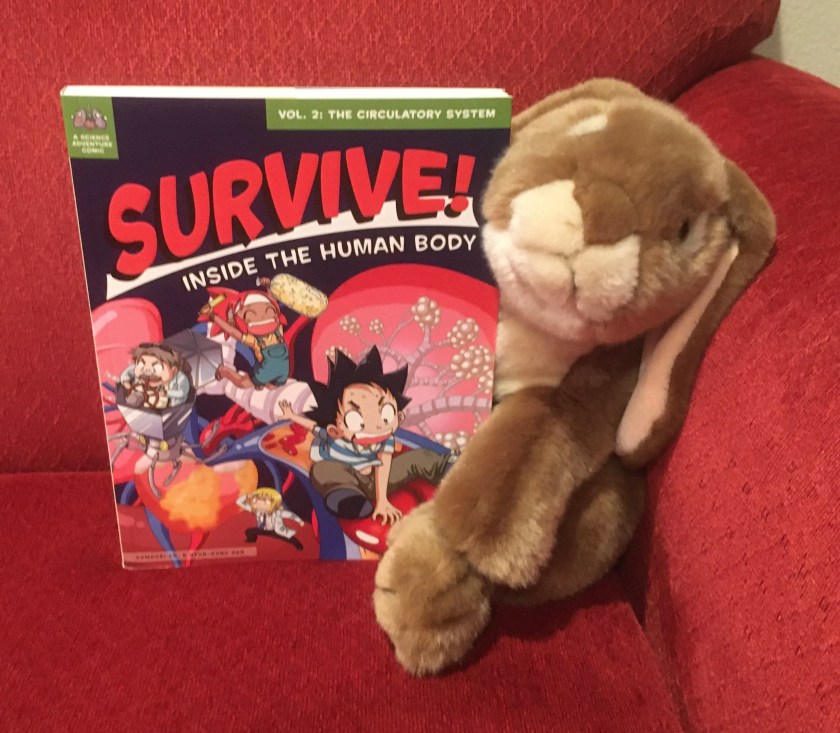
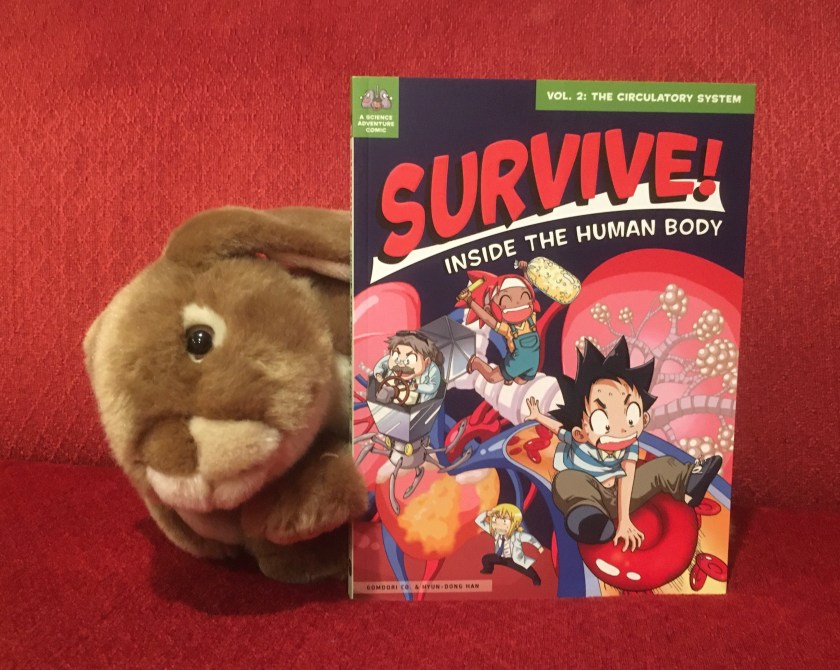
Caramel reviews Survive! Inside the Human Body: The Circulatory System by Hyun-Dong Han.

Sprinkles: So Caramel, you have enjoyed these books so much that you wanted to talk about the second one today.

Caramel: Yep.

S: So tell us from the beginning. What is this book about?

C: It is about the circulatory system.

S: So what is the circulatory system?

C: The circulatory system is the system that moves blood around the body.

S: So in this book we learn about the human body and the blood circulating through it. But then is it all about facts? Or is there a story line too?

C: Yes, there is a story line.

S: Tell me about it.

C: It’s about Geo and Doctor Brain and they go into Phoebe’s body accidentally. She eats them.

S: Wait, these are the same characters from the first book, right?

C: Yes. Phoebe and Geo are two friends. Doctor Brain is a mad scientist who invented the S.S. Hippocrates.

S: Oh do you know who Hippocrates was?

C: Yes. He lived in ancient Greece and he was a healer, and he believed that people should look at diseases in a more scientific way.

S: Yes. People see him as “the father of medicine”. So what is S.S. Hippocrates?

C: It’s a big ship but can shrink and go inside a human body. But they were not trying to get into anybody’s body.

Caramel is reading Survive! Inside the Human Body: The Circulatory System by Hyun-Dong Han

S: Hmm, so in the first book they somehow get trapped inside Phoebe’s digestive system, she somehow eats them. How do they get into her blood stream this time?

C: They are digested.

S: So they were not able to get out the last time, and from the digestive system they are transferred into the circulatory system. Is that correct?

C: Yes.

S: Oh that sounds exciting but also kind of scary.

C: It is. They are attacked by microphages, white blood cells, and Kupfer cells.

S: Wait, what are Kupfer cells?

C: Oh apparently they are a type of microphage!

S: So they are attacked by the immune system while in the blood stream? That makes sense. After all, they are not supposed to be there!

C: Yeah. Plus Doctor Brain apparently made S.S. Hippocrates look like a bacterium.

S: That makes even more sense, of course: then the body’s defense system would try to fight it. We learned all about white blood cells and microphages in Cells At Work, right?

C: Yes, but we did not learn about the Kupfer cells there. Hey, why don’t we put in the song for Cells At Work here?

S: Good idea! Here you go, but viewers should keep in mind the show is quite violent—the little bunnies in our household often covered their eyes while we were watching the show—so this introductory sequence is also kind of violent (in second 39, you meet the White Blood Cell and with him start the violence and the gore):

Here is the introductory sequence to Cells At Work in English (warning: there is significant violence and gore in the show and in this video too).

S: Let us get back to the book. So do they figure out how to get out of Phoebe’s body?

C: Nope, not yet. You need to read the third book for that.

S: Oh, so this one ends with a cliffhanger!

C: Yes! But it was not bad because I actually wanted to read the third book anyway.

S: That makes sense. You like graphic novels and you like learning about facts.

C: Yes I really like facts and there are a lot of them in this book.

Caramel is reading about the liver in Survive! Inside the Human Body: The Circulatory System by Hyun-Dong Han

S: So this was a good read, then?

C: Yes, it was!

S: Tell me three words to describe it.

C: Colorful, informative, and funny.

S: Those make a good endorsement for this book! So it is time to wrap up!

C: Stay tuned for more book bunny adventures!

Caramel enjoyed reading Survive! Inside the Human Body: The Circulatory System by Hyun-Dong Han, and recommends it to all bunnies interested in learning about the human body.

Caramel reviews Survive! Inside the Human Body: The Digestive System by Hyun-Dong Han

A few weeks ago, as the book bunny household was just finishing up watching the (surprisingly violent but also extremely engaging) manga series Cells At Work, we came across a series of graphic novels set inside the human body. Of course both little bunnies read through the books in the blink of an eye. Today Marshmallow interviews Caramel about the first book in the series: Survive: The Digestive System, illustrated by Hyun-Dong Han.

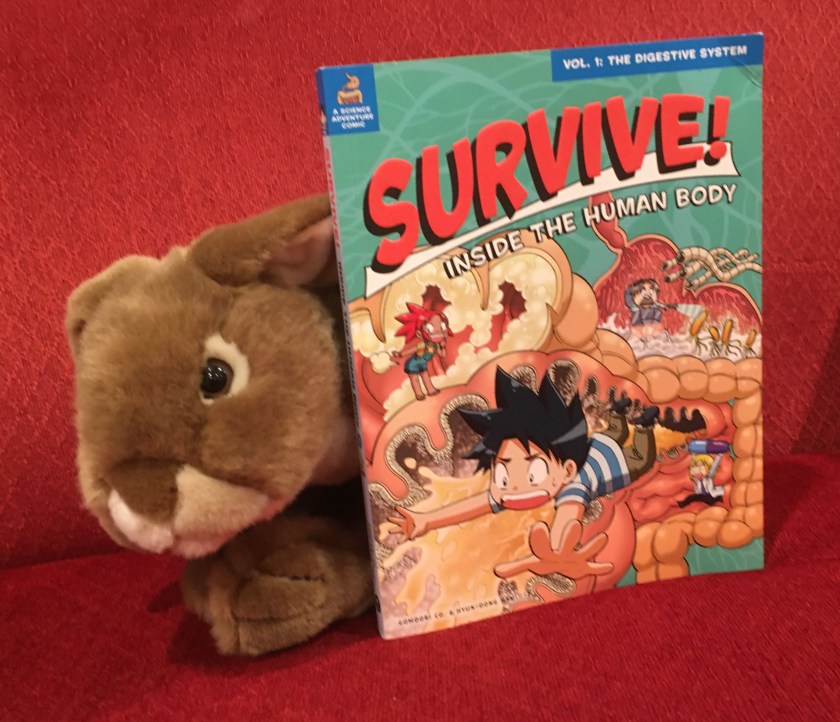
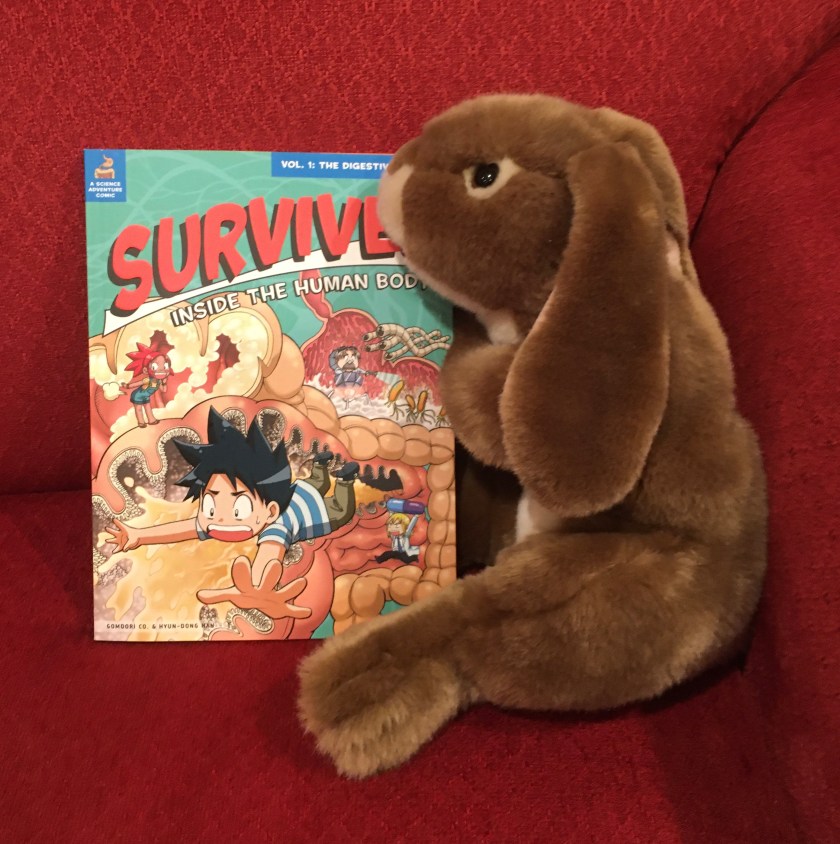
Caramel reviews Survive: The Digestive System, illustrated by Hyun-Dong Han.

Marshmallow: So, Caramel, what do you want to tell us about this book?

Caramel: This book is a book that can teach a lot. 

M: What is something you learned?

C: I learned that the esophagus is a hole that goes down to your stomach.  

M: What happens in the book?

C: It’s about a girl named Phoebe, and then there is this Doctor Brain. Doctor Brain’s a medical person who’s a mad scientist too. He invents this machine that makes things smaller, and then accidentally, Geo and Doctor Brain get swallowed by Phoebe.

M: Who is Geo?

C: Phoebe’s friend. 

M: Who is the other character on the cover?

C: That is Kay, the assistant of Doctor Brain, and Geo and Phoebe’s friend. 

M: What are Geo and Doctor Brain trying to do?

C: They are trying to get out of Phoebe’s body after she swallows them. 

M: What part of her body are they in?

C: In this book, they are in the digestive tract. 

M: “Digestive tract,” that’s a big word. But wait, does the “In this book” mean that there are more books?

C:  Yes, there are two more. There is a book on The Circulatory System and another on The Nervous System.

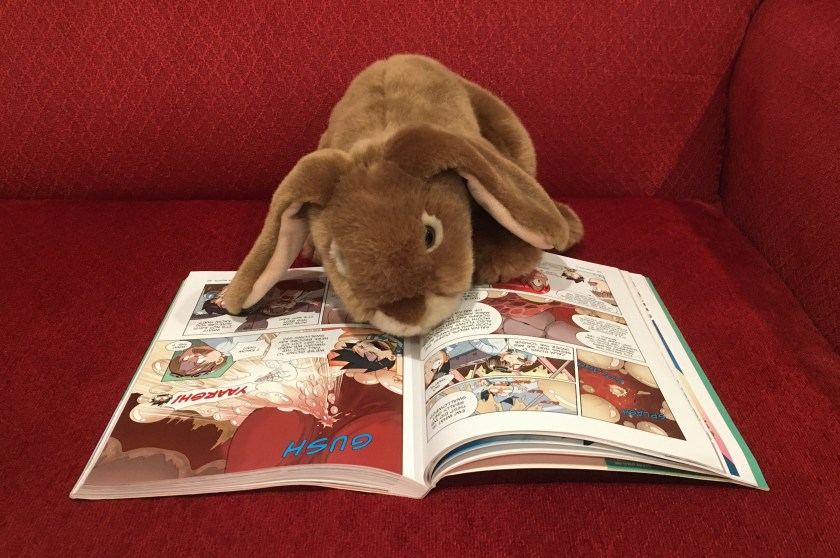
Caramel is reading Survive: The Digestive System, illustrated by Hyun-Dong Han.

M: Is this book scary?

C: Sort of, maybe for little kids. It could be scary for younger kids. 

M: Do you have a favorite character?

C: Doctor Brain because he’s smart. Really smart. 

M: Do you think that this book is easy to read?

C: Yes, it’s a pretty easy book. It’s a graphic novel, and it has fewer words than a normal book.

M: Did you enjoy reading it? 

C: Yes, I really liked it.

M: Do you think that everyone could like it or do you think that the book is meant for a certain age group?

C: I think that every one could like it. 

M: Do you like the pictures or the drawings?

C: The pictures are pretty good drawing. They do describe the action pretty well. They are colorful. 

M: In some parts, there are facts, right?

C: Yes, there are many facts. Here’s one, “We use nearly 40 muscles to chew and swallow.” 

M: Wow! That a lot of muscles. I wonder if bunnies like us use more or less.

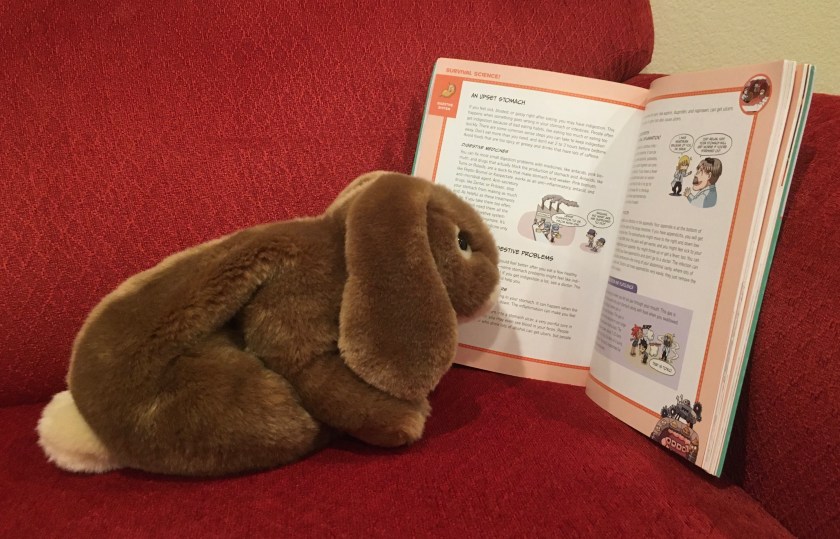
Caramel is reading one of the fact based spreads in Survive: The Digestive System, illustrated by Hyun-Dong Han.

M: So, Caramel, what are three words that describe this book?

C: Action, informative, and colorful.

M: Sounds good to me! And it’s about time to wrap up. What do you say?

C: Stay tuned for more book bunny reviews!
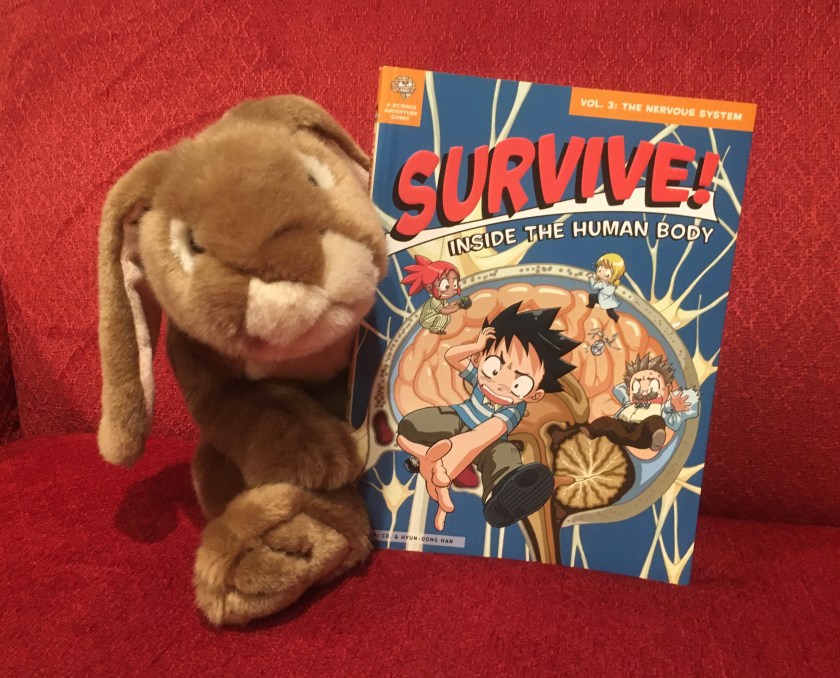
Caramel has enjoyed reading Survive: The Digestive System, illustrated by Hyun-Dong Han, and recommends it to all other little bunnies interested in the human body.