Marshmallow reviews The Light Eaters by Zoë Schlanger

Today Marshmallow reviews The Light Eaters: How the Unseen World of Plant Intelligence Offers a New Understanding of Life on Earth, a 2024 book by Zoë Schlanger.
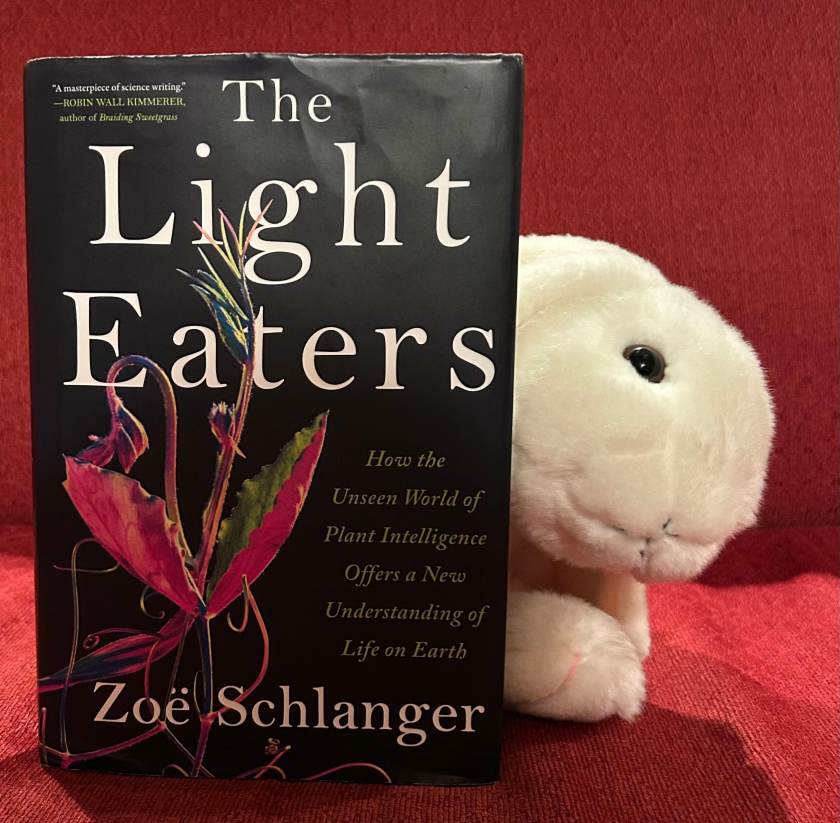
Marshmallow reviews The Light Eaters by Zoë Schlanger.

Marshmallow’s Quick Take: If you like reading, then this is the book for you!

Marshmallow’s Summary: Generally, I tend to read fiction. As a result, most of the books I review here are fiction. However, this book was uniquely written and exists somewhere between the two. While it is completely centered on science and factual reality, some of the things I learned from it were so wonderful that I wonder whether we need fiction at all when nature has already provided us with such beautiful truths. (Sprinkles told me that this made her think of something the famous physicist Richard Feynman said: “I think nature’s imagination is so much greater than man’s, she’s never going to let us relax.”)

The book starts off with a modest introduction of the central question—are plants conscious? As such, the title of the first chapter is “The Question of Plant Consciousness.” The other chapters are as follows: “How Science Changes Its Mind,” “The Communicating Plant,” “Alive to Feeling,” “An Ear to the Ground,” “The (Plant) Body Keeps the Score,” “Conversations with Animals,” “The Scientist and the Chameleon Vine,” “The Social Life of Plants,” “Inheritance,” and “Plant Futures.” In each one, Schlanger focuses on a different aspect of plant life and delves into how it relates to the central question.

I’ve already been one to tend towards animism, and I did not have a difficult time considering the idea of plant consciousness; on the contrary, I found it enthralling. I loved how each example was so fantastic yet grounded in solid fact. One particularly striking example case Schlanger described was the emerald green sea slug. Ever since I read about it in this book, I have brought up this sea slug at every single opportunity I get (you’d be surprised by how many ways you can relate daily conversation to sea slugs and I’ve done them all). The slug is born brown and red, but immediately seeks out bright green micro-alga (basically, big and visible algae). It drinks up the chloroplasts, which are smooth and round circles, filling its body and turning it green. This process—with the slug’s transparent, tubelike tongue—looks just like drinking boba; this comparison delights me to this day! Then the sea slug somehow, wondrously begins to photosynthesize. While the sea slug is not a plant, Schlanger uses this creature to illustrate how the borders between animal and plant are not quite as defined as we might have once thought. This story was one of many fascinating facts I learned from this book. (It feels insufficient to say “facts” because they are more like revelations to me.)

Towards the end, Schlanger debates the nuances of what societal acceptance of plant consciousness would look like. She examines the wordings that botanists have used and would like to use. Perhaps new words and definitions will have to be made to help the public better understand that plant intelligence and / or consciousness is completely unlike those of humans or bunnies. The book ends in a rather abstract yet equally profound manner, leaving the reader wishing Schlanger had continued her marvelous writing.
Marshmallow is reading The Light Eaters by Zoë Schlanger.

Marshmallow’s Review: I think this might just be my favorite book. I did not finish it for the longest time because I didn’t want it to end. Each chapter revealed another beautiful part of nature and I felt constant awe, like one does when watching well-made documentaries.

I found Schlanger’s prose very different from what I’ve read from other writers. She writes the way that I feel she probably speaks. I don’t think she always used semicolons or other punctuation the way the standards of the English language demand; she used them more as tools to convey what she wanted. I know that this usage might bother some readers, and I was a bit taken aback initially. However, it did not counteract or undermine her words and her meaning.

I loved learning about what the world of plant and plant studies is like. Some recent events have made me start thinking about entering STEM a lot more. This book made me realize that science and the natural world has so much to explore and learn about. Regardless, I think everyone should read this book—even bunnies who don’t particularly like science. I think it raises and explores some very interesting and important questions about plants, their place on this planet, and ours. As concern for the climate becomes more and more critical, books that enlighten the public about the complexities of ecology are increasingly vital for social discussion. So, like I said at the beginning of this review, if you like reading or if you can read, then I would recommend reading this book with all of my heart.

Marshmallow’s Rating: 121%.
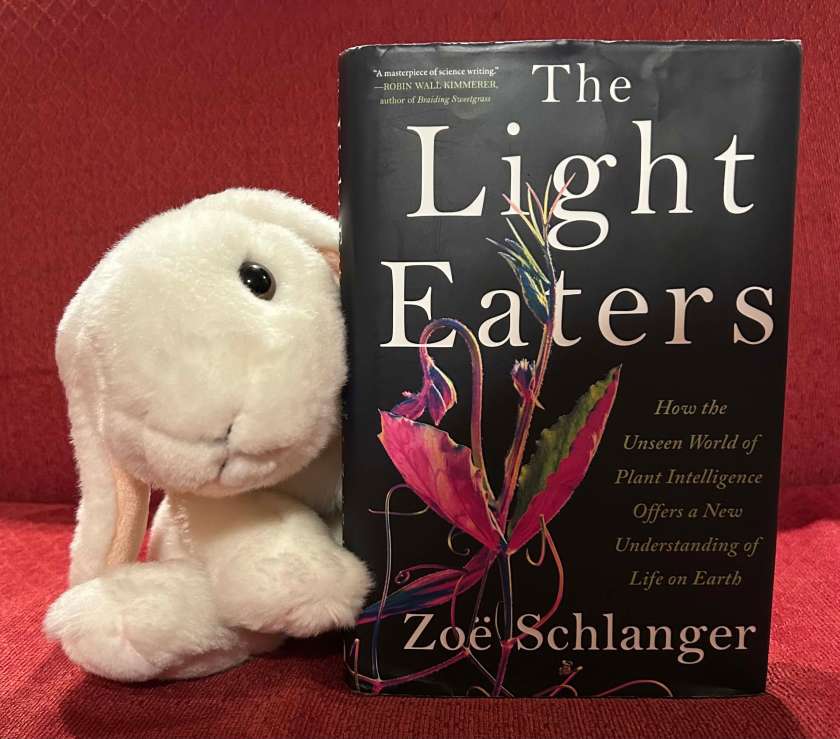
Marshmallow rates The Light Eaters by Zoë Schlanger 121%.

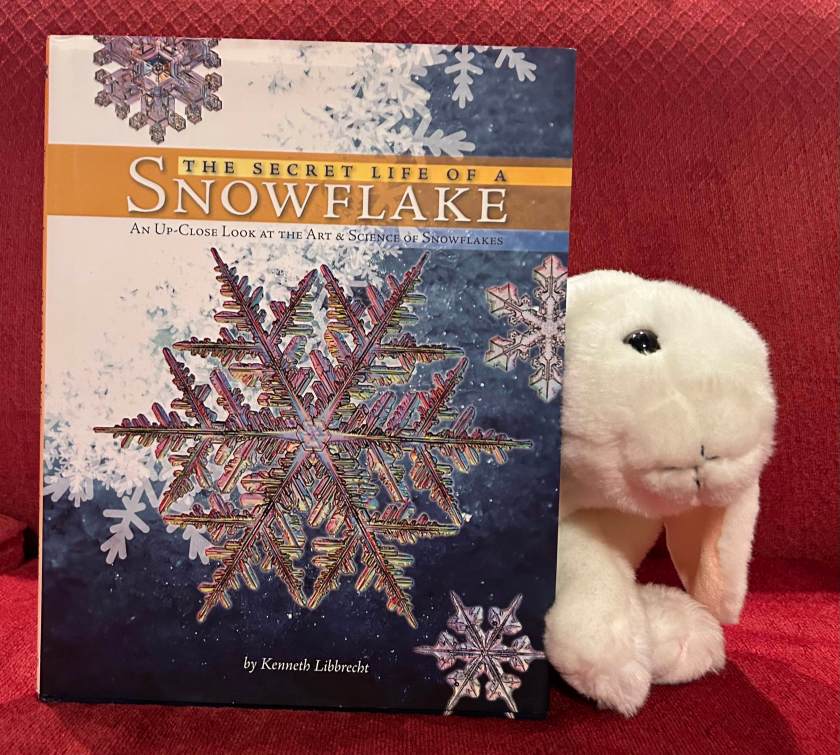
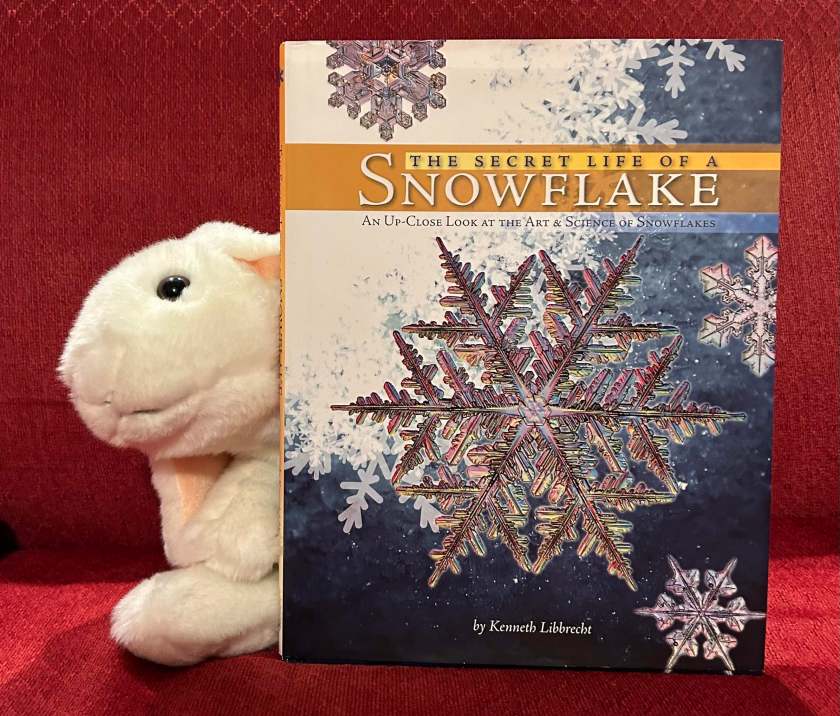
Marshmallow reviews The Secret Life of a Snowflake by Kenneth Libbrecht

Today Marshmallow reviews a beautiful book she really likes: The Secret Life of a Snowflake: An Up-Close Look at the Art and Science of Snowflakes by Kenneth Libbrecht, published first in 2009. Sprinkles is asking questions and taking notes.

Marshmallow reviews The Secret Life of a Snowflake: An Up-Close Look at the Art and Science of Snowflakes by Kenneth Libbrecht.

Sprinkles: So Marshmallow, you decided to talk about The Secret Life of a Snowflake today. This book has been on our bookshelves for a while now. I’m glad you picked it up for the blog today. Can you tell us a bit about it?

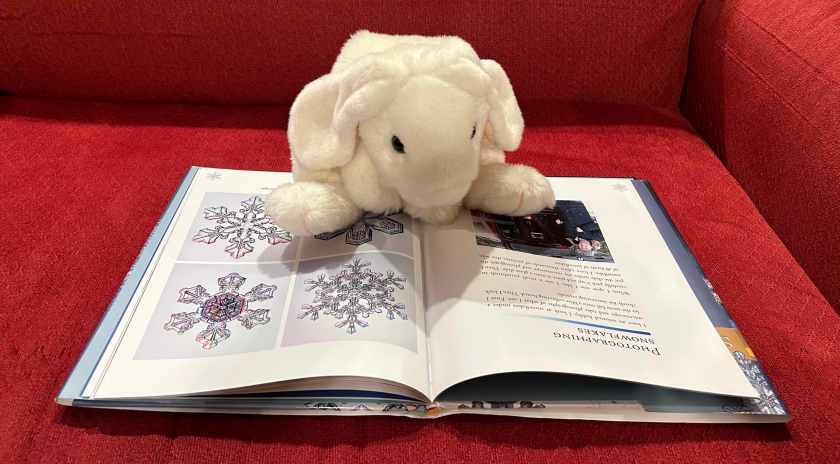
Marshmallow: This is a book written by a physicist named Kenneth Libbrecht who loves and studies crystals. And snowflakes are crystals, and he loves to take their photos. There are lots of photos in the book, and I love looking at them.

S: I know. I love looking at this book, too. It is just beautiful.

M: Yes! But the author is a scientist, so he also explains a bit about how snowflakes are formed and also about how clouds are formed, why snow is white, and so on.

S: Caramel would like this book, right?

M: Of course. He would love it because it is so “factful”!

S: Exactly.

Marshmallow is reading The Secret Life of a Snowflake: An Up-Close Look at the Art and Science of Snowflakes by Kenneth Libbrecht.

S: Did you know that the author has a website where he has a lot more information and photos about snowflakes?

M:Well, I did not, until you told me. And then we went and checked it out together. Our readers should check it out too: http://snowcrystals.com/

S: Yes. There are lots of exciting things there.

M: Exciting and beautiful. I found the section about designer snowflakes especially interesting.

S: There is also a special page for a monster snowflake which is apparently almost comparable to a penny in size! But back to the book. I know reading it once or twice, you get the science down. But I saw you read this book many many more times.

M: Yes. Because I really like the pictures in it. They calm me and comfort me.

S: And they make you smile. I saw.

M: Yes. They are very pretty, and each snowflake is so different, so pretty in a different way.

S: They are all very symmetric. I think that can feel somewhat calming.

M: Yes, maybe.

S: So if you were to rate this book, what would your rating be?

M: 100%. Definitely. I think this could be a really neat book for young bunnies to read with their parents, because it has science, it has beautiful pictures; it has all kinds of good things. The writing is simple, but very clear. And it gets a lot of information across.

S: Agreed. But I think bunnies can definitely read it on their own and enjoy it too, no matter how old they are.

M: Yes. Or it could make a great gift, especially for a winter holiday…

S: What a neat idea! Okay, Marshmallow. I think this is a good time to wrap up this review. What would you like to tell our readers?

M: Stay tuned for more amazing reviews from the book bunnies!

Marshmallow rates The Secret Life of a Snowflake: An Up-Close Look at the Art and Science of Snowflakes by Kenneth Libbrecht 100%.

Caramel reviews Oliver’s Great Big Universe by Jorge Cham

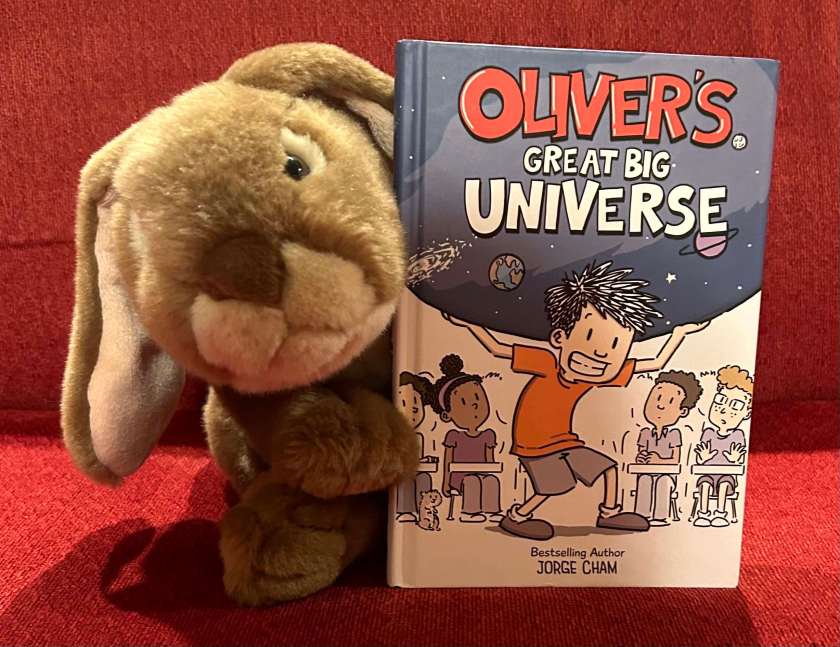
Caramel loves science and all sorts of factful books and documentaries. Today he is talking to Sprinkles about Oliver’s Great Big Universe by Jorge Cham, just published a couple weeks ago.

Caramel reviews Oliver's Great Big Universe by Jorge Cham.
Caramel reviews Oliver’s Great Big Universe by Jorge Cham.

Sprinkles: So Caramel, tell us a bit about this book.

Caramel: This book is about a kid named Oliver. He is eleven and is starting middle school. He really likes science.

S: Kind of like you then, right?

C: Yes.

S: So is he anxious about starting a new school?

C: Yes he is. But he really really likes science, and he keeps talking about things he is learning. He talks about the universe, for example.

S: Tell me a fact he talks about that you did not know before.

C: He says the sun is squish-ploding.

S: What does that mean?

C: Essentially it means that the sun is squished by its huge gravity and then it explodes.

S: It keeps doing this?

C: Yes.

S: I wonder what the technical term for it is. Squish-ploding does not sound terribly technical. Anyways, what else did you learn?

C: If you lived in Mercury, you would be able to celebrate your birthday every three months!

S: I see. It is because the planet Mercury rotates around the sun much faster than our planet Earth?

C: Yep. Much faster.

Caramel is reading Oliver's Great Big Universe by Jorge Cham.
Caramel is reading Oliver’s Great Big Universe by Jorge Cham.

S: Okay, so I am guessing you like this book because it is full of facts.

C: Yes.

S: But it is not just a book of facts, is it? It is also about Oliver and how he is adjusting to his new school.

C: Yes.

S: Do you like Oliver?

C: Yes, he is cool. He knows a lot of scientific facts. In fact he wants to become an astrophysicist.

S: That is cool. So besides the science facts, is Oliver’s own story interesting, too?

C: Yes. He makes a friend eventually.

S: So I am guessing that this means the book has a happy ending.

C: Yep. Another reason why I liked the book!

S: I see. So if you were to describe the book in three words or so, how would you do that?

C: Factful, hilarious, science fun.

S: I think those work! So do you think any bunny could read this book and enjoy it?

C: I think so. There are many many funny pictures on each page, and I think the science is fun, but getting to know Oliver is really funny, too.

S: Yes, the author is the creator of a very successful web comic called Piled Higher and Deeper (also called PhD Comics). He was working on his doctoral degree at Stanford University when he began to publish these comic strips about graduate student life. Some of them are more like inside jokes than others, but a lot of them are really really hilarious.

C: I didn’t know that! But I can see he knows how to draw very funny things.

S: So I was curious about this book and now I know it is good. Thank you for sharing your thoughts about it. I will definitely want to read it myself too.

C: You should Sprinkles. I think you will really like it too.

S: I bet. So let us wrap up this review so I can grab the book from your paws and get started. What do you want to tell our readers?

C: Stay tuned for more book bunny reviews!

Caramel enjoyed reading Oliver's Great Big Universe by Jorge Cham and recommends it to all young bunnies who are curious about the world (and the universe!) around them.
Caramel enjoyed reading Oliver’s Great Big Universe by Jorge Cham and recommends it to all young bunnies who are curious about the world (and the universe!) around them.

Caramel reviews Animated Science: Periodic Table by Shiho Pate and John Farndon

For his first review back from his summer break, Caramel wanted to talk about Animated Science: Periodic Table, a 2021 book illustrated by Shiho Pate and written by John Farndon. As usual Sprinkles is taking notes and asking questions.

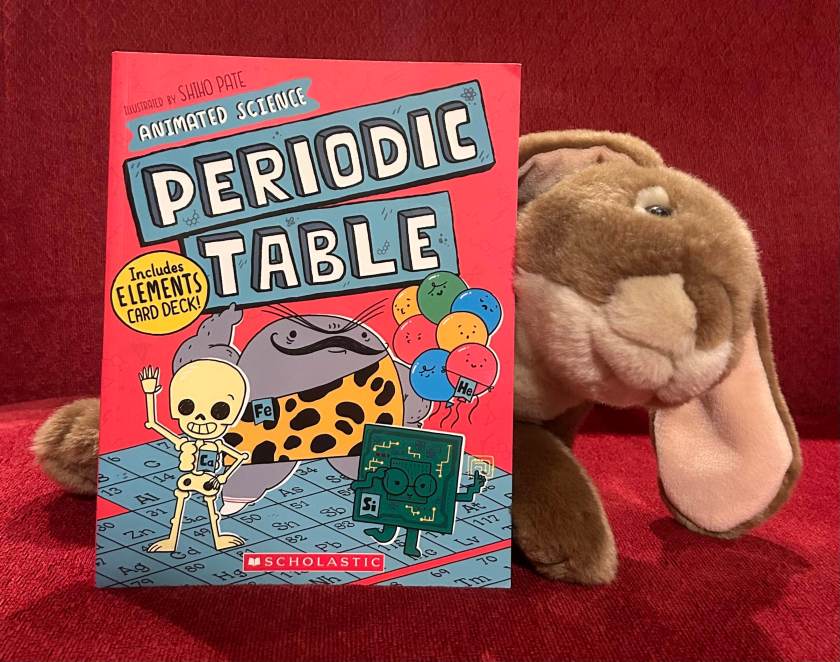
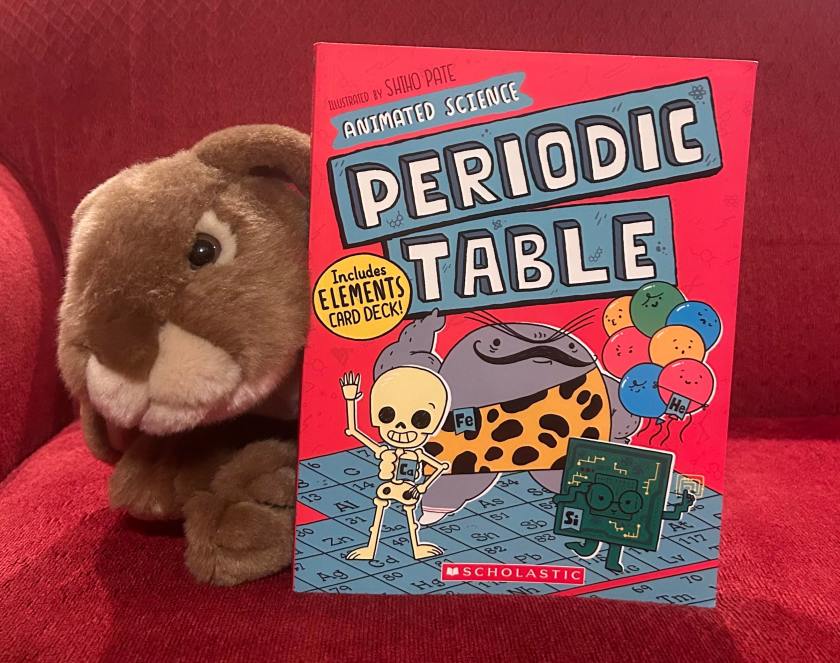
Caramel reviews Animated Science: Periodic Table, illustrated by Shiho Pate and written by John Farndon.

Sprinkles: Welcome back Caramel!

Caramel: It’s great to be back!

S: Yay! Are you ready to talk about books again?

C: Always!

S: So you chose a nonfiction book to talk about today. Can you tell us what it is about?

C: It is about the periodic table, as its title says.

S: So what is the periodic table?

C: The periodic table is a way to organize the elements and the atoms.

S: Yes, you actually talked about it before, when you were reviewing The Elements: A Visual Exploration of Every Known Atom in the Universe by Theodore Gray. Do you remember that book?

C: Yes, of course I do.

S: So how is this book similar ot or different from that book?

C: Well, it is similar because it talks about many different elements and their uses. There are special pages for some of the elements and some of the elements are together on one page, but they talk about each of the elements.

S: That is cool!

C: Yes.

S: Back then, you told me your two favorite elements were titanium and uranium. If you were to pick two new ones now, which ones would you pick?

C: That’s a tough question. But I found some new interesting facts. Can I tell you about them?

S: Sure.

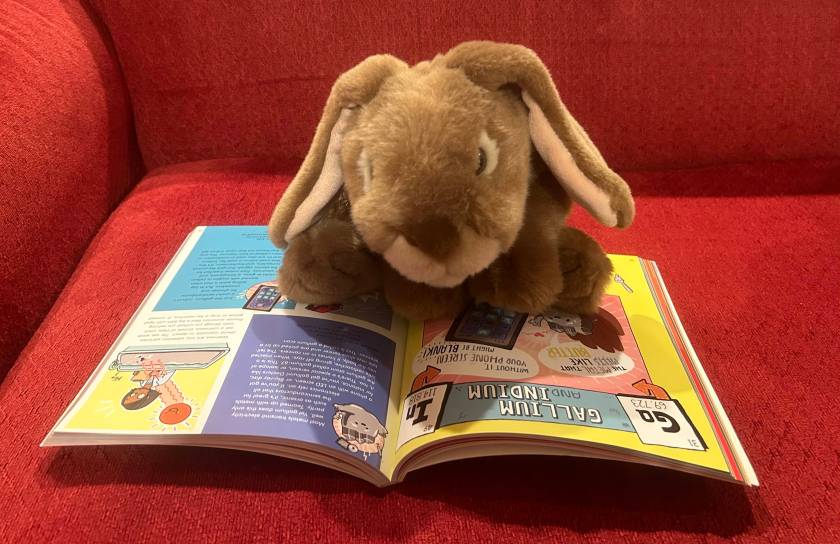
C: For example, Gallium is a metal that melts very quickly, only at 86 degrees Fahrenheit.

S: That is a reasonably warm day in California, no?

C: Yep.

S: That sounds interesting, a metal that can melt at a temperature that we can survive in. Is that what you found interesting about Gallium?

C: Yes. Also the book has very cute drawings, and I like the one for Gallium. It is a melted gray blob and it is very cute!

Caramel is reading about Gallium in Animated Science: Periodic Table, illustrated by Shiho Pate and written by John Farndon.

S: So tell me more about the drawings then.

C: They make them very cute. All the elements have faces and they are different colors and some are wearing clothes.

S: That is funny!

C: Yep. Then there is a green cube that is silicon and he is being sliced up so people can make chips with it. It could be sad or scary, but the cube is looking very serious but not in pain. So maybe he is concentrating.

S: That could be!

C: Also I learned from this book that the Latin name for lead is plumbum, and that is why its abbreviation is Pb.

S: I did not know that!

C: Neither did I.

S: So the book is full of lots of new facts then, right?

C: Yes. So “factful” is one of my three words.

S: Okay, so what are your other words then?

C: Incredibly cute pictures.

S: Hmm, that is three words on its own. But alright, I think we can let it slip by. So do you think other little bunnies would enjoy this book?

C: Yep. Especially if they like cute pictures.

S: Okay, that sounds good Caramel. Let us wrap this up then. What would you like to tell our readers?

C: Stay tuned for more book bunny reviews!

Caramel loved reading Animated Science: Periodic Table, illustrated by Shiho Pate and written by John Farndon and recommends it to all curious little bunnies looking to learn more about the world around us.