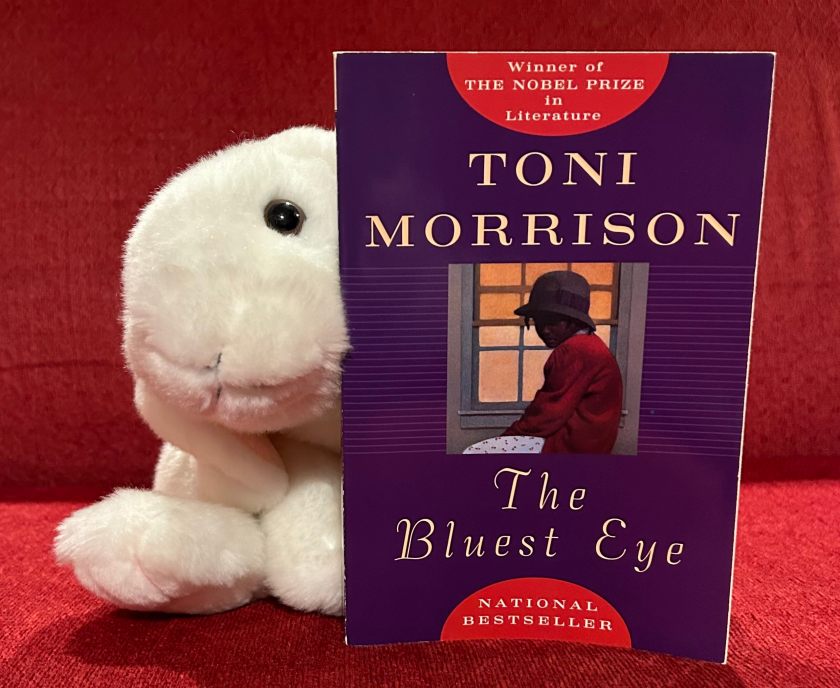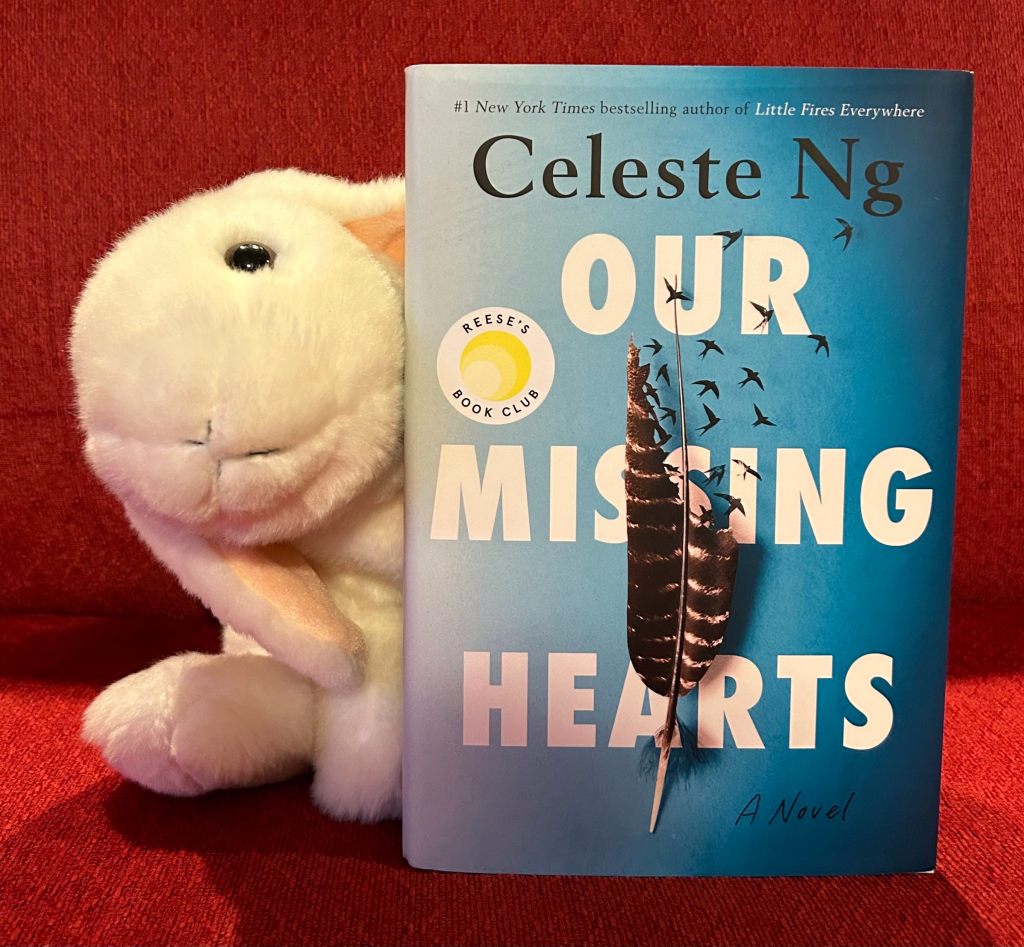
Marshmallow reviews Our Missing Hearts by Celeste Ng

Today Marshmallow reviews Our Missing Hearts, a novel by Celeste Ng, first published in 2022. Sprinkles has also read the book and is asking her questions, while also taking notes.

Marshmallow reviews Our Missing Hearts by Celeste Ng.

Sprinkles: So Marshmallow let us start at the beginning. In your reviews, you always start by telling us who this book would be good for. So go ahead.

Marshmallow: This book would be a good choice for readers who enjoy realistic fiction. Or if you are interested in possible near-futures in the United States, especially dystopian ones, this might be the book for you.

S: Okay, I think that is a good start. Can you give us a brief summary of the plot?

M: Sure. So there is this kid whose mother ran away after her poem was used in controversial protests about this law called PACT.

S: Okay, so maybe let us stop there a bit. Tell us about the setting, and of course, PACT.

M: PACT stands for Protecting American Culture and Traditions Act. This law was, in the book, passed about ten years before the story starts. And it essentially allows the government to do things that are supposedly in the interest of preserving American culture. In reality, it is used to take children away from their families, if the families are not “American” enough. In this world, the law specifically targets Asian Americans, due to a fear of China.

S: The author may have been somewhat inspired by the USA PATRIOT Act that was passed after 9/11, and it was very controversial too, because many argue that it cut into people’s civil liberties. This PACT Act was passed after a different but very impactful crisis, right?

M: Yes, and in fact, in the book that crisis was called The Crisis. That left everyone very susceptible to xenophobia, and some people blamed China for all that went wrong, and then of course that distrust of China translated into a distrust of Chinese Americans and then spread all over to a distrust of all Asian Americans. So when the government began to remove children from the homes of some Asian American families, most of the other people remained quiet, believing that there should be a reason for the removal. And most people did not even know how many children were being taken away. The numbers and the full impact of the removals were downplayed by the media, and the families who dared to speak out were demonized.

S: But still there were some protests against the law and these removals, right?

M: Yes, and those are my favorite part of the book actually.

S: So tell us about them.

M: I liked the protests because they were so creative. For example, one involved a bunch of trees which were wrapped up with red yarn and small dolls representing the stolen children. And they were mainly emotional and only subtly political, so people would be more intrigued by them rather than immediately dismiss the message.

S: And that is where the title of the book comes in, right?

M: Yes. The poem that the main character’s mom wrote is called “Our Missing Hearts,” and the protestors took that as their motto, that they wanted their missing hearts to be brought back.

S: Okay, so let us get back to the main character and the plot then.

M: Yes, the main character is a twelve-year-old boy named Bird. Actually his legal name is Noah Gardner, but his mom Margaret Miu always called him Bird, but since she left, people are calling him Noah again. And she left because her poem became too visible with the protests, and Bird’s parents were worried that the government would take Bird away. The mother left so that Bird would at least be able to continue to live with his dad.

S: So the book starts with Bird getting a message which he believes is from his mom.

M: And it is full of cat drawings. And it triggers some memories, Bird is not sure why he knows it is from his mom, but he is sure it is from her. And that part is also very neat. but I cannot say more without spoilers.

S: I guess that is fair. Let us stop with the plot then.

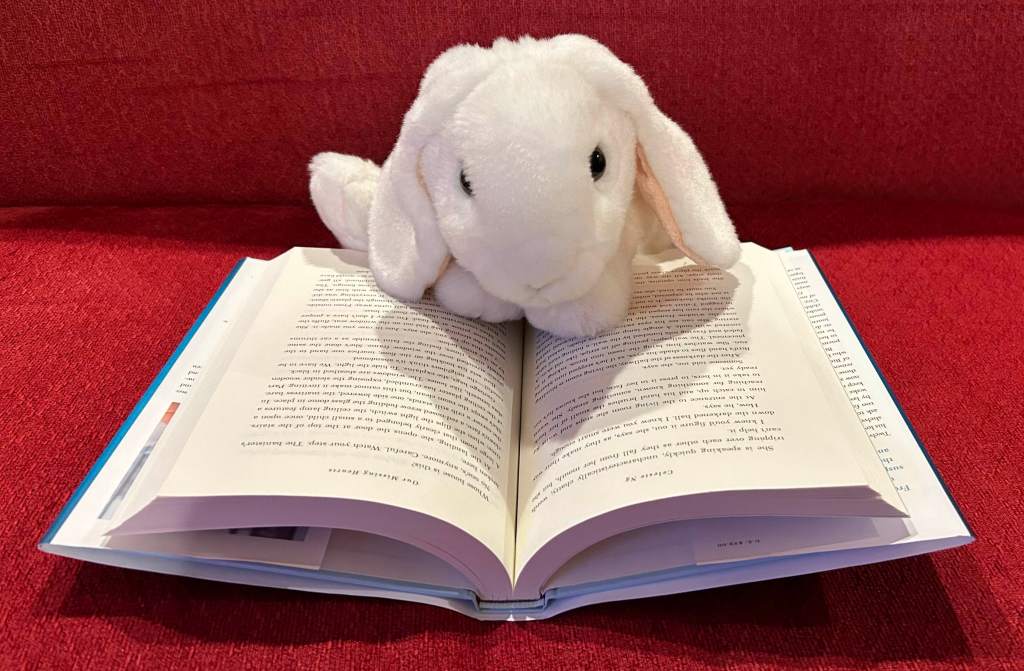
Marshmallow is reading Our Missing Hearts by Celeste Ng.

S: Tell us a bit about the characters.

M: Well, there is Bird, who is the boy who is looking for his mom. And there is Sadie, a half-black girl who was removed from her family because they spoke out against PACT. The law is mainly targeting Asian Americans, but anyone who speaks up against it is also in danger. So Bird meets her at school, where she is sort of an outcast. Sadie is braver than Bird, and she becomes his friend. And then we also meet Bird’s parents. Margaret plays a big role in a large part of the book; she tells her story and we learn about the Crisis a bit more from her. But anyways, Margaret is maybe more timid than Sadie and her parents, and she ran away instead of fighting, but then again, running away meant that maybe her child would be able to stay with his dad, and it could also be seen as a brave sacrifice.

S: Agreed. So did you feel like you connected with these characters? Did you like any of them a lot? Did any of them make you angry or feel something strongly? Did they feel like real people?

M: I think they were all pretty well developed. I thought reading Bird’s perspective felt like I was seeing the world through his eyes, it was a pretty bad place, but anyways, very realistic. And when Margaret told her story, you could also hear her voice very clearly. So I think the author was very successful in creating very compelling and very realistic characters.

S: I agree with you, again. Okay, so I am guessing you liked this book? I certainly did, and that is why I suggested you read it, too.

M: Yea. I really liked it. I’d rate it 100%.

S: That is high praise coming from you, Marshmallow.

M: Yes, I think Our Missing Hearts is a really good book.

S: Okay, so how do we finish this review? What would you like to tell our readers?

M: Stay tuned for more amazing book reviews from the book bunnies!
Marshmallow rates Our Missing Hearts by Celeste Ng 100%.

Marshmallow reviews The Murder of Emmett Till by Karlos K. Hill and David Dodson

After reviewing a handful of historically motivated graphic novels (They Called Us Enemy by George Takei, The English GI by Jonathan Sandler and Brian Bicknell, and Victory. Stand! Raising My Fist for Justice by Tommie Smith), this week Marshmallow takes on yet another historical graphic novel. Today she shares her thoughts on the book The Murder of Emmett Till by Karlos K. Hill and David Dodson, published in 2020.

The review below describes some of the events from the book, which are cruel and terrifying, and as such, might not be appropriate for very young bunnies.

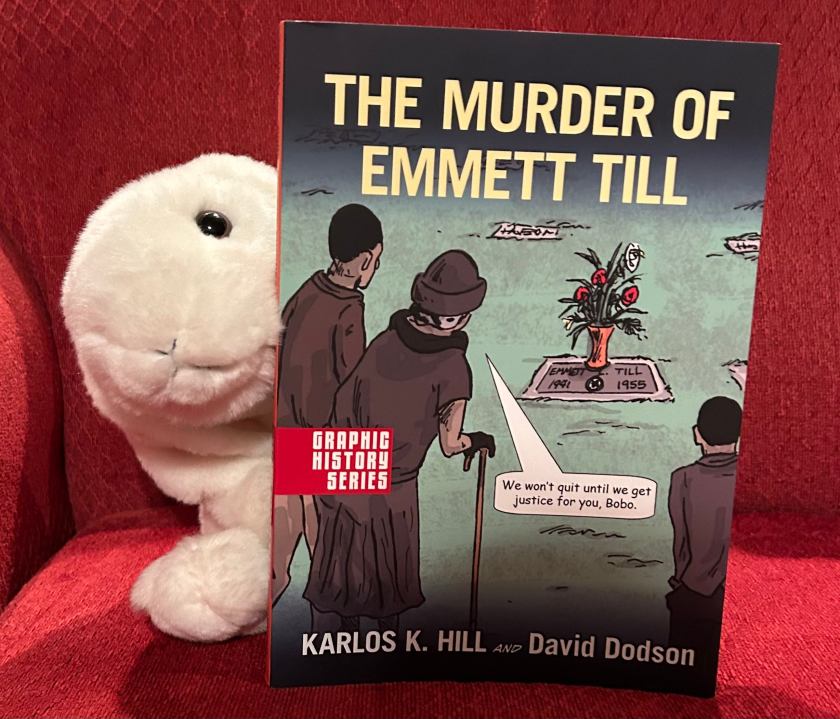
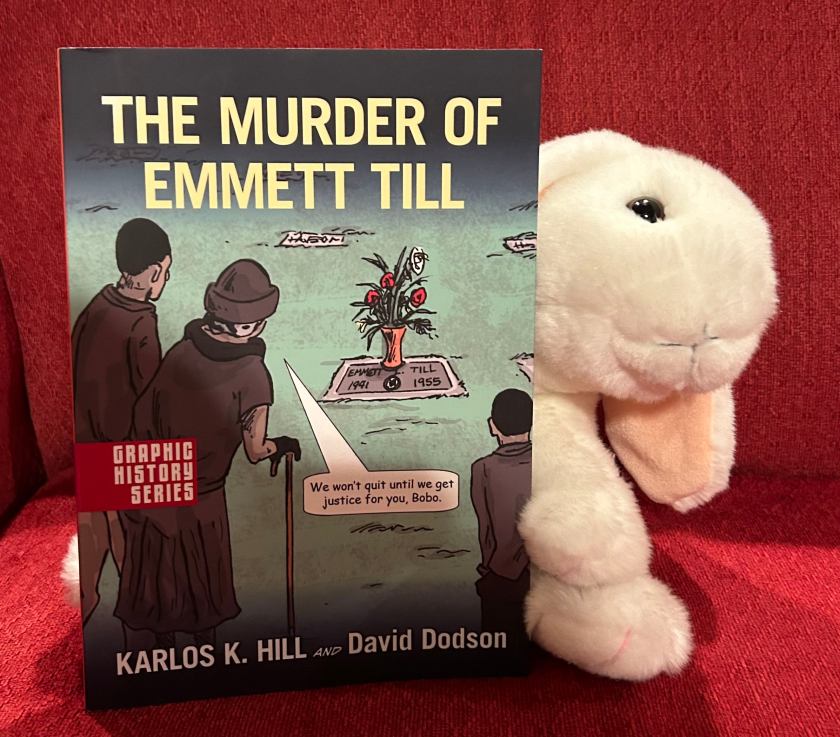
Marshmallow reviews The Murder of Emmett Till by Karlos K. Hill and David Dodson.

Marshmallow’s Quick Take: If you would like to read a book about recent United States history or racial (in)justice, and if you appreciate graphic novels, then this might be the book for you. 

Marshmallow’s Summary (with Spoilers): On August 20, 1965, fourteen-year-old Emmett Till left his home to visit his mother’s uncle in Mississippi. There, Emmett was accused of whistling at and making lewd comments to a white woman. Emmett was kidnapped, tortured, and killed by the woman’s husband and his friends.

The murder of Emmett Till is a disgusting, horrible event that shows the evil act of lynching. In this book, historian Karlos K. Hill and illustrator David Dodson use the art of graphic novels to tell the story of Emmett Till. After the main story, the authors provide facts, dates, testimony, quotes, and images to teach about this tragic event.

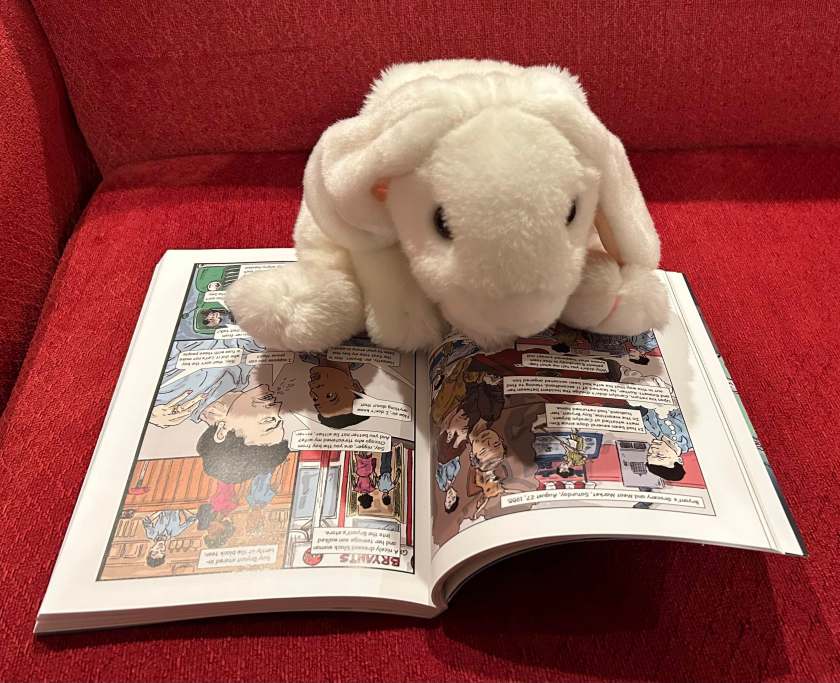
Marshmallow is reading The Murder of Emmett Till by Karlos K. Hill and David Dodson.

Marshmallow’s Review: This book is a good way to teach and learn about Emmett Till’s murder. This is such a horrifying event that words cannot describe it. Emmett Till was a young boy who should not have been murdered; he should have lived a long, full life. His life was cut short so cruelly, and he was killed after being tortured. The torture and murder of Emmett Till must be taught to future generations to ensure that the disgust and horror we feel never goes away. Only if we remember such events can we hope to never repeat them again.

I liked how this book is both for reading and for learning. The first half of the book (“The Graphic History”, about 75 pages) is written in the format of a graphic novel that shows the events leading up to and after Emmett’s death. This part is divided into four chapters, one on the incident, the second on the kidnapping, the third on the murder, and the fourth on the trial and the aftermath.

The second half (another 75 pages or so) provides a broader context for the event, in three more sections, including a section titled “The Historical Context”, with subsections on lynchings and racial violence in the South, civil rights activism in Mississippi, and other similar topics. There is a whole section (“The Documents”) which includes photos and documents from the trial and beyond. Then there is a short “Conclusion” section which has some suggestions for further reading. Overall, there is a lot of evidence and even more background, which is educational and informational. In other words, the second half is almost similar to a textbook, while the first part is a graphic novel that describes the events in a chronological narrative.

I think this book offers a great way to teach older children and students about Emmett Till’s murder. The horror I felt when reading this book and the disgust of how a human being could do something so horrible to another person was real. This is a book about a dark topic and some of the worst facets of humanity. I would mostly recommend this to older bunnies, maybe 13-14 and up. However, since this is such a huge event in history, it is a valuable book to read and a good resource for knowledge. 

Marshmallow’s Rating: 100%.

Marshmallow rates The Murder of Emmett Till by Karlos K. Hill and David Dodson 100%.

Marshmallow reviews Victory. Stand! Raising My Fist for Justice by Tommie Smith

Readers probably already know that Marshmallow enjoys reading graphic novels which are fictional, but she has occasionally also read memoirs or biographies written in graphic novel format and reviewed them for the book bunnies blog. (See, for example, her reviews of They Called Us Enemy by George Takei and The English GI by Jonathan Sandler and Brian Bicknell.) Today she writes about a 2022 book in this genre: Victory. Stand! Raising My Fist for Justice, by Tommie Smith, co-written by Derrick Barnes and illustrated by Dawud Anyabwile.

Marshmallow reviews Victory. Stand! Raising My Fist for Justice, by Tommie Smith, written together with Derrick Barnes and illustrated by Dawud Anyabwile.

Marshmallow’s Quick Take: If you like autobiographies or books about recent history, or if you want to read specifically about one of the consequential events in the history of the Civil Rights and Black Power movements in the United States, then this might be the book for you. 

Marshmallow’s Summary (with Spoilers): Tommie Smith is an American athlete, who is the first person to run 200 meters in under 20 seconds. In this book, Smith shares his experiences and retells the events leading up to and after his famous 1968 Olympics Black Power salute.

The narrative starts by showing the beginning of Smith’s Olympic finals race. Then we are shown his earlier life. As a young child, Tommie and his family were sharecroppers, meaning that they worked on land owned by someone else. Tommie did chores and picked cotton with his family. Even at a young age, Tommie could see injustice. He watched his parents and siblings work so hard everyday, toiling in the sun, while the white family who owned the land had a better, bigger house and did not have to work as much. However, things soon got even worse, and mechanized equipment and the drop in cotton prices took jobs away from sharecroppers. As a result, Tommie and his family moved to a labor camp in Stratford, California. There Tommie began to attend school regularly and “had to make sense of something that made no sense at all”. The white children in his class had several privileges, and the teachers saw them raise their hands, but they never seemed to see Tommie’s.

Everything changed, however, after a momentous race with his sister. Tommie realized that he could achieve anything, and he joined his school’s track team. This led him to becoming a star, winning almost every single competition he entered. By the time he graduated high school, he had accolades in multiple sports and several scholarship offers.

Tommie became a star athlete, and eventually, he made it to the Olympics. But he never lost his sense of justice and equality. He raised his fist at the 1968 Games to protest the racism and the many injustices in the United States at the time. Afterwards, there was a lot of push-back, and Smith faced a lot of difficulties as a result, but also a lot of people felt seen and heard. The book ends in the present, mentioning a few other athletes who have made similar protests after Smith in the intervening years.

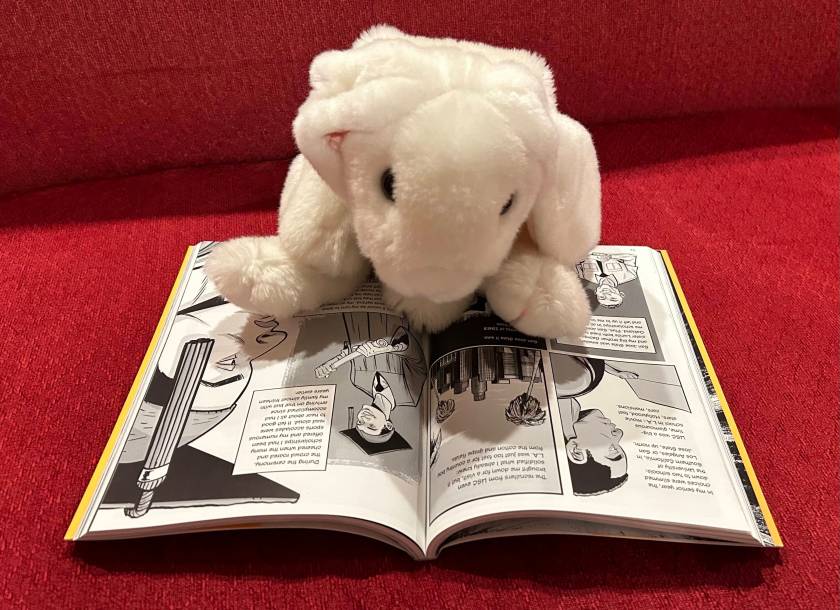
Marshmallow is reading Victory. Stand! Raising My Fist for Justice, by Tommie Smith, written together with Derrick Barnes and illustrated by Dawud Anyabwile.

Marshmallow’s Review: I really enjoyed reading Victory. Stand! Raising My Fist for Justice. It is very informative, and I learned a lot that I did not know before. I think it is very important to know and remember such acts of bravery and the people who committed them. 

The drawings are really good. I think that they show movement, especially running, very well. I have reviewed historical graphic novels before, and I appreciated them too, but the drawing style in this one was unique and enjoyable. I also enjoyed the writing style of the author. The writing paired with the drawings made this a really good book overall.

Victory. Stand! Raising My Fist for Justice mentions horrible things that some people have done and has one image that is disturbing. Additionally, it does have some derogatory words. But the message of the book is vital. I think this is a book that every young bunny should read at least once. The story of Tommie Smith’s courageous life and his raised fist is a touching story that gives us hope for the future. 

Marshmallow’s Rating: 100%.

Marshmallow rates Victory. Stand! Raising My Fist for Justice, by Tommie Smith, written together with Derrick Barnes and illustrated by Dawud Anyabwile, 100%.

Marshmallow reviews The Parker Inheritance by Varian Johnson

In her first review for 2022, Marshmallow writes about The Parker Inheritance, a 2018 novel written by Varian Johnson.

Marshmallow reviews The Parker Inheritance by Varian Johnson.

Marshmallow’s Quick Take: If you like books about mysteries, and if you would like to read about racial injustices and their impact and the resilience of people of color to honor the Black History Month, then this might be the book for you.

Marshmallow’s Summary (with Spoilers): Candice Miller has just found a letter addressed to her grandmother, Abigail Caldwell, who was disgraced after she searched for a hidden treasure by digging a tennis court. Candice’s parents have just gotten a divorce and so she has moved from Atlanta (her real home, as she calls it) and is now temporarily living with her mother in Lambert, a small town in South Carolina.

We learn that Candice’s grandmother was the first African American city manager of Lambert. During her time as manager, she received a letter from a mysterious person. The letter writes that there is an inheritance of 40 million dollars, which will go to the city (one tenth goes to the person who solved the puzzle), that can be obtained if one solves the puzzles set up by the writer of the letter.

The letter explains that, a long time ago, a family named the Washingtons was driven out of town by another family, the Allens. (The Washingtons were black and the Allens were white and this was the reason why the Washingtons were driven out.) The writer of the letter was in love with one of the Washingtons, Siobhan (pronounced Shi-vaun). The writer, it seems, was a wealthy business person and destroyed the Allen family economically. He then started to economically destroy the city of Lambert, because the officials did nothing to help the Washingtons, but Siobhan begged him not to.

It turns out that Candice’s grandmother tried to solve this puzzle using the clues in the letter, but she made a mistake. She dug up one of the city’s tennis courts by forging city paperwork to pay a crew and rent a backhoe. Unfortunately, she didn’t find anything. She ended up, basically, getting fired and becoming the laughingstock of the city. (She wasn’t fired, necessarily, but she was suspended by the mayor and soon, forced to resign from her job.)

Now Candice finds this letter in her deceased grandmother’s boxes of stuff. There is a note from her grandmother that says, “Find the path. Solve the puzzle.” Candice believes that her grandmother intended for her to solve the puzzle, and get the inheritance. Candice has lots of practice with puzzles; she loves doing puzzles and puzzle books. And with the assistance of Brandon, a boy who lives across the street, she starts to solve the mystery. As she learns more, she uncovers unpleasant truths about Lambert’s past.

Marshmallow is reading The Parker Inheritance by Varian Johnson.

Marshmallow’s Review: I think that this is a very good book. I found it really interesting as it was written from multiple perspectives. I’ve read books that have multiple perspectives, but what made this interesting for me was the fact that the characters were all in different times, like one chapter is Candice, who is living today, and the other is Siobhan, who lived many years ago. This change of perspective and time helped make some of the mystery clearer and also gave more detail; that way the reader can also understand and solve the puzzle by themselves.

I think that this book is good for all ages, but it might be easier for children ages 8 and up to solve the puzzle.

Marshmallow’s Rating: 100%.

Marshmallow rates The Parker Inheritance by Varian Johnson 100%.