Today Marshmallow reviews the very first prequel to The Hunger Games trilogy by Suzanne Collins, The Ballad of Songbirds and Snakes, originally published in 2020.
[Marshmallow also reviewed The Hunger Games, Catching Fire, Mockingjay, The Hunger Games: The Illustrated Edition, and Sunrise on the Reaping.]
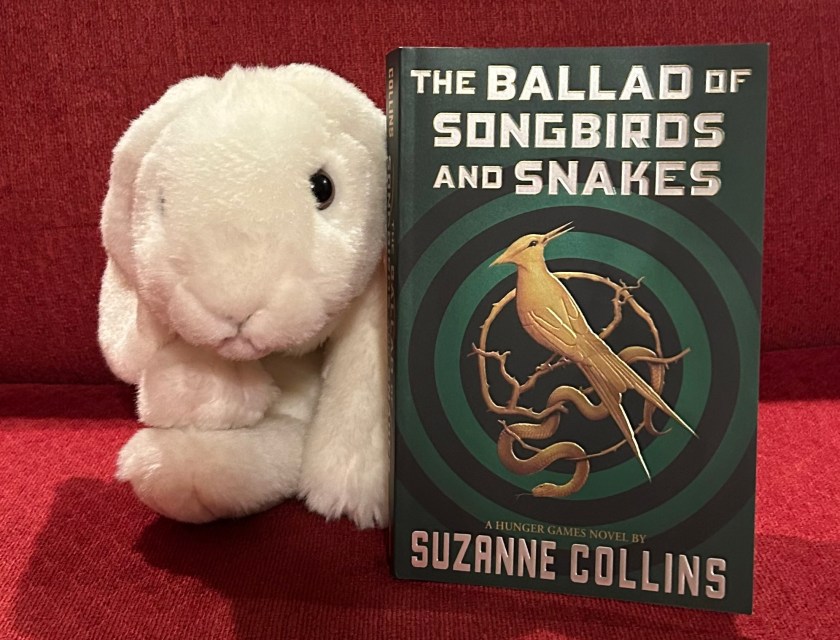
Marshmallow’s Quick Take: If you liked the previous Hunger Games books or are interested in beginning the series, then this is the book for you!
Marshmallow’s Summary (with Spoilers): Coriolanus Snow is better known as President Snow of Panem to most, but in this book he is little more than a student at the Academy. Though he comes from one of the most prestigious families in the Capitol, he struggles to make ends meet after the recent war.
During those Dark Days, the thirteen districts surrounding the Capitol rebelled against it—cutting off its resources to starve it into submission—and citizens of the Capitol experienced hardships that scarred all and killed many; Even though Coriolanus and his cousin Tigris survived the Dark Days (barely), they both witnessed horrific things that haunt them throughout the book.
At the beginning of the book, Coriolanus and Tigris are living with their Grandma’am in their once-luxurious apartment. Coriolanus’s parents died during the Dark Days, and their family’s lucrative munitions manufacturing business located in District 13 was destroyed when that district was obliterated by the Capitol as punishment. Even after the war ended (with a Capitol victory), the Snow family suffered. Without parents and their income, Tigris and Coriolanus are left to uphold the Snow reputation—even though they are no longer the rich family they were. Grandma’am trains Coriolanus and Tigris to maintain their dignity and they keep their economic struggles a secret, so the Snow family still seems powerful.
At his school, Coriolanus excels and hopes to be assigned as mentor to the tribute who will win the Hunger Games. One of the professors, a Professor Gaul, wants to make the Games into a spectacle and has a student paired with each tribute in an effort to help them survive or, at least, entertain Panem. Professor Gaul wants all of Panem to remember the war in this way, and she is hoping to make more people watch the Games (because many, of course, don’t love the idea of little kids killing each other).
At this time there have only been nine Hunger Games so far because the war was so recent. The Games have yet to become the extravagant extravaganzas seen in Sunrise on the Reaping or the trilogy with Katniss starting with The Hunger Games. The Capitol simply places the twenty-four children in an arena with a pile of weapons and watches them kill one another until only one remains.
While the Snow name is respected, Coriolanus does not have parents to bribe the school (while the other students do) and is assigned the worst possible tribute: the girl from District 12. This seems like an automatic loss because District 12 is full of weak, starving people, and the girls are presumed to be even weaker than the boys. However, when the Reaping occurs, Coriolanus realizes that this curse might have been a blessing in disguise; the girl, Lucy Gray Baird, becomes the most memorable tribute after some surprising events. While not physically threatening, Lucy Gray is charming and popular, both things Coriolanus can use to get her to victory. Her singing fascinates all of Panem and Coriolanus, who begins to fall for her. Luckily for him, the feeling is reciprocated. Unluckily for him and her, she is soon to be sent into the arena. And Professor Gaul is determined to make this year’s Games one that Panem will never forget.
Marshmallow’s Review: I think that The Hunger Games trilogy and specifically this book should be made required reading for high school students. This book continues Collins’ trend of examining human instinct, morality, violence, and more.
I think The Ballad of Songbirds and Snakes can be a stand-alone if necessary or could be a great way to start reading the Hunger Games books. I wonder what it would have been like to read this book first and go through the series chronologically. Having read the other books first, I think both ways work well. However, this book stands out in its analysis of humanity because Coriolanus’s Academy setting facilitates discussions on these topics. For example, Professor Gaul has him and his classmates write essays about what they love about war. Such analyses make this a very deep and profound piece of work, something I believe could rival the works of Orwell and Huxley.
I think Collins also did an amazing job of writing this book from the perspective of a control-obsessed, self-promoting, yet initially well-intentioned young man. I knew that Snow was going to turn evil (because I knew his role in the other books), but watching the transformation was fascinatingly disturbing. He was manipulative and a bit narcissistic from the start, but watching the worst parts of him take over—especially at the end—was very strange.
The whole book is written in third person, but I read it in a flow state in which it felt in first person … until around halfway through when I felt a sense of disconnection from the character because I realized that something about him was no longer quite right. I am not sure how to explain this.
I would strongly suggest reading The Ballad of Songbirds and Snakes. I will say that it might be too dark for younger bunnies though, so I wouldn’t read it until around twelve years old—appropriately, the age when children are entered into the Reaping. I was a bit confused on the ending, but the epilogue tied everything up with a link foreshadowing what is to come in Snow’s future.
Marshmallow’s Rating: 100%.
 BookBunnies