
As the United States is approaching another presidential election, Sprinkles thought that it could be a good idea to review children’s books about a recent president: President Barack Obama. Here Sprinkles shares her candid opinions on five books about him, with the goal of informing parents of young bunnies. Perhaps other young bunnies (and their parents too) will find one or more of these books worth the read to learn from and get inspired by.
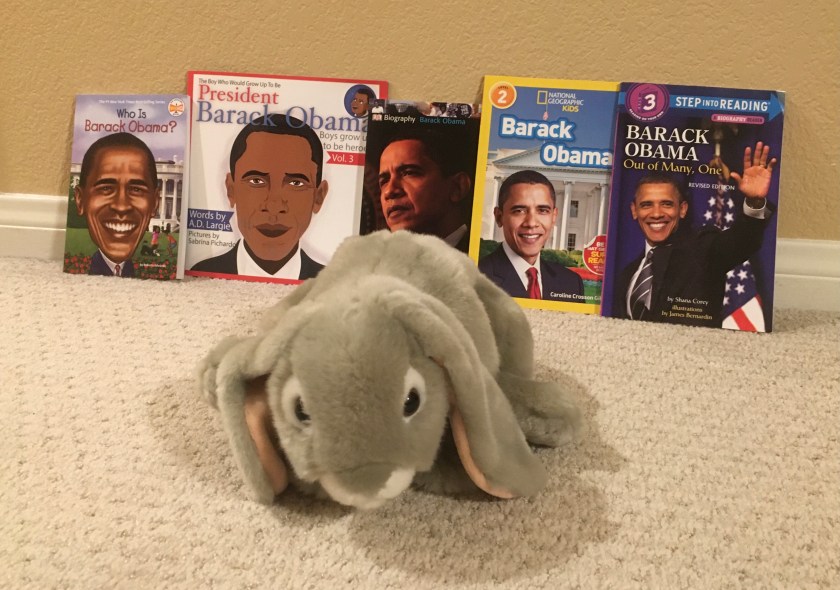
School-age bunnies often need to find people to write about for school reports. Most of the books I review in this post found their way to the book bunnies household as the younger bunnies were writing reports about their personal heroes, about well-known world leaders, and about past presidents. And occasionally young readers get their paws on books about inspiring people and just read them on their own. The five books I review in this post are all suitable for both kinds of reading goals. If your little one is curious about president Barack Obama, just keep reading to see which of these five books might be the right one for them!
In what follows I organize and present my thoughts in the order of reader level. By that I mean that the youngest bunnies will likely find it easier to read the books I mention first, and the older ones, those that are more independent readers and those that can handle more challenging sentences, might get more details and all around just more out of the books that come up later.
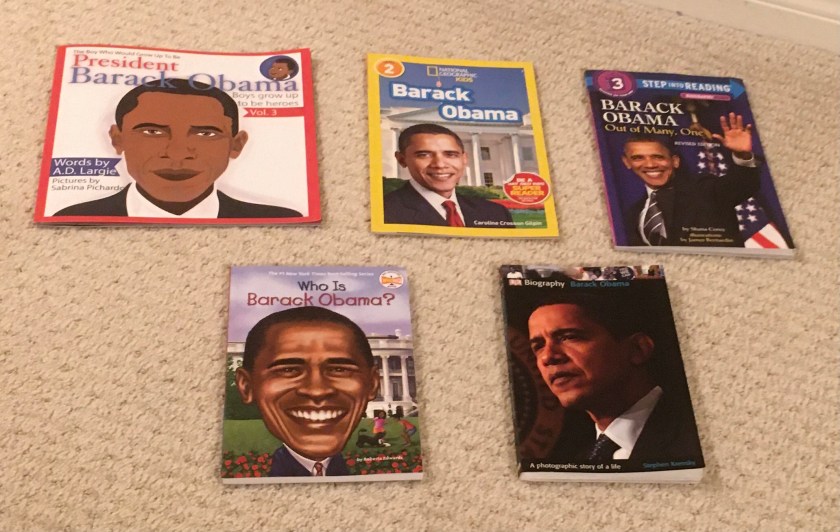
The first book I will describe for this review is President Barack Obama, written by A. D. Largie and illustrated by Sabrina Pichardo. A slim and mid-size paperback, this book is aimed at younger readers. It can be read out loud, as there is some basic rhyme built into the text on each page. I wished that some of this rhyming was made more visible by formatting of the text or by punctuation. For example the text “Barack Obama proved that you can can (sic) do anything that you believe as long as you hope for the best and focus you can achieve.” would be easier to read if it were written more visibly in two lines and / or with more punctuation:
Barack Obama proved that you can do anything that you believe,
As long as you hope for the best and focus, you can achieve.
Still, a parent used to reading books out loud for their little ones will probably figure out the rhythm soon enough.
There was also a small factual error in the book. Obama was elected to the Illinois state senate in 1996, and to the United States Senate in 2004. But again it is not a big enough deal; a parent can easily correct it while reading.
Despite these two minor issues, I would say that this can be a good book to teach young ones about President Obama. A part of a “Boys Grow Up To Be Heroes” book series, the book emphasizes that Obama was teased for his name when he was young but he persevered; he worked hard on his classes and on building community; and he wanted to bring people of many differences together. And after all that, he was the first black president! This can certainly be an inspiring read.
Next, I will describe Caroline Crosson Gilpin’s Barack Obama, published by National Geographic Kids. Rated Level 2 by the publisher, the book is meant for transitional readers who are getting comfortable reading on their own. The font size is large and the pictures are colorful. After a brief introduction starting on January 20, 2009, the day of the inauguration of President Barack Hussein Obama, most of the rest of the book is organized chronologically, and ends the story with a quote from Obama himself:
“The best way to not feel hopeless is to get up and do something. Don’t wait for good things to happen to you. If you go out and make some good things happen, you will fill the world with hope, you will fill yourself with hope.”
President Barack Obama
The book ends with a seven-question quiz, and a one-page glossary describing terms like “civil rights lawyer”, “community organizer”, and “multiracial”. All in all, this is a good book, telling the story with just enough details, and besides the facts, you also get a little dose of the inspiration that Obama’s presidency offered for many.
Barack Obama: Out of Many, One, written by Shana Corey and illustrated by James Bernardin, is also aimed toward the same level of readers, I believe. The book’s publisher Random House ranks it “Step 3: Reading on Your Own” and this is still written for the young reader, who is not yet quite ready for the chapter book. President Obama’s story is told in simple and clear language, from the beginning up to the time of writing of the book, during Obama’s second term. We start with:
We all have stories–each and every one of us. This is one of those stories. It is the story of a skinny little boy with a funny name and how he became part of America’s history.
and end along similar lines:
But the story is not complete. In fact it’s just started. Where does your story fit in the American story? You could help your neighbor or your school. You could even grow up to be president! Anything is possible–what happens next is up to you!
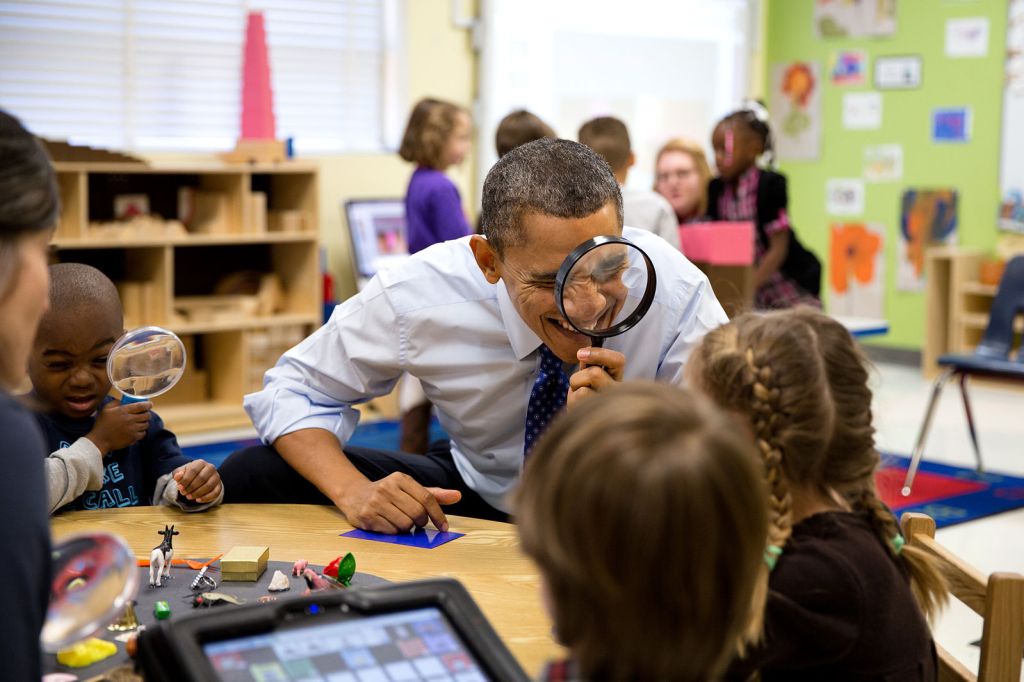
The illustrations are appealingly hand-drawn, and are peppered with actual photographic images. My favorite was the last one, right under the words I quoted above, where President Obama is looking at some school kids through a ginormous magnifying glass. And luckily due to copyright laws that say “a work of the U.S. federal government” will be on public domain, I can insert it right here:
Next I will share my thoughts on Who Is Barack Obama? by Roberta Edwards and John O’Brien. This book is clearly directed towards readers who are comfortable with chapter books, as it is one, and at over one hundred pages, it is actually quite an informative read. Its twelve chapters tell a chronological story, with a great many details, including a description of the Democratic nomination process and the competition between Barack Obama and Hilary Clinton at the time before the 2008 presidential elections. The author seems to trust that her reader can handle both details and large-picture connections; I always appreciate authors who respect their readers! The book ends with two timelines, one for Obama’s life and the other noting some world events relevant to the narrative of the book.
I believe that this would make an excellent choice for the young reader who is curious to learn about President Obama. Illustrated in simple black and white sketches by John O’Brien, the book tells the story of one of the most inspiring political figures of our times, and situates his story within the wider American context.
The last book I will describe in this review is Stephen Krensky’s Barack Obama. This book also targets a similar audience but perhaps expects a little bit more from the reader. The font size is much smaller, the sentences are a little bit more complex, and the book overall has more the flavor of a historical biography than that of a children’s book. This is not particularly a disadvantage, however, and should definitely not deter any young reader wishing to learn more about the first black president of the United States. The details and the historical conextualization that were strengths for the previous book are also a strength for this one, and the photographic images add a lot to the book’s appeal.
The longest of the books reviewed in this blog post, at 125 pages, Krensky’s Barack Obama is a good text for those young bunnies writing reports or essays about the president, and it can be a good resource for learning more about his life and accomplishments. (Among other things, it contains a neat timeline and several references for further reading and study.) However, it does end on the inauguration day of 2009, and we do not learn much about his accomplishments as the forty-fourth president of the United States. Still, I would recommend it for those bunnies looking to learn more.
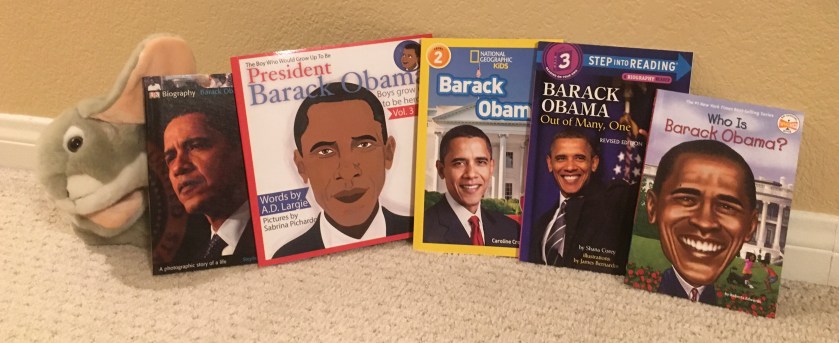
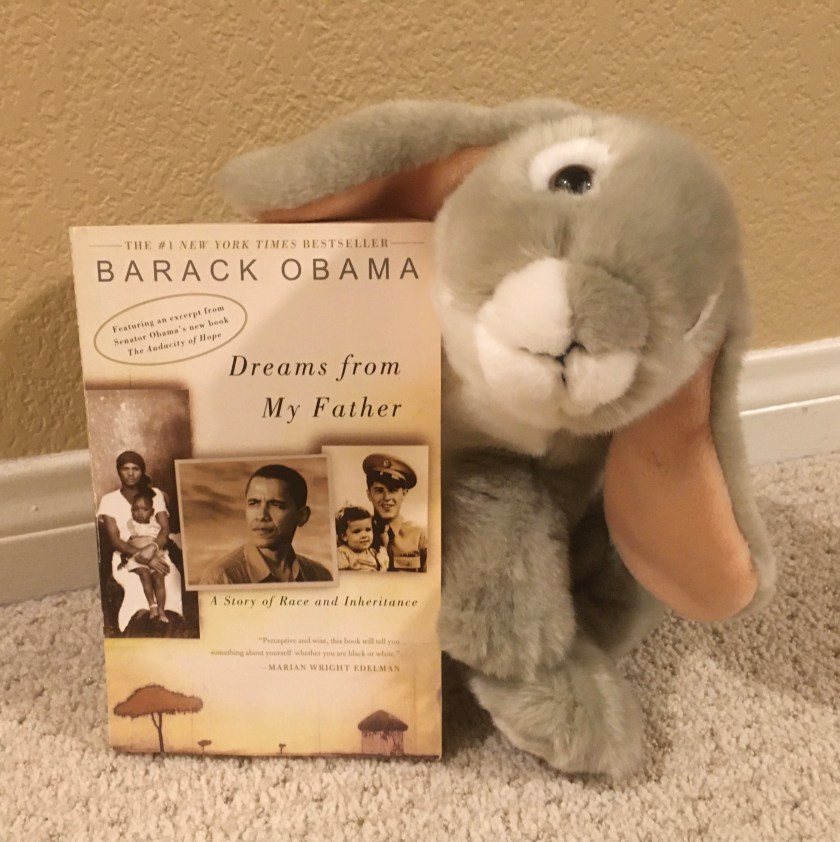
But perhaps those same young bunnies are up to learn even more about this man? Then I’d urge them and their parents to consider diving into one of Obama’s own books. Many parents will likely think Obama’s 2006 book The Audacity of Hope might be too political (or politically motivated) for their young ones, but his first book, Dreams From My Father: A Story of Race and Inheritance, written in 1995, tells this man’s tale up to that time in lyrical but not overly dramatic language. This is a beautiful coming-of-age story, and it is perhaps uniquely American. Obama tries in it to open up, understand (for himself–and to our benefit), and come to terms with his own multicultural multiracial heritage. It can be a challenging read for preteens, but for tweens and teenagers, it is bound to be inspiring. And I’d say, it can be especially so, knowing that this young man narrating his own story would become the forty-fourth president of the United States in a little less than fifteen years from the end of the book.
 BookBunnies
