Caramel reviews The Science of Snot and Phlegm: The Slimy Truth about Breathing by Fiona MacDonald

Recently Caramel got his paws on a set of four books about the human body, each focusing on one major system. Today he reviews the first one he read in the series: The Science of Snot and Phlegm: The Slimy Truth about Breathing written by Fiona MacDonald. As usual, Sprinkles is taking notes and asking questions.

Caramel reviews The Science of Snot and Phlegm: The Slimy Truth about Breathing by Fiona MacDonald.

Sprinkles: Tell me about this book Caramel.

Caramel: This book is about snot and phlegm. As you could tell from the title.

S: Hmm, sounds fascinating. Do you know the difference between them? It seems everywhere in the book they are used together, like “snot and phlegm”.

C: Snot and phlegm are both mucus, and the difference is that phlegm is in the chest and throat and snot is in the nose.

S: Do they ever define them?

C: They only define them in the glossary I think. So phlegm is “thick mucus from the chest often containing dead white blood cells, bacteria and sailva.” And snot is “mucus from the nose.”

S: What else is in the glossary?

C: Adenoids, allergens, allergies, alveoli, arteries, asthma, bacteria, and …

S: Okay, that is enough I think.

C: No wait! I wasn’t finished!

S: But we got the point, don’t you think?

C: Too bad.

S: But we should talk more about the book itself. We can go over the glossary again together later.

C: Okay.

S: So tell me more about this book.

C: Okay. Here are the chapter names. Introduction. The Breath of Life. Protect and Survive. Why Do Noses Run? Sinuses, Tonsils, and Adenoids. The Cold Virus. What is Hay Fever? Too Much! Why Do We Cough? What Are Bronchitis and Pneumonia? Breathless. No Airway! Breathe Easy. And then there is the glossary and the index.

S: Those sound interesting! So why do we cough?

C: Let’s consult the book. Page 20. Coughing is our diaphragm pushing out air from our lungs fast. It is supposed to clear the airways.

S: What does that mean?

C: The windpipe. The breathing tube connecting your lungs to your nose and mouth.

Caramel is reading about runny noses in The Science of Snot and Phlegm: The Slimy Truth about Breathing by Fiona MacDonald.

C: So this book is not only about snot and phlegm.

S: What else is there?

C: Heartburns. A heartburn is when your stomach acid goes up your throat and hurts it.

S: How is that related to your respiratory system?

C: I have no idea. Hmm, okay, apparently “a cough can also be caused by digestive difficulties.” And that is where the book talks about heartburn.

S: I see. So basically the book has some information about the respiratory system, and then some other interesting things that are closely related.

C: Yes.

S: You have read and reviewed another series of books about the human body, do you remember?

C: Yes! The Survive series. We talked about  Survive: The Digestive System and Survive: The Circulatory System and then Survive! Inside the Human Body: The Nervous System, all by Hyun-Dong Han. The second book talked about the heart, and arteries, and blood and a bit about breathing.

S: But it was not really about respiration, right?

C: Yes. That is true. That book was mainly about the circulatory system.

S: So did you learn anything new from this book?

C: Yeah. A lot. I learned about allergens for example. And the cold virus. There are many viruses that make people sick. Over three hundred that make you catch a cold.

S: Yes, that is exceptionally relevant today when we are dealing with a pandemic caused by what we think is a respiratory virus.

C: Yes. COVID-19.

S: Okay Caramel. Let us wrap up this review. What three words would you use to describe this book?

C: Helpful, interesting, colorful.

S: Okay, I think these are good descriptors. And what will you tell our readers?

C: Stay tuned for more book bunny reviews!
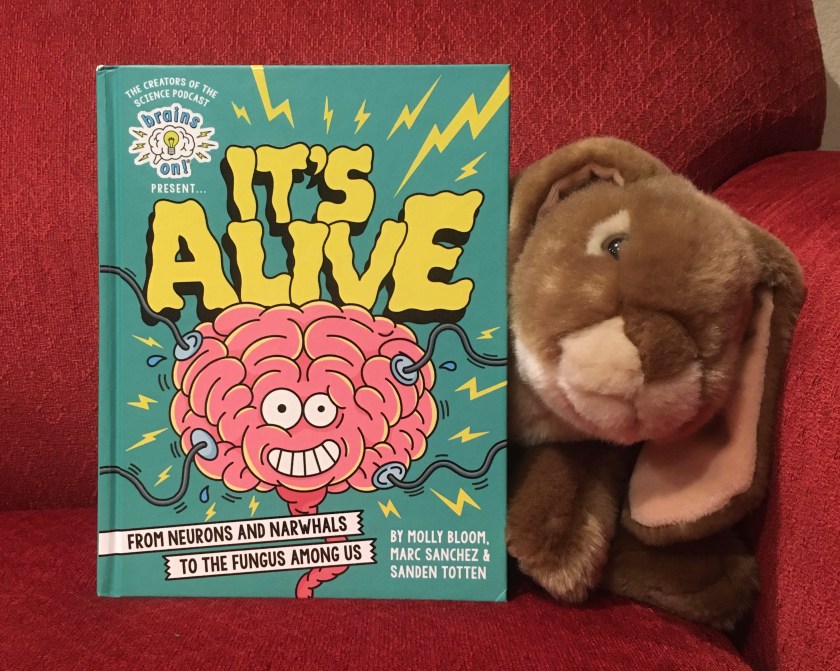
Caramel enjoyed reading The Science of Snot and Phlegm: The Slimy Truth about Breathing by Fiona MacDonald, and is looking forward to reading and reviewing the remaining books in the same series.

Caramel reviews Out of Darkness: The Story of Louis Braille by Russell Freedman

Today Caramel wanted to talk about Out of Darkness: The Story of Louis Braille, written by Russell Freedman and illustrated by Kate Kiesler. As usual Sprinkles is taking notes and asking questions.

Caramel reviews Out of Darkness: The Story of Louis Braille, written by Russell Freedman and illustrated by Kate Kiesler.

Sprinkles: Caramel, tell me a bit about this book.

Caramel: This book is about the life of Louis Braille. Braille is the person who invented the Braille alphabet. The Braille alphabet is used by people who cannot see to read and write.

S: Did you know about him before reading the book?

C: No. I had heard of the Braille alphabet, and I thought it was probably invented by someone named Braille, but I did not know anything else about Braille.

S: So you learned about his life from this book. Tell us about him a bit.

C: Louis Braille was not born blind. He could see at some point but when he was four, one of his eyes got poked out and his other eye got infected and he lost both.

S: Yes, I read that part too. It is a sad accident that leads to the loss of one eye and the infection on the other eye. It is really sad.

C: Yes very sad. And also because the infection could probably be cured today.

S: Yes. It is possible. But he was living in the first half of the nineteenth century, and they did not have antibiotics or anything else to fight infections with.

C: Yes. They did use leeches for some medical purposes, which is weird.

S: Yes, I think so too. But apparently they still use leeches for some medical purposes!

C: I did not know that! That is so strange. I learn something new every day!

Caramel is reading Out of Darkness: The Story of Louis Braille, written by Russell Freedman and illustrated by Kate Kiesler He is on the page where the Braille alphabet is being described. .

S: Tell me more about the book.

C: If you like biographies, you would probably like this book. It is about a young person doing some really big and important things. Like inventing an entirely new alphabet! And he was also blind!

S: Yes, but maybe being blind, he knew what would help him better than seeing people who assumed that everybody should use the same alphabet. In the book we learn that Louis as a student learns about a writing system devised by an army captain and then modifies it in novel ways that would make it practical and easy to learn and use.

C: Yes. The government and the school do not want to use his system at first.

S: Yes, first his school has a headmaster who likes his ideas but once he is replaced, the new director bans its use.

C: The students already had been using it, but the new headmaster bans it. So they still use it, but in secret.

S: Yes, it is a very interesting story, isn’t it?

C: Yes, it definitely is. But it is also very sad.

S: Why do you say that?

C: Because he works so hard to develop this alphabet, he works when everybody is sleeping. But then people do not want to use it.

S: But in the end things work out, don’t they?

C: Yes. But he also dies.

S: Yes, people do die, but you are right that his death is sad too.

C: He dies from tuberculosis, and we can cure it today, right?

S: Yes, that is true and it is indeed sad. But at least he knew his alphabet was being used and was much appreciated by then. So what three words would you use to describe this book?

C: Fascinating, biography, black-and-white illustrations.

S: Hmm, that is a few more words than three, but I’ll let it be. What do you want to tell our readers as we wrap up this review?

C: Stay tuned for more book bunny reviews!
Caramel has appreciated reading Out of Darkness: The Story of Louis Braille, written by Russell Freedman and illustrated by Kate Kiesler, and recommends it to other little bunnies who might like to learn about a young person who overcame big obstacles and achieved great things.

Marshmallow reviews Akira Yoshizawa: Japan’s Greatest Origami Master

This week Marshmallow shares her thoughts on Akira Yoshizawa: Japan’s Greatest Origami Master, a beautiful book with “Texts, Original Diagrams, and Models” by Akira Yoshizawa, a preface by Kiyo Yoshizawa, and an introduction by Robert J. Lang. Accompanying her in this review is her little friend for the day: Turtle.

Marshmallow reviews Akira Yoshizawa: Japan’s Greatest Origami Master, with text, diagrams, and models by Akira Yoshizawa. Accompanying her is her little friend, Turtle.

Marshmallow’s Quick Take: If you like books that teach you how to do stuff, or if you ever wanted to see really cool origami models of all sorts of animals and things, then this might be the book for you. 

Marshmallow’s Summary (with Spoilers): This book does not tell a story. It teaches the reader how to make the origami pieces in the book, though the origami in this book is not easy. This is not a book for people who don’t know what origami is. 

Here is Wikipedia’s definition of origami:

“Origami (折り紙, Japanese pronunciation: [oɾiɡami] or [oɾiꜜɡami], from ori meaning “folding”, and kami meaning “paper” (kami changes to gami due to rendaku)) is the art of paper folding, which is often associated with Japanese culture. In modern usage, the word “origami” is used as an inclusive term for all folding practices, regardless of their culture of origin.”

In this book, there is a detailed introduction written by an American origami expert, Robert Lang, where readers can learn about Akira Yoshizawa and his origami work. In the next few pages of the book, there are many pictures of Mr. Yoshizawa and his incredible origami works. Then most of the rest of the book is made up of Yoshizawa’s models of different types of animals and things. For example, there are models for making origami rabbits, sea turtles, small birds, wild geese, angel fish, butterflies, flying carpets, children from Snowland, lighthouses, seesaws, planes, and all sort of other neat things. There are step-by-step instructions and folding directions for each of these.

Marshmallow is pointing to the inside cover pages of Akira Yoshizawa: Japan’s Greatest Origami Master, with text, diagrams, and models by Akira Yoshizawa.

Marshmallow’s Review:  Reading Akiro Yoshizawa’s book, you can learn how to make some pretty complex pieces of origami. If you can’t or don’t want to try to make the origami, then you can just look at the pictures, which are in color and are very impressive. Mr. Yoshizawa’s origami animals and other origami are all very realistic.

Marshmallow and Turtle are looking at the table of contents of Akira Yoshizawa: Japan’s Greatest Origami Master, with text, diagrams, and models by Akira Yoshizawa.

If you want to make the origami in the book you need to have origami paper, but there is a way that you can make square origami paper with normal paper. Still, real origami paper might make your origami look prettier.

Some of the pieces of origami in this book require cutting or glue or multiple pieces of paper to finish. And almost all the models are pretty hard to do. I was able to make only a few of them, mostly the simpler ones, but still I enjoyed looking through the more complex ones, too.  

Marshmallow and Turtle are looking at the directions to make a sea turtle in Akira Yoshizawa: Japan’s Greatest Origami Master, with text, diagrams, and models by Akira Yoshizawa.

I think that this is a very good book for the whole bunny family; it can be read by many types of people. Younger bunnies will enjoy looking at the pictures, and older bunnies might want to try to make some of the origami pieces.

This book might also inspire the reader to go and try to learn more about origami, either about its history, or more about how to make more. (I know Caramel enjoys making samurai hats for example!) I really enjoyed trying to make the origami in this book, even when I couldn’t make it exactly the same as it was in the book.

Marshmallow’s Rating: 100%.

Marshmallow rates Akira Yoshizawa: Japan’s Greatest Origami Master, with text, diagrams, and models by Akira Yoshizawa, 100%.

Caramel reviews Sea Monsters (Magic Tree House Fact Tracker #17) by Mary Pope Osborne and Natalie Pope Boyce

Caramel has reviewed several Magic Tree House books already: Night of the Ninjas (Magic Tree House #5), Afternoon on the Amazon (Magic Tree House #6), Knights and Castles (Magic Tree House Fact Tracker #2), Sunset of the Sabertooth (Magic Tree House #7), Midnight on the Moon (Magic Tree House #8), and  Dolphins at Daybreak (Magic Tree House #9). This week he wanted to talk about another fact tracker book: Sea Monsters. As usual, Sprinkles is taking notes and asking questions.

Caramel reviews Sea Monsters (Magic Tree House Fact Tracker #17) by Mary Pope Osborne and Natalie Pope Boyce.

Sprinkles: So Caramel, you found another book about real things, I see.

Caramel: Yes. This is a book about ocean “monsters”.

S: So who are these monsters? Can you tell me a few of them?

C: There is the angler fish, the giant squid, the goblin shark, the cookie cutter shark, the hairy angler fish, the vampire squid, the dragon fish, oar fish, …

S: Okay, I get the point.

C: … giant tube worms. There is also this dunkleosteus–

S: Hmm, I have never heard of most of these. But this last one does not sound familiar at all. What is a dunkleosteus?

C: It is a giant armored fish, I think it is about forty feet long. Its teeth are actually bone.

S: And it is extinct, right?

C: Yes. And there are other extinct species too. There is the liopleurodon, and the megalodon–

S: So I understand. The book talks about large sea creatures, then. Right?

C: Yes. And my favorite is the liopleurodon.

S: Why?

C: Because it is not armored but it has a giant head. I think it looks really interesting!

S: I’m not sure I’d like to face one under water any time soon!

C: You don’t have to worry about that. They are already extinct!

S: That’s good.

C: Not for them.

S: That is right Caramel. This does seem like an interesting book, with many different types of facts in it. So tell me how it is organized.

C: Chapter titles! Here you go: The first chapter is called Sea Monsters. Then the second is Exploring the Oceans. The third is Squids, Octopuses and Other Creatures. Then there is a chapter called Creatures of the Deep.

S: That’s where we learn about the angler fish!

C: Yes. then there is Prehistoric Seas. And there we learn about the liopleurodon, the megalodon and similar creatures. And then the last chapter is called Sea Monster Tales.

S: Which chapter was most interesting for you?

C: I think I liked the Prehistoric Seas chapter most.

S: I know you like prehistoric animals. You have reviewed a Magic Tree House book about the saber tooth before. And another book on dinosaurs. No wonder you chose the liopleurodon as your favorite sea monster.

Caramel is reading about the liopleurodon in Sea Monsters (Magic Tree House Fact Tracker #17) by Mary Pope Osborne and Natalie Pope Boyce.

S: So what else do you want to tell us about this book?

C: It has a lot of pictures and tons of facts! Jack and Annie from the Magic Tree House books tell us all sorts of things. There is also some facts about Steve Irwin and about Jacques Cousteau.

S: We watched a lot of episodes of Steve Irwin’s show together, right? It is sad he died of a sting ray sting. And Cousteau was a famous explorer who was one of the first to go deep into the oceans and to explore. That is great that you read a bit about both. So tell me the most interesting fact you learned from this book.

C: It’s about the largest jellyfish. So let me find it… Okay, here I will read it to you: “The longest animal in the world is not a whale. It is a special jellyfish called a siphonophore. Its tentacles can reach 131 feet long!”

S: Wow, that is long! Wikipedia tells us that “a siphonophore may appear to be an individual organism, each specimen is in fact a colonial organism composed of medusoid and polypoid zooids that are morphologically and functionally specialized.” That is really interesting! I had never heard of them before.

C: Me neither!

S: Okay Caramel, it is probably a good time to wrap up this review. Would you like to tell our readers your three words on this book?

C: Factful, curious because these are really curious animals, and black-and-white because all the illustrations are black and white.

S: Maybe instead of factful we can say “informative”?

C: Yes, that works too!

S: Great! I think then it is finally time for you to say your closing words!

C: Stay tuned for more book bunny reviews!
Caramel recommends Sea Monsters (Magic Tree House Fact Tracker #17) by Mary Pope Osborne and Natalie Pope Boyce, to all curious little bunnies who want to know more about ocean life.