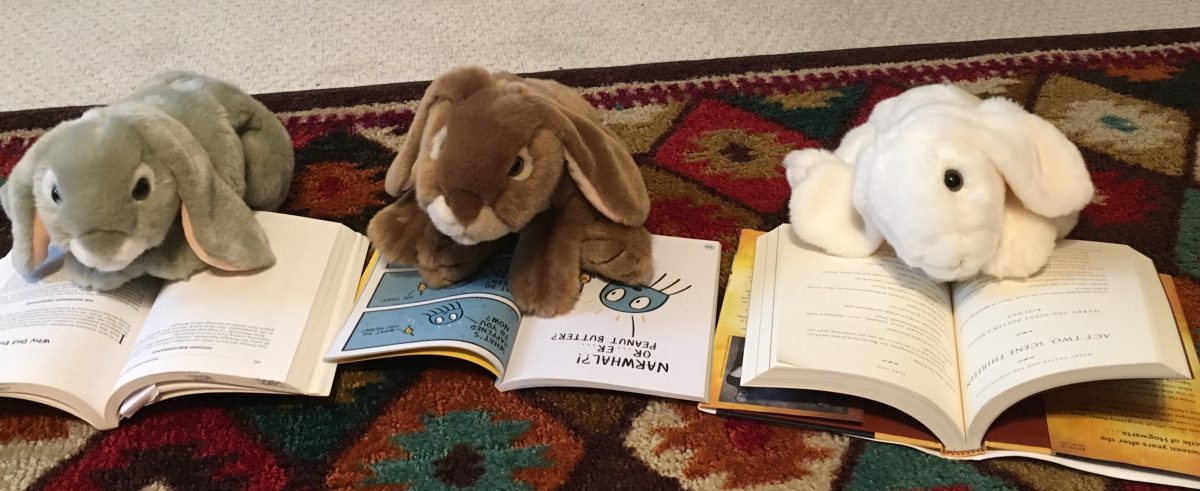
Caramel reviews A Writer’s Notebook by Ralph Fletcher

Over the summer Caramel got into keeping a notebook where he doodles sketches and writes stories. Today he reviews the book that inspired it all: A Writer’s Notebook by Ralph Fletcher. As usual, Sprinkles is taking notes and asking questions.

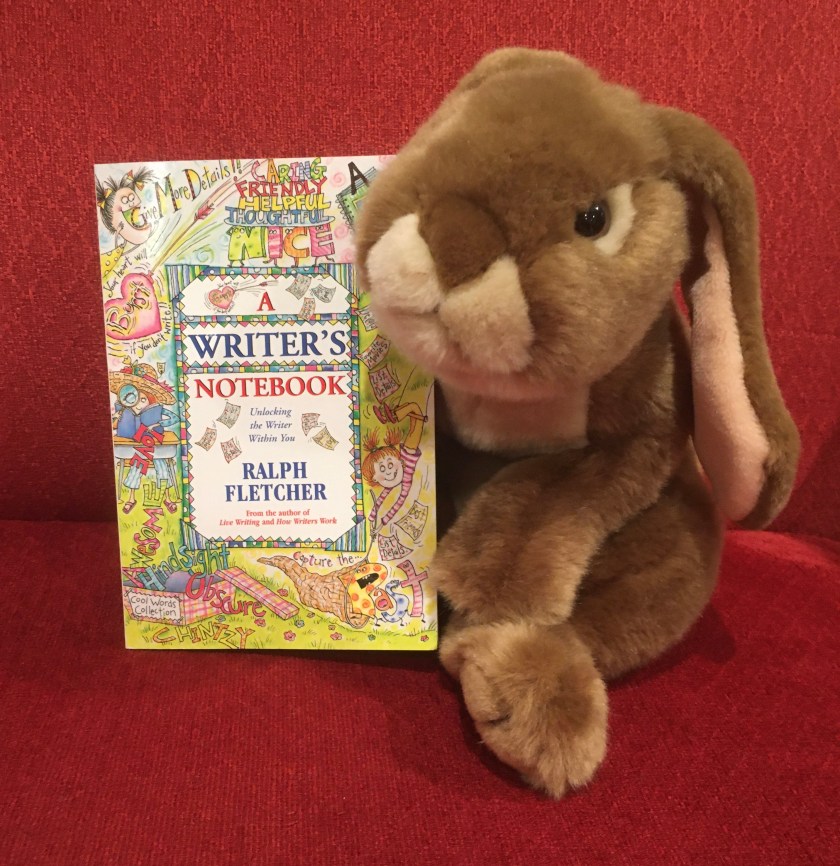
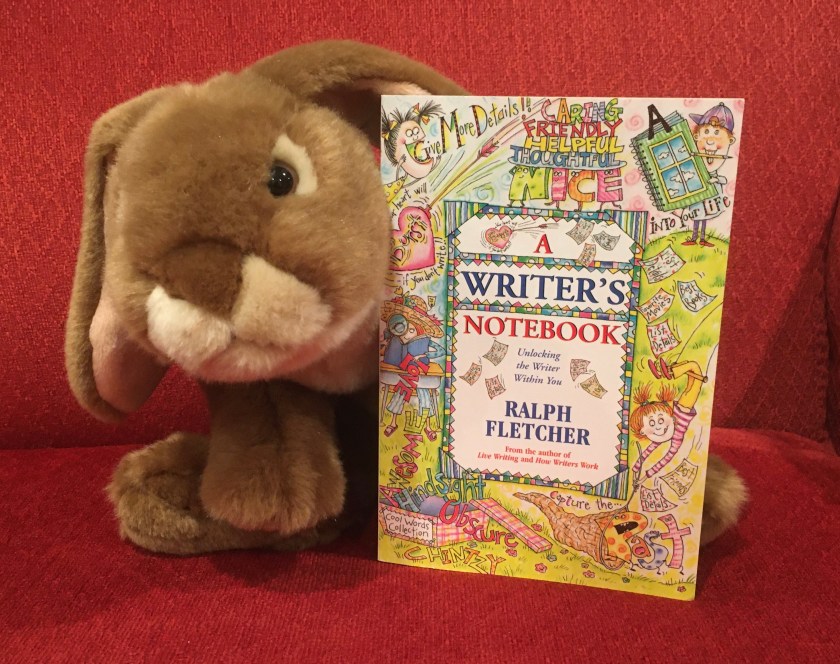
Caramel reviews A Writer's Notebook by Ralph Fletcher.
Caramel reviews A Writer’s Notebook by Ralph Fletcher.

Sprinkles: So Caramel, tell us a bit about this book.

Caramel: This book is about keeping a writer’s notebook.

S: What is a writer’s notebook?

C: A notebook where writers put writing about their everyday lives. Things they see, think of, and read about. They use it to capture interesting points in the past, so that they can remember them.

S: So it is like a journal, in some ways. They write notes on what is going on and what they think about those things. So how is a writer’s notebook different from a journal? What makes a writer’s notebook a writer’s notebook?

C: Hmm, I am not sure.

S: Maybe it has something to do with the person being a writer?

C: Yes, because if you are a writer, you come back to what you wrote and think about it and maybe you can use it in your stories or poems and so on.

S: So a writer’s notebook is basically a journal, but the person keeping it uses it for their writing purposes.

C: Yes.

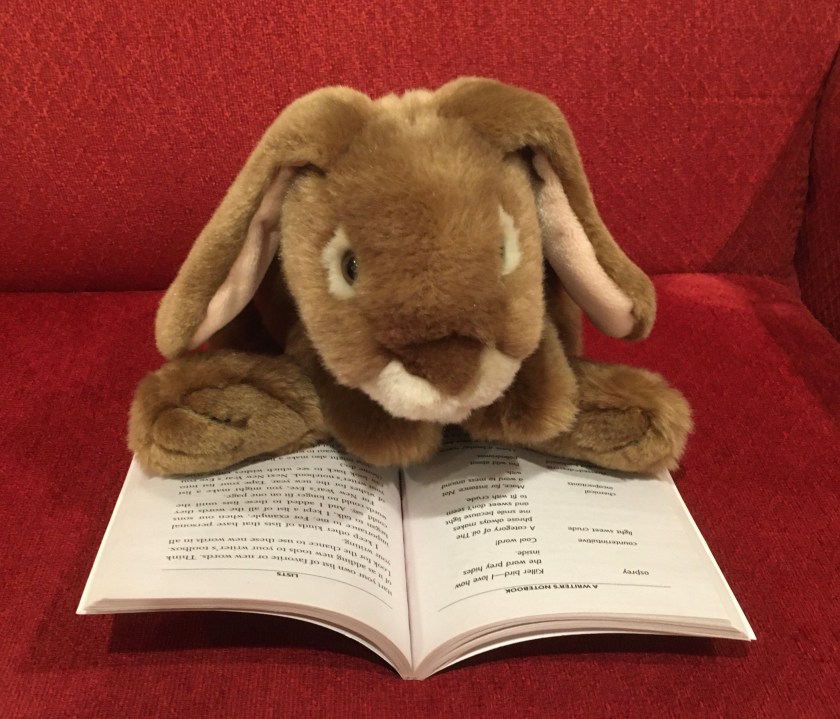
Caramel is reading A Writer's Notebook by Ralph Fletcher.
Caramel is reading A Writer’s Notebook by Ralph Fletcher.

S: So what is in the book exactly?

C: There are chapters about how different people use their writer’s notebooks. For example, there is a chapter about writing down memories of events that were important to you. Then there is a chapter where you learn that you can also write about really small things, things that might be interesting but not really important. But then somehow those might be useful later if you are writing a story or something.

S: I see.

C: There is a chapter called Fierce Wonderings, which is about how you can also write in your notebook about things that you want to know more about. There is a chapter about listening in on other people’s conversations and taking notes if they sound interesting.

S: I guess that teaches you about interesting dialogue.

C: I guess so. You can also have seed ideas.

S: What are those?

C: A seed idea is an idea that you can build on, so for example the author writes about someone who kept collecting facts about spiders.

S: That reminds me of your notebook, where you keep drawing different robot models.

C: Yes.

S: I think yours is not only a writer’s notebook, but rather, an artist’s notebook. Because you are drawing more than writing.

C: I guess so. But I think the idea is the same.

S: Yes, I can see that. You also keep drawing similar things and try to improve on the details. I think sometimes writers do that in their notebooks too.

C: Writers also put other people’s sentences and ideas in their notebooks too, if they like it.

S: And that is kind of similar to when you were trying to draw Eve in your notebook, inspired by the female robot in the movie Wall-E. You like how she is drawn and want to see if you can draw something similar.

C: Yes.

S: So do you also write stories or even shorter things in your notebook?

C: Yes. I have a few sentences here and there.

S: Do you like keeping a notebook?

C: Yes. Because then I can draw things whenever I want.

S: I can see how that is appealing. So let us get back to this book. What three words would you use to describe this book?

C: Many voices because the author shares writings of many other people, many of them are kids like me. Good ideas to get started with your own notebook… And … quick. It is a short book so I read it quickly.

S: That was definitely more than three words, but you did provide us with three distinct features of the book. Thank you. So let us wrap things up. What do you want to tell our readers?

C: Stay tuned for more book bunny reviews!

Caramel enjoyed reading A Writer's Notebook by Ralph Fletcher, and will probably continue to doodle and write in his notebook in the coming months and years. .
Caramel enjoyed reading A Writer’s Notebook by Ralph Fletcher, and will probably continue to doodle and write in his notebook in the coming months and years.

Caramel reviews Dinosaurs (Magic Tree House Fact Tracker #1) by Will Osborne and Mary Pope Osborne

A while back, Caramel inherited Marshmallow’s collection of Magic Tree House books and he has been going through them. (For his reviews of books in the series, see Night of the Ninjas (Magic Tree House #5), Afternoon on the Amazon (Magic Tree House #6), Sunset of the Sabertooth (Magic Tree House #7), Midnight on the Moon (Magic Tree House #8), Dolphins at Daybreak (Magic Tree House #9), Ghost Town at Sundown (Magic Tree House #10), and Lions at Lunchtime (Magic Tree House #11).) He has also been revisiting the accompanying Fact Tracker books. (For his reviews of some of the Fact Tracker books, see Knights and Castles (Magic Tree House Fact Tracker #2) and Sea Monsters (Magic Tree House Fact Tracker #17).) Today he decided to discuss the first ever Fact Tracker book in the series: Dinosaurs. As usual, Sprinkles is asking questions and taking notes.

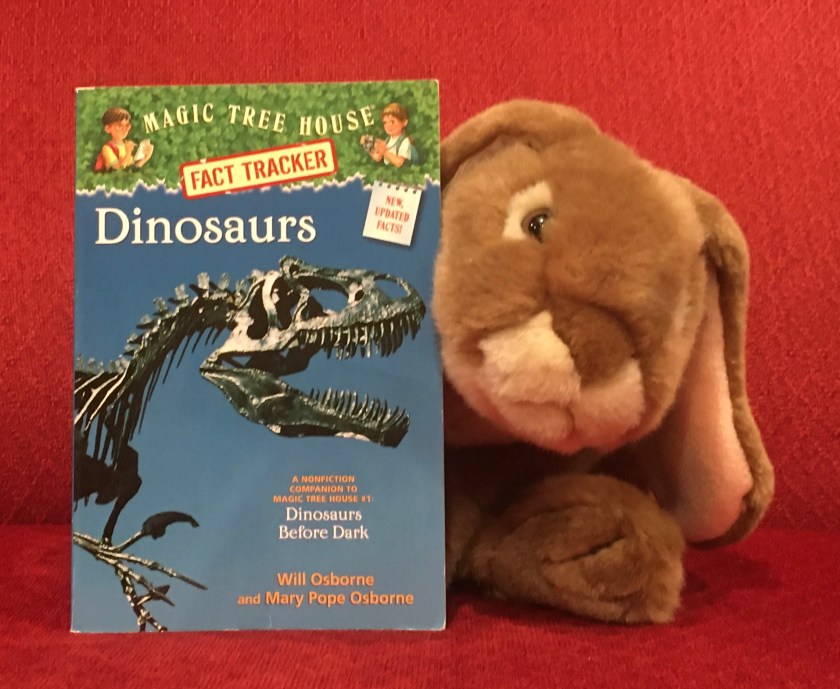
Caramel reviews Dinosaurs (Magic Tree House Fact Tracker #1) by Will Osborne and Mary Pope Osborne.

Sprinkles: Okay Caramel, tell me about this book.

Caramel: This is the first Fact Tracker book for the Magic Tree House books. It is supposed to be paired up with the first Magic Tree House book, Dinosaurs Before Dark.

S: Hmm, you did not review that book, but you did read it of course. Right?

C: Right. That was where we first met Jack and Annie, and learned about the magic tree house. In that book, Jack and Annie went back to the time of the dinosaurs.

S: And so this book is written to accompany that one for young bunnies like you who like to learn more facts about the topic of the book.

C: Yes, I always want to know more about dinosaurs and things.

S: I know. You already reviewed a book about dinosaurs for our blog, The Complete Guide to Dinosaurs and Prehistoric Reptiles by Chris McNab.

C: Yes. And I reviewed a whole lot of How Do Dinosaurs … books by Jane Yolen and Mark Teague last week.

S: Of course those latter ones were not really about dinosaurs though they did have a lot of pretty precise drawings. But let us get back to this Fact Tracker book.

the biggest C: Yeah. This book tells us everything humans know about dinosaurs. There are pages for Tyrannosaurus rex, and other meat eaters, and then there are pages and pages of information on plant eating dinosaurs like sauropods, triceratops, and ankylosauruses. Then there is a Hall of Fame. There are lists of the fastest, the biggest, and the ones with the biggest heads, biggest eyes, and the longest necks, and the longest names, and so on.

S: Hmm, what is the one with the biggest eyes?

C: Dromiceiomimus! They had enormous eyes apparently.

S: I had not heard of those before!

Caramel is reading about Tyrannosaurus Rex in Dinosaurs (Magic Tree House Fact Tracker #1) by Will Osborne and Mary Pope Osborne.

S: So even though you are a little bunny who already knew a lot about dinosaurs, you found new things to learn in this book, right?

C: Yep. For example, I learned more about the ankylosauruses. And I learned that the stegosaurus has a brain the size of a hot dog, so small for a dinosaur of that size.

S: So I know you often reread books you have read before. Do you think you will come back to this one again?

C: Yes. I love this book because it is about dinosaurs and I love dinosaurs. And I like the pictures! And sometimes, I forget some facts and then I can remember them when I read the book again.

S: So tell me more about the pictures?

C: They are black and white but very realistic. They are almost 3D, and there are some photographs. I love looking at them. My favorite is the ankylosaurus!

S: That is great Caramel. Tell me your three word summary of this book. Which three words would you use to describe it?

C: Informative, helpful, neat facts, and cool drawings.

S: Hmm, again that is a little bit more than three words, but it’s alright. So let us wrap up our review then. What do you want to tell our readers?

C: Stay tuned for more book bunny reviews!

Caramel enjoyed reading Dinosaurs (Magic Tree House Fact Tracker #1) by Will Osborne and Mary Pope Osborne, and expects he will be coming back to it for tidbits on dinosaurs many more times in the future.

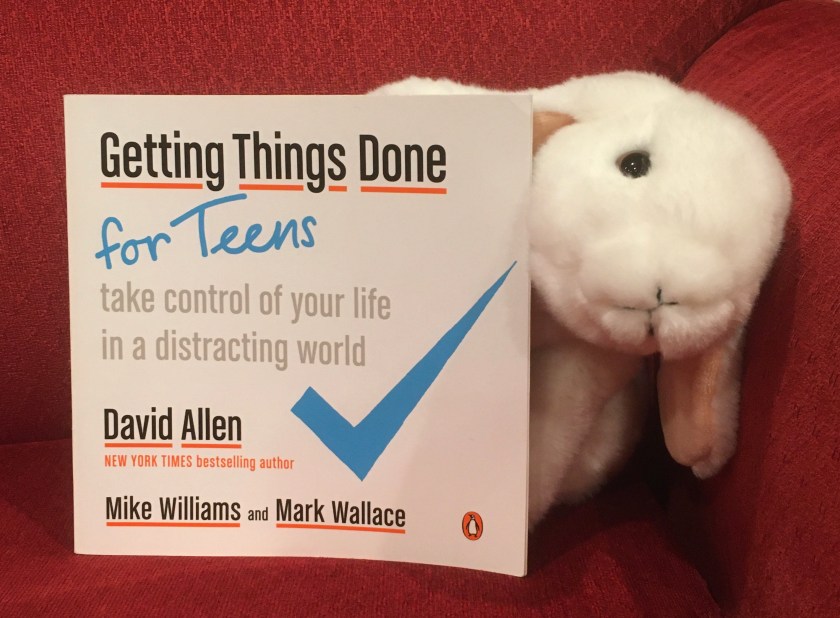
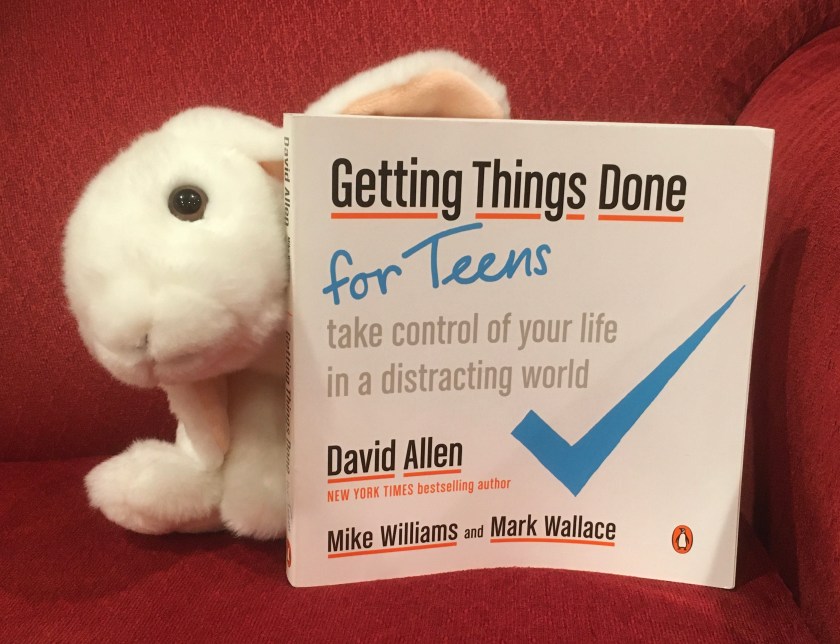
Marshmallow reviews Getting Things Done for Teens by David Allen, Mike Williams, and Mark Wallace

Marshmallow has always been a curious little bunny. She has always been eager to learn about the world as well as about how our minds work. Recently she got her paws on a book for teens, written by David Allen, the David Allen, of GTD fame, together with Mike Williams and Mark Wallace, about the way our minds work and about how to build a fulfilling life in a world full of distractions: Getting Things Done For Teens: Take Control of Your Life in a Distracting World. Though she is not yet a teen, Marshmallow found this book extremely interesting and eye-opening. Below is her review of this neat little book, perfect for teens and tweens as well as the adults in their lives.

Marshmallow reviews Getting Things Done For Teens: Take Control of Your Life in a Distracting World, written by David Allen, Mike Williams, and Mark Wallace.

Marshmallow’s Quick Take: If you like how-to books or books about time management, organization, and self-improvement, or if you want to understand how your mind works and how to take control of your life, then this might just be the book for you.

Marshmallow’s Overview: Getting Things Done for Teens: Take Control of Your Life in a Distracting World is non-fiction, and it aims to teach the reader literally how to take control of their work and/or life. There are two main characters in the book: Cortland, an owl who represents the prefrontal cortex, and Myggy, a monkey who represents the amygdala. Like the prefrontal cortex, Cortland is slower and more thoughtful than Myggy. Myggy, on the other hand, is quick and makes decisions without a lot of thought. The book starts with an overview of how these two parts of the brain help us make decisions, and then introduces the basic features of the Getting Things Done perspective on living a life.

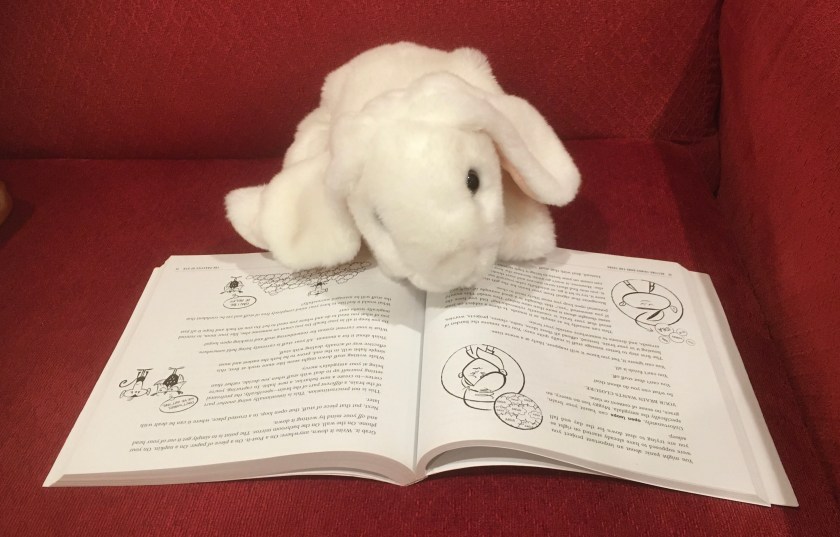
Marshmallow is reading Getting Things Done For Teens: Take Control of Your Life in a Distracting World, written by David Allen, Mike Williams, and Mark Wallace. Here she is looking at the page about "open loops", the things your mind feels like it needs to keep track of unless you resolve the issue about them or at least record them somewhere so you know you will get back to them later.
Marshmallow is reading Getting Things Done For Teens: Take Control of Your Life in a Distracting World, written by David Allen, Mike Williams, and Mark Wallace. Here she is looking at the page about what you need to do about “open loops”, the things your mind feels like it needs to keep track of unless you resolve the issue about them or at least record them somewhere so you know you will get back to them later.

The quick summary is that the book helps teenager bunnies organize their work and how to get their lives in order. It does this by teaching the reader how to deal with “stuff” in their minds. Some examples of “stuff” that one might need to deal with are classes, homework, bullying, college applications, and parent pressure.  

Marshmallow’s Review: This is a great book for bunnies that want to be better at organizing their life or work. There is a lot of information and useful advice packed into the book. But it does not get boring because the tone is light and humorous. Scenarios used to explain things are all realistic. There are helpful graphs, for example about stress and about things teens worry about. Also there are pictures on basically every other page. The illustrations of Cortland and Myggy, especially, are everywhere and keep reminding you of how your mind works in different ways.

There are also inspiring quotes sprinkled throughout. One of the quotes I really liked is:

“I don’t want other people to decide who I am. I want to decide that for myself.”

Emma Watson
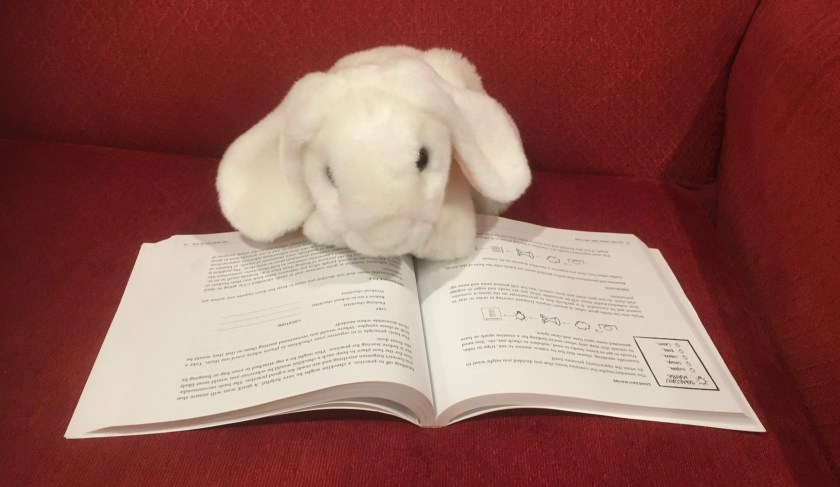
Marshmallow is reading Getting Things Done For Teens: Take Control of Your Life in a Distracting World, written by David Allen, Mike Williams, and Mark Wallace. Here she is looking at the page about the "someday / maybe" list, a list that you can put things that you want to do some day but maybe it is not yet time to work towards them.
Marshmallow is reading Getting Things Done For Teens: Take Control of Your Life in a Distracting World, written by David Allen, Mike Williams, and Mark Wallace. Here she is looking at the page about the “someday / maybe” list, a list that you can put things that you want to do some day but maybe it is not yet time to work towards them.

Though Getting Things Done For Teens: Take Control of Your Life in a Distracting World has ideas that can be useful for everyone, I think it might be best for 9 and up. One of the reasons is because Myggy sometimes uses informal (and for some, inappropriate) words, but also because the methods might confuse younger bunnies. And younger bunnies might have fewer things that they can control in their lives and fewer things to have to worry about. In the other direction, Sprinkles told me that she thinks the book could help grownup bunnies, too. She thinks that this book does a great job explaining how the mind works and how this knowledge can help us organize our work so that our lives become much more manageable and enjoyable.

Marshmallow’s Rating: 100%.

Marshmallow rated Getting Things Done For Teens: Take Control of Your Life in a Distracting World, written by David Allen, Mike Williams, and Mark Wallace 100%, and recommends it highly.

Caramel reviews It’s Alive: From Neurons and Narwhals to the Fungus Among Us by Molly Bloom, Marc Sanchez, and Sanden Totten

The book bunnies are fans of Brains On!, a science podcast directed toward young bunnies but, at least in our household, also much appreciated by the older set. When we heard that the amazing Brains On! team, made up of Molly Bloom, Marc Sanchez, and Sanden Totten, had published a science book together, we knew we all had to read it. Today Caramel reviews this book: It’s Alive: From Neurons and Narwhals to the Fungus Among Us. As usual, Sprinkles is taking notes and asking followup questions.

Caramel reviews the Brains On! book It's Alive: From Neurons and Narwhals to the Fungus Among Us, by Molly Bloom, Marc Sanchez, and Sanden Totten.
Caramel reviews the Brains On! book It’s Alive: From Neurons and Narwhals to the Fungus Among Us, by Molly Bloom, Marc Sanchez, and Sanden Totten.

Sprinkles: So Caramel, this book is right up your alley, right?

Caramel: Yep. It’s full of fun facts, and illustrations are awesome!

S: I know! It is so colorful! So tell me what the general theme of the book is. What is the book about?

C: It’s about science. There are all sorts of facts about all sorts of living things. There is a part about animals, one about plants, one about humans, and another about microorganisms.

S: That sounds cool! So tell me about your favorite animal fact you learned from this book.

C: There are so many, I can’t choose.

S: Give me one or two then…

C: Okay, let me try. I like the Animal Superpowers part a lot.

Caramel is reading the Brains On! book It's Alive: From Neurons and Narwhals to the Fungus Among Us, by Molly Bloom, Marc Sanchez, and Sanden Totten. Here he is checking out the section on Animal Superpowers.
Caramel is reading the Brains On! book It’s Alive: From Neurons and Narwhals to the Fungus Among Us, by Molly Bloom, Marc Sanchez, and Sanden Totten. Here he is checking out the section on Animal Superpowers.

S: That sounds interesting! What kinds of superpowers?

C: There are super-healers for example. Did you know that the axolotl can regrow part of its missing limbs, and even its brain? It is cool, isn’t it?

S: That is really cool, you are right! And that is one cute animal I had not heard about before! Here is a picture from Wikipedia if people want to see one:

An axolotl in captivity, image by th1098, taken from https://en.wikipedia.org/wiki/Axolotl#/media/File:AxolotlBE.jpg

S: So would you like to have such a super power, Caramel?

C: Yes, being able to regrow limbs would be awesome!

S: So then how about the plants? Tell me a favorite fact you learned from this book about plants.

C: Shall we visit the Tree Hall of Fame?

S: Okay…

C: The tallest tree is a redwood tree named Hyperion. It is 380 ft tall. That is taller than the Statue of Liberty!

S: Wow! That is tall!

C: It is in Redwood National Park, in California, but the scientists are keeping its exact location secret.

Caramel is reading the Brains On! book It's Alive: From Neurons and Narwhals to the Fungus Among Us, by Molly Bloom, Marc Sanchez, and Sanden Totten. Here he is looking at the section on "the rose that went to space".
Caramel is reading the Brains On! book It’s Alive: From Neurons and Narwhals to the Fungus Among Us, by Molly Bloom, Marc Sanchez, and Sanden Totten. Here he is looking at the section on “the rose that went to space”.

S: The book sounds really packed full of interesting facts Caramel. Just perfect for you!

C: Yep. Exactly. I recommend that you read it too.

S: Yes, I will definitely do that after this review. I can’t wait!

C: But you have to wait! Because I need to tell you about the Mega Matchups!

S: What’s that?

C: There are parts in the book where they compare two things. Like there is one where they pit dogs against cats. I think there is one in each part. Wait, there is the octopuses vs the dolphins. So that is at least two in animals. And then there is another matching porcupine caribou against monarch butterflies.

S: Wait. How do those two compare? Why are they even pitted against one another?

C: It seems random till you read it. These are two creatures that are “long-distance travelers that travel thousands of miles without a map or a compass.”

S: I see. This matchup idea is like the Smash-Boom-Best segment the Brains On! folks used to do sometimes in their podcasts. Did you know that that eventually became its own podcast?

C: No I didn’t know that. Then again I think Marshmallow listened to an episode for her class one time.

S: Yes, I remember. It was pizza vs tacos I think.

C: I think pizza wins for me!

S: I think they both have their time and place.

C: True. Wait, here is another matchup. The durian vs the corpse flower. They’re both stinky! A corpse flower apparently smells like, well, a corpse.

S: I know durian. I ate durian ice cream once. Did you know that?

C: Nope.

S: It tasted like vanilla ice cream, but with a terribly strong garlicky, or onion-y aftertaste.

C: That does not sound too appetizing.

S: I know.

Caramel is reading the Brains On! book It's Alive: From Neurons and Narwhals to the Fungus Among Us, by Molly Bloom, Marc Sanchez, and Sanden Totten. Here he is looking over the "Mega Matchup: Tardigrade vs. Slime Mold".
Caramel is reading the Brains On! book It’s Alive: From Neurons and Narwhals to the Fungus Among Us, by Molly Bloom, Marc Sanchez, and Sanden Totten. Here he is looking over the “Mega Matchup: Tardigrade vs. Slime Mold”.

S: So this review is already quite long. Let us wrap it up. What three words would you use to describe this book to someone who is interested in learning about it?

C: Factful, interesting, and very colorful.

S: I agree with all of those Caramel, even before I got to read it fully. I think I’d also add “very fun” to the list.

C: Yes, it is really fun and funny too.

S: Great! So we are done. What do you say to our readers?

C: Stay tuned for more book bunny reviews!

Caramel loved reading the Brains On! book It's Alive: From Neurons and Narwhals to the Fungus Among Us, by Molly Bloom, Marc Sanchez, and Sanden Totten, and cannot wait to share all his new facts with friends and family.
Caramel loved reading the Brains On! book It’s Alive: From Neurons and Narwhals to the Fungus Among Us, by Molly Bloom, Marc Sanchez, and Sanden Totten, and cannot wait to share all his new facts with friends and family.