Caramel reviews Hot Lava! Fiery Facts About Volcanoes by Alice Fewery

A couple of weeks ago, Caramel visited the book fair held in his school campus and picked a handful of nonfiction books for himself. Last week he reviewed one of them: Sea Bunnies by Kelly Hargrave. Today he talks about a second book: Hot Lava! Fiery Facts About Volcanoes, written by Alice Fewery and published in 2021. As usual, Sprinkles is asking questions and taking notes.
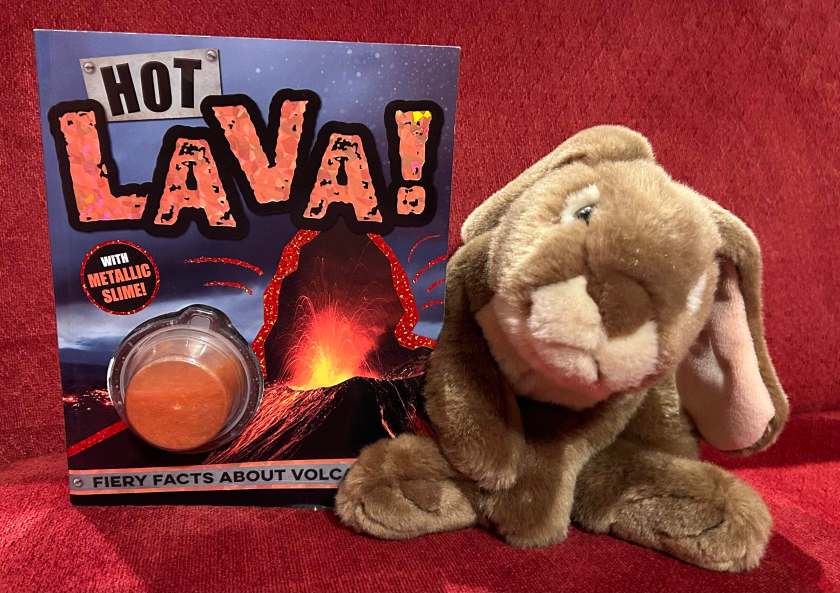
Caramel reviews Hot Lava! Fiery Facts About Volcanoes by Alice Fewery.

Sprinkles: So Caramel, this was the second book you got from the school book fair. Tell us about it. Why did you want to read it?

Caramel: Because I wanted to know more about volcanoes! And of course, the slime!! It comes with slime!

S: I can see that the book combined two things you like: slime and facts!

C: Exactly. I like books full of facts, and this book is full of facts. And I like playing with slime, and this book came with metallic slime.

S: What’s metallic slime?

C: It’s just regular slime but its color is metallic.

S: Hmm, I see. Did you know that you could make magnetic slime?

C: Not until you showed me that page you found. Can we link to it so we can make some of our own some time? We have to!

S: Okay, maybe we can. Here is the link: How to make magnetic slime.

C: Cool.

S: Okay, can we get back to the book now?

C: No. Of course, I’m kidding! Yes let us talk about the book.

S: You got me there. Okay, now tell me about the book.

C: It is forty pages full of “fiery” facts about volcanoes. For example, did you k know that when a volcano in the Krakatoa island blew up in 1883, it changed the climate of the whole world? The temperatures fell by 0.72 degrees Fahrenheit all around!

S: No, I had heard of the Krakatoa explosion, but I did not know that its climate effects were so significant. So the book talks about famous volcanic explosions, right?

C: Yes. It has two-page spreads on three other “famous eruptions”: Mount Vesuvius in Pompeii, Italy, which blew up in 79 CE, Mount St. Helens in Washington, USA, which blew up in 1980, and Mount Pelée in Martinique, which blew up in 1902.

S: Did you know about these disasters before, Caramel?

C: I had heard about Pompeii and Mt Vesuvius. And I am not sure but I think I might have heard about that one person who survived because he was in a windowless jail cell during the explosion of Mount Pelée. But I did not know about the others.

S: So you learned some things from this book.

C: Yes of course. I also learned a lot about the mechanism of volcanoes and a lot of new words about them. For example, apparently magma is called “magma” under the crust, but when it gets out we call it “lava”. So I knew both were molten rock, but I did not know they were exactly the same thing, just one is inside and one is outside.
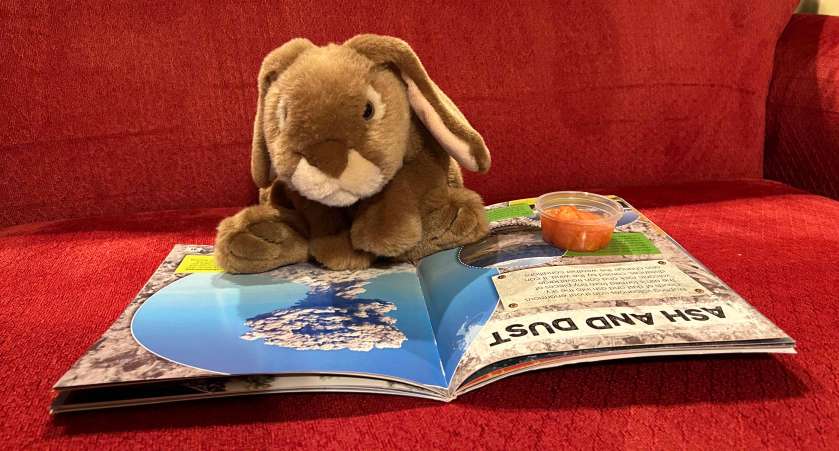
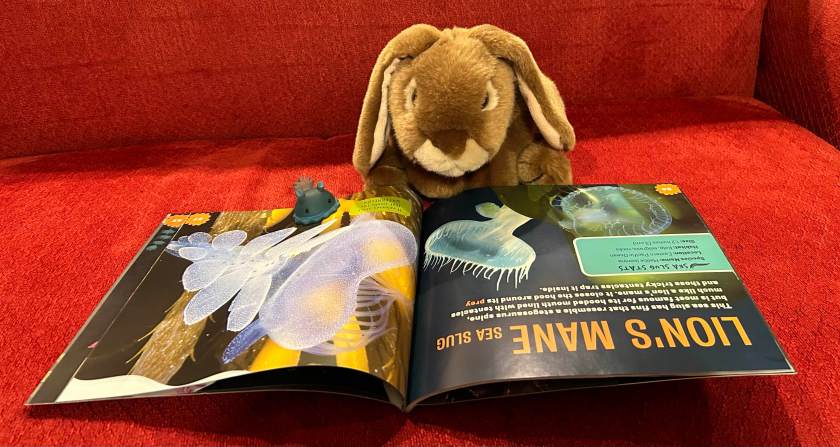
Caramel is reading Hot Lava! Fiery Facts About Volcanoes by Alice Fewery, accompanied by the metallic slime that came along with the book.

S: So the book was “factful”, right?

C: Yes, that would definitely be one of my three words.

S: What other words would you use?

C: Colorful, and maybe slimy. But not in a bad way; I call the book slimy because it comes with slime. Really nice metallic orange color.

S: I understand. So tell me what other facts there are in the book before we wrap up this review and you go back to playing with that cool slime.

C: Okay. Maybe I can read to you some of the section titles.

S: Sure.

C: I’ll skip the famous eruptions because I already listed them. Then there are sections titled “What is a volcano?”, “Volcano varieties”, “Why do volcanoes erupt?”, “Life cycle of a volcano”, “Liquid rock”, “Hot water”, “Ash and dust”, “Gas and lightning”, “Weather warning”, “Supervolcanoes”, “Volcanoes in space”, “Living on a volcano”, “Visit a volcano”, “Make your own volcano”. And there is the glossary and an index.

S: Some of those sound really interesting! I’d love to know more about volcanoes in space and making your own volcano.

C: We can try making one at home some day, maybe?

S: Maybe.

C: And space volcanoes are really neat too. You should read this book Sprinkles.

S: Maybe I will.

C: But I’m not sharing my slime!

S: Hmm, we’ll see about that. Okay, let us wrap this up. What do you want to tell our readers?

C: Stay tuned for more book bunny reviews!
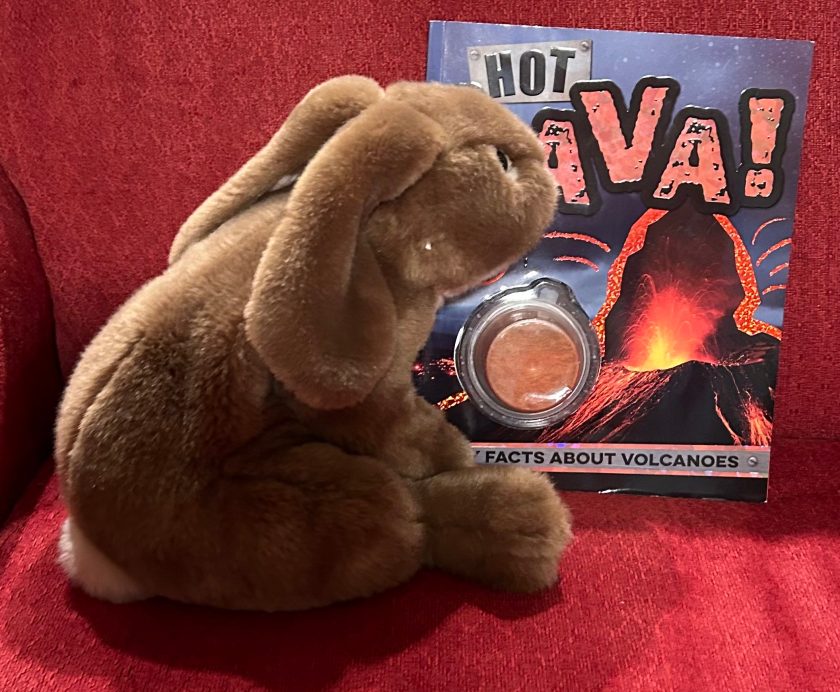
Caramel enjoyed reading Hot Lava! Fiery Facts About Volcanoes by Alice Fewery, and playing with the metallic slime that came along with the book, though it did get into his fur a little.

Caramel reviews Sea Bunnies by Kelly Hargrave

Caramel loves books with facts. He also loves soft squishy toys. So he could not help but get exceptionally excited when he visited the book fair in his school and he saw Sea Bunnies, a 2021 book by Kelly Hargrave. The book was colorful and full of interesting facts, and on top of all that goodness, it came with a new squishy friend! So of course today Caramel is talking about Sea Bunnies. As usual, Sprinkles is taking notes and asking questions.

Caramel reviews Sea Bunnies by Kelly Hargrave.

Sprinkles: So Caramel, you saw this book and had to read it!

Caramel: Yes! Can you imagine me passing by a book about our distant relatives? They are called sea bunnies, so they must be related to us somehow, right?

S: Hmm, i’m not so sure. Guinea pigs are not really related to pigs. So what are these sea bunnies? Are they mammals like regular bunnies are?

C: Well, not really. They are sea slugs.

S: Hmm, so they are not really bunnies after all.

C: No, but they have antennas that look like bunny ears, so people call them sea bunnies. And they are cute! Though maybe not as cute as most bunnies. Still they can be our friends.

S: Especially your new squishy friend, right?

C: Yes! My squishy friend is very cute. He might actually be cuter than the real sea bunnies, but that’s alright I think.

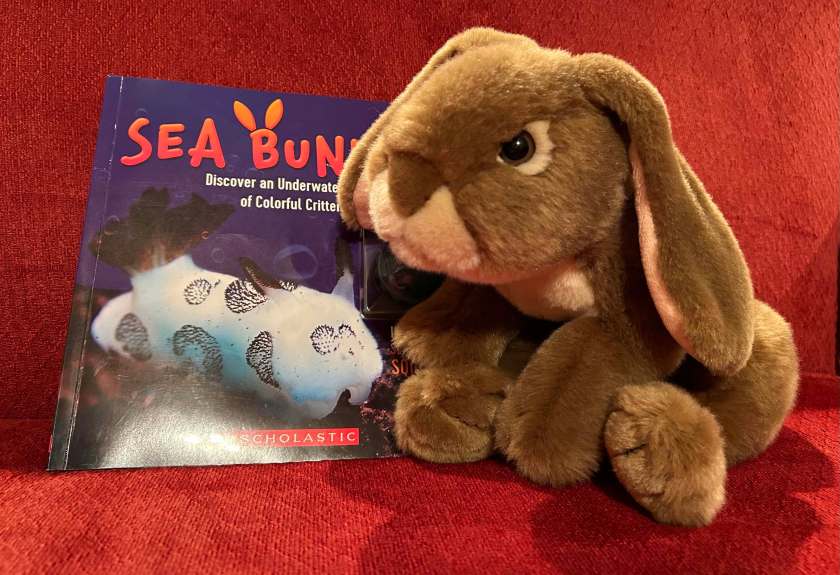
Caramel and his new squishy friend are reading Sea Bunnies by Kelly Hargrave.

S: So let us get back to the book. Tell us a bit about it please.

C: The book has fifty pages. On each two-page spread, you learn about a new type of sea slug or sea bunny. There are about thirty different types they talk about. For example, there is one they call a Ninja Sea Slug. Then there is a sea angel. There is a leaf sheep. And so on.

S: So they all have interesting names!

C: Yes, in the beginning the author says “each sea slug featured in this book has been given an awesome nickname.” And they are awesome nicknames!

S: I agree. They are all pretty imaginative and evocative nanes.

C: Those would be some words I could use to describe the book!

S: I guess so. But I’d also assume you would want to say “colorful” and “fact-full”, right?

C: Yes! The book is very colorful and full of facts!

S: Any facts that were new for you?

C: Of course! I didn’t even know that there was an animal called a sea bunny, to start with. So yes.

S: True, the name was new, but what else did you learn about these creatures?

C: They have tentacles, and some have wing-like extensions. Some glow in the dark. Some are pink and have toxins. They can be all sorts of colors. There are over two thousand different types of sea slugs!

S: Those are all very interesting facts Caramel! I’m glad you read this book.

C: Me, too! And I’m glad I have a new squishy friend!

S: I know. Okay, this is probably a good time to wrap up the review so you can continue to play with him. What would you like to tell our readers?

C: Stay tuned for more book bunny adventures!

Caramel and his new squishy friend strongly recommend reading Sea Bunnies by Kelly Hargrave and learning more about these amazing creatures. And of course who doesn't want another squishy friend?
Caramel and his new squishy friend strongly recommend reading Sea Bunnies by Kelly Hargrave and learning more about these amazing creatures. And of course who doesn’t want another squishy friend?

Marshmallow reviews You Know, Sex by Cory Silverberg and Fiona Smyth

Marshmallow is reading about growing up and this week she wanted to talk about a recent book she read about puberty, growing up, and sex written for young people who are around her age: You Know, Sex: Bodies, Gender, Puberty, and Other Things by Cory Silverberg and Fiona Smyth. Sprinkles is taking notes and asking questions.

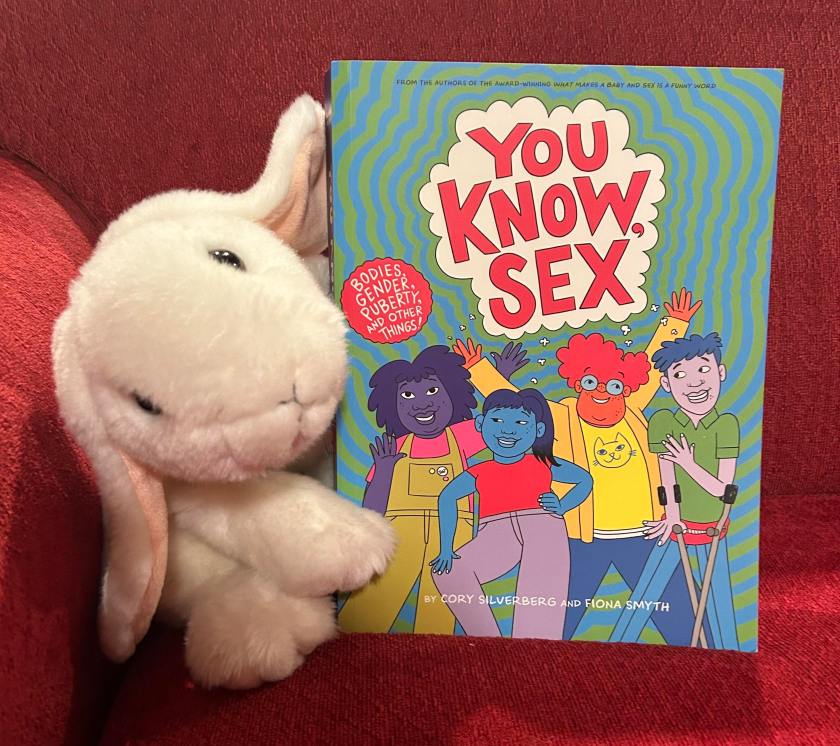
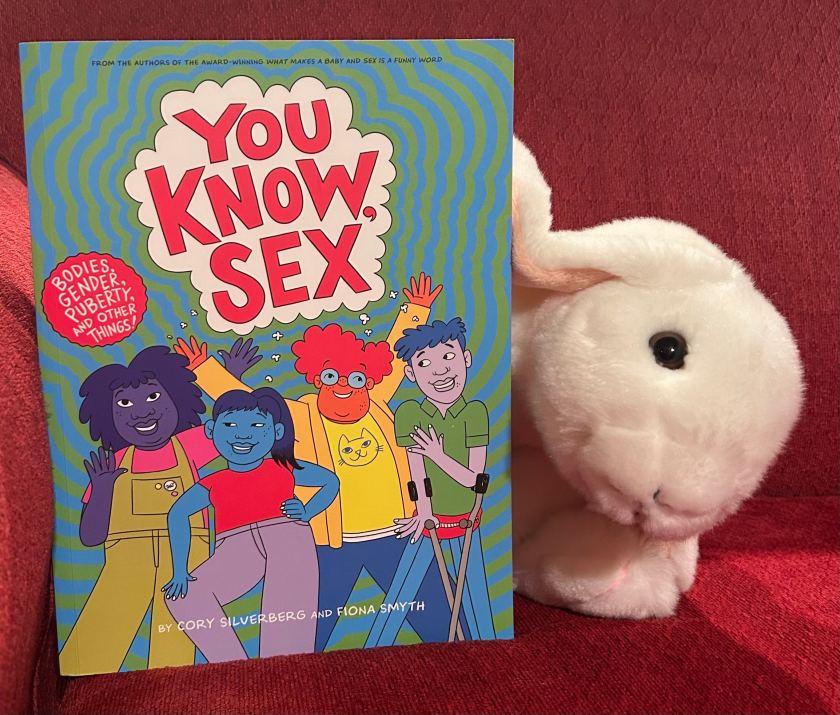
Marshmallow reviews You Know, Sex: Bodies, Gender, Puberty, and Other Things by Cory Silverberg and Fiona Smyth.

Sprinkles: First of all, as we begin this review, I want to thank you for reading this book, Marshmallow. After reviewing a collection of books about where babies come from, I had intended to write a post about a handful of books about puberty next. And one of the books I chose was this one, a huge, 432-page tome written in graphic novel form. But when I began to read it, I realized that my personal discomfort with the form (due to my poor eyesight) would mean I would probably not be able to give it its full due. So thank you for helping me out and checking the book out on your own.

Marshmallow: Well, that’s alright, Sprinkles. It was an interesting read.

S: That’s good to know. Can you tell us a bit about the specifics of the book?

M: Sure. You already said it is big, and has 432 pages. And you said it is written as a graphic novel.

S: The two who wrote this book also were the writer and the illustrator of What Makes A Baby?, one of the books I read for that review of books about where babies come from. And the pictures have the exact same style.

M: Yes, there are people with many different skin colors, like orange and purple and green and blue, and many different shapes and sizes.

S: Does that work well?

M: Yes, it is interesting. I think the people all look quite unique.

S: Well, I guess that makes the book more realistic, right? We are all quite different from one another.

M: Yes.

S: So tell us more about the book.

M: There are eleven chapters. They are titled: What is Sex? Bodies, Gender, Puberty, Feelings, Consent, Talking, Relationships, Reproduction, Touching, and Safety.

S: So the book covers a lot of ground.

M: Yup. It is also very contemporary.

S: What do you mean by that?

M: It has some ideas which I think are contemporary. They talk about gender identity and sexual orientation, transgender and non-binary people, and people having relationships with multiple partners.

S: The last one does not sound too contemporary to me. Polygamy and polyamory have been around for a long time. They have not always been accepted or legal though. I guess the authors are trying to teach the reader to be open minded about different arrangements.

M: I am not sure all readers would be too open to all of these ideas at this point.

S: I agree with that. Actually I too find some of these ideas challenging, especially polygamy. Though rabbits are typically not monogamous, according to Wikipedia, “scientific studies classify the human mating system as primarily monogamous, with the cultural practice of polygamy in the minority”. In any case, it is good to learn about how different people can relate with others.

M: Well, the book does not talk so much about polygamy as polyamory. But yes, it is good to learn about these different things.

Marshmallow is reading You Know, Sex: Bodies, Gender, Puberty, and Other Things by Cory Silverberg and Fiona Smyth.

S: They also talk about the changes a young bunny goes through in puberty, and more generally about biology and mechanics of sexual reproduction, right?

M: Well, yes. There are also very vivid depictions of things. They make an effort to show all kinds of things, so that the reader does not end up assuming that a body part has to look in one specific way. And they show people doing all kinds of different things together or alone.

S: I did look through the pages a lot, too, and I’d say there really are a lot of illustrations that some parents may not be comfortable with.

M: The self-discovery and self-exploration parts might also be kind of touchy topics for some folks, I’d imagine.

S: I did see a section on pornography, and that too is a very challenging topic. Perhaps grownup bunnies should read this book together with their young ones when they feel like the conversations about the various themes and issues that come up will be constructive.

M: I’d agree with that.

S: What were some of the other topics in the book? What topics did you find were most important?

M: They talk a lot about relationships, and I thought it was useful to learn about that. They talk about consent and power in relationships, and sometimes how people talk about being with people as a competition.

S: Yes, I did see that page about how sometimes people talk about “scoring” and the book instead encourages young people to think about “trust, respect, justice, joy, and choice”.

M: Yes, I did find those parts useful. All in all, it is an interesting and useful book, but I think grownups should probably check it out before sharing with their little ones.

S: Agreed. So what would you tell our readers as we wrap up this review?

M: Stay tuned for more amazing book bunny reviews!

Marshmallow appreciated reading You Know, Sex: Bodies, Gender, Puberty, and Other Things by Cory Silverberg and Fiona Smyth, and she thinks all growing bunnies should read a book along these lines; she also suggests grownups check it out before sharing with their little ones.

Caramel reviews Robot by Roger Bridgman

Caramel loves everything about robots, and he loves books about facts. Today, therefore, he wanted to share with our readers a book on robots that he has read: Robot, written by Roger Bridgman. As usual, Sprinkles is taking notes and asking followup questions.

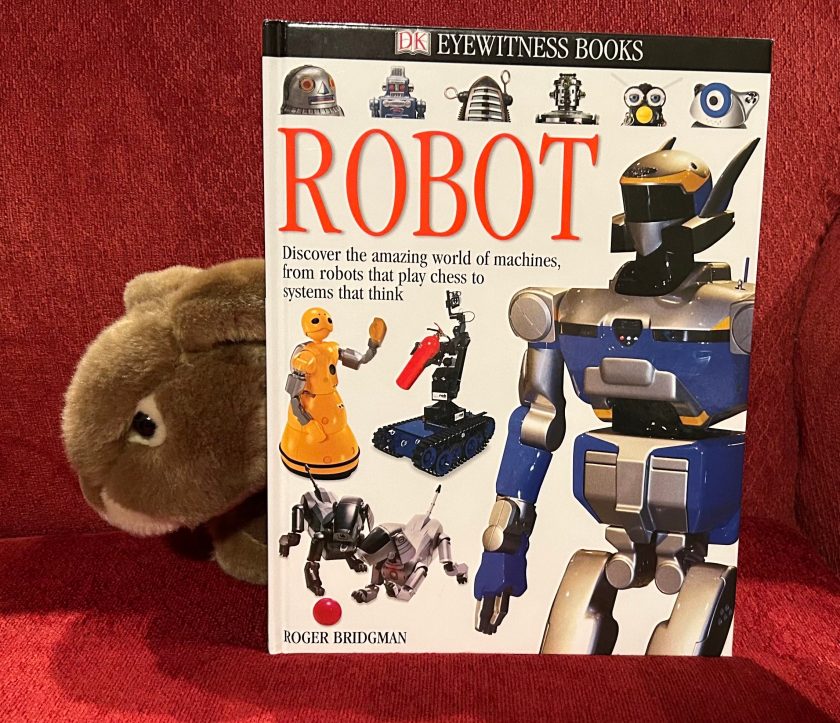
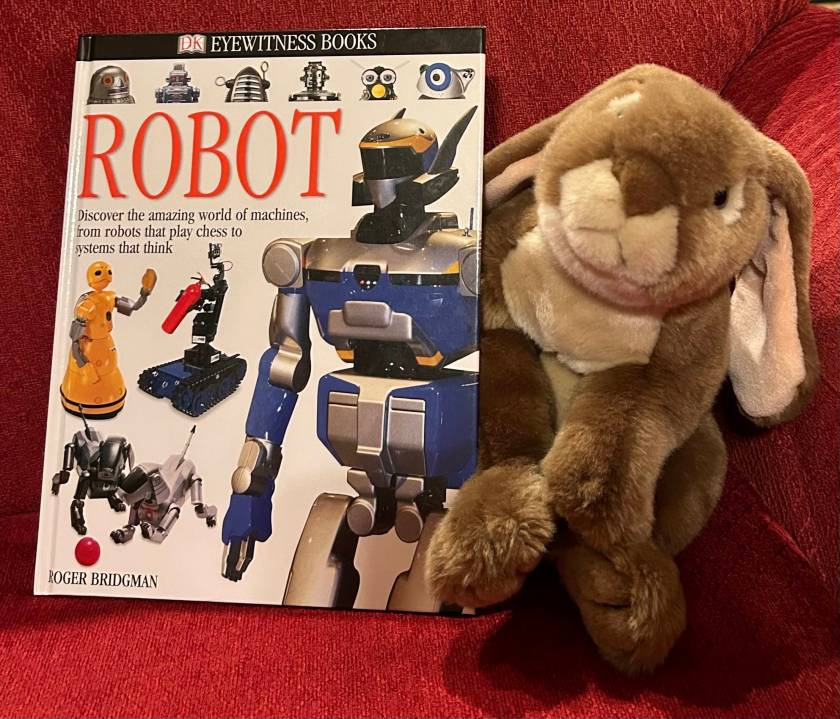
Caramel reviews Robot by Roger Bridgman.

Sprinkles: Caramel, here we are, ready to talk about a whole book about robots!

Caramel: Robots! Yay!

S: I know you like robots.

C: That’s an understatement. I love them!

S: I know! You reviewed a two-book series about a robot and her travels (The Wild Robot and The Wild Robot Escapes by Peter Brown), and you told us that then too. So let us get started. What do you want to tell us about this book?

C: This is a book about robots and tons of good facts about them.

S: Tell me one.

C: Let’s see. Did you know that there is a robot that looks like a shark and researchers use it to study sharks? It helps them “film sharks without disturbing their natural behavior”.

S: That’s pretty cool.

C: And did you know that they have a robot that can climb up on walls and actually walk on the ceiling?

S: That’s cool, too. Kind of like ants and bugs and flies.

C: Yes.

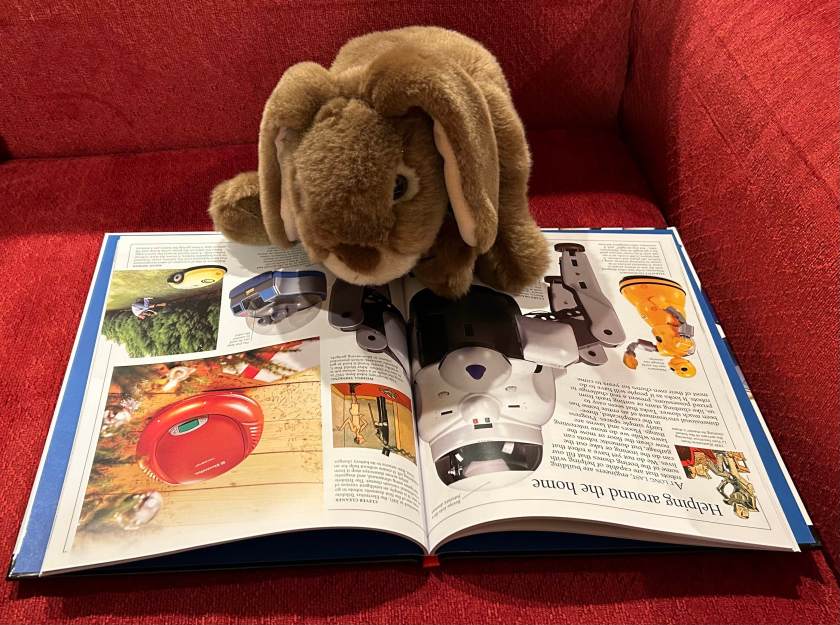
Caramel is reading Robot by Roger Bridgman and learning about robots that can help around the home.

S: So there are a lot of different types of robots in this book, right?

C: Yes. There are robots that can help around the home. Then there is a two-page spread on robots that move, one on robots that sense. And another on artificial intelligence. There is a section on robots in the industry and in space and under water.

S: That is pretty cool.

C: There is also a section on fictional robots and robots in art. Like C3PO from Star Wars. But they also have a mistake there! They put a picture of a Dalek, from the Doctor Who universe, but Dalek are not robots. They do say they are mutants, but they should not have put them in a book on robots!

S: I guess people make robot Dalek to play with, though, right?

C: Yes. I even saw a remote-control Dalek once. So maybe that is why they put a picture in the book.

S: I suppose that makes sense.

C: They also have sections on machines with feelings, which is kind of like that Wild Robot I read about.

S: That is interesting! I’ve always thought the feeling part is quite hard to implement. But also, this is a relatively old book, right? It was first published in 2004. A lot must have changed since then, I’d presume.

C: Yep, I think so. In fact we should probably put here that video about robots which behave like animals. That seemed really new!

S: I agree. That video is brand new, only two weeks old now. So here it is:

“Biophysicist Reacts to Animal Inspired Robotics”, YouTube.

C: I like this video a lot! We should see it again.

S: Sure. Let us finish the review first. I know you knew a lot about robots already. What did you learn from this book Caramel?

C: Well, you are right that I knew a lot of things about robots before, so I knew a lot of the things in the book. But I did not know about the shark-shaped robot. And there were just so many different robots! It is a pretty awesome book and I liked it very much.

S: I can see that! I have been observing you looking carefully at the pages of the book over and over again. You have read it all already, but you still enjoy looking at it.

C: Yes. I like robots! And I told you; these are cool robots!

S: That’s wonderful Caramel. So what three words would you use to describe this book?

C: Factful, colorful, and robotful. There are a lot of facts, a lot of colorful pictures, and lots of robots!

S: I cannot argue with that reasoning! Okay, then let us wrap this review up. What do you want to tell our readers?

C: Stay tuned for more book bunny reviews!
Caramel loved reading and reviewing Robot by Roger Bridgman, and he looks forward to learning more and more about robots as he grows up.