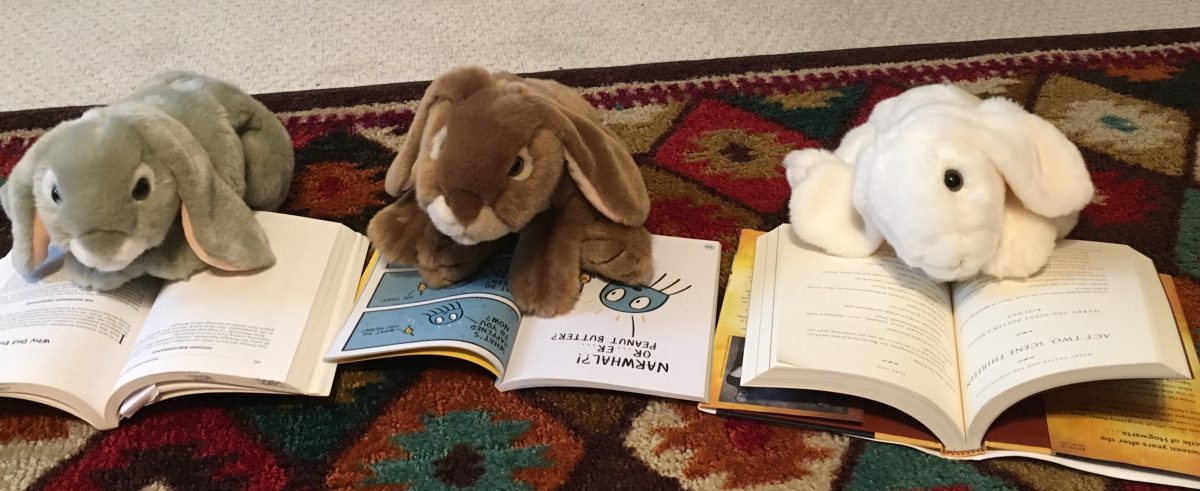
Caramel reviews Ultimate Spy by H. Keith Melton

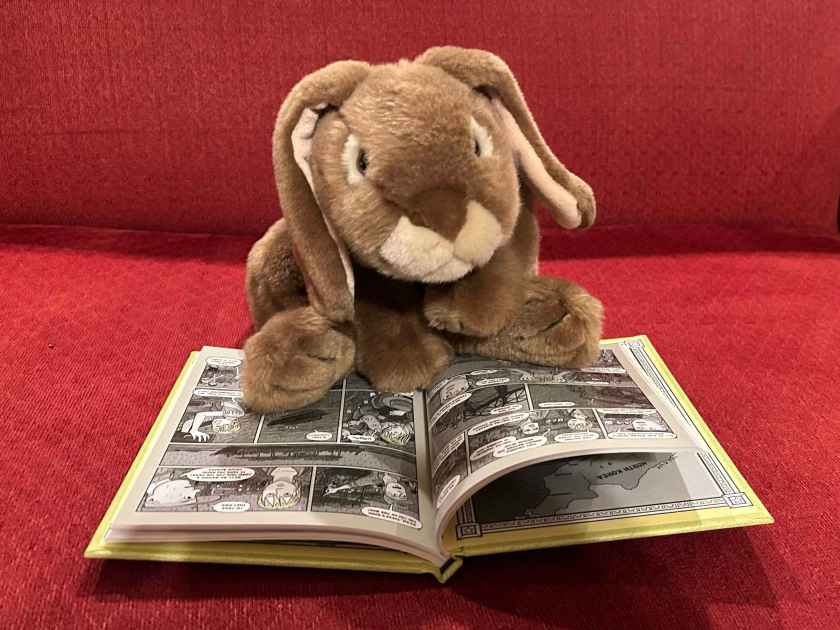
Today Caramel reviews Ultimate Spy by H. Keith Melton, published in 2002. As usual, Sprinkles is taking notes and asking questions.

Caramel reviews Ultimate Spy by H. Keith Melton.

Sprinkles: So what is this book about Caramel?

Caramel: This is about the equipment and weapons that spies use.

S: I see. After reading so many Spy School books, you needed to get to some of the facts! 

C: Yep. You know me and facts. I like them. 

S: Okay, so what kind of equipment and weapons are we talking about here? 

C: Some of them are really cool gadgets, like the match box pistol.

S: Sounds like something out of a James Bond movie. What is the match box pistol?

C: Yes, it sounds like it’s from a movie and it does look like it, too. It basically looks like a metal match box, but a barrel can be attached, and it can shoot one bullet. So you can carry it around without anyone being suspicious that you are carrying a weapon. Or you could simply let it sit on a coffee table and they would not suspect anything. 

S: I see. That is cunning. 

C: Yes, it is, it’s crazy. There are so many little and big things that they have made that spies can use as secret weapons. 

S: And these are real, not for movie sets and such?

C: Yep, they are all things that were used at some point.

S: Oh wait, you used the past tense. So these are real but maybe no longer classified, like the government no longer needs to keep them secret. 

C: Yeah, at least I think so. The author is a historian and the foreword of the book is written by some real people from the intelligence world. Some guy named Richard Helms who was apparently a former director of the CIA and Markus Wolf who was the former head of the East German Foreign Intelligence Service, the HVA. This is the real CIA, the Central Intelligence Agency! And I didn’t know about the HVA, but now I do. 

S: Wow! That is pretty cool. This all probably means that they have a lot of other cool stuff they are using these days, and we don’t know about them. 

C: Yeah, most likely a lot. And this book was published all the way back in 2002, so definitely they must have a lot of new tools and gadgets that they are not telling us about. 

S: I did notice that our copy is from 2002. There is apparently a newer edition, from 2015. 

C: Oh, that is cool. Maybe that edition has a few new things. But this book was more than good enough; it definitely has enough neat things to keep me busy! 

S: I can see that!

Caramel is reading Ultimate Spy by H. Keith Melton.

S: Okay, so tell me a bit more about the book. 

C: Sure.  The content is organized around some themes like Famous Spying Operations, World War II, Cold War, Post-Cold War Spying, and Equipment and Techniques.  Under that last one, there are pages on Cameras, Secret Operations, Counterintelligence, Clandestine Communications, and Weapons. Finally there is a section on How To Be a Spy. 

S: Hmm, it is interesting that there is some historical context to this all. And there are lots of big words in there. Did you know what “clandestine” means for example? 

C: Of course. It means secret. 

S: Of course, I should have guessed that. You are a little bunny with a huge vocabulary. Anyways, what else can you tell us about the book?

C: There are 206 pages. And there are many, many, many pictures on each page. 

S: That makes sense. You’d want to see these gadgets of course! 

C: Yeah, I definitely liked looking at them.

S: So what was your favorite gadget? 

C: Probably the match box pistol, it’s small, even a bunny spy could carry it around! 

S: Wait, are you interested in becoming a spy? 

C: Not really. I was teasing you. It is too dangerous. But it is neat to read about them. And you know I love my Spy School books, so this book helps me put what is going on in those books into some context. 

S: Alright, so maybe this is a good place to wrap up this review. You seem to have really enjoyed this book. 

C: Yes. And yes. 

S: So what would you like to tell our readers as we end this post?

C: Stay tuned for more book bunny reviews!

Caramel enjoyed reading Ultimate Spy by H. Keith Melton and learning about cool gadgets and some history, too.

Marshmallow reviews Learning How to Learn: How to Succeed in School Without Spending All Your Time Studying (A Guide for Kids and Teens) by Barbara Oakley, Terrence Sejnowski, and Alistair McConville

Marshmallow occasionally reads and reviews books about how to be a good student and today she is writing about one such book: Learning How to Learn: How to Succeed in School Without Spending All Your Time Studying (A Guide for Kids and Teens), a neat book by Barbara Oakley, Terrence Sejnowski, and Alistair McConville, published originally in 2018.

Marshmallow reviews Learning How to Learn: How to Succeed in School Without Spending All Your Time Studying (A Guide for Kids and Teens) by Barbara Oakley, Terrence Sejnowski, and Alistair McConville.

Marshmallow’s Quick Take: If you are a student, a teacher, or anyone who has felt lost in school, then this is the book for you!

Marshmallow’s Summary (with Spoilers): The book starts off with a note to parents and teachers who are reading the book to help a young student. The book officially starts with one of the authors, Oakley, introducing herself to the reader. She writes that she used to be a student who focused only on her liberal arts subjects, feeling that science and math (the subjects she struggled in) were not relevant to her because she was following her passions. However, I was a bit surprised to read the next sentence in which she reveals that she is now a professor of engineering—which requires a deep understanding of science and math as she admits. The enabling factor of this switch was her ability to learn how to learn. She next introduces her co-authors Sejnowski and McConville and then describes how her life changed and how she changed to adapt.

Most chapters in the book have case examples of somebody who, like Oakley, demonstrates the importance of knowing how to learn. Some of the chapter names are as follows: “The Problem with Passion,” “Easy Does It: Why Trying Too Hard Can Sometimes Be Part of the Problem,” “I’ll Do It Later, Honest! Using a Tomato to Beat Procrastination,” “Brain-Links and Fun with Space Aliens,” “Learning While You Sleep: How to Wake Up Smarter,” and “Learning Surprises: Pssst…Your Worst Traits Can Be Your Best Traits!”

One can probably tell that the book is full of interesting yet slightly silly-sounding topics. The authors talk about and teach a lot about fascinating neuroscience, but they explain everything with metaphors and cartoon drawings. There are a lot of pictures and the text of the book is large, so it is overall very comprehensible.

I liked how the authors synthesize the most relevant parts into tips at the end of the chapter. In order to teach the reader how to get better at learning, each chapter also has a list of questions to answer that help you do some active recall. I felt like these end-of-chapter activities make the book feel very interactive and energetic!

Overall, the authors provide a lot of intriguing information and shrewd advice. Some of the strategies were ones I had heard of before or have discovered on my own as a student, but a lot of them were also new to me. Each chapter focuses on a general theme or topic, expanding on the subject at hand throughout. This book is a great source for all students, teachers, and bunnies looking to get better at learning or just understand how the brain works better!

Marshmallow is reading Learning How to Learn: How to Succeed in School Without Spending All Your Time Studying (A Guide for Kids and Teens) by Barbara Oakley, Terrence Sejnowski, and Alistair McConville.

Marshmallow’s Review: I would highly recommend Learning How to Learn to everyone, especially students. I think (and I have heard some of my friends at school talk about this) that a lot of students feel as though they have never actually been taught how to learn. This is partially true, as most students are never told how to study or do their homework. When students are working on their own time, away from school and the direction of teachers, they are not always very good at knowing where to go or what to do. This book provides a lot of good instructions and helps steer the reader on a clearer, better path.

I regret not having read this book earlier. I will try to establish some of the habits suggested by this book and I hope that I will be better at learning and learning how to learn. I have already, on my own volition, focused a lot on how to learn and be a good student. For people also interested in this topic, I would also recommend looking at Cal Newport’s How to Be a High School Superstar and How to Become a Straight-A Student. This book is a lot more kid-friendly though, and a lot easier to read and understand. I really liked how interactive Learning How to Learn is and how it has a lot of images to break down the more complex ideas. I think the authors have done a very good thing by writing this book.

I would highly recommend that parents read Learning How to Learn with their children—the younger and earlier, the better. Too many bunnies fall behind in school because they feel like they simply aren’t smart enough to learn the material. This book shows that you don’t need to be smart, at least not in the way you think; you just need to try your best in a smarter way. 

Marshmallow’s Rating: 100%.

Marshmallow rates Learning How to Learn: How to Succeed in School Without Spending All Your Time Studying (A Guide for Kids and Teens) by Barbara Oakley, Terrence Sejnowski, and Alistair McConville 100%.

Marshmallow reviews The Light Eaters by Zoë Schlanger

Today Marshmallow reviews The Light Eaters: How the Unseen World of Plant Intelligence Offers a New Understanding of Life on Earth, a 2024 book by Zoë Schlanger.

Marshmallow reviews The Light Eaters by Zoë Schlanger.

Marshmallow’s Quick Take: If you like reading, then this is the book for you!

Marshmallow’s Summary: Generally, I tend to read fiction. As a result, most of the books I review here are fiction. However, this book was uniquely written and exists somewhere between the two. While it is completely centered on science and factual reality, some of the things I learned from it were so wonderful that I wonder whether we need fiction at all when nature has already provided us with such beautiful truths. (Sprinkles told me that this made her think of something the famous physicist Richard Feynman said: “I think nature’s imagination is so much greater than man’s, she’s never going to let us relax.”)

The book starts off with a modest introduction of the central question—are plants conscious? As such, the title of the first chapter is “The Question of Plant Consciousness.” The other chapters are as follows: “How Science Changes Its Mind,” “The Communicating Plant,” “Alive to Feeling,” “An Ear to the Ground,” “The (Plant) Body Keeps the Score,” “Conversations with Animals,” “The Scientist and the Chameleon Vine,” “The Social Life of Plants,” “Inheritance,” and “Plant Futures.” In each one, Schlanger focuses on a different aspect of plant life and delves into how it relates to the central question.

I’ve already been one to tend towards animism, and I did not have a difficult time considering the idea of plant consciousness; on the contrary, I found it enthralling. I loved how each example was so fantastic yet grounded in solid fact. One particularly striking example case Schlanger described was the emerald green sea slug. Ever since I read about it in this book, I have brought up this sea slug at every single opportunity I get (you’d be surprised by how many ways you can relate daily conversation to sea slugs and I’ve done them all). The slug is born brown and red, but immediately seeks out bright green micro-alga (basically, big and visible algae). It drinks up the chloroplasts, which are smooth and round circles, filling its body and turning it green. This process—with the slug’s transparent, tubelike tongue—looks just like drinking boba; this comparison delights me to this day! Then the sea slug somehow, wondrously begins to photosynthesize. While the sea slug is not a plant, Schlanger uses this creature to illustrate how the borders between animal and plant are not quite as defined as we might have once thought. This story was one of many fascinating facts I learned from this book. (It feels insufficient to say “facts” because they are more like revelations to me.)

Towards the end, Schlanger debates the nuances of what societal acceptance of plant consciousness would look like. She examines the wordings that botanists have used and would like to use. Perhaps new words and definitions will have to be made to help the public better understand that plant intelligence and / or consciousness is completely unlike those of humans or bunnies. The book ends in a rather abstract yet equally profound manner, leaving the reader wishing Schlanger had continued her marvelous writing.

Marshmallow is reading The Light Eaters by Zoë Schlanger.

Marshmallow’s Review: I think this might just be my favorite book. I did not finish it for the longest time because I didn’t want it to end. Each chapter revealed another beautiful part of nature and I felt constant awe, like one does when watching well-made documentaries.

I found Schlanger’s prose very different from what I’ve read from other writers. She writes the way that I feel she probably speaks. I don’t think she always used semicolons or other punctuation the way the standards of the English language demand; she used them more as tools to convey what she wanted. I know that this usage might bother some readers, and I was a bit taken aback initially. However, it did not counteract or undermine her words and her meaning.

I loved learning about what the world of plant and plant studies is like. Some recent events have made me start thinking about entering STEM a lot more. This book made me realize that science and the natural world has so much to explore and learn about. Regardless, I think everyone should read this book—even bunnies who don’t particularly like science. I think it raises and explores some very interesting and important questions about plants, their place on this planet, and ours. As concern for the climate becomes more and more critical, books that enlighten the public about the complexities of ecology are increasingly vital for social discussion. So, like I said at the beginning of this review, if you like reading or if you can read, then I would recommend reading this book with all of my heart.

Marshmallow’s Rating: 121%.

Marshmallow rates The Light Eaters by Zoë Schlanger 121%.

Caramel reviews The Little Book of Bees: Buzzy Wit and Wisdom by Sandra Lawrence

Today Caramel is chatting with Sprinkles (and a new friend!) about a little yellow book about bees: The Little Book of Bees: Buzzy Wit and Wisdom, compiled and written by Sandra Lawrence and published first in 2021.

Caramel reviews The Little Book of Bees: Buzzy Wit and Wisdom by Sandra Lawrence.

Sprinkles: So we are talking about a little book about bees today.

Caramel: Yes! And that is why my friend is here with me. 

Bee-positive the bee: Hello, Sprinkles and the book bunnies fans! I read this book first, to make sure Caramel would not be learning anything wrong about me and my folks. It seemed fine. There are six chapters. I like the first introductory one the most because it is called The Joy of Bees. Because we bring joy everywhere we go. 

S: Except when you sting someone, but of course that is not a thing you like doing. I understand it is only a matter of self-defense and last resort. 

C: Sprinkles, the stinging usually kills the bee, so maybe it is a bit morbid to be talking about that. 

S: Okay, yes, you have a point, Caramel, how thoughtless of me…  What kind of a hostess am I being? Welcome, Bee-positive, to the book bunnies blog.

B: Happy to be here!

S: I am glad you and Caramel read this book together. 

C: Yeah, I really liked being able to share it with Bee-positive. 

Caramel and Bee-positive the Bee review The Little Book of Bees: Buzzy Wit and Wisdom by Sandra Lawrence.

S: Okay, so Bee-positive started us off with the contents of the book. Maybe tell us a bit more. What are the other chapters like? 

C: Well, the second chapter is called “Nectar of the Gods: Bees in myth, folklore and superstition”. So here I learned all kinds of weird things about bees. For example, Alexander the Great was buried in a sarcophagus filled with honey, did you know that?

B: But of course it is not true!

S: Hmm, I wonder… Anyways, I guess that is why the chapter is titled myth, folklore, and superstition.

C: Yep, probably. 

S: Though honestly, I for one would not have wanted to lie down in a pool of honey. You know I love honey but …

C: Then again, it might be soft and comfortable and smell good too!

S: Hmm. No. Not for me. 

B: Hey, it is a bit rude, don’t you think?  We don’t make our honey so folks sleep in it or put old things in it. 

S: Agreed. 

C: Alright, let us move on then. The third chapter is “Hive World: Of bees and beekeeping” There are many facts about beekeeping here. 

B:  And the fourth chapter is “What’s the Buzz: Bees of the rich, powerful, famous and fashionable”. This is about the posh part of the family, the bees associated with rich and famous people. 

C: Yeah, so this is where we learn about how Napoleon’s symbol was the bee. 

S: Huh, I guess there is something to be said about bees being hard-working and so on. But apparently, according to Wikipedia, Napoleon chose them as a symbol for immortality and the resurrection of the empire and such. That is so interesting! 

C: Yeah, I had no idea, either. Then the fifth chapter is called “A Taste of Honey”.

S: Hmm, I think I might like that chapter. Me and Winnie the Pooh. 

C: Yes, you might. We did too. There are many facts in the chapter about honey. 

S: Can you share with us something new that you learned about honey? 

C: Sure, for example, they found jars of honey in the Valley of the Kings, 3500 years old.

S: Wow! That is old! I wonder how it tastes… as far as I know, honey does not spoil, really. 

C: Well, we can never really keep it long enough to see; we eat it all up.

Caramel and Bee-positive the Bee are reading The Little Book of Bees: Buzzy Wit and Wisdom by Sandra Lawrence.
!Caramel and Bee-positive the Bee are reading The Little Book of Bees: Buzzy Wit and Wisdom by Sandra Lawrence.

C: Okay, now the last chapter. This one is called “Listen to the Bees: Advice for Life”. 

B: Wait, maybe this is my favorite chapter! 

C: Well, it is kind of one of my favorites too. It is full of interesting facts and proverbs and quotes from people who think about what the bees can tell us.

S: Can you give us an example? 

C: Ok, here is an Arabian proverb: “When you shoot an arrow of truth, dip its tip in honey.” 

S: Oh, cool. Can you tell our reader what you think it might mean?

C: To be kind when you tell the truth, like honey-coat it.

S: That makes sense. People might be too overwhelmed with pain to get your point if you don’t try to be gentle with them when telling them hard, painful truths. 

B: Now, that would be a good use of honey. I approve. 

C: Me too. 

S: So this was a neat book for you, right, Caramel? You got to hang out with your new friend Bee-positive and learn a whole lot of new facts. 

C: Yes, it is a very good book, and we had a lot of fun reading it. Right, Bee-positive?

B: Yeah, totally!

S: Okay, maybe this is a good time to wrap up this review. What would you like to tell our readers as we wrap up this review, Bee-positive?

B: See you guys, maybe, later! I will be the one buzzing around on those flower beds. 

S: And how about you, Caramel?

C: Stay tuned for more book bunny reviews!

Caramel and Bee-positive the Bee loved reading The Little Book of Bees: Buzzy Wit and Wisdom by Sandra Lawrence together and recommend it to all other little bunny friends!