Caramel reviews Three Tales of My Father’s Dragon by Ruth Stiles Gannett

Today Caramel reviews Three Tales of My Father’s Dragon, that brings together the 1948 classic My Father’s Dragon, a Newberry Honor recipient, and its two sequels, Elmer and the Dragon (1950) and The Dragons of Blueland (1951), all written by Ruth Stiles Gannett and illustrated by Ruth Chrisman Gannett. As usual, Sprinkles is taking notes and asking questions.
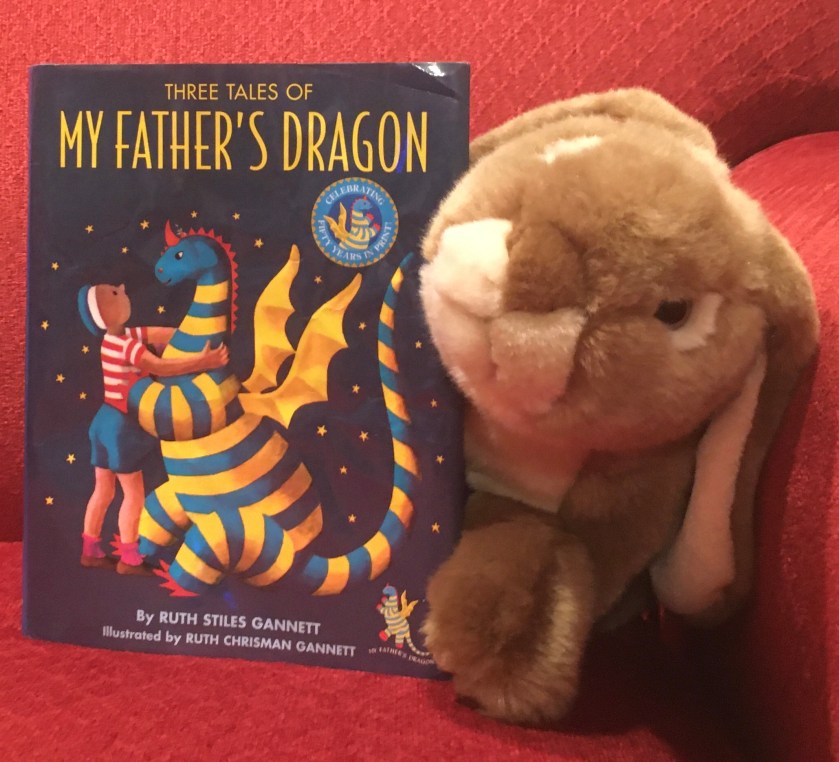
Caramel reviews Three Tales of My Father's Dragon, written by Ruth Stiles Gannett and illustrated by Ruth Chrisman Gannett.
Caramel reviews Three Tales of My Father’s Dragon, written by Ruth Stiles Gannett and illustrated by Ruth Chrisman Gannett.

Sprinkles: So Caramel, tell me about this book.

Caramel: This book is nice if you like happy books and dragons.

S: Oh, so it is a happy book about dragons?

C: Yes and no. It’s also about Elmer Elevator, who meets a cat, who tells him about a dragon. Then Elmer goes and finds this dragon.

S: So is Elmer the father in the title?

C: Yes. The first part of the book is told by someone who calls Elmer “my father”. It makes it sound like it is a true story that happened to someone’s dad.

S: Hmm, so the narrator of the first book, My Father’s Dragon, is Elmer’s child, right?

C: Yes. And Elmer is a nine year old boy when things are happening.

S: So it really reads like you are hearing a tale that Elmer told his child and that child grew up and is telling you the story. And then the remaining two books are told in the third person, right?

C: Yes. There is no narrator calling Elmer “my father” anymore. Elmer is only a boy in those two parts.

S: I see. So then Elmer finds this dragon and they get to be friends?

C: Yes. The dragon has blue and yellow stripes and has a long tail and has red eyes and red feet.

S: That’s a very colorful dragon!

C: Yup. The cat helps Elmer devise a plan to help the dragon and Elmer goes and saves the dragon. The first part of the book is all about Elmer finding the dragon. Then they become friends, and in the second book, they are stuck in an island. Then the dragon takes Elmer home, and in the third part of the book he goes to his own home, Blueland. And then there is some trouble there, and Elmer helps him.

S: That sounds like a sweet story.

C: Yes, I think so.
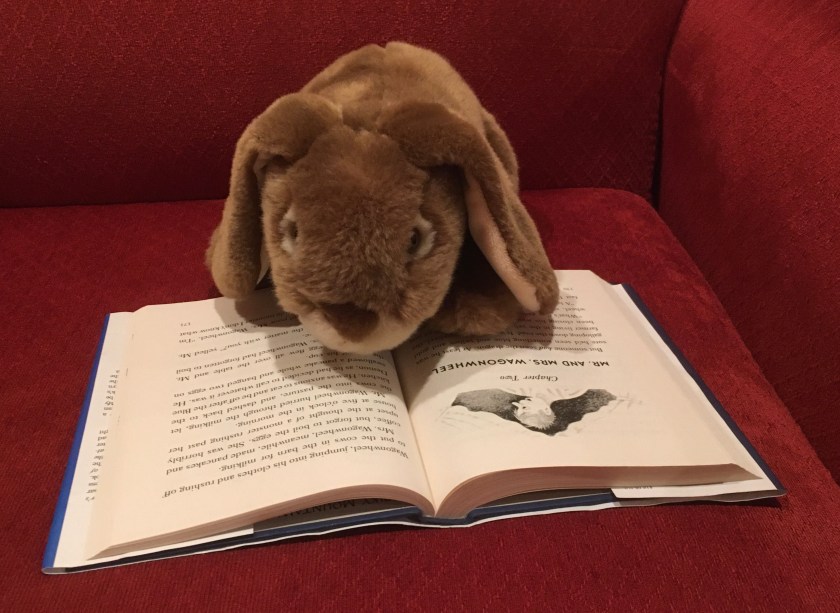
Caramel is reading Three Tales of My Father's Dragon, written by Ruth Stiles Gannett and illustrated by Ruth Chrisman Gannett.
Caramel is reading Three Tales of My Father’s Dragon, written by Ruth Stiles Gannett and illustrated by Ruth Chrisman Gannett.

S: So you have read a lot of books about dragons. Does the dragon in this book resemble any dragons you know of?

C: Not really. This dragon is completely different. He does talk, and he is very colorful, like he is wearing striped PJs, dragon-sized and shaped of course. And I don’t think he can breathe fire or anything.

S: Do any one of Elmer’s family or friends meet this dragon?

C: No.

S: So is Elmer the only human involved in the stories?

C: Yes. There are canaries, there is the cat, there is an adult gorilla, and six baby gorillas, but there are not any other humans in the story. I mean, some show up, but they don’t really play a role in the story.

S: That is interesting. Somehow a lot of the things you are telling me about this book remind me of another classic Marshmallow had reviewed way back: Mr. Popper’s Penguins by Richard and Florence Atwater, There were humans in that story, but the tone of the book and the happiness you are talking about reminded me of that one. Anyways, did you enjoy reading this book?

C: Yes. I especially liked the pictures.

S: Oh, tell me more.

C: They are all black and white, but they are very detailed and I could see exactly what Elmer and his dragon look like.

S: That sounds great Caramel. Would you have enjoyed being friends with Elmer and the dragon?

C: Yep. They are both fun and nice.

S: So did you know that there is apparently a 1997 animated movie version of this story?

C: Yes, we just found it, but it is in Japanese!

S: Yes, so we could not really watch it and understand it fully, but it was nice to look at, wasn’t it?

C: Yes. Let’s put it in here!

S: Sure. We can put a link to it. Here it is: https://youtu.be/5obEfjUyr6k. We might still watch it some day.

C: Especially if we learn to speak Japanese.

S: True. Okay, let us wrap up our review. What are your three words to describe this book?

C: Adventure, happy, friendship.

S: Hmm, those are not quite descriptive words, but I get your point. Thank you. So what do you want to tell our readers as we wrap things up?

C: Stay tuned for more book bunny reviews!
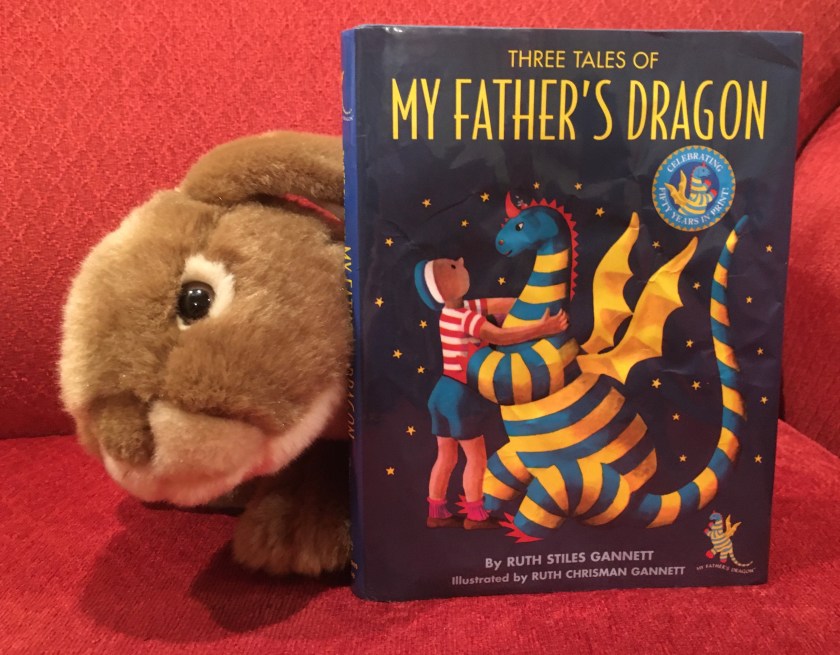
Caramel really enjoyed reading Three Tales of My Father's Dragon, written by Ruth Stiles Gannett and illustrated by Ruth Chrisman Gannett.
Caramel really enjoyed reading Three Tales of My Father’s Dragon, written by Ruth Stiles Gannett and illustrated by Ruth Chrisman Gannett.

Marshmallow reviews The Girl Who Drank the Moon by Kelly Barnhill

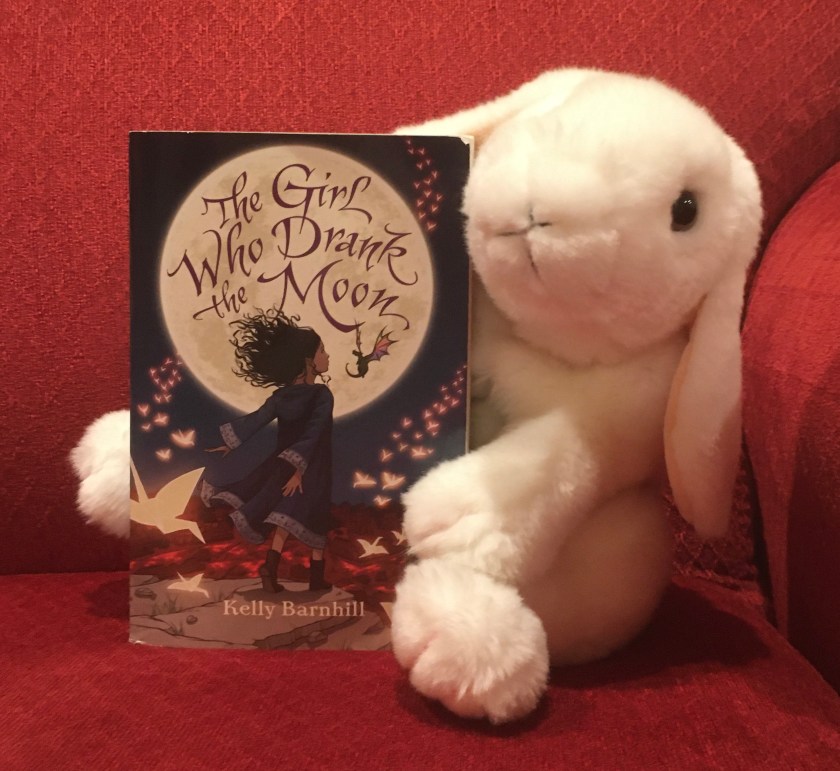
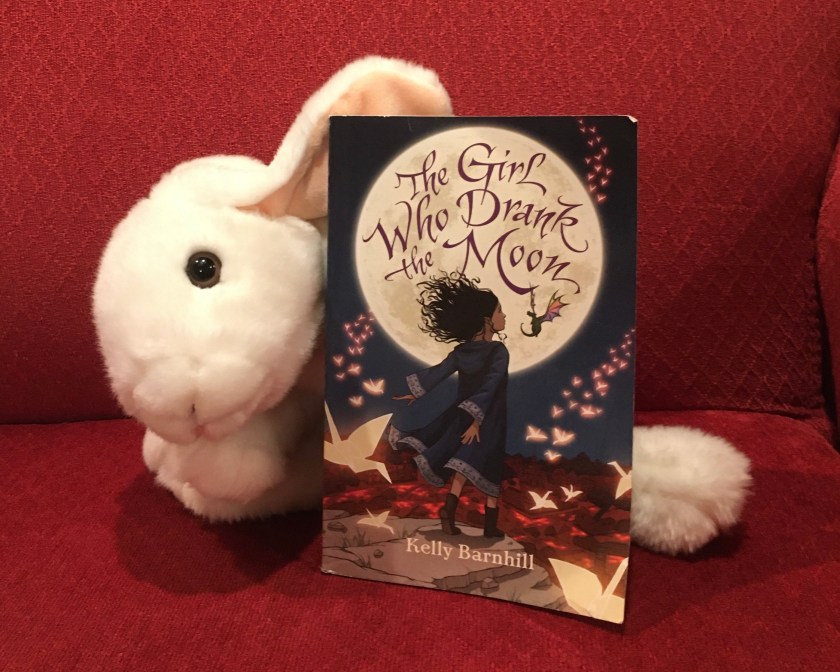
This week Marshmallow reviews The Girl Who Drank the Moon, the 2016 novel by Kelly Barnhill that won the 2017 Newberry Medal. Sprinkles is taking notes and asking questions.

Marshmallow reviews The Girl Who Drank the Moon by Kelly Barnhill.

Sprinkles: This looks like an interesting book Marshmallow. Can you tell us a bit about it?

Marshmallow: This book is about a girl named Luna and a witch named Xan. Luna comes from a village that sacrifices one baby per year. The baby is left in the woods, supposedly to be taken by an evil witch who lives in the woods. But it turns out that the witch is actually Xan, and she is very kind-hearted. She travels every year to pick up the sacrificed baby, and takes it to a loving family in a different village. The children brought by Xan are called Star Children in that village because Xan feeds them starlight before their journey through the forest.

However, one year, Xan accidentally feeds one of the children moonlight. Moonlight is more powerful than starlight and it enmagicks her. In other words, she ends up with extraordinary magical powers. Xan decides to name her Luna and raise her as her own.

S: That is a very interesting premise. And I can see why the book is titled The Girl Who Drank the Moon. I’m guessing that is Luna. So does Luna know any of this?

M: Not really. Not for a long time. And she cannot hear the word “magic”.

S: That is weird. So the book is about Luna and Xan and their adventures?

M: No. Not quite. There are multiple stories that are going on at the same time. There is a guy who is determined to kill Xan for example, but he is a good person, he just wants to protect his own child. And eventually we see Luna’s real mom show up. Lots of things are happening at the same time, and Luna is trying to figure out how to use her magic.

S: Hmm, that sounds intriguing. I might want to read it too some day.

M: Yes, I think you should. It is about family, love, and who becomes your family. Luna’s family is made up of a dragon and a bog monster besides the witch Xan, and eventually she is reunited with her birth mom too. And there is a surprising twist towards the end, but I am not going to spoil things.

S: Hmm, I guess I will just have to read the book to find out for myself.

Marshmallow is reading The Girl Who Drank the Moon by Kelly Barnhill.

S: So apparently there was a prequel published right around the time the book came out. What did you think of that?

M: I thought it was interesting to get some backstory on one of the characters. We should probably put links to them in our review.

S: Okay, here is the link to the first part of the prequel, and here is the second part. We should warn our readers that there are lots of popups and ads on the linked pages but the story seems to be worth it.

M: I’d say so.

S: Did this book remind you of any other books you have read or reviewed before?

M: No, I think it was quite unique. I’d say it is really a beautiful story.

S: What you did tell me so far reminded me of a couple of the stories in Soman Chaimani’s Beasts and Beauty: Dangerous Tales. Or even the beginning of the School for Good and Evil stories. There, too, children are taken to save their villages.

M: Yes, I can see what you mean. And I do love the School for Good and Evil books. But I view this book as something quite different.

S: Okay, it is a book of its own, deserves its own place among your favorites?

M: I’d say so. I will definitely reread it at least once more.

S: So then would you be rating it 100%?

M: Yes!

S: And that is a good place to wrap up this review then. I might just grab the book and start reading it right away.

M: You do that! And our readers, they should stay tuned for more amazing reviews from the book bunnies!

Marshmallow rates The Girl Who Drank the Moon by Kelly Barnhill 100%.

Marshmallow reviews Hoot by Carl Hiaasen

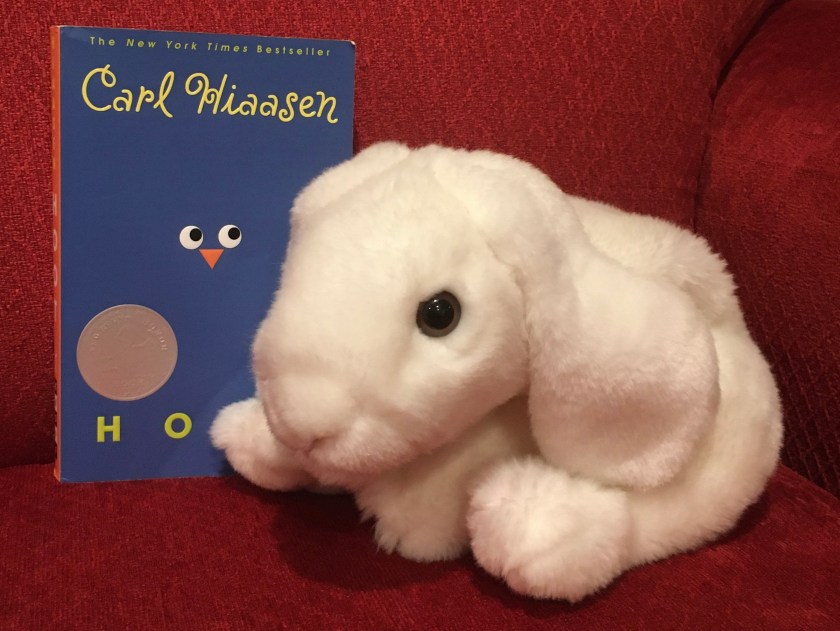
Today Marshmallow reviews Hoot by Carl Hiaasen, published first in 2002 and awarded a Newberry Honor in 2003. Sprinkles read the book, too, and is asking questions to Marshmallow and taking notes as they go along.

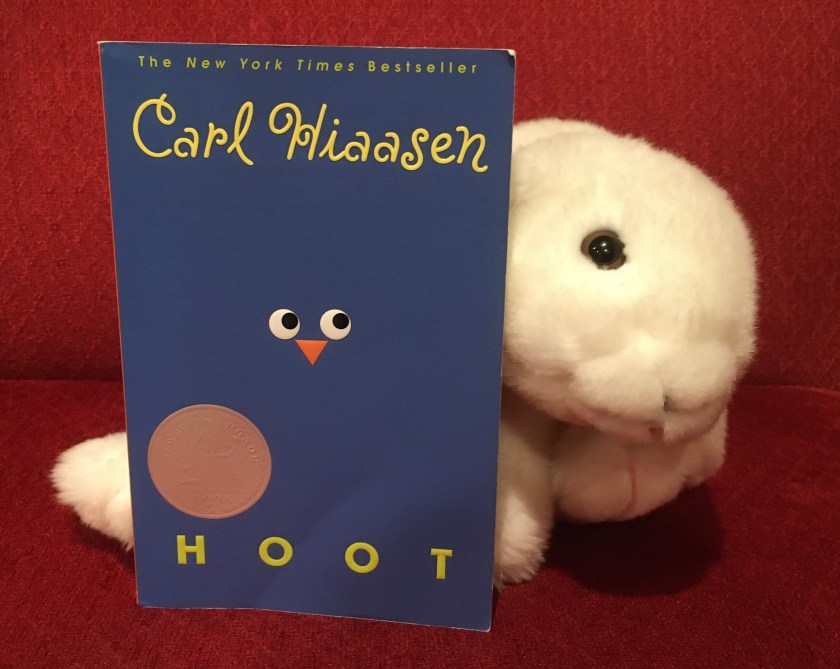
Marshmallow reviews Hoot by Carl Hiaasen.

Sprinkles: So Marshmallow, let us start with an overview of the book. What is the book about?

Marshmallow: It’s about this boy named Roy Eberhardt who has recently moved to Miami, Florida. One day while he is on the school bus, he sees a strange boy running outside without shoes. And the book is about him trying to find out who that boy is.

S: That sounds like the beginning of a good mystery. Would you say this is a mystery story?

M: Yes. It takes a while for Roy to figure out who that boy is and what is going on with him.

S: And then, the book is not yet over, though, right?

M: There is a second mystery in the book. There is a second narrator, besides Roy, who sees some other events happening, and he is also trying to figure out just what is going on. This one is a police officer named David Delinko.

S: And the two events end up being intertwined, right?

M: Yes. And things are tied in and resolved quite well at the end.

Marshmallow is reading Hoot by Carl Hiaasen.

S: It sounds like you enjoyed reading this book Marshmallow.

M: Yes, I did. I thought the two mysteries being related was really neat, like a typical Nancy Drew story. Or like in the FunJungle series.

S: And I know you really liked both Nancy Drew stories and all the FunJungle books. So that is a compliment, coming from you!

M: Yes. I especially thought the plot was very interesting.

S: You wanted to add “bullying” to the tags for the post. Why is that?

M: Because there is an older boy at school who bullies Roy, and that is actually why Roy comes to notice the running boy. And then the bullying is related to how things evolve and are resolved, too.

S: The bully gets his comeuppance, right?

M: Yes, but I don’t want to give too much away.

S: I know. Okay, let us not say much more about that then. What else do you want to tell us about this book?

M: When you interview Caramel about books, you ask him for three words to describe the book. So I think three words that could describe this book are animal-friendly, fast-paced, and mystery. Or maybe I’d describe the book as “animal-friendly, fast-paced school mystery”. That’s not three words, but then again, I am not Caramel.

S: That makes sense to me, Marshmallow. And that is a good description of this book. We did not say much about the animal-friendly part but I suppose our readers might guess that from the title.

M: Yes, “hoot” is the sound owls make. So the readers might already guess there will be some owls somewhere.

S: Yes, I think that is quite reasonable. We rabbits may not like owls much, but the owls in this book are cute and lovable. Right?

M: Yes. They are nothing like Mr. Ocax in Poppy. They’re more like Rufus in Of a Feather.

S: Okay, Marshmallow, I think it is time for us to wrap up this review. What would you rate this book?

M: I’d rate it 95%. It is a good read and the two mysteries keep you wanting to read it fast.

Marshmallow rates Hoot by Carl Hiaasen 95%.

Marshmallow reviews Nothing But The Truth by Avi

Marshmallow first read Avi’s Nothing But The Truth in school. Then this summer, during the book bunnies’ break, she had reason to get back to this documentary novel once more. Below she shares her thoughts on this book, first written in 1991 by Avi, the author of the Tales from Dimwood Forest series that Caramel reviewed several times times for this blog, and awarded a Newberry Honor in 1992.

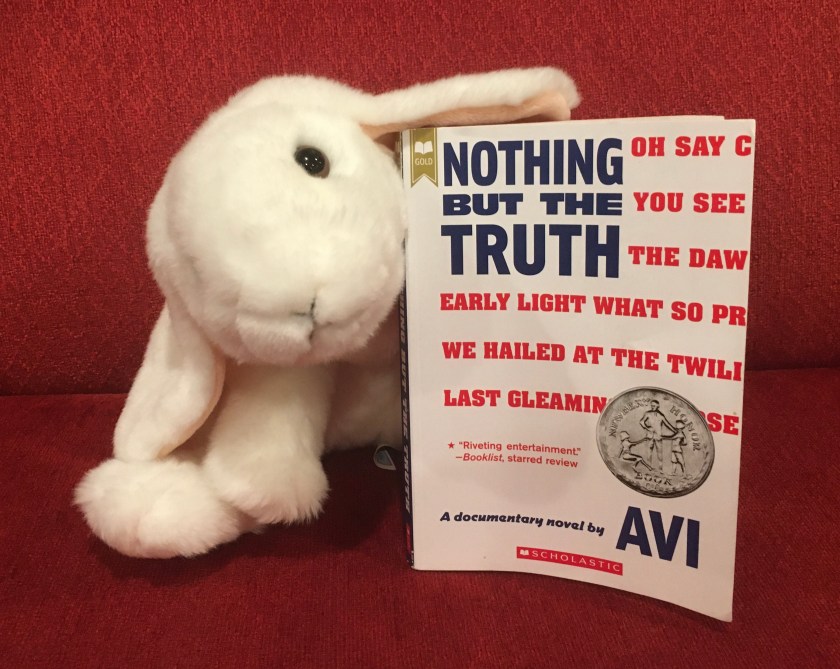
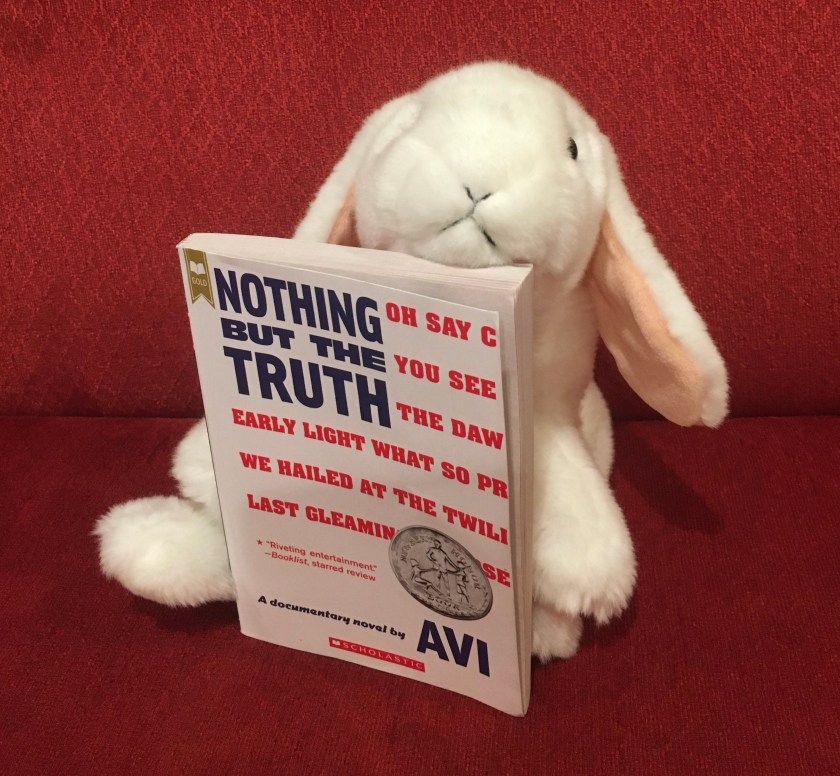
Marshmallow reviews Nothing But The Truth: a documentary novel by Avi.

Marshmallow’s Quick Take: If you like books about school or you like thinking about different perspectives on a particular event, then this might be the book for you. 

Marshmallow’s Summary (with Spoilers): Philip Malloy is a high school student who loves running but dislikes his English teacher. He thinks that she is out to get him. When he learns that he needs to get a passing grade in every class to try out for the track team, he decides he needs to get moved out of his English class.  

His teacher, Miss Narwin, thinks that Philip is smart, but that he does not work hard. During English class, Philip constantly makes rude comments and disrupts the class. Now that he has moved to Miss Narwin’s homeroom, he starts to hum or sing during the daily playing of the national anthem, “The Star Spangled Banner”. (It is unclear whether he hums or sings, as the characters believe different things happened.) The school’s rule is to stand in respectful silence while the anthem is played, so Miss Narwin tells him to stop doing what he is doing.

Philip hums or sings during the anthem a total of three times on three different days, hoping he’ll annoy his teacher enough to be moved to a different class. The third time he does it, Miss Narwin tells him to go to the office. There, the assistant principal asks him to apologize to Miss Narwin. Philip refuses, though he is threatened with suspension and a bad mark on his record. Eventually he is suspended and his mother is called to pick him up.

Philip tells his parents that Miss Narwin yelled at him for singing or humming. His parents tell their neighbor Ted Griffen about the event. Griffen is running for the school board, so when he hears about this story, he wants to have it published in the papers. He contacts a journalist to ask some questions about the event, and soon, the journalist writes an article about the event titled “Kicked Out Of School For Patriotism”. The article spreads the news about Philip’s suspension, and soon, people around the country have all heard about the event.

People start to send telegrams to the school, Miss Narwin, and Philip Malloy. The telegrams to the school say that they should fire Miss Narwin. The ones to Miss Narwin say things like, “Surely you have something better to do with your classroom authority than attacking kids who express their love of our country.” The telegrams sent to Philip support his “patriotism”. As the book progresses, it gets harder and harder to tell what really happened and who is telling the truth. 

Marshmallow is reading Nothing But The Truth: a documentary novel by Avi.

Marshmallow’s Review: I think that Nothing But The Truth is a really interesting book. It is written like a play when there is dialogue (with minimal narration), but the author also shows us excerpts from Philip’s diary, memos, letters, and more. I can see why it is called a documentary novel: it seems to be documenting a real event with different kinds of documents that the reader needs to interpret to understand what really happened. I also found it interesting to read Avi’s explanation of how he ended up writing this book.

The characters themselves are really realistic, with normal hobbies and everything, though they are not always trustable (similar to books or movies with unreliable narrators). The author, Avi, does a great job in making you feel really annoyed by certain characters. And you also sympathize with some of them.

I really liked how Nothing But The Truth keeps you thinking about what really has happened and how you can’t always trust the information that you are given. Its central story has many different interpretations, and what is true, and what is right, is not always what it seems.

Marshmallow’s Rating: 95%.

Marshmallow rates Nothing But The Truth by Avi 95%.