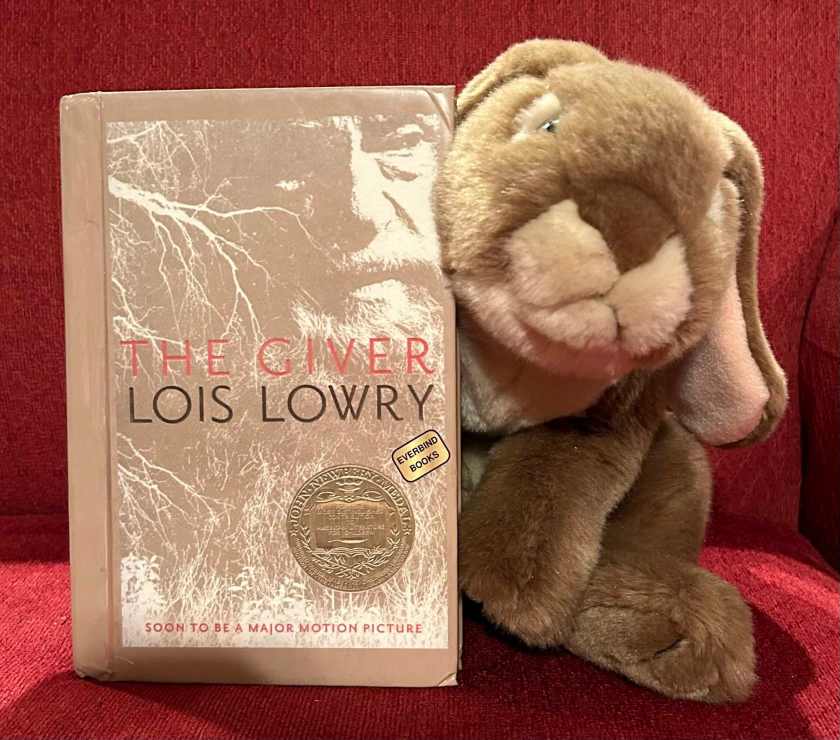
Today Caramel reviews a book he read in school: The Giver, by Lois Lowry. Published originally in 1993, the book has already become a classic, read by many students across the United States; it has also won the Newberry Medal in 1994. Sprinkles, who has not had the chance to read the book yet, is asking questions and taking notes.
Caramel reviews The Giver by Lois Lowry.
Sprinkles: So Caramel, today we are talking about The Giver, a book you have read and discussed in school over the course of a few weeks.
Caramel: Yup.
S: So let us start at the beginning. Can you tell our readers what the book is about?
C: Yes, sure. This book is about Jonas, a boy that lives in a community that controls the lives of those that live in the community.
S: I see. In what ways are they controlled? Can you give some examples?
C: They are not able to decide who they marry or choose their jobs. Even their death is controlled! The leaders get to choose who dies and when. They also choose the names of the newborn children. So the world of those who live in the community is very controlled, and they basically have no choice in anything.
S: Oh my goodness! When you first began with people not getting to choose who they marry or what their jobs should be, I was going to say that that has been the case in many societies throughout history, but then things got even more and more restrictive. No wonder this book is classified as a dystopian novel. Which according to my trusty dictionary means “an imagined state or society where there is great suffering or injustice.”
C: Yup, it sure does make sense, doesn’t it? But there is more. The people are also taking drugs to not have any emotions. Color is also taken from their lives, so at least they are not racist. But seriously, they are supposedly doing all this so everyone is equal, but it is pretty depressing.
S: Wow! That is really disturbing. Marshmallow had read and reviewed Brave New World where the people also had access to a drug called soma but there the drug was to just make them not feel bad things. That was also bad, of course, and it numbed them and made them more complacent, but forcing people not to have any emotions, and not to even see color, sounds really terrible.
C: This is kind of a next level of control from Brave New World, even Nineteen Eighty-Four, I think. I mean I have not yet read those books, but from what Marshmallow wrote in her reviews, I have got a pretty good idea of what is going on.
S: Well, it seems you did understand them well enough. And of course you should read them at some point, too. But you are making a good comparison, Caramel. In Nineteen Eighty-Four, maybe there they do not mess with feelings in the same way; rather they break people who have attachments to other people and make them love the Big Brother only.
C: In The Giver, too, they have a Big Brother-like leadership group. So for example, if you speak out against them once, you are “released.” Or injected with a deadly poison. The same happens with twins: one is kept, and the other is killed.
Caramel is reading The Giver by Lois Lowry.
S: Alright so in this dystopian world, what is going on? You told us the setting. Now tell us the plot, the events.
C: Sure. So in the beginning, Jonas, the main character, starts to notice some weird things, For example, he starts to see some color. Like he has an apple and it for a moment becomes red. And then his friend Fiona is in color, too. But remember they could not see color before.
S: It must be shocking to start seeing things in color if you had never seen color before. I remember the first color TV I saw, and I was so excited. But I could at least see color outside a TV screen before.
C: Yep, it made him think that he was going crazy.
S: I bet! So then he starts asking questions and trying to understand what is going on with him and with his community and learns some really big secrets?
C: Hey, I was just going to say that! You stole my line Sprinkles.
S: Well, I have read my fair share of dystopian novels.
C: That is probably true. I have not read as many books as you.
S: Well, you are still a very little bunny. And so you have many years to catch up. I bet you will catch up and pass me in just a few years…
C: Maybe, just maybe.
S: Anyways, so what did you think? Did you enjoy reading this book?
C: Yep, it was a good book, except for chapters 11-13. I thought those were a bit too mushy, so I only skimmed through them. I am not sure I missed much.
S: I am guessing you are using mushy the same way Marshmallow uses it so some close romantic relationships were involved?
C; Yeah, but it really did get a bit too mushy for me.
S: Okay, I understand. So I would expect that there was some character development and such in those sections, so you probably did miss some things like that. But that’s alright. About the main setting and the story though, did things feel a bit too tense for you while you were reading it? Too depressing? It feels like it is a really oppressive world.
C: Yeah, it is really oppressive. So I did not enjoy it like fun and games because it is about a very harsh world, but the story is very interesting, so I kept on reading. Also I had to read it. It was for school, remember?
S: Yes, true that. But for example, do you think I should read the book, too? Do you think other young bunnies should read it?
C: It is probably better suited, I suppose, for those bunnies that are not too young, but somewhere in the tweens or teens, everyone over ten or something should find it an interesting book, too. So yes, Sprinkles, you should definitely read it!
S: Hmm, my last dystopian novels were the Hunger Games books that I read after Marshmallow recommended them. I guess I should look into this one, too. Did you know that there are apparently three other books from the same author that take place in the same world as The Giver? Do you think we should look into getting a copy of one of those for you?
C: Maybe, but I think that this is kind of conclusive, and works really well as its own thing.
S: Oh, so no cliffhangers. That is great! And maybe you can take a break and look at some other worlds and stories for a bit.
C: I’d like that. Maybe I will get to read a totally different type of book next week. We might at some point come back and revisit Jonas’s world though. I could like that, too.
S: Sounds good. This might be a good place to wrap up this review Caramel. What do you want to tell our readers?
C: Stay tuned for more book bunny reviews!
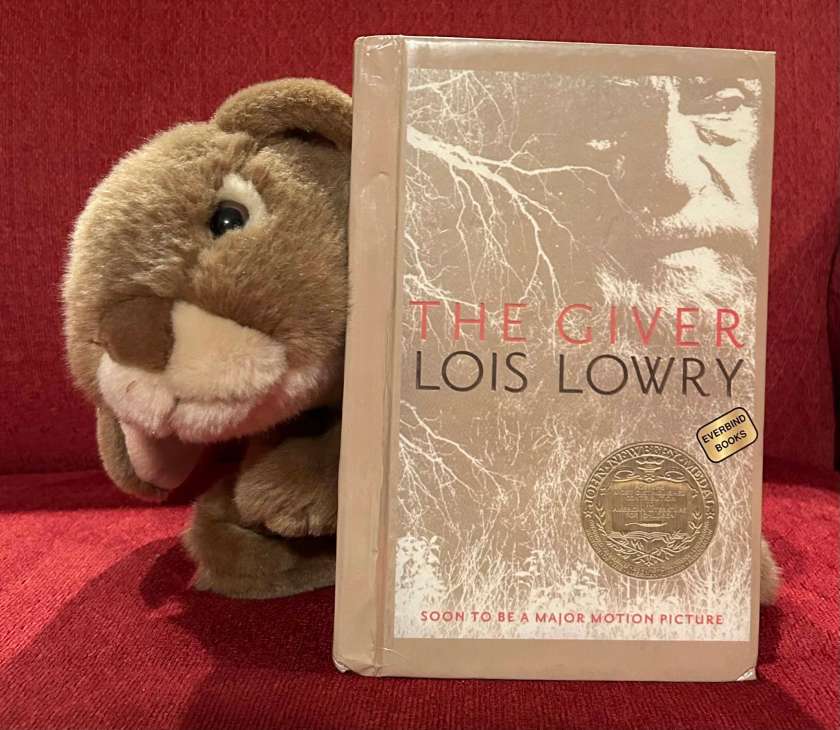
Caramel has enjoyed reading The Giver by Lois Lowry and is curious about the other books its author wrote as sequels.
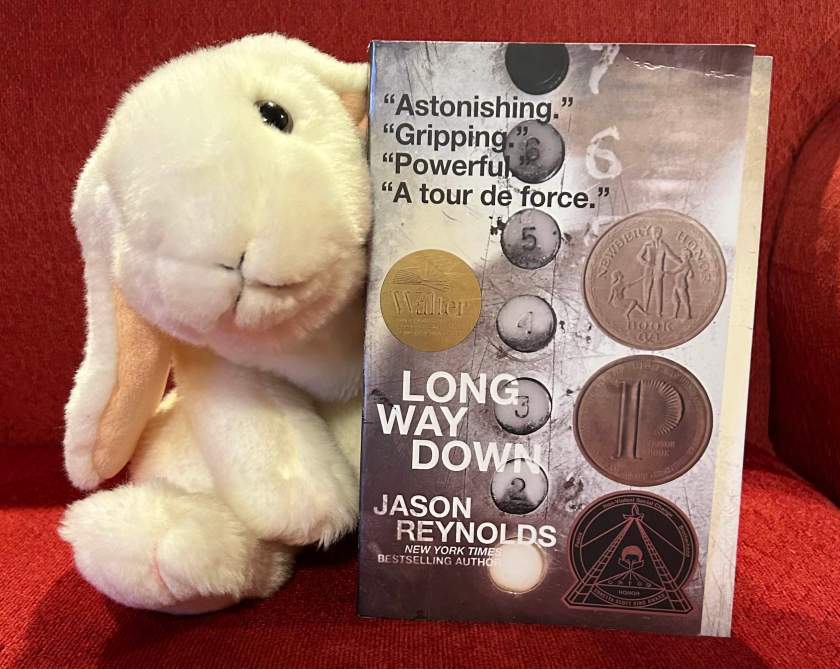
In her second review for 2024, Marshmallow talks about Long Way Down by Jason Reynolds, first published in 2017, and awarded the Newberry Honor in 2018.
Marshmallow reviews Long Way Down by Jason Reynolds.
Marshmallow’s Quick Take: If you are interested in reading books about family, gang violence, growing up against significant challenges, and morality, then this might be the book for you.
Marshmallow’s Summary (with Spoilers): Will’s brother, Shawn, was just shot in front of him. They live only a couple blocks away from the territory of the Dark Suns, a dangerous local gang, and Shawn had gone into their territory to get a special soap for their mother’s eczema. Will is sure that he knows who is responsible for his brother’s death: Riggs. And he is going to make sure that Riggs pays for it.
See, Will lives in a hard, tough neighborhood. There are gangs, shootings, murders, and violence regularly. And everyone follows the Rules. Shawn, in fact, was the one who taught them to Will:
Number 1: No crying,
Number 2: No snitching,
Number 3: Get revenge if someone hurts your loved ones.
Will is determined to follow the Rules. He sure is not going to cry or “snitch” to the police, but he is going to try to get revenge on Riggs. He takes his brother’s old gun (which is fully loaded except for missing only one bullet) and heads out of his apartment on the eighth floor, to get to where he thinks Riggs is as soon as possible. He gets on the elevator and presses “L”, for lobby.
Unfortunately for Will, it is a long way down and the elevator stops at each level, a person getting on at each. What is more, these are not normal people. These are dead people who Will knew. First, it’s a friend of Shawn. Next, it’s Will’s old friend who was shot at a playground with him. And so on.
Each person Will meets in this short elevator ride that takes the whole book is important to him in some way. His mindset, originally so focused on revenge, starts to loosen. Once the elevator reaches the last floor, will Will continue with his plan or will he make a different choice?
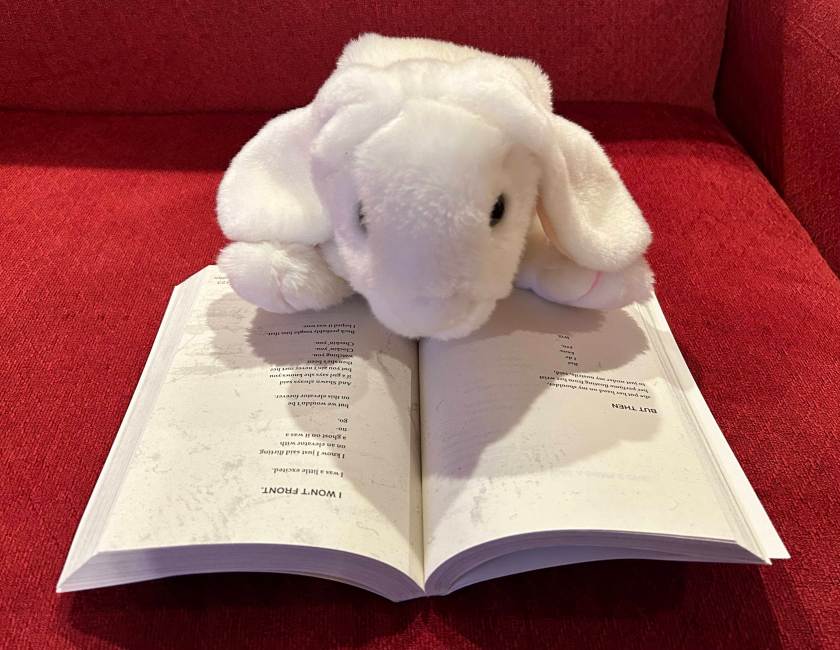
Marshmallow is reading Long Way Down by Jason Reynolds.
Marshmallow’s Review: I think that Long Way Down is a very successfully written book, in more ways than one.
I, personally, do not always love books written in verse; I sometimes find it hard to discern the plot and I feel like it limits character growth. Before this book, Starfish by Lisa Fipps was the only such book I really appreciated. So when I started reading this book and realized it was in verse, I was a little disheartened. However, I feel like this book was very successful in all the categories most good novels excel in. The narration through Will’s eyes and voice worked well, the characters introduced came across quite clearly, and the events unfolded effectively. The free-style though structured poetry added to the feeling of confinement in an elevator.
Both the plot and the premise of Long Way Down are most intriguing; the whole book takes place in the course of one fateful elevator ride as conversations unfold in front of Will. I do want to warn readers that there is a cliffhanger at the end of the book, and this is not part of a series. However, the journey to that point is worth it. The author did not leave things hanging just for the sake of it of course; the end makes the reader think hard about what will happen next and process the message of the book even more carefully. I can see this book successfully paired with The Outsiders by S. E. Hinton in important discussions young people can have about gangs and violence.
If it is not clear already, let me say explicitly that I think Long Way Down is important for bunnies of all ages to read. There is some slang used, and of course the weight of gang violence might make the book a bit inappropriate for the youngest bunnies. But for bunnies reading middle grades books, it is an important (and quick, breathless) read. Will’s story makes you realize the harsh reality of gang violence if it is not your own actual reality. Many people, pop culture, and the media glorify gangster culture, but this book shows what happens to the people who are affected.
Marshmallow’s Rating: 100%.
Marshmallow rates Long Way Down by Jason Reynolds 100%.
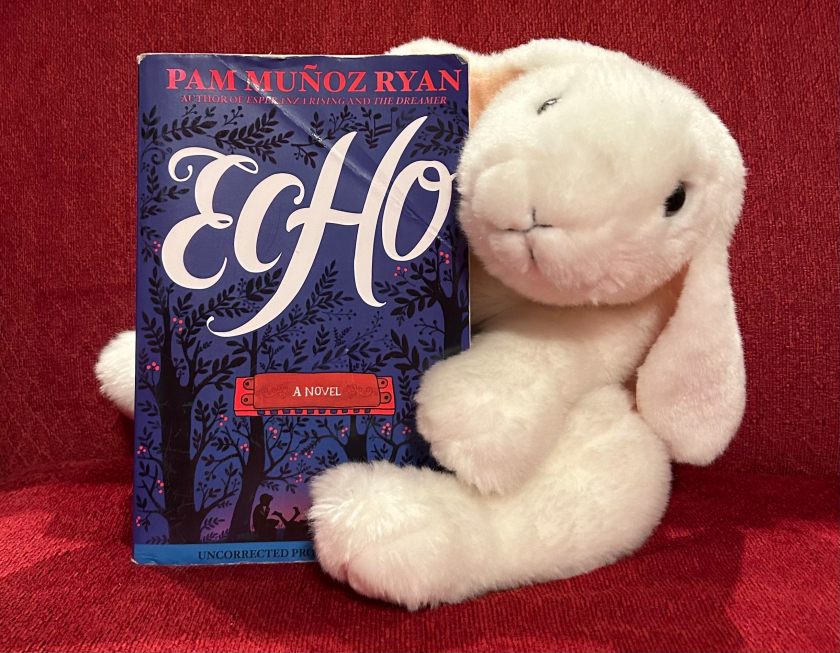
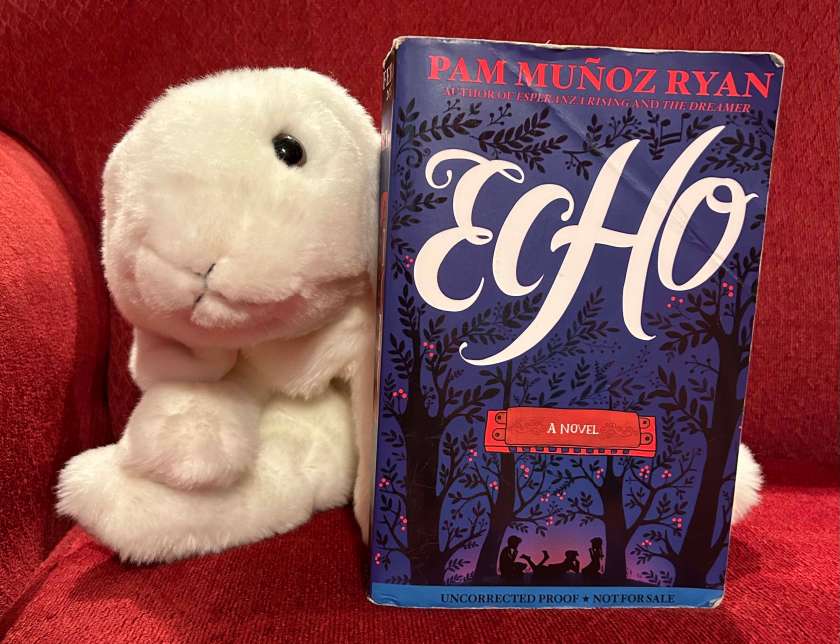
In the past weeks and months, Marshmallow has reviewed several books by Pam Muñoz Ryan. This week she went back and reread the very first book she had read by her, Echo. This book was published in 2015 and won Muñoz Ryan a Newberry Honor in 2016. Marshmallow originally read it for school a couple years ago, and she very much enjoyed revisiting it this week. Below she shares her thoughts on this 600-page page-turner.
Marshmallow’s Quick Take: If you like books based on historical events or if you have enjoyed reading some of Pam Muñoz Ryan’s other books, then this might be the book for you.
Marshmallow’s Summary (with Spoilers): “Fifty years before the war to end all wars”, a little boy named Otto goes into the forest to hide while playing hide-and-seek and gets lost. Having recently bought a book and a harmonica from a Gypsy, he gets so intrigued by the story in the book that he does not realize how long he had stayed hidden.
The tale is about three sisters who were raised by a witch. The three sisters were in fact the daughters of a king who desperately wanted a son. Upon their birth, the king ordered the midwife to leave them in a forest. The midwife took pity on the babies and brought them to a witch, who named them Eins, Zwei, and Drei in the order they were brought to her. These girls grew up unaware of their royal origins. Years later, when the king died, his son (the sisters’ brother) learned of them. He and his mother were overwhelmed with happiness and sent the midwife to bring them to the kingdom. The midwife came and told the sisters the good news. However, the witch did not want to lose the girls, who had become useful servants to do all the work. She cursed them, saying that they could never leave the forest unless they saved someone’s life.
After tripping and hitting his head, the little boy, Otto, wakes up and discovers the sisters in the forest. The sisters, Eins, Zwei, and Drei, help Otto find his way home but ask for a favor. They each take a turn playing the harmonica, and it appears that they store their spirits in the harmonica. He promises to pass on the harmonica when the time is right.
Seventy years later, Friedrich Schmidt discovers the harmonica in Nazi Germany. Born with an unusual birthmark and a father who dislikes the new regime, Friedrich is not safe. When his father is taken to Dachau, Friedrich’s life turns upside down.
Years later, in Philadelphia, Mike Flannery is living in The Bishop’s Home for Friendless and Destitute Children. His brother, Frankie, is a fountain of enthusiasm. Mike and Frankie must stick together. When a rich woman named Mrs. Sturbridge adopts them both, it seems like all their dreams have come true. Mike soon gets his hands on a harmonica that has an unusually magical sound (and yes, of course, this is the same one Otto and Friedrich had). However, Mike eventually discovers that Mrs. Sturbridge is planning to “unadopt” them and he must figure out a way for him and Frankie to stay together.
Much later, Ivy Maria Lopez in California is excited to play a harmonica solo on the radio. The United States just joined World War II, and Ivy’s brother is off fighting in the army. Ivy soon learns that her family is moving again and she won’t be able to perform her solo. Upon moving, she faces segregation. The Hispanic children are put in a different school from everyone else. Prejudice and hate seem to be everywhere during the war. Can Ivy adjust to her new home?
Marshmallow is reading Echo by Pam Muñoz Ryan.
Marshmallow’s Review:Echo is perhaps my favorite book by Pam Muñoz Ryan, and I really enjoyed (re)reading it. I especially love the end, and I really love how the separate stories are all tied up in the end. All storylines are set in different time periods, with different characters, and different plots, but they are all connected by the harmonica and wrapped together in the end. Some themes that are started in the beginning are repeated in the end, which makes it feel even more like a conclusion. It is impressive that the author could distinguish all the stories and make each a separate line but put them together in a fashion that was not clunky or confusing.
The characters are all unique, and you come to really care about them by the end of the story. They each have strong connections to music which brings them joy and empowers them to face challenges. The tragedies they face and the events that occur are all based on real history. (For example, while writing the book, Pam Muñoz Ryan researched Roberto Alvarez v. the Board of Trustees of the Lemon Grove School District (1931), a desegregation case from California with connections to Ivy’s story. The internment of Japanese Americans during World War II also plays a significant role.)
I think another strong point of this book is the fact that it tackles several challenging issues in one place successfully. The author weaves a tale spanning from Nazi Germany to a negligent, abusive orphanage to a war-torn California. The hate, neglect, mistreatment, prejudice, and unfairness the characters face and eventually overcome all make this an even more touching story.
The only flaw with Echo one may find is the contradictory tones of the different parts of the book. The prologue is a major part of the overall plot but has a more fantasy-like, magical atmosphere. Then the vibe of the book changes significantly. The realistic, down-to-earth, historical fiction aspect of the rest of the story does not really follow naturally from the fantastic, magical, surrealist tones at the beginning.
However, I still loved Echo. I would recommend it to all readers. The writing is not particularly difficult to read but the topics and plot make it intriguing to older readers as well.
In short, Echo is a touching, majestic piece of literature that should hold a place on everyone’s bookshelf and everyone’s heart.
Today Marshmallow is reviewing The Inquisitor’s Tale: Or, The Three Magical Children and Their Holy Dog, the 2016 novel by Adam Gidwitz which won a Newberry Honor in 2017. (Coincidentally she had already reviewed the book that won the Newberry Medal that same year: The Girl Who Drank the Moon by Kelly Barnhill.) Following Marshmallow and her recommendation, Sprinkles also read the book, which offers a lot of food for thought, both for young bunnies and the not-so-young ones. The two bunnies discuss the book together below.
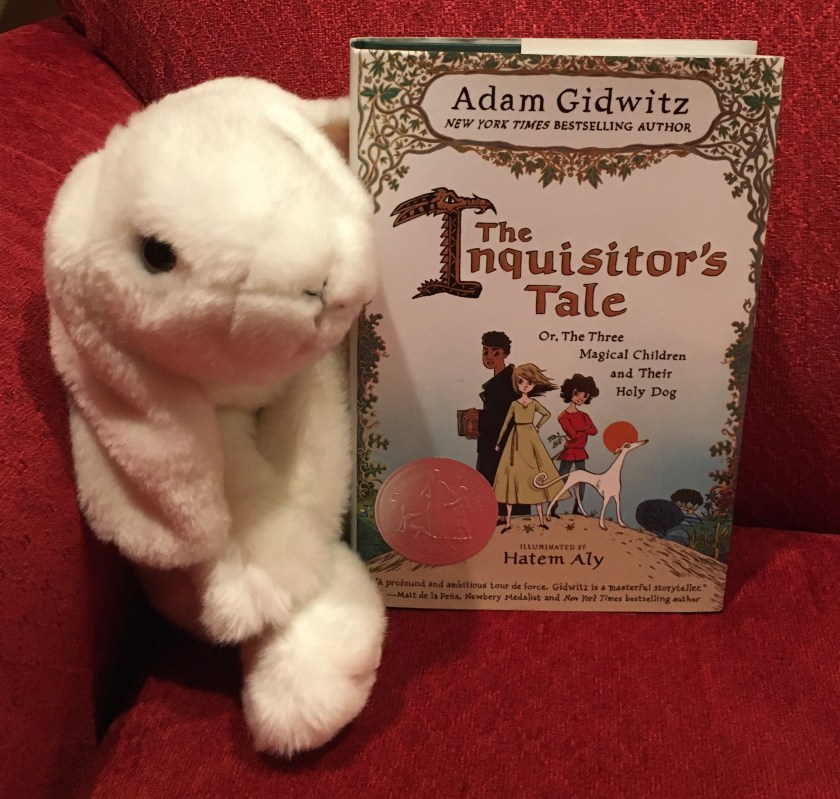
Marshmallow reviews The Inquisitor’s Tale: Or, The Three Magical Children and Their Holy Dog, written by Adam Gidwitz and illuminated by Hatem Aly.
Sprinkles: So Marshmallow, why don’t we start with a brief introduction to the book? What is the book about?
Marshmallow: This book is about three kids, named Jeanne, William, and Jacob, and their dog, named Gwenforte. The kids have superpowers. Jeanne has fits and can see the future when having them. William is tall and very very strong. And Jacob has the power to heal people, but at an uncanny level. Even the dog seems magical. She died and then many years later reappeared above the plot of land she was buried in.
S: The subtitle of the book sort of hints at this, right? Three magical children and their holy dog?
M: Yes. And they are living in France, in the middle ages.
S: Yes, the story starts in 1242, and there are a lot of historical facts and people who show up in the book.
M: Yes, for example the king is Louis IX, the ninth Louis, and we also get to meet his mother Blanche of Castille. They are both real people from the history of France.
S: So in some very real sense this is historical fiction, which according to Wikipedia is “a literary genre in which the plot takes place in a setting related to the past events, but is fictional”.
M: Yes, but if we want to talk about genre, I think we might also have to talk about magical realism. Remember, I reviewed two books that I thought fit this category before: Ikenga and Hurricane Child.
S: Why would you say that?
M: Because everything seems real and like things are in the real world, but every now and then some weirdly magical stuff happens. And some of the characters interpret them as magic, and some think they are miracles. But they are almost always extraordinary and supernatural.
S: Can you give an example?
M: Jeanne has visions of the future for example. And then there is a dragon whose fart causes things to burst into flames. And everyone acts as if dragons are real and the main issue is that this dragon’s fart is unexpectedly deadly.
S: Yes, there is a farting dragon, and I am sure Caramel would love to learn more about that. And you are right, I think. I’d agree that this book is somewhere between magical realism and historical fiction. In fact at the end of the book, there is a section where the author explains which parts of the book are real history, which storylines he took from legends and myths and other stories of medieval times, and which he himself totally made up. All together these all add up to make a really rich story, don’t you think?
M: Yes. And the book is written like a medieval manuscript. There are illustrations on most pages, and they are credited as “illuminations by Hatem Aly”. Illuminations are the decorative illustrations that were sprinkled here and there in medieval manuscripts. We learned about them in history class when learning about the middle ages.
S: I can see why the author and the illustrator and the publisher decided to call these illuminations, besides the historical connection. I think they are not just illustrations that would accompany the text and depict some event happening in there. Sometimes they do not seem to be directly related to the story at all.
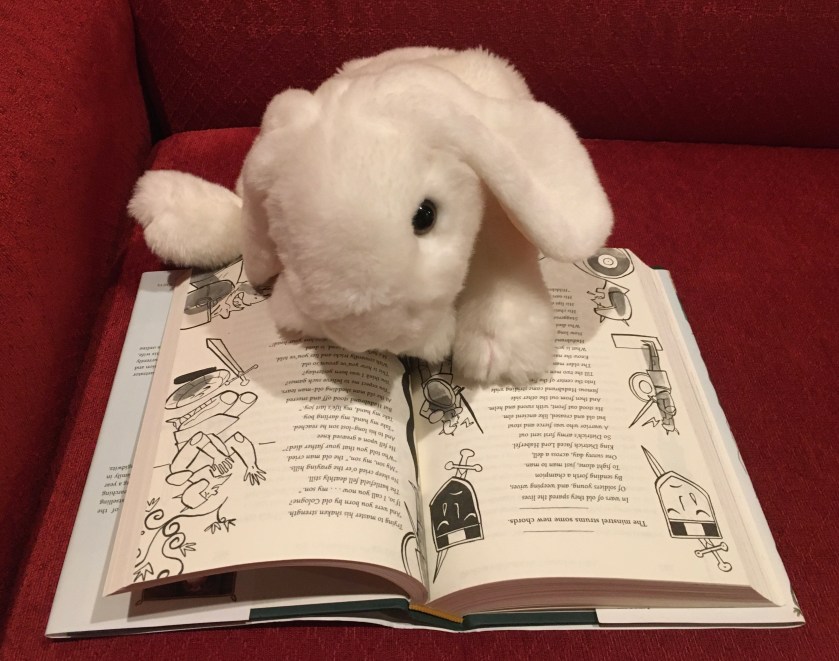
Marshmallow is reading The Inquisitor’s Tale: Or, The Three Magical Children and Their Holy Dog, written by Adam Gidwitz and illuminated by Hatem Aly.
S: So you read this book a while ago and really wanted me to read it, too, so we could discuss it. Can you tell me why?
M: Because this book, more than any other book I read or reviewed recently, talks about religion at length, and I wanted to think out loud about some of the themes that came up together with you.
S: You are right of course. The book talks a lot about religion. Europe of the thirteenth century was almost a Christian continent, and we see this in the characters and their world views very clearly throughout the book. And Jacob, one of the three magical children, is Jewish, and we also see the tension between his world and the world of the other characters involved. In fact one of the main challenges the children have to face involves the king’s decision to burn all copies of the Talmud in France so as to get rid of all non-Biblical wisdom available to the Jews. And this was actually a real event that happened. Some background can be found in this Wikipedia article about the Disputation of Paris. Did you know what the Talmud was before reading this book?
M: No, I did not. But reading this book made me curious. It seemed to be really important to the Jewish communities and it seemed like Louis IX was trying to destroy something sacred to and vital for them. Then I learned from the relevant Wikipedia article that the Talmud is a collection of writings of more than a thousand Jewish scholars that addresses all sorts of theological and philosophical issues as well as very practical ones, like how to live one’s life.
S: So the children set out to try and save the copies of the Talmud that would be burned. Why did they want to do that? Only Jacob is Jewish. How come the other children agreed too that this was an important thing to do?
M: Because it was centuries of knowledge and wisdom collected and cared for by generations of people. And of course it was not fair to the Jewish communities who had so cared for these volumes of books one generation after another.
S: Yes, there is a part of the book when the children realize how each book is written and illuminated by a person who dedicates years of their lives to this work. And I really liked this because, even though we have the publishing press today and books can be published much faster, a book is still the product of many years of hard work of many many people.
M: And I like books! I mean I can like some books more than others, but every book I read takes me to a different world! I would not want even the worst novel I read to be burnt. And these are not novels. They contain sacred wisdom of a whole people. It just seems pretty terrible.
S: Yes, and the children can see beyond their own differences of world views, their own religious backgrounds, to see the value of these books and the cruelty of burning them.
M: Of course they are kind of guided to this by Michelangelo of Bologna, “the red, fat, and wicked” priest who begins as their nemesis and ends up being their friend and mentor. And in the end he turns out to be–
S: Wait, let us not spoil that. That is revealed all the way at the end and we don’t want to spoil it for our readers.
M: Okay.
S: How about we instead talk about one of the big questions of all time that shows up in the book? The question of evil? The question of the reason and the justification of the existence of evil in a world created by a good God?
M: Yes. Some really bad things happen in the book, and at some point the children are so sad that they ask why God ever allows for such bad things to happen if He is good. And I think this is a really tough question. I don’t know how to answer it.
S: I think you are not alone Marshmallow. This is a big question for a lot of theologians and philosophers. What did you think of the answers offered in the book?
M: I’m not sure I totally understood them.
S: Well, the main Christian answer is, I think, captured in the Book of Job, and the drunk friar named Roger Bacon recites a part of that book to explain that the living are too small to understand the grand plans of God. What may seem like evil to us may not be. What we find wrong and bad may not be.
M: And then there is a troubadour (apparently that is a “a French medieval lyric poet composing and singing in Provençal in the 11th to 13th centuries, especially on the theme of courtly love”) who gives a different answer. He says God is a troubadour. I did not quite get that answer.
S: Yes, there is a part of the story when a troubadour sings The Song of Hildebrand, a story of a father and son who meet in battle. The father recognizes his son but cannot convince him that he is his father, so they go on and battle and it is all pretty bad and sad all around. And the troubadour sings this song and the song is sad, too, but it is also beautiful. And then he says that this is how our lives are. When we live them, it may be sad and ugly and terrible and we cannot make any sense of it. But all in all, there is a song that God is putting together and that song is beautiful. I think in a way this is the same answer as the answer from the Book of Job. While we are in the thick of things, going through the rollercoaster of life, we cannot appreciate the big picture. But the faithful believe that there is a meaning to it all, and it is known to God.
M: Hmm, I will have to think more about that.
Marshmallow is reading The Song of Hildebrand in The Inquisitor’s Tale: Or, The Three Magical Children and Their Holy Dog, written by Adam Gidwitz and illuminated by Hatem Aly.
S: Okay, then let us get back to the form of the book. What can you tell us about the general organization of the book?
M: Well, there are twenty-seven chapters. Each of them is titled The Innkeeper’s Tale, the Nun’s Tale, and so on. Each is told through the perspective of someone else who knows a part of the story of the three children and their dog. And slowly, chapter by chapter, we get to learn their story as it unfolds. Also there is a main narrator, who is the “I” of the main story. And he is trying to learn about the children and what happened to them and so on.
S: So maybe it makes sense to also tell our readers that the story starts in an inn and the different people talking are all at that inn, taking turns, telling us the story of the children, in more or less chronological order.
M: Yes, I guess that would also be useful to know.
S: In that way the book resembles some medieval stories, in particular The Canterbury Tales and the earlier Decamoeron, which were each written as collections of tales told by a handful of characters one after another.
M: I did not know about those earlier books. But looking them up on Wikipedia, I see that they were both written in the middle ages, so it makes sense that the author chose this form. I like that!
S: Me too. It somehow gives the book an even more authentic feel.
M: Agreed.
S: Okay, Marshmallow, this is already a pretty long review. Let us try and wrap things up. Who is your favorite character?
M: I liked the children a lot. They are all good people. And they are also in some ways very realistic even though they have some strange super powers. They act like real children.
S: True. Which super power among the three would you have liked to have if you could choose?
M: Probably the healing power of Jacob. I think that would be really good, so I could help a lot of people.
S: Did you know the author would choose William’s strength? He says “Well, Jeanne has visions of the future. That could only screw you up psychologically. Jacob has the power to heal wounds—which just means I’d be running around like an EMT all day. William has incredible strength. That I would take.” (This is from a longer interview with the author, which you can find here.)
M: I guess I can understand that.
S: You have also read and reviewed A Tale Dark and Grimm, by the same author. Do you see any similarities between the two books?
M: That was a lot of fun to read but also kind of scary. This too has some scary things that happen. So maybe both would be more appropriate for older bunnies, like me, rather than Caramel.
S: I see. This one also engages with some pretty mature themes, so I agree that perhaps it is best for more mature readers, like you. So finally how would you rate this book Marshmallow?
M: I’d rate it 95%.
S: And what do you want to tell our readers as we wrap up this review?
M: Stay tuned for more amazing book reviews from the book bunnies!
Marshmallow enjoyed reading and discussing The Inquisitor’s Tale: Or, The Three Magical Children and Their Holy Dog, written by Adam Gidwitz and illuminated by Hatem Aly, and rates it 95%.

 BookBunnies