Marshmallow reviews There’s A Hair In My Dirt! A Worm’s Story by Gary Larson

Today Marshmallow is reviewing There’s A Hair In My Dirt! A Worm’s Story by Gary Larson, first published in 1998. A fan of Larson’s The Far Side, Sprinkles is asking questions and taking notes.
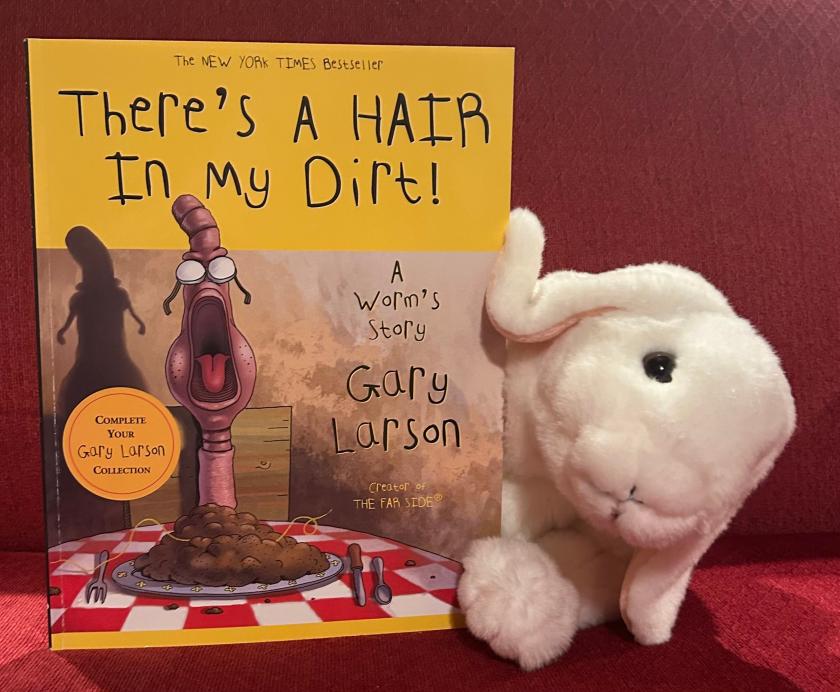
Marshmallow reviews There's A Hair In My Dirt! A Worm's Story by Gary Larson.
Marshmallow reviews There’s A Hair In My Dirt! A Worm’s Story by Gary Larson.

Sprinkles: So Marshmallow, tell us a bit about what you thought when you first saw this book.

Marshmallow: I felt very surprised that Gary Larson had written a children’s book. I really like his Far Side comics, and we have a collection of them at home –and maybe we should review them some time!

S: Yes, maybe we should some day. But you are right. Larson is most well-known for his Far Side cartoons. But then you read this book and realized that maybe it is not quite a children’s book, right?

M: Nope. Do not have your children read this book!

S: Wait! Really? I mean, it is a bit rough for younger bunnies, and it is quite long for them, too, at 64 page, but older bunnies like yourself can appreciate it, I thought.

M: Yeah, I guess so. But it is kind of dark and even morbid. Then again, it is kind of a fable, with some underlying messages, which are thought-provoking. You are right, I guess bunnies my age and the like might appreciate the book. But I was definitely surprised and was not expecting how dark it would get.
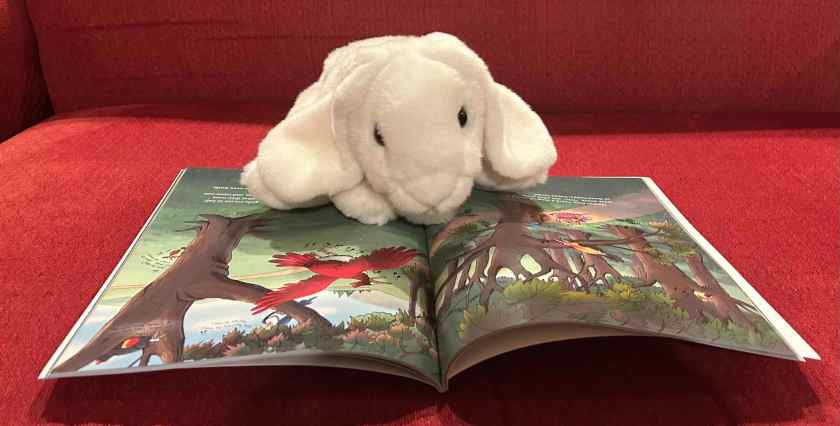
Marshmallow is reading There's A Hair In My Dirt! A Worm's Story by Gary Larson.
Marshmallow is reading There’s A Hair In My Dirt! A Worm’s Story by Gary Larson.

S: Okay, so maybe we should start from the beginning and tell our readers what the book is about.

M: Sure. This book is about a little earthworm who is eating his dirt dinner in his family’s hole in the ground. And he finds a hair in his dirt and starts complaining to his earthworm parents. He hates being an earthworm, he hates living underground. He hates not having legs and having to eat dirt. And so on.

S: Totally understandable of course.

M: Of course. But then his father starts to tell him a story about a girl named Harriet. And then the rest of the book is basically Harriet’s story. Harriet lives near a forest and goes through the forest one day, seeing all sorts of animals interacting with one another, and she always has a positive outlook, thinking about Nature admiringly and yet not really comprehending what is really going on around her.

S: Yes, the foreword for the book is written by the famous biologist Edward O. Wilson and he writes “The maiden, as you will see as the narrative unfolds, might have enjoyed her saunter better if she understood.”

M: And it is not just a matter of enjoying; it costs her dearly that she does not understand. It is a little disturbing actually, because Harriet loves Nature, or what she thinks it is. And she wants to help and she is trying to be a good steward of living things, but since she does not know how things are all connected, she ends up harming the forest and herself.

S: This reminds me of this song “We Are All Connected” which some people made by putting together a few words from four outstanding science communicators:

M: Yeah, I like that song!

S: But let us not go further into the story because I think we might be getting too close to giving away some of the plot. Tell me, Marshmallow, what did you think about the illustrations?

M: It is in full color, and obviously it is Gary Larson, so all characters are distinctive, and they have very evocative expressions. It is very amusing to study them actually. The topic is complicated and nuanced, that we are all connected, and that, as Edward O. Wilson puts it, “Life is tough!” But Gary Larson’s drawings are often hilarious and you can’t help but laugh on almost every single page. Or raise your eyebrows in a shocked and yet amused manner. The mother earthworm is wearing those cat-eye glasses!

S: I know, right? Each page is itself a Far Side comic, almost. But they are all telling a coherent story, and it is an important one.

M: I agree. I do not really love the last page, but I agree. The message is important. And no, if you get a hold of this book, please do not just turn it to the last page to see what I mean! It will work much better if you read the book in the proper way.

S: And I agree with you, Marshmallow. This is a thought provoking book, not as light reading as one might imagine, but definitely amusing to look at, too. So maybe this is a good place to wrap up our review. What do you think?

M: Sure. Let’s.

S: What would you like to tell our readers?

M: Stay tuned for more amazing reviews from the book bunnies!
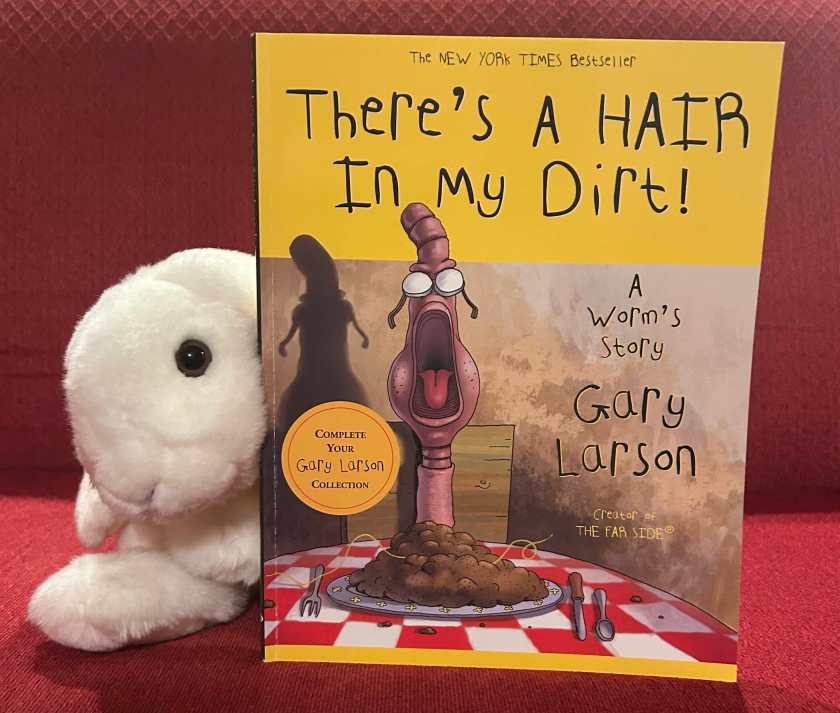
Marshmallow rates There's A Hair In My Dirt! A Worm's Story by Gary Larson 100%.
Marshmallow rates There’s A Hair In My Dirt! A Worm’s Story by Gary Larson 100%.

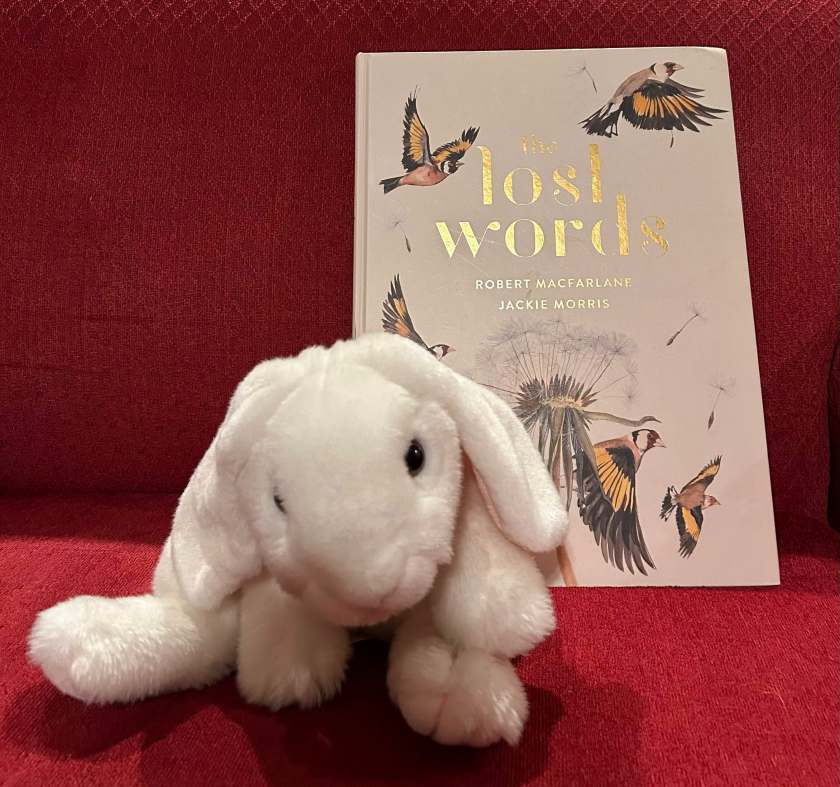
Marshmallow reviews The Lost Words: A Spell Book by Robert Macfarlane and Jackie Morris

Today Marshmallow reviews a beautiful large-format book by Robert Macfarlane and Jackie Morris: The Lost Words: A Spell Book, published in 2017. Sprinkles is taking notes and asking questions.

Marshmallow reviews The Lost Words: A Spell Book written by Robert Macfarlane and illustrated by Jackie Morris.

Sprinkles: So Marshmallow, let us begin. I thought this was a beautiful book, so I am very happy we get to talk about it today.

Marshmallow: Yes, it is a really beautiful book. Majestic, I could say. Each page is almost like a work of art.

S: I heard about this book a while back. I read the following and it stuck with me:

The book began as a response to the removal of everyday nature words – among them “acorn”, “bluebell”, “kingfisher” and “wren” – from a widely used children’s dictionary, because those words were not being used enough by children to merit inclusion. But The Lost Words then grew to become a much broader protest at the loss of the natural world around us, as well as a celebration of the creatures and plants with which we share our lives, in all their wonderful, characterful glory. –https://www.thelostwords.org/lostwordsbook/

M: Well, I did not know about this when I began reading the book. But it totally makes sense. The book is kind of like a children’s alphabet book. Approximately one word for each letter of the alphabet. For “A” for example there is an entry for “acorn” and another for “adder”. And for “B”, there is “bluebell” and “bramble”. but there is nothing for “E” for example. But anyways, each word chosen is a word for an animal or plant, some object of nature that used to be more familiar to young bunnies many years ago, but now that most of us live in much more urbanized environments, we do not always see or hear about them. So I really like that the authors decided to bring back these words to us.

S: Yes, me too! Okay, so then there should be about twenty-five words, then.

M: Not quite. There were apparently forty words that were dropped from that children’s dictionary, and the people who created this book picked twenty of those words and focused on those.

S: The book is not only twenty pages though.

M: Of course not, Sprinkles! That would be kind of too short. There are six pages for each word.

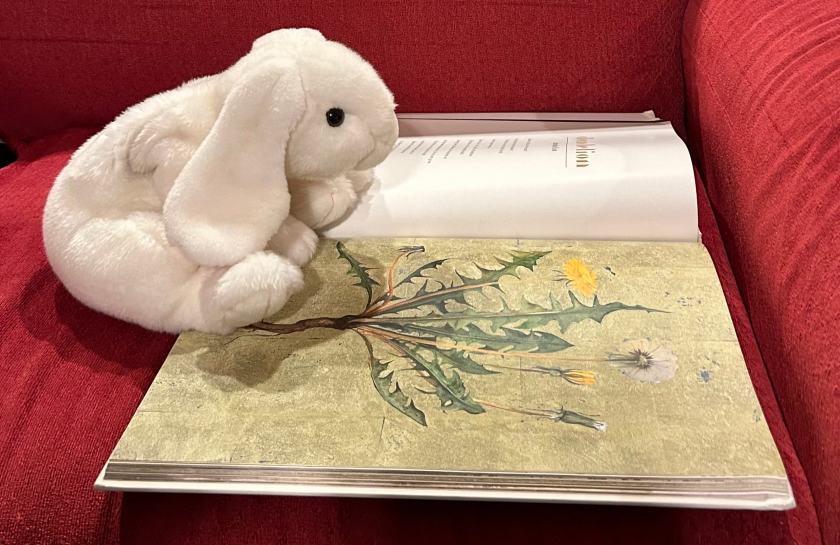
Marshmallow is reading The Lost Words: A Spell Book written by Robert Macfarlane and illustrated by Jackie Morris.

S: I see. So what happens on each of those pages?

M: What they do with each word is actually really amazing. For each word, there is first a two-page spread showing the letters making up the word in a way that is aesthetically pleasing. The letters making up the word are kind of hiding among many other letters, kind of reminding us that the word is lost somehow, but if we look carefully, we will find it again.

S: That is beautiful, Marshmallow.

M: Yes, the book is really beautifully designed. Anyways, after the first two-page spread, then there is a second two-page spread for the word. The left hand side there is an acrostic poem describing the word, and on the right hand side there is a water color painting of the animal or plant that the word depicts.

S: Remind our readers what an acrostic poem is maybe?

M: Sure. Basically when you take the letters of the first word on each line and put them in a vertical line, they make up a word. So for example here is the poem for IVY:

ivy

I am ivy, a real high-flyer.
Via bark and stone I scale tree and spire.
You call me ground-cover; I say sky-wire.

S; That is lovely!

M: It really is! I love the paintings! They are kind of like portraits! And then there is a final two-page spread, which is a large picture showing the animal or plant in its natural environment. Again the paintings are beautiful.

S: I agree with you completely Marshmallow. I have been looking through the pages for the last hour or so and I am amazed. The poems are quite neat too.

M: Yes, agreed. Each poem has a deeper meaning; they do not just provide a physical description, but also what it might represent, what makes it unique and special, and how it is a part of nature. I really liked the book!

S: I can see that. So if you were to rate it–

M: -I’d rate it 100% for sure!

S: That is wonderful Marshmallow. I am glad we were able to read this book.

M: Yes.

S: So let us wrap up this review then. What would you like to tell our readers?

M: Stay tuned for more amazing reviews from the book bunnies!
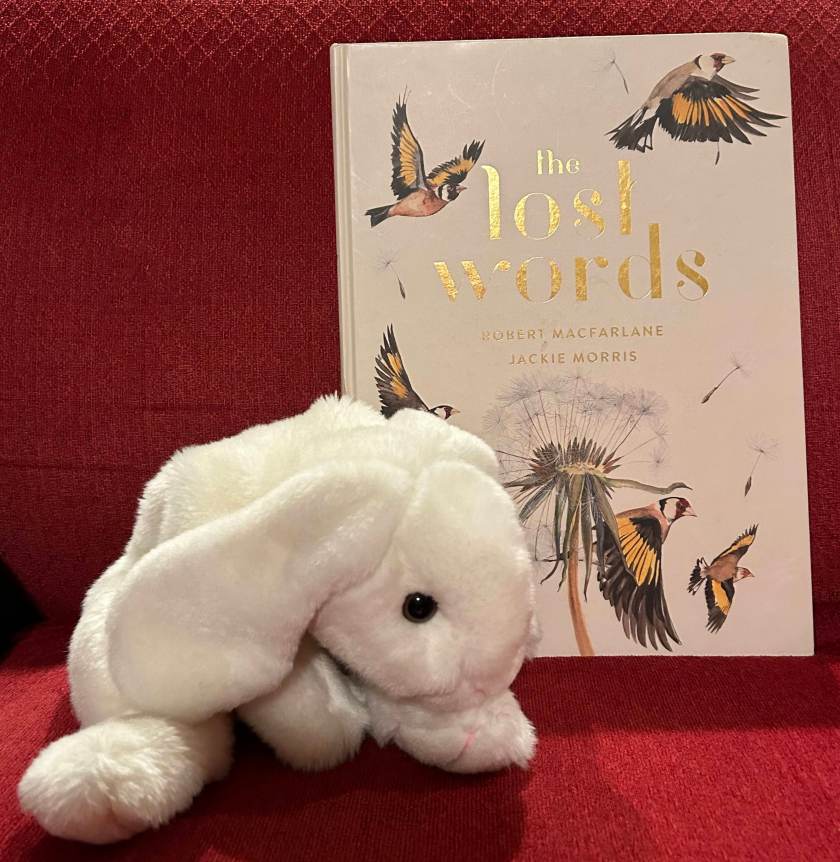
Marshmallow rates The Lost Words: A Spell Book written by by Robert Macfarlane and illustrated by Jackie Morris 100%.

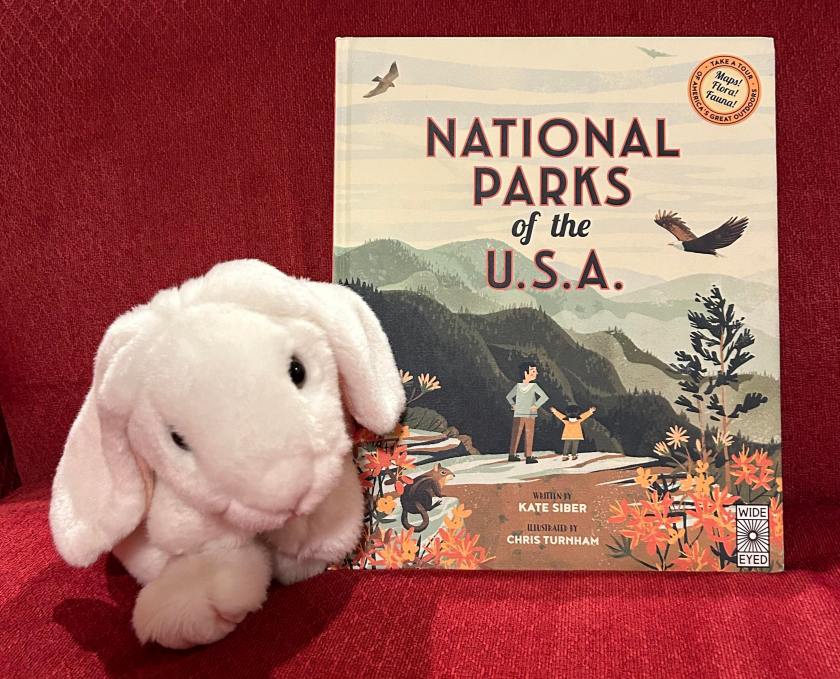
Marshmallow reviews National Parks of the U.S.A. by Kate Siber and Chris Turnham

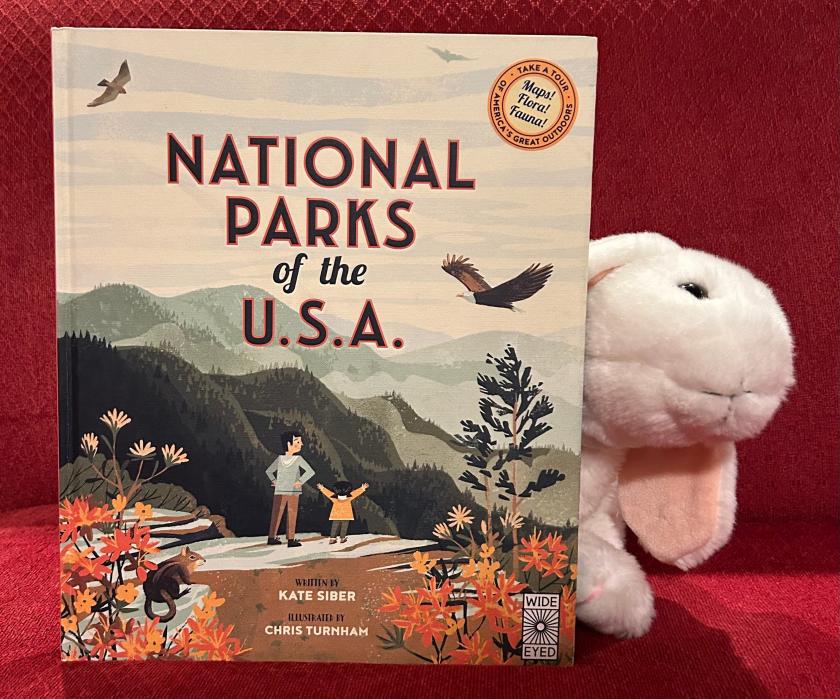
Marshmallow loves everything beautiful, and today she picked a beautiful book to talk about: National Parks of the U.S.A., written by Kate Siber, illustrated by Chris Turnham, and first published in 2018. Sprinkles was intrigued by the book and therefore is asking questions and taking notes along the way.

Marshmallow reviews National Parks of the U.S.A., written by Kate Siber and illustrated by Chris Turnham.

Sprinkles: So Marshmallow, you picked a really beautiful book for today’s review. Can you tell us a bit about it?

Marshmallow: If you like the wilderness or at least you enjoy being outdoors, and especially if you are in the U.S.A. and want to know more about its many national parks, then this might be the book for you.

S: It also seems to be a great book for folks who might just want to look at a pretty book.

M: Yes, I agree. It is really a pretty book. Every page is beautifully illustrated. Even though the illustrations seem to be using a limited color palette, focusing mainly on oranges, browns, and greens, each page is distinct and well designed. The limited color scheme actually works really well.

S: Okay, so we both agree that this is a beautiful book to look at. So let us get to the content of the book next.

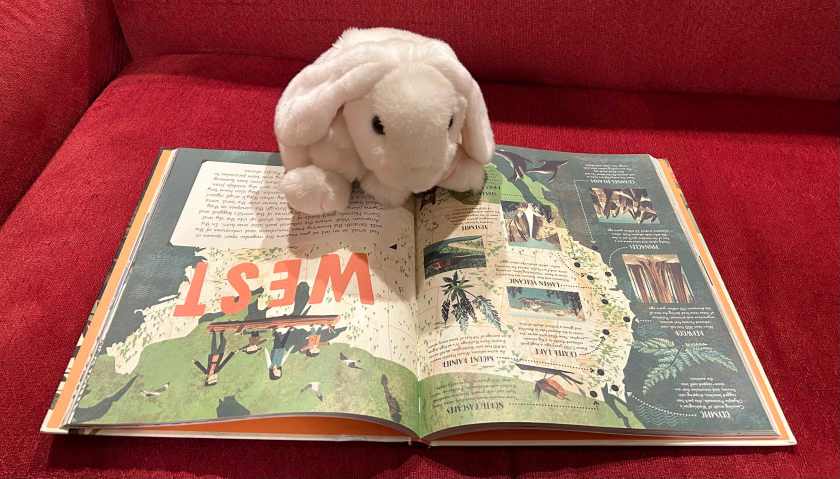
M: As you can tell from the title, the book is about the national parks in the U.S.A. They are organized more or less geographically. It goes from the east, to the central U.S., then to the Southwest, then to the Rocky Mountains, then to the West. And finally there is a section on Alaska and then the tropics. For each of the regions there is an introductory page or two, and then they focus on some specific parks from the region and talk about the geographic formations, and the flora and fauna found in there.

Marshmallow is reading National Parks of the U.S.A., written by Kate Siber and illustrated by Chris Turnham.

S: Did you find some parks that you want to visit some day?

M: Yes, several actually. We have not been to most of these yet. And I think it would be great if we could go to at least some of them.

S: True. Our country has so many beautiful national parks to visit. We have been to a few state parks but not to any of the national ones yet.

M: Maybe we can go on a rabbit-road trip and see some of them.

S: That would be lovely Marshmallow! Did you know that the idea of national parks is relatively new? The first one in the U.S. is the Yellowstone National Park, which only became a national park in 1872. And today many countries around the world have reserved land in similar ways.

M: I did not know that before we found that Wikipedia article; it is very informative. But my book is also very informative. For example did you know that glaciers are not “massive stationary blocks of ice”, but instead are “rivers of frozen water that flow down mountains”? I learned that when I was reading about the Glacier National Park.

S: That is cool!

M: And apparently rangers in the Badlands National Park say that “you have only 500,000 years to visit before the spires and the hills [of the park] wash away from rain and wind”.

S: Sounds like the author has a playful voice.

M: Yes. I really liked her voice. She is playful and friendly and makes the reader want to see all these places.

S: I’d say that is a successful book! How would you rate it?

M: I’d rate it 100%.

S: I knew it! Okay, this is a good time to wrap this up. What would you like to tell our readers?

M: Stay tuned for more amazing reviews from the book bunnies!
Marshmallow rates National Parks of the U.S.A., written by Kate Siber and illustrated by Chris Turnham, 100%.

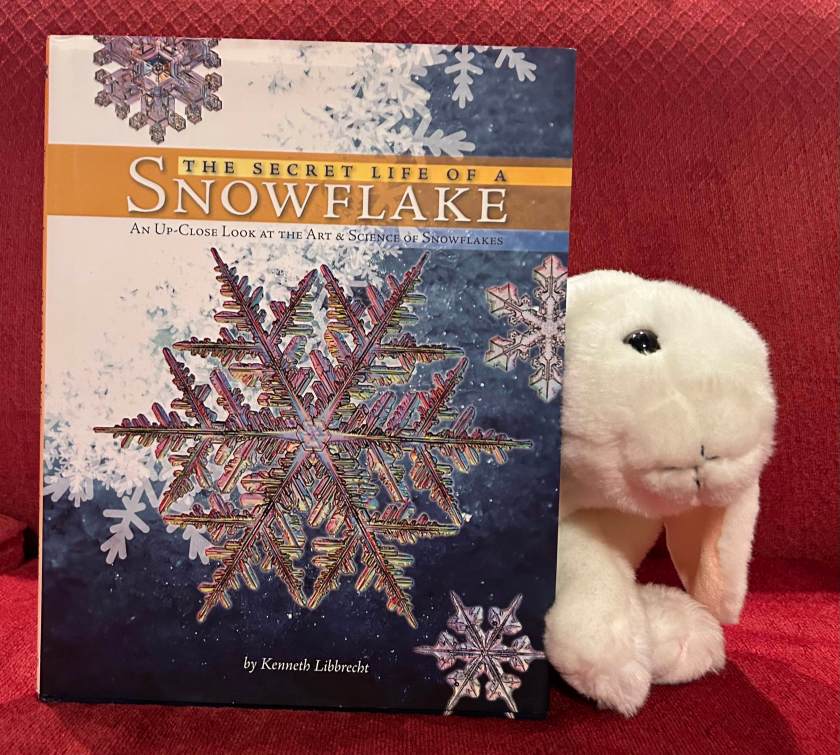
Marshmallow reviews The Secret Life of a Snowflake by Kenneth Libbrecht

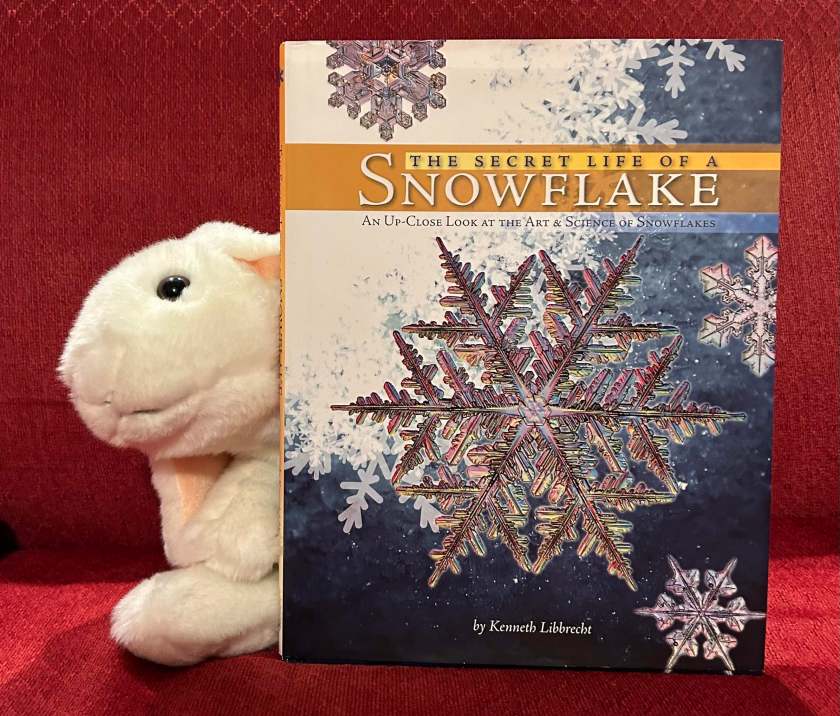
Today Marshmallow reviews a beautiful book she really likes: The Secret Life of a Snowflake: An Up-Close Look at the Art and Science of Snowflakes by Kenneth Libbrecht, published first in 2009. Sprinkles is asking questions and taking notes.

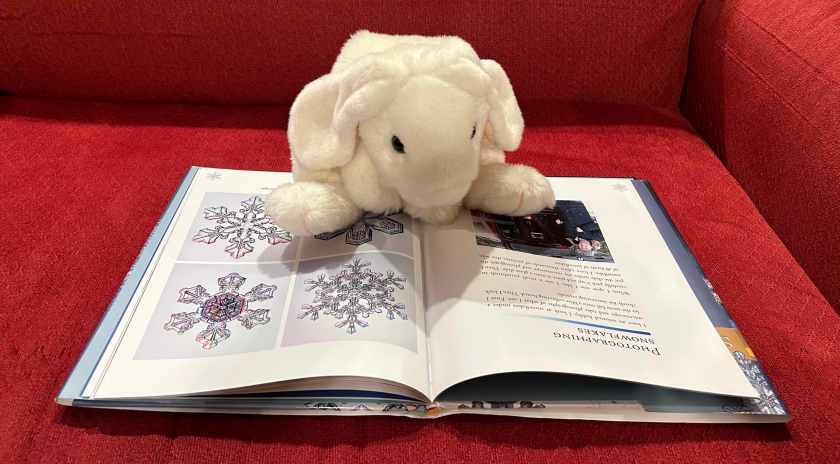
Marshmallow reviews The Secret Life of a Snowflake: An Up-Close Look at the Art and Science of Snowflakes by Kenneth Libbrecht.

Sprinkles: So Marshmallow, you decided to talk about The Secret Life of a Snowflake today. This book has been on our bookshelves for a while now. I’m glad you picked it up for the blog today. Can you tell us a bit about it?

Marshmallow: This is a book written by a physicist named Kenneth Libbrecht who loves and studies crystals. And snowflakes are crystals, and he loves to take their photos. There are lots of photos in the book, and I love looking at them.

S: I know. I love looking at this book, too. It is just beautiful.

M: Yes! But the author is a scientist, so he also explains a bit about how snowflakes are formed and also about how clouds are formed, why snow is white, and so on.

S: Caramel would like this book, right?

M: Of course. He would love it because it is so “factful”!

S: Exactly.

Marshmallow is reading The Secret Life of a Snowflake: An Up-Close Look at the Art and Science of Snowflakes by Kenneth Libbrecht.

S: Did you know that the author has a website where he has a lot more information and photos about snowflakes?

M:Well, I did not, until you told me. And then we went and checked it out together. Our readers should check it out too: http://snowcrystals.com/

S: Yes. There are lots of exciting things there.

M: Exciting and beautiful. I found the section about designer snowflakes especially interesting.

S: There is also a special page for a monster snowflake which is apparently almost comparable to a penny in size! But back to the book. I know reading it once or twice, you get the science down. But I saw you read this book many many more times.

M: Yes. Because I really like the pictures in it. They calm me and comfort me.

S: And they make you smile. I saw.

M: Yes. They are very pretty, and each snowflake is so different, so pretty in a different way.

S: They are all very symmetric. I think that can feel somewhat calming.

M: Yes, maybe.

S: So if you were to rate this book, what would your rating be?

M: 100%. Definitely. I think this could be a really neat book for young bunnies to read with their parents, because it has science, it has beautiful pictures; it has all kinds of good things. The writing is simple, but very clear. And it gets a lot of information across.

S: Agreed. But I think bunnies can definitely read it on their own and enjoy it too, no matter how old they are.

M: Yes. Or it could make a great gift, especially for a winter holiday…

S: What a neat idea! Okay, Marshmallow. I think this is a good time to wrap up this review. What would you like to tell our readers?

M: Stay tuned for more amazing reviews from the book bunnies!
Marshmallow rates The Secret Life of a Snowflake: An Up-Close Look at the Art and Science of Snowflakes by Kenneth Libbrecht 100%.