Caramel reviews Vietnamese Children’s Favorite Stories by Tran Thi Minh Phuoc

The book bunnies love various retellings of the classic fairy tales of the Western tradition, and through the years, they have reviewed many books that offered different takes on them. They also have explored, these past few months, several books that collect together fairy tales from geographies from around the world. Therefore they were delighted to learn that they made it to the list of 30 Best Fairy Tale Blogs and Websites in 2025, curated by Feedspot, a blog aggregation site.

To celebrate, today Caramel is reviewing yet another book of fairy tales: Vietnamese Children’s Favorite Stories, retold by Tran Thi Minh Phuoc and illustrated by Nguyen Thi Hop and Nguyen Dong, published originally in 2015. As usual Sprinkles is taking notes and asking questions.
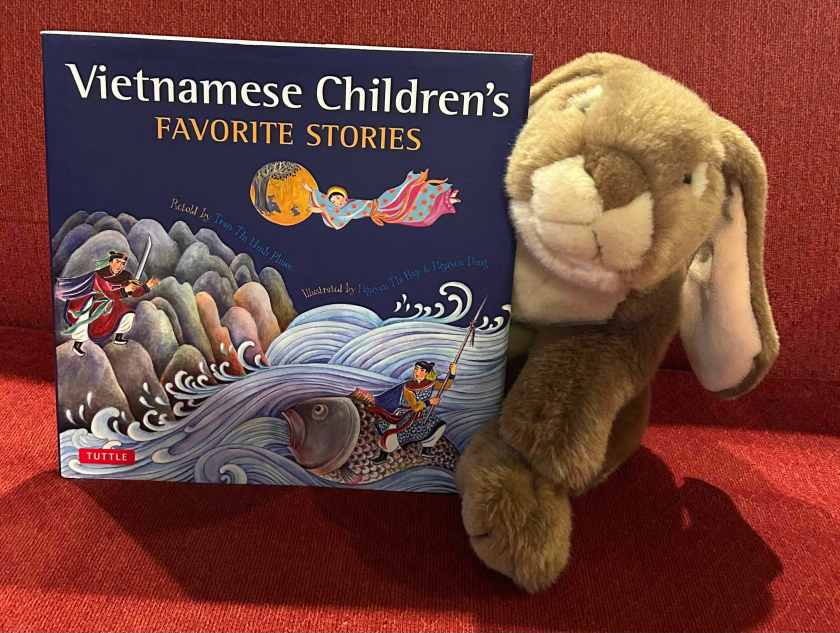
Caramel reviews Vietnamese Children's Favorite Stories, retold by Tran Thi Minh Phuoc and illustrated by Nguyen Thi Hop and Nguyen Dong.
Caramel reviews Vietnamese Children’s Favorite Stories, retold by Tran Thi Minh Phuoc and illustrated by Nguyen Thi Hop and Nguyen Dong.

Sprinkles: So Caramel, what are we talking about today?

Caramel: Well, this is a book about the fairytales and stories that Vietnamese children would be told as they grew up.

S: So just like Japanese Myths, Legends, and Folktales, Tamamo the Fox Maiden and Other Asian Stories, and Chinese Myths and Legends: The Monkey King and Other Adventures, which you reviewed before for our blog, this is one of those books you read for that course you took on Asian myths and legends, right? 

C: Yeah, and just like those other books, this is a good book, too. I liked it a lot.

S: That sounds great! Tell us about it then. 

C: This book contains fifteen stories that the author remembers from their own childhood. They were told these stories as they were growing up. Each story is around nine pages or so. The stories all contain some sort of moral, like most children’s stories do. 

S: Yes, that is true; most fairy tales have some morals. The author Tran Thi Minh Phuoc writes in the introduction that all of the stories “paint a picture of a world that values the five great virtues: Nhan (compassion), Le (Rituals), Nghia (Righteousness), Tri (Wisdom), and Tin (Trust)”. What kinds of morals come up in these stories? 

C: Don’t be greedy, be kind to others, and don’t be selfish.

S: Those seem like very standard morals, good values to pass on to young bunnies. Did you come across any that felt different? 

C: No, not really. But there is a story called “Why Ducks Sleep on One Leg”, which, as you might guess, is about why ducks sleep on one leg.

S: Wait, does that one have a moral? What would it be?

C: I think it’s more of an explanation of why they sleep that way.

S: That is interesting. So not all have morals then. But all across different cultures, there are many traditional stories about how things are and they give explanations, sometimes humorous but always creative, about why things are the way they are. 

C: Yes. Some of the stories do not have obvious morals, but they still contain at least an explanation of something interesting, like a duck’s behavior. There is another story, “Why The Sea Is Salty”, about why the sea is salty. And there is a story about a tradition and why it exists: “Why One Shouldn’t Sweep the House on Tet Nguyen Dan“.
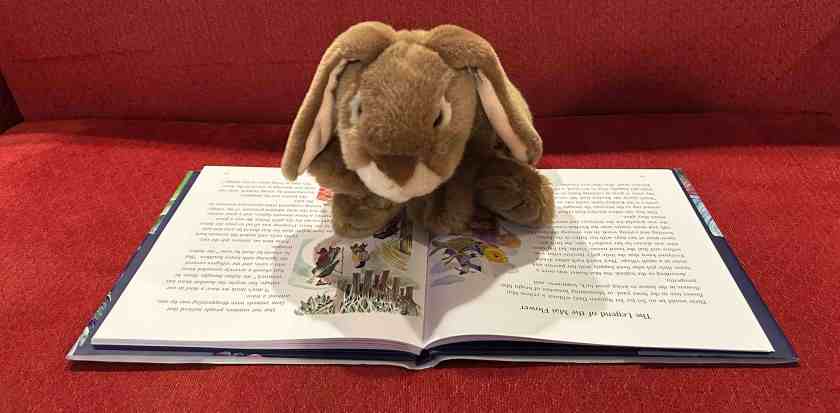
Caramel is reading Vietnamese Children's Favorite Stories, retold by Tran Thi Minh Phuoc and illustrated by Nguyen Thi Hop and Nguyen Dong.
Caramel is reading Vietnamese Children’s Favorite Stories, retold by Tran Thi Minh Phuoc and illustrated by Nguyen Thi Hop and Nguyen Dong.

S: I seem to recall a story about how the tiger got its stripes. The internet tells me it is also a Vietnamese story. Apparently such stories are called “pourquoi” stories, stories that purport to explain why some natural thing is the way it is. Anyways, does the story of the tiger stripes come up in this book? 

C: I don’t believe so. But there is the origin story of the jade rabbit. The jade rabbit lives in the forest with his friends and his companion, the goddess Chang’e, and he makes immortality elixirs.

S: Wait, the jade rabbit is not a natural being. It is a mythical creature, isn’t it? And didn’t we read about it in another story before? And the goddess Chang’e?

C; Yeah, the moon goddess Chang’e appeared in one of the stories we talked about before from Chinese Myths and Legends: The Monkey King and Other Adventures. And I remember the jade rabbit from the movie Over The Moon, which we talked about when we discussed that book. Anyways, according to the story “The Jade Rabbit” in this book, the jade rabbit used to be a normal rabbit, who sacrificed himself to help someone who happened to be the jade emperor in disguise. The rabbit did not know this though. Then the emperor carried him to the moon, and the goddess Chang’e turned him into the jade rabbit, an immortal being who makes immortality elixirs.

S: That is neat Caramel! According to Wikipedia, the character of the jade rabbit shows up in many East Asian traditions. And how wonderful that we now know one of its origin stories! 

C: Yeah, it’s cool. I told you this is a good book! 

S: So you did. Okay now, please tell me a bit about the illustrations. I see that this is really a beautiful book. 

C: Yes! The pictures are very interesting! They are made in the sort of painting type. I mean, the individual pictures look like they were made with water color and acrylic paint. Very pretty. Sometimes people look like they are floating and there is a lot of color. 

S: Cool! Alright, so it seems like you approve of this book and would recommend it to other young bunnies? 

C: Yeah, the stories were kind of made for younger bunnies. At least the book is very much meant for us. 

S: Then maybe young bunnies like you can read the book on their own, and even younger ones can maybe get an adult bunny to read it to them. 

C: Yeah that would be a good idea! They should do that!

S: Okay, Caramel. Thank you for this review. Do you want to say something to our readers as we wrap up this post?

C: Stay tuned for more book bunny reviews!

Caramel enjoyed reading Vietnamese Children's Favorite Stories, retold by Tran Thi Minh Phuoc and illustrated by Nguyen Thi Hop and Nguyen Dong, and recommends it to all young bunnies curious to hear more fairy tales from around the world.
Caramel enjoyed reading Vietnamese Children’s Favorite Stories, retold by Tran Thi Minh Phuoc and illustrated by Nguyen Thi Hop and Nguyen Dong, and recommends it to all young bunnies curious to hear more fairy tales from around the world.

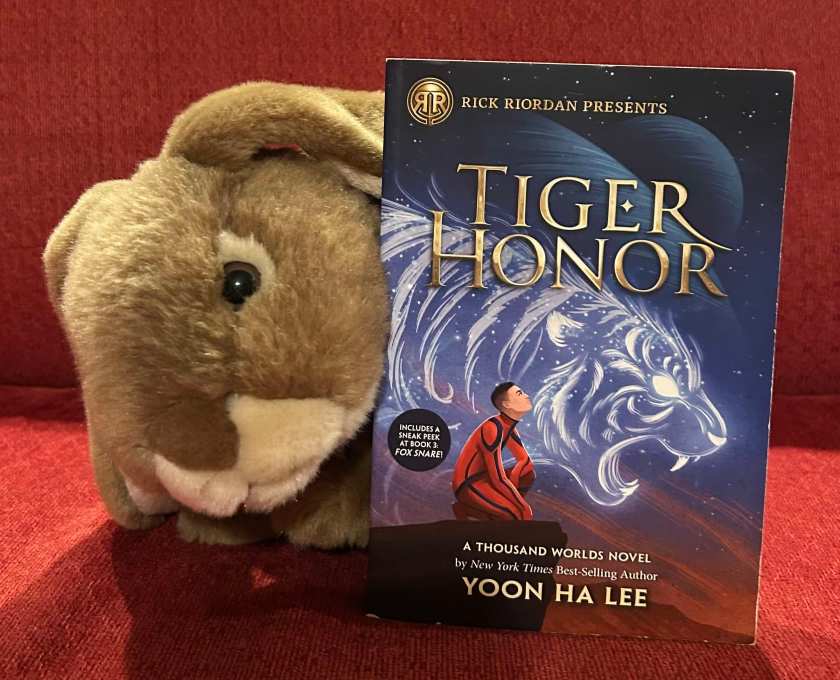
Caramel reviews Tiger Honor by Yoon Ha Lee

A while back Marshmallow reviewed Dragon Pearl, a book involving various themes from Korean mythology, written by Yoon Ha Lee. Today Caramel reviews a second book by the same author, Tiger Honor, published in 2022. As usual Sprinkles is taking notes and asking questions.

Caramel reviews Tiger Honor by Yoon Ha Lee.

Sprinkles: So Caramel, today you wanted to talk about another book with some Asian themes. 

Caramel: Yeah, but this one is a novel, and it is called Tiger Honor. It is a really good book.

S: It must be. You read it rather quickly. So what is it about?

C: It is about this person named Sebin who wants to join the Space Forces of the Thousand Worlds and maybe become a captain like their uncle Hwan, but then Hwan is named a traitor. Sebin is shocked of course, but they join the Force nonetheless, hoping that they can perhaps clear their uncle’s name. 

S: There is something special about Sebin, right?

C: Yes, they are a tiger spirit, and so you get the ”Tiger” in the title of the book. And their tribe the Juhwang Clan has a strong honor code. Again, that is the second part of the title of the book. Honor is very important to Sebin. Sebin wants to save their family’s honor by clearing Hwan’s name. 

S: I see. What is a tiger spirit? Does it become clear in the book?

C: Yeah, it is explained in the first chapter. Sebin is a human but can shapeshift into a tiger and is exceptionally strong. 

S: Are there other kinds of spirits in the book? 

C: Yes, there are foxes, and ghosts, and I think others, but I’m not sure. But from what I understand these kinds of spirits show up in Korean myths and that is what inspired the author.

Caramel is reading Tiger Honor by Yoon Ha Lee.

S: Oh, yes, in the first book of this series, the main character was a fox spirit. In fact, as far as I understand, that character shows up in this book, too. Her name is Min. 

C: Hmm, yes, Min does show up. She is an important character here actually. But I did not read that first book. 

S: I have not read the book yet, but again from what I understand from everything I read about it, even though Min shows up here, too, and both books involve the Dragon Pearl and the Space Forces of the Thousand Worlds, they are actually independent stories. So I think it is okay that you did not read that one before reading this one. 

C: That is good to know. I might still go ahead and read Dragon Pearl at some point though. This world is interesting!

S: Can you tell me more about this world then?

C: Sure, there are mostly human-like people, like the tiger and fox spirits, and some mercenaries.out-of-galaxy mercenaries fighting against the Space Force. There are a lot of planets and civilizations that came together and signed a treaty to form the Thousand Worlds, which is kind of like the United Federation of Planets in Star Trek. And the Space Force is basically Starfleet. 

S: Okay, that is cool. It sounds like a neat mixture of science fiction and Korean mythological themes. So then tell us a bit more about what happens in the book. 

C: So, Sebin joins the space force, and then the ship they join is sabotaged, and by Uncle Hwan no less. And it gets more and more exciting and a lot messier from there on, but maybe in order to really see this, one should read the book. And it is a good book so it is very much worth it.

S: Sounds like it. So maybe this is a good place to end this review

C: And maybe I should go and read Dragon Pearl next. 

S: Makes sense to me. What do you want to tell our readers?

C: Stay tuned for more book bunny reviews!
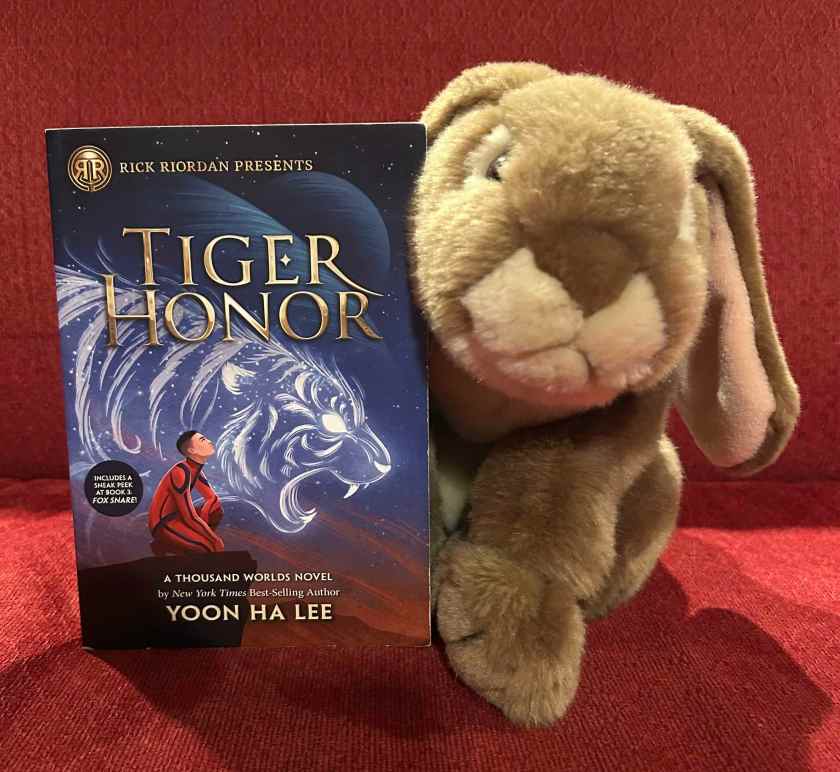
Caramel enjoyed reading Tiger Honor by Yoon Ha Lee and is considering whether it is time to go and read Dragon Pearl.

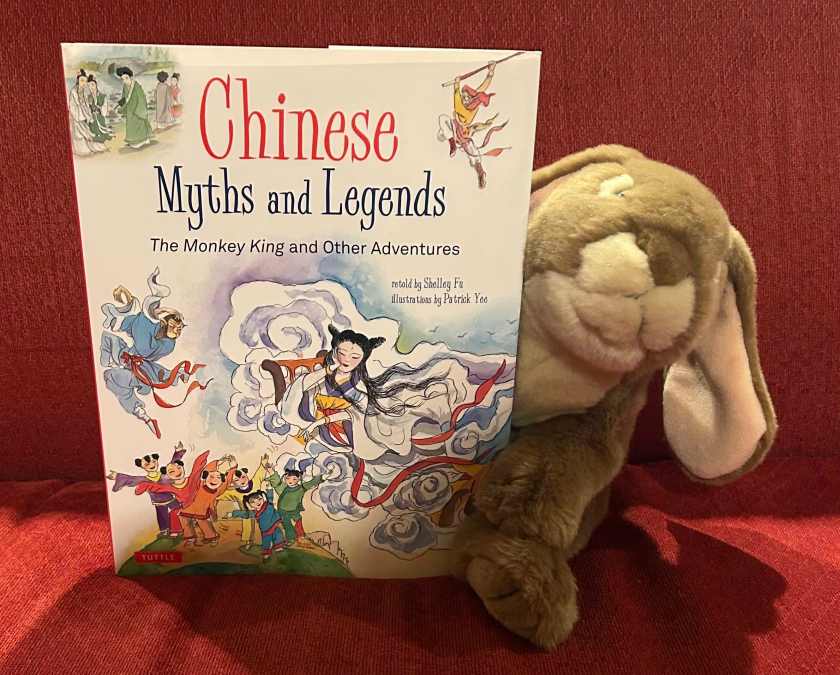
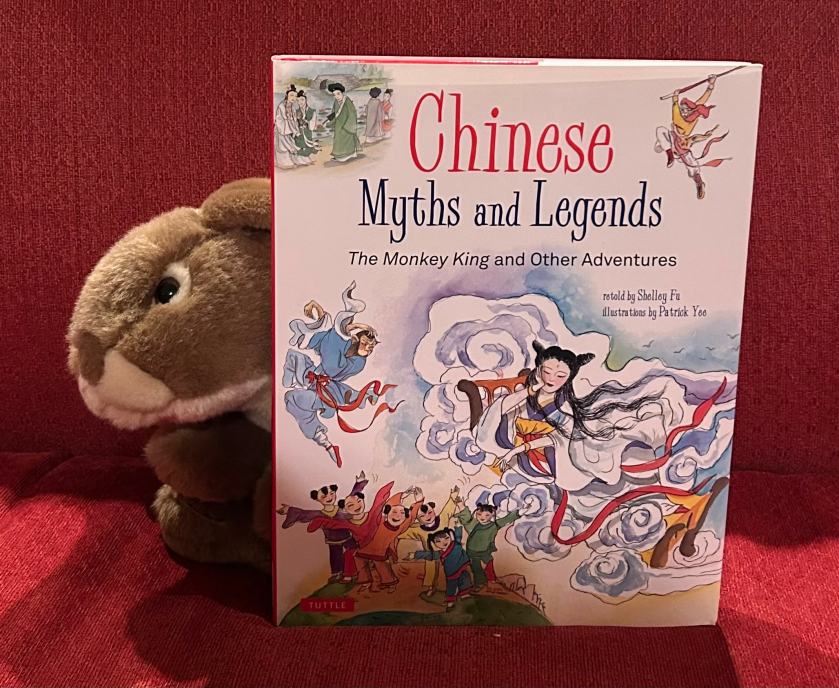
Caramel reviews Chinese Myths and Legends: The Monkey King and Other Adventures by Shelley Fu and Patrick Yee

In the summer of 2024, Caramel took an online course on Asian myths and legends and as part of this course, he read several books on the topic. He has already reviewed a couple of these for the book bunnies blog; see these here and here. Today he picked up a third book from that summer experience and is talking to Sprinkles about Chinese Myths and Legends: The Monkey King and Other Adventures, retold by Shelley Fu, illustrated by Patrick Yee, and published originally in 2018.

Caramel reviews Chinese Myths and Legends: The Monkey King and Other Adventures by Shelley Fu and Patrick Yee.

Sprinkles: So Caramel, I see you have for us another book about Asian myths and legends today.

Caramel: Yeah, and it is a very good one at that. 

S: Please do tell us a bit about the book.

C: It is about Chinese myths. There are seven stories in it. The first one is “Pan Gu and The Creation of the Universe.” 

S: That is quite sensible, to start at the beginning with a universal creation myth. 

C: Yeah, it’s also cool, it’s a cool concept.

S: So how was the universe formed according to this story?

C: This guy named Pan Gu was holding the universe in a ball away from the earth or something similar, and he became satisfied and lay down and became part of the earth.

S: Hmm, you say some guy, but if he was holding the universe, he is probably not just a regular person. Maybe a giant. 

C: Yeah, he is a god.

S: Interesting! In Greek mythology, too, there is a giant deity named Atlas who carries the world on his shoulders. 

C: Yeah, that is interesting. I guess a lot of people thought about how the world began. 

S: It is an interesting question after all, no? Anyways, there is a long and detailed Wikipedia article on Pan Gu too, if our readers want to know more. We can maybe move on. You said there were six more stories in the book. 

C: Yes, let me see. The next one is “Nu Wo: The Mother of Mankind.” It is told in six parts, and it is about the creator of humans, Nu Wo. 

S: That is interesting. So the universe was created by one deity and humans were created by another. Or are these competing theories of creation? 

C: Yup, there are two creators, one of earth, and the other of humans.

S: That is very interesting. In the three Abrahamic religions Judaism, Christianity and Islam, there is one creator who created everything. But Chinese mythology takes a different path. 

C: Yeah, it’s cool, isn’t it?

S: Yes, very much so. I looked it up and will link to the Wikipedia article for Nu Wo (apparently more typically called NuWa) in case some of our readers want to learn more about her. 

C: Good idea!

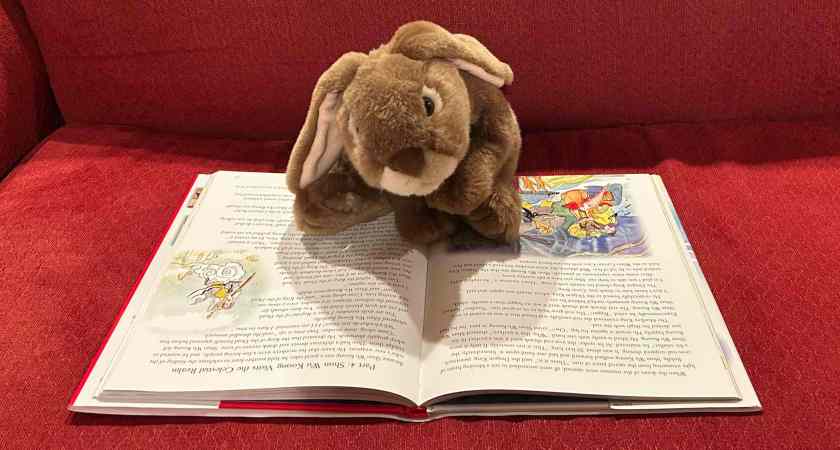
Caramel is reading Chinese Myths and Legends: The Monkey King and Other Adventures by Shelley Fu and Patrick Yee.

S: So that makes two stories. What comes after? 

C: Then the next is “Ho Yi the Archer,” about a god loving another god. Ho Yi himself is an archer and a god, and he is married to a goddess of the moon. This story has five parts. 

S: That is neat Caramel. I looked up this character, too, and the Wikipedia article about him made me realize we watched an animated movie that retold the story of Ho Yi and his wife, the lunar deity Chang’e. Do you remember it? 

C: Yes, I do! It was called Over the Moon! It was a really good movie, and a bit strange. Can we maybe put a link to the trailer so our readers can see it a bit too?

S: Sure: here it is:

C: Thank you, and now for the next one! This one is a bit longer, and has nine parts. It is about the Monkey King, who is a monkey that becomes immortal and angers the gods.

S: Yes, I see that this chapter is titled “Journey to the West”. It is the story of the Monkey King, who angers the gods because of his impetuousness, and then travels to the West to find some scrolls of wisdom. There is a whole Wikipedia article about the classical version of the story too. 

C: Yes, the book version is also neat. And we watched a TV series about it a while back; maybe you remember?

S: Yeah! When you said that I looked it up, and apparently there are many movies animated and not, about the Monkey King. But the one we watched was really funny. 

C: Though it did get violent and a bit scary sometimes. 

S: True. But we can still put a link to the trailer of The New Legends of Monkey!

C: Yes, good idea!

S: Okay, here goes:

S: So what other stories are there in the book? You told us about four so far. There should be three more. 

C: Well, there is one called “The Man in the Moon” and it is one of the shorter stories. It is about a kid who saved a bird and he got rewarded with treasure, and another boy is angry and is bad and gets punished with being sent to the moon.

S: Hmm, the moon sounds like it could be lonely and cold. 

C: yeah but he is busy attempting to cut a tree down, and guess who else is there?

S: Who?

C: Ho Yi’s wife!

S: Oh cool! Small world! Or rather, small solar system, I guess!

C: Exactly. 

S: Does she teach the boy a lesson or help him somehow? 

C: No, he ignores her.

S: That is not a good idea, to ignore a goddess. 

C: Yeah, but she was in trouble too, so it’s most likely fine.

S: So interesting that the stories are kind of intertwined! Okay, so there are two more stories left. 

C: Yes, the sixth one is “The Story of the White Snake,” and this is one of the longest stories in the book. It has twelve parts. It is about two snakes or snake spirits, one who wants to see humans and their world, and another one who wants to complete their training in immortality. But they do go into the human world and the first snake spirit falls in love with a human. And then it all goes wrong. 

S: I remember this story! Here is the Wikipedia article about it in case our readers are curious to read more. I also remember we watched a Chinese opera about this legend!

C: Yes, that was also kind of different. Maybe we can put a link to that video, too. 

S: Sure, why not? Here it is:

C: Thanks. It is very long. This video is only one part of two and it is already one and a half hours, but it will still give people an idea of the story.

S: And also they will get an idea of what classical Chinese opera is like, if they don’t already know.  

C: Yeah, that is a good point. Anyways the last story is “The Heavenly River” and it is also one of the shorter stories. It is about a cowherd who is treated badly by his sister-in-law. When he comes into some money, she wants some of it, and he doesn’t want to give any money, so he asks some gods and goddesses for guidance. He meets a weaver girl, who is not just a girl but maybe a deity herself. When they try to run away from their duties, they are separated and sent to the two opposite sides of the Milky Way. They can only see each other every seven years.

S: Hmm, a sad story. I think I found the relevant Wikipedia article here, in case anyone wants to read up about this story. 

C: Well, they can also just read this book! I mean it is really a neat book. And it has really cool illustrations on each page. And if you really want, there are notes in the back about each story, so curious bunnies could learn even more about them. 

S: Yes, of course. Our readers can just read this book! It seems like you really enjoyed it. This is one of our longest reviews so far! 

C: Yup, I did like it and there was a lot to talk about. A lot of interesting stories that I had not heard before. 

S: This sounds like a good place to end this post then, upbeat and enthusiastic.

C: Yup, I agree.

S: So what do you want to tell our readers?

C: Stay tuned for more book bunny reviews!
Caramel enjoyed reading Chinese Myths and Legends: The Monkey King and Other Adventures by Shelley Fu and Patrick Yee and recommends it to other young bunnies interested in learning about the famous stories of people from around the world.

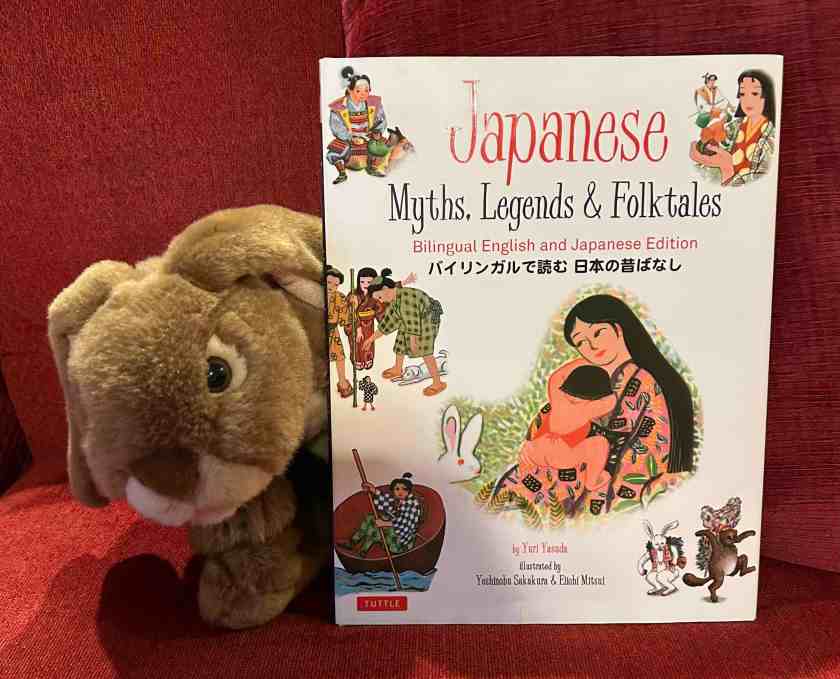
Caramel reviews Japanese Myths, Legends, and Folktales by Yuri Yasuda

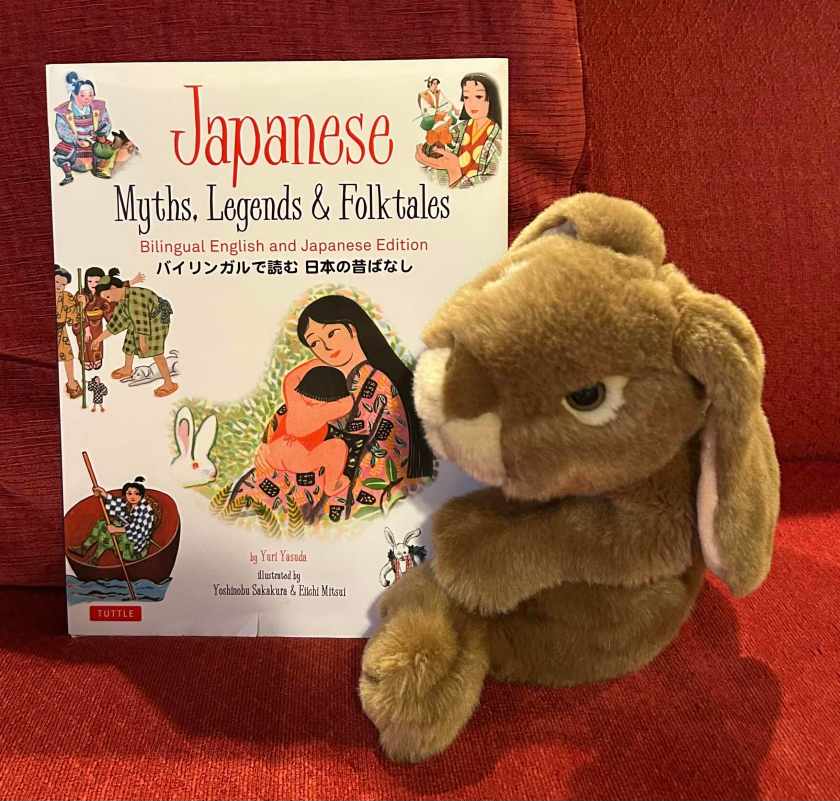
Last summer Caramel read several books on Asian myths and legends. Today he is talking to Sprinkles about one of these: Japanese Myths, Legends and Folktales: Bilingual English and Japanese Edition, written by Yuri Yasuda, illustrated by Yoshinobu Sakakura and Eiichi Mitsui, and published in 2019.

Caramel reviews Japanese Myths, Legends, and Folktales by Yuri Yasuda.

Sprinkles: So Caramel, this is one of your last reviews before we take off for the summer. What do you want to talk about today?

Caramel: It’s this book on Japanese myths and legends. I like all of the nice stories, and the pictures. The colors are nice.

S: You are right, there are a lot of illustrations in this book. Each page has at least one. And they are very stylized. That is, they all kind of fit in one style, they resemble one another in some ways. 

C: That makes sense though. It is all the same people who drew them. So it makes sense they would look like one another. 

S: True. 

C: And they are all very colorful and they use some really cool drawing  techniques!

S: That is a good observation Caramel! I agree with you! Now tell me a bit more about the stories.

C: There are twelve stories. Each of them takes about three to five pages, usually below ten. On each page there is a picture or two, and then the top of the page is in English. And in the second half of the page the story is in Japanese. 

S: Oh, part of the book is in Japanese then! I guess it makes sense: the book is subtitled “The Bilingual Edition” after all. 

C: Well, actually, it’s called, “Bilingual English and Japanese Edition”.

S: Thank you for the correction Caramel. That makes total sense. But you don’t know how to read in Japanese. Was that okay?

C: Well, I don’t know how to read in Japanese YET. But yes, it was more than okay. It was cool to see the difference in the writing. Japanese people use a different alphabet than us. Or rather three different writing systems. I looked it up. There is a long Wikipedia article about it. And we tried to learn a bit of Japanese last summer. It is hard but it is also a lot of fun. I loved using the brush pens! 

S: Yes, that was a lot of fun! And you are so right in saying that you don’t know it YET. You are still such a young bunny, maybe you will learn it at some point.

C: I hope so. I especially want to play more with the brush pens, mostly the pens.

S: Sounds like a plan to me!

Caramel is reading Japanese Myths, Legends, and Folktales by Yuri Yasuda.

S: Okay, so let us get back to the stories. You said there are twelve of them. So tell us a bit about a couple of them. Maybe your favorites?

C: I liked the first one, “The Tongue-Cut Sparrow”. It’s about a kind old man who finds an injured sparrow and saves it. One day as he is out doing something, the sparrow eats the house flour, so the old man’s wife cuts the sparrow’s tongue off as punishment, and the sparrow flies off. Then on another day, the old man goes walking, and he meets the sparrow again. The old man was always kind to the bird, so the sparrow offers him some gifts. The old man takes the smaller gift and walks home to find that it has money. But his wife is not a nice person and she is greedy too so she gets upset that her husband did not get the bigger gift. So the next day she takes off to find the sparrow and asks for the bigger gift. The sparrow gives her the bigger gift and tells her not to open it until she is home. But she does open it before she gets home, and the demons inside the box attack her. Finally the old kind man finds her and saves her and the wife apologizes for being mean and unkind and they all forgive each other and live happily ever after. 

S: Hmm. What do you think the story means?

C: I think the moral of the story is that if you are given a gift, and told not to open it till home, then you should not open it till home. 

S: I can see how that could be one of the messages you get. Anything else?

C: You should not be selfish or greedy? And ask for the bigger gift? Bigger is not always better. 

S: That too could be a good lesson. 

C: Yes, and maybe being kind is always a good thing? The old man was kind to the bird and he was rewarded for it even though he was not being kind to get a reward. 

S: All true. Very good Caramel! I like these messages! And apparently this is a well-known story. There is even a Wikipedia article on it.

C: I am not surprised. The book is supposed to be about myths and legends, and those are probably all well known.   

S: You do have a good point there Caramel. Can you tell us the names of some of the other stories? 

C: Here is the full list: The Strong Boy, The Marriage of a Mouse, The Fisherman and the Tortoise, The Luminous Princess, The Peach Boy, The Kachi Kachi Mountain, The Old Man With Wens, The Old Man Who Made Trees Blossom,  The One-Inch Boy, The Lucky Cauldron, and The Monkey-and-Crab Fight. 

S: What is that last one about?

C: There is a crab who wants some peaches and asks for help from a monkey but the monkey cheats him and steals all the peaches.

S: So these stories are somewhat different from the fairy tales you grew up with, right? 

C: Yes very much so. There are lessons to learn in these too, but sometimes the lessons are a bit harder to see. 

S: Maybe because we did not grow up in Japan, the cultural context is not as transparent to us. 

C: Maybe. But I really liked these stories. They are all somewhat different but also very interesting. Kind of surprising and definitely fun to read. 

S: So I am guessing you would not mind it if other young bunnies read this book too?

C: Mind it? Of course not. In fact I would say they should read it. And maybe also look at the pictures and also the Japanese text below. I will learn how to read it one day, hopefully.

S: Sounds like a good goal, Caramel. Okay, this is a good time to wrap up this review. What do you want to tell our readers?

C: Stay tuned for more book bunny reviews!
Caramel enjoyed reading Japanese Myths, Legends, and Folktales by Yuri Yasuda and recommends it to all curious little bunnies who want to learn about the many different stories young bunnies around the world grow up with.