Sprinkles reviews Flatland: A Journey of Many Dimensions – The Movie Edition by Edwin A. Abbott

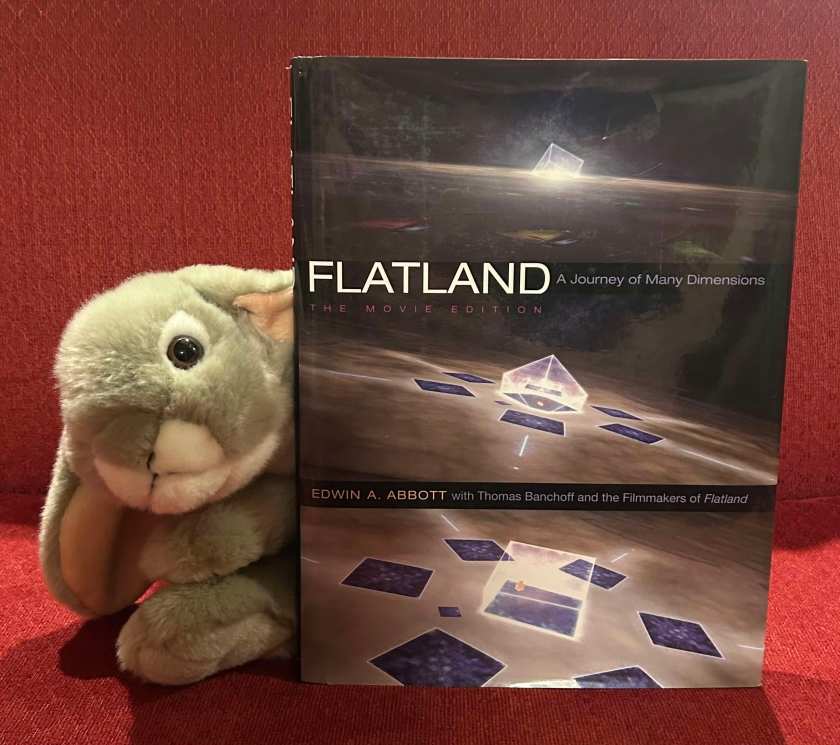
Today Sprinkles reviews a 2008 edition of a unique classic: Flatland: A Journey of Many Dimensions – The Movie Edition, credited to “Edwin A. Abbott, with Thomas Banchoff and the Filmmakers of Flatland“.
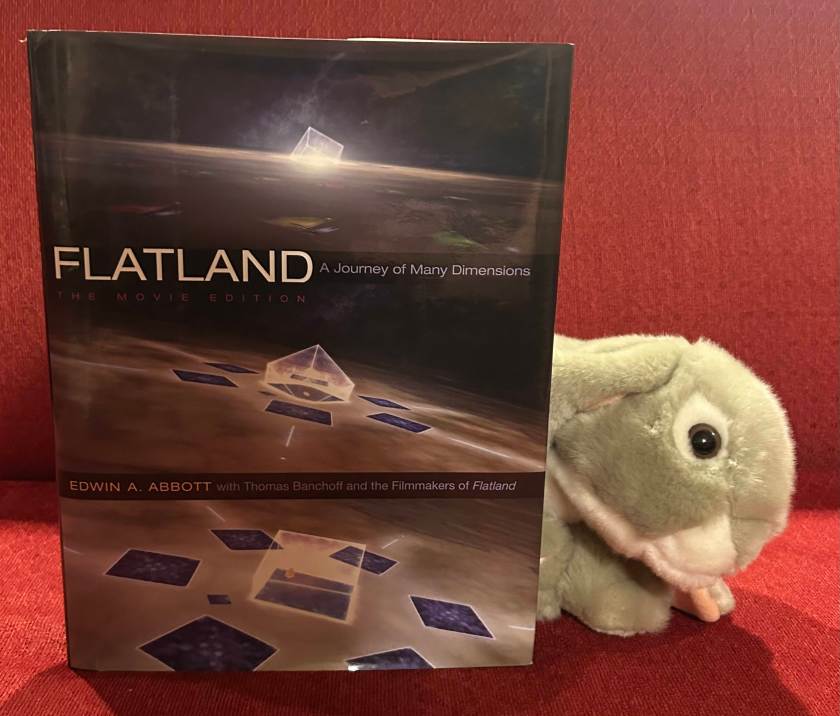
Today Sprinkles reviews Flatland: A Journey of Many Dimensions - The Movie Edition by Edwin A. Abbott, with Thomas Banchoff and the Filmmakers of Flatland.
Today Sprinkles reviews Flatland: A Journey of Many Dimensions – The Movie Edition by Edwin A. Abbott, with Thomas Banchoff and the Filmmakers of Flatland.

Flatland: A Romance of Many Dimensions by Edwin A. Abbott was originally published in 1884. As Wikipedia tells us, this was a novella written by “A Square” who lived in a two-dimensional world called Flatland. The main plot of the book involved the Square meeting a Sphere, coming into Flatland and teaching him about the third dimension. The Square, his consciousness now widened, began to stipulate the existence of fourth and higher dimensions, which in turn confused the Sphere.

The book’s story is amusing, and for many young minds it could be a welcome introduction to the mathematics and philosophy of higher dimensions. The adults reading the book together with their young one would also appreciate the satire underneath it all. Abbott’s pointed comments about the second class status of women in Victorian England, on the other hand, can be comprehended by some of the young crowd. (In Flatland, men are two-dimensional — they are polygons of various types — but women are one-dimensional; they are very very pointy and have no depth.)

The bottom of the Wikipedia article on Flatland lists several online places where one can access the full text of Flatland, as it is now in public domain. (Here, for example, is the Project Gutenberg version.) But I wanted to review this particular 2008 edition of the book because it not only contains the full text but also has some information about the 2007 movie made based on it. As such there are many colorful illustrations in the book, and this might make it even more fun for a young bunny to look through and read along.
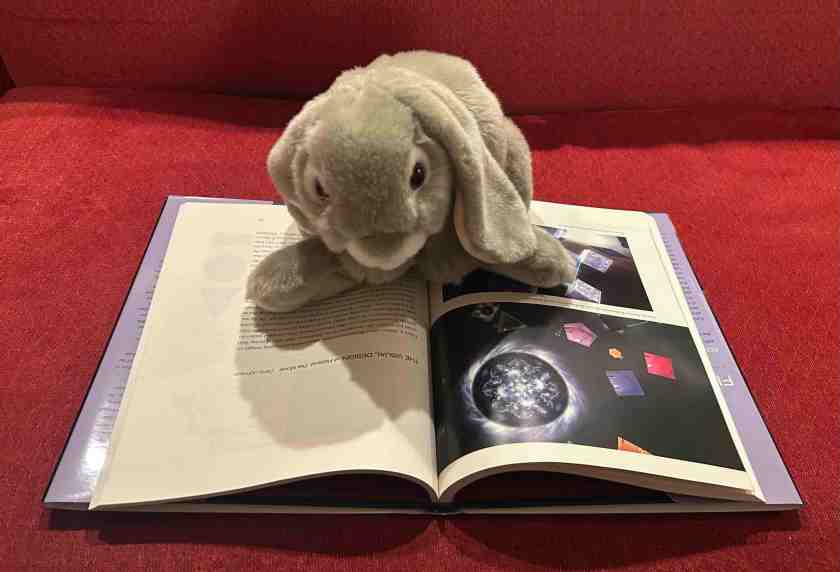
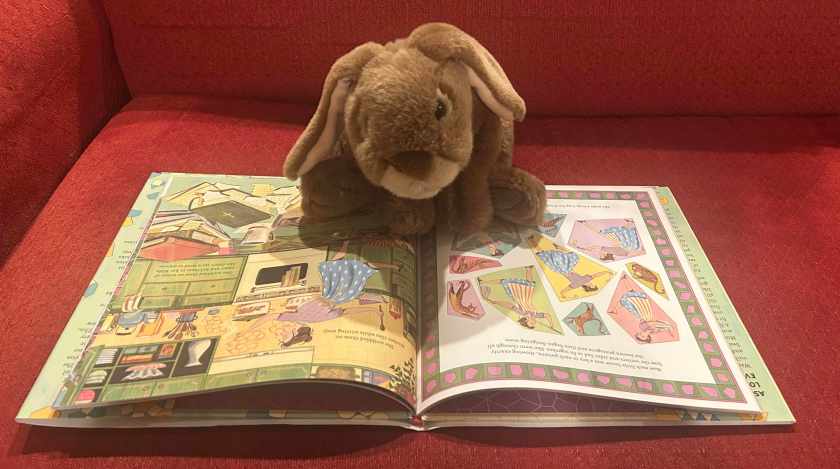
Sprinkles is reading Flatland: A Journey of Many Dimensions - The Movie Edition by Edwin A. Abbott, with Thomas Banchoff and the Filmmakers of Flatland.
Sprinkles is reading Flatland: A Journey of Many Dimensions – The Movie Edition by Edwin A. Abbott, with Thomas Banchoff and the Filmmakers of Flatland.

Abbott’s original novella is not too long, so it takes about half of this large-format book. The rest of the book is also worth reading however. There is a short introduction by the mathematician Thomas Banchoff at the beginning, which is worth reading to contextualize what is to come. Then the whole text of the classic Flatland follows. After that, the second part of the book starts. This section is titled “Flatland: The Movie” and includes three brief essays (“Finding Flatland” by producer Seth Caplan, “Imagining Flatland” by director Jeffrey Travis, and “The Visual Design of Flatland: the Movie” by director and animator Dano Johnson), lots of colorful images on high-quality paper, and then the screenplay of the whole film.

Trailer of Flatland: The Movie, from YouTube.

The movie is also worth watching, actually, and it seems to be available in a bunch of places, including YouTube. Apparently right around the same time, some other folks made a second movie based on Flatland, so sometimes people get confused, but the book I am talking about here and the trailer above are both related to the shorter movie voiced by actors like Martin SheenKristen Bell and Tony Hale.

All in all, I recommend Flatland very highly; you should read it and you should introduce all the bunnies around you to it. The 2008 edition here is a good place to start, but it is also fine if you choose the movie version first. I should note that the women are not one-dimensional in the movie: the Victorian satire tends to go on the back-burner there, and the math seems to come to the fore. Which is fine by me but your preferences might be different.
Sprinkles enjoyed reading Flatland: A Journey of Many Dimensions - The Movie Edition by Edwin A. Abbott, with Thomas Banchoff and the Filmmakers of Flatland, and recommends it to all bunnies young and old.
Sprinkles enjoyed reading Flatland: A Journey of Many Dimensions – The Movie Edition by Edwin A. Abbott, with Thomas Banchoff and the Filmmakers of Flatland, and recommends it to all bunnies young and old.

Caramel reviews The Five Sides of Marjorie Rice: How to Discover a Shape by Amy Alznauer

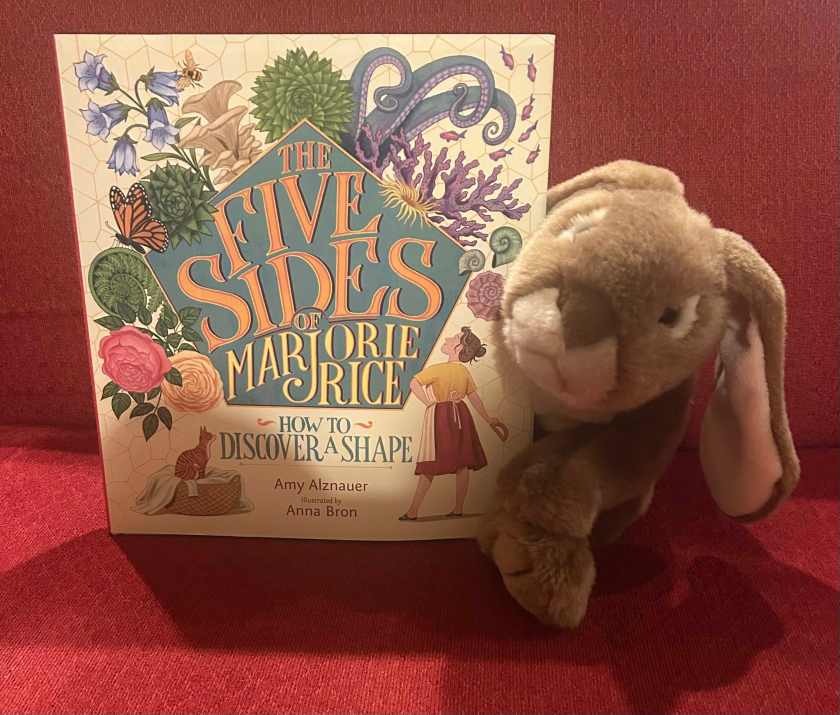
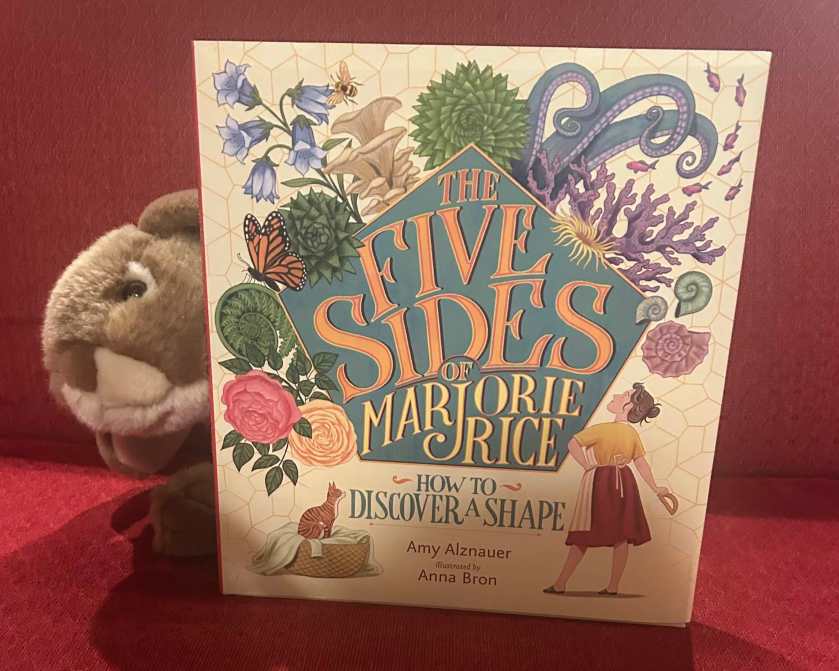
Today Caramel reviews an intriguing and colorful picture book: The Five Sides of Marjorie Rice: How to Discover a Shape, written by Amy Alznauer and illustrated by Anna Bron. Published in June 2025, this beautiful book was recommended to the book bunnies by a long-time friend of the blog: thank you, you-know-who-you-are! As usual Sprinkles is taking notes and asking followup questions.

Caramel reviews The Five Sides of Marjorie Rice: How to Discover a Shape, written by Amy Alznauer and illustrated by Anna Bron.

Sprinkles: Today we are talking about another picture book, written by Amy Alznauer. We reviewed another book by her a while back.  

Caramel: Yes, I remember! That was a cool book, too; it was about a mathematician who thought about beautiful number patterns. This one is about a woman who discovered a new pentagon.

S: A new pentagon? How does one discover a new pentagon? I mean, pentagons are five-sided geometric shapes, and there are infinitely many of them. 

C: So yes, there are a lot of different types of pentagons, right? So she just found a new type. Pretty cool, right?

S: Yes, sounds cool, but I am still not sure I understand. Among the infinitely many different pentagons, the one she found has to be special somehow to be important. 

C: So, let me try to say it more carefully then. She found multiple new types of five-sided shapes that could cover the whole plane.

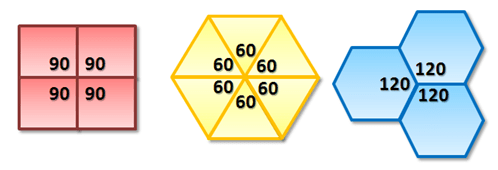
S: Oh, I see. So she found a new tile! I know about these! The problem is if you have a bathroom or a kitchen and you want to tile it with tiles, then in the hardware store, they usually will have square tiles, because squares tile the plane. That means you can use square tiles to cover a surface without leaving any gaps. It turns out that you can use hexagonal (six-sided) tiles or triangular (three-sided) tiles too. But these are the only options if you want to use regular tiles. That means each side has to be the same length and the corners in the angles should be the same. Here is a nice picture, showing the angles meeting at a corner for the three regular tiles:

Image from https://pappagallodifermat.blogspot.com/2012/07/ma-che-bel-pavimento.html

C: Yeah, so when she learned about this, she wondered why not five-sided tiles.

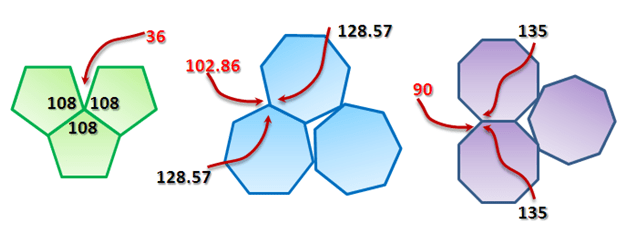
S: The math does not add up with five sides, at least if you want regular tiles, with the same side lengths and corner angles. See:

Image from https://pappagallodifermat.blogspot.com/2012/07/ma-che-bel-pavimento.html

C: Cool, I think I understood it a bit when reading the book, but these pictures help me understand it better. So let us keep them for our readers, too. Hopefully it will help them too. .

S: Sure. So all of that means that regular pentagons don’t work. So then she must have found a five-sided shape that can still tile the plane. That sounds really cool! 

C: Yeah, I agree. It looks like a crooked house! And she kept playing with different crooked houses in her head until she found one that worked. It is really cool. And the pictures are also very interesting. 

S: Yeah, I had a chance to look over the pages of the book, too, and agree with you. It is very colorful, and shapes of all types are all over the place. It is visually a very satisfying book. 

C: Yep. 

Caramel is reading The Five Sides of Marjorie Rice: How to Discover a Shape, written by Amy Alznauer and illustrated by Anna Bron.

C: So the book does tell us a bit about all the people who worked with this tiling problem you described above. But I wondered why this Marjorie Rice was the only woman among them, and no other women were mentioned other than her.

S: Hmm, you know, this is kind of a challenge for many people who want to encourage everyone to be more expansive about how they think of just who can do math. It seems that throughout human history, the mathematicians who made names for themselves have almost all been men. So I think Marjorie Rice’s story is a very interesting one, not only because the math she did is fascinating but also because she is a woman who did not become a famous mathematician, but while going about doing her life – she was a homemaker – she just happened to find a mathematical problem so interesting that she could not stop thinking about it. And she found a really neat solution to it, too!

C: Yeah, it is really cool, isn’t it?

S: Yes, I agree. This all reminds me of this article I read about what it means to be a mathematician. The author, a cool math blogger, basically says that you find mathematical problems interesting and you give yourself the freedom to work on them. 

C: Huh, cool, I like that! It means I could be a mathematician, too, if I found a problem that I could not stop thinking about and just kept at it. 

S: Yes, exactly. It is about curiosity and keeping at it. 

C: But maybe I want to become an astronaut instead?

S: Well, that is part of the point of the story, right? You don’t have to be a professional mathematician to do math. You can be anything else, and also play with math on the side. You know, some of the very famous mathematicians we still talk about today did math as a hobby. Like Pierre de Fermat, who was a lawyer but also did a lot of very interesting math on the side. 

C: Hmm, that is interesting… I am not sure I want to become an astronaut by the way. I like this planet too much, and as a tiny bunny, being in orbit is kind of intimidating. 

S: Yeah, I think you are very much planted on this planet. Me too. But you think reading about space is cool, though, right? 

C: Yeah, it really is. Hmm, I have not reviewed a space book recently. 

S: Well, you did just review Space Case: The Graphic Novel

C: True. And that is a really good book by the way. But I was kind of hinting toward another space book review coming up soon, wink wink! 

S: I know! Okay, maybe we should wrap this up because it is getting close to your bedtime. What would you like to tell our readers as we end this post Caramel?

C: Stay tuned for more book bunny reviews!

Caramel enjoyed reading The Five Sides of Marjorie Rice: How to Discover a Shape, written by Amy Alznauer and illustrated by Anna Bron, and is now looking around himself to see if he can find new hexagons.

Caramel reviews What’s Your Angle, Pythagoras? by Julie Ellis

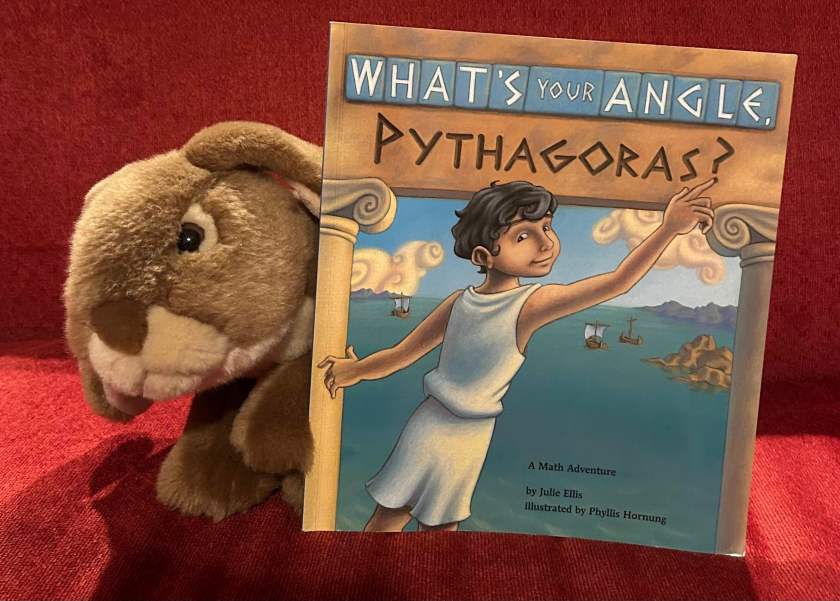
This past week Caramel’s class was learning about the Pythagorean Theorem so he thought that this was just the perfect week to talk about What’s Your Angle, Pythagoras? A Math Adventure, written by Julie Ellis, illustrated by Phyllis Hornung, and first published in 2004. As usual Sprinkles is taking notes and asking questions.

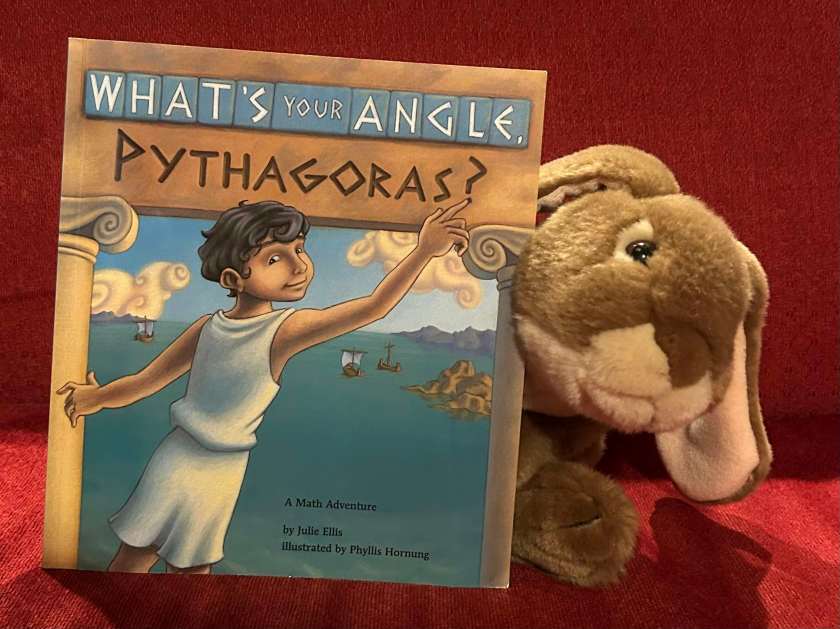
Caramel reviews What's Your Angle, Pythagoras? A Math Adventure, written by Julie Ellis and illustrated by Phyllis Hornung.
Caramel reviews What’s Your Angle, Pythagoras? A Math Adventure, written by Julie Ellis and illustrated by Phyllis Hornung.

Sprinkles: So Caramel, today we are talking about a math book. 

Caramel: When you say it like that, it sounds like we are talking about a school book. 

S: True, this is not quite a school book, though, in some sense, we are talking about it because of school. 

C: Yep. We were learning about the Pythagorean Theorem at school, so you gave this book to me. 

S: That I did. So what did you think? 

C: It was not that bad.

S: Hmm, that is faint praise. 

C: Yep.

S: So did you not like the book then? We do not review much that we do not like. 

C: No, I was kind of joking. The book is actually pretty good as a story, and the pictures are nice, too. There are some real mathematical diagrams, but they fit right into the story and it seems like they just show up naturally. But I do not think this is how Pythagoras came up with his theorem. 

S: I see. So it is the fiction part that you did not find most appealing. I do know you like your books with facts in them, so this had some facts, like the theorem itself, but a kind of a made-up story about how it came about, right?

C: Yes. Pythagoras is a boy living in ancient Greece, and he is trying to figure things out about distances, and he discovers the theorem all by himself. I mean it could have happened that way, but …

S: But you are not convinced?

C: Yeah, not really.

S: But it could have happened that way; we do not exactly know how Pythagoras came to his result. And don’t you think it might be fun for young bunnies to imagine themselves coming up with such an important result on their own? 

C: Yeah, I guess you’re right, but still…

S: Are you a little envious perhaps? A bunny might have more difficulty playing with ropes and such like the boy in the story and so might have more difficulty coming up with such a result maybe. 

C: No, I am not envious! And I like my paws and I can still do quite a lot of fun things with them!

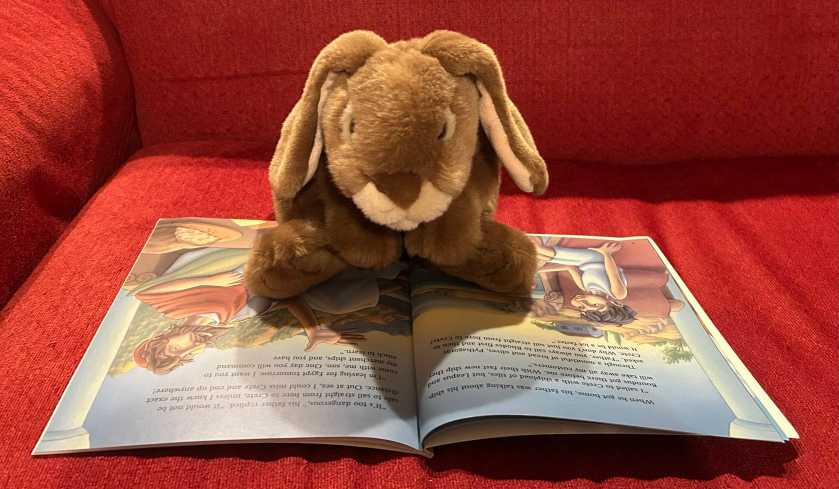
Caramel is reading What's Your Angle, Pythagoras? A Math Adventure, written by Julie Ellis and illustrated by Phyllis Hornung.
Caramel is reading What’s Your Angle, Pythagoras? A Math Adventure, written by Julie Ellis and illustrated by Phyllis Hornung.

S: Okay okay, so you did not like the fictional part of the story. I get it. Did you think the math was explained well at least?

C: Yeah, it made sense. I think I will not forget the theorem ever after that. So in that sense the book did its job well. 

S: Oh, that’s good! 

C: Yeah, and I think my math teacher would like this book, too. She likes the Pythagorean Theorem a lot. 

S: I am sure she will be at least happy that you now know the Pythagorean Theorem really well. Can you tell our readers what it is?

C: a2+b2=c2. You say it like “a squared plus b squared equals c squared.”

S: Okay, that is an equation. It does not mean much before you tell me what a, b, and c are.  

C: So you have a right triangle and these are the side lengths. c is the hypotenuse, that is the side across from the right angle. b and a are the legs, or the sides that are the part that from a right angle. And the cool thing is that this equation I said is always true, for any right triangle you can find. 

S: Yes, it is pretty neat actually! In the book the boy Pythagoras is trying to solve another problem and somehow figures out that this theorem works for all right triangles. So what is his angle then? The angle in the title, I mean?

C: They have a wordplay there. So the right angle is the one you need to look in the right way to find your answer… But also the right angle is the angle between two lines that splits the space between them into equal halves, and Pythagoras’s theorem is about right angles. So there are two meanings. 

S: Kind of clever!

C: Yep, I thought so, too. I do like wordplay.

S: So maybe this is a good place to wrap up our review Caramel. What would you like to tell our readers?

C: Stay tuned for more book bunny reviews!

Caramel enjoyed reading What's Your Angle, Pythagoras? A Math Adventure, written by Julie Ellis and illustrated by Phyllis Hornung, and expects that he will never ever forget the Pythagorean Theorem!
Caramel enjoyed reading What’s Your Angle, Pythagoras? A Math Adventure, written by Julie Ellis and illustrated by Phyllis Hornung, and expects that he will never ever forget the Pythagorean Theorem!

Sprinkles reviews children’s books about Emmy Noether

Sprinkles has recently seen the one-woman play Diving Into Math with Emmy Noether, performed expertly by Anita Zieher. When she saw the play, she was in the middle of writing a joint review of two recent biographies on Emmy Noether for the newsletter of the Association for Women in Mathematics: Proving it Her Way: Emmy Noether, A Life in Mathematics, by David E. Rowe and Mechthild Koreuber, and Emmy Noether – Mathematician Extraordinaire by David E. Rowe, published in 2020 and 2021, respectively. The play impacted her deeply, and so she began to wonder if there were any good books about Emmy Noether written for children. This post is the outcome of her resulting explorations.

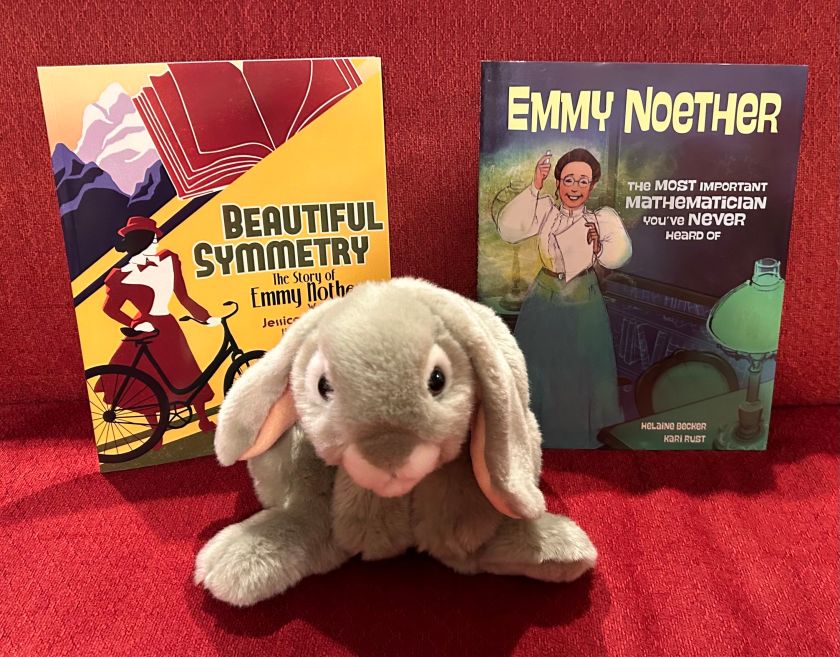
Sprinkles reviews two children's books about Emmy Noether: Beautiful Symmetry: The Story of Emmy Noether, written by Jessica Christianson and illustrated by Brittany Goris, and Emmy Noether: The Most Important Mathematician You've Never Heard Of, written by Helaine Becker and illustrated by Kari Rust.

Today I am writing to share with you some of my thoughts on reading two children’s books about Emmy Noether (1882-1935), who just happens to be one of the greatest mathematicians of the twentieth century. After having reviewed a whole bunch of children’s books about Ada Lovelace, I expected that Noether’s life must also have been depicted in several children’s books, given the importance of her work to modern mathematics and physics.

Emmy Noether’s life is also intrinsically interesting: though filled with sorrows and frustrations, and all sorts of challenges due to her gender (being a woman) and ethnicity (being a German Jew during the rise of Nazism before World War II), Noether’s life was also jam-packed with good friendships, great creative accomplishments, and according to the one-woman play Diving into Math with Emmy Noether performed by Anita Zieher, plenty of delicious pudding. [In case you are interested, here is a trailer for the play:

Trailer for Diving into Math with Emmy Noether, via YouTube.]

Especially after seeing Diving Into Math, I was convinced that Noether’s story would be appealing not only to an adult general audience of curious readers but also to a great many young readers. So I began to look around for books intended for a young audience.

Surprisingly I could find only two books: Beautiful Symmetry: The Story of Emmy Noether, written by Jessica Christianson and illustrated by Brittany Goris, and Emmy Noether: The Most Important Mathematician You’ve Never Heard Of, written by Helaine Becker and illustrated by Kari Rust. Both books are interesting and could be appealing to young readers, though I believe they have somewhat different strengths.

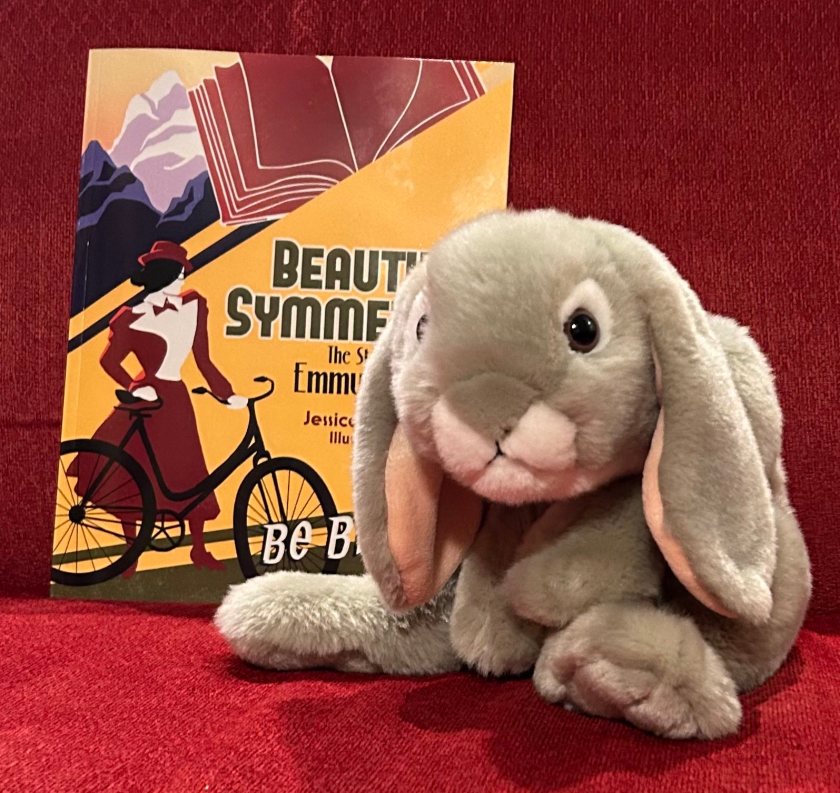
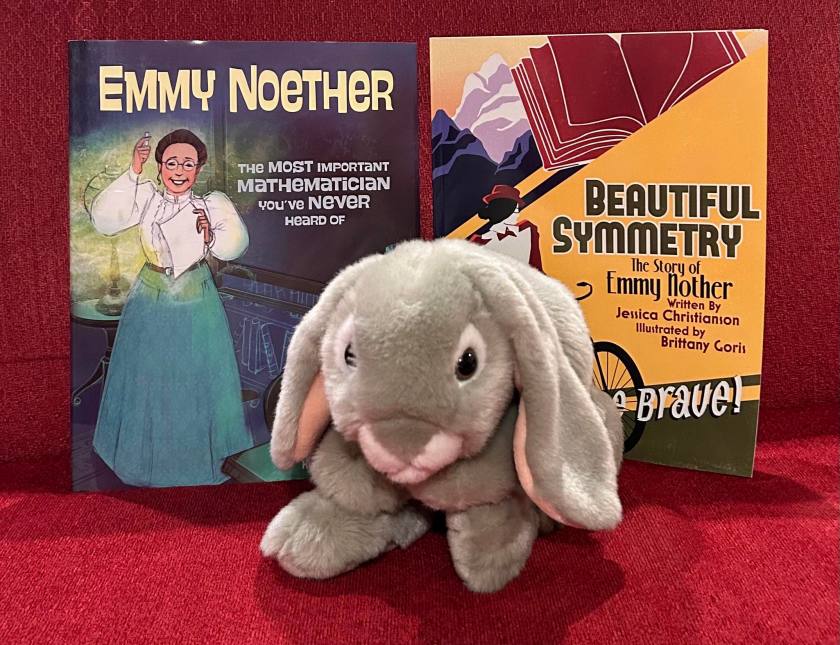
Sprinkles is posing with Beautiful Symmetry: The Story of Emmy Noether, written by Jessica Christianson and illustrated by Brittany Goris.

The first of the pair, Beautiful Symmetry: The Story of Emmy Noether, written by Jessica Christianson and illustrated by Brittany Goris, was published in 2017. In softcover paperback, the book is large format. The bold, striking page design which alternately reminded me of political posters and The Powerpuff Girls, and the large font used throughout might make the book more appealing to younger bunnies. The story of Emmy Noether’s life is told in the book in broad strokes, and that might also help with the younger crowd.

Beautiful Symmetry is visually very appealing and symmetry abounds throughout the book, adding to the theme and encouraging the reader to associate Noether’s life and accomplishments with the visual experience of symmetry. The end of the book has a short section on Emmy Noether’s mathematical work as well as a few simple math puzzles for the young readers who might want to explore math on their own a bit now that they have presumably gotten all inspired by the story they just read. I liked and appreciated each of these features.

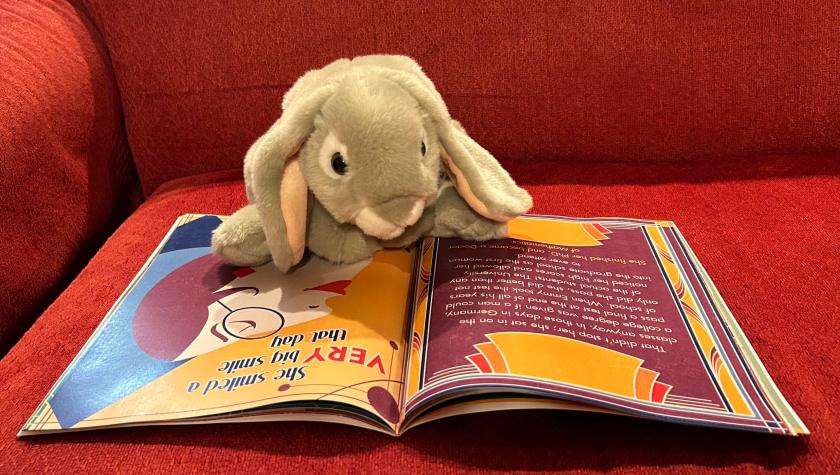
Sprinkles is reading Beautiful Symmetry: The Story of Emmy Noether, written by Jessica Christianson and illustrated by Brittany Goris.

Unfortunately, one occasionally finds a few factual errors here and there. For example, it was not a simple university official but the great mathematician David Hilbert who defended Emmy Noether in Göttingen, and he did not mention a locker room; rather he said “After all, we are a university, not a bathhouse.” (Well, he said it in German, so his exact words were “Meine Herren, der Senat ist doch keine Badeanstalt.”) Here is another example: Emmy Noether eventually did find a position at Bryn Mawr College, but despite what we read in Beautiful Symmetry, she never became the math department head there. (For more on Noether’s time at Bryn Mawr, see, for example, “A Refugee Scholar from Nazi Germany: Emmy Noether and Bryn Mawr College” by Qinna Shen.) These and a couple other small errors (including an embarrassing typo on the front cover) make me a bit wary to encourage readers to use this book as a reference for a book report.

For a book report, a much better reference would be Emmy Noether: The Most Important Mathematician You’ve Never Heard Of, written by Helaine Becker and illustrated by Kari Rust, and published in 2020. This book is well researched and according to the acknowledgments, had some fact-checking assistance from the Perimeter Institute. So in terms of facts, including the math and physics connections of Noether’s work, this book is a lot more reliable.

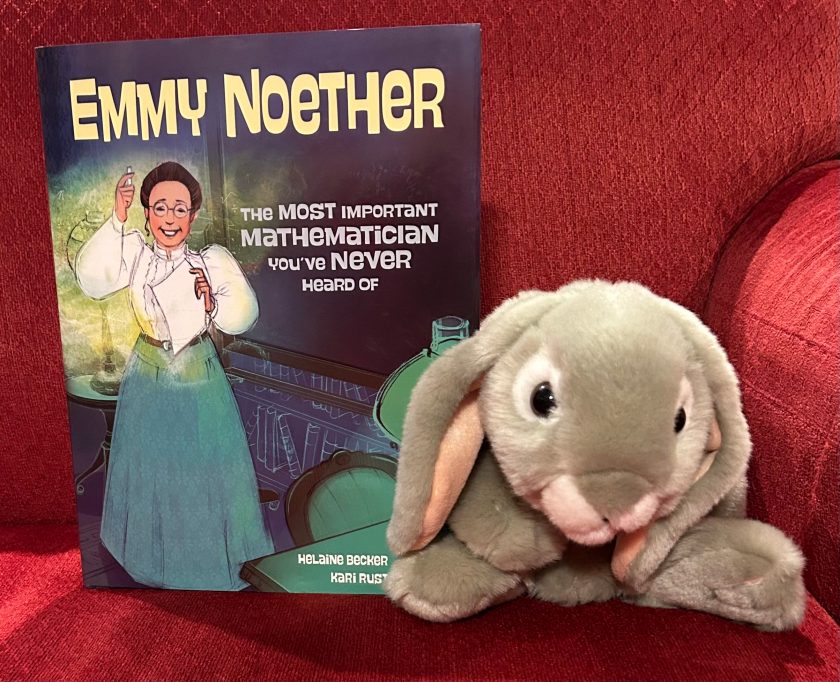
Sprinkles is posing with Emmy Noether: The Most Important Mathematician You've Never Heard Of, written by Helaine Becker and illustrated by Kari Rust.
Sprinkles is posing with Emmy Noether: The Most Important Mathematician You’ve Never Heard Of, written by Helaine Becker and illustrated by Kari Rust.

Emmy Noether: The Most Important Mathematician You’ve Never Heard Of was published in 2020, and the title is reminiscent of a 2012 New York Times article on Noether, “The Mighty Mathematician You’ve Never Heard Of” by Natalie Angier. But that essay, though very well written, made an unfounded claim that Noether published articles using men’s names. (Beautiful Symmetry also makes this unfounded claim, so perhaps Angier’s article led to some misunderstandings that were propagated. See this discussion for more details on the claim.) Becker’s book does not fall into such oversimplifications. And the story of Emmy Noether does not need such tropes. It is fascinating on its own with no need for embellishments.

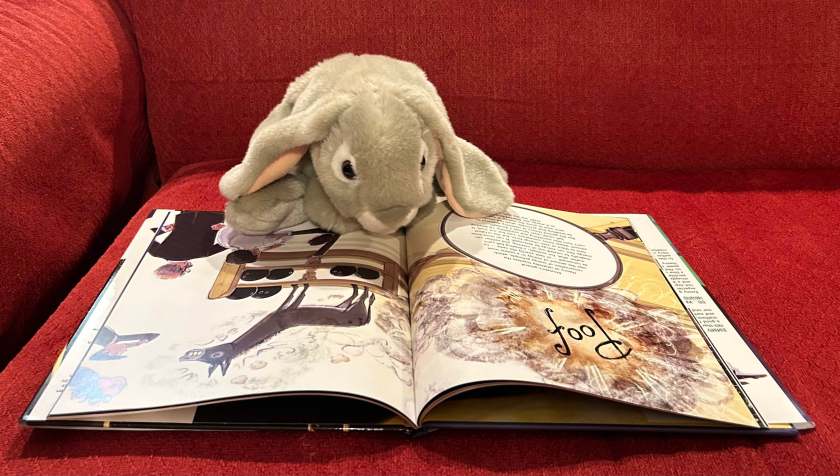
Rust’s illustrations are cute and sharp at the same time, and the cartoonish detractors of Noether are shown humorously while the severity of Noether’s challenges is not minimized. The math and physics connections of her work are explained with precise terms in what is still a totally comprehensible language, and the illustrations support these descriptions. The book manages to distill into simple language some relatively abstract and advanced mathematical ideas, and somehow still retains a entertaining quality. The reader cannot help but root for Emmy, and laugh triumphantly each time she embarrasses her detractors.

Sprinkles is reading Emmy Noether: The Most Important Mathematician You've Never Heard Of, written by Helaine Becker and illustrated by Kari Rust.
Sprinkles is reading Emmy Noether: The Most Important Mathematician You’ve Never Heard Of, written by Helaine Becker and illustrated by Kari Rust.

All in all, I enjoyed reading Emmy Noether: The Most Important Mathematician You’ve Never Heard Of, and would definitely recommend it to any young person interested in learning about what a mathematician does. Similarly the book would work well to introduce young bunnies to a most creative and impactful woman scientist, whose name is unfortunately not as well known as some others. There is a significant amount of math in the book, too, for those who want it, though the reader who does not want to dive too deep into those pools can easily avoid the more technical bits (left to a separate section at the very end) and enjoy and appreciate the rest of Emmy Noether’s story completely.

To be honest, I did enjoy reading both books, and despite the factual errors of Beautiful Symmetry, I would recommend either book to young readers. If one is looking for complete factual accuracy of course, I’d suggest sticking with The Most Important Mathematician You’ve Never Heard Of, or perhaps even jumping over to the other side and looking into some of the more standard biographies, written for adult consumption. Proving It Her Way by David E. Rowe was published in 2020 to accompany the play Diving into Math with Emmy Noether I started this review with. Rowe is a historian of mathematics, but this book was intended for a general audience. As such, I think it could be a great next step for anyone interested in learning more about this creative mind who found so much joy in mathematics, abstract ideas, and good intellectual companions.

Sprinkles encourages all young bunnies to learn more about Emmy Noether by exploring one of the two children's books about Emmy Noether she reviewed here: Beautiful Symmetry: The Story of Emmy Noether, written by Jessica Christianson and illustrated by Brittany Goris, and Emmy Noether: The Most Important Mathematician You've Never Heard Of, written by Helaine Becker and illustrated by Kari Rust.
Sprinkles encourages all young bunnies to learn more about Emmy Noether by exploring one of the two children’s books about Emmy Noether she reviewed here: Beautiful Symmetry: The Story of Emmy Noether, written by Jessica Christianson and illustrated by Brittany Goris, and Emmy Noether: The Most Important Mathematician You’ve Never Heard Of, written by Helaine Becker and illustrated by Kari Rust.