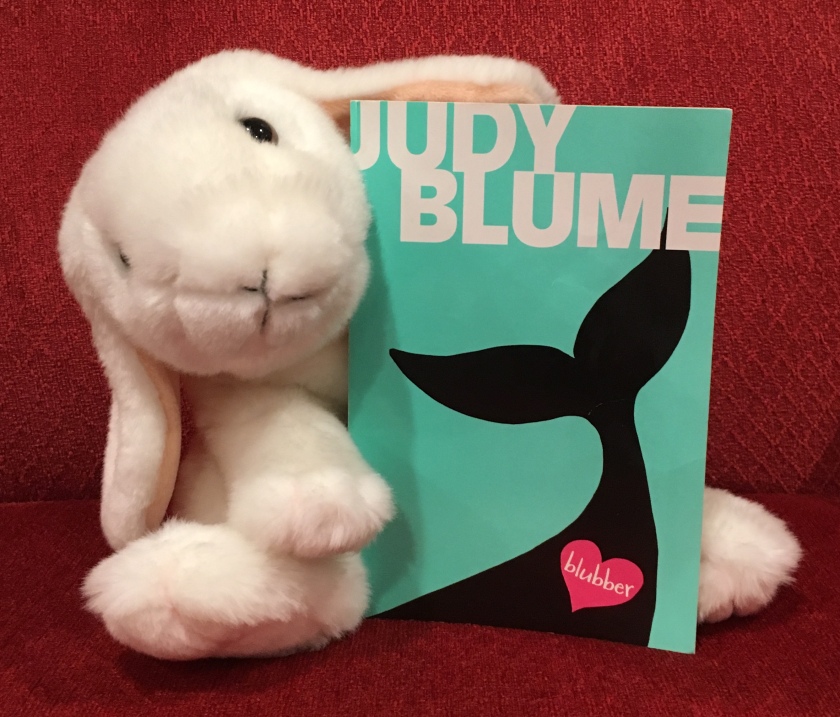
Marshmallow reviews Blubber by Judy Blume

Marshmallow reviews Blubber (1974) by Judy Blume, about school, bullying, and friendship.

Marshmallow likes reading books about school-age kids, even if there are no dragons or wizards, though she quite likes it when those kinds of things do appear. Below she reviews a classic, Blubber by Judy Blume, first published in 1974.

Marhsmallow reviews Blubber by Judy Blume.

Marshmallow’s quick take: If you like books about things that happen at school, then this might be the book for you.

Marshmallow’s Summary (with spoilers): Fifth grader Jill Brenner is a part of a group of girls that bully a girl named Linda. Linda is bigger than the other kids in the class and so is bullied and mistreated. Since she gave a report on the whale and talked about a whale’s blubber, the bullies call her Blubber. Jill’s group, along with the rest of the class, tease, bully, and mistreat Linda.

The gang of bullies is made up of girls named Wendy, Caroline, and Jill. In this group they all have roles. Wendy is the leader, while Caroline is the muscle that holds the victims’ hands together while Jill does whatever Wendy says. Wendy is very manipulative. All the teachers like her and so if one of her victims tells on her, she just comes up with a lie, and then the teachers believe her, and so she does not get in to trouble. In this terrible way Wendy not only makes herself seem innocent but also makes the victim look like a liar.

On Halloween, Jill and her friend, Tracy Wu, try to get revenge on a man named Mr. Machinist (apparently he is a mean person) by putting rotten eggs in his mailbox. They put the rotten eggs in his mailbox. Then they meet Wendy and Caroline, who don’t believe that they put the eggs in his mailbox. When they show the eggs to Wendy and Caroline, Mr. Machinist catches them. They manage to get away, but Mr. Machinist takes a picture of Jill and Tracy before they can get away.

Marshmallow is pointing toward the letter Mr. Machinist sent to Jill's parents.
Marshmallow is pointing toward the letter Mr. Machinist sent to Jill’s parents.

Later Mr. Machinist sends a letter to Jill’s and Tracy’s families telling them that they put rotten eggs in his mailbox and that they need to pay. Mr. Machinist assigns them the job of raking up leaves in his backyard.

At school the girls decide that someone must have told Mr. Machinist the names of the girls in the picture. They think that it must have been Linda. Jill convinces her friends that they should hold a trial to determine if Linda is innocent or not. The trial brings an unexpected twist which changes the course of the story. 

Marshmallow’s Review: This book is written in the first person, from the perspective of Jill Brenner, who is part of the gang that bullies Linda, or as the group of bullies call her, Blubber. This fact (that the book is written in the first person) is not the only difference from most of the other books that I have reviewed though. (Ella Enchanted was also in first person.) The narrator, Jill, is just not a nice person. It is strange reading the story from her perspective. She does call Linda Blubber, which is not nice at all.

This book is about events that can occur in real life, and life doesn’t always end like “and they lived happily ever after“. This book does not end happily, but the main message (“treat others how you want to be treated“) does come through very clearly. It will make a good read for readers who appreciate books that don’t end “happily ever after” but instead leave you with things to think about.

There are some curse words in the book, which is one of the reasons why it might not be appropriate for all young readers.

Marshmallow’s rating: 90%
Marshmallow rates Blubber by Judy Blume 90%.

Marshmallow reviews Make Your Own Optical Illusions by Clive Gifford and Rob Ives

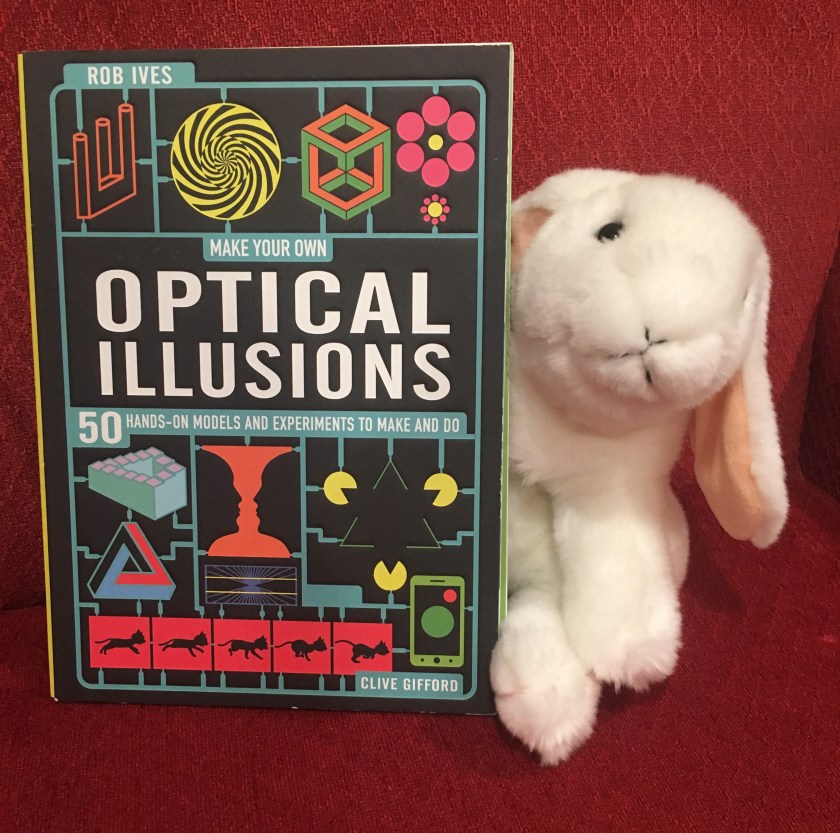
This week Marshmallow reviews a neat activity book written by Clive Gifford (text) and Rob Ives (paper engineering): Make Your Own Optical Illusions: 50 Hands-On Models and Experiment to Make and Do.

Marshmallow reviews Make Your Own Optical Illusions: 50 Hands-On Models and Experiment to Make and Do by Clive Gifford and Rob Ives.

Marshmallow’s quick take: If you like books that are about optical illusions and how they work, then this might be the book for you.  

Marshmallow’s Overview: This book is about optical illusions and what makes them so convincing that they fool your brain and eyes in to thinking that something looks different than it actually is.

There is a large variety of optical illusions in the book. At the beginning we learn about literal illusions, cognitive illusions, and physiological illusions.

“Literal illusions simply use one type of object to trick your brain into thinking it is viewing a different object or scene. Cognitive illusions occur because of the way your brain judges and decides on the information sent to it by the eyes. Physiological illusions are designed to exploit the limits of your body and vision system.”

This page from Arizona State University, written by Abigail Howell, explains the difference between these three, in case you want to learn more. There are also neat examples of each in the book.

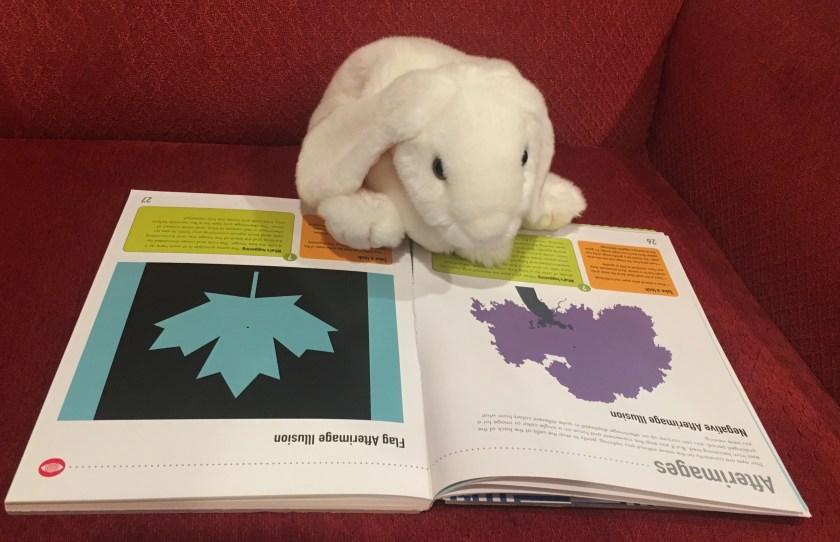
One of my favorite optical illusions in the book is a physiological illusion called Afterimages. This is where you stare at an image, for example a black light bulb, and then you look at a piece of paper that is white and then you see a glowing light bulb that looks like the light bulb you saw in the book but now the bulb you see is glowing! The reason that this happens is because, according to the book, your special light-detecting cells get tired after staring at an image for a long time, and they send a weak signal so that your brain reads it as the opposite color that the image actually is, thus making the light bulb look like it is glowing. 

Marshmallow is reading up on afterimages, a special kind of physiological illusion.

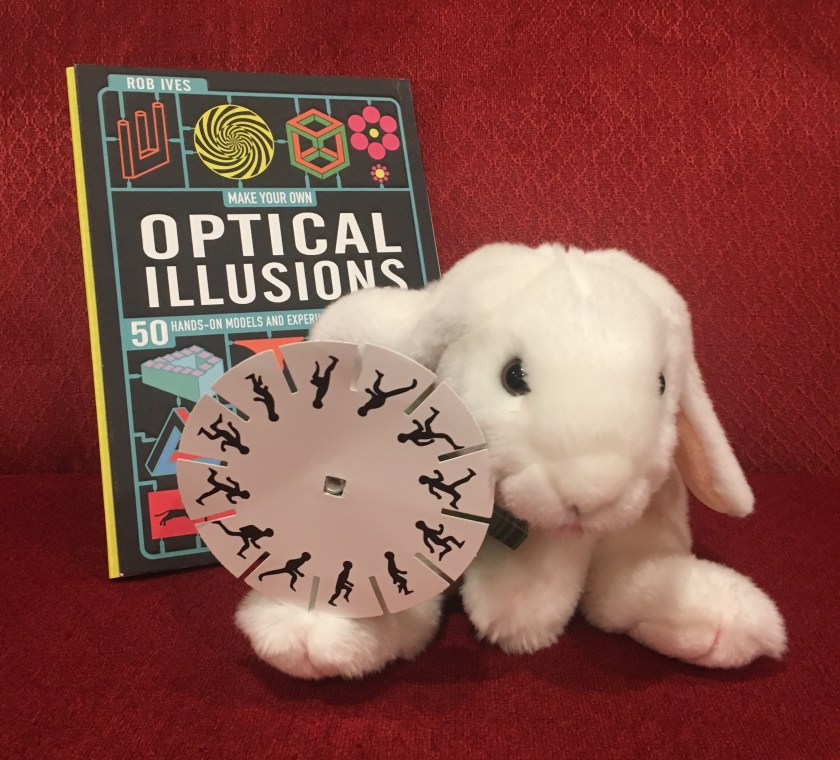
The book has a total of 64 colorful pages of text and examples of illusions. Then there are twenty pages in the back that have cardboard cutouts. You can “press them out” and they come out easily, so you can build your own optical illusions, little hand-held thingies that you can use to fool or trick your brain and eyes into thinking in strange ways. Some of these hands-on projects are things that you spin and then you see a person running. Some of the papers that you can press out are one that are to help you see why one of the optical illusions work.

Marshmallow is proudly showing one of the optical illusion toys she made using the cutouts from Make Your Own Optical Illusions: 50 Hands-On Models and Experiment to Make and Do.

Marshmallow’s Review: This is a great book which contains many great optical illusions that will definitely fool you. Some are optical illusions that you can build, and some are ones that make your eyes see two images in one picture. The explanations given to explain what is happening in your brain when you get fooled are expertly written so that anyone can understand why you see something that is not on the page.

The authors, Rob Ives and Clive Gifford, have cooked up some great illusions that are really interesting. When these optical illusions are mixed together, they make a mind-boggling illusion book.

This is a hands-on book that includes projects that you can put together by yourself and then amaze your mind. I have only made some of the projects at this point and I am excited to make some more.

Overall Make Your Own Optical Illusions is a great book for all bunnies, especially those who like to play with their minds and hands (or paws?).      

Marshmallow’s rating: 95%

Marshmallow rates Make Your Own Optical Illusions: 50 Hands-On Models and Experiment to Make and Do by Clive Gifford and Rob Ives 95%.

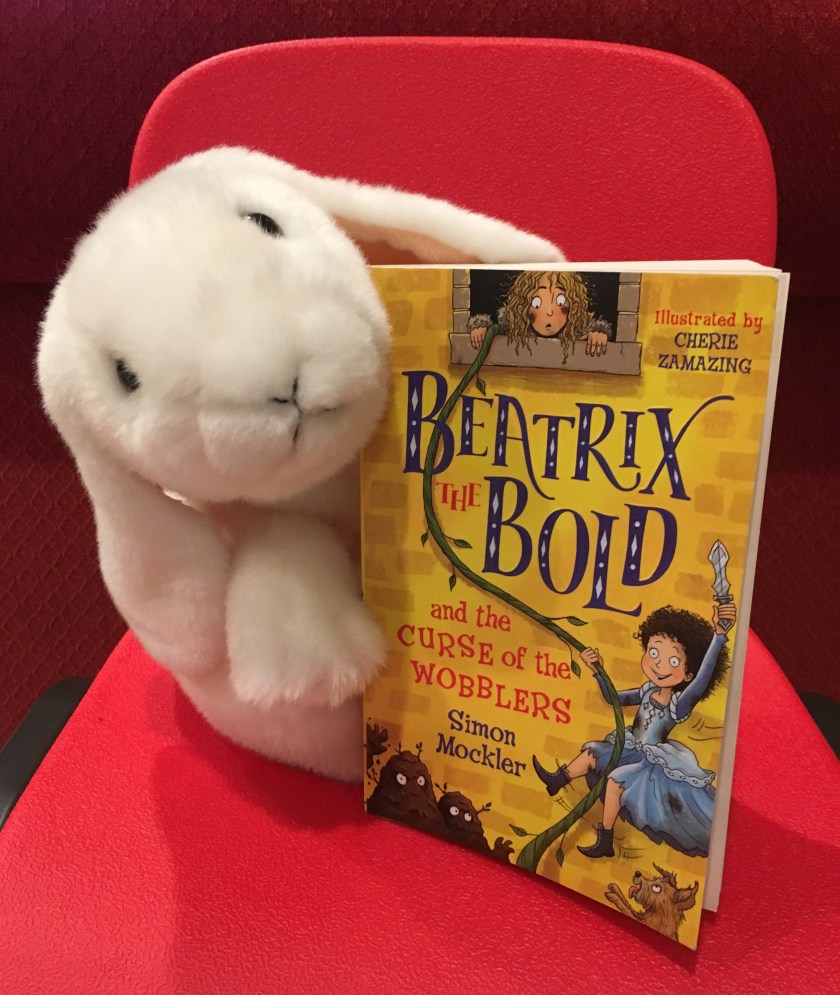
Marshmallow reviews Beatrix The Bold and the Curse of the Wobblers by Simon Mockler

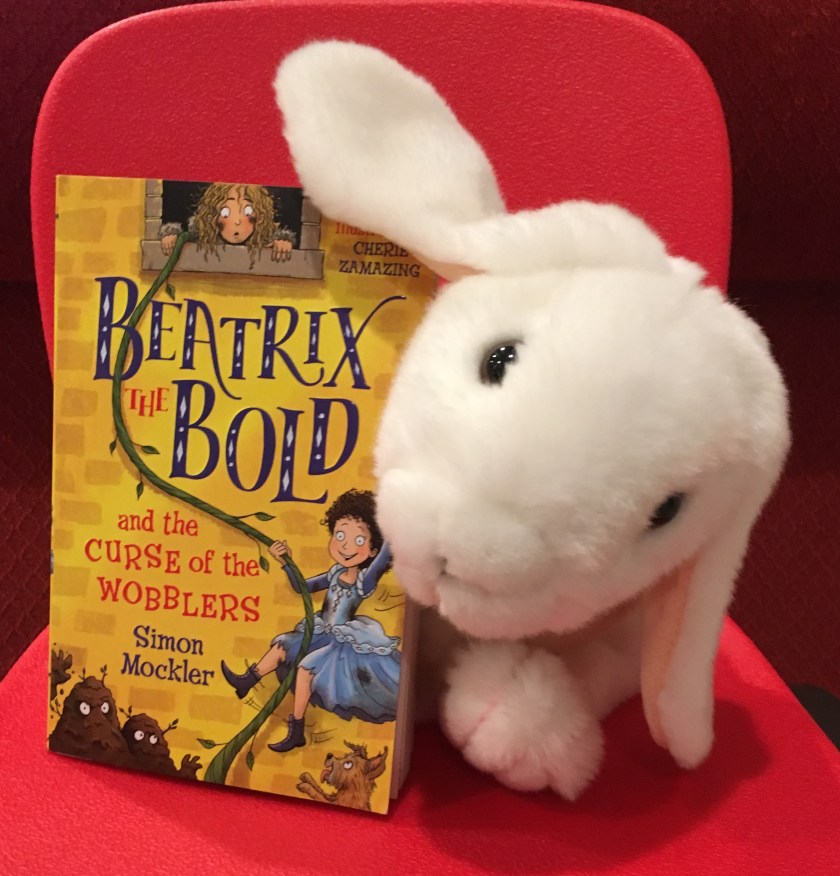
Marshmallow heard about Beatrix The Bold and the Curse of the Wobblers by Simon Mockler from a fellow blogger, Asha at A Cat, A Book, and A Cup of Tea (see Asha’s enticing review here). So of course she had to get her paws on a copy of the story of this fun and courageous little queen. Below she shares her thoughts on this recent book.

Marshmallow reviews Beatrix The Bold and the Curse of the Wobblers by Simon Mockler.

Marshmallow’s quick take: If you like books that have a strong female character, then this might be the book for you.       

Marshmallow’s Summary (with spoilers): Beatrix the Bold has a big secret she does not know about.

“In a faraway palace in the Kingdom of Morden lived a small girl, with a big secret. The secret and the girl, whose name was Beatrix, lived side by side but never met. The secret was big, but the palace was bigger, and there were plenty of dark places for it to hide.”

So here is the first big spoiler: The secret is that Beatrix is a queen. Her parents had sent her to live at this big palace with her aunt, Esmerelda the Terrible, and her uncle, Ivan the Vicious. Her aunt, Esmerelda the Terrible, loves gold a LOT. Her uncle, Ivan the Vicious, is … well, vicious. She was sent to live with her aunt and her uncle because she was in mortal peril. An Evil Army from Beyond the Woods has a mission to kill her and slice her into small pieces if necessary.

Beatrix has only been in ten rooms of the castle. The ten rooms include a classroom, a story room, and a war room. In the classroom she takes classes from Wilfred the Wise. In the story room she can listen to stories acted out by a storyteller. In the war room she throws KNIVES and plays war with mini soldiers, with her uncle coaching.

She attempts to escape from the palace, and she fails. Her aunt catches her in the process. The fact that Beatrix only knows about ten rooms in the palace soon changes though. Her aunt, Esmerelda the Terrible, betrays her to the Evil Army for gold. Beatrix is soon on the run.    

Marshmallow’s Review: This is a good book that will intrigue a lot of people. It was published in April 2019, so it is not a very old book. The character, Beatrix, is a strong female character. She throws knives and is great at military tactics. She is not afraid of danger, unlike most fairy-tale queens and princesses. She is a good role model. (Except that she throws knives! Really, there are a lot of knives in this book!)   

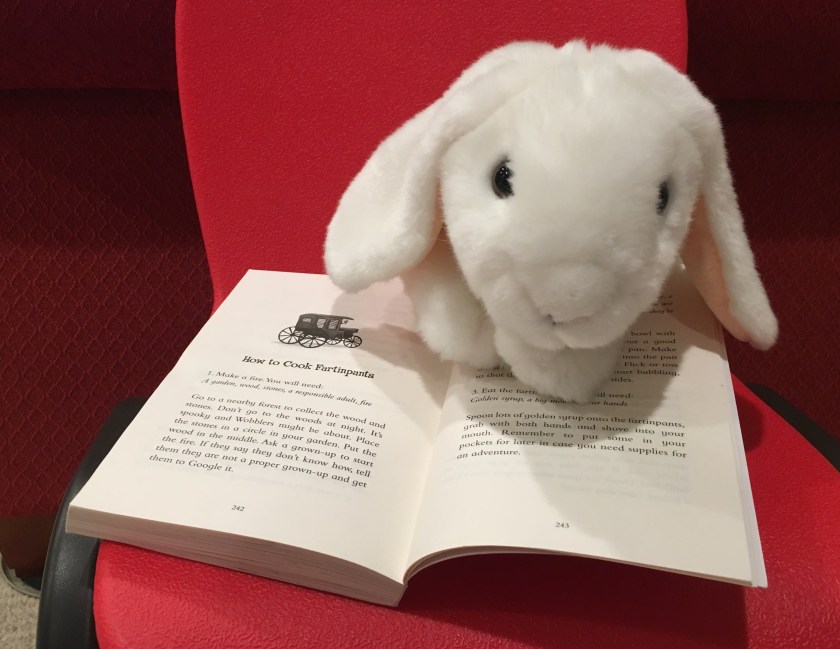
The end of the book contains a recipe for fartinpants. Fartinpants are like pancakes and crepes mixed together, and they can make a good breakfast, especially if you put jam, chocolate/hazelnut spread, strawberries, or syrup in or on the fartinpants. (The Book Bunnies household did try them this morning and can verify.)

Marshmallow insisted on trying the fartinpants recipe included at the end of Beatrix The Bold and the Curse of the Wobblers. The whole Book Bunnies household was quite pleased.
Marshmallow insisted on trying the fartinpants recipe included at the end of Beatrix The Bold and the Curse of the Wobblers. The whole Book Bunnies household was quite pleased with the outcome. Thankfully, no adults (or younger ones) were too burnt during the experience.

Beatrix The Bold is sure to entertain a lot of children in the 7-10 age group . The author’s writing style is light-hearted and the characters are funny. The book itself is not very hard to read and there are many illustrations (by Cherie Zamazing) sprinkled in here and there. I for one am looking forward to reading the next book about Beatrix and her adventures.

Marshmallow’s rating: 95%

Marshmallow rates Beatrix The Bold and the Curse of the Wobblers by Simon Mockler 95%.

Marshmallow reviews Tuck Everlasting by Natalie Babbitt

Marshmallow enjoys reading books that pose complicated questions. Below she reviews a newish classic, Tuck Everlasting by Natalie Babbitt, published first in 1975, that explores the theme of immortality, in a way reminiscent of the story of Peter Pan.

Marshmallow reviews Tuck Everlasting by Natalie Babbitt.

Marshmallow’s quick take: If you like books that pose life-size dilemmas and dig deeper into well-known stories, then this might be the book for you.  

Marshmallow’s Summary (with spoilers): Winifred Foster (nicknamed Winnie) is venturing in a forest that she thinks is owned by her family when she finds a spring. She sees a boy that is drinking from it. The boy tells her that she should not drink from it. He says that his name is Jesse Tuck. Winnie asks him how old he is. Jesse claims that he is one hundred and four years old. Of course, she thinks that he is joking and trying to trick her and so she asks him how old he really is. He says that he is seventeen years old. Then she attempts to drink the water coming from the spring. He stops her, wondering aloud how he will explain the story of the spring to her. Then he hears his parents coming and says that they will explain the story to her. 

Jesse Tuck and his family take Winnie to their house. There they explain to her the curse of the spring. The curse of the spring is that it grants the drinker eternal life. Jesse’s family all drank from it and became immortal. 

But what is wrong with eternal life? The brother of Jesse Tuck, Miles Tuck, was married, but when he became immortal, his wife thought that he had sold his soul to the Devil. She then ran away with their children. He never saw them again. 

Later in the story, the Tucks set out to take Winnie back to her family. Then another man learns about the spring that makes the drinker immortal. He tells Winnie’s family (who have started to worry about her) that he will find Winnie and bring her back if they give him the forest. He later confronts the Tucks and tells them that he knows their secret and the secret of the spring. He tells them also that he will sell the spring water as immortal water. How can they stop him?    

Marshmallow’s Review: This is a great book that raises the question:

Is eternal life a blessing or a curse?

The Tucks say that it is a curse because people they love end up thinking that they sold their souls to the Devil. It can also be very lonely:

That’s what us Tucks are, Winnie. Stuck so’s we can’t move on. We ain’t part of the wheel no more. Dropped off, Winnie. Left behind. And everywhere around us, things is moving and growing and changing. You, for instance. A child now, but someday a woman. And after that moving on to make room for the new children.

Living’s heavy work, but off to one side, the way we are, it’s useless too …. You can’t call it living what we got.

But then there is the man who thinks he will make a fortune selling immortality. So people both want immortality and are afraid of it. 

The question of how the spring is there is also interesting. Mr. Tuck thinks that it is something left over from a plan that did not work. This remains a mystery in the book. 

Tuck Everlasting is a story that takes some of the ideas and themes from an older story, Peter Pan, and makes things messier and more complicated. In a paper she wrote in 1982, Professor Catherine M. Lynch says the following:

Both Peter Pan and Tuck Everlasting explore two alternative solutions to a conflict central to childhood experience: to grow up to adult responsibilities or not to grow up at all. By introducing readers to the Tuck family who magically cannot die in a world where everyone else does, Natalie Babbitt’s novel deepens the Peter Pan “myth” by dramatizing the fact that the choice of embracing adulthood includes, of necessity, choosing death.

I agree. I think this is a deeper and a more moving book than Peter Pan, which to me felt to be mainly about a little boy who did not want to grow up. But hmm, maybe I should read that story again…

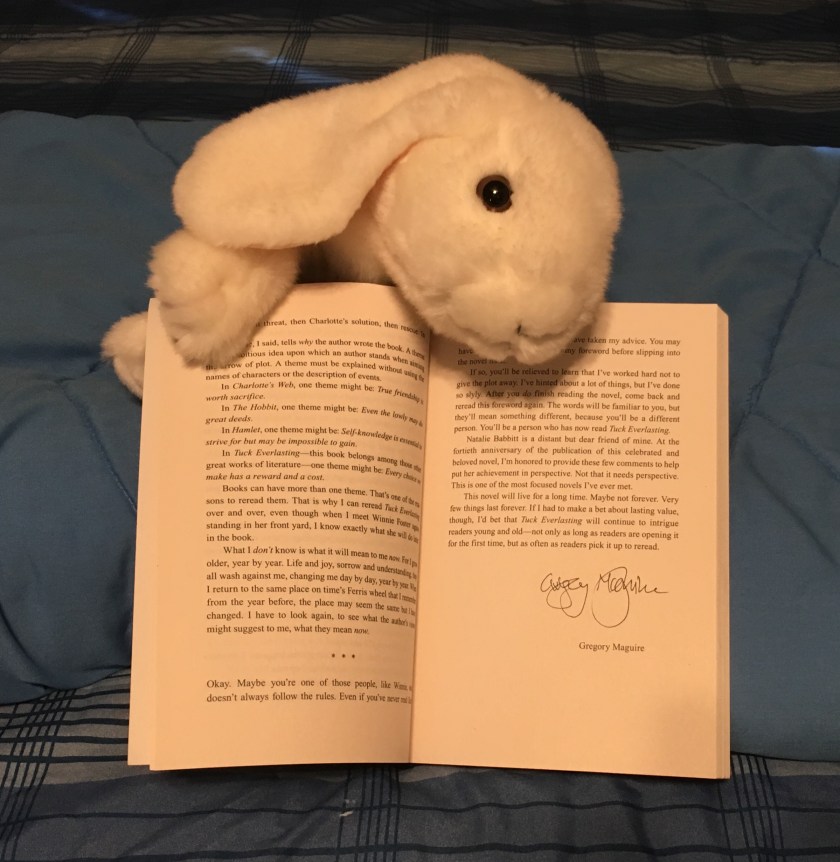
Marshmallow is pointing to the foreword to her edition of Tuck Everlasting, written by Gregory Maguire. Maguire has a convincing argument for rereading good books, which Marshmallow agrees with.

Marshmallow’s rating: 95%.

Marshmallow rates Tuck Everlasting 95%.