Marshmallow reviews Hope in the Dark by Rebecca Solnit

Marshmallow enjoys reading fiction and most often reviews works of fiction for our blog. But this week she decided to write about Rebecca Solnit’s Hope in the Dark: Untold Histories, Wild Possibilities, first written in 2004 and then republished with a new foreword and an afterword in 2016.

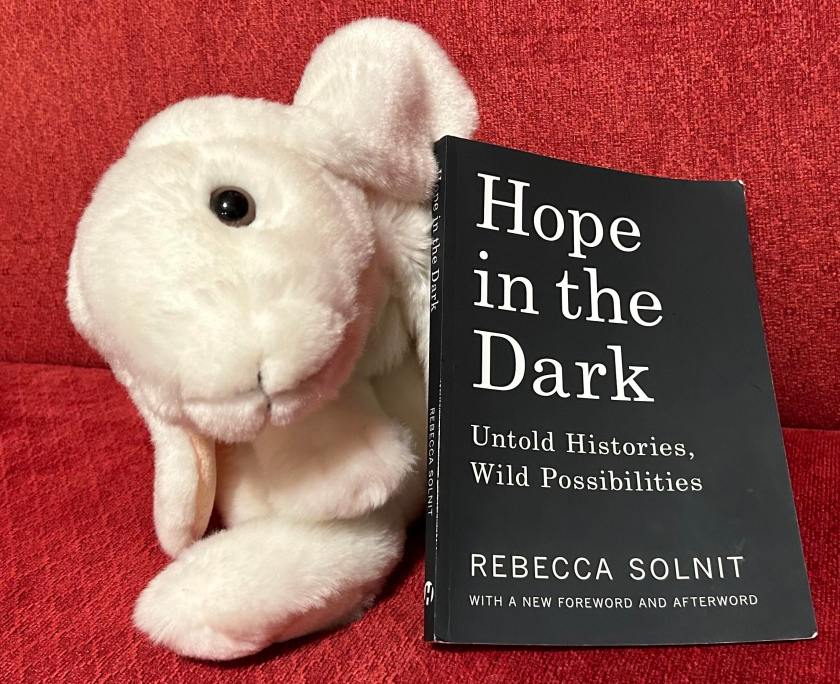
Marshmallow reviews Hope in the Dark: Untold Histories, Wild Possibilities by Rebecca Solnit.

Marshmallow’s Quick Take: If you like nonfiction books that discuss current events, or if you are worried about the future because of said current events, then this might be the book for you. 

Marshmallow’s Summary (with Spoilers): Rebecca Solnit goes over several depressing events of the recent years with a new perspective. She defines hope, not as optimism, but as the acknowledgment of possibilities for a better world. The author carefully analyzes the past and the present to demonstrate how hope is intertwined with action. Her rousing book encourages readers to keep sight of a brighter future, within reason. Diverging from the common conceptions of hope, this book presents a stronger, newer perspective:

Hope locates itself in the premises that we don’t know what will happen and that in the spaciousness of uncertainty is room to act.

Simply put, hope is not naive optimism but rather the ability to see the possibilities in the uncertainties that surround us and the capacity to act accordingly. 

Citing recent events, famous people, and writers of old, Rebecca Solnit builds her case as to why hope is so relevant and important to our modern world. In each of her twenty-one short chapters, she focuses on a different aspect of hope and how we should nurture it. In the end, she builds a solid argument for why there is always hope, even in the darkest times.
Marshmallow is reading Hope in the Dark: Untold Histories, Wild Possibilities by Rebecca Solnit.

Marshmallow’s Review: In these deeply troubled times, hope is difficult to find. This book is refreshing to read as it does not offer any easy solutions or fake comfort; rather it states clearly that things are not going to work out the way we want them to unless we start making changes. With clear evidence and reasoning, the author proves with finality that we are not inevitably doomed (the key word being “inevitably”).  

This is a book that we should all read, though it might be a little advanced or confusing for younger bunnies. The clarity with which the author presents her position helps the reader engage effectively with her ideas. The flow of thought is easy to follow, and the chapters all have several ideas and concrete examples relevant to the main topic (hope).

Originally, I read this book for a project concerning hope. This book not only proved itself to be an invaluable resource for evidence, quotes, and ideas for my project, but also was a source of inspiration more broadly for life in a dark world. I found it wise that the author, Rebecca Solnit, never says it will get better. This specifically, I felt, was not just a sound decision, but also a main theme throughout the course of the book. If anything, I found this book to be a call to action— what this action must be, however, is more difficult to perceive. Yet, this book was extremely helpful to read, as it served as a reminder that we have the potential and opportunity to improve our world. 

In this short book review, I hope I have done more than just inform you about a book I have read. I hope that I have also pointed you towards a refreshing idea, a new perspective, that I think can be both informative and beneficial for everyone.

Marshmallow’s Rating: 99%

Marshmallow rates Hope in the Dark: Untold Histories, Wild Possibilities by Rebecca Solnit 99%.

Marshmallow reviews Hollow City: The Second Novel of Miss Peregrine’s Peculiar Children by Ransom Riggs

A few weeks ago, Marshmallow reviewed Miss Peregrine’s Home For Peculiar Children by Ransom Riggs and ended her review telling us that she was eager to read the next book in the series. In the following weeks, she indeed found and read the second book, Hollow City, published in 2014, and today she shares her thoughts on it with our readers.

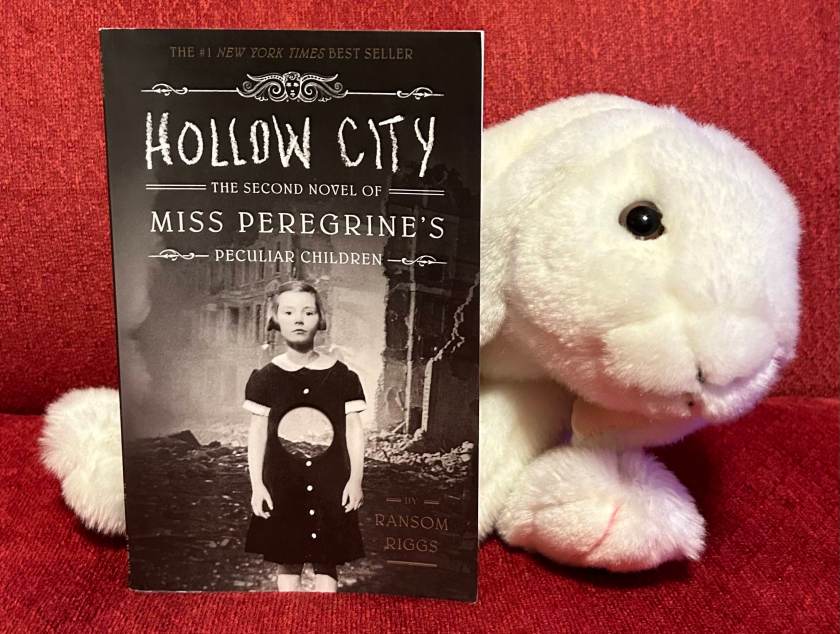
Marshmallow reviews Hollow City: The Second Novel of Miss Peregrine's Peculiar Children by Ransom Riggs.
Marshmallow reviews Hollow City: The Second Novel of Miss Peregrine’s Peculiar Children by Ransom Riggs.

Marshmallow’s Quick Take: If you like books about magic and friendship, then this might be the book for you. 

Marshmallow’s Summary (with Spoilers): Jacob Portman is peculiar. In Miss Peregrine’s Home For Peculiar Children, the first book of the series, Jacob discovered that the fantastic stories his grandfather told him were all true. Upon his grandfather’s death, he went to the island where the stories were based and discovered a hidden world, one full of children who had been living sheltered in a time loop for decades. These children were hiding from the rest of the world because they all possessed a peculiarity that made life outside dangerous for them. (Some examples of peculiarity include having control over fire and being invisible) These children were protected by women who could turn into birds. Unfortunately, soon after Jacob’s arrival, the children who were living on the island were driven out of their home and their keeper, Miss Peregrine, was forced into her bird form. During his time with these children, Jacob formed a close bond with them, specifically a girl named Emma. When they were forced out, Jacob and his friends ended up in the 1940s and were on the run from monsters who wanted to eat children with magical peculiarities.

This second book starts more or less at the same time where the first one ended. The children are in rowboats, running away. They believe that Miss Peregrine is the only one who can help them, but since she is trapped in her bird form and seemingly cannot change back, Jacob and his friends must find another time loop run by another keeper who can help them. Unfortunately, the monsters who want to eat them are coming after them fast. Besides this serious worry, Jacob also learns that Miss Peregrine has only a few days left before she will be stuck in bird form forever. How long can Jacob and the children go before it’s too late to save Miss Peregrine? How can they find a new home that will keep them safe?

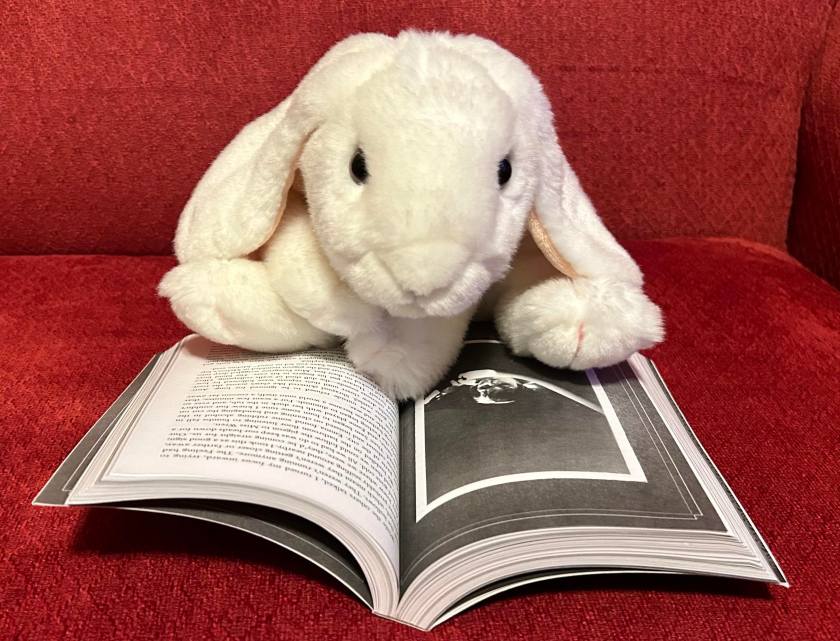
Marshmallow is reading Hollow City: The Second Novel of Miss Peregrine's Peculiar Children by Ransom Riggs.
Marshmallow is reading Hollow City: The Second Novel of Miss Peregrine’s Peculiar Children by Ransom Riggs.

Marshmallow’s Review: I think Hollow City is a great followup to Miss Peregrine’s Home For Peculiar Children, the first Miss Peregrine’s Peculiar Children book. And it definitely did not curb my enthusiasm, and I look forward to reading the next one. That said, I did find this book a little more confusing than the first. I think I have missed certain details during my first read and so had to go back and reread some parts to figure things out.

The plot twist at the end (though I suspected it) led to a great turn of events and made the book much more interesting! I liked how it shook the ending up and made the book lead into the next one. Of course this means that the end of this book is not the end of the series, and there is definitely a cliffhanger, and you know I am not too keen on cliffhangers. But the author introduces several new characters towards the end and they really intrigued me.

This edition of Hollow City is similar to the first book. There are many old-looking photos sprinkled in through the book, and the story connects with them, just like before. Most of the photos are eerie, like the ones from the first book, but maybe they are a tad less scary. Or I might just be getting used to the feel of these images.

Hollow City adds much more to the world of peculiar children. There are many new characters, both human and animal. I enjoyed reading it thoroughly. I should still repeat my warning for the first book however. This is a great book, but it might be too scary or complicated for children younger than 12.  

Marshmallow’s Rating: 98%. 

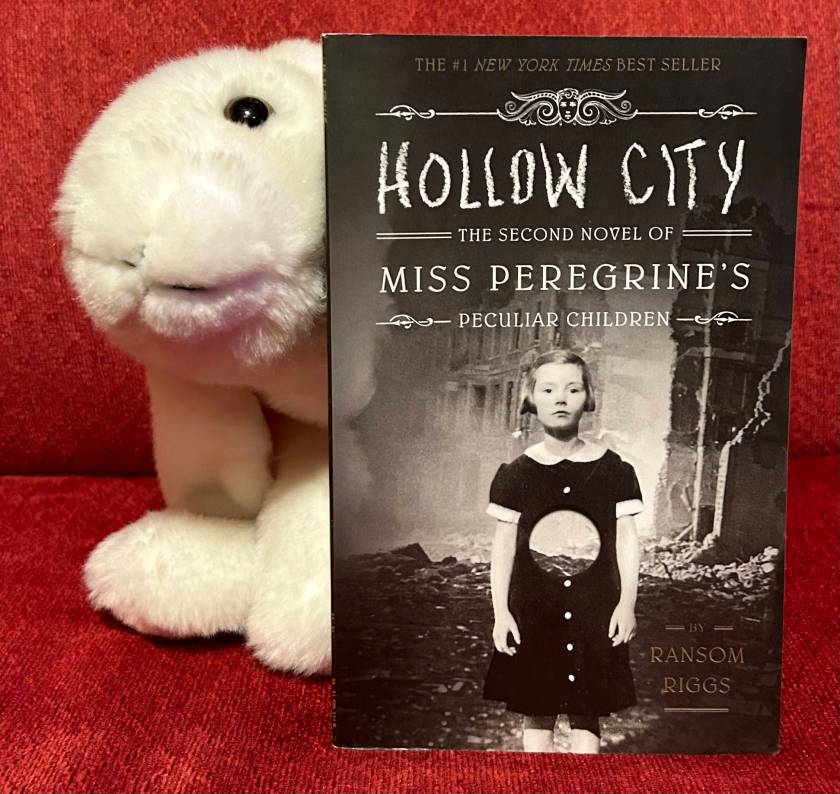
Marshmallow rates Hollow City: The Second Novel of Miss Peregrine's Peculiar Children by Ransom Riggs 98%.
Marshmallow rates Hollow City: The Second Novel of Miss Peregrine’s Peculiar Children by Ransom Riggs 98%.

Marshmallow reviews Shatter Me by Tahereh Mafi

A couple weeks ago, while Marshmallow was writing her review of Miss Peregrine’s Home For Peculiar Children, she and Sprinkles looked up some information on the author, Ransom Riggs, and learned that he is married to a fellow author, Tahereh Mafi, who has a significant following of her own. When the bunnies learned about her first novel, Shatter Me (2011), they were intrigued by its plot, and so they decided to check it out. What follows is Marshmallow’s review of this book.

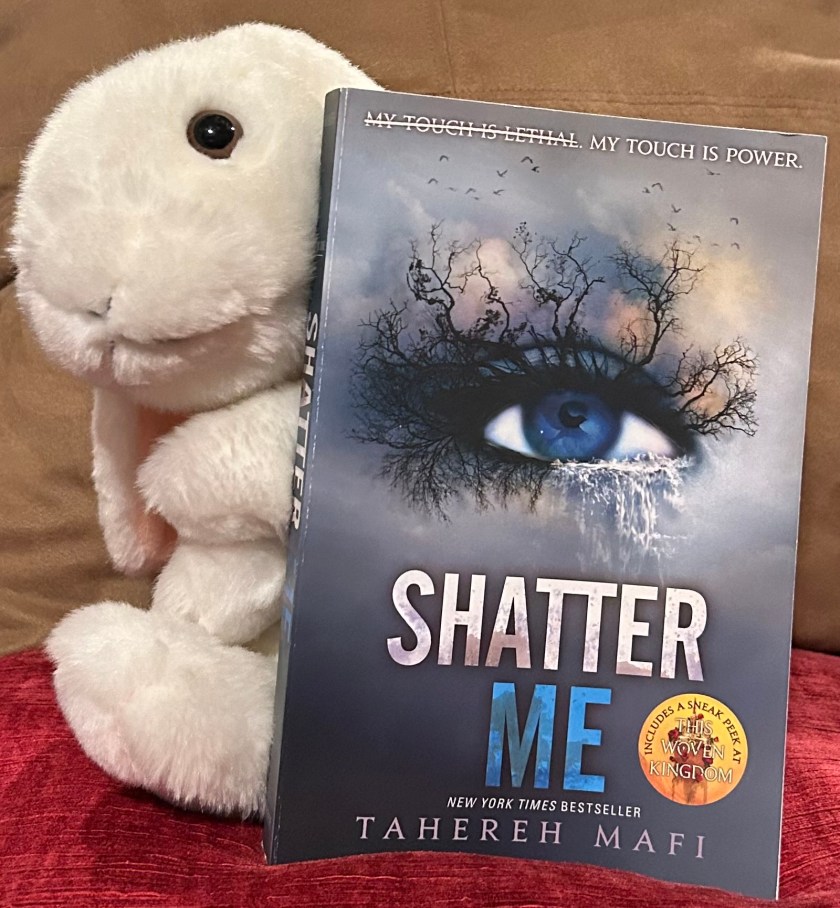
Marshmallow reviews Shatter Me by Tahereh Mafi.

Sprinkles: So Marshmallow, you read this book rather quickly.

Marshmallow: You know I am a quick reader.

S: That’s true. What did you think about this book?

M: Let me first tell you what the book is about. No?

S: Okay.

M: The book is about a girl named Juliette who is living in a special institution, in solitary confinement, because her touch is deadly to other people. And she is living in a strange world, kind of dystopian.

S: That really sounds intriguing! So how old is Juliette?

M: She’s seventeen I think.

S: Okay. Do we ever learn why her touch is deadly? That is a weird condition.

M: Sort of, towards the end, but I won’t tell. You do need to read it yourself.

S: I am going to, for sure. I’m very curious.

M: Well, you won’t learn everything. But you will have a better idea of things. This is the first of a series of several books.

S: I see. Does it stand alone on its own?

M: Well, some of the conflicts and problems in the book are resolved, but many others pop up, and when the book ends, you are kind of left hanging, and need to read the next book. And then probably the next. And so on.

S: Hmm. Well, let me read this first and then see if I want to continue. How about you? Do you want to read the next book? Are you curious about what will happen to Juliette and her world? Did you like her as a character?

M: She is a bit too much into romance for my taste. Maybe it makes sense because she cannot touch anyone, until she meets this one person that she can. So I can see how she might be very excited, but then things do get a bit very touchy, kissy, and so on.

S: Hmm, so probably the book would not be very appropriate for bunnies younger than 12.

M: Hmm, maybe even older than that.

S: I guess we are seeing one of the differences between middle grades and young adult literature.

M: I think that’s right.

Marshmallow is reading Shatter Me by Tahereh Mafi.

S: So let us get back to the plot. So she is in this confined space, but then she meets this one other person who can touch her and not be hurt. Does she ever get out?

M: Yes, there are some folks who want to use her as a weapon. One specific guy especially, and so they help her get out. And the rest of the book is about her learning about these people who want to use her, about the power structure around her, and so on. It is a dystopian world, reminds me a bit about Nineteen Eighty-Four by George Orwell.

S: Yes, you used that word, dystopian, before. But what did you mean?

M: There is an oppressive regime. People have messed up the planet, and a group took charge claiming they’d help, they call it the Reestablishment, but they have not really. And they have erased all other power structures, all other institutions, and so on. Pretty depressing actually.

S: That makes for an interesting setting, I can see that.

M: Yes, I did want to know more, and maybe in the later books, Juliette and her friends will fight the Reestablishment and maybe take them down.

S: Yes, something to look forward to, I’m sure. So tell me a bit about the style of the book.

M: Sure. The whole book is written from a first-person perspective, Juliette’s. And she has a very distinctive voice.

S: How so?

M: When she uses numbers, she does not spell them out even when they are small numbers. She always uses the numerals. Except the chapter numbers in the book; those are all spelled out. She always writes in present tense. And she crosses out things and corrects herself. Of course you can still read what she wrote originally, so that makes her voice different from many other narrators I read.

S: I skimmed through it and I did see some lines crossed out. Even on the title page, there is a part which I am assuming is Juliette saying: MY TOUCH IS LETHAL, crossed out, and followed by MY TOUCH IS POWER. That is really interesting. Then the book reads kind of like a diary, right?

M: Yes, though, apparently, she also has a diary, but this is not quite the diary, I think. I’m not sure actually.

S: Okay, I am now really curious to read the book. Let us wrap this up so I can take it from your paws and get started. How would you rate the book in the end?

M: I’d rate it 90%. I really like the plot, I like the author’s writing style, and I really really want to learn more about Juliette and her story, but the mushy stuff is not terribly exciting for me.

S: That makes sense to me Marshmallow, thanks. What do you want to say to our readers as we close this up?

M: Stay tuned for more amazing reviews from the book bunnies!

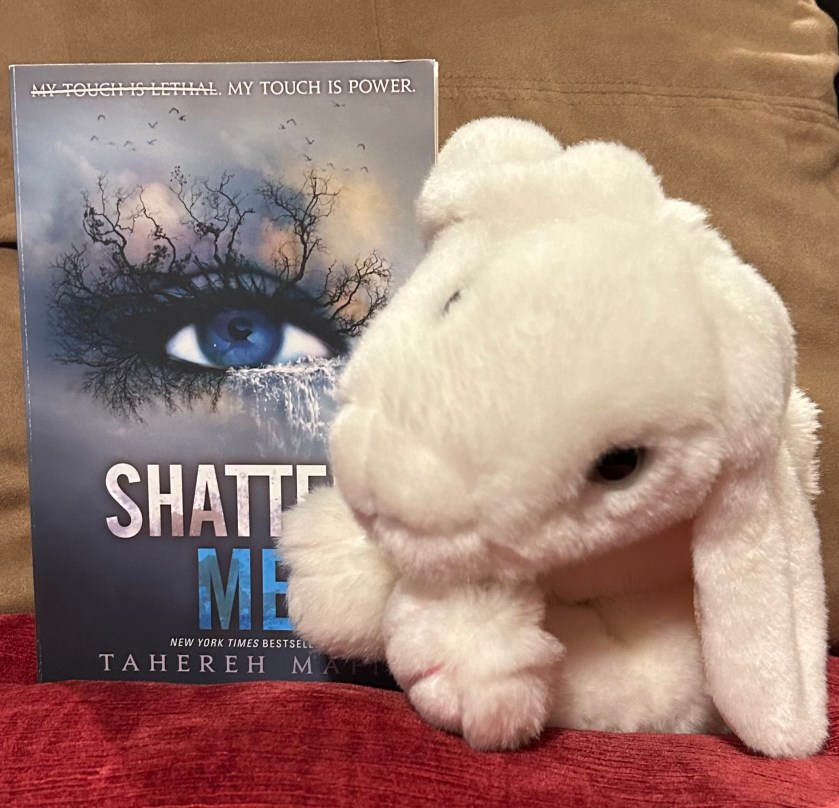
Marshmallow rates Shatter Me by Tahereh Mafi 90%.

Marshmallow reviews The English GI by Jonathan Sandler and Brian Bicknell

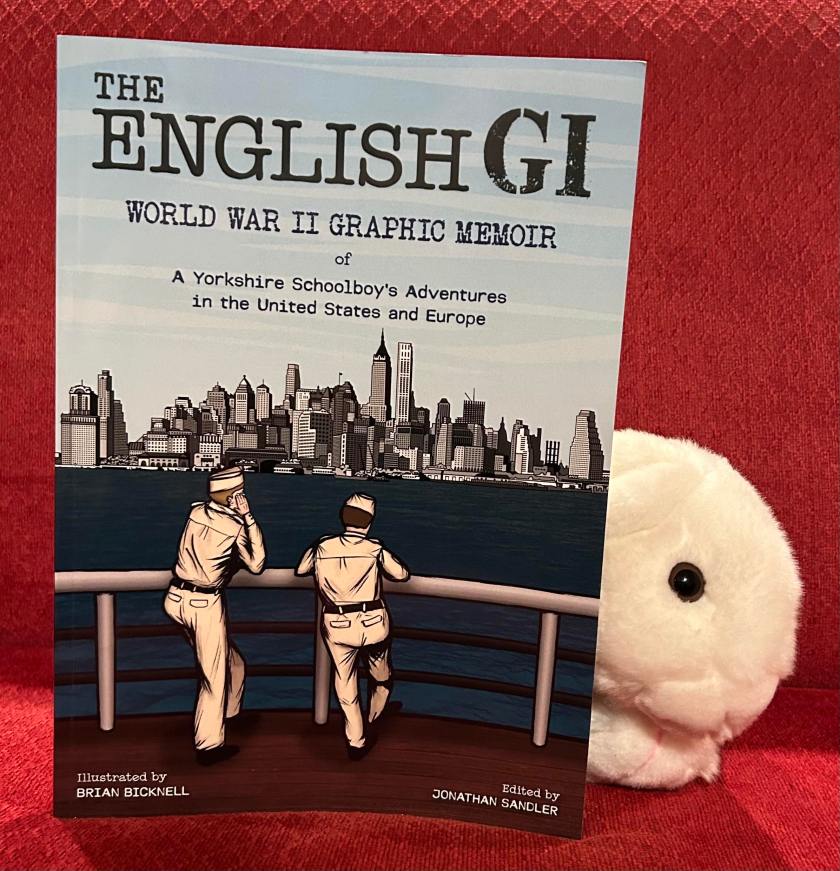
Marshmallow, just like Caramel, enjoys and appreciates graphic novels of various types. As such she has reviewed several of these books for the book bunnies blog. Today she reviews another recent graphic novel, The English GI: World War II Graphic Memoir of A Yorkshire Schoolboy’s Adventures in the United States and Europe, written by Jonathan Sandler and illustrated by Brian Bicknell. Sprinkles was curious about the book too, and so she is taking notes while asking questions.

The book bunnies received this book as a review copy.

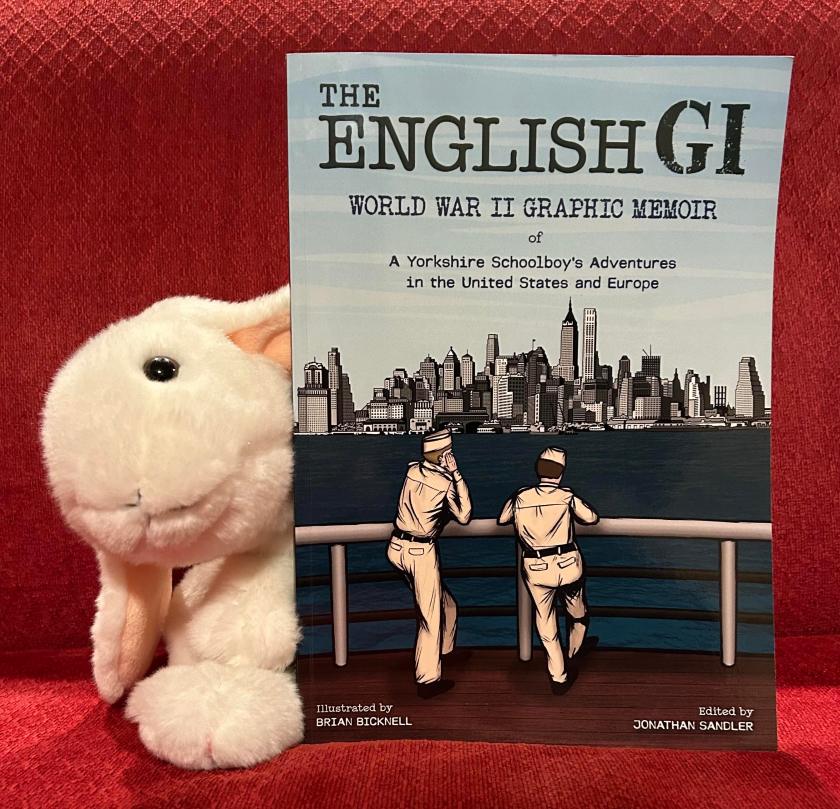
Marshmallow reviews The English GI: World War II Graphic Memoir of A Yorkshire Schoolboy's Adventures in the United States and Europe, written by Jonathan Sandler and illustrated by Brian Bicknell.
Marshmallow reviews The English GI: World War II Graphic Memoir of A Yorkshire Schoolboy’s Adventures in the United States and Europe, written by Jonathan Sandler and illustrated by Brian Bicknell.

Sprinkles: So Marshmallow, let us start with a quick summary. What is this book about?

Marshmallow: This book is about Bernard Sandler, a seventeen-year-old boy from Yorkshire, England, who goes on a school trip to the US. Then the second world war starts and he cannot go back home. He has to find his own way through life in a new country. And he eventually joins the US army and fights in the war too.

S: That sounds like a really rough path for a young person.

M: I think so too. But he does survive and he lives a good life. And the author is his grandson who wanted to tell his story.

S: That is so neat! A lot of families have stories to tell, but not everyone ends up writing them up for others to learn about. So the book is not fiction, then?

M: No. In fact there is a long epilogue at the end of the book, which takes almost a fourth of it actually, and it gives a lot of details about Bernard’s life and his family.

S: I did see that. It looked really well documented. And in some ways it reminded me of two books you reviewed before.

M: Which ones?

S: Nothing But The Truth by Avi and They Called Us Enemy by George Takei.

M: I see how the second one is similar. That too was about real life, written by George Takei, whose childhood was during the second world war, and he went through a lot of difficult times. How do you connect this book to Avi’s?

S: That book also had a lot of documentation, no? Though of course that was fiction, and this is a real story.

M: Hmm, I see. Yes, you are right. This is not quite a typical graphic novel; first off it is true, and then it has a lot of historical documentation that connects it to history.

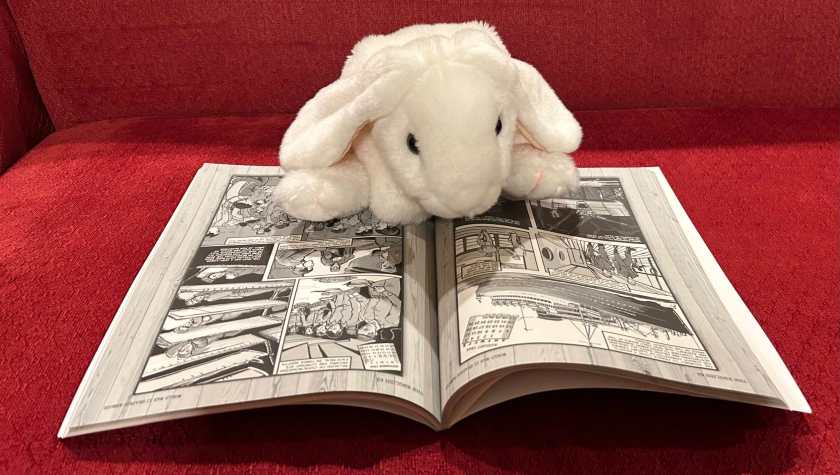
Marshmallow is reading The English GI: World War II Graphic Memoir of A Yorkshire Schoolboy's Adventures in the United States and Europe, written by Jonathan Sandler and illustrated by Brian Bicknell.
Marshmallow is reading The English GI: World War II Graphic Memoir of A Yorkshire Schoolboy’s Adventures in the United States and Europe, written by Jonathan Sandler and illustrated by Brian Bicknell.

S: So what else would you like to tell us about the book?

M: I really liked the illustrations.

S: They are black and white, no?

M: Well, they are more or less grayscale, but you can see a lot of details, and they are almost like photos, and since it is a history being told, I think it fits really well.

S: That totally makes sense.

M: Also I’d like to say that this would be appropriate for readers of all ages.

S: Especially if someone is a history buff, no? I think a lot of people like to read and learn about the second world war. This could be really perfect for such a reader.

M: Yes, but even if you are not particularly interested in that war, this is a good book. It has a really interesting story. And there is not much that would be difficult for young bunnies, except of course it is about war, which is a terrible thing, and Bernard has to separate from his original family and his original country, so those could be too sad for really young bunnies.

S: I agree with you Marshmallow. Some young bunnies might be really sad, so for them, this might not be a good choice. But if a bunny is willing to read a book about the war, and if they are keen on graphic novels, this would be a neat book for them.

M: Yes.

S: So did you learn some things from this book?

M: Yes. It was like looking through a window to see what life was like for a young person during the war. So I found it very interesting that way.

S: Did you know what a G.I. is?

M: I knew of the G.I. Joe action figures, but I did not know exactly what the initials meant, so I had to look it up! Wikipedia says: “G.I. are initials used to describe the soldiers of the United States Army and airmen of the United States Air Force and general items of their equipment. The term G.I. has been used as an initialism of “Government Issue”, “General Issue”, or “Ground Infantry”, but it originally referred to “galvanized iron”, as used by the logistics services of the United States Armed Forces.”

S: The evolution is interesting, isn’t it?

M: Yes.

S: So maybe it is about time to wrap up this review. How would you rate the book overall Marshmallow?

M: I’d rate it 97%. I like how it is a real story and I like the illustrations.

S: That’s great Marshmallow. So what do you want to tell our readers then?

M: Stay tuned for more amazing book reviews from the book bunnies!

Marshmallow rates The English GI: World War II Graphic Memoir of A Yorkshire Schoolboy's Adventures in the United States and Europe, written by Jonathan Sandler and illustrated by Brian Bicknell 97%.
Marshmallow rates The English GI: World War II Graphic Memoir of A Yorkshire Schoolboy’s Adventures in the United States and Europe, written by Jonathan Sandler and illustrated by Brian Bicknell 97%.