Marshmallow reviews Lord of the Flies by William Golding

Marshmallow has been reading some classics on and off. Today she talks to Sprinkles about Lord of the Flies by William Golding, first published in 1954.

Marshmallow reviews Lord of the Flies by William Golding.

Sprinkles: So Marshmallow, it’s been years since I have read this book. So can you tell me a bit about what it’s about?

Marshmallow: Sure. This book is about a couple dozen British school boys whose plane crashlands on a deserted island. The boys try to set some rules and they use a conch that sort of represents order and civility. One of the boys named Ralph is elected leader, and another boy named Jack takes on hunting duties. The boys start a fire so that there will be smoke for ships to see.

As the story progresses, Ralph tries to encourage the boys to make shelter and keep the fire going. So basically what is essentially logical to do given the circumstances. But most of the other boys do not obey him and start to act like feral animals. At some point they start thinking that there is a beast in the island and they are terrified. Jack promises to hunt it down. And hunting and killing animals makes the boys become wilder and more violent and bloodthirsty, and eventually most of the boys join Jack and his hunters, which becomes a separate tribe than Ralph’s group. And they come into conflict, and things escalate very quickly after that.

S: Okay, I think this is a good summary of the plot and some of what happens in the book. Before saying much about what happens in the end, can you tell me if you thought it was tied up well?

M: I am not sure I’d say it was tied up, but the message of the book was well delivered and the moral is conveyed. The story is probably not really finalized. But it ends in a way that is still satisfying.

S: Though not quite happy, right?

M: Well, I can’t say too much without spoiling everything. But some things happen in the book that make it kind of impossible for a fully happy ending.

S: I do remember some of the book and definitely agree with you there. So what is this message or the moral you are talking about? Can you tell us that?

M: I think the moral of the book is that when humans are left to their devices there is potential for great evil. The children represent untouched innocence, but they eventually go feral and become morally corrupt. I think the author was probably trying to depict the violent side of humans and that it can lead them towards evil. The boys’ hunting leads to further violence and bloodthirst.

S: But how come do human societies ever go beyond violence then if humans left to their devices can easily go feral? There had to be some time that some humans decided to do things differently.

M: I think that the author is not claiming this always happens. I think that he is trying to show that there is a potential in humans for this kind of darkness, that there is a dark side of human nature.

Marshmallow is reading Lord of the Flies by William Golding.

S: Okay, that is heavy stuff. Tell me about the writing a bit. Did you think the author made the island visually come alive? Could you see the locations? How about the boys and how they looked and behaved? Could you visualize them?

M: Yes, but I think he focused a lot more on how they felt and their emotions and their transformation through the story. It is more psychological than physical descriptions, I’d say.

S: So would you say the characters were vividly created? Or were they more like archetypes, like Jack representing the violent tendencies and Ralph perhaps representing the inclination for law and order?

M: Well, I am not sure individual characters represented specific characteristics. In fact I think nobody represented a specific vice or virtue, because they all were pretty fleshed out as real people, who were basically mixed in virtue and vice. But you could see some changed in different ways than others.

S: Alright. That makes sense. So how did this book make you feel after you read it? It is a bit of a dark book, don’t you think?

M: Yes. Just as a narrative, just as a story, it is good, maybe like an adventure that has gone bad. But when you think about the ideas behind it, it enhances the reading experience. It definitely made me think about human nature. And I like that. And it is a classic so that is another reason why people should read it.

S: Did you know that about a decade after this book was published, a similar thing actually happened and a bunch of boys were stranded in an island by themselves? They did not become feral however, and they actually built a functioning mini-society.

M: I did not know that before we checked out the Wikipedia article for the book. But again, I think the book is not claiming this has to happen this way, but that there is a possibility that humans might give in to their violent and dark tendencies.

S: I guess so. The story of the Tongan boys makes me a lot more optimistic, but Golding’s book, even though I know it is fiction, is always a reminder for me that civil behavior or a safe and functioning society are not automatic or natural.

M: I’d agree.

S: Okay Marshmallow. Let us wrap this up. How would you rate this book?

M: 100%.

S: Wow! You liked it that much! Cool. I do recall it being one of my favorite books from high school, too, though I cannot bring myself to read it again, because I worry I’d get too depressed.

M: Well, then you can always reread the real story of what happened to those Tongan boys.

S: You are right! Anyways, what do you want to tell our readers?

M: Stay tuned for more amazing book reviews from the book bunnies!
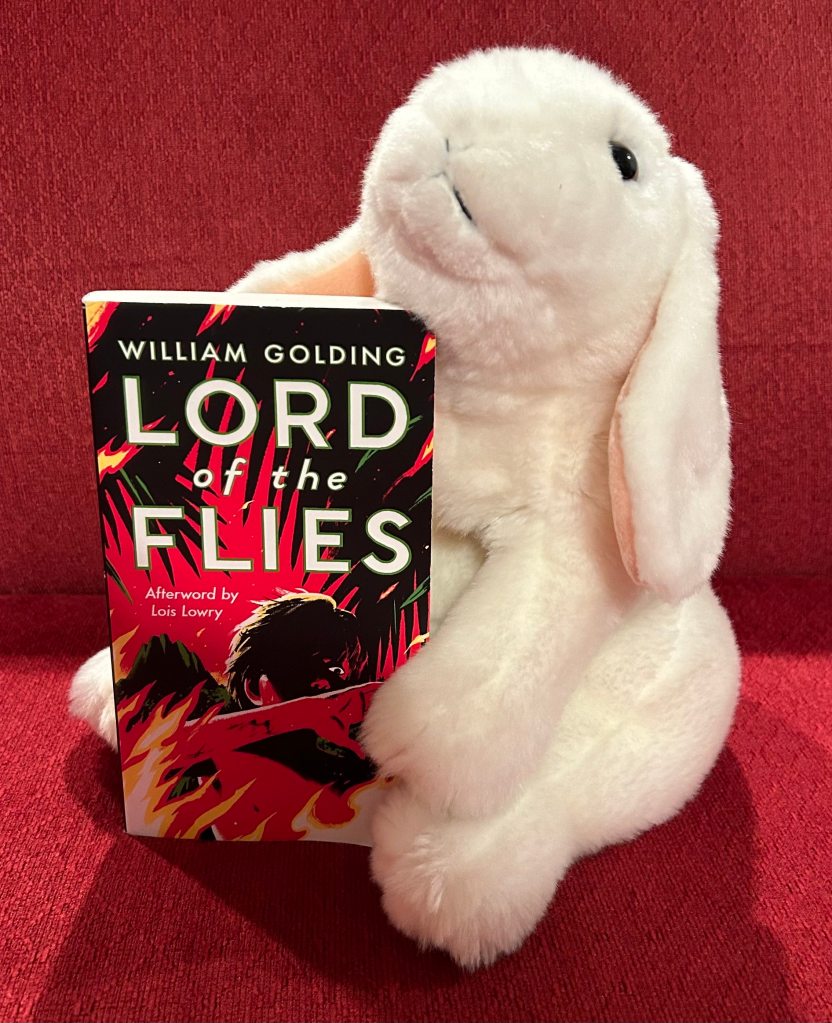
Marshmallow rates Lord of the Flies by William Golding 100%.

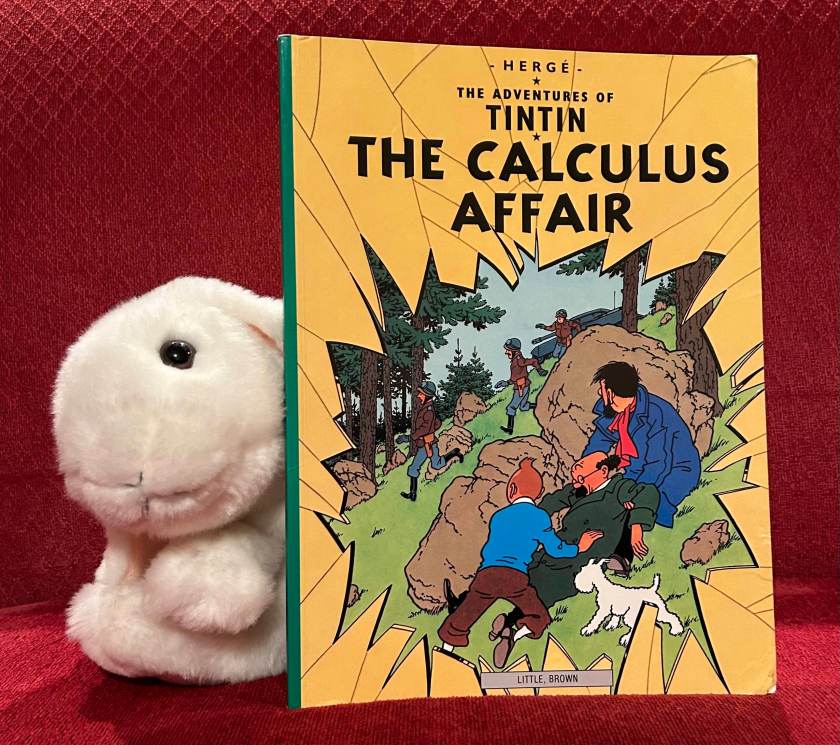
Marshmallow reviews The Adventures of Tintin: The Calculus Affair by Hergé

Marshmallow likes graphic novels. And today she is talking to Sprinkles about a comic book that was published many years ago in 1956 though she only read recently: The Adventures of Tintin: The Calculus Affair by Hergé.

Marshmallow reviews The Adventures of Tintin: The Calculus Affair by Hergé.

Sprinkles: So Marshmallow this book was apparently published in 1956. Can you tell?

Marshmallow: I can tell that it is not contemporary. But I cannot really tell exactly what time the story is supposed to be happening.

S: That’s not too bad then. Tell me about the story.

M: What happens is that Tintin is visiting his friend Captain Haddock when suddenly everything in the house starts to break. They eventually learn that Professor Calculus has invented a device that can shatter glass. And soon this puts Calculus in danger because some people want to use his invention to make weapons.

S: And the book is about Tintin and Haddock trying to protect Calculus?

M: No. Calculus gets kidnapped so they have to find and rescue him.

S: Oh my. That sounds dangerous.

M: It does get a bit dangerous.

S: But of course since Tintin is the main hero, and Professor Calculus is apparently a recurring character in the series, we can imagine that he will be saved.

M: Yep. But no spoilers!

S: Okay. You are right.

Marshmallow is reading The Adventures of Tintin: The Calculus Affair by Hergé.

S: I think this is the first Tintin story you have read, right?

M: Yes. I looked at it before but it did not seem too interesting for some reason. But when I picked it up this time, I was kind of drawn into the story much easier. Maybe it is more appealing to older readers.

S: Maybe. My sister really liked Tintin, but I never read his adventures. As you know I am not very good with graphic novels. But I knew there are a lot of fans of Tintin all around the world. So I am glad you read this. According to some, this is one of the best books in the whole series, and there are about 23 or 24 books.

M: Well, I am glad I read it, too. I really liked the drawings. I felt like they were really detailed and you could see or even feel the movement in some of them. When I was reading, I felt enveloped in the world of the story.

S: I think, given that you have read a lot of graphic novels, Marshmallow, that is pretty high praise from you. Especially for a book that is older than even me!

M: Well, what can I say? I think it is very well done.

S: Do you think you might want to know more about Tintin and maybe read more of the series?

M: Yes. I did read the Wikipedia article about it a bit and learned that Tintin is a Belgian journalist who solves mysteries. But I also learned that at least one of the earlier books was eventually seen to be seriously racist.

S: I can unfortunately imagine that something written about Africa in 1930s by a Belgian could be racist about Africans.

M: You know, the back of the book I have read does not even list that particular adventure. So I am guessing they do not want to even bring it up.

S: I can understand that too. I don’t think we will be reading that book any time soon.

M: Definitely not. But I might want to read some of the other books.

S: Alright. We will look into that then. Let us wrap this up now. How would you rate the book Marshmallow?

M: I’m rating it 95% because of the really awesome drawing and the interesting story.

S: That’s great, thank you. And what do you want to tell our readers?

M: Stay tuned for more amazing book reviews from the book bunnies!
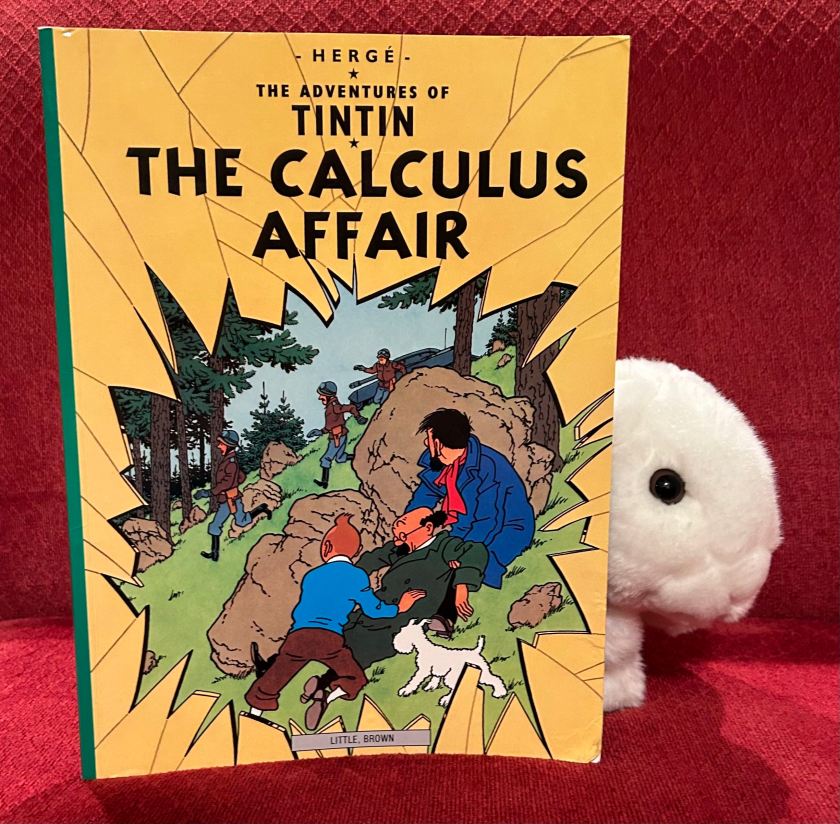
Marshmallow rates The Adventures of Tintin: The Calculus Affair by Hergé 95%.

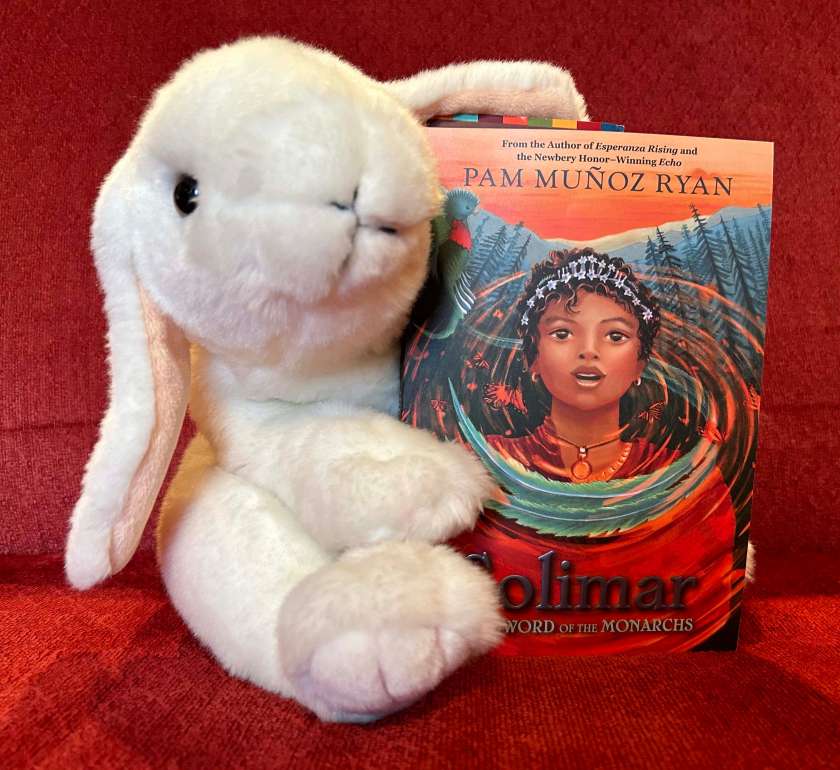
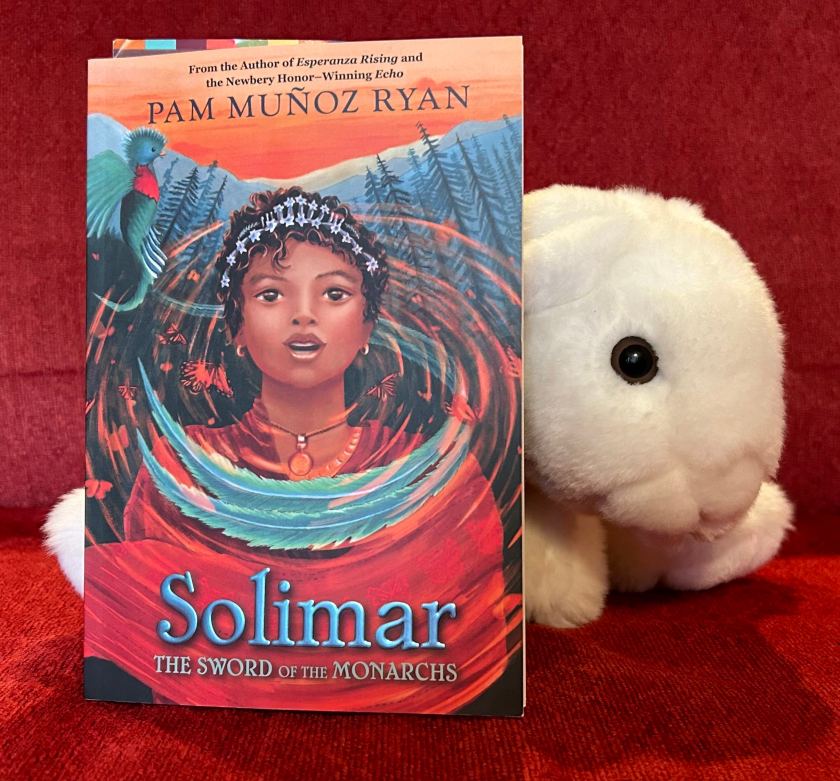
Marshmallow reviews Solimar: The Sword of the Monarchs by Pam Muñoz Ryan

Marshmallow first read Pam Muñoz Ryan’s Esperanza Rising (2000) for school and liked the book so much that she wanted to review it for the book bunnies blog. About a year ago, she enjoyed reading and reviewing her Paint the Wind (2007). Today she talks about her most recent book, Solimar: The Sword of the Monarchs, published in 2022.

Marshmallow reviews Solimar: The Sword of the Monarchs by Pam Muñoz Ryan.

Marshmallow’s Quick Take: If you like books about magic and fantastical events, then this might be the book for you.

Marshmallow’s Summary (with Spoilers): Solimar, daughter of the king of the land of San Gregorio, has watched the monarch migration since she was a little girl. However, in previous years, she would go to the oyamel forests and watch the monarch butterflies come in to hibernate from a distance. This year, before her quinceañera, she crosses the creek and sits among the butterflies when they come home. But then something mystical happens, and she finds herself with a peculiar gift.

Solimar discovers that she can correctly answer questions about the future, but she soon figures out that this ability only functions in the sunlight. Additionally, her rebozo (her silk shawl, see Wikipedia for more) gains a peculiar, shiny side. Solimar tries to tell her best friend about her new gift, but the friend, Maria, dismisses it as a combination of great intuition and clever guessing. Then Solimar tells her abuela (grandmother), who takes her to the curandera, whom Solimar believes is a witch. This woman tells Solimar that the ancestors appointed her as a guardian to protect the monarch butterflies on their way home. She must protect the young and weak butterflies with her magical rebozo.

Then Solimar’s father and brother leave on an expedition. Taking advantage of their absence, a neighboring king invades their kingdom and holds everybody hostage. This invader king plans to cut down the oyamel forest in which the butterflies live. Solimar escapes, but now she has a tough mission. Can she save her kingdom, her family, and the monarch butterflies? 

Marshmallow is reading Solimar: The Sword of the Monarchs by Pam Muñoz Ryan.

Marshmallow’s Review: I’ve read several books written by Pam Muñoz Ryan before and really liked them. I like her poetic writing style and the mystical aspects of her books. This book displays the same lyrical style and magic is threaded neatly into the story line.

The mission Solimar must embark upon was exciting to read about, and the descriptions throughout the book were lovely. The characters were all interesting and unique. They all stood out as separate individuals. I also liked how Pam Muñoz Ryan wove some parts of Mexican culture into the book. Some examples would include the usage of Spanish words and Solimar’s quinceañera.

I would recommend this book for bunnies of any age. There isn’t really anything that would make this book scary or inappropriate for younger bunnies.

I did feel like the book was a little short. I would have liked it a little more if the adventure was a little longer or more complicated. Also I think that the main character could have used a little bit more depth. However, Solimar: The Sword of the Monarchs is a beautiful story overall, and I appreciated reading another book from an author whose writing I really enjoy.

Marshmallow’s Rating: 90%.

Marshmallow rates Solimar: The Sword of the Monarchs by Pam Muñoz Ryan 90%.

Marshmallow reviews Doctor Who: The Encyclopedia by Gary Russell

The book bunnies are all Whovians, that is, they are all fans of the British science fiction TV show Doctor Who. Having watched and enjoyed many episodes of the show from both its original run 1963-1989 and the reboot series 2005-present, they also have several books about the series on their bookshelves. Today Marshmallow talks about one of these books, Doctor Who: The Encyclopedia, written by Gary Russell in 2011. Sprinkles is taking notes and asking questions.

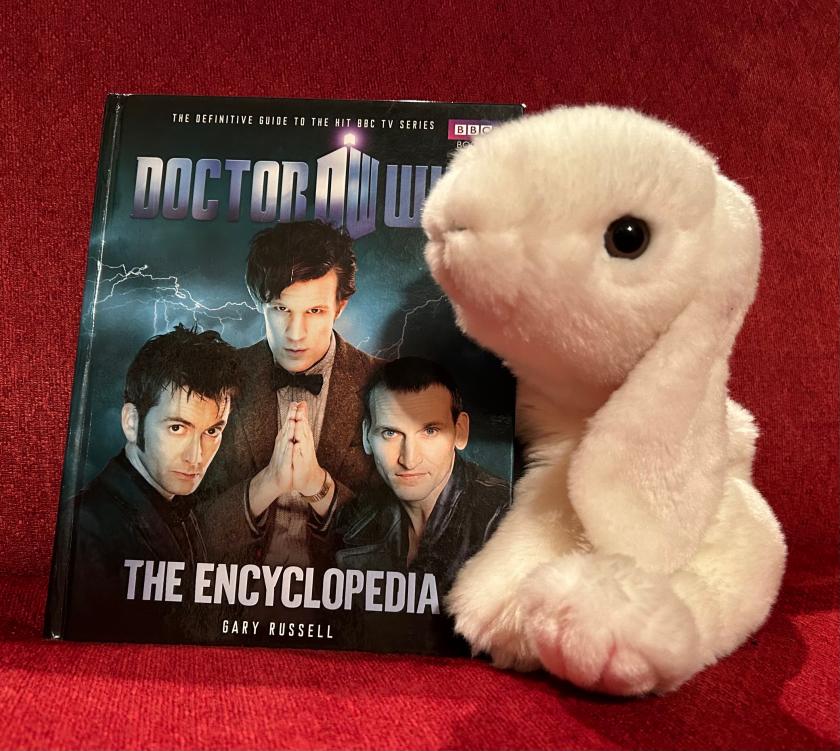
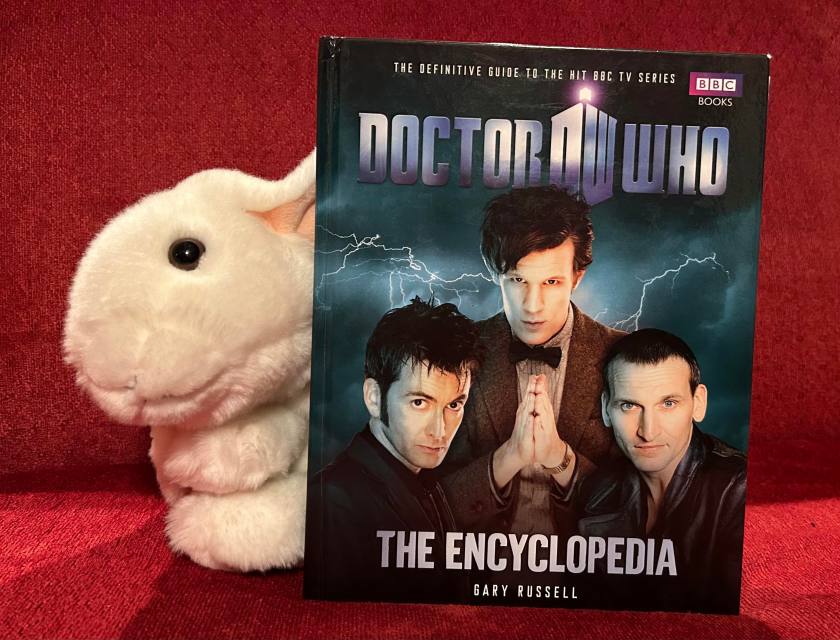
Marshmallow reviews Doctor Who: The Encyclopedia by Gary Russell.

Sprinkles: So Marshmallow, tell me a bit about why you wanted to talk about this book today.

Marshmallow: We went to a Doctor Who convention recently, and I thought it would be fun to revisit this book.

S: Yes, makes sense to me. So tell me a bit about Doctor Who for readers who may not know who he is.

M: Well, that’s a tall order. But let me try. Doctor Who is an alien, from a planet named Gallifrey, and he travels through time and space. Realistically, I think he finds himself on Earth way too often, but through his travels, he makes friends and defends humanity and anything good in this universe against all sorts of evil villains.

S: I think that is a good summary. And I like how you said he finds himself on Earth too often. In fact he finds himself in the UK, almost all the time, right?

M: Of course. It is after all a BBC show!

S: Of course.

M: And he has a companion or two almost in every episode. He is usually the only Time Lord — that is what people from his planet are called — but he often travels with a human or two, finding them in one of his many trips on Earth and bringing them along with him through many adventures.

S: I’m guessing Time Lords call themselves Time Lords. Kind of pretentious, don’t you think?

M: Yes, but they kind of are lords of time. They have the technology to travel through time and space, and they kind of have the ability to even get out of time sometimes. Which is of course weird, and even incomprehensible, for bunnies like us, who are bound by time.

S: I see. Okay, maybe they can call themselves Time Lords then. So tell me about the book. What is it about?

M: Well, it is written like an encyclopedia, and hence the title. So there are many entries, all ordered alphabetically, about all sorts of things about the show and its main characters.

S: I see on the book cover the faces of three of the Doctors.

M: Oh, yes, I forgot to tell you that one of the features of being a Time Lord involves regenerating as a new face and body when your original body is worn out or poisoned or otherwise damaged extensively. So of course this makes it awfully convenient for the BBC to change the actor who is playing the Doctor more or less regularly. And yes, the cover of the book has the ninth Doctor, Christopher Eccleston, the tenth Doctor, David Tennant, and the eleventh, Matt Smith. These are the first three doctors from the reboot era.

S: I see. So the book was published in 2011 —

M: And the Doctor was still Matt Smith back then.

S: But he is no longer?

M: Yep. At some point Matt Smith regenerated, and became Peter Capaldi, who was the twelfth Doctor. Then Capaldi regenerated to become Jodie Whitaker, who is the thirteenth. Apparently she will regenerate, and they will bring back David Tennant for a couple more episodes before he regenerates into Ncuti Gatwa, who will be the fifteenth Doctor.

S: Do you think it could be a bit hard to keep track of all these doctors?

M: Not really. They all have their own personalities. Even though it is supposed to be the same person, and the show is really about the life story of one particular individual, each actor has their own interpretation, and each Doctor is totally different.

S: That is amazing, and it is one of the things that keep the show fresh, no?

M: Yes. I think so too.

Marshmallow is reading Doctor Who: The Encyclopedia by Gary Russell.

S: Okay, back to The Encyclopedia. So this was published before the twelfth doctor, so it would not have anything about his adventures or companions or those of the thirteenth Doctor. Does it have information about the companions and adventures of the earlier doctors, or is it only about the three new doctors, nine to eleven?

M: I think it is mostly nine to eleven. But they have had a lot of adventures and so there is a lot to say. At the end of the book they list the episodes that the book covers, and they go from Episode 1 of the ninth Doctor to the end of the second year of the eleventh Doctor. And they also have some stuff about The Infinite Quest, which apparently was an animated series with the tenth Doctor and Martha, one of his companions. Somehow we must have missed that one.

S: I see. So there are a lot of details for about six years of the new show.

M: Yes, so you could learn so much! And the book has a lot of colorful pictures. It is really neat to read and look at. Though I must say, there are some scary pictures. And if you just see a picture like that when you turn a page, it could freak you out… It did to me.

S: What do you mean?

M: You know some of the episodes of Doctor Who are pretty scary, and so the pictures about those episodes remind me of the episodes and how scary they were. And even if I had not seen the full episodes, the pictures would still be very scary.

S: Hmm. So maybe this is not a great book for young bunnies.

M: No. But if a bunny likes Doctor Who and is not too scared of the scary episodes, I’m sure they would love this book. There are so many details on each of the episodes. It will be fun to re-watch the show after looking over this book. I think I will notice so much more.

S: So then you like the book, right?

M: Yes. If you are a Whovian, and especially if you like the new series, you have to read this book.

S: I see. Then how would you rate it?

M: I’d rate it 95%, only because of the scary pictures. But otherwise it is a pretty awesome book and would be appreciated by anyone who likes the show.

S: Thank you Marshmallow. I think that is fair. So what would you like to tell our readers as we wrap this up?

M: Stay tuned for more amazing book reviews from the book bunnies!
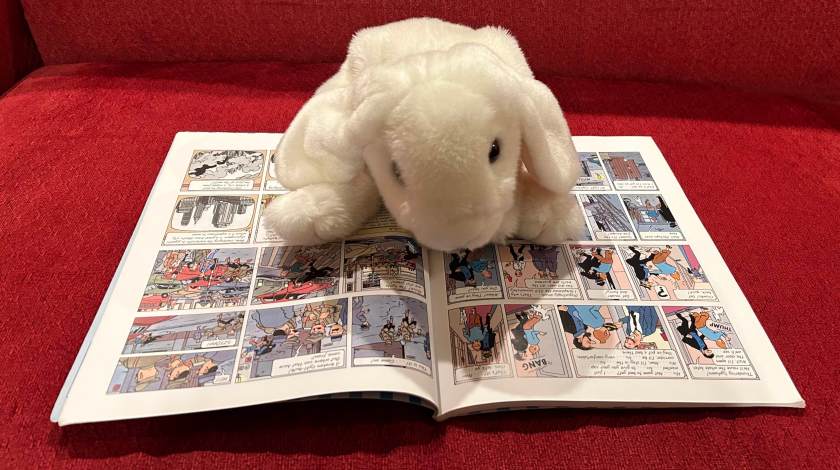
Marshmallow rates Doctor Who: The Encyclopedia by Gary Russell 95%.