Last week Marshmallow reviewed How to Become a Straight-A Student by Cal Newport. This week, as we dive into the new school year, she is continuing with a similar book, How to Be a High School Superstar, first published in 2010. Sprinkles is asking questions and taking notes.
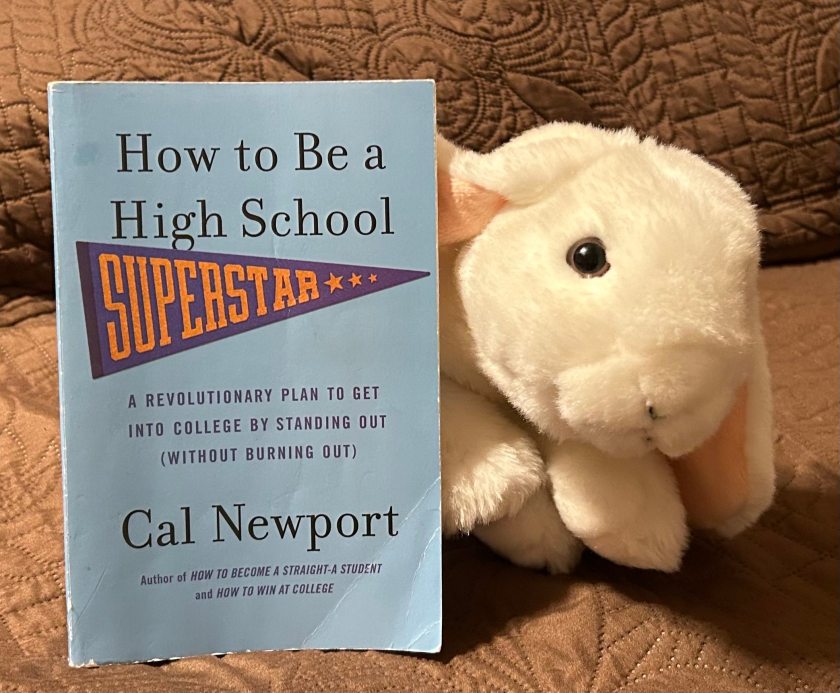
Marshmallow reviews How to Be a High School Superstar by Cal Newport.
Sprinkles: So Marshmallow, it is back to school time, and you are reading all these books about how to be a good student. You just reviewed How to Become a Straight-A Student by Cal Newport last week. And now we are looking at How to Be a High School Superstar, which was written later but is meant for a younger audience.
Marshmallow: Yes, this one is for bunnies who are beginning high school and want to know about how to make the best of it. The other book was mainly intended for college bunnies.
S: I see. So what kinds of advice do you find in this book?
M: The main ides is to be an interesting student so that you can get into college.
S: What does that mean?
M: So Cal Newport thinks that it is not how many As you get in your classes and how many activities you are involved in that matters. He thinks that college admissions folks look at the whole package and want to admit students who look interesting.
S: So what does interesting mean?
M: He suggests that you should leave yourself a lot of free time to explore new directions and find a thing or two that you are really into and you can really advance in, so you can be more than just a good student.
S: So I am assuming he takes it for granted that you will be a good student, or at least a good enough student, and then he tells the reader what else to do to round out one’s college application package. Right?
M: Yes, I think so.
S: So the book is very much directed towards high school students who are looking to get into college.
M: Yep.
Marshmallow is reading How to Be a High School Superstar by Cal Newport.
S: Okay, so tell me how one can become a more interesting person.
M: According to Cal Newport, doing less is more, so focus on one thing and do that really well. Like, he thinks that doing a sport and doing some volunteering and doing theatre and doing band and so on all at once without really paying any special attention to any one of them makes you dilute your efforts, and while trying to be well rounded you end up being mediocre in all things.
S: That reminds me of something I had heard from a college faculty member I know. He said something like, “while people are looking for well roundedness, I want to find all the sharp knives.”
M: I think I can see what he means by that! I think Cal Newport would agree.
S: Besides this big idea, what other recommendations does he make in this book?
M: Well, I think that is really the main point of the book. He uses the phrase “relaxed superstar”. He thinks that is what one should aspire to be.
S: I see. That sounds nice.
M: I think so, too.
S: So how would you rate this book then?
M: I’d rate it 100%. I think it makes a good point about being intentional about how one goes about doing high school. Wow! I managed to make one sentence with three “about”s!
S: Yes, I give you 100% for that! So this is a good place to wrap up this review, I think. What would you like to tell our readers?
M: Stay tuned for more amazing reviews from the book bunnies!
Marshmallow rates How to Be a High School Superstar by Cal Newport 100%.
Marshmallow is a young bunny who is always curious about how she can improve herself. Today she is talking to Sprinkles about a 2006 book by Cal Newport about being a good student: How to Become a Straight-A Student.
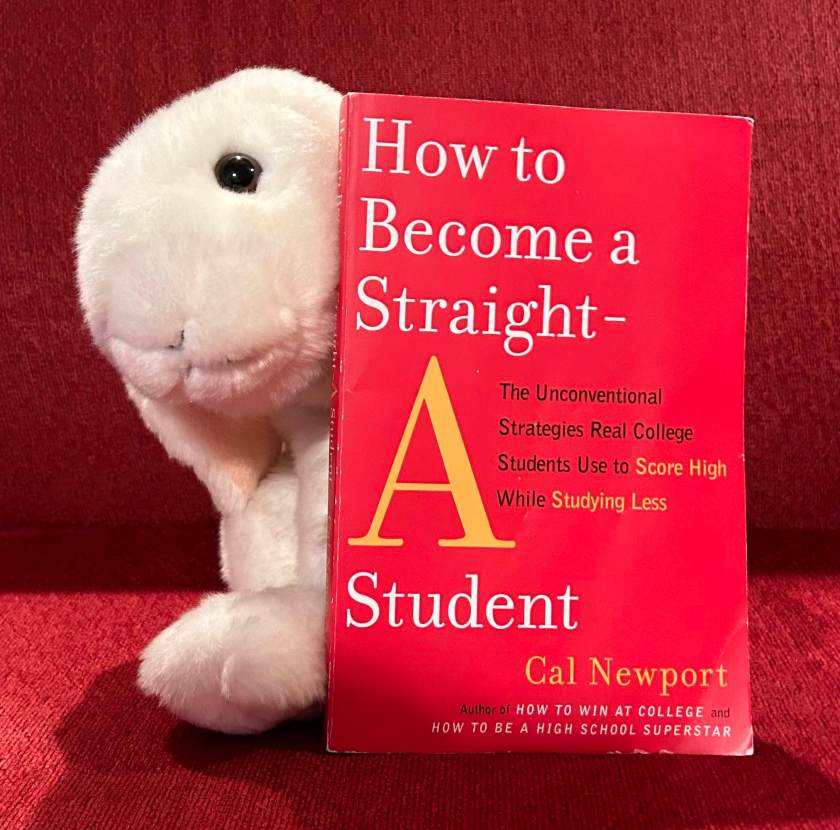
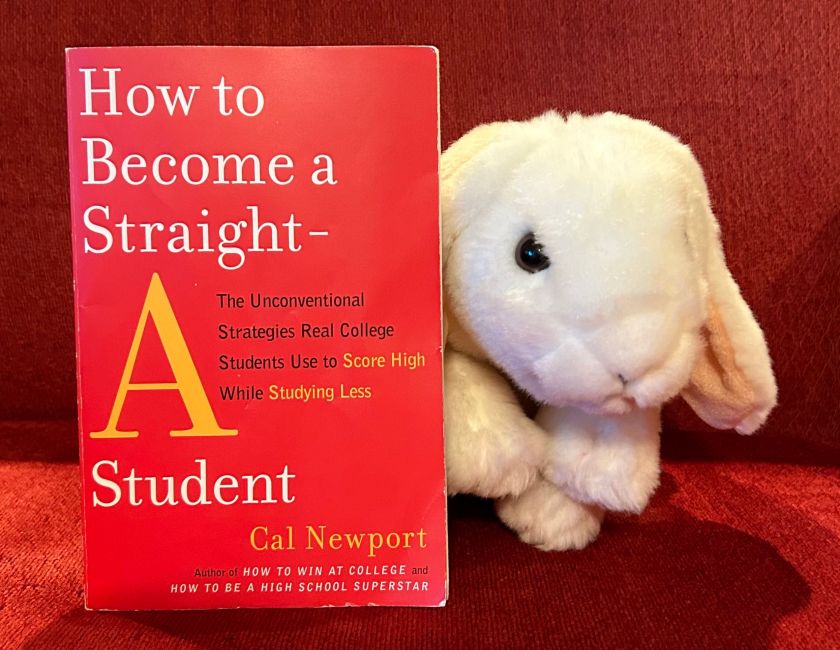
Marshmallow reviews How to Become a Straight-A Student by Cal Newport.
S: So tell me a bit about what this book is about, something more than the title of the book.
M: Well, I should first start with the full title. The full title is How to Become a Straight-A Student: The Unconventional Strategies Real College Students Use to Score High While Studying Less.
S: Hmm, so this is about how to be a straight-A student in college actually.
M: Yes, but the strategies can probably apply to other school contexts. Which is why I am reading this. I am not off to college just yet!
S: Thankfully! I am not ready for that!
M: Me neither.
S: Alright, so tell me about the book then.
M: So Cal Newport is a computer science professor today, but when he wrote this book, he had just finished college. And he had sone really well, and he wanted to write a book about how he did so well. But he does not only talk about his own experiences. He interviewed and surveyed a lot of college students asking them about their study habits and time management choices that they made, and put the book together with all that data.
S: That sounds like a good premise for a solid advice book. So tell me about some of the main ideas.
M: One of the main ideas Newport is talking about is efficiency. So for example, he calls it pseudo-work when students are spending all night in a library but not working efficiently.
S: So I can see that there are inefficient study habits. But what are his alternatives? What does he suggest? How should one study efficiently?
M: He suggests making a schedule, taking smart notes, researching better, with big ideas in mind. And there are a lot more. There are a total of three parts in the book. The first part is titled Study Basics. Then there are a series of chapters under the heading of Quizzes and Exams. Finally there are several chapters under the name of Essays and Papers.
S: So basically he talks about a variety of ways to work more effectively and efficiently for different types of assessment tasks. That makes sense to me.
Marshmallow is reading How to Become a Straight-A Student by Cal Newport.
S: So the book is intended for college students. As a bunny who is still far too young for college, did you find the book off-putting or somehow inaccessible in parts?
M: No, not at all. Though it did make me a bit worried about how much work one needs to do in college.
S: Do you like Newport’s author voice?
M: Yes, he is confident but very relatable. I also liked that he emphasizes that you need to ensure that you have a social life, that it is possible to have a social life that complements good grades and academic achievement. So I like that. It is hopeful.
S: That’s good. So do you see yourself applying any of this advice in this coming school year?
M: I will definitely try. I have a nice planner now and I want to start with planning. And I want to figure out how I can study more efficiently.
S: These all sound great to me Marshmallow. So all in all, you seem to have enjoyed this book. How would you rate it?
M: I’d rate it 100%.
S: Nice! Okay, I think it is time for us to wrap up this review, which is the last one before schools start in our part of the world. So what would you like to tell our readers?
M: Stay tuned for more amazing reviews from the book bunnies! And I hope you all will have a lot of fun if school is starting in your part of the world too!
Marshmallow rates How to Become a Straight-A Student by Cal Newport 100%.
Marshmallow has already reviewed Shatter Me and Unravel Me, the first two books of Tahereh Mafi’s Shatter Me trilogy. Today she talks about the third and last book of the series, Ignite Me, published first in 2014. As Sprinkles finds this series interesting, she is asking questions and taking notes.
(The author wrote a handful of short novellas later within the same story world, that were interspersed into the timeline of the three original books. Then she wrote three more books to continue the main story line. But when Ignite Me was published, it was presented as the end of the series.)
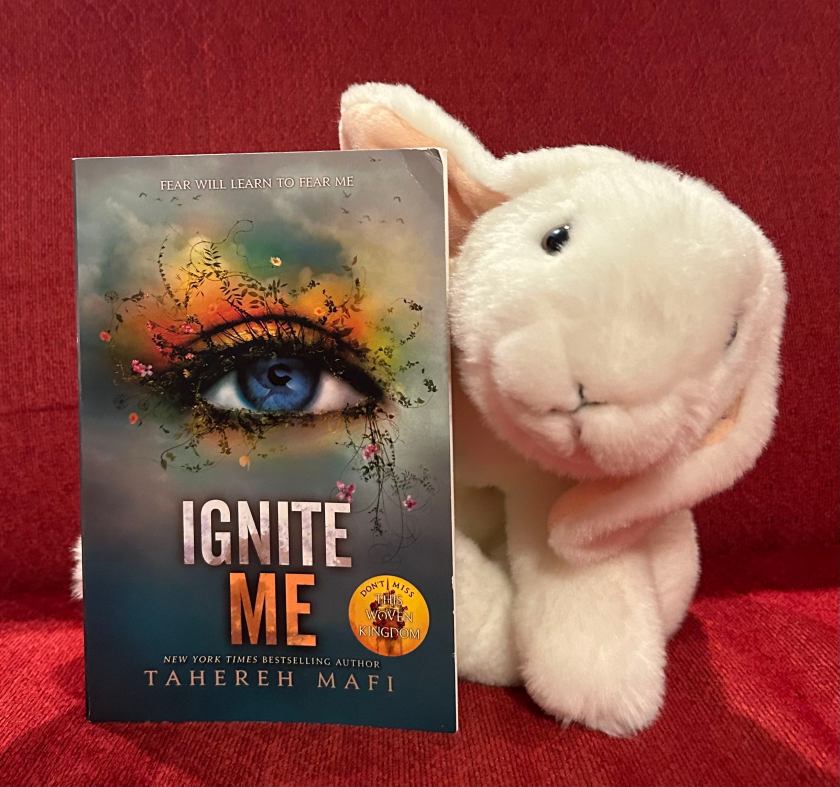
Marshmallow reviews Ignite Me by Tahereh Mafi.
Sprinkles: So Marshmallow, you are finally done with the third book in the series. How do you feel?
Marshmallow: Relieved.
S: Yes, some of the conflicts and the main problems of the series have finally been resolved, right?
M: Yes, mostly.
S: So can you tell us a bit about the main plot?
M: This book starts about when the second book, Unravel Me, ended. So Juliette and Warner are going to take on the Reestablishment. And Omega Point, where Juliette’s friends in the resistance were living, is now destroyed. So Juliette is really angry and wants revenge.
S: I can understand that.
M: It turns out that her friends are not all dead, but the destruction was pretty extensive. But the main thrust of the book is about how Juliette and Warner figure out how they will take down the Reestablishment.
S: So wait, perhaps we should say that people should read the first two books if they want to get anything out of this book.
M: Yes, definitely. I expect that the two novellas would also be useful, but I have not read those yet, and so they are not as necessary.
S: Okay. From what I understand, Destroy Me and Fracture Me mainly complemented the stories told in the other books. But of course since we have not read them, we cannot say for sure what we are missing.
M: Yes. But I felt like diving into this book after Unravel Me felt alright.
S: Okay. So now we know that the author wrote several other books after this one, but when this one was published, it was promoted as the end of the Shatter Me books. Did it feel that way to you?
M: In a way, maybe a not totally satisfying way, but it was an end. I mean, the main conflict is resolved. And when the book ends, Juliette and her friends are at the beginning of a new world, in some sense. But there is a lot to do. How are they going to save the world?
S: So in some sense, the author was probably right to write a few more books to tell us those stories too, no?
M: I suppose. I mean, in a lot of books, it is like, there is a big struggle, and eventually the bad guys are dead and gone, and then what? I think the next books probably tell that part of the story. The then what part.
S: Yes, that seems to be the case, from what I am understanding when I read things on the web about the other books in the series.
M: So it is in that sense not quite an ending.
S: Maybe a good place to pause.
M: Yes, one could say that.
Marshmallow is reading Ignite Me by Tahereh Mafi.
S: I know you felt very strongly about the main character Juliette.
M: Yes, I actually disliked her, especially in this book. And I know that there are a lot of readers who love her and think she is so vulnerable and compassionate despite all that has happened to her, but to me she does not really feel very compassionate, especially in this book. She seems quite self-absorbed and not very empathetic. She cannot understand how other people might be in pain. For example, after the destruction of Omega Point, she is all angry and wants revenge, but she does not seem to register how her friends are in pain and mourning and so broken.
S: I can see you really do not find her a very compelling character.
M: I would not say that. I would say “likeable”. I do think she is compelling, I want to learn what she is going through, I want to continue to read her story, but I do not think I like her, you know?
S: I see.
M: I am also quite upset about her relationships with Adam and Warner.
S: I know you said this book is even mushier than the other two books. Is that what you mean?
M: Well, not just that. I felt like Adam and Juliette had a relationship that seemed more based on human qualities and emotions and affection, while Warner and Juliette seem to simply be physically attracted to one another. I mean, Juliette tries to rationalize things by saying that Adam was holding her back from her power, and fulfilling her potential, and how Warner was actually a good person but he had been deeply wounded by his father, but I am not sure I buy all of that.
S: Okay, I did not read this third book just yet, but I do agree with you that her relationship with Warner seemed almost purely physical to me, too, from the start. Then again, to me, Juliette does not seem to be much of a thinking and feeling character.
M: Wait, she is a very feeling character! She has a lot of emotions!
S: I agree. What I meant was that she had only strong passions, not really affection, care, sympathy, empathy, and so on.
M: Okay, something like that. She does not strike me as a nice person really. In the dystopian world the book is set in, everyone has suffered so much. Juliette herself was locked up by herself for over two hundred days. However, she sometimes seems to forget that everyone else in the story has also suffered as much as her.
Juliette annoys me somewhat in the same way that Sophie from the School for Good and Evil books did. But then again Sophie at some point decides to be a villain and she is a good villain. Juliette is a hero, but her romantic life is so much at the center of everything that her heroic development is not really fulfilled.
S: Well, this is supposed to be a romance.
M: Yes, I understand the author is writing a romance here, but I really really wished that she would focus more on the world falling apart and these young people trying to put it back together. I really found the world-building and the plot to be very compelling, but maybe I am not the right reader for a romance. I felt the characters were not developed enough, other than romantically.
S: I can totally see that. I think the author’s writing voice is fluid, and she uses a very emphatic and evocative language.
M: Yes, I agree with that. I think her writing is really beautiful. But I really wished the plot and character development were more front and center rather than the romance …
S: You wanted a full-blown dystopian novel, nothing mushy!
M: I think I can handle some mushy, and actually, I think that romantic relationships in books, especially in series where the protagonists are growing up, can add a lot to the character development and can be really meaningful. For example, in the Harry Potter books, I think the romantic parts were not bad but made the characters more realistic and more endearing. In the Percy Jackson books, some of the romantic moments are really cute and show what a healthy relationship between young people could look like. In these cases, I think that these romantic relationships are not just beneficial to the characters and the plot, but almost necessary for the sake of realism and make the entire series / book more enjoyable and memorable. However, in this book series, I felt like the romantic aspect invaded the entire plot of the story, putting any character development or plot line in the back seat. When I started reading this series, I was expecting an epic saga about a group of brave teenagers facing down an unjust government while confronting their inner demons and trauma with a side serving of romantic relationships. I was unhappy to find that the romantic side of the story took over the entire series, with more than half of the book being spent on Juliette’s romantic life. The romance part could have been important for character development, but I felt like it was not. And it stole away time from other aspects and made the plot and resolution of the book series feel like an afterthought.
S: I think I get it. So I am guessing your rating for this book will not be 100%.
M: No. In fact, I’d rather not rate it. I think I was not the right reader for this book. I did not expect the romance to so much overwhelm the main dystopian plot line. The plot had a lot of potential and I felt like the romance stunted it. So if a reader is looking for teen romance with a strong serving of teen angst in the middle of a catastrophic environmental breakdown of the world order, maybe this is the book for them.
S: Fair enough. I think I will read the book, too, so I can make up my own mind about it.
M: Yes, I hope you do so we can talk more about the book together.
S: Sounds like a plan. So maybe we can wrap up this review. What would you tell our readers?
M: Stay tuned for more amazing reviews from the book bunnies!
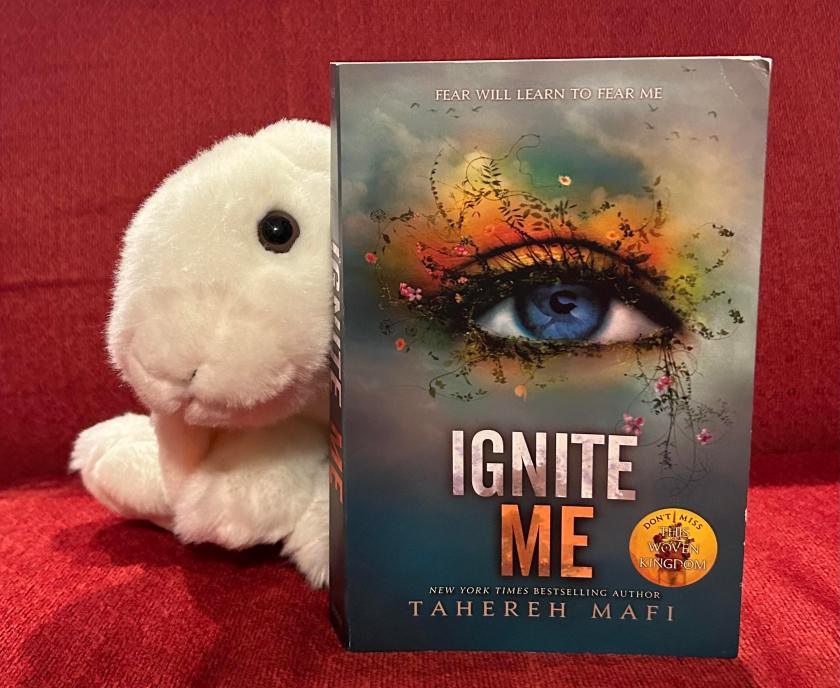
Marshmallow is posing once again with her copy of Ignite Me by Tahereh Mafi.
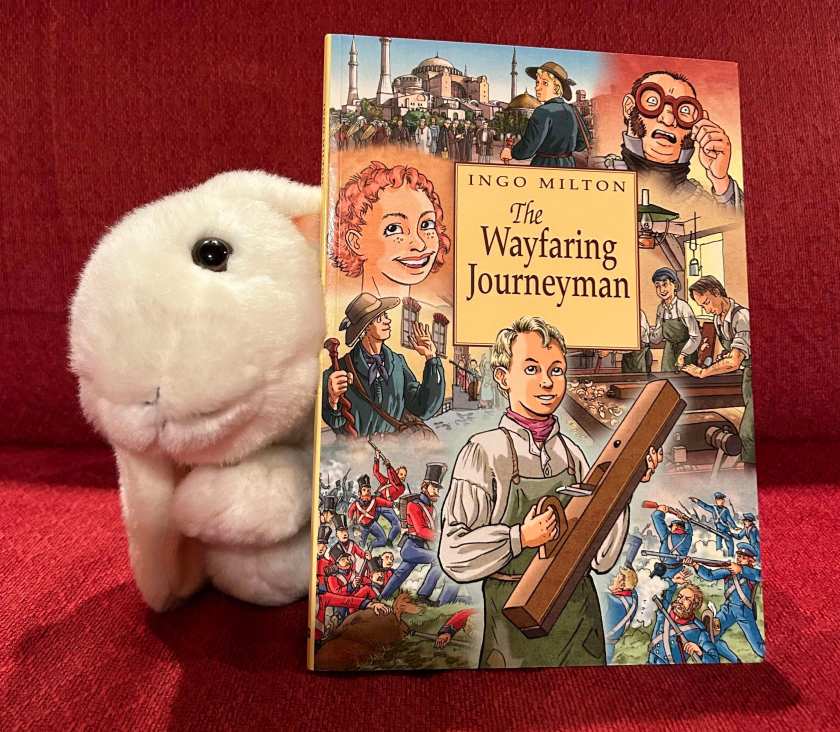
Today Marshmallow reviews The Wayfaring Journeyman: Oskar’s Story from Apprentice to Master, a short graphic novel by Ingo Milton and published in 2015 by Den Gamle By.
Marshmallow reviews The Wayfaring Journeyman: Oskar’s Story from Apprentice to Master by Ingo Milton.
Marshmallow’s Quick Take: If you like historical fiction or if you enjoy graphic novels, then this might be the book for you.
Marshmallow’s Summary (with Spoilers): Born in 1827 and raised in Haderslev, Denmark, Oskar Larsen begins an apprenticeship in 1839. Apprenticeship is hard work: working under a master cabinet maker, he must endure physical hardship for five years as he toils and trains to become a journeyman. During this time, he must build a wide variety of items and work as a joiner (“a person who constructs the wooden components of a building, such as stairs, doors, and door and window frames”, according to Oxford Languages).
During the day, Oskar works and eats with his fellow apprentices and their master. The master has a wife and two daughters. After the death of the family cat, Oskar becomes close with Esther, one of the master’s daughters. Before he can finish his apprenticeship, he must build a test piece.
After his test piece is approved and he passes the hazing, Oskar becomes a journeyman. As a journeyman, he can work for other master craftsmen but cannot employ others to help him. He travels all around Europe looking for employment opportunities; he even goes to Constantinople, which is today Istanbul. Striving to build his own workshop, he must get approval from the Guild to get his Master’s Certificate.
Once he gets his Certificate, there are unexpected events and Oskar ends up getting married. Things get even more complicated.
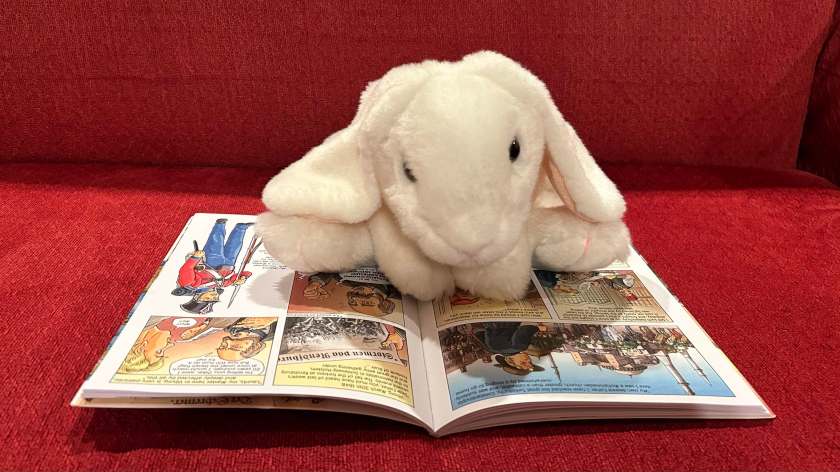
Marshmallow is reading The Wayfaring Journeyman: Oskar’s Story from Apprentice to Master by Ingo Milton.
Marshmallow’s Review: I liked reading The Wayfaring Journeyman: Oskar’s Story from Apprentice to Master. In less than 50 pages, this graphic novel offers a unique perspective on life as an apprentice, a journeyman, and, eventually, a master craftsman in the 1800s. This book taught me a lot that I didn’t know before, especially about trade guilds and their traditions from a couple centuries ago.
Though the story was overall interesting and engaging, I felt the ending was a bit abrupt. The illustrations are vivid and colorful, and overall, the book is easy to read.
According to the text on page 45 of the book, “Oskar is a fictitious character, but the storyline is historically correct, and information refers to actual facts.” He narrates the story, and it is interesting to hear from someone who is supposed to have lived about two hundred years ago.
The Wayfaring Journeyman is mostly kid-appropriate, and I think that the story would appeal to many young bunnies. However, there is a dead body shown pretty early on. There is also some nudity at the end of the book and some bad words here and there, so parents may want to read the book first and decide for themselves.
Marshmallow’s Rating: 95%.
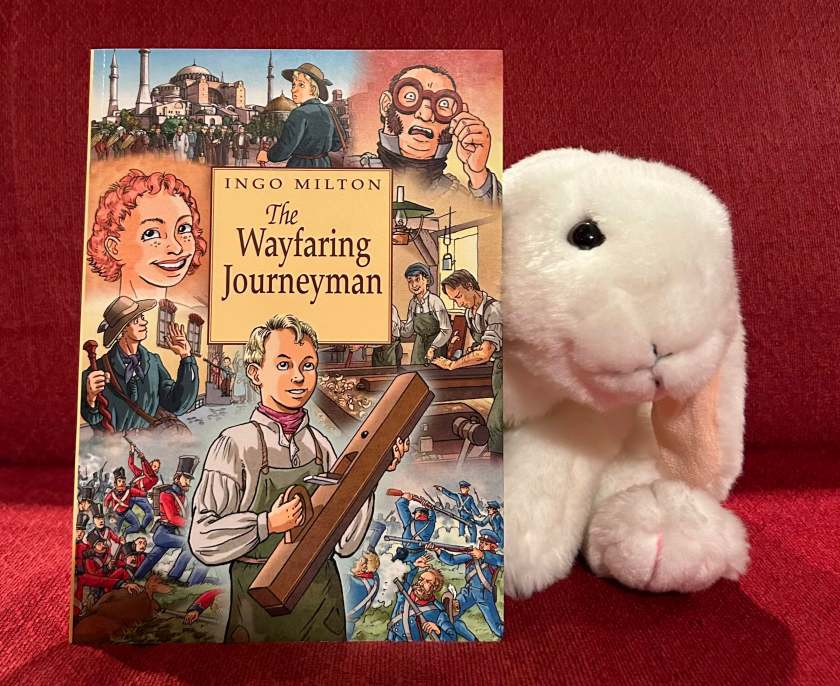
Marshmallow rates The Wayfaring Journeyman: Oskar’s Story from Apprentice to Master by Ingo Milton 95%.


 BookBunnies