Marshmallow reviews One of Us is Lying by Karen M. McManus

Today Marshmallow is writing about One of Us is Lying, a novel by Karen McManus, first published in 2017 and eventually made into a TV series of the same name.
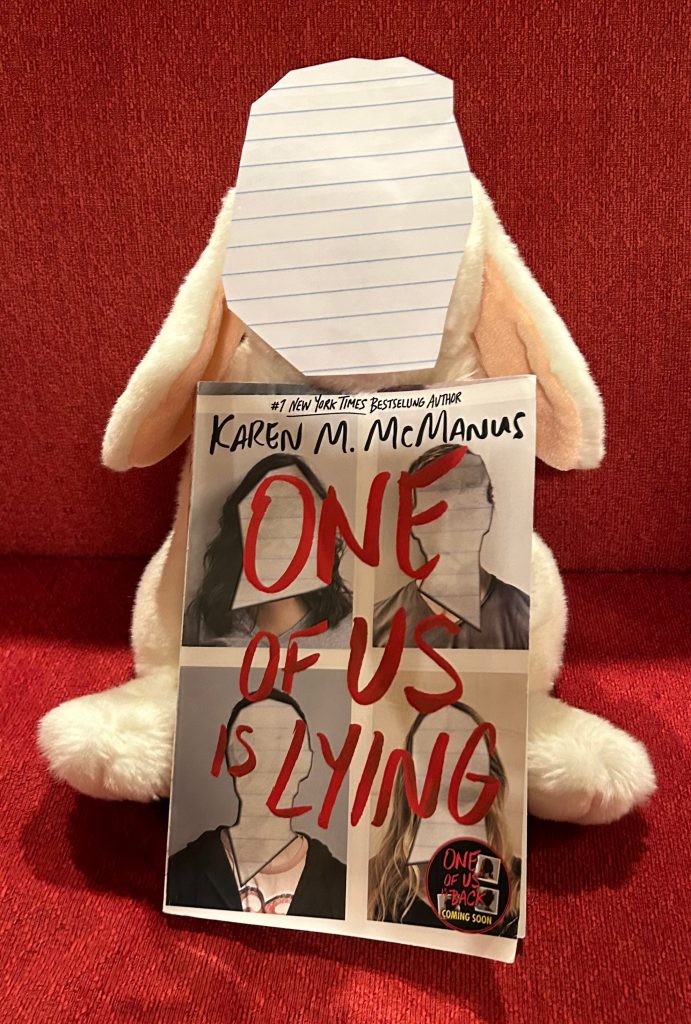
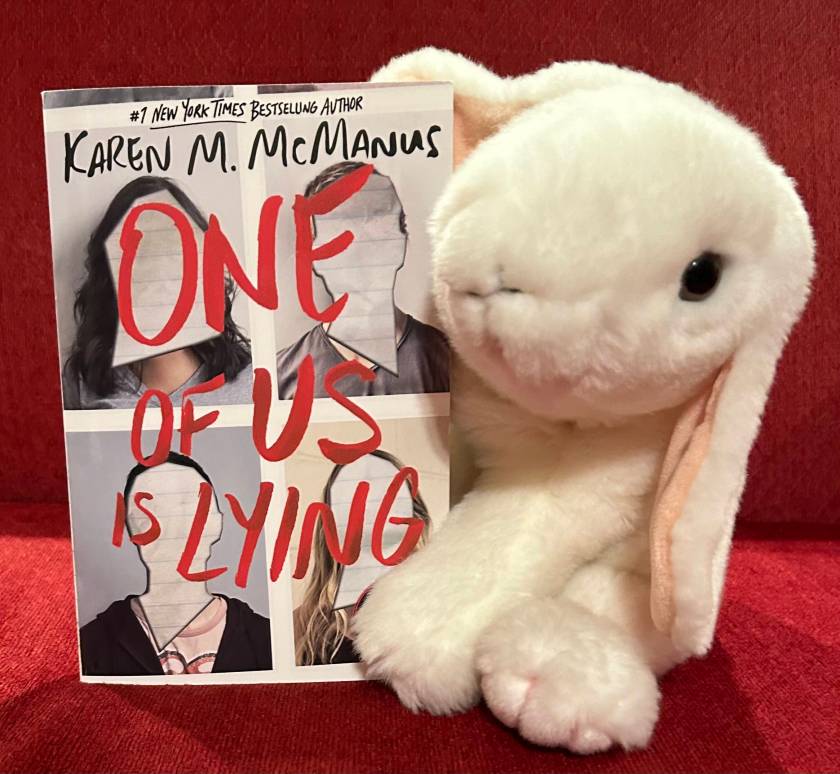
Marshmallow reviews One of Us is Lying by Karen McManus.

Marshmallow’s Quick Take: If you like books about mystery, murder, or high school drama, then this is definitely the book for you. 

Marshmallow’s Summary (with Spoilers): Bronwyn is shocked when she is put in detention. After all, she is a rule-follower on track to go to Yale, much like the rest of her family. But a phone that isn’t hers, that she’s never seen before, is found in her backpack, and off she’s sent to detention.

But Bronwyn’s shining school record isn’t the only weird thing about this detention. Four other kids are also put in detention that day, for the same reason: phones found in their backpacks that aren’t theirs. Of course, all of them honestly say they’ve never seen these phones before, but they are still put in detention.

In addition to Bronwyn, there is Addy (homecoming princess who is eternally “glued” to her boyfriend), Nate (well known for having a criminal history already), Cooper (perfect, popular, and propelled towards a career in baseball), and Simon.

While the rest resemble some familiar stereotypes of high school dramas, Simon stands out. Simon is the creator of Bayview High School’s infamous gossip app About That, an app on which he regularly posts the most vicious, damaging, and insidious gossip, scandals, and stories about his peers. Sure, he doesn’t say any names, but with initials and a small school, every new post practically ruins someone’s life.

So when Simon dies of an allergic reaction to peanuts in detention, the blame is placed on the four students present in detention with him: Bronwyn, Addy, Cooper, and Nate. At first, his death might seem natural but somehow he died from a peanut allergy while drinking tap water; peanut residue was found on the cup. The situation starts looking even worse when it is revealed that Simon’s About That post for the day after he died was going to be about the Bayview Four. Bronwyn was accused of cheating on a test (which could ruin her reputation), Addy was accused of cheating on her boyfriend (which is unthinkable because they’re the picture perfect couple), Cooper is accused of taking steroids (which would discredit his phenomenal improvement in his pitching speed), and Nate is accused of violating his probation (by selling drugs, which would get him sent to prison). If these revelations are true, reasons the police, then all four students are prime suspects for the murder. After all, if Simon couldn’t publish the post, their secrets would remain secrets.

Then the press gets involved and the next thing you know, the “Bayview Four” become the biggest suspects in the biggest scandal ever to happen in Bayview. Soon after, Simon’s post about the four students is published, unleashing chaos. Despite their lawyers telling them to keep away from each other, the four students bond together and realize that the only way to prove their innocence is to find the murderer themselves. 
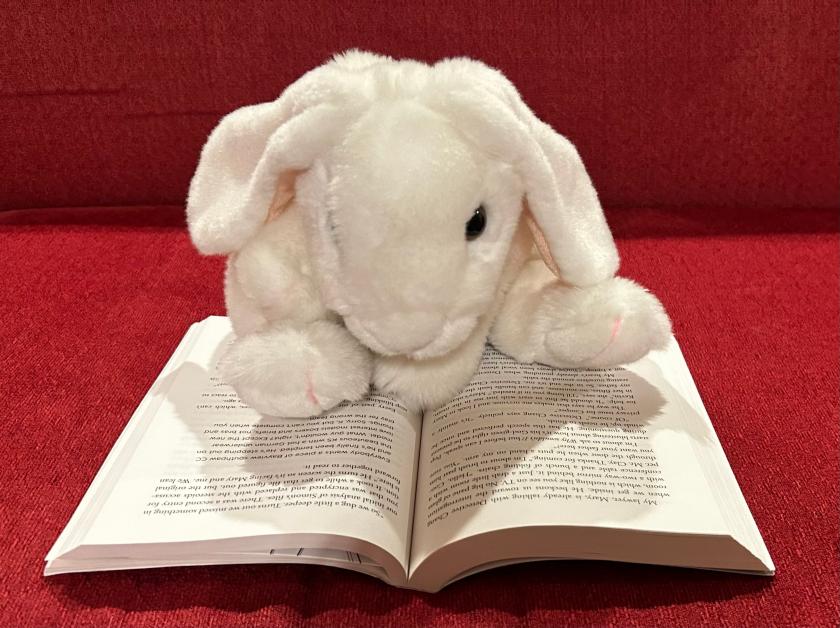
Marshmallow is reading One of Us is Lying by Karen McManus.

Marshmallow’s Review: I really enjoyed One of Us is Lying. I found it to be an extremely interesting mystery that ended in a way I never saw coming. And as the book goes on, suspense rises and the tension increases as the mystery’s answer is slowly revealed. All in all, I think the plot was really, really well written and I definitely recommend bunnies give this book a try.

One thing that I really liked about this book was the fact that the author set up characters based on the typical tropes in high school dramas, and then she made them evolve past their basic characteristics. For example, even though Addy seems like a blank slate without her boyfriend, at first, throughout the course of the book, her character changes a lot. The same goes for all of the other characters as well. All of them start as typical, simple characters and then grow together and you really become attached to them.

The book does have some mature content since the characters do sometimes use curse words and there are some references to sexual acts that characters have taken part in. There are no explicit scenes. I think bunnies over 14 could handle this book, but it depends on the maturity of each bunny. Some might be able to enjoy it at 12 while others might prefer to read it at 15. Overall, however, there is not really that much inappropriate content in this book.

I also liked Karen McManus’s writing style and found it interesting that we got to see the same story from different characters’ points of view. Each chapter is from either Bronwyn’s, Nate’s, Cooper’s, or Addy’s perspective. I appreciated the different views on the plot and how the author shows that everyone is more complex than they seem. On surface value, people assess Nate to be a delinquent on a one-way road to prison. But the author adeptly shows his perspective and how harsh life has been for him. Addy, who is viewed as a stupid, vapid girl who only cares about her love life, is revealed to be a much more complex, multifaceted person whose family life makes things more complicated. Cooper, who seems to be living the dream life, is shown to have struggles that no one else sees. And in the chapters written in Bronwyn’s perspective, we see the pressures that she faces on her path to Yale and success. McManus does a really good job of showing the complexity, depth, and nuance of the characters. Most books I’ve read don’t show so much detail about so many different people. The book made me remember the following quote, which is credited to a large number of people including the actor Robin Williams:

“Everyone you meet is fighting a battle you know nothing about. Be kind. Always.”

Marshmallow’s Rating: 100%.
Marshmallow rates One of Us is Lying by Karen McManus 100%.

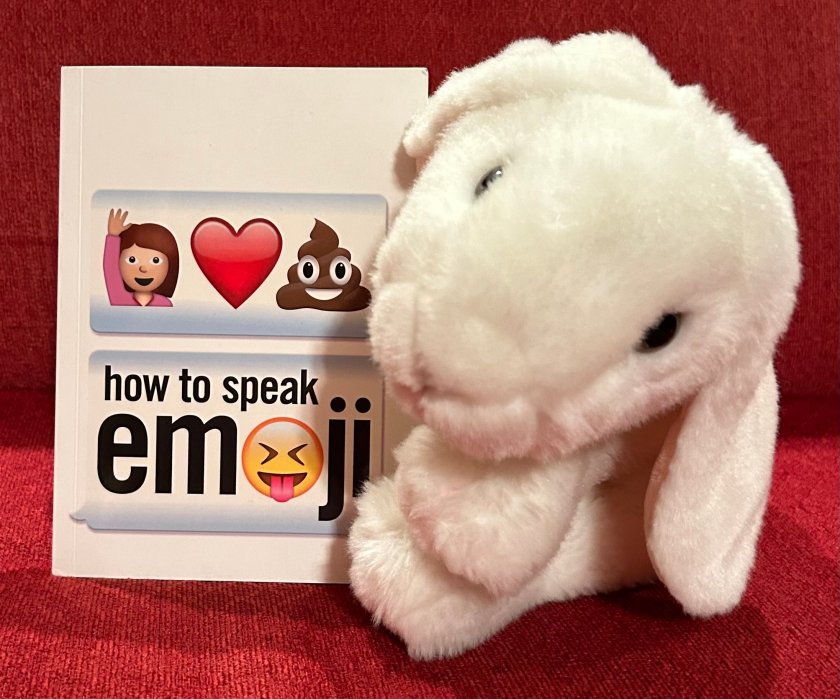
Marshmallow reviews How to Speak Emoji by Fred Benenson

Today Marshmallow wanted to talk about a little book on emoji originally published in 2015: How to Speak Emoji by Fred Benenson.

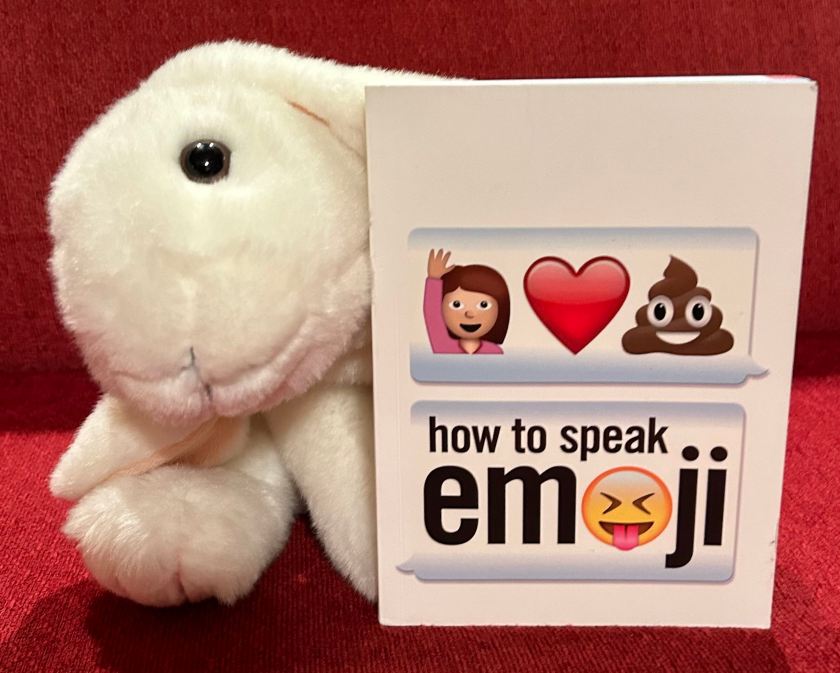
Marshmallow reviews How to Speak Emoji by Fred Benenson.

Marshmallow’s Quick Take: If you like funny books about how to do something or books about popular culture, then this might be the book for you. 

Marshmallow’s Summary (with Spoilers): In this book, Fred Benenson creates a useful glossary that you can use to navigate text conversations using emojis. Though this book is nonfiction, and is meant to be informative, some of the emoji strands have humorous meanings.

In the first part of the book, there is a list of the meanings of singular, specific emojis. These can get a bit subjective. For example, the author writes that the 💅 emoji means “Ooh, fancy!” And the 🆗 emoji means “grudging approval”.

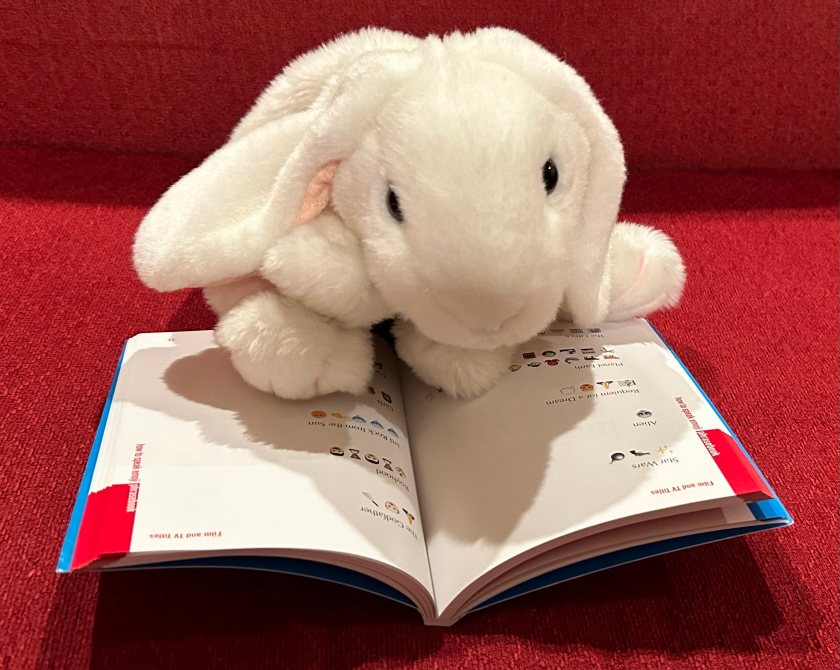
After the initial, brief glossary, there is an emoji phrase book. The phrases in this vary by section. There is one section for pickup lines (which get pretty, um, weird 🫤), a section for food and drink 🍔, a section for insults, and many more (including but not limited to technology, travel, medical/emergency, weather, the Twelve Days of Christmas, etc ♾️). Idioms like “an elephant never forgets” become 🐘🚫💭 and “above and beyond” becomes 👆➕🔭🌌 (this is in the idioms section). These sections are all very entertaining, and it is interesting to see how the author translates standard phrases and sayings into emojis. 

Marshmallow is reading How to Speak Emoji by Fred Benenson.

Marshmallow’s Review: You might be wondering, “Marshmallow 🤨🧐🤔 why would I want a book about the meaning of emojis when I can just google them?” My response to that question is that this book is also funny and teaches you how to communicate with emojis by themselves, which, admittedly, is not necessarily an essential skill but is definitely fun. And how can you not love a book which has the smiling poop emoji on its cover? I was a little sad to see that my favorite melting 🫠 emoji was not mentioned. However, it makes total sense because that is a new, quite recent (2023) addition to the vast army of emojis and only came out after this book was written (2015).

As a bunny who enjoys using emojis for the sake of using emojis, I liked this book a lot. Sometimes I find emojis that I don’t understand the meaning of, like this one: 🙃. And it is fun to learn how to use emojis to make phrases, and decoding them can be a fun game with friends and family. However, I would say that some of the content in this book is not appropriate for young bunnies, let us say, under the age of thirteen. Some of the phrases can be overly sexual. I just skimmed over those to get to the ones that were more amusing in my opinion. Otherwise however, this would be a very fun book for all readers. The sheer number of emojis and their complex meaning is fascinating 🤩 and this book does a good job explaining them.

Overall, this is a cute guide to using emojis 🥰 and I will take my knowledge gained from this to write this phrase: ⤵️📻➕😎📚🐰🐰🐰📋. (If you want, you can put your guess of what it means in the comments below!)

Marshmallow’s Rating: 98%

Marshmallow rates How to Speak Emoji by Fred Benenson 98%.

Marshmallow reviews Sapiens – A Graphic History: The Birth of Humankind by Yuval Noah Harari, David Vandermeulen, and Daniel Casanave

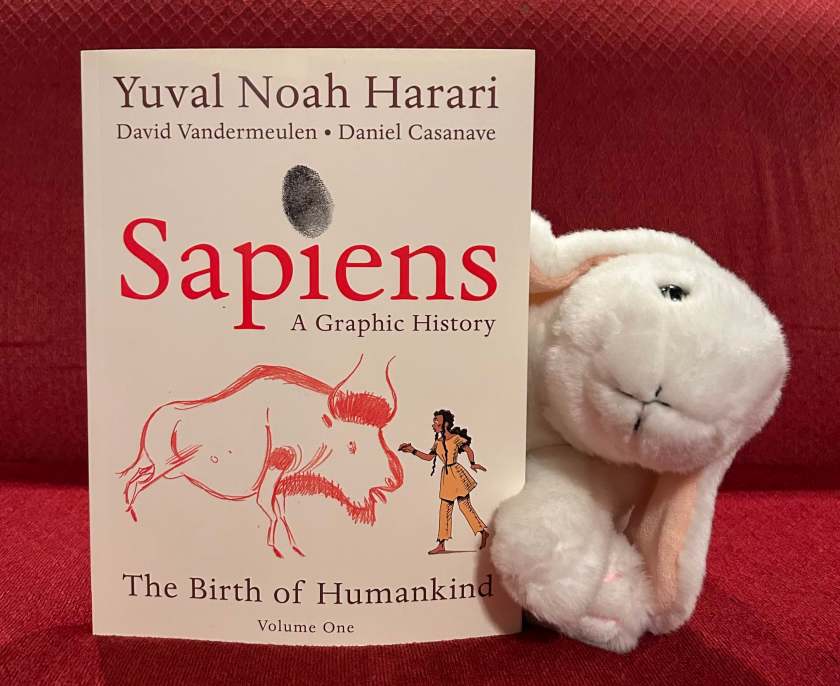
Today Marshmallow reviews Sapiens – A Graphic History: The Birth of Humankind, the first volume, published in 2020, of the multi-volume graphic novelization of Yuval Noah Harari’s 2011 book Sapiens – A Brief History of Humankind. Sprinkles is taking notes and asking questions.

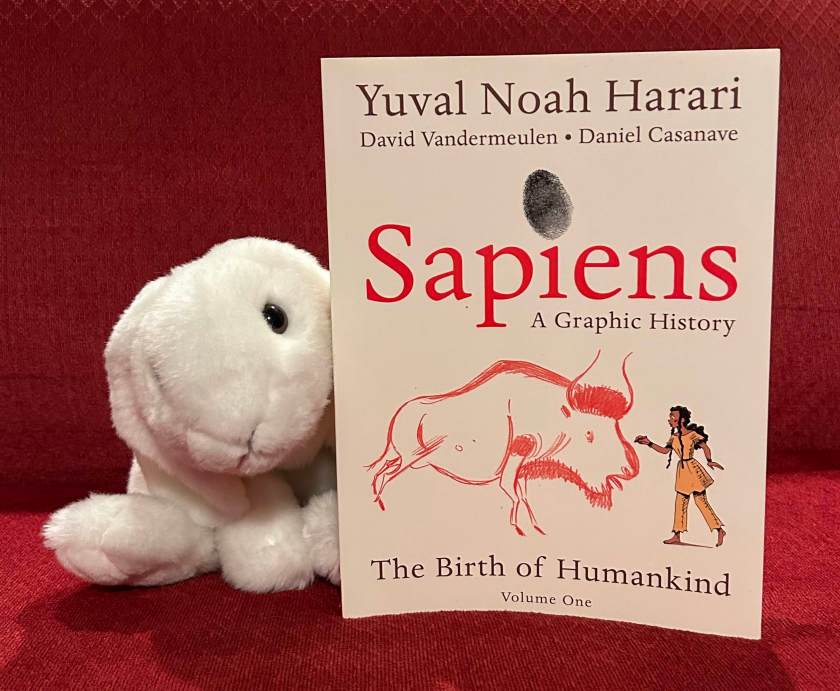
Marshmallow reviews Sapiens - A Graphic History: The Birth of Humankind by Yuval Noah Harari, David Vandermeulen, and Daniel Casanave.
Marshmallow reviews Sapiens – A Graphic History: The Birth of Humankind by Yuval Noah Harari, David Vandermeulen, and Daniel Casanave.

Sprinkles: I know you enjoy graphic novels, just like Caramel does, so I was not too surprised when you decided to pick up this book.

Marshmallow: Yep, and I actually enjoyed reading it too. And I think that, if you like books that ask deep questions or investigate human history, then this is the book for you! 

S: Hmm, I see what you did there. You begin all your reviews with this kind of an invitation. I think it works well here too! So what is this book about?

M: It is basically about the entire history of humanity’s origins.

S: That sounds ambitious!

M: It is. So I think this will take him four or five volumes, but he is trying to tell in graphic novel form what he writes in his original book from 2011. It’s pretty novel I’d say.

S: I see. Tell me more.

M: So in this book, human evolution is portrayed as a reality TV show. And mass extinction becomes a crime investigation. We follow the author Yuval and his niece Zoe as they investigate the meaning of labels like “species” and “genus” with Professor Saraswati. Each character is drawn as a little caricature. Then we see Yuval and Zoe watching “The Greatest Show on Earth!”, or “Evolution!” This leads to an investigation of why and how the species of Homo Sapiens dominates the Earth today. After all, there were several other species in the human genus. 

S: I can see that you are using some big words, maybe from your biology class?

M: Well, not quite. The book uses them, so I think it makes sense for me to use them too.

S: Makes sense to me.

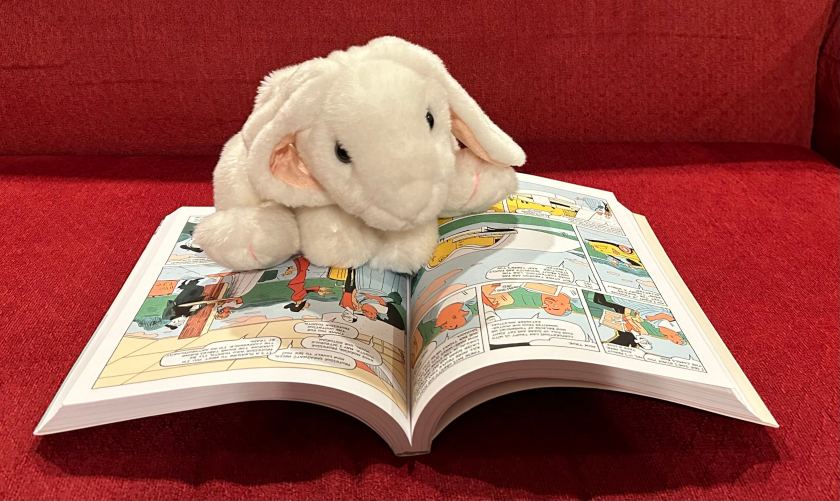
Marshmallow is reading Sapiens - A Graphic History: The Birth of Humankind by Yuval Noah Harari, David Vandermeulen, and Daniel Casanave.
Marshmallow is reading Sapiens – A Graphic History: The Birth of Humankind by Yuval Noah Harari, David Vandermeulen, and Daniel Casanave.

S: So I know that after reading this book, you also followed up with some reviews of it to see how it was received.

M: Yes. Because the author intends to share some possibly controversial ideas about the history of humanity, there was a lot I did not know about in the book, so it was really interesting to read. But I wanted to know if what he was saying was really correct. This is a graphic novel after all, and though some graphic novels have extensive footnotes and such, this one has none, and it has no references. So I wanted to check to see what others who know more about the topic thought.

S: So what did you find out?

M: Well, our readers can start by checking the Wikipedia article on the original book. The original book sold really well and got a lot of great reviews from well-known and highly regarded people. But it seems like some of the more scientific takes on the book are not as complimentary. A lot of them do like it actually, but there are some folks that say that there is not that much that is new in the book and whatever is new and original is not accurate.

S: I see. Now it is not terrible if there is nothing new for scientists, because no matter what they all know, their knowledge is not always accessible to the general audience.

M: Exactly. The graphic novel format is a really good way to reach a lot more people. So some apparently called it “infotainment,” but maybe that is actually not a terrible thing. I think the Lucy & Andy Neanderthal series that I read and reviewed is also kind of infotainment but I still found it extremely educational.

S: I agree with you there. Those books are a lot of fun and teach you a lot too.

M: Even our reviews are probably infotainment – fun yet informative, I hope. The accuracy concern is more difficult to dismiss though. Not being a scientist, I am not great at gauging that. So my advice for curious bunnies is to read this because it is a great story, and you will learn a lot, but still take it with a grain of salt, because if some parts of it feel really out there, maybe they are. So it might be worth double-checking things out on your own.

S: I think that is a very prudent and thoughtful recommendation, Marshmallow.

M: I’m a very prudent and thoughtful bunny. And now we are both using big words!

S: Yep, it must be this book!

M: We must be smarter or something! Maybe we are evolving.

S: Okay, okay, hold it there. Maybe this is a good place to end this review. So if you were to rate this book what would your rating be?

M: I really really enjoyed it, and I’d say 100% but then again the accuracy question makes me say 95%.

S: That’s fair. Okay, thanks for your neat review, Marshmallow. What would you like to tell our readers as we wrap it up?

M: Stay tuned for more amazing reviews from the book bunnies!

Marshmallow rates Sapiens - A Graphic History: The Birth of Humankind, by Yuval Noah Harari, David Vandermeulen, and Daniel Casanave, 95%.
Marshmallow rates Sapiens – A Graphic History: The Birth of Humankind, by Yuval Noah Harari, David Vandermeulen, and Daniel Casanave, 95%.

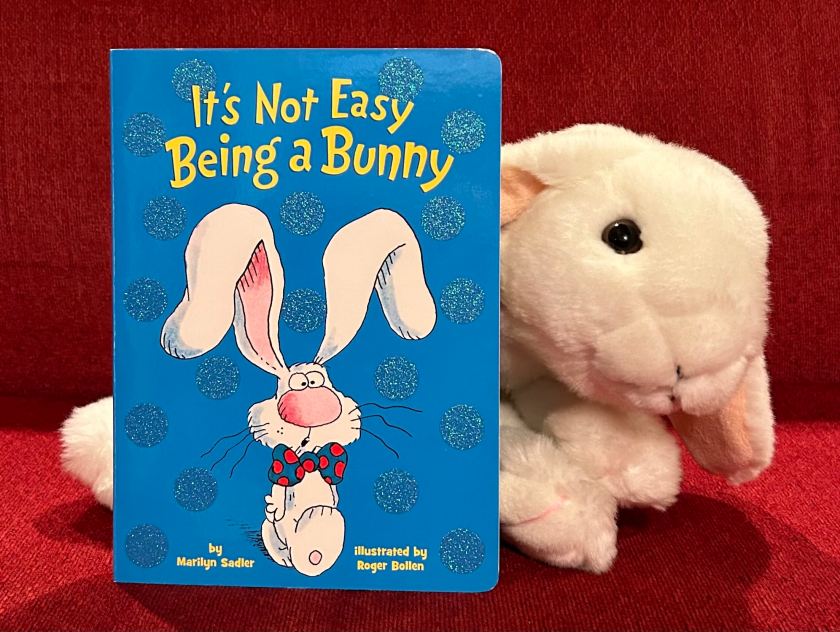
Marshmallow reviews It’s Not Easy Being a Bunny by Marilyn Sadler

Tomorrow, many people around the world will celebrate Easter. Marshmallow wanted to commemorate this holiday with a cute book about bunnies, so today she is reviewing It’s Not Easy Being a Bunny, a little book written by Marilyn Sadler, illustrated by Roger Bollen, and originally published in 1983. Sprinkles is taking notes and asking questions.

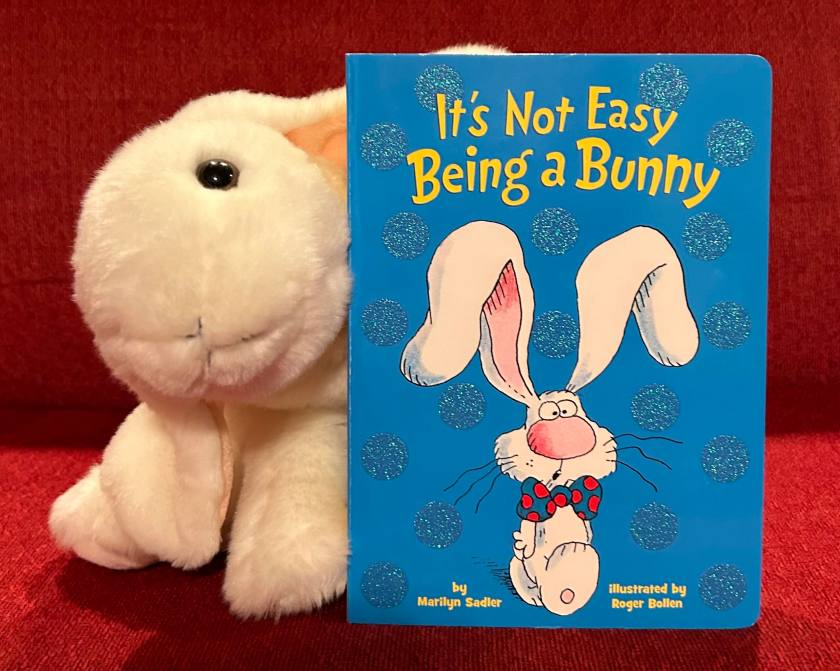
 Marshmallow reviews It's Not Easy Being a Bunny, written by Marilyn Sadler and illustrated by Roger Bollen.
Marshmallow reviews It’s Not Easy Being a Bunny, written by Marilyn Sadler and illustrated by Roger Bollen.

Sprinkles: So Marshmallow, we are talking about a picture book today.

Marshmallow: Yes. I thought it would be appropriate given that this weekend a lot of people are talking about bunnies and egg hunts and such.

S: I agree. This is a sweet book, so why don’t you tell us what it is about?

M: First of all, I should say that the book is not about Easter at all. But it is a book about a bunny, a bunny named P.J. Funnybunny.

S: That is a funny name for a bunny.

M: Yes, it is not as cool as my name, but it is a funny one. It is definitely fun to say. It just rolls off your tongue.

S: Agreed. So tell us a bit more about P.J. Funnybunny.

M: P.J. is not very happy at the beginning of the book. He does not like the cooked carrots his mommy gives him. So he runs away from home to try and not be a bunny anymore.

S: Aw, that is so sad! A little bunny running away from home…

M: Let me just say that it does not work out great.

S: Well, how could it? But what do you mean? Does he get hurt?

M: No, not really. But he does meet some different animals and he tries to join them. But in the end, he decides that maybe being a bunny is not so bad.

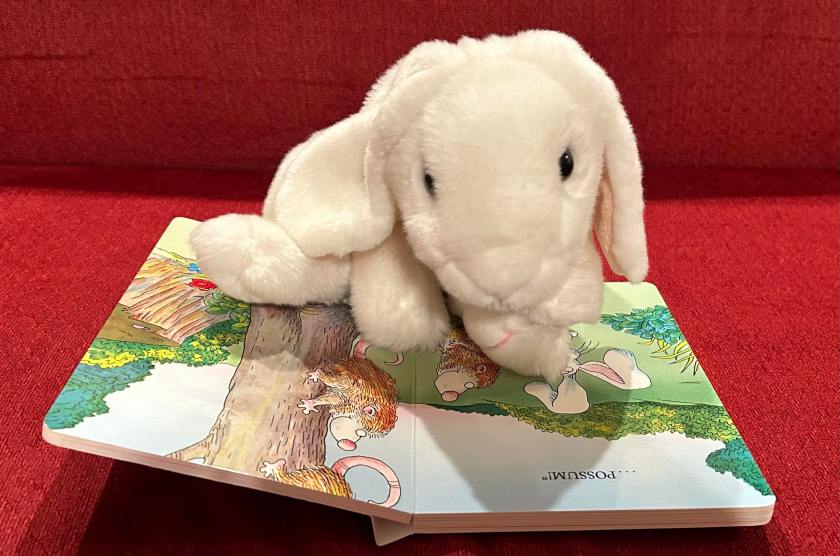
 Marshmallow is reading It's Not Easy Being a Bunny, written by Marilyn Sadler and illustrated by Roger Bollen.
Marshmallow is reading It’s Not Easy Being a Bunny, written by Marilyn Sadler and illustrated by Roger Bollen.

S: Do you like being a bunny Marshmallow?

M: Well, most of the time. I’m one of the lucky ones though. According to the Humane Society of the United States, “[m]ore than half the world’s wild rabbit species, such as South African riverine rabbits, are endangered or threatened. Domestic bunny species, like Angora or New Zealand White, are subject to the abuses of cosmetics testing, the pet trade and the fur industry.”

S: You are right Marshmallow. Sometimes it can be rough to be a bunny.

M: But at least P.J.’s story ends well. He figures out that he belongs with his family and goes back.

S: Yes, it is in the end a sweet story of coming back home and appreciating it more, maybe for the first time, right?

M: Yes. I think it would be really nice for little bunnies and their grownups to snuggle together and read this book.

S: I agree. I know you are all grown up and stuff, but maybe we can do that too?

M: I think I would like that.

S: Okay, then. Maybe this is a good time to wrap up this review. What would you like to tell our readers?

M: Stay tuned for more amazing reviews from the book bunnies!

Marshmallow recommends It's Not Easy Being a Bunny, written by Marilyn Sadler and illustrated by Roger Bollen, to all the little bunnies around the world and their grownups.
Marshmallow recommends It’s Not Easy Being a Bunny, written by Marilyn Sadler and illustrated by Roger Bollen, to all the little bunnies around the world and their grownups.