Marshmallow reviews An Unexpected Light by José Saramago

Earlier this summer, Caramel reviewed a neat picture book by the distinguished Portuguese author José Saramago. Today Marshmallow picks up where Caramel had left off, and reviews An Unexpected Light, another excerpt from Saramago’s book on his childhood memories. Illustrated by Armando Fonseca and translated by Margaret Jull Costa, An Unexpected Light was first published in English in August 2024. Readers can learn more about the book here.
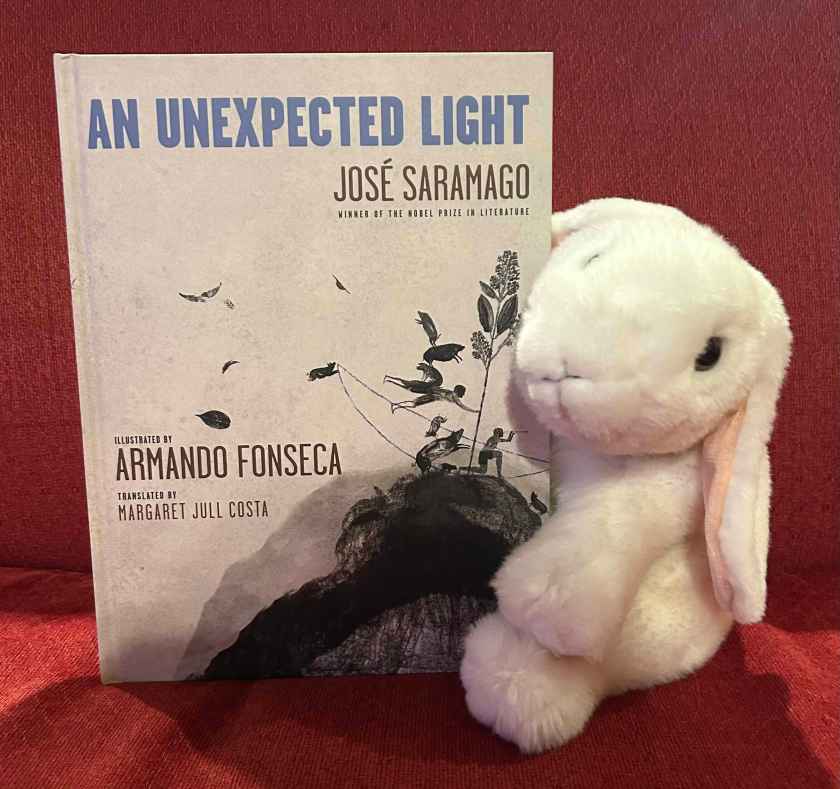
Marshmallow reviews An Unexpected Light,  written by José Saramago, translated by Margaret Jull Costa, and illustrated by Armando Fonseca.
Marshmallow reviews An Unexpected Light, written by José Saramago, translated by Margaret Jull Costa, and illustrated by Armando Fonseca.

Marshmallow’s Quick Take: If you like books that are calming, thought-provoking, and subtly wonderful, then this is the book for you!

Marshmallow’s Summary (with Spoilers): José Saramago was born in Portugal, somewhere I have never been; yet, through this book, I feel like I know what it is like to be there. When he was twelve years old, Saramago went along with his youngest uncle to help him sell his grandparents’ pigs at a market in Santarém. They embarked on a journey that is beautifully understated. The author describes in quite simple terms what he and his uncle did, what happened, and where they were.

The story overall is quite simple. Yet, there is something profoundly special about it. You can tell when you open the book that there is something different in this book–-something that most other books cannot convey in more than Saramago’s meager twenty or so pages. The plot is not particularly convoluted as a result. But the experience is unique.
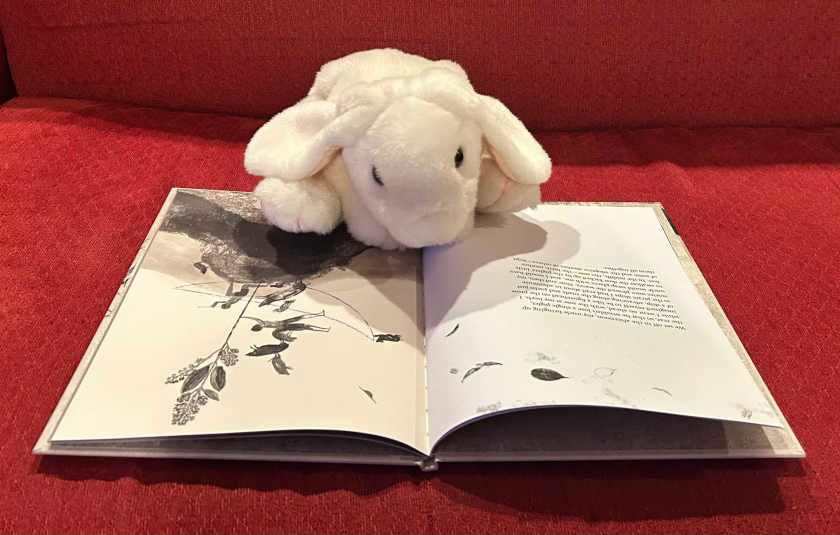
Marshmallow is reading An Unexpected Light,  written by José Saramago, translated by Margaret Jull Costa, and illustrated by Armando Fonseca.
Marshmallow is reading An Unexpected Light, written by José Saramago, translated by Margaret Jull Costa, and illustrated by Armando Fonseca.

Marshmallow’s Review: If reading this book has taught me one thing, it is that Saramago didn’t win a Nobel Prize for nothing. This is definitely a lot different from the picture books I’ve read. It is still short, has drawings, and relatively little text per page. But it nonetheless feels different. I don’t exactly know how to describe it, but I felt as though I had been transported to Portugal when I first read this book. The drawings are not complex but they convey shapes and people that your mind transforms into a living, breathing environment around you. I think maybe the illustrator chose a more minimalistic style to allow the eyes to spark the imagination which then builds a more detailed, immersive world on its own. This might in turn be inspired by Saramago’s style, which achieves the same effect.

I am still not exactly sure what the last couple of sentences in the book mean. Caramel reviewed another book by this author and used the term “quiet conviction.” I feel like the theme is different in this book, but the word “quiet” is still quite applicable. Saramago doesn’t use elaborate descriptions or fancy words. In fact, I did notice: he doesn’t seem to use quotation marks either. This is clearly a stylistic choice, which I found interesting. But the author and the book as a whole have a very understated feel throughout. I really liked that. 

I think authors generally don’t try to push their works to have a singular, trite meaning; leaving the interpretation up to the reader makes the work really what the reader wants it to be. In my opinion, this book is about slowing down, thinking, feeling, and admiring the world. Saramago watches everything with not much judgement in this book which makes the reader kind of slow down and calm down. I think this book shows me that the world and nature are awe-inspiring in a quiet way, a way that I think Saramago strove to emulate.

I had read this book earlier in the summer when Caramel was looking over the two books. Today, I had an experience that really made me think of this book again, in so subtle a way I didn’t really even notice it. I woke up early and was in a car for a while, groggy at the beginning. But I looked out the window and saw a sky that was indescribably beautiful. The sun was rising, making its daily ascent, but I was watching as if for the first time; perhaps it was the first time I really looked. It was truly awe-inspiring and wonderful. It made me realize how beautiful nature is, but in a way that is so encompassing that we don’t and maybe can’t recognize always. This book really gives you the time to slow down and recognize that there is beauty and the extraordinary in so many places that we consider ordinary. 

Marshmallow’s Rating: 10/10.
Marshmallow rates An Unexpected Light,  written by José Saramago, translated by Margaret Jull Costa, and illustrated by Armando Fonseca 10/10.
Marshmallow rates An Unexpected Light, written by José Saramago, translated by Margaret Jull Costa, and illustrated by Armando Fonseca 10/10.

Caramel reviews The Silence of Water by José Saramago

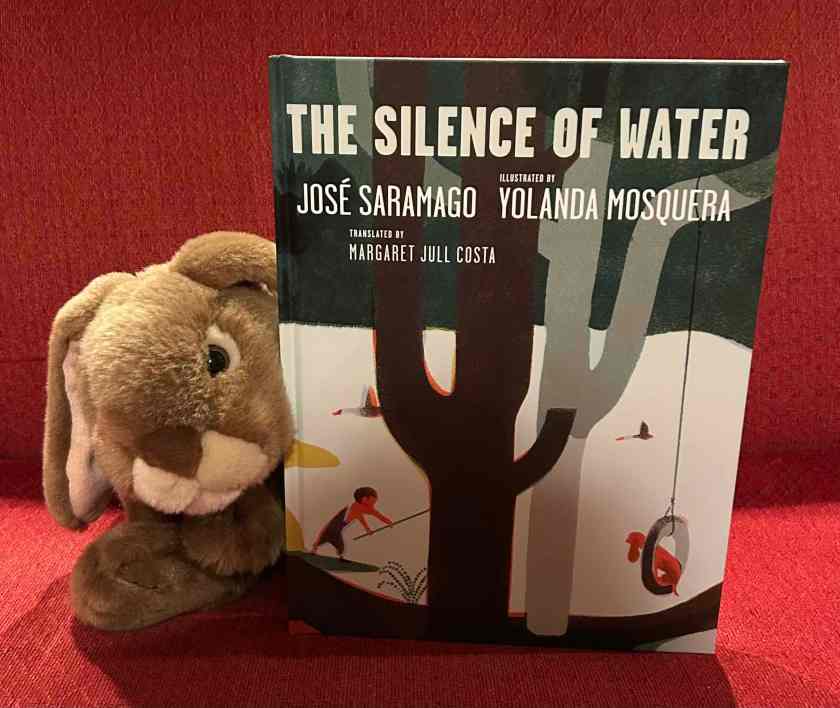
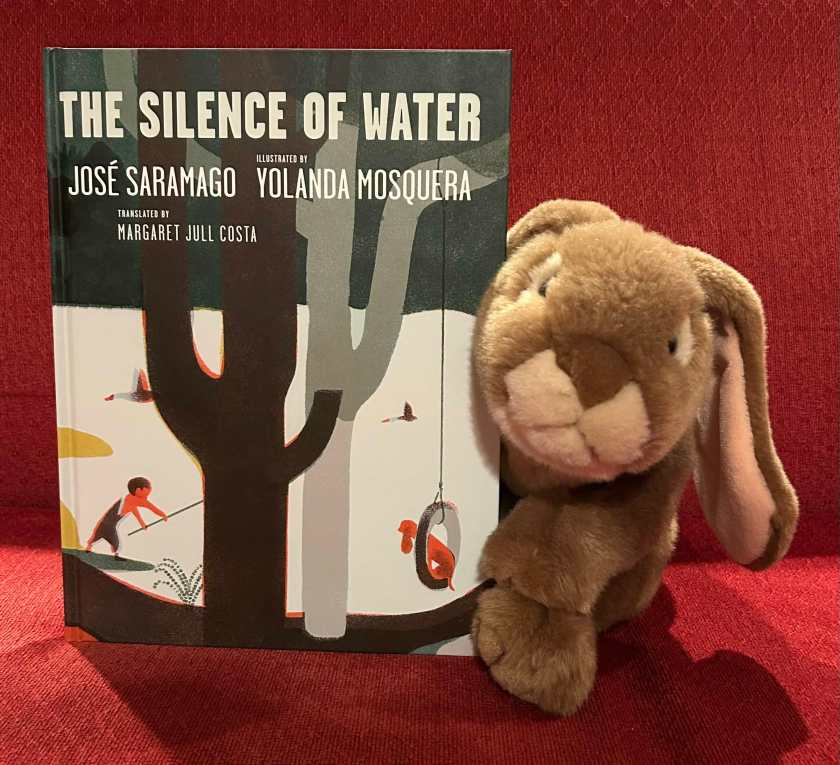
José Saramago was a Portuguese writer who received the 1998 Nobel Prize in Literature for his “parables sustained by imagination, compassion and irony [with which he] continually enables us once again to apprehend an elusory reality.” Today Caramel is talking to Sprinkles about The Silence of Water by Saramago, a picture book published in English in 2023. (The original Portuguese version was published in 2011). The book was translated into English by Margaret Jull Costa and was illustrated by Yolanda Mosquera.

Caramel reviews The Silence of Water by José Saramago.

Sprinkles: So Caramel, today we are talking about a picture book. 

Caramel: Yes, it is called The Silence of Water

S: Can you tell us what it is about?

C: Sure. It is about this kid, the author, who goes fishing, and catches this big fish, a barbel, and he tries to pull it out, but the fish is too strong and escapes. It just pulls his fishing rod and everything with it too. 

S: Ouch! 

C: Yes, so the boy is annoyed, and he runs back to his home and gets another fishing rod and stuff and gets back to the pond and tries to catch the barbel again. He waits and waits, until the night falls. But he fails to catch it ever again.

S: Hmm, that is the whole story, right?

C: Yes, it is short. 

S: So what do you think about it?

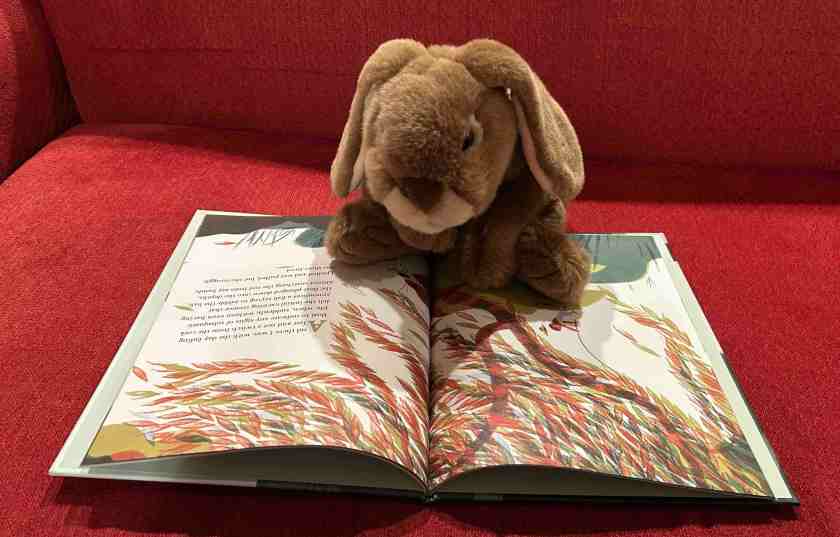
C: I think it is good, but I kind of wished it was a little bit longer. There are many pages with just pictures in them. So there is a lot more room for more words. But they chose not to put more words. 

S: Do you think that could be intentional? Maybe they wanted to make you feel the “silence”, without too many words.

C: I guess that makes sense, yeah, I can see the thinking that the writer may have had. The many wordless pages are really quiet, and you do sort of feel, or even hear, the silence. 

S: I’d say many of the scenes have a serenity to them. Except the times the boy is running of course! 

C: I guess so. It’s kind of cool. 

S: The illustrations made me remember a couple books you reviewed before. Albert’s Quiet Quest and Colette’s Lost Pet, both by Isabelle Arsenault, and Captain Rosalie by Timothee De Fombelle. All three of those books had somewhat sparse illustrations, and quite limited color palettes, kind of like this book. 

C: Yeah, I can see that. There is definitely a fixed and limited color scheme, and it looks kind of like a jungle, which may have been the idea.

S: Overgrown nature all around the boy, right? But it is not the wet green of the jungle; it is a lot more subdued. Though there are some reds and blacks too. 

C: Yep, the contrast was pretty good.

Caramel is reading The Silence of Water by José Saramago.

S: Okay, so why do you think the book is titled The Silence of Water? Which water is it?

C: The pond, I think. 

S: And in the pond, the barbel. The barbel is silent, too, right? The boy never gets to see or hear from it again?

C: Maybe, that could explain it.

S: Why do you think the author wrote this book, Caramel? What do we get out of it as readers?

C: it was the fact that he never stopped trying to catch the fish, so the theme is to never give up.

S: I can see that Caramel. A great analysis! Did you know that the text is actually an excerpt from the author’s memoir Small Memories, originally published in Portuguese in 2006? At the back cover it says that it is taken from a story of his childhood, “a tale of quiet conviction”.

C: Huh, I think “conviction” is a big word for a lot of young bunnies. 

S: You are right it is a big word. But you know what it means, right? It means more or less what you said. It means determination. It means having a belief or opinion but very firmly held. So the boy was determined to catch the fish. And it was impossible, and he more or less knew it was impossible, but he still gave it his all. And in the end, in most such stories, we often see the main character succeeding. So the moral becomes if you persist, you will eventually win. But this boy does not win. He does not get the fish. What do you say to that?

C: Well, that makes sense. The boy does not get the fish, but he knows he tried. And he also says in the end that he still left his mark on the fish. The fish is still his in some way. Though it is a bit morbid to say that. Because the mark he left on the fish is probably a big wound. The fish is probably wounded by the fishing hook and stuff. So he did leave a mark. But I am not sure I like the mark. Poor fish. 

S: You have a good point Caramel. The fish is hurt most likely. But then again maybe, since it is such a big and powerful fish, maybe it will be alright. And there will only be a little scar left. 

C: Huh, that’s a good way to see that. I hope so. And then it would be kind of like a memory. And the boy could feel that he made an impression. And it would not be so morbid. Okay, I will take it like that. 

S: Yes, let us do that. Then the boy’s story of determination, or of “conviction” like the book tells us, is still inspiring. The boy did not give up. And it was impossible, and he did fail, in the most straightforward meaning of the word, but he did leave his mark. And he did not give up. So he does end the book in an upbeat tone. 

C: Yes, he does, I guess. I was trying to understand why. This helped. 

S: Talking things out with you always helps me, too, Caramel. So overall, did you find this book worthwhile?

C: Yeah, it is a quick read, and the pictures are lovely, and when you dig into the determination thingy, it has a deeper message, too. Yes, overall, I like it! And I think other little bunnies could enjoy it, too!

S: That is great, thank you Caramel. So let us wrap this up, because it is getting really late. 

C: Yes. I should sleep soon.

S: What would you like to tell our readers?

C: Stay tuned for more book bunny reviews!

Caramel enjoyed reading The Silence of Water by José Saramago and recommends it to other young bunnies looking for a quiet book.