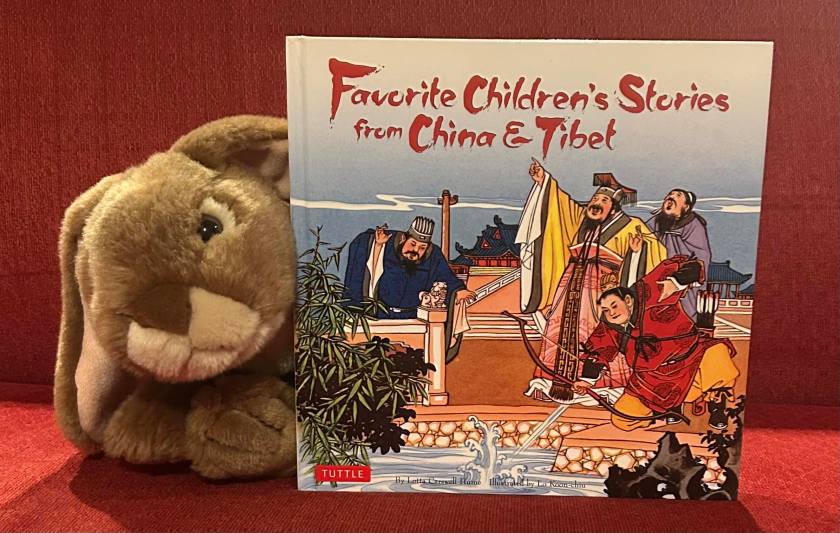
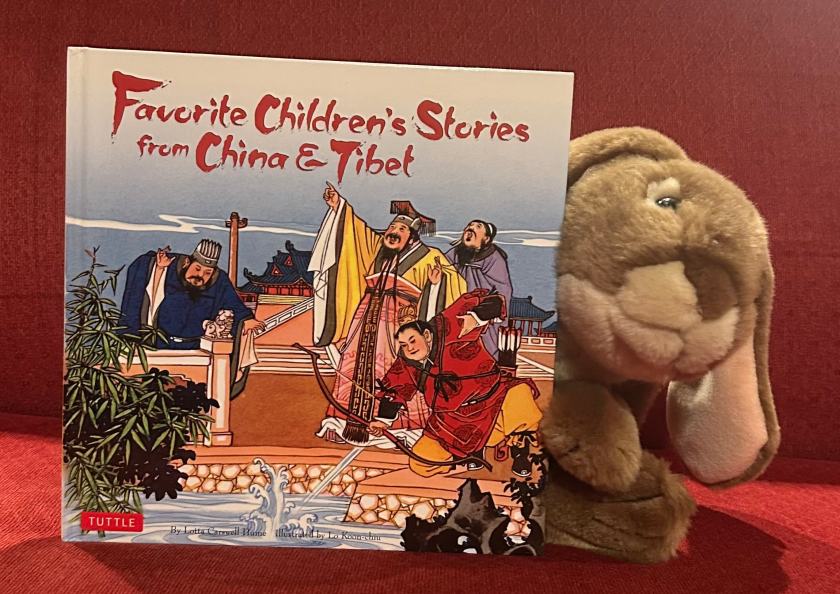
In these past few months Caramel has reviewed several books that collect together stories from various Asian traditions: Japanese Myths, Legends, and Folktales, Tamamo the Fox Maiden and Other Asian Stories, Chinese Myths and Legends: The Monkey King and Other Adventures, and Vietnamese Children’s Favorite Stories. Today he adds to this list another book: Favorite Children’s Stories from China and Tibet, written by Lotta Carswell Hume (1876-1976), illustrated by Lo Koon-Chiu (1918–2012), and originally published in 1962. The edition Caramel read was the 2004 edition. As usual, Sprinkles is taking notes and asking questions.
Sprinkles: So Caramel, here we are, talking about another neat collection of stories!
Caramel: Yes, this one has stories from China and Tibet.
S: Tell me more.
C: Well, let me see. There are eighteen stories. Each of them is about three to seven pages long. And there are a lot of pictures. I really liked them!
S: Yeah, I saw that there are a lot of colorful illustrations. Apparently they were made by a Chinese artist named Lo Koon-Chiu.
C: That makes sense. Because a lot of the stories are Chinese. But the person who wrote them does not sound like a Chinese person. And I don’t know too many Tibetan names, but the author’s name does not sound Tibetan either.
S: You are right. The author was apparently from Baltimore, USA, and then got married and moved to Asia with her husband. She lived in China and India for decades, and her children got to hear a lot of traditional Chinese stories. So this is a collection she put together to share those stories with children who would read or be read to in English.
C: I see. Then she did not write the stories herself. That makes a lot more sense now.
S: Yeah, I was curious too, and then looked it all up. Anyways talk a bit about the stories. Can you tell which stories are from Tibet and which are from China?
C: Yes. There is a little note under the story title for each one. So there are five stories from Tibet. The rest are from China. But they separated those, too. Some are from West China, some from Southeast China, some from Central China, and so on.
S: Hmm, I guess that makes sense. China is a big country. Maybe they did not want to go into detail about the exact geography of China and give the province names and such.
C: I guess. But there are a lot more stories from China, so maybe they just split the Chinese stories so they would not look too uneven.
S: Interesting! That could be a good reason, too, Caramel.
S: Anyways, so why don’t you tell me more about the stories themselves?
C: Well, there is a story like Cinderella, and it is called A Chinese Cinderella, And there is this story about a woman who is called Mrs. Number Three who is an innkeeper.
S: That is a very strange name!
C: It is not her real name, but nobody knows her real name so they call her that. But the story is really interesting. Its name is “The Magic Pancakes at the Footbridge Tavern”. So as you can imagine, there are magic pancakes!
S: Oh, I know you love pancakes!
C: Yeah, but these are magic and you really don’t want to eat them.
S: Oh, that is interesting! I guess I just have to read the story to figure out what you mean.
C: Yep.
S: Okay, so that is two of the eighteen stories. What about the others?
C: A lot of the others are about animals. Like there is a Tibetan story about a tortoise and a monkey and another about some jackals and a tiger. And then there is another about a hungry wolf, and one about some mice.
S: Oh, that is interesting. Kind of like fables, I am guessing.
C: Yeah, kind of. But wait, it looks like the animal stories are almost all stories from Tibet. Some of the Chinese stories also have animals, but they also have people.
S: Very interesting observation, Caramel.
C: And then there are two stories like the ones we talked about before about how some things came to be the way they are. There is a story about how the rooster got its red crown and another about how the deer lost its tail. They are both from China.
S: I see. True, we did talk about such stories when you were reviewing Vietnamese Children’s Favorite Stories by Tran Thi Minh Phuoc. Apparently such stories were called “pourquoi” stories.
C: Oh, yes, I remember you said that last time.
S: Okay, so all in all it seems like you have enjoyed reading this book, right?
C: Yep!
S: Can you tell us if you have a favorite story?
C: No, I liked them all.
S: That is wonderful, Caramel. Okay, maybe this is a good time to wrap up this review. What would you like to tell our readers?
C: Stay tuned for more book bunny reviews!
 BookBunnies