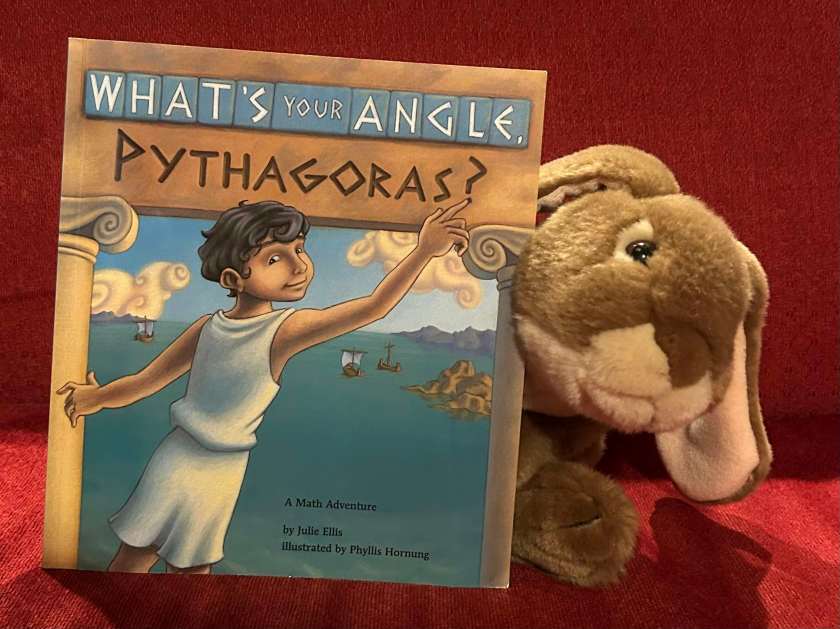
This past week Caramel’s class was learning about the Pythagorean Theorem so he thought that this was just the perfect week to talk about What’s Your Angle, Pythagoras? A Math Adventure, written by Julie Ellis, illustrated by Phyllis Hornung, and first published in 2004. As usual Sprinkles is taking notes and asking questions.
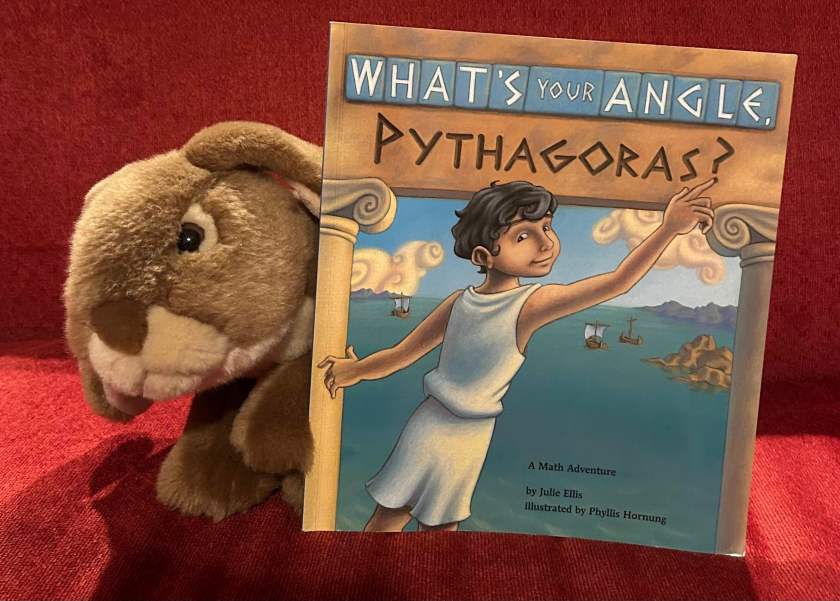
Sprinkles: So Caramel, today we are talking about a math book.
Caramel: When you say it like that, it sounds like we are talking about a school book.
S: True, this is not quite a school book, though, in some sense, we are talking about it because of school.
C: Yep. We were learning about the Pythagorean Theorem at school, so you gave this book to me.
S: That I did. So what did you think?
C: It was not that bad.
S: Hmm, that is faint praise.
C: Yep.
S: So did you not like the book then? We do not review much that we do not like.
C: No, I was kind of joking. The book is actually pretty good as a story, and the pictures are nice, too. There are some real mathematical diagrams, but they fit right into the story and it seems like they just show up naturally. But I do not think this is how Pythagoras came up with his theorem.
S: I see. So it is the fiction part that you did not find most appealing. I do know you like your books with facts in them, so this had some facts, like the theorem itself, but a kind of a made-up story about how it came about, right?
C: Yes. Pythagoras is a boy living in ancient Greece, and he is trying to figure things out about distances, and he discovers the theorem all by himself. I mean it could have happened that way, but …
S: But you are not convinced?
C: Yeah, not really.
S: But it could have happened that way; we do not exactly know how Pythagoras came to his result. And don’t you think it might be fun for young bunnies to imagine themselves coming up with such an important result on their own?
C: Yeah, I guess you’re right, but still…
S: Are you a little envious perhaps? A bunny might have more difficulty playing with ropes and such like the boy in the story and so might have more difficulty coming up with such a result maybe.
C: No, I am not envious! And I like my paws and I can still do quite a lot of fun things with them!
S: Okay okay, so you did not like the fictional part of the story. I get it. Did you think the math was explained well at least?
C: Yeah, it made sense. I think I will not forget the theorem ever after that. So in that sense the book did its job well.
S: Oh, that’s good!
C: Yeah, and I think my math teacher would like this book, too. She likes the Pythagorean Theorem a lot.
S: I am sure she will be at least happy that you now know the Pythagorean Theorem really well. Can you tell our readers what it is?
C: a2+b2=c2. You say it like “a squared plus b squared equals c squared.”
S: Okay, that is an equation. It does not mean much before you tell me what a, b, and c are.
C: So you have a right triangle and these are the side lengths. c is the hypotenuse, that is the side across from the right angle. b and a are the legs, or the sides that are the part that from a right angle. And the cool thing is that this equation I said is always true, for any right triangle you can find.
S: Yes, it is pretty neat actually! In the book the boy Pythagoras is trying to solve another problem and somehow figures out that this theorem works for all right triangles. So what is his angle then? The angle in the title, I mean?
C: They have a wordplay there. So the right angle is the one you need to look in the right way to find your answer… But also the right angle is the angle between two lines that splits the space between them into equal halves, and Pythagoras’s theorem is about right angles. So there are two meanings.
S: Kind of clever!
C: Yep, I thought so, too. I do like wordplay.
S: So maybe this is a good place to wrap up our review Caramel. What would you like to tell our readers?
C: Stay tuned for more book bunny reviews!
 BookBunnies