Midnight reviews Foundation by Isaac Asimov

Today we have a surprise for you: The mysterious and reclusive black bunny of the family, Midnight, decided he wants to join in the book fun! So here follows the first book review by Midnight, where he talks to Sprinkles about Isaac Asimov’s classic Foundation, the first book of the famous Foundation trilogy, originally published as a stand-alone book in 1951.
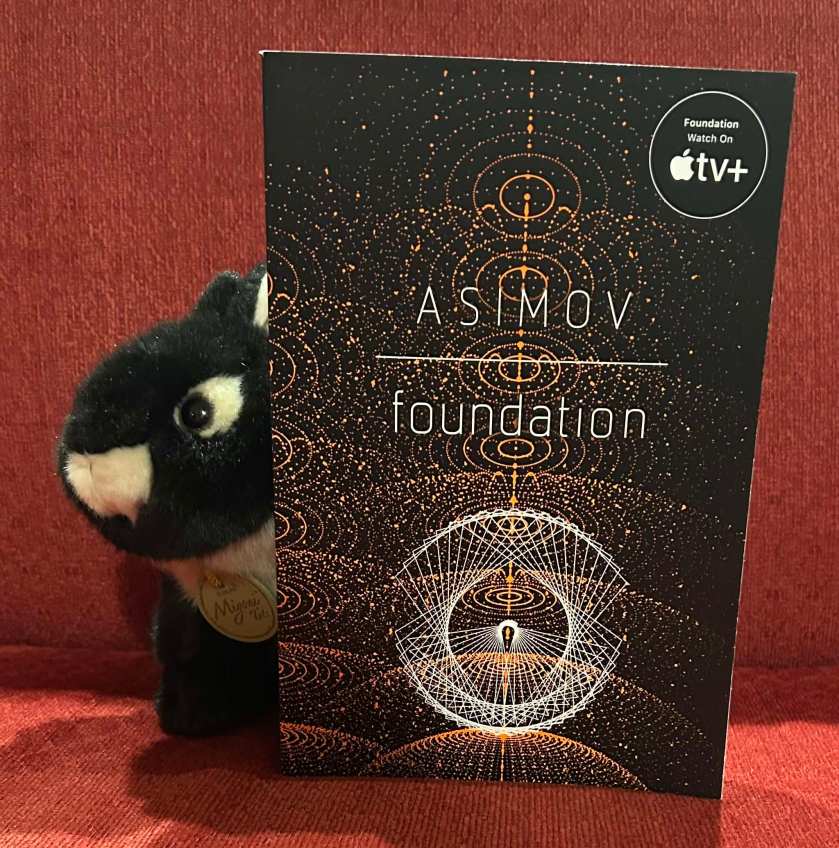
Midnight reviews Foundation by Isaac Asimov.

Sprinkles: Midnight, I am so happy to welcome you to the book bunnies blog!

Midnight: It’s wonderful to be here. It’s certainly a thrill.

Sprinkles: So you chose Asimov’s Foundation as your first book. Can you tell us a bit about it?

Midnight: It’s almost like another bunny purchased it for me and suggested that I read it.

Sprinkles: Yes, that is true. I read it on my tablet via the Libby app, but then I thought you might enjoy it too.

Midnight: It is a short book about the decline and fall of the Galactic Empire.

Sprinkles: Wait, the Galactic Empire is something from Star Wars, no?

Midnight: Foundation predates Star Wars by several decades. It was written originally as a series of short stories in the 1940s, and published in science fiction magazines, until in 1951 Asimov put them together into a book. The first Star Wars movie came out in 1977.

Sprinkles: Okay, okay, of course you know the timeline really well. But then tell us a bit about this Galactic Empire. Are we talking about our own galaxy, the Milky Way?

Midnight: Yes, we are, and they keep talking about humans and no other aliens. And sadly no bunnies are mentioned. (But we can assume that they control everything from the shadows–as they do in the present.)

Sprinkles: Midnight, let us not scare our readers away with your schemes of world (or universe) domination. Let’s get back to the book. Okay, we are talking about a galactic empire in the Milky Way, so this is far into the future, right?

Midnight: Yes. The Galactic Empire has endured for about twelve thousand years and spans the entire galaxy. According to other Asimov books in the same universal timeline, the Empire was founded about ten thousand years into the future from now.

Sprinkles: That is way in the future! Kind of like Caramel’s WarHammer storyline, which was about forty thousand years into the future. That’s kind of cool!

Midnight: That’s not a question.

Sprinkles: Okay, I will try to phrase my words into questions. I did not read much about WarHammer, but I know it describes a rather dystopian future. The one Asimov describes is not as dismal, is it?

Midnight: True. The Galactic Empire seems modeled after the Roman Empire to some extent. It is ruled by a monarch from the imperial capital planet Trantor. But the empire is in a slow decline that is inexorable according to Hari Seldon, the main character in the first portion of the book.

Sprinkles: Yes, I remember the book is written in five separate sections, which must be the five stories that were published separately earlier. Seldon is the main character in the very first one, but he does appear in the later ones too, no?

Midnight: Yes, but it is probably more accurate to say his influence is felt in the later ones.

Sprinkles: Yes okay. Go on.

Midnight: So Seldon is a scholar of psychohistory, a discipline that uses mathematical tools to model psychology of large groups of people to make predictions about their collective behavior. If the sample sizes are large enough, Asimov suggests that predictions can be made with high degree of certainty. Seldon predicts the downfall of the Empire, and that the galaxy will go through a dark age that would last thirty thousand years.

Sprinkles: That would bring us to past 40K, the time of WarHammer! What an interesting coincidence! Anyways, psychohistory kind of sounds to me like using big data to predict, and we know that has worked pretty well in predicting people’s purchasing decisions and such, but it is not clear it would work for historical events. I guess that is why this is science fiction.

Midnight: Yes. And the book was written quite a bit before mathematicians began studying chaos theory, and Lorenz’s discovery of the butterfly effect in weather prediction.

Sprinkles: Yes, that is true too. Okay, coming back to this being fiction. Let us accept the premise of the book that Seldon has this theory that predicts the future of the Empire. Then what happens?

Midnight: Seldon starts a foundation on the planet Terminus, at the edge of the galaxy, recruiting a group of scholars, ostensibly to compile a great encyclopedia of all knowledge from which humanity will be able to restore the galaxy to some sense of civilization. According to the Seldon Plan, the Foundation would be able to shorten the dark age to only one thousand years.

Sprinkles: I see what you did there. The word “ostensibly” seems to have silently found its way into your sentence.
Midnight is reading Foundation by Isaac Asimov.

Sprinkles: Anyways, maybe this is enough about the plot of the book.

Midnight: Okay. What do I need to say now?

Sprinkles: Well, you can tell me what you thought of the book.

Midnight: The book takes place over many centuries, so a new cast of characters is introduced in each part of the book.

Sprinkles: The five main parts we mentioned earlier?

Midnight: Yes. But this means that characters do not necessarily have the same depth that they might in a conventional novel.

Sprinkles: Yeah, I can see that.

Midnight: And there is a lot of speaking about things as opposed to showing events take place. Asimov has a lot of big ideas, but when centuries pass every few pages, one does not feel quite as invested in the individual characters and one does not get too much of a sense of who they are as people. They are more vehicles to deliver context and story.

Sprinkles: I can see your Tolkien fan feelings coming out here. Tolkien spent a lifetime developing his world, and his characters are often much richer and deeper.

Midnight: Let’s compare this to the Silmarillion, which takes place over thousands of years and characters come in and out of the narrative over these vast time scales, kind of like in Foundation. I feel like I have a lot clearer sense of those characters than Asimov’s in this book.

Sprinkles: I have not read Silmarillion, but my guess is that Tolkien has a different style and different goals. He cares a lot more about his characters, while maybe Asimov is trying to tell us a possible future.

Midnight: I am not sure I’d say that. I think Tolkien is also retelling a vast history, and does not set out to write a character-driven drama. But somehow his characters are more complete people in my mind.

Sprinkles: Well, Midnight, then you will have to come back and review Silmarillion for us some day.

Midnight: Well, I don’t want to sound too negative about Foundation. I did find the ideas intriguing and read the next several books in the series. I found some of the characters in those books more compelling and three-dimensional.

Sprinkles: Okay, then, maybe you will also tell us about those books some day?

Midnight: Maybe. As a mysterious and reclusive bunny, I do not wish to commit to anything at this time.

Sprinkles: But that is alright. You have already shared with us some good thoughts on a classic, and that is already wonderful! I did like Foundation a lot myself, and it seems that you enjoyed it, too. So maybe this is a good place to wrap up your first review. What do you think?

Midnight: Sounds reasonable to me.

Sprinkles: The little bunnies I interview for the blog have their own closing phrases when they are ending their posts. What would you like to tell our readers as we wrap up yours?

Midnight: A bunny as sophisticated, as complicated, and as self-important as I, cannot be reduced to a simple catchphrase.

Sprinkles: I understand. But we do need to end this post. So what will you say as your last words?

Midnight: Farewell, dear reader. Until such a time as the Black Bunny sees fit to reappear.
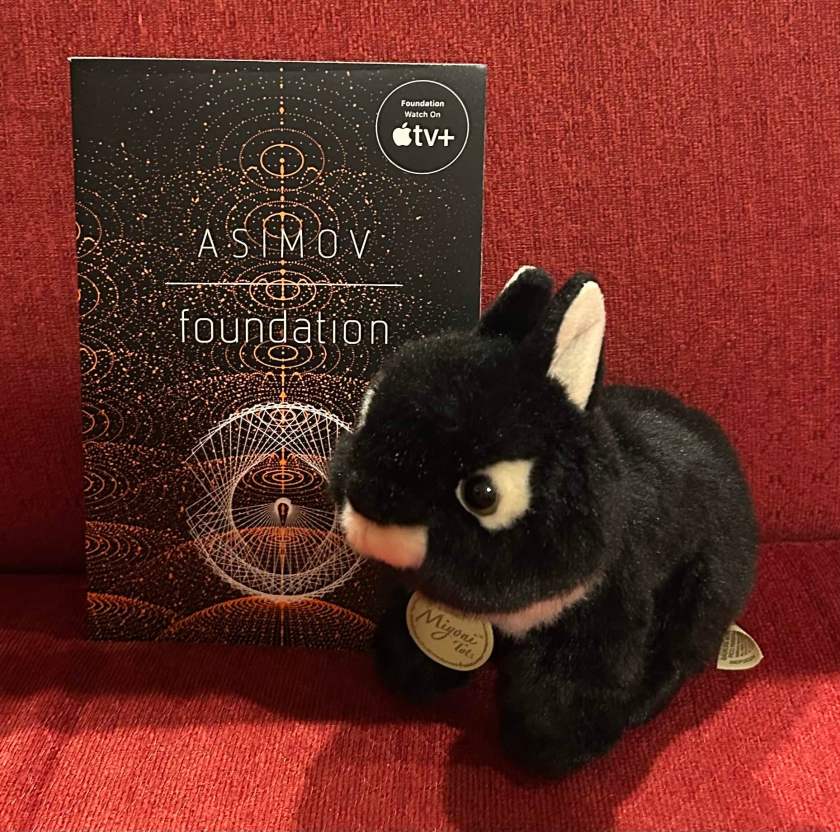
Midnight enjoyed reading Foundation by Isaac Asimov. He also enjoyed coming out of the shadow realm where he normally resides and pontificating about the book.

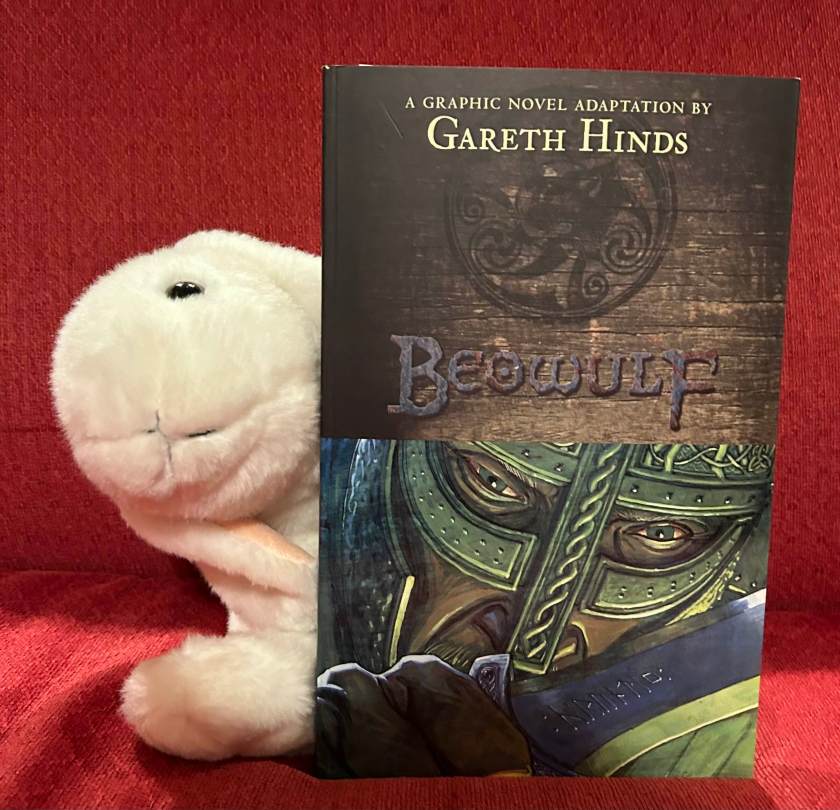
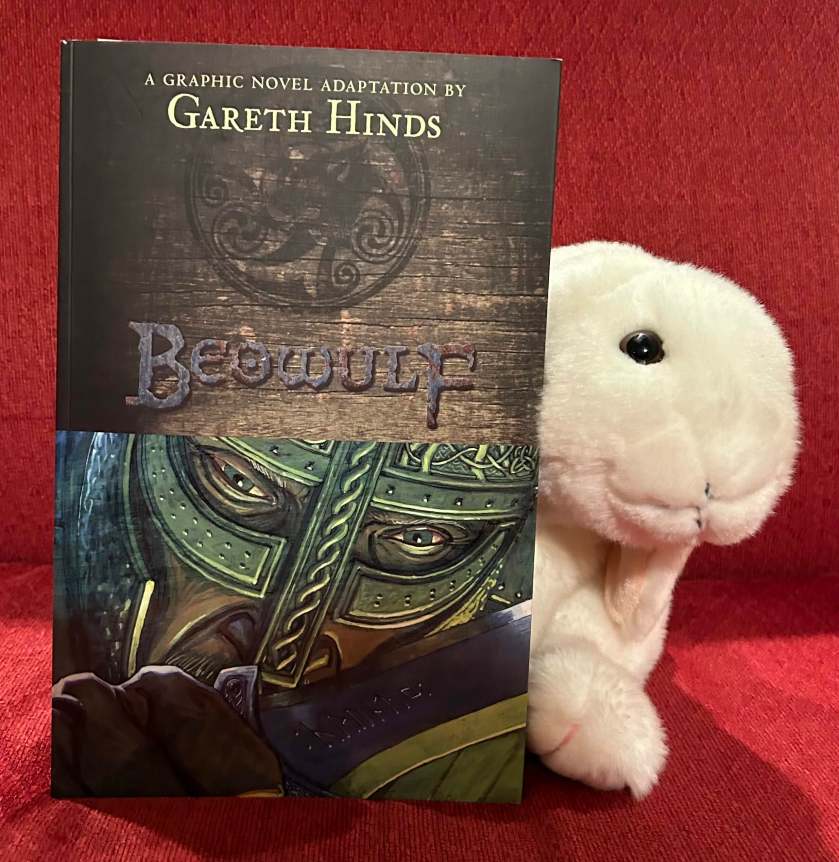
Marshmallow reviews Beowulf: A Graphic Novel Adaptation by Gareth Hinds

Today Marshmallow is talking to Sprinkles about Beowulf: A Graphic Novel Adaptation, written and illustrated by Gareth Hinds and first published in 2007.

Marshmallow reviews Beowulf: A Graphic Novel Adaptation by Gareth Hinds.

Sprinkles: So Marshmallow, you read yet another graphic novel adaptation of yet another ancient story. Tell us a bit about this book.

Marshmallow: This book is about a hero named Beowulf. The story takes place within the world of Norse mythology. Beowulf is a strong warrior, who is the leader of a people called the Geats. There is a king named Hrothgar, who is the leader of the Danes, who decides to build a banquet hall that will be the greatest ever. Once this great hall is finished however, this monster from “an accursed race” called Grendel comes and eats everyone who is there at night. And then this happens for twelve winters.

S: Wait, so there is a monster who comes and eats the folks in the great hall at night. Then why don’t they leave the hall empty at night?

M: I do not really understand the logic there either. But that is what happens. So Grendel is a big threat to the Danes and their king. Until Beowulf comes and he says he will save them. And he fights Grendel and kills him.

S: So is that the whole story then?

M: No, this is only part one. Then Beowulf has to kill Grendel’s mother who is another monster, and then there is a dragon who comes, and Beowulf kills that too.

S: So the book is about three different heroic triumphs of Beowulf protecting or saving the Danes.

M: Almost but not quite. Those things kind of happen but there is more. Between the murder of Grendel’s mother and the dragon, Beowulf returns home and rules over his land for fifty years. And then the dragon comes and attacks the Geats. So Beowulf has to fight against the dragon. He manages to kill it but he is mortally wounded in the fight.

S: So he dies in the end?

M: Yes, but he seems quite at peace with it because he lived a long and valiant life and he saved his land and his people. And other people too.

S: You mean the Danes?

M: Right.

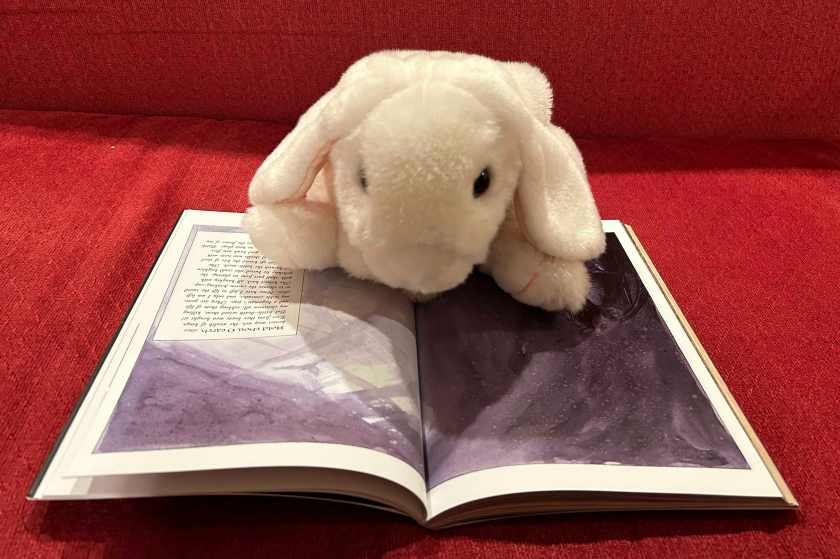
Marshmallow is reading Beowulf: A Graphic Novel Adaptation by Gareth Hinds.

S: So the original Beowulf story is very old.

M: Yes, not as old as the Iliad or the Odyssey, but the first known manuscript of the story is more than a thousand years old. But this graphic novel looks like it would fit right in with the genre. Especially if you like graphic novels which are very graphic.

S: Can you open that up a bit?

M: I mean the fights are depicted very explicitly. It is rather violent. For example, Beowulf rips off Grendel’s arm and Grendel is shown eating people and ripping off other people’s limbs and so on. It is really violent. I would definitely not recommend the book for little bunnies.

S: I looked at the book a bit and did see a lot of action and violence.

M: Yes. But I think most teenagers can handle it. And if they are trying to get the sense of the historic text, this could be very helpful. It is a very fast read. There is very limited amount of text, and there are many pages where there is no text whatsoever.

S: Hmm, that sounds interesting. It does seem like you appreciated reading the book.

M: Yes. I’d even rate it 95%. Honestly when I first began to read it, I thought that maybe the font of the text was a bit too fancy and could make it hard to read, but then I got used to it and could read it easily. I’d definitely recommend this book to bunnies curious to know the story of Beowulf.

S: That makes sense.

M: Did you know that J.R.R. Tolkien, the writer of the Lord of The Rings trilogy and The Hobbit, was a scholar who wrote a bunch about the original story Beowulf? He worked on a translation of it from Old English and even wrote about translating it.

S: I knew he was a scholar of ancient literature but I think I did not know he worked with Beowulf specifically. That is very interesting Marshmallow.

M: I thought so too.

S: Okay, then; this is probably enough for this review. What would you like to tell our readers as we wrap it up?

M: Stay tuned for more amazing reviews from the book bunnies!

Marshmallow rates Beowulf: A Graphic Novel Adaptation by Gareth Hinds 95%.

Marshmallow reviews The Hobbit by J.R.R. Tolkien

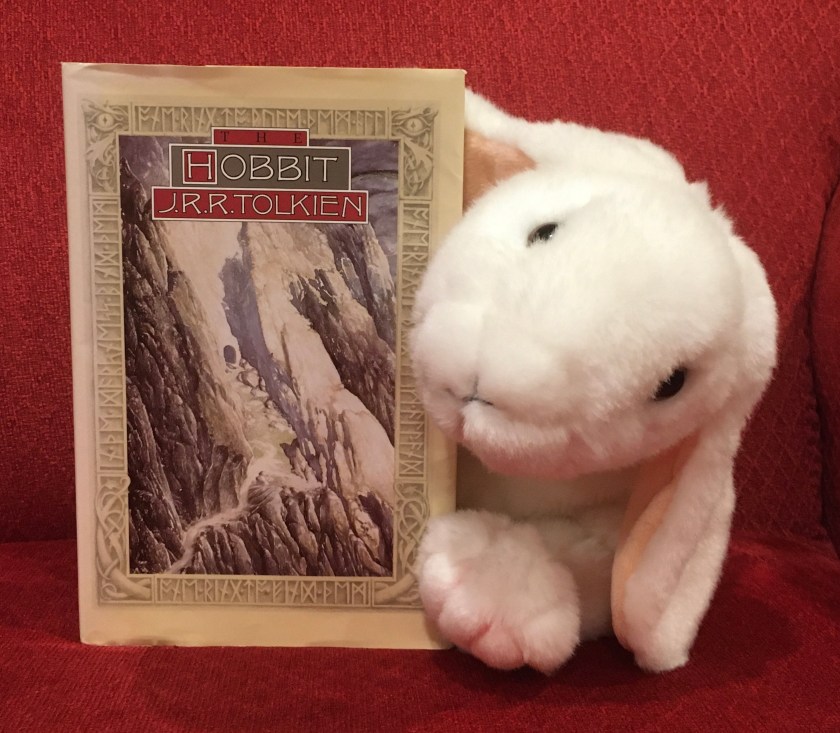
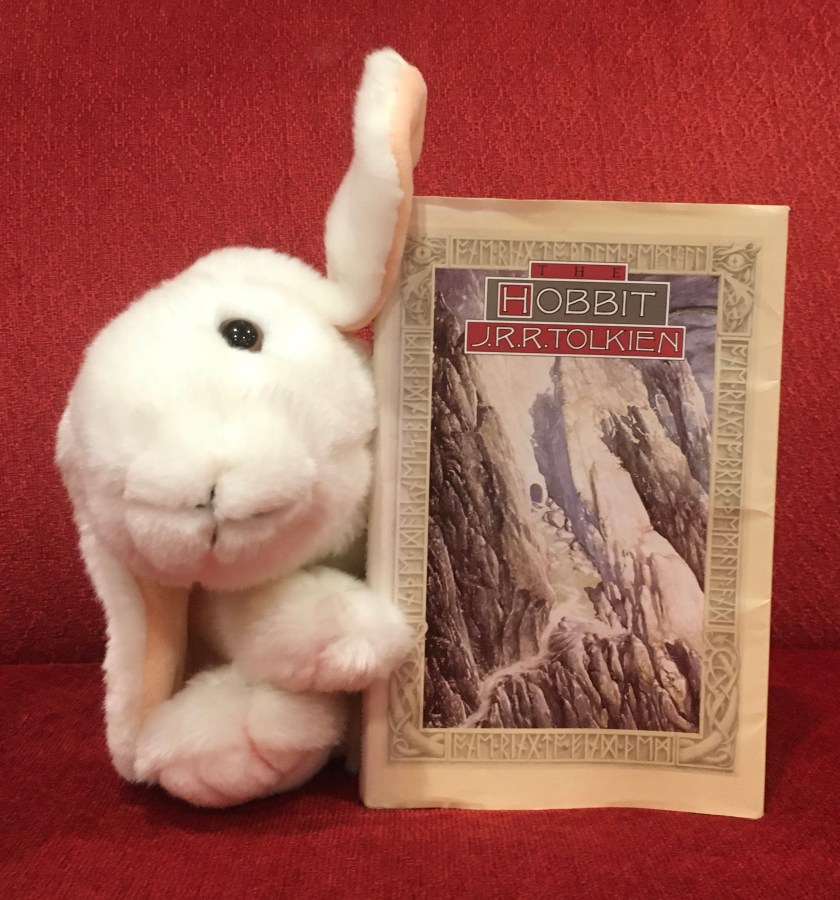
Today Marshmallow reviews a classic: The Hobbit: or There and Back Again, by J.R.R. Tolkien, first published in 1937.

Marshmallow reviews The Hobbit by J.R.R. Tolkien.

Marshmallow’s Quick Take: If you like fantasy, magic, or quests that take place in a fantastic alternative world, then this might be the book for you.

Marshmallow’s Summary (with Spoilers): Bilbo Baggins is a respectable hobbit who never goes on any adventures, until now. One day, an elderly traveler comes to Bilbo’s hobbit hole, and says that he is looking for someone to share an adventure with. Bilbo thinks lowly of adventures, saying that they are “Nasty disturbing uncomfortable things! Make you late for dinner!”

Bilbo at the time does not know that this man is Gandalf, who is a family friend, so he says that he doesn’t want any adventures, trying to imply that their conversation is at an end. Gandalf says that he won’t leave, and so Bilbo asks him his name. When Bilbo learns that he is Gandalf, he invites him to tea. Then he rushes in to his home, and closes his door. Gandalf scratches a sign on Bilbo’s door, and leaves.

The next day, a little before tea time, someone rings the door bell. Bilbo, thinking it is Gandalf, opens the door and finds a dwarf. The dwarf says his name is Dwalin. Soon more dwarves start arriving, until there is a total of thirteen dwarves. Their leader is Thorin Oakenshield, the heir of the King Under the Mountain. The dwarves are on a quest to reclaim their mountain home of Erebor. Of course, now we know that this is the quest Gandalf was talking about

Erebor was the most successful dwarf kingdom. The dwarves of Erebor mined many treasures, which is where their wealth was from. The human city next to it was prosperous and rich, as well.. Unfortunately, Erebor’s wealth attracted the attention of a dragon, Smaug, who took over Erebor and killed almost all of the dwarves (and destroyed the human city nearby, too). Now Thorin and his company are trying to take back their home. And they want Bilbo to be their burglar, though in the beginning it is not obvious why they require a burglar.

Bilbo finds the idea of himself joining the quest as a hired burglar distasteful but eventually agrees. So the company of fourteen (Bilbo and the thirteen dwarves together) sets out to defeat Smaug and reclaim Erebor.

Marshmallow is reading The Hobbit by J.R.R. Tolkien.

Marshmallow’s Review: I think that this is a great book! It is not only a classic but really is in its own world. In this world of Middle Earth, there are different races of creatures: dwarves, elves, Hobbits, and humans (as well as wizards and orcs and goblins, too). J.R.R. Tolkien came up with songs and whole language systems for this book, which is really impressive. The characters’ names also make the book a lot more realistic, as they are not typical names; each name fits the particular race of its character.

Tolkien writes with long sentences and gives a lot of descriptions, but I found the story interesting enough to read the whole book easily. The plot of The Hobbit is very well written and the characters are all very interesting. It is unusual to read about a character like Bilbo, who is not necessarily the typical hero. Early on, Bilbo has a nervous breakdown, or panic attack, when the dwarves tell him there is a chance of him dying in this quest. So Bilbo seems to be nothing like a hero going on a quest: he is scared, he is not given to action and adventure, and he prefers to simply have his tea in a calm and relaxed manner. But he takes on this quest and we see him being brave and most honorable in his own way through the voyage.

I watched the 2012-2014 Hobbit movie series before I read the book, and I think that the book goes very well with the movies even though there are some differences between the two.

The trailer of the 2012 movie: An Unexpected Journey.

You can definitely watch the movies first and then read the book (like I did), or vice versa.

The trailer of the 2013 movie: The Desolation of Smaug.

The original is the one book, but Peter Jackson, the director of the movies, wanted to make the Hobbit story into a trilogy.

The trailer of the 2014 movie: The Battle of the Five Armies.

As you can probably already tell from the trailers, the movies can get scary at times and there are some violent scenes, so younger bunnies should definitely not watch them unsupervised. Caramel and I often covered our eyes when we were watching those types of scenes. They are really good movies for sure, but it might be a good idea for adult bunnies to watch them before showing them to a younger bunny.

Marshmallow’s Rating: 97%.

Marshmallow rates The Hobbit by J.R.R. Tolkien 97%.