Caramel reviews The Hitchhiker’s Guide to the Galaxy by Douglas Adams

Today Caramel is talking to Sprinkles about The Hitchhiker’s Guide to the Galaxy, the 1979 book by Douglas Adams that originated from a 1978 radio show and then went on to evolve into a whole “comedy science fiction franchise”, according to Wikipedia.
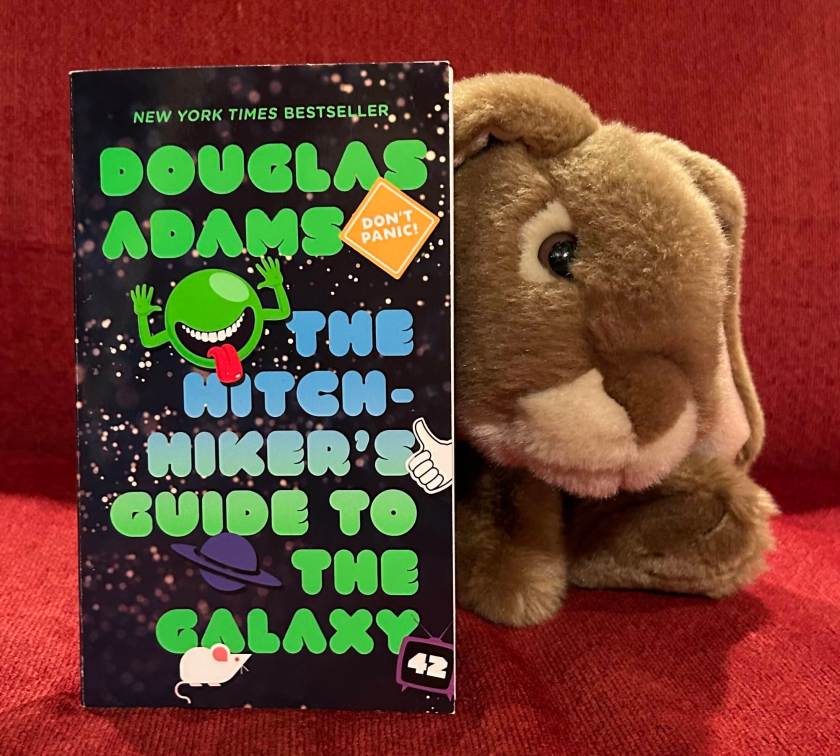
Caramel reviews The Hitchhiker's Guide to the Galaxy by Douglas Adams.
Caramel reviews The Hitchhiker’s Guide to the Galaxy by Douglas Adams.

Sprinkles: So we are talking about The Hitchhiker’s Guide to the Galaxy today. I am excited! I had really enjoyed reading this book myself.

Caramel: Yup, this book was surely a really good read. I had a lot of fun reading it.

S: Yay! So maybe we can start with a brief introduction to the story for anyone reading our blog who might not know about it. 

C: Sure. It is a scifi book that is infused with a lot of comedy.

S: It is funny, I agree. Tell us more.

C: This book tells the story of a guy named Arthur Dent and another one named Ford Perfect.

S: It is actually Prefect, as in Ford Prefect, the car

C: Yes, I knew that but somehow forgot. Yes, he is actually named that because he came to Earth fifteen years before the start of this story, maybe around when the car came out, you see Ford Prefect is an alien from Betelgeuse Seven. 

S: Yes, apparently the author at some point said that Ford “had simply mistaken the dominant life form on Earth” (again according to Wikipedia). 

C: Yes, when you look at it from outer space, apparently, humans don’t look like the dominant species on Earth. So Ford Prefect thought he should blend in and  gave himself the name of a common car. But actually humans are really not the dominant species on Earth, according to The Hitchhiker’s Guide. It is the mice who are the smartest species on our planet. 

S: That is funny! I mean, we have read many books about clever mice, remember Poppy and Ragweed

C: Yes, then there is Ralph and Babymouse. So to me it sounds reasonable!  

S: But this book is not really about mice, is it? 

C: No, it is about the adventures of Arthur and Ford. So Ford comes to Earth to work on a guide book, and then is stuck. At the time when the book starts, Ford knows that the planet is going to be destroyed soon and wants to save Arthur and he tries to teach him about life in the universe. He tells him about this amazing guide book, The Hitchhiker’s Guide, that anyone who is going out traveling in space should have. 

S: So the book The Hitchhiker’s Guide to the Galaxy is about a book called The Hitchhiker’s Guide to the Galaxy

C: Kind of, but it is more about Ford and Arthur. 

S: So what happens? Do they leave the Earth together? And why on earth is the Earth going to be destroyed?

C: Because the planet is in the way of an intergalactic highway that some people want to build.

S: Ouch! That’s rough! Okay, so Earth cannot appeal and they have to leave, right? What do they do? Does the Earth really get destroyed in the book?

C: Yes, the entire planet is destroyed and turned to ash. 

S: You said this was a funny book. That sounds pretty terrible. 

C: Yes, but you know it is fiction when you are reading it. And the book is funny! Really funny. And they do not go into the details of the destruction at all really; that is almost an excuse to get Ford and Arthur traveling together.

S: And also telling us that our planet is one of many and maybe we should not be so full of ourselves if they can just demolish it to make a highway, like we do not really matter in the grand scheme of things. 

C: When you say it like that, it maybe does not sound so funny, but it is really funny Sprinkles. 

S: I know Caramel, and actually I like being reminded that we should not be too full of ourselves. Our lives matter, what we do matters, but we are not at the center of the universe. It is a small world after all but it is inside a very big universe.
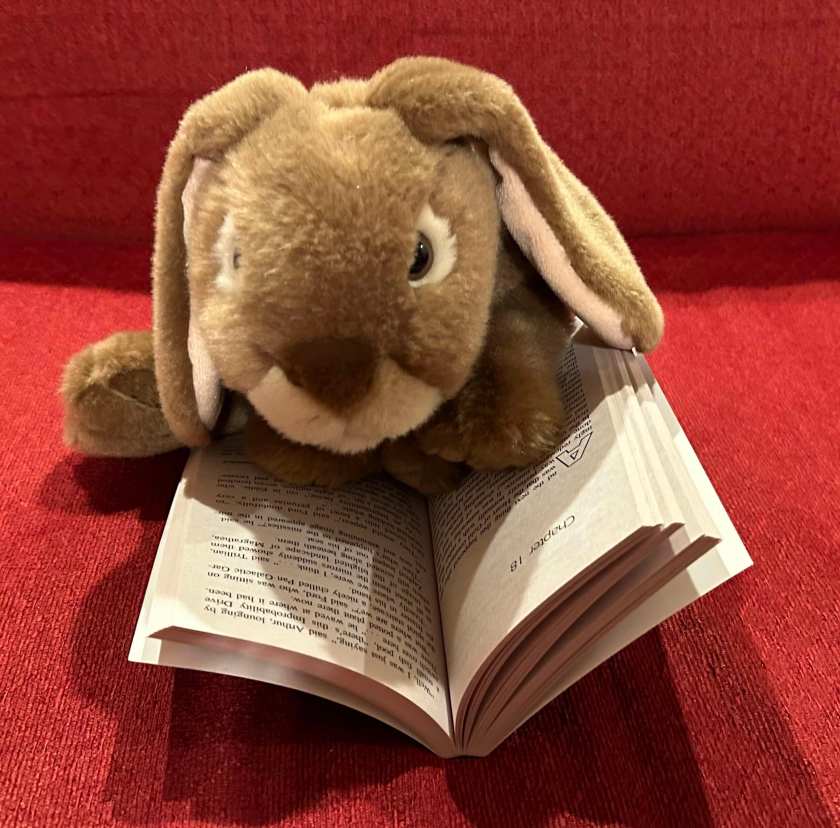
Caramel is reading The Hitchhiker's Guide to the Galaxy by Douglas Adams.
Caramel is reading The Hitchhiker’s Guide to the Galaxy by Douglas Adams.

S: Anyways back to the book. So what happens in the end? You know there are many more books in the series?

C: They get picked up on accident by an alien ship, and are then thrown out of the ship, and then are picked up by another ship. Apparently Arthur is the only human remaining from Earth, and it is kind of funny because he is just a normal guy. Anyways, along the way a lot of hilarious things happen and we learn from Ford about the Guide and all sorts of weird facts from it. 

S: Oooh, you like facts! But of course these are probably fictional facts, right? Can you tell me a couple?

C: Yep, they are fictional but also really fun. One is about the Babel fish which feeds off of brain waves and can translate any language.

S: Ooh, cool, like the universal translator in Star Trek or in Doctor Who, but it is a fish! Awesome! One more?

C: There is a thing called the Pan Galactic Gargle Blaster, which is a cocktail that contains Ol’ Janx Spirit, a particularly vicious alcoholic drink, and is so strong that you will need to recuperate in a hospital. 

S: That sounds bad. Okay, so maybe it is time to wrap up this review. Overall it seems like this book kept you entertained, right? Do you want to read the next book in the series? It is called The Restaurant at the End of the Universe. I think there are five more books in total. 

C: Sure, why not?

S: Alright, we will see if we can get you a copy. Okay, Caramel, what would you like to tell our readers as we wrap up this review?

C: Stay tuned for more book bunny reviews!
Caramel enjoyed reading The Hitchhiker's Guide to the Galaxy by Douglas Adams and is keen to read more from this series.
Caramel enjoyed reading The Hitchhiker’s Guide to the Galaxy by Douglas Adams and is keen to read more from this series.

Marshmallow reviews How to Speak Emoji by Fred Benenson

Today Marshmallow wanted to talk about a little book on emoji originally published in 2015: How to Speak Emoji by Fred Benenson.

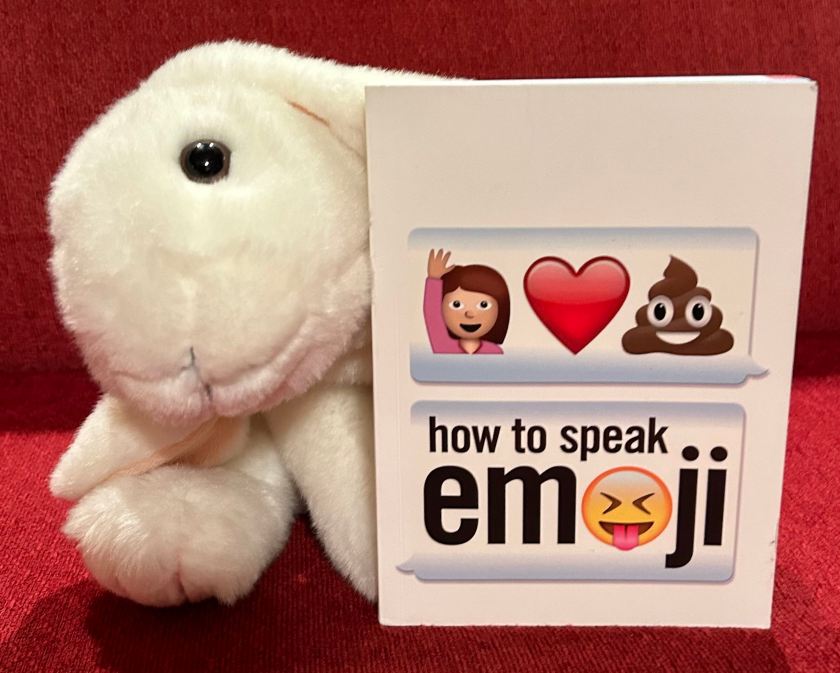
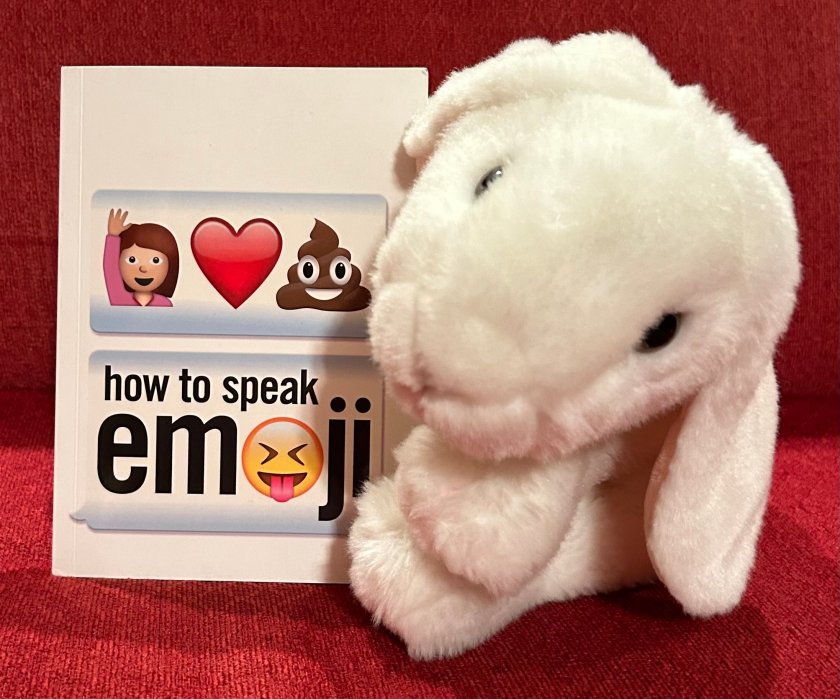
Marshmallow reviews How to Speak Emoji by Fred Benenson.

Marshmallow’s Quick Take: If you like funny books about how to do something or books about popular culture, then this might be the book for you. 

Marshmallow’s Summary (with Spoilers): In this book, Fred Benenson creates a useful glossary that you can use to navigate text conversations using emojis. Though this book is nonfiction, and is meant to be informative, some of the emoji strands have humorous meanings.

In the first part of the book, there is a list of the meanings of singular, specific emojis. These can get a bit subjective. For example, the author writes that the 💅 emoji means “Ooh, fancy!” And the 🆗 emoji means “grudging approval”.

After the initial, brief glossary, there is an emoji phrase book. The phrases in this vary by section. There is one section for pickup lines (which get pretty, um, weird 🫤), a section for food and drink 🍔, a section for insults, and many more (including but not limited to technology, travel, medical/emergency, weather, the Twelve Days of Christmas, etc ♾️). Idioms like “an elephant never forgets” become 🐘🚫💭 and “above and beyond” becomes 👆➕🔭🌌 (this is in the idioms section). These sections are all very entertaining, and it is interesting to see how the author translates standard phrases and sayings into emojis. 

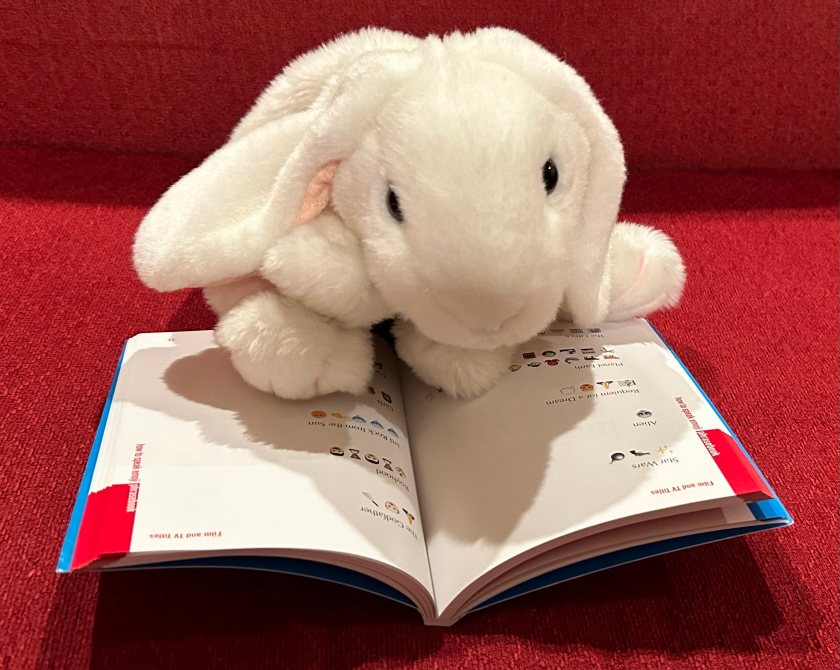
Marshmallow is reading How to Speak Emoji by Fred Benenson.

Marshmallow’s Review: You might be wondering, “Marshmallow 🤨🧐🤔 why would I want a book about the meaning of emojis when I can just google them?” My response to that question is that this book is also funny and teaches you how to communicate with emojis by themselves, which, admittedly, is not necessarily an essential skill but is definitely fun. And how can you not love a book which has the smiling poop emoji on its cover? I was a little sad to see that my favorite melting 🫠 emoji was not mentioned. However, it makes total sense because that is a new, quite recent (2023) addition to the vast army of emojis and only came out after this book was written (2015).

As a bunny who enjoys using emojis for the sake of using emojis, I liked this book a lot. Sometimes I find emojis that I don’t understand the meaning of, like this one: 🙃. And it is fun to learn how to use emojis to make phrases, and decoding them can be a fun game with friends and family. However, I would say that some of the content in this book is not appropriate for young bunnies, let us say, under the age of thirteen. Some of the phrases can be overly sexual. I just skimmed over those to get to the ones that were more amusing in my opinion. Otherwise however, this would be a very fun book for all readers. The sheer number of emojis and their complex meaning is fascinating 🤩 and this book does a good job explaining them.

Overall, this is a cute guide to using emojis 🥰 and I will take my knowledge gained from this to write this phrase: ⤵️📻➕😎📚🐰🐰🐰📋. (If you want, you can put your guess of what it means in the comments below!)

Marshmallow’s Rating: 98%

Marshmallow rates How to Speak Emoji by Fred Benenson 98%.

Caramel reviews Be the Bus by Mo Willems

Caramel, just like the rest of the book bunnies, loves Mo Willems’s Pigeon, and he has already reviewed one of his adventures, The Pigeon HAS to Go to School!, for the blog. Today, he talks about the brand new Pigeon book, Be The Bus: The Lost & Profound Wisdom of the Pigeon as told to Mo Willems, published this year, 2023, which is also the twentieth anniversary of the very first Pigeon book: Don’t Let the Pigeon Drive the Bus. As usual, Sprinkles is taking notes and asking questions.

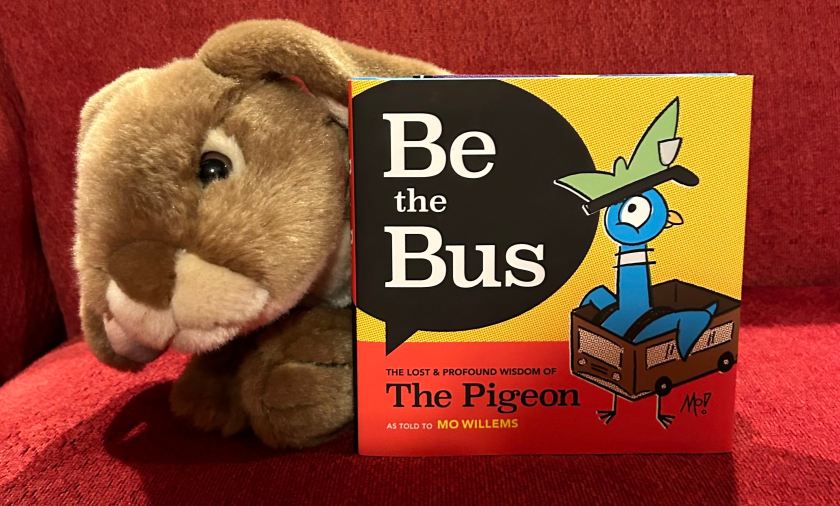
Caramel reviews Be The Bus: The Lost & Profound Wisdom of the Pigeon as told to Mo Willems, by Mo Willems.

Sprinkles: So Caramel, when I heard of this book, I knew you would want to read it. Even though it is supposedly meant for grownups.

Caramel: I am sure grownups can enjoy it, too, but I really liked it. So I don’t think it is only for grownups.

S: I agree with you Caramel. It definitely fits the adult humor genre, kind of in the spirit of Penguins Hate Stuff by Greg Stones, which you have reviewed a while ago. But it is also perfectly hilarious for little bunnies like you, and there is nothing too adult there, I feel.

C: Well, there is no mushy stuff for starters, and that is good.

S: Yep, nothing like that.

C: It’s just the Pigeon saying stuff. He says for example “I’m not susceptible to flattery. Unless it is about me.” I think that is funny.

S: Yes. I thought all of it was hilarious. The Pigeon says the funniest things. What was your favorite?

C: I don’t think I have a favorite. They are all funny.

S: I did hear you laugh out loud.

C: Yep. LOL.

S: Hmm, now you speak textspeak?

C: Well, I just said what you said.

S: Okay then.

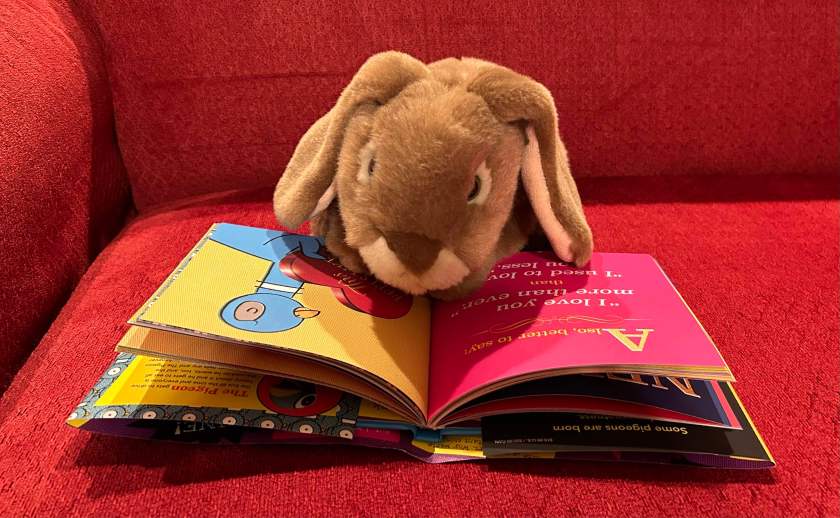
C: The Pigeon is really wise. He says that it is better to say “I love you more than ever” than “I used to love you less.” And it is true. The two sentences say the same thing. But the first one does sound much better than the second.

S: Yes, I took a photo of you with that page. Let me put it right here.

Caramel is reading Be The Bus: The Lost & Profound Wisdom of the Pigeon as told to Mo Willems, by Mo Willems.

S: So all in all, which three words would you use to describe this book Caramel?

C: Colorful, hilarious, and profoundly wise.

S: I see what you did there Caramel! You picked out the word “profound” from the title of the book!

C: Yep. Guilty as charged. I guess.

S: And some of the advice is on target, don’t you think?

C: Some of it, yes. The “I love you more than ever” one is clever. And there is another one like that, that I liked, too. and that is true: you should say “You are one in a million!” rather than saying “there are 7,960 other people like you!” Because if you are one in a million on a planet with 7.9 billion people, then the second sentence is right, too, but it does not sound so good.

S: Yes, and there are some quite wacky thoughts in the book, too, no?

C: Yes. Here is one: “Genius is seldom recognized. That is why I wear a name tag.” And the name tag says “Hello. I’m a genius.” So that is kind of wacky.

S: I agree. The Pigeon is definitely not a very modest creature.

C: That’s true. I’m sure nobody ever claimed he was.

S: So we read almost all the Pigeon books.

C: Yes, all except the one with the duckling and the cookie. We just saw that one in a YouTube video.

S: Yes.

C: Can we put the video here in this post?

S: Sure. Here it is.

The Duckling Gets a Cookie!? by Mo Willems | A Pigeon Read Aloud – from YouTube.

S: So do you think you are done with the Pigeon?

C: No. Never! I like the Pigeon and I like reading and rereading his funny adventures. And now there is this short book, too, so maybe Mo Willems will continue to write more Pigeon stories, and we can read them, too.

S: Yes, who knows? So maybe this is a good time to wrap this review up. What would you like to tell our readers?

C: Stay tuned for more book bunny reviews!
Caramel loved reading Be The Bus: The Lost & Profound Wisdom of the Pigeon as told to Mo Willems, by Mo Willems, and recommends it to all the bunnies who know and love the Pigeon.

Caramel reviews How to Survive a Robot Uprising: Tips on Defending Yourself Against the Coming Rebellion by Daniel H. Wilson

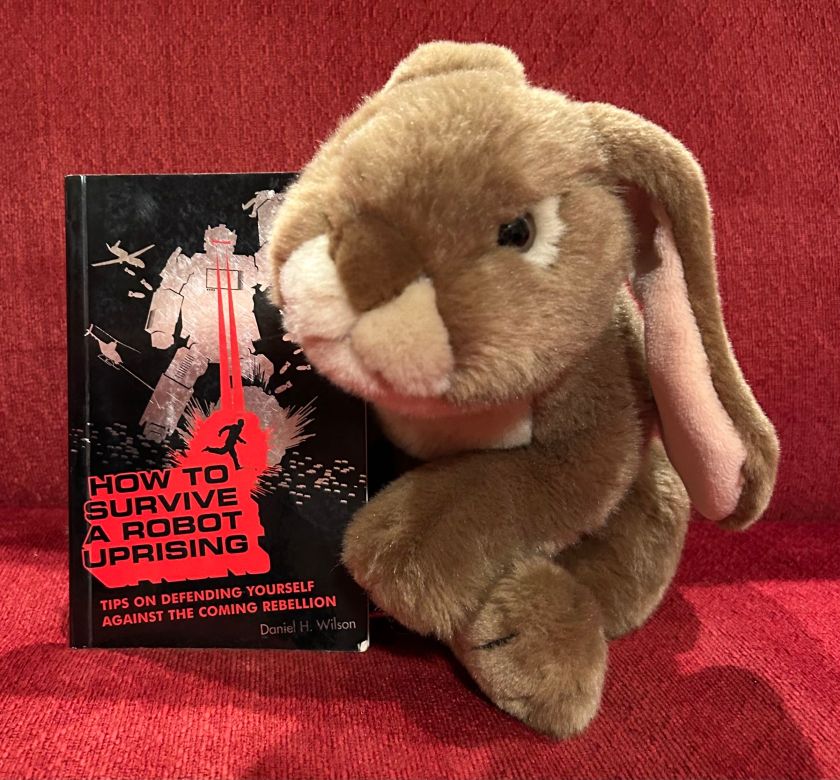
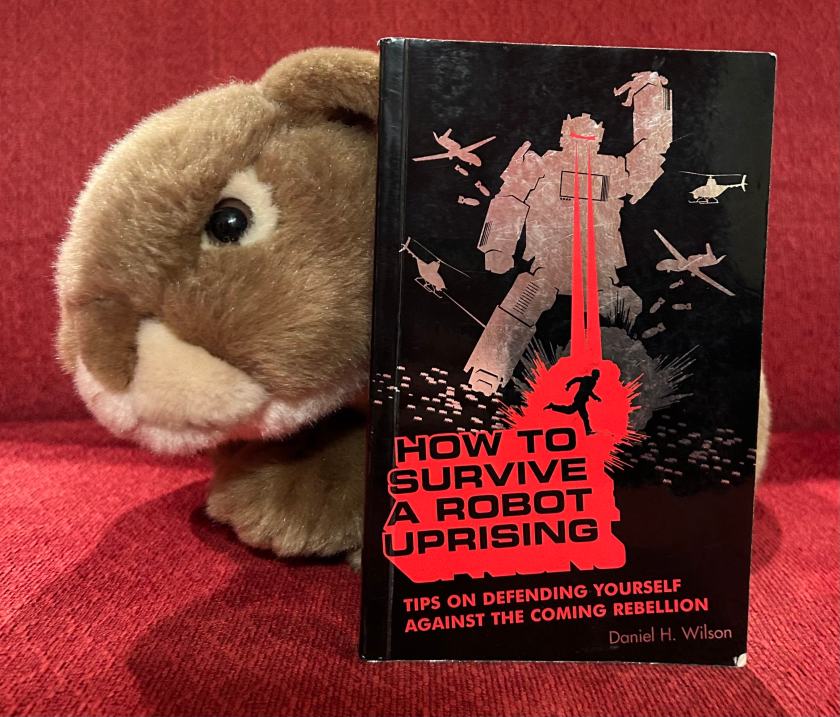
Today Caramel reviews Daniel H. Wilson’s How to Survive a Robot Uprising: Tips on Defending Yourself Against the Coming Rebellion (2005). As usual, Sprinkles is asking questions and taking notes.

Caramel reviews How to Survive a Robot Uprising: Tips on Defending Yourself Against the Coming Rebellion by Daniel H. Wilson.

Sprinkles: Caramel, I know you love robots, and so it was natural that you would pick up a book with robots in its title. So what did you think of How to Survive a Robot Uprising: Tips on Defending Yourself Against the Coming Rebellion?

Caramel: I thought it was a good book. But there is one small problem.

S: Wait, I think I know! Unlike some of the other robot books you have reviewed for our blog, this book is not about lovable robots. Instead, it is about bad robots, right?

C: Kind of. It is about what you should do if robots decide to turn bad and take over the world.

S: I can see that from the title. Reminds me of some of the zombie books I reviewed a while back.

C: Don’t talk about zombies. I don’t like them. But yes, kind of like that. What happens if something really bad happens? How do you survive? But this is a lot better than your zombie books.

S: How come?

C: Well, zombies are made up. But robots are real. And this book has a lot of real facts about robots. And for some reason it teaches you how to make an EMP grenade.

S: What’s that?

C: An electromagnetic pulse grenade. You can use it to fry the circuits of a robot.

S: I see. So it would be a way to stop a bad robot.

C: But it could kill it! And that is bad. You can reason with a robot, and maybe talk it out of being bad, but if you kill it, it is dead. And you can’t take that back.

S: You are right of course.

C: Then again, if it is really evil, you might not be able to talk it out of it. Then, maybe, you do need to do something about it.

S: Hmm…

C: I don’t like it.

S: I totally understand, Caramel. I know you love robots, and you would not want to harm any of them.

Caramel is reading How to Survive a Robot Uprising: Tips on Defending Yourself Against the Coming Rebellion by Daniel H. Wilson.

S: But back to the book. Did you learn some new things from it?

C: Yes. For example, I did not know about EMP grenades before. The book also talks about different types of robots, and that is cool. There is a part about speech recognition and how it is hard. Some scientists apparently wore a T-shirt with the sentence “I helped Apple wreck a nice beach”, which is a bad way to write down the original sentence “I helped Apple recognize speech”. So that was cool!

S: Yeah, speech recognition is hard, but it has improved so much in the last few years! My phone used to not understand me very well before, and now it gets almost everything I say right. But today, everyone is obsessed with ChatGPT and other AI tools that can write essays and answer lots of questions, though not always correctly. Some people are really worried about artificial intelligence. So I think this book is sort of humorously opening up that fear.

C: Yes.

S: Are you afraid of robots?

C: Kind of but also kind of not. I want to have a robot friend, like R2-D2 or BB-8.

S: Yes, those are really friendly robots, and also very cute.

C: I think so too. I don’t think I’d be afraid of such robots.

S: But the robots in this book are not that kind of robot.

C: They are not. But humans build robots, so they could just build friendly ones.

S: I guess some fear that, at some point, robots would evolve and decide that humans are not treating them well enough or that humans do not deserve the support of robots.

C: I guess so.

S: Do you know of Asimov’s Three Laws of Robotics? Here they are:

First Law: A robot may not injure a human being or, through inaction, allow a human being to come to harm.

Second Law: A robot must obey the orders given it by human beings except where such orders would conflict with the First Law.

Third Law: A robot must protect its own existence as long as such protection does not conflict with the First or Second Law.

https://en.wikipedia.org/wiki/Three_Laws_of_Robotics

Then there is a zeroth law too, but I will leave that for another day.

C: I do know these laws! And I really like them! I think all robots should be created with those laws built in. And maybe I should read some Asimov.

S: Okay, you can start with his short story “Robbie“. I really like that one.

C: Okay, I will read it then.

S: That means this is a good time to wrap this review up. What do you want to tell our readers, Caramel?

C: Stay tuned for more book bunny reviews!
Caramel hopes that he will never need any of the defensive methods he read about in How to Survive a Robot Uprising: Tips on Defending Yourself Against the Coming Rebellion by Daniel H. Wilson, but he also thinks it is better to be safe than sorry.