Marshmallow reviews Beautiful News by David McCandless

Today Marshmallow chose to review a beautiful book of infographics by David McCandless published in 2022, aptly named Beautiful News: Positive Trends, Uplifting Stats, Creative Solutions.
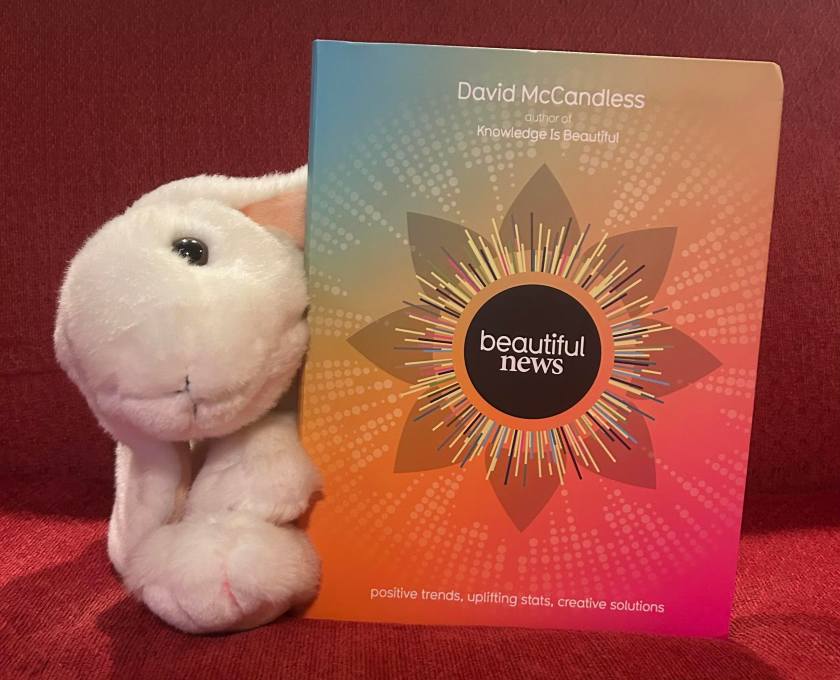
Marshmallow reviews Beautiful News: Positive Trends, Uplifting Stats, Creative Solutions by David McCandless.

Marshmallow’s Quick Take: If you want hope (or if you simply like pretty pictures displaying lots of cool information), then this is the book for you!

Marshmallow’s Summary (with Spoilers): In today’s status quo, things are looking grim. Everyday everyone looks at the news and sees only darkness. Every headline promises impending doom, but each one is terrifying in its own separate way. Isn’t it great!?! More seriously though, this is a daily occurrence that everyone, regardless of the news and media type they consume (CNBC, CNN, Fox, New York Times… they are all extremely depressing), experiences. This is mostly due to a phenomenon known as negativity bias. But no matter how natural, the end result is universal hopelessness and—quite frankly—rampant depression. Birth rates are falling as youth start to equate having children to condemning them to a horrific future. But amidst this barrage of fear, sadness, and anger (all of which is undeniably present and must be recognized), there is also hope. Hope may initially feel like a fragile concept, but this book helps back it up with statistics and data.

The author David McCandless has compiled exactly what is written on the first page: “positive trends, uplifting stats, creative solutions.” After the table of contents, each page or two is a spread of data, with brilliant colors and clear infographics (a portmanteau word smashing together “information” and “graphics”). The book is divided into sections based on what topic the information is about. The sections are titled as follows: health, cleaner energy, progress, climate, money, nice!, nature, mixed, freedom and rights, women and girls, what to do?, and cool tech.

Every page in this book is bright and cheery and truly provides reasons to stay hopeful. For example, one beautiful graph shows that “Far More Unites Us Than Divides Us.” Apparently, between countries, 84% is the percent average similarity in common values between groups. Between religions, it’s 91%; between rich and poor, and between education levels, and between age groups, it’s 96%. Between genders, it’s 97%. This is just one example from the more-than-200 pages in this book! At the end, there is also a map of the world and each country is labeled with something that makes it special and good. This book truly is a candle—like the author’s name—in the dark.
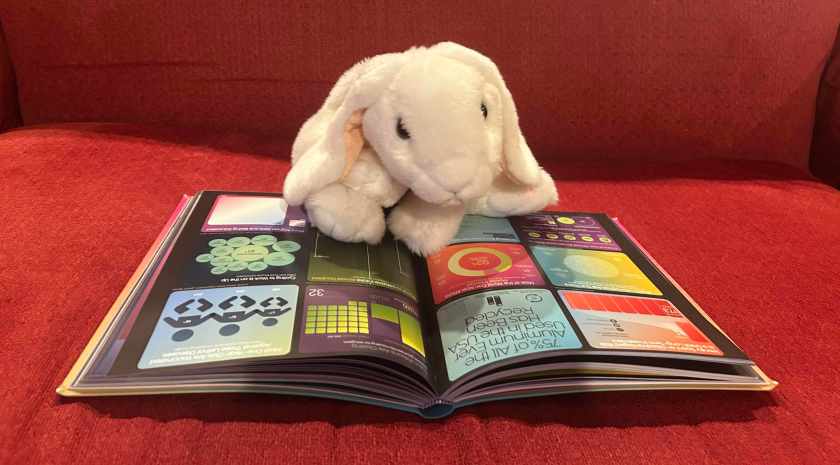
Marshmallow is reading Beautiful News: Positive Trends, Uplifting Stats, Creative Solutions by David McCandless.

Marshmallow’s Review: I love this book! I have read so many amazing books, but this is my favorite one because it really embodies hope. I think I will definitely return to this book over and over again. If you can’t tell, I would highly recommend this book. I think it is great to read for oneself, but I think it could also make an amazing gift to a worried friend or source material to comfort them with facts to prove that there is always hope. (Here is one of my other favorite books about hope: I have already reviewed it for this blog. That was more of a narrative of hope however. This book just gives you proof! Colorful visuals and data! What more could one ask for?)

I was very small when I decided that hope is something one should always have, even when it seems false. What’s the point in giving up? Nothing is ever absolute. I think this book is really good because it shows that you don’t even need to follow that stubborn logic. There are reasons to have hope already.

I think everyone should be given a copy of this book. The only problem is that, being written 2022, the data is not the most recent. But the fact that most show trends of even longer periods of time is still encouraging. This can’t fix all existential dread or depression, but it can spark a bit of hope that can be nursed into a flame.

On this topic, if you cannot read this book for any reason, try visiting the Good News Network—an American online newspaper that focuses on good news only. So, in summary, I would highly recommend reading this book and treasuring it forever… but I would recommend keeping hope even more.

Marshmallow’s Rating: 150%. Yes, I am that excited about this book!
Marshmallow rates Beautiful News: Positive Trends, Uplifting Stats, Creative Solutions by David McCandless 150%!

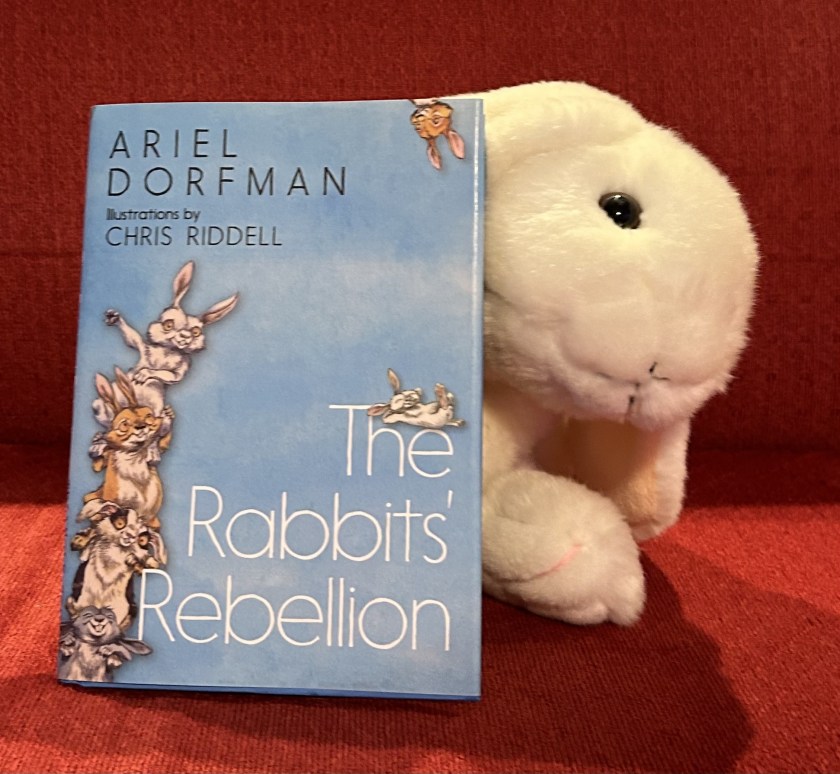
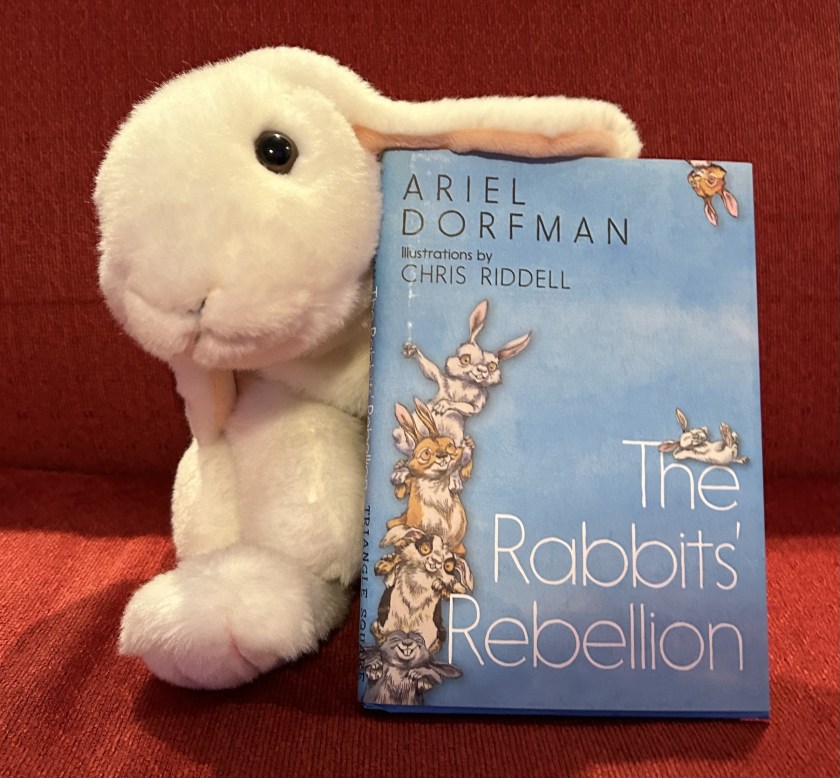
Marshmallow reviews The Rabbits’ Rebellion by Ariel Dorfman and Chris Riddell

Today Marshmallow reviews a little book with a big message, first published in 2020: The Rabbits’ Rebellion, written by Ariel Dorfman and illustrated by Chris Riddell.

Marshmallow reviews The Rabbits' Rebellion, written by Ariel Dorfman and illustrated by Chris Riddell.
Marshmallow reviews The Rabbits’ Rebellion, written by Ariel Dorfman and illustrated by Chris Riddell.

Marshmallow’s Quick Take: If you like children’s books about animals and clever political commentary, then this is the book for you!

Marshmallow’s Summary (with Spoilers): When the wolves invade the land of the rabbits, the Wolf of all Wolves crowns himself king and begins to make some wild claims. First of all, he—feeling quite omnipotent that day—declares that rabbits don’t exist. He bans any reference to them in books (by personally crossing them all out) or in conversation. Unfortunately, birds can fly and report seeing some, which spread rumors that perhaps rabbits do exist.

The king then decides then, if (as his fox advisor says) “seeing is believing,” he’ll make his subjects see exactly what type of a ruler he is. So he commands an old monkey to take regal photos of him to be put up in every town square, every neighborhood, and in every house. He forces the birds to carry these posters, tying their feet to an “endless” cord to make sure they can’t escape. Naturally, the old monkey is terrified of the king and bends to his every whim and want. In other words, he says, too, that rabbits don’t exist. On the other hand (or paw!), the monkey’s daughter—with the fearlessness of innocence—knows that rabbits do exist even though her parents make sure to censor her whenever it becomes necessary.

But that’s just the beginning of the old monkey’s struggles. Every time he takes a photo of the wolf king, there is some hint of a rabbit in the background. When the king shatters the beavers’ dam (which took them three years to build), there are two rabbits sitting on the grass in front of the camera. When the king snarls in the most ‘majestic’ manner, a long, fuzzy ear shows up in the corner. This is most problematic because the monkey can’t show the king photos that go against his rule that rabbits don’t exist. So he doctors his photos after they develop, erasing any and every trace of rabbit hair, ears, or tails.

As the king becomes increasingly more controlling, more egotistical, and more tyrannical, the monkey must keep taking photos and editing them. Despite the king’s advisor tightening security around the photo shoots (he doesn’t want the king to know about the rabbits either—it would look bad on him), the rabbits persistently keep up their rebellious photo-bombing. But how could they, when they don’t exist?

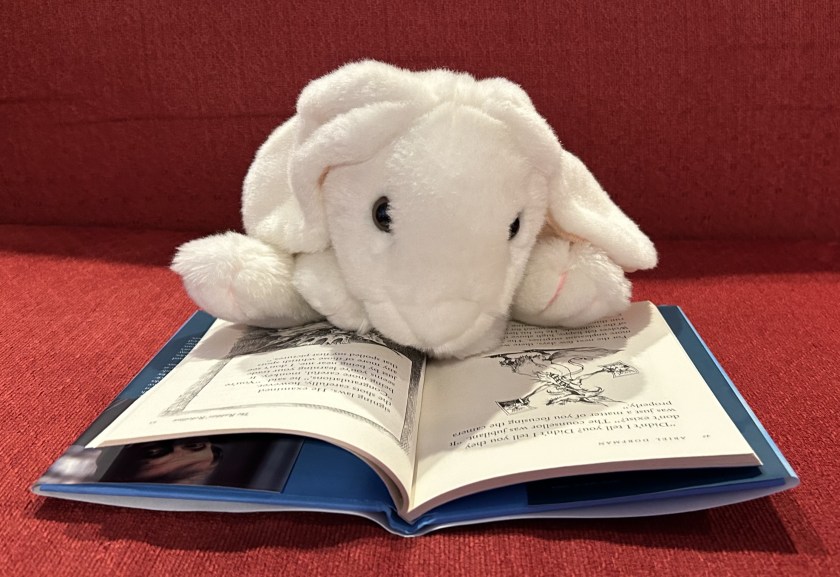
Marshmallow is reading The Rabbits' Rebellion, written by Ariel Dorfman and illustrated by Chris Riddell.
Marshmallow is reading The Rabbits’ Rebellion, written by Ariel Dorfman and illustrated by Chris Riddell.

Marshmallow’s Review: The Rabbits’ Rebellion is a really good book! It is written as a book for little children, and it reminds me of some Roald Dahl books I read earlier. Roald Dahl was unique in a way because his books could be read as childish tales, but they also touched on deeper topics. Likewise, the meaning of Dorfman’s book might not be understood by very young readers even though they would still enjoy reading about these mischievous rabbits who insist on existing! (Go, bunnies! Of course I cannot be too impartial here.)

At its core, The Rabbits’ Rebellion is about authoritarianism and dictatorship. The king’s suppression of truth, especially a truth that is so obvious, is in a way an almost comically extreme example of an Orwellian dystopia. In a way, this book is like Animal Farm or Nineteen Eighty-Four for young children. Except—spoiler alert—this one ends better than both of those books.

The Rabbits’ Rebellion is entertaining even if you don’t catch this theme. It is kind of like how one might enjoy reading parts of Animal Farm even without digging into the allegory. But Animal Farm ends at a quite depressing place for young bunnies to really enjoy it all the way to the end. Similarly, I learned that some parents have complained that the ending of The Rabbits’ Rebellion is too graphic to make it appropriate for a calm bedtime. So readers beware!

I found it interesting that the world of this book is so different yet also very similar to ours. There is no magic, but they do have cameras and books. Remember how in Maus the whole story only involved mice and a few other types of animals, but we could see our own world in it? Just in the same way, the differences and the similarities despite those differences help convey Dorfman’s message very clearly.

All in all, The Rabbits’ Rebellion has a really poignant yet simple plot and is a very thought-provoking book even though it is extremely short (only 63 pages). Written in large font and with really beautiful illustrations that evoke a serious, fairy-tale feel, it is quite easy to read, too. I think it could be a great way to introduce children to political thought and discussion. (I might reread Nineteen Eighty-Four as a result of reading The Rabbits’ Rebellion, because this book really reminded me of it.) Overall, I would definitely recommend this book to bunnies young and old, who both will find it entertaining (perhaps intellectually) and thought provoking. 

Marshmallow’s Rating: 100%.

Marshmallow rates The Rabbits' Rebellion, written by Ariel Dorfman and illustrated by Chris Riddell 100%.
Marshmallow rates The Rabbits’ Rebellion, written by Ariel Dorfman and illustrated by Chris Riddell 100%.

Caramel reviews Hope and Fortune by Marissa Bañez

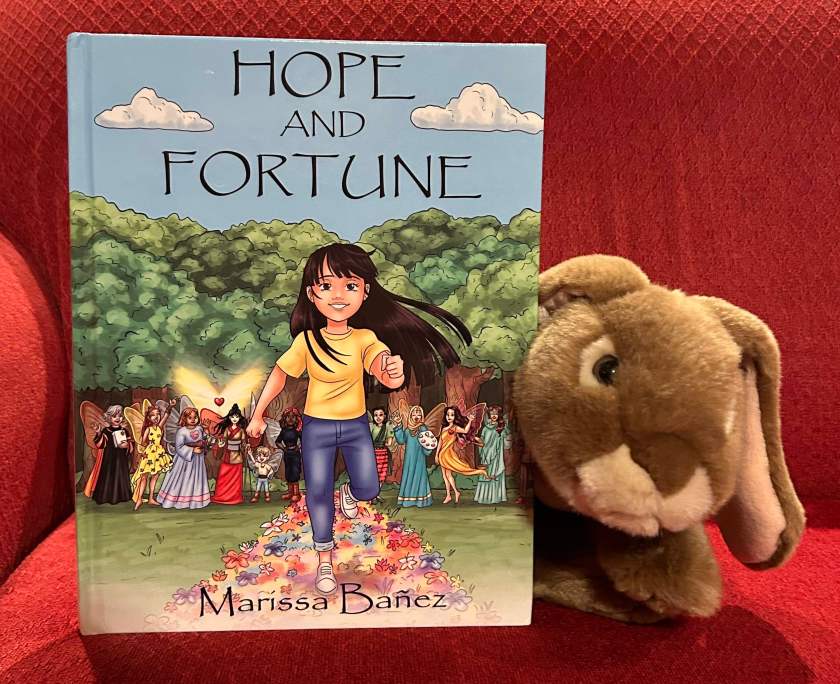
Caramel is growing up: even though he started the book bunnies blog as a little bunny reading and reviewing picture books, he has in the intervening years moved on to chapter books and eventually more traditional novels and even encyclopedias. However he still enjoys reading and talking about picture books. Today he reviews Hope and Fortune, a picture book by Marissa Bañez published in 2023. As usual Sprinkles is taking notes and asking questions.

The book bunnies received this book as a review copy.

Caramel reviews Hope and Fortune by Marissa Bañez.

Sprinkles: So Caramel, why don’t you start by telling us what this book is about?

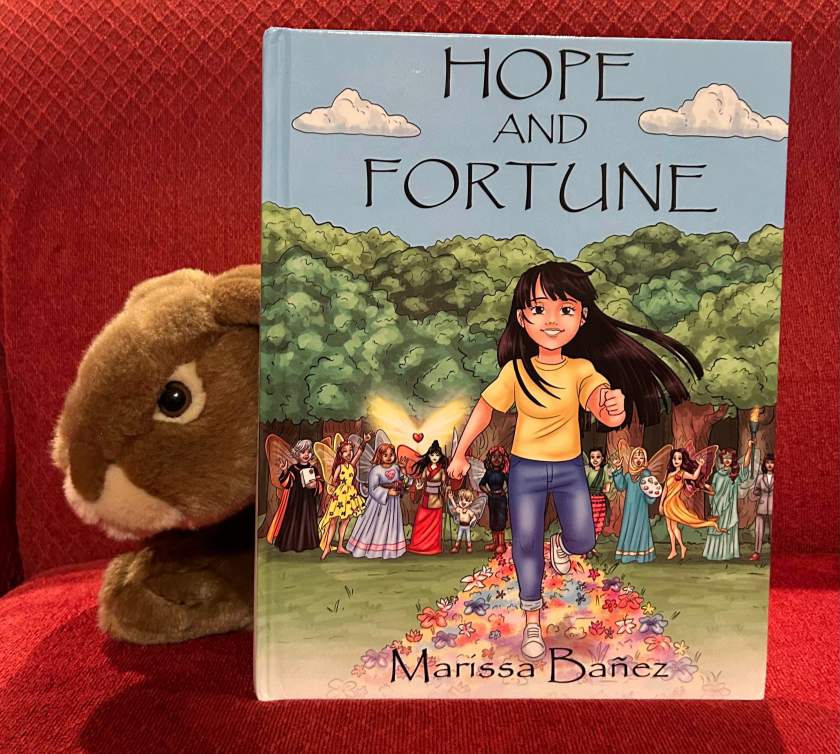
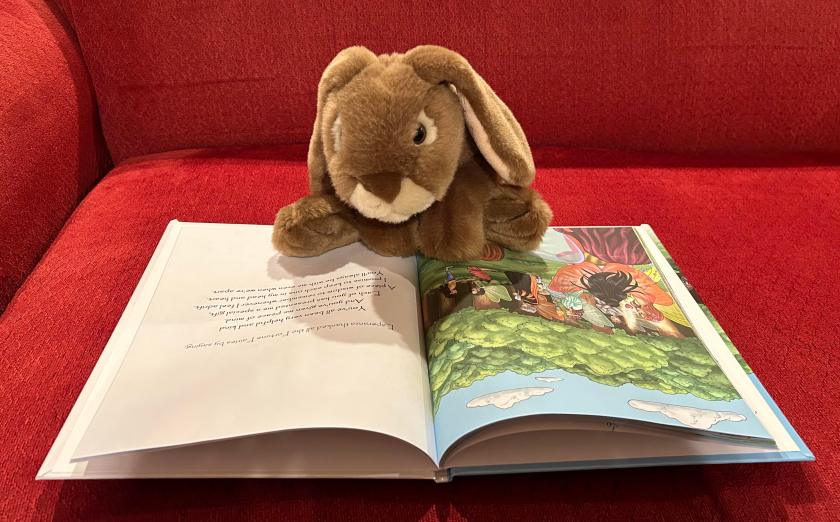
Caramel: This book is about a girl named Esperanza who goes into a forest following a butterfly and gets lost. Then she meets twelve fairies who tell her things, and they help her find her way out.

S: The twelve fairies are all different, right?

C: Yes. They are all fairies of different things. For example, there is the Fairy of Innocence and Wonder. And that is the only one who is a boy. All the other fairies are female.

S: Yes, that is true. Good observation, Caramel! What else do you notice about the fairies?

C: They are each representing some good thing. There is one who represents strength and courage; that one looks like an Asian warrior. Then there is one who represents wisdom and intelligence.

S: That one has gray hair and is holding a book or a binder in her hand which has the symbol of Princeton University.

C: I did not notice that.

S: Actually, I think that each page is full of interesting details. For example, all the fairies seem to have some animal companion.

C: Not really. Almost all do. But the first one, the Fortune Fairy of Hope, and the last one, the Fortune Fairy of Love and Friendship, do not.

S: Hmm, again, good observing Caramel. I liked the animal companions, but I guess not all of them have them. By the way, that fairy of love and friendship reminded me of Boticelli’s famous painting, The Birth of Venus.

C: Yes, I can see the oyster shell, and the way they are holding themselves resemble one another!

S: You are right! The arm positions are the same!

C: Of course the fairy in the book is not naked.

S: Yes. I suppose it would not be appropriate otherwise, even though the ancient Greek gods and goddesses were often depicted naked, so Boticelli’s painting makes sense in that context.

C: Wait! Venus is Roman!

S: Yes, thank you for correcting me. I should have known to be more careful talking with you about Greek and Roman mythologies…

C: Well, Marshmallow knows a lot more than I do about them.

S: But you are not that bad yourself!

C: Well, I try.

Caramel is reading Hope and Fortune by Marissa Bañez.

S: Let us get back to the book. What did you think about the script?

C: Each page is one page picture and the other a poem. The fairies all speak in rhyme.

S: Yes, I noticed that, too. A lot of picture books have rhyming text, and it makes them more fun to read out loud and more fun to listen, I think.

C: I can see that.

S: So when do you think one should read this book?

C: I think maybe when a little bunny is feeling down, they might feel lost, and then this book might help them. So maybe a parent bunny can read it to them.

S: Yes,. I agree that that could be useful. It does offer some good advice to lift a sad person’s spirits.

C: Yes. For example, the Fortune Fairy of Respect and Dignity tells Esperanza to “value yourself” and “don’t give others the power to put you down”. The Fortune Fairy of Confidence tells her to “be proud of everything that you accomplish”.

S: And the Fortune Fairy of Wisdom and Intelligence tells her to “remember that you learn the most from things that are hard.”

C: You keep telling me that, too.

S: Yes, I do. Because I believe it is really true.

C: But hard things are hard!

S: I know. So we sprinkle in some fun and take on the hard stuff, too. Because we can do hard things. And then we grow stronger.

C: Well, I will have to take your word for it, because you have lived a lot longer than me.

S: That’s fair. Okay, so let us wrap up the review then. What three words would you use to describe this book?

C: Hopeful, colorful, and rhyming.

S: I think those will work well. And what do you want to tell our readers?

C: Stay tuned for more book bunny reviews!

Caramel enjoyed reading Hope and Fortune by Marissa Bañez and recommends it to all the little bunnies who are looking for a colorful book that will lift their spirits up.

Marshmallow reviews Hope in the Dark by Rebecca Solnit

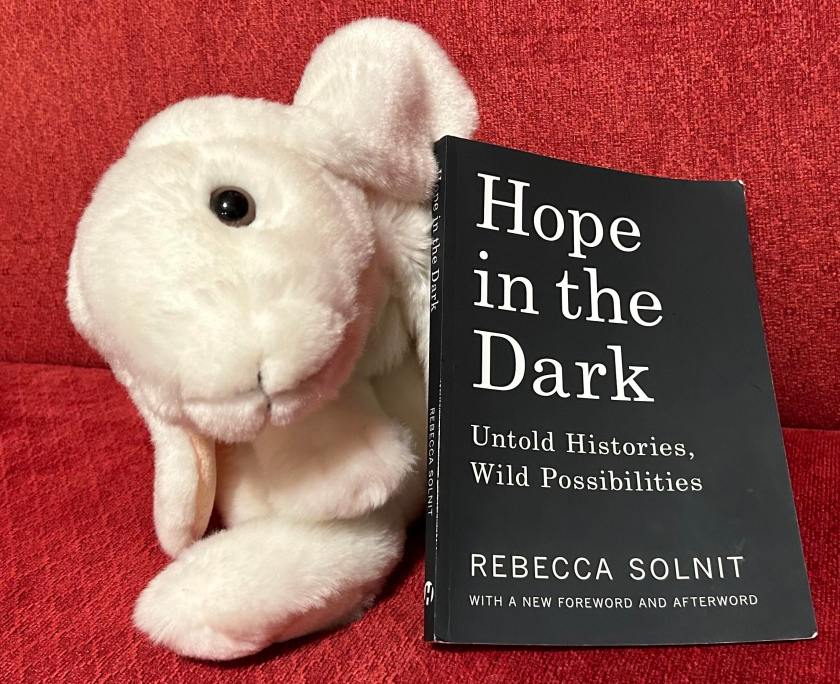
Marshmallow enjoys reading fiction and most often reviews works of fiction for our blog. But this week she decided to write about Rebecca Solnit’s Hope in the Dark: Untold Histories, Wild Possibilities, first written in 2004 and then republished with a new foreword and an afterword in 2016.

Marshmallow reviews Hope in the Dark: Untold Histories, Wild Possibilities by Rebecca Solnit.

Marshmallow’s Quick Take: If you like nonfiction books that discuss current events, or if you are worried about the future because of said current events, then this might be the book for you. 

Marshmallow’s Summary (with Spoilers): Rebecca Solnit goes over several depressing events of the recent years with a new perspective. She defines hope, not as optimism, but as the acknowledgment of possibilities for a better world. The author carefully analyzes the past and the present to demonstrate how hope is intertwined with action. Her rousing book encourages readers to keep sight of a brighter future, within reason. Diverging from the common conceptions of hope, this book presents a stronger, newer perspective:

Hope locates itself in the premises that we don’t know what will happen and that in the spaciousness of uncertainty is room to act.

Simply put, hope is not naive optimism but rather the ability to see the possibilities in the uncertainties that surround us and the capacity to act accordingly. 

Citing recent events, famous people, and writers of old, Rebecca Solnit builds her case as to why hope is so relevant and important to our modern world. In each of her twenty-one short chapters, she focuses on a different aspect of hope and how we should nurture it. In the end, she builds a solid argument for why there is always hope, even in the darkest times.

Marshmallow is reading Hope in the Dark: Untold Histories, Wild Possibilities by Rebecca Solnit.

Marshmallow’s Review: In these deeply troubled times, hope is difficult to find. This book is refreshing to read as it does not offer any easy solutions or fake comfort; rather it states clearly that things are not going to work out the way we want them to unless we start making changes. With clear evidence and reasoning, the author proves with finality that we are not inevitably doomed (the key word being “inevitably”).  

This is a book that we should all read, though it might be a little advanced or confusing for younger bunnies. The clarity with which the author presents her position helps the reader engage effectively with her ideas. The flow of thought is easy to follow, and the chapters all have several ideas and concrete examples relevant to the main topic (hope).

Originally, I read this book for a project concerning hope. This book not only proved itself to be an invaluable resource for evidence, quotes, and ideas for my project, but also was a source of inspiration more broadly for life in a dark world. I found it wise that the author, Rebecca Solnit, never says it will get better. This specifically, I felt, was not just a sound decision, but also a main theme throughout the course of the book. If anything, I found this book to be a call to action— what this action must be, however, is more difficult to perceive. Yet, this book was extremely helpful to read, as it served as a reminder that we have the potential and opportunity to improve our world. 

In this short book review, I hope I have done more than just inform you about a book I have read. I hope that I have also pointed you towards a refreshing idea, a new perspective, that I think can be both informative and beneficial for everyone.

Marshmallow’s Rating: 99%

Marshmallow rates Hope in the Dark: Untold Histories, Wild Possibilities by Rebecca Solnit 99%.