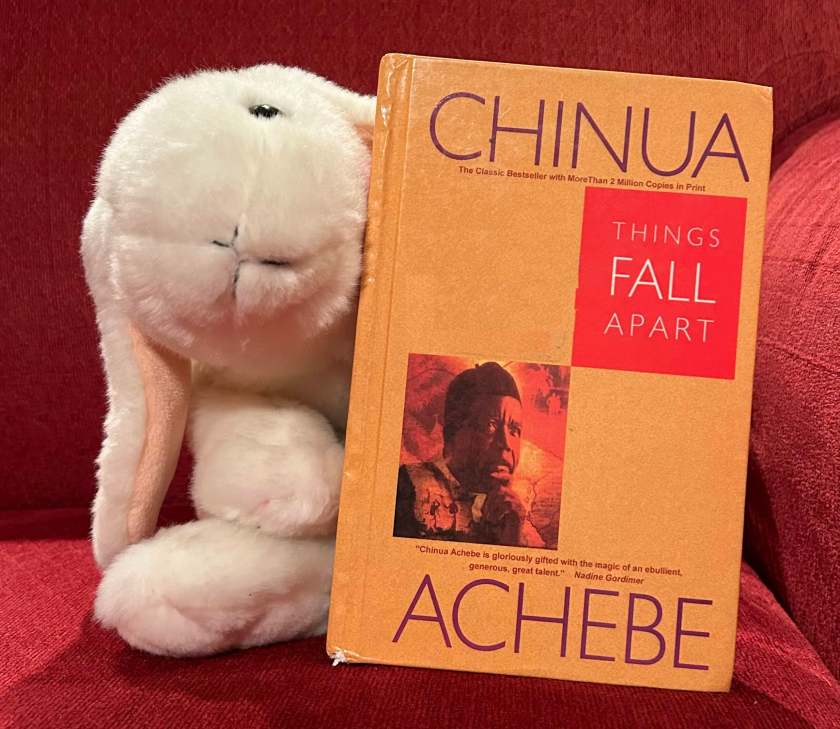
As the first review of the book bunnies blog this new year, we present to you Marshmallow’s review of Chinua Achebe’s Things Fall Apart. First published in 1958, Achebe’s novel is a modern classic, and Marshmallow has read it in school.
Marshmallow reviews Things Fall Apart by Chinua Achebe.
Marshmallow’s Quick Take: If you like historical fiction books about colonialism in Africa or books that make you think or feel, then this is the book for you!
Marshmallow’s Summary (with Spoilers): Set in the Nigerian Ibo society during the 1890s, this book starts with the introduction of Okonkwo. Okonkwo is a highly-respected man in his village Umuofia. Through his victories in battle and his defeat of the Cat (a famous wrestler), Okonkwo is a powerful man. As a result (as is Ibo culture), he has three wives, many children, a successful farm, and on occasion drinks palm wine out of his first human skull. He is what is called a “strong man.” However, his success and strength is a result of fear. His drive to succeed is fueled by a fear of being similar to his father, who was a efulefu (or worthless man). Okonkwo’s father was lazy and debt-ridden; thus, Okonkwo compensates for his father’s failures by working obsessively. Luckily for Okonkwo, in Ibo society, a man is not judged by his father, but by his own merit. Eventually, his success seems cemented. Yet, he is still controlled by anxiety, fear, anger, and violence. His household, though it reflects the traditional Ibo setup of its time, is a model case of domestic abuse.
Meanwhile, a woman from Umuofia is killed in a neighboring village. To avoid war with the fear-inspiring Umuofia, this village sends a virgin girl and a young boy to compensate. For the purposes of the plot, the boy (named Ikemefuna) is most important. Umuofia doesn’t immediately decide what to do with the boy, taking several years to do so. During this, he is placed in Okonkwo’s household and soon becomes fast friends with Okonkwo’s son, Nwoye. Over time, Okonkwo starts to view Ikemefuna as a son.
But when tragedy strikes, Okonkwo finds himself in a situation that pits his “strong man” facade against his heart. And as the book progresses, Okonkwo continually finds himself at odds with the changing village. The question is, how much more can he take before he falls apart?
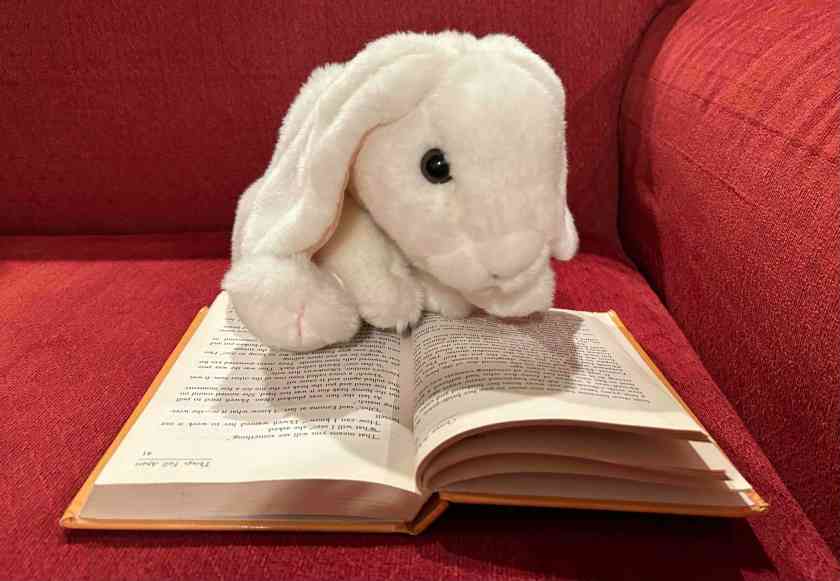
Marshmallow is reading Things Fall Apart by Chinua Achebe.
Marshmallow’s Review: I think reading this book is an extremely important experience that all people and bunnies should have. Chinua Achebe–the author–wrote it in simple, easy to read English specifically so it would be accessible to all; this makes it a good book for all ages and levels of reading ability. But ultimately, this book is remarkably subtle and nuanced. The author’s tone is simple and unique, while startlingly complex at the same time. The plot evolves elegantly and the author creates compelling characters that make you need to see the storyline though. Additionally, Achebe successfully grapples with and portrays issues like colonialism, racism, and toxic masculinity. This book is incredible because of the insights it gives on such topics. It also shows the reader what (some) life and culture was like in Nigeria before colonialism.
Additionally, this book’s themes are philosophically, historically, psychologically, and culturally intriguing. Throughout, Achebe weaves in the concept of facades: facades of strength, of stability, of security, of trustworthiness, of happiness, of truth. Achebe’s work is remarkable, and the astute reader will recognize and appreciate the importance of such work.
Overall, I highly recommend this book to all because it’s imperative to understand what others in the world experience and experienced, especially in a world of such divided opinions and narrow perspectives.
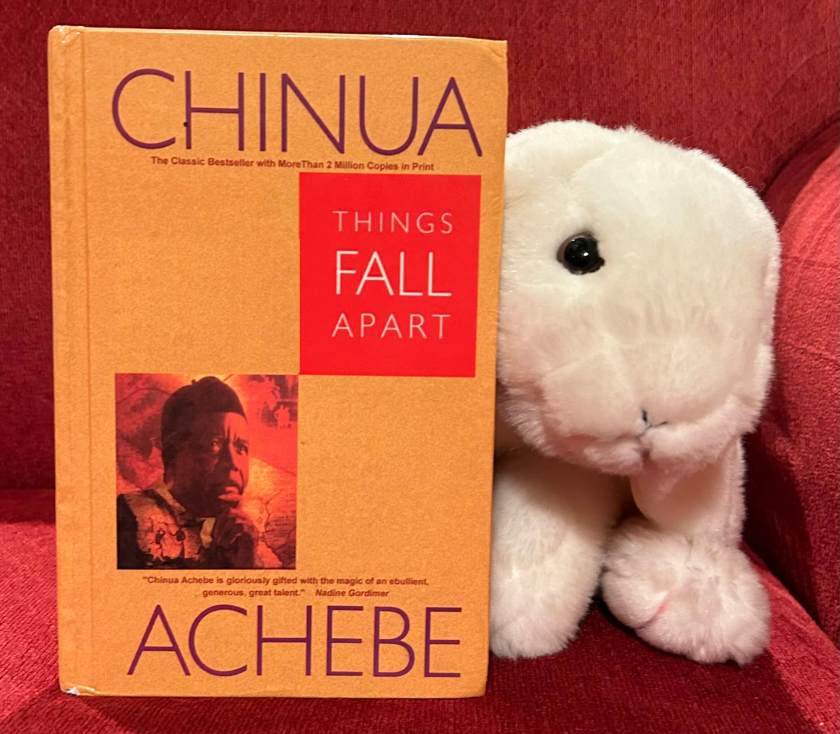
Marshmallow’s Rating: 100%.
Marshmallow rates Things Fall Apart by Chinua Achebe 100%.
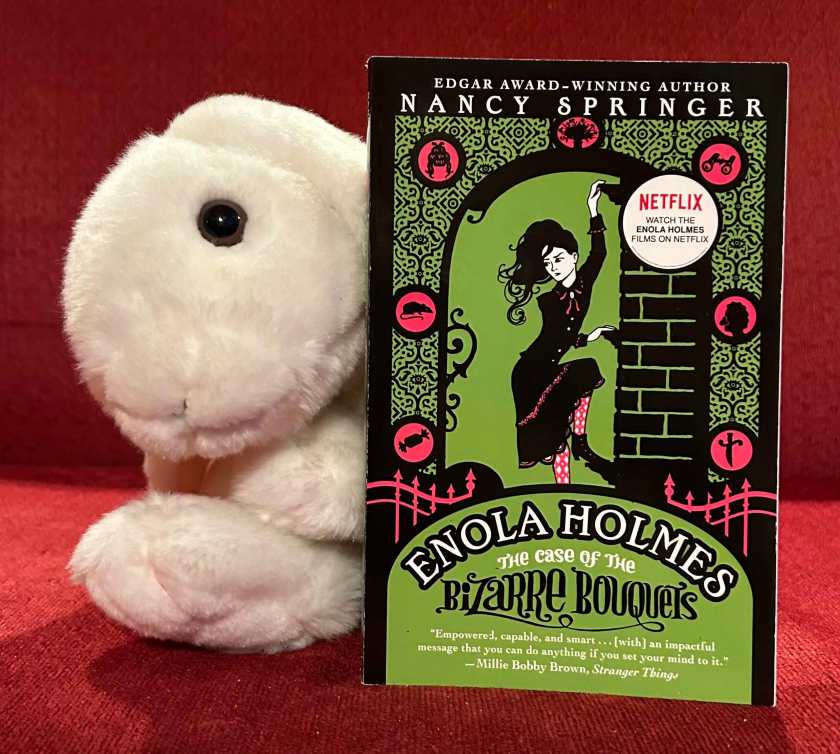
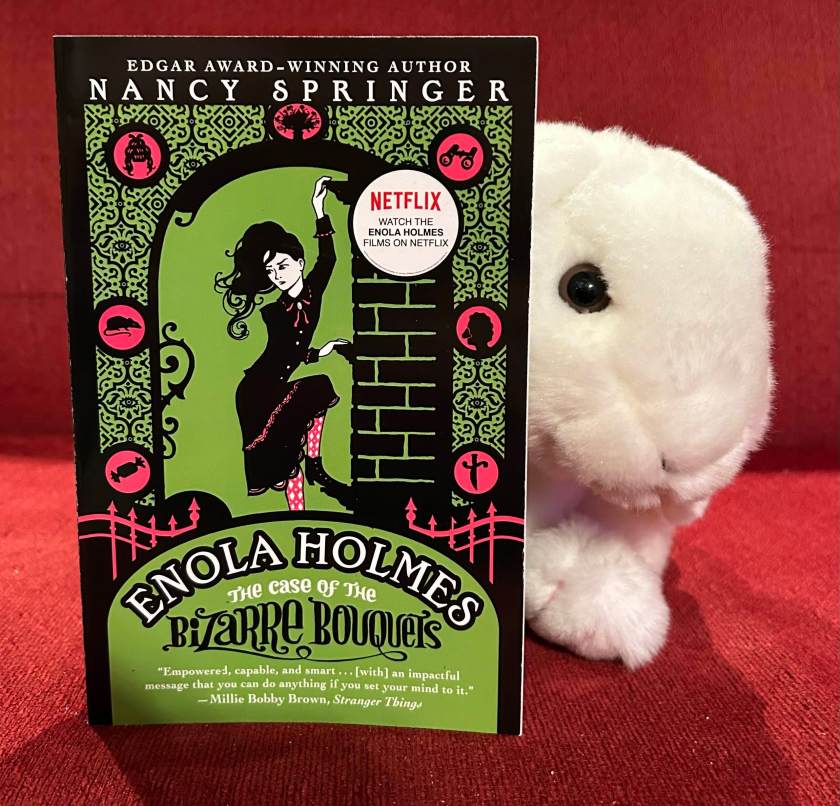
Marshmallow reviews Enola Holmes: The Case of the Bizarre Bouquets by Nancy Springer.
Marshmallow’s Quick Take: If you’re a Sherlock Holmes fan or if you like mysteries with female protagonist detectives, then this is the book for you!
Marshmallow’s Summary (with Spoilers): Enola Holmes has been living on her own in nineteenth century London for a couple months now. Given the fact that she is fourteen years old, one might ask why. The reason for her self-inflicted solitude is the fact that, during this period, women have no autonomy in the social status quo. Enola’s mother ran away from this set-up in a previous book and left Enola the means to do the same. Enola (whose name spells “alone” backwards) examined her surroundings and the expectations she was going to be forced to fulfill (finishing school, marriage, childbirth, etc.) and followed her mother’s suit. In doing so, Enola escaped the control of her older brothers: Mycroft and Sherlock Holmes (the famous detective). But even the famous detective Sherlock Holmes cannot locate her and she (while lying low) becomes adept at disguising herself by altering her appearance through various methods. Drawn to mysteries and puzzles, she solves several cases on her own (see for example The Case of the Missing Marquess and The Case of the Left-Handed Lady) and decides to found her own business as the world’s first and only professional “perditorian” (see The Case of the Missing Marquess: “From the Latin perditus, meaning “lost.” Perditorian: one who divines that which is lost”.)
Unfortunately, because women have no autonomy, she creates the business under the name of a male doctor while she disguises herself as his “assistant” Ivy Meshle. However, if her brothers find her, she will be forced to return to them and begin training to be a perfect “ornament to genteel society.” After several close brushes of being discovered by Sherlock and / or Mycroft, Enola once again finds herself drawn to the case of a certain Dr. John Watson. The reticent Arthur Conan Doyle reader may notice that this is the same Dr. Watson who is Sherlock’s loyal companion on his cases. For the few times she met him, Enola felt a fatherly affection towards Dr. Watson, so she (after some introspection and inspection of the situation) decides to search for Dr. Watson, too.
Normal mysteries are dangerous on their own. But her brother’s close proximity to this case makes it also a gamble with the freedom and autonomy she has had so far. Will Enola be able to find the doctor before her brother finds her?
Marshmallow is reading Enola Holmes: The Case of the Bizarre Bouquets by Nancy Springer.
Marshmallow’s Review: I would really recommend reading the first couple books in this series before this one to get context. But on its own, the world-building is enough to immerse the reader entirely in this Victorian-era mystery. The author consistently writes fascinating mysteries that never fail to disappoint in intrigue and complexity; yet the reader is never left confused at the end.
These Enola Holmes books stand out among all other mysteries I’ve read so far because the setting is so wonderfully set up. People often say reading is like a passport to other worlds and times. I was pretty sure they were lying, until now. Once I started reading this book, I couldn’t put it down because I didn’t want to stop learning about the mystery and the fascinating world it is in. The descriptions of London (I am pretty sure) are all factually correct for that time and all the details create an immersive experience that I would fully recommend.
This book series is also unique because it depicts a girl who is fully independent. Enola is perhaps the only female protagonist I have ever read about who isn’t in love, interested in, dating, or married to a guy. She is truly alone (in that sense) and is perfectly fine with it. It is good for girls to see that they have the choice to be so and that it is fine to be fine with that. This book also has strong themes of feminism; Enola’s strength, competence, and wit are rebelliously scandalous for the time. She stands up to the patriarchical system and doesn’t care what it thinks of her. She games the system to use it to her advantage when she disguises herself. But she never forgets to help the less fortunate with her fortunes.
But Enola is also more distinctive among other female protagonists because, as the author explicitly makes sure to state, Enola is not traditionally beautiful. She has a large nose, no delicate, feminine features of particular value, and a body like a “beanpole.” It is Enola’s virtue, brains, and bravery that makes her such a compelling character and I, for one, am expectantly looking forward to reading the next book!
Marshmallow’s Rating: 100%.
Marshmallow rates Enola Holmes: The Case of the Bizarre Bouquets by Nancy Springer 100%.
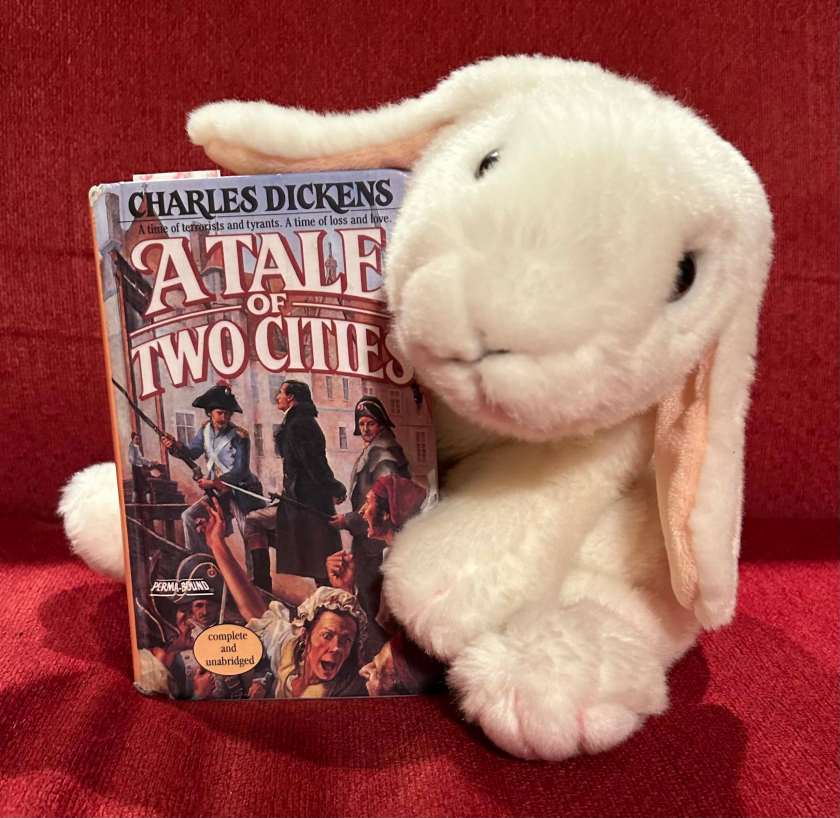
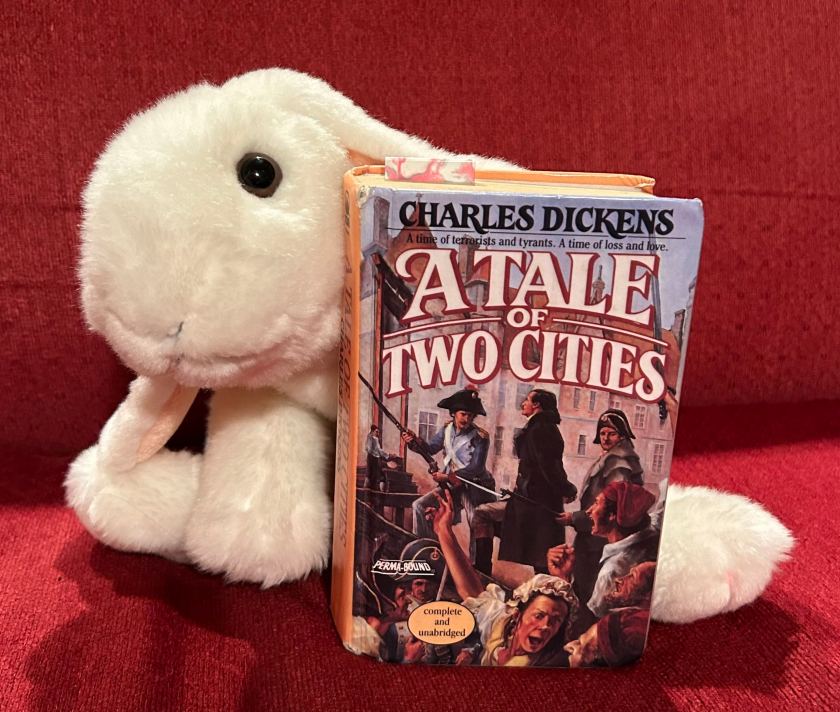
Marshmallow has been reading A Tale of Two Cities by Charles Dickens at school and so thought it would be a good idea to review it for the blog. Below are her thoughts on this classic from 1859.
Marshmallow reviews A Tale of Two Cities by Charles Dickens.
Marshmallow’s Quick Take: If you like historical fiction, famous books about the French Revolution, family, and fate, then this is the book for you!
Marshmallow’s Summary (with Spoilers): Set during the years 1775-1792 in London and Paris, this really is a tale of two cities. The book travels between London and Paris, with the French Revolution developing throughout and playing a major role in the storyline.
The book begins with the introduction of both places and the presentation of the plot: Lucie Manette, a seventeen year old French girl living in London, learns from a banker named Mr. Jarvis Lorry that her father Dr. Manette is alive after being imprisoned for eighteen years in the Bastille. She believed him to be dead, but after this shocking revelation, sets out with Mr. Lorry to Paris to find him. They discover that, upon his release, Dr. Manette was taken in by his old servant Monsieur Defarge and his wife Madame Defarge. We learn that Dr. Manette has been driven insane by his time in the Bastille, obsessively making shoes to cope. But Lucie’s love and faithful devotion begins to heal him back to himself. They all travel back to London, and he recovers over the next five years.
Then, in 1780 in London, another character named Charles Darnay is put on trial for treason against England (being a spy). Lucie and her father are called to testify against him. Two witnesses (both English spies) testify against him as well, but Lucie’s pity for Charles begins to sway the jury in his favor. After Sydney Carton, one of Charles’ defense lawyers, points out the striking resemblance between himself and his client, the verdict of not guilty is declared and Charles Darnay and both of his defense lawyers become close family friends of the Manettes and Mr. Lorry.
Sydney Carton is a drunken, unstable man who is subservient to the other defense lawyer. For reasons unknown, he seems to have given up on himself and his potential, wasting away his talents, believing that he is worthless and lacks any ability to be good. The other defense lawyer is Mr. Stryver, an overly-ambitious man whose only goal is furthering his own status in the world.
Mr. Stryver, Carton, and Charles Darnay all begin to fall in love with Lucie, but all in different ways and for different reasons. Mr. Stryver believes that she fulfills his social expectations for a wife and would be beneficial for his life goals, while Carton loves her for being the only person who believes that he has the possibility of good within him (when he himself doesn’t believe so). Mr. Stryver plans to propose, but decides not to after Mr. Lorry (in a very passive-aggressive fashion) tells him that he would be rejected. Carton confesses his love to Lucie (who cares for him in a motherly way), but tells her that he knows she cannot and should not love a man like him who has given up on everything: life, love, himself, and the world; he swears to protect her and everyone she loves when the time comes. But in the end, it is Charles Darnay who wins Lucie’s hand in marriage. He fell for her because of her compassion for him while on trial, her deep love and dedication to her father, and her beauty. After getting her father’s blessing, the two get married.
Charles wants to tell Dr. Manette his real last name before the marriage, but is told by Dr. Manette himself to wait till the wedding day. On that day, Charles in true honesty informs Dr. Manette that he is an Evrémonde, an aristocratic family from France. As a result, Dr. Manette relapses back into his old insanity right after the couple leaves for their honeymoon. Mr. Lorry helps Dr. Manette return to himself before the couple return and the breakdown is kept secret from Lucie.
In 1789, in France, the Defarges lead the famous Storming of the Bastille, and Monsieur Defarge finds a note written by Dr. Manette hidden in his old cell. The French Revolution is becoming increasingly bloody and aristocrats like Marquis St. Evrémonde (Charles’ uncle) are being slaughtered for their past insensitivity and cruelty towards the impoverished. One of the Marquis’ servants is put on trial and sends a letter to Charles (in London), asking for his help. After leaving letters of explanation, Charles secretly leaves his family in London to return to France. He is captured and put on trial, essentially for being an aristocrat, despite the fact that he denounced his family’s immoral behavior and fled from France to London to escape his name Evrémonde.
Mr. Lorry, on business in Paris, unexpectedly meets Lucie and Dr. Manette who came to France right when they read Charles’ letters. Dr. Manette, a former Bastille prisoner and thus a hero of the Revolution, uses his influence to get Charles a trial. But with the revolutionary bloodlust unquenchable, nothing can save Charles from La Guillotine, except for an act of true love.
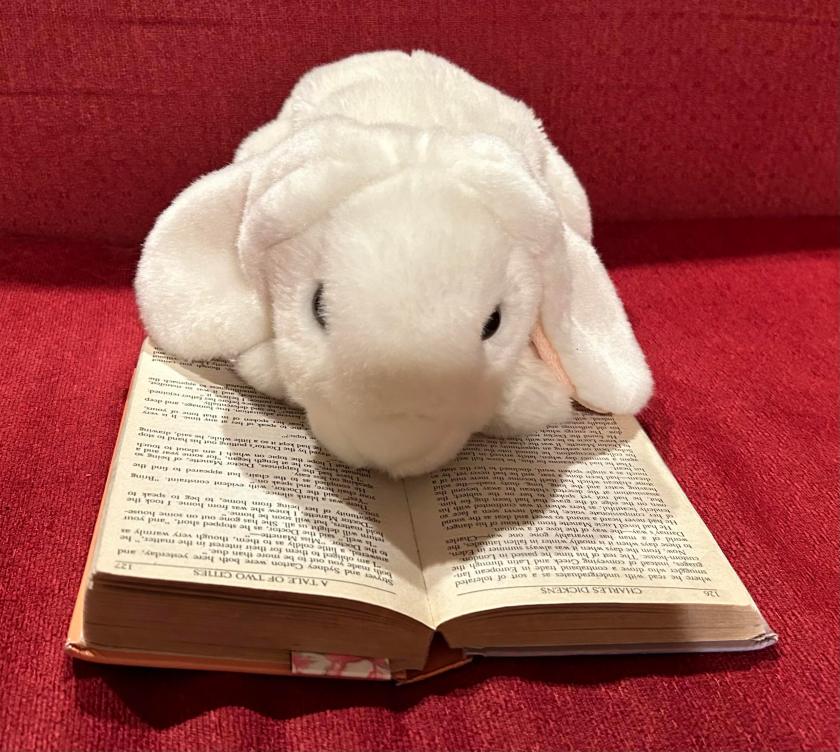
Marshmallow is reading A Tale of Two Cities by Charles Dickens.
Marshmallow’s Review:A Tale of Two Cities is an amazing book. It’s really hard to read in the beginning, but after the first couple of chapters, it gets pretty easy to understand. Dickens uses a lot of old language so it is difficult by today’s standards. But I’ve never read a book that has completely changed my view of the world to such an extent.
This book is amazingly written because its plot is touching and exciting, but it also shows the development and the impacts of the French Revolution, a chilling period of human history. Dickens shows us our fragility, through Dr. Manette’s insanity, and the violence that we create when others have wronged us. But Dickens also shows our graces: Lucie’s never-ending compassion, faith, love, kindness, and devotion to others.
I chose to read this book for an English unit, and I’m so glad I did because this book is absolutely beautiful; it is truly a masterpiece. The world the author shows us immerses you as you read and shows you glimmers of a past far behind. However, the past is sometimes the clearest mirror. Throughout this book, the most poignant message I uncovered was this: when destiny mercilessly takes what one loves, those who were hurt can lose their mercy too. This is how the frenzied violence of the French Revolution occurred: the horrific treatment of the lower classes by the elites made the Revolutionaries utterly empty of empathy for the aristocrats when La Guillotine (as they referred to it) descended. The world’s harshness hardens humanity which turns into (perhaps righteous) hatred, something we still see today.
This disturbing reality of human nature is so profoundly portrayed by Dickens that this story is uniquely compelling in a way like no other. A Tale of Two Cities really made me reflect on us and our society as a whole. When we break one another, the broken become capable of breaking others without feeling empathy and perhaps it’s not completely their fault. But if humanity is to become better, if we are to avoid another bloodbath like the French Revolution, if our world is to become brighter and more prosperous for all, we need to learn to fix each other’s humanity, not break one another apart till we become capable of inhumanity. I might just be a bunny, but this book makes it obvious for all.
Marshmallow’s Rating: 110%.
Marshmallow rates A Tale of Two Cities by Charles Dickens 110%.
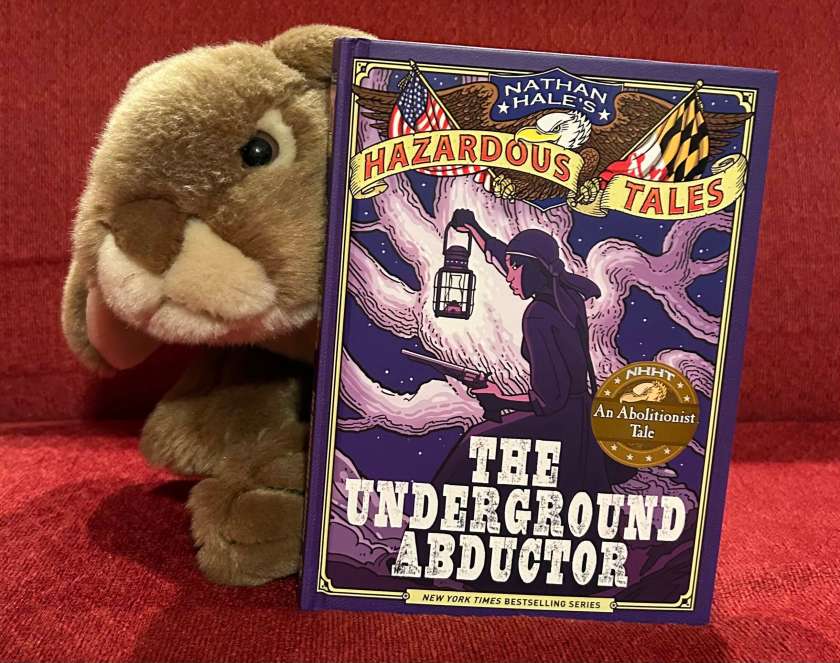
Caramel has read and reviewed One Dead Spy and Treaties, Trenches, Mud, and Blood, the first two books in Nathan Hale’s Hazardous Tales series, a series of historical graphic novels that cover a variety of historical events. Today he talked to Sprinkles about The Underground Abductor, the third book in our Nathan Hale collection.
[We were hoping to go through these books in order, but Caramel happened to first read a three-book sampler which was made up of the first, fourth, and the fifth books! So the numbering of these posts is mainly about the order Caramel is reading them in. The Underground Abductor, reviewed in today’s post, is the fifth ever book in the series, originally published in 2015.]
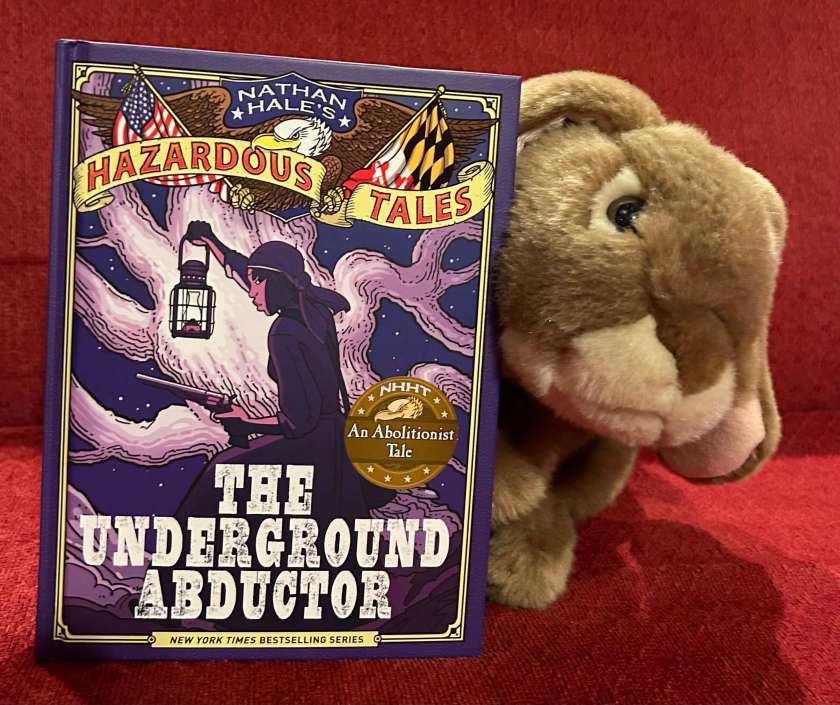
Caramel reviews Nathan Hale’s Hazardous Tales #3: The Underground Abductor by Nathan Hale.
Sprinkles: So Caramel, this was the third book in our collection of Nathan Hale books. And now that you have read it, can you tell us a bit about it?
Caramel: Sure. this is about Harriet Tubman, a woman who was a slave but escaped and then she worked hard to help many other slaves escape through a network of secret paths and secret safe houses called the Underground Railroad. She also worked as a spy in the American Civil War. She was very brave.
S: So tell me more. Does the book start from Tubman’s childhood?
C: Yes. And then it goes on to speak about the first time that she ran away. Then she came back and helped her family escape. And then she kept doing it. Then when the Civil War started, she helped with the war, and spied for the Union side.
S: That does sound really brave, Caramel. I am glad you are learning about a historical figure like Tubman. Did you learn about her from this book?
C: I had heard of her before but I learned a lot more about her from the book.
S: So I am assuming this is again a very factful book.
C: Yes. And as you know, I like facts, so I like this book.
S: You also like graphic novels, and this is one, so I am assuming that helps, too. Right?
C: Yes, it does. I like seeing the events as they happen. It adds some humor too.
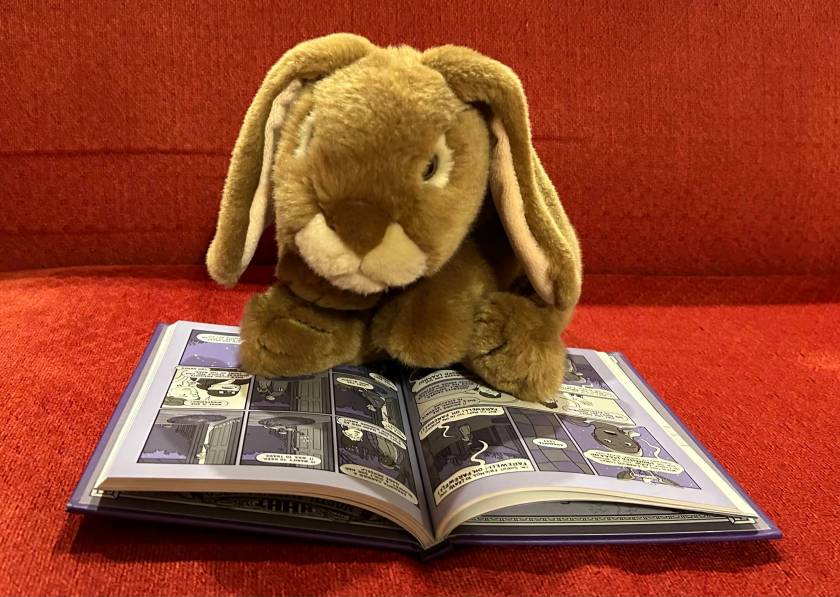
Caramel is reading Nathan Hale’s Hazardous Tales #3: The Underground Abductor by Nathan Hale.
S: So is the main character Tubman herself narrating the story, or is there a different narrator telling us her story?
C: The narrator is still Nathan Hale, from the other books. The fictitious version of the spy from the first book.
S: I see. That makes sense. After all, these are his tales! Are there any other connections to the other books?
C: Yup. There is the Hangman and the British Commander.
S: Wait, who are they?
C: They are characters from the first book. The Hangman is the one who is supposed to end up hanging Nathan Hale and the British Commander is the one who has ordered his hanging.
S: So wait, we know Hale was hanged. But all these stories, then he is telling them before his hanging?
C: Kind of.
S: Sounds a bit morbid honestly.
C: A little. But it is also funny. Because both the Hangman and the Commander are very funny characters. And they say some really funny things.
S: I see. So they are kind of like the audience?
C: Yes.
S: Okay, Caramel. Thank you for telling me this story. It seems like you really enjoyed the book.
C: Yes. I really enjoyed all three of the books. Maybe I will get to read some more. Hint hint.
S: Okay, we will see. Let us wrap up this review then. What would you like to tell our readers?
C: Stay tuned for more book bunny reviews!
Caramel enjoyed reading Nathan Hale’s Hazardous Tales #3: The Underground Abductor by Nathan Hale and is keen to read more from this exciting and factful series.
 BookBunnies