Caramel reviews Kiki’s Delivery Service by Eiko Kadono

Today Caramel reviews Kiki’s Delivery Service, originally written in Japanese by Eiko Kadono in 1985. Kiki’s story became a world sensation when the animated movie Kiki’s Delivery Service by Hayao Miyazaki of Studio Ghibli came out in 1989. Caramel and Sprinkles both read the book before watching the movie, and in this post, they are talking about the English translation by Emily Balistrieri, published originally in 2020.

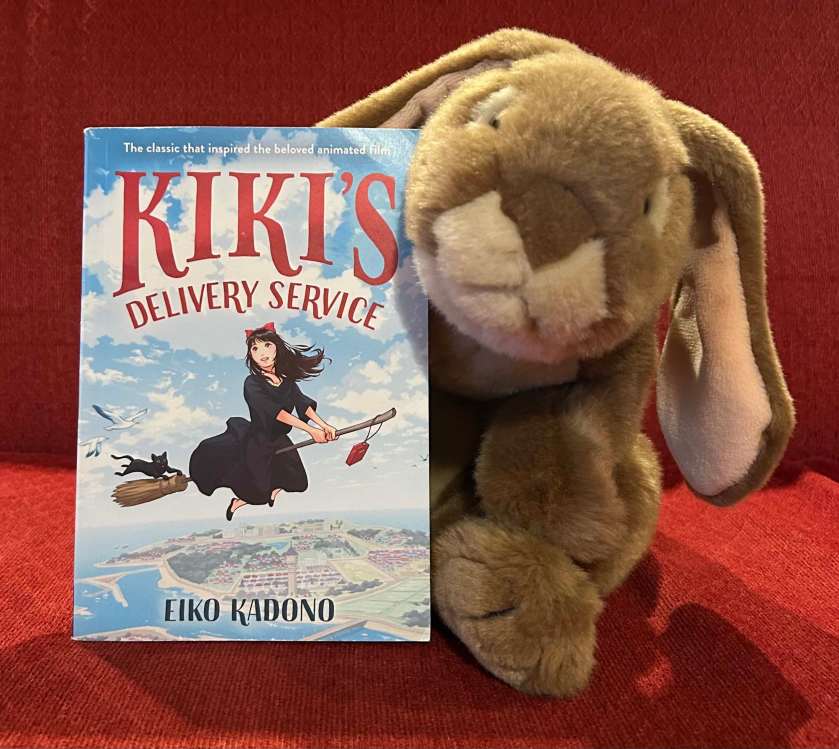
Caramel reviews Kiki's Delivery Service, written by Eiko Kadono and translated into English by Emily Balistrieri.
Caramel reviews Kiki’s Delivery Service, written by Eiko Kadono and translated into English by Emily Balistrieri.

Sprinkles: Today Caramel and I are talking about a book written several decades before he was born. And an animated movie of the book also became famous all the way back then. But Caramel and I only read it this year. The story is pretty timeless though, so I think it still worked out well. What do you think, Caramel?

Caramel: Yeah, I agree. The story is timeless, and it is pretty good. It’s about a witch. In this world witches are nice, and at thirteen they need to leave home and go to a new town and help the people there.

S: Okay, that’s cool, I like that witches are nice. And I like growing-up-and-figuring-yourself-out stories. So I’m guessing that this book is about a witch named Kiki, and she starts a delivery service in a new town?

C: Yes, that’s almost exactly what happens. When Kiki turns thirteen, she needs to leave her home. Her mom is also a witch and both her parents are very supportive of what she has to do. So she leaves home and flies to a town near the ocean. 

S: Wait! She literally flies?

C: Yes, on her broomstick!

S: Cool! So she is a broomstick witch. Okay go on.

C: So in this new town, Kiki begins to live with a farm family. She then sets up shop in their barn and gets a telephone, and she starts her delivery service there.

S: So she begins to deliver things to people using her broomstick, like courier services provided by people on mopeds?

C: Yeah, she delivers small things. Toy cats, real cats, children, bread, things like that.

S: Wait, she delivers children?

C: Yeah, no, that’s a joke. But she delivers all kinds of other stuff. And she has a talking cat named Jiji who always comes along.

Caramel is reading Kiki's Delivery Service, written by Eiko Kadono and translated into English by Emily Balistrieri.
Caramel is reading Kiki’s Delivery Service, written by Eiko Kadono and translated into English by Emily Balistrieri.

S: Oh, that sounds really cool. Wouldn’t you like to have a talking cat?

C: Maybe. I think it could be fun. But these witches sure like names that repeat a syllable. Ki-ki and Ji-ji. 

S: Both names sound cute though, right? 

C: Sure-sure; see I did the same thing?

S: You are in a good mood today Caramel! Okay, let us get back to the book. So did you know that the author who wrote this book wrote eight more following the adventures of Kiki? 

C: Really, are they translated yet? This book was pretty good so I’d definitely like to read at least some of the followup books.

S: I don’t think any of them is translated yet. But you’re right. The story sounds really cute.

C: Yeah, it’s a nice calm book. Nothing really bad happens, and Kiki feels lonely at the beginning and faces some challenges, but nothing too scary, and she eventually finds her footing. All young bunnies could enjoy it, I think. 

S: Agreed. Did you know that the animated version of the book was what made it so famous? The movie was made all the way back in 1989 and it is still well liked by many around the world. 

C: Huh, that’s cool, I didn’t know that.

S: Yeah, it was made by Hayao Miyazaki, from Studio Ghibli. Do you remember them? They are the people who made My Neighbor Totoro (1988), Spirited Away (2001), and The Boy and the Heron (2023). 

C: Oh yeah, I do think we saw the trailer for Kiki before we watched The Boy and the Heron, and that was one weird movie! But I think Marshmallow liked My Neighbor Totoro

S: I did not see that one but yes, The Boy and the Heron was a very different type of movie. I think it would be neat to see the movie about Kiki, too.

C: Yes! Maybe we can put in a link for the trailer? 

S: Sure. Here it is:

C: Thank you. Maybe we can find a way to watch the full movie too.

S: Yes, I think that would be lovely! Do you think this is a good time to wrap up this review? 

C: Yes, I think so. 

S: Okay, then, what would you like to tell our readers?

C: Stay tuned for more book bunny reviews! And merry Christmas to all who celebrate!

Caramel enjoyed reading Kiki's Delivery Service, written by Eiko Kadono and translated into English by Emily Balistrieri, and is eager to see the movie itself next.
Caramel enjoyed reading Kiki’s Delivery Service, written by Eiko Kadono and translated into English by Emily Balistrieri, and is eager to see the movie itself next.

Marshmallow reviews North of Tomboy by Julie A. Swanson

Today Marshmallow reviews North of Tomboy, a new book by Julie A Swanson, that is coming out this week.

The book bunnies received this book as an advance review copy.

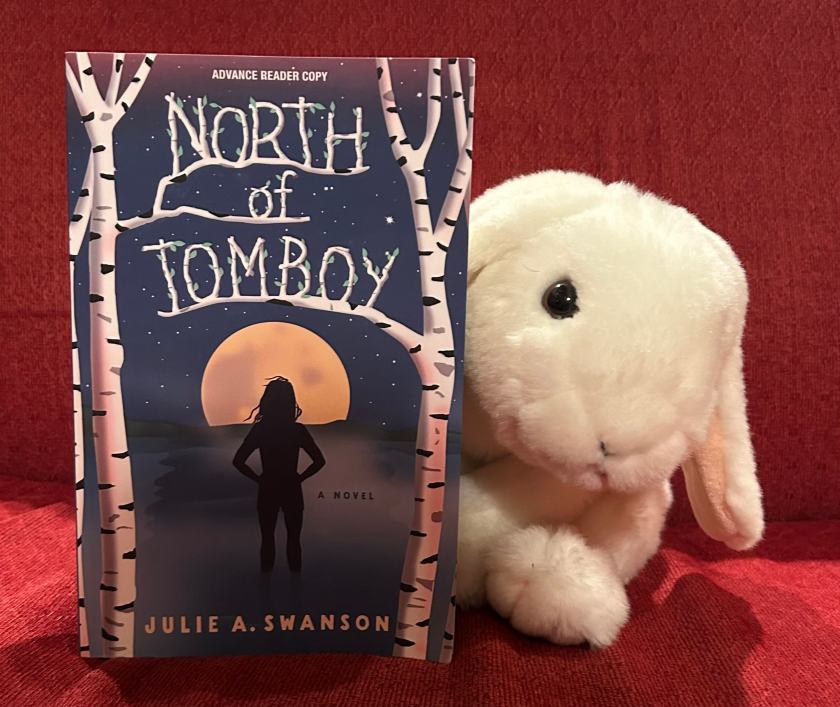
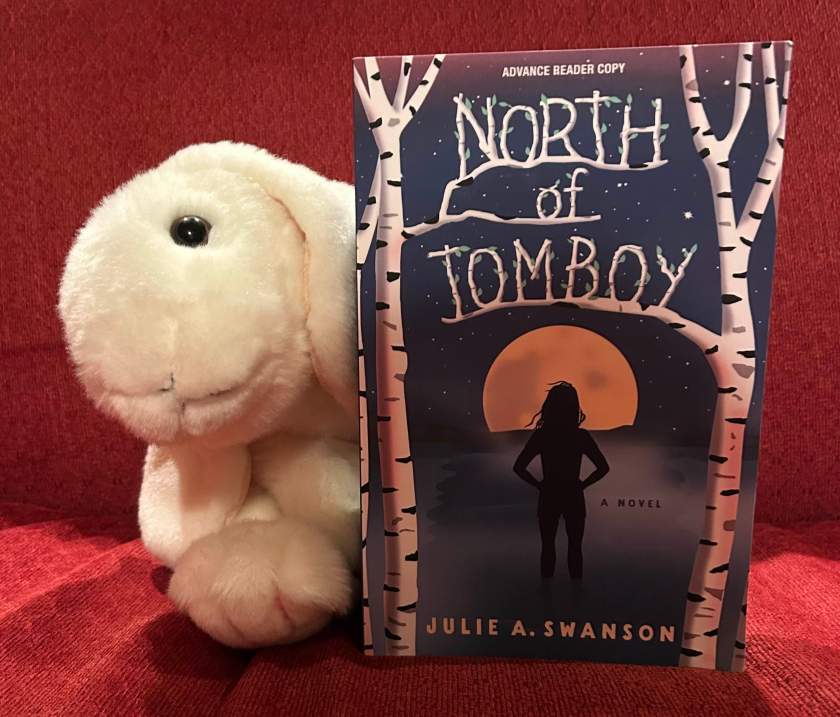
Marshmallow reviews North of Tomboy by Julie A. Swanson.

Marshmallow’s Quick Take: If you like books about growing up and exploring your identity and gender, then this is the book for you!

Marshmallow’s Summary (with Spoilers): Jessica Jezowski is a nine-year-old girl, but she definitely doesn’t feel like one. She believes that God must have made her with both girl and boy parts, except for the defining part which he made with only girl parts. Jess lives in Leelanau County in Michigan with her parents, two brothers, and little sister in the very early 1970s. Her mother is very enthusiastic about things Jess feels are only for “girly girls.” She doesn’t like having long hair or wearing dresses because she feels like that prevents her from having any fun and it seems to actually cause her physical and emotional distress.

Jess loves her family, but she sometimes wishes they would stop treating her differently from her older brothers just because she is a girl. For example, she wishes they’d stop giving her baby girl dolls every year for Christmas. However, one year, she can’t bring herself to ignore or destroy the doll she is given (it is insinuated that the previous ones suffered unfortunate fates). She ends up feeling a sort of connection to the doll and cutting its hair. She names it Mickey and announces that it is a boy. She pretends that he is the family’s newly adopted son and animates him, giving him a charming Southern drawl. Using Mickey as a transparent veil of protection, Jess finds that she can be funnier, more confident, and more herself. Mickey, she finds, seems to be more loved than she is. Eventually though, she starts to feel like Mickey is taking over. Jess realizes that she needs to find who she is without hiding behind a doll. 

Marshmallow is reading North of Tomboy by Julie A. Swanson.

Marshmallow’s Review: This was a very interesting and eye-opening book. It introduced me to a way of life in a different time period in a different location that I had never experienced before. Swanson does a very good job immersing the reader in Michigan’s nature and scenery, and I really enjoyed learning about what it would be like to live in a place like Jess’s home in the past.

In the beginning of the book, I felt like the writing was a little different from most books I have read. The dialogue felt a little bit off. But then again Jess is supposed to be just nine years old and I have not been nine for quite some time now. (Yes, I am pretty mature for a bunny!) In any case, over time, the prose fell into place and the picture of Jess’s world felt more whole and realistic. Later on, the dialogue was exceptionally good and the characters in Jess’s family became extremely human.

I like how the book both romanticizes the Jezowski’s way of life, but also shows its dark parts. Jess’s father often loses his temper and ends up blaming his wife for things that are not her fault. I thought the way Swanson handled the dialogue concerning his behavior and the family’s responses felt extraordinarily real and nuanced.

North of Tomboy as a whole got progressively more and more nuanced as I read on. I was originally confused by Jess’s feelings in the beginning. It seemed like she just did not like girls or women and so did not want to be one. But I liked how, in the end, Jess realizes that she isn’t necessarily against being female; she just wants to be her own type of girl. This is a take that I found very interesting. At the start, I was confused about whether Jess would have wanted to transition to a different gender or not if this were possible during her time. But soon enough, I noticed that Jess herself is very sexist. She hates being a girl because she thinks girls are all stupid and weak and whiny. This is a result of her upbringing. I think, in other words, that the main character definitely has a lot of internalized misogyny which parent bunnies might wish to discuss with their children if they are reading the book together.

I liked how Jess found who she wanted to be in the end, but I would have preferred it if the book were more explicit in affirming that women do not have to be stupid and weak and whiny. I also liked that we also got to learn a lot about how Jess’s faith shaped her thoughts. It was very interesting to hear her internal dialogue, and the growth of her faith as she was trying to figure herself out was definitely a critical part of the story.

I would highly recommend North of Tomboy to all readers because it really shows the workings of people that many do not understand. Some might say this is a good book about people thinking about their gender, and I think that it is. But I would also say that this is a good book for a lot of other people to read, too, and not for reasons related to gender. I think this shows the way many families work and how some people are raised. It shows a way of life many are not familiar with. Learning about how Jess and her family live was eye-opening. North of Tomboy offers one perspective of what it’s like to be from a very rural, very religious, and rather conservative background. This is not something everyone understands, something I have never experienced. Of course, one book obviously does not and cannot represent the complete picture. But it shows that people whom some vilify are still very human. It is always important to remember that. Understanding where everyone comes from is crucial to making this world a better place for everyone.

Marshmallow’s Rating: 95%.

Marshmallow rates North of Tomboy by Julie A. Swanson 95%.

Caramel reviews Will the Pigeon Graduate? by Mo Willems

All the book bunnies love Mo Willems and his books about the Pigeon. Caramel even reviewed a couple of them for the book bunnies blog. See, for example, his reviews of The Pigeon HAS To Go To School and Be the Bus. Today he talks to Sprinkles about a brand new Pigeon book: Will the Pigeon Graduate? As usual, Sprinkles is taking notes and asking questions.

Caramel reviews Will the Pigeon Graduate? by Mo Willems.

Sprinkles: So Caramel, today we are talking about a new book about the Pigeon!

Caramel: Yep, the best pigeon in the world is back!

S: You have read quite a lot of the other books about the Pigeon. You also reviewed two of them. What is this one about?

C: This one is about how the pigeon is growing up, and he is scared about the future after finishing school.

S: He is already graduating? How exciting!

C: Well, he had to go to school back in 2019 so I suppose it is time. 

S: You are right of course. At some point school ends and the rest of life begins. 

C: Yep, but I don’t like that idea.

S: Why not? 

C: I like being a young bunny going to school. I like it too much.

S: Why do you like it so much? I know you learn a lot of things at school every day and I know you like learning. But you can continue to learn outside of school. too. 

C: True, I guess you are right. But at school you have friends–

S: You can make friends after school, too. 

C: Yes, but school friends are the best! And at school, people tell you to do things, and you do them, and that is all the work you have. You do not have to earn money, save money, buy or rent a house, and all that adult stuff. 

S: I get that, Caramel. Growing up can be hard. And this is exactly what this book is about, isn’t it?

C: Yeah, I guess that the Pigeon is very smart.

S: How so?

C: Well, he knows finishing school means he has to start making important decisions and taking care of more things and being careful about all kinds of details and so on. 

S: That is very much true Caramel. But in the end he gathers up his courage and decides he is ready for whatever is coming his way, right?

C: Yes. 

Caramel is reading Will the Pigeon Graduate? by Mo Willems.

S: I  am thinking this could be a really nice gift for someone finishing high school or elementary school or even college. What do you think? 

C: Yep, I think in a couple of years, Marshmallow might like it. There is even a little place in the inside cover of the book for a photo of someone graduating. We could put Marshmallow’s picture there. 

S: We could definitely do that. But we could also save it for you. You will also be graduating soon yourself. 

C: Yes, but I am going to go to another school right after. 

S: That still counts as moving to a bigger new world. That new school is bigger than your current one. And there will be a lot of changes. 

C: Hmm, I am not sure I am ready for a lot of changes. 

S: I know. We are not always ready but they come nonetheless. Anyways, there is still some time, but by the time that change comes, you will be ready. I am quite sure. 

C: Hmm, I hope you are right, Sprinkles. 

S: Remember how many years ago, you were about to change classrooms and get a new teacher and you were kind of anxious about it? We talked about it when we were discussing My Teacher Is A Robot

C: Yeah, that was a good book. And I did end up liking my new teacher a lot. Okay, maybe you are right. Maybe I can handle some changes, just like the Pigeon. 

S: Yay! That’s the right attitude Caramel! I think this is a perfect place to end this review. 

C: Alright by me!

S: Okay, what would you like to tell our readers then?

C: Stay tuned for more book bunny reviews!

Caramel enjoyed reading Will the Pigeon Graduate? by Mo Willems and thinks this book would be a great gift for new graduates.

Sprinkles reviews children’s books about puberty – for boys

A few weeks ago, Sprinkles reviewed a handful of children’s books about puberty written for girls. Today she is writing about children’s books about puberty written for boys.

This review is intended for parents and guardians.

Sprinkles reviews children's books about puberty - for boys.
Sprinkles reviews children’s books about puberty – for boys.

Today’s post is about five books about puberty appropriate for young boy bunnies who are approaching that important time of great change. The first four are written exclusively for an audience of boy bunnies, and at the end of the post, I will mention a fifth book that can also help this particular audience though it is not exclusively targeting them.

The first book I will discuss is What’s Going on Down There? A Boy’s Guide to Growing Up, a 2017 book written by Karen Gravelle and illustrated by Robert Leighton.

Sprinkles reviews What's Going On Down There? A Boy's Guide to Growing Up, written by Karen Gravelle with Chava and Nick Castro, and illustrated by Robert Leighton.
Sprinkles reviews What’s Going On Down There? A Boy’s Guide to Growing Up, written by Karen Gravelle with Chava and Nick Castro, and illustrated by Robert Leighton.

This book makes a neat companion to the author’s 1996 The Period Book which I wrote about in my review on books about puberty written for girls. Published by the same company, the book comes in a small format just like the earlier book. And just like that earlier one, this is a very readable and surprisingly informative book. In thirteen chapters ranging from how boys’ bodies change during puberty to sexual harassment, from sexually transmitted diseases to how babies are made and how they can be avoided, Gravelle’s book offers young readers a ton of useful information, well organized and presented in fluent and compassionate language. There is even a full chapter on how girls change during puberty so boys reading the book will not be totally clueless about what is going on with their female classmates, their sisters, and their female cousins. The goal is not merely to quench curiosities though; I believe the inclusion of this chapter also serves a more compassionate purpose. When a boy understands that girls are changing too, and that boys are not the only ones who are feeling awkward, uncertain, and even perhaps scared, maybe he will be a bit more compassionate towards himself and others. He will also hopefully be able to see the girls in his life more like peers and friends rather than alien, incomprehensible objects.

Sprinkles is reading What's Going On Down There? A Boy's Guide to Growing Up, written by Karen Gravelle with Chava and Nick Castro, and illustrated by Robert Leighton.
Sprinkles is reading What’s Going On Down There? A Boy’s Guide to Growing Up, written by Karen Gravelle with Chava and Nick Castro, and illustrated by Robert Leighton.

What’s Going On Down There? uses explicit and scientifically accurate language about the sexual organs and human reproduction. The illustrations are hand-drawn, and though detailed, would most likely not be viewed as obscene. The author is compassionate and matter-of-fact through the book, and she mentions both homosexuality and transgender individuals and the possible social and religious tolerance limits in relation to both. Being a woman, she explains that she had substantive input from two young boys, Chava and Nick Castro, as well as interviews with fifteen men who told her the most important things they wished they knew when they were boys themselves.

**

The next book I will write about is the 2020 book Everything you Always Wanted to Know About Puberty — and Shouldn’t Be Googling – For Curious Boys, written by Morris Katz and illustrated by Amelia Pinney.

Sprinkles reviews Everything you Always Wanted to Know About Puberty -- and Shouldn't Be Googling - For Curious Boys, written by Morris Katz and illustrated by Amelia Pinney.
Sprinkles reviews Everything you Always Wanted to Know About Puberty — and Shouldn’t Be Googling – For Curious Boys, written by Morris Katz and illustrated by Amelia Pinney.

Everything you Always Wanted to Know About Puberty — and Shouldn’t Be Googling – For Curious Boys is written from the perspective of a “cool older brother”, as the author Morris Katz describes himself tongue in cheek. The pages are colorfully organized and illustrated. The style is informal and perhaps a bit unserious, though the author voice comes across as friendly and helpful: the author is indeed young and has younger brothers, so the tone feels authentic. The main thrust of the book is captured in this little excerpt:

“My advice on this could be applied to puberty as a whole. You can’t control what’s going to happen, but you can control how you react to your experiences. Accepting things as they are and taking it easy on yourself no matter what will make your life a lot less stressful. Don’t drive yourself crazy over things you can’t control.”

Sprinkles is reading Everything you Always Wanted to Know About Puberty -- and Shouldn't Be Googling - For Curious Boys, written by Morris Katz and illustrated by Amelia Pinney.
Sprinkles is reading Everything you Always Wanted to Know About Puberty — and Shouldn’t Be Googling – For Curious Boys, written by Morris Katz and illustrated by Amelia Pinney.

Some sections of the book provide extensive details. The hormonal changes that eventually lead to puberty in boys are described in great detail, for example. Therefore, I was surprised that the male genitalia and the general reproductive system are not described as much in detail as in Gravelle’s What’s Going On Down There? book. The book does cover an extensive list of topics, distributed into three large parts (Part 1. What Looks, Sounds, and Smells Different? Part 2. What Feels Different? and Part 3. The Outside World). There is thoughtful discussion of social media, peer pressure, relationships with parents, thrill seeking and risky behavior, respecting girls and women, avoiding toxic masculinity, and many more.

Parents may or may not feel comfortable with the tone in which topics such as drugs, masturbation, and porn are discussed. To me, the particular tone felt consistent with an older brother, one who knows what is best for you, one who wants you to make the right decisions, and who is trying to support you along the way without sounding preachy. But some parents might wish for a different tone altogether. All in all, I found this to be a good book, but all families are different, and parents would best take a good look at it before sharing with their little ones.

**

The third book from my shelves is Growing Up Great!: The Ultimate Puberty Book for Boys, written by Scott Todnem, illustrated by Anjan Sarkar, and first published in 2019.

Sprinkles reviews Growing Up Great!: The Ultimate Puberty Book for Boys, written by Scott Todnem and illustrated by Anjan Sarkar.

Growing Up Great is written by Scott Todnem who has been teaching health education to middle schoolers for a long time, and you can read him as a trusted teacher who is telling it like it is. The main thrust of the book is captured in two statements the author makes repeatedly in slightly different forms throughout the book:

“Change is good. And knowledge is power.”

and

“Just be you through it all. No one has ever been you, and no one will ever be you.”

Among the books I have read for this review, this one is perhaps the most “factful”, if I am allowed to use one of Caramel’s favorite words. I have learned quite a lot of things from the book myself (which may not be too surprising, especially given that I did not have brothers or male cousins or even male classmates as I was growing up — having gone to a girls’ high school — and so did not have first-hand experience with male puberty). The book covers the physical changes a boy’s body goes through extensively. There is also much emphasis on the importance of mental, physical, and social health, self-respect, and consent in all situations.

Sprinkles is reading Growing Up Great!: The Ultimate Puberty Book for Boys, written by Scott Todnem and illustrated by Anjan Sarkar.

Among the books I have read for this review, this one is perhaps the most “factful”, if I am allowed to use one of Caramel’s favorite words. I have learned quite a lot of things from the book myself (which may not be too surprising, especially given that I did not have brothers or male cousins or even male classmates as I was growing up (having gone to a girls’ high school) and so did not have first-hand experience with male puberty). But I did find the book very readable and informative.

**

The fourth book about puberty written for boys that I wanted to talk about in this post is the 2017 book Guy Stuff: The Body Book for Boys, written by Cara Natterson and illustrated by Micah Player.

Sprinkles reviews Guy Stuff: The Body Book for Boys, written by Cara Natterson and illustrated by Micah Player.

Brought to us by American Girl Publishing, just like Cara Natterson’s earlier book The Care & Keeping of You 2: The Body Book for Older Girls, Guy Stuff is one of a series of books aiming to help adolescents learn more about themselves as they are going through puberty. It is overall well organized and playfully illustrated. The text is not one long narrative; rather, each page has different text boxes, lists, short subsections, and other organizational tools that allow for skimming and jumping back and forth rather than simply sitting down for an extended time to read through from cover to cover.

The chapters themselves are vaguely organized around the body: the “Heads Up” chapter focuses on hair, ears, eyes, face, and so on, while the “Belly zone” chapter focuses on nutrition, body shape and size. The “Get Going” chapter is about legs and feet but also exercise and physical movement. The “Big Changes” chapter is where we get into the big basics: the subheadings list hormones, pubic area, underwear, erections, shaving, voice, moods. The book begins with a short chapter (“Body Basics”) emphasizing good habits and attitude, and ends with another short chapter (“Your Inner You”) including a discussion under the subheadings: “your feelings”, “being a guy”, “all of you”, where peer pressure and the stereotype of “boys don’t cry”are covered.

Sprinkles is reading Guy Stuff: The Body Book for Boys, written by Cara Natterson and illustrated by Micah Player.

All in all, Guy Stuff is engaging and informative. There are clear illustrations of male body parts. However, the book does not touch some of the topics that might be more uncomfortable for some parents (e.g., masturbation, porn) that some of the other books do mention, at least in passing, so it could perhaps be a safer choice for more parents.

**

The four books I mentioned above are all written for an audience of boys exclusively. And they all do the job quite well, to inform and comfort the young bunny whose body is going through some surprising changes. However, before I wrap up, I would like the readers to also consider the gender-neutral classic, It’s Perfectly Normal: Changing Bodies, Growing Up, Sex, and Sexual Health, written by Robie H. Harris and illustrated by Michael Emberley.

Sprinkles has already reviewed It’s Perfectly Normal: Changing Bodies, Growing Up, Sex, and Sexual Health, written by Robie H. Harris and illustrated by Michael Emberley. See https://bookbunnies.blog/2024/09/28/sprinkles-reviews-childrens-books-about-puberty-for-girls/

As I wrote earlier, It’s Perfectly Normal: Changing Bodies, Growing Up, Sex, and Sexual Health is a somewhat controversial book as it depicts naked human bodies (in caricature) and certain sexual acts (also in caricature). It also introduces ideas of gender diversity (Chapter 5 is titled “Who You Are: Straight, Lesbian, Gay, Bisexual, transgender, +”) and discusses masturbation and abortion (Chapter 16: “Perfectly Normal: Masturbation” and Chapter 24: “Laws and Rulings: Abortion”, respectively). So even parents who might find these topics suitable for their young ones might wish to review the book on their own before sharing it with them.

All that being said, I found the book very informative and generous. The laws in the United States are in constant flux in relation to abortion, but other than that, most of the information in the book is up to date and seemed to me to be more than relevant to a young bunny growing into her own body. The generosity I am talking about is in the compassionate ways the book explains differences of opinion about controversial topics like abortion and LGBTQ+ issues, as well as the many ways people can form families by methods such as in-vitro fertilization and adoption. And the bird and the bee that we had met in the other books by Harris and Emberley apparently first made their debut in this book, and they are just the same funny odd couple they were in those other books. Their reactions to the illustrations as well as the content of the text reflect the many types of natural reactions a young bunny may have to them. The bird is often the more enthusiastic one, enthusiastic about learning everything there is to learn, while the bee is often the one who is a little overwhelmed with it all and wants to quit talking about it. Both are natural reactions, and I have seen them in my own children at times when these issues came up. I think therefore that their presence through the book might help a young bunny reading the book to feel seen.

**

It is probably time to wrap up this review. I have already written a lot, and only about five books; there are many other options out there. However, I chose these five because each of these books is clear and informative and supportive. Overall, I am glad there are so many good options for young people these days to learn about puberty. I do hope caring parents and loving guardians will encourage their young ones to read some of these books and use them as a way to initiate conversations and discussions about the many exciting features and challenges of puberty.

Sprinkles has enjoyed and appreciated the opportunity to read each and every one of these books about puberty directed at tween boys, and recommends that grownups of young bunnies consider sharing at least one of them with their young ones.