Caramel reviews The Last Olympian: The Graphic Novel by Rick Riordan

While tidying up his books this weekend, Caramel happened to come across his copy of The Last Olympian: The Graphic Novel, by Rick Riordan, and just realized that he had not yet reviewed it for the book bunnies blog. As he had already reviewed the first four books in the Percy Jackson and the Olympians series, he thought it would be only appropriate if he also reviewed this fifth book. So today that is exactly what he is doing. As usual, Sprinkles is taking notes and asking questions.
The whole book bunny household loved reading the Percy Jackson and the Olympians series by Rick Riordan. Marshmallow reviewed the first three novels (The Lightning Thief, The Sea of Monsters, and The Titan’s Curse), and Caramel reviewed the graphic novel versions of the first four (The Lightning ThiefThe Sea of MonstersThe Titan’s Curse, and The Battle of the Labyrinth).

Caramel reviews The Last Olympian: The Graphic Novel, by Rick Riordan, adapted by Robert Venditti, with art from Orpheus Collar, Antoine Dodé, and Chris Dickey.

Sprinkles: So Caramel you have reviewed the fourth book a little bit more than a year ago. So maybe let us start by reminding our readers what the Percy Jackson and the Olympians series is all about.

Caramel: Okay. The series is about Percy Jackson, who is a demigod, which means he is a half-god. Percy is the son of the Greek god Poseidon, and the whole series is about him and his friends trying to help save the Olympian gods from Kronos, who is a titan and wants to take them down.

S: Okay, I think this is a good overview. So what happens in this book?

C: Percy first tries to attack Luke’s ship, Princess Andromeda. You might remember Luke as the demigod who is working with Kronos. But there is an explosion, and one of their friends dies. Or actually, the friend sacrifices himself by blowing up the ship. Then Percy finds himself in Poseidon’s underwater palace, which is under attack itself. He is then sent to Camp Halfblood and then eventually goes home, too, to see his mom. Along the way he picks up Nico, who is the son of Hades, and they try to plan a new strategy.

S: I remember Nico. He also had a sister, right?

C: Yes, but the sister, Bianca, joined the Hunters of Artemis in Book Three, The Titan’s Curse. And then she died. Anyways, then, Percy bathes in the River Styx and becomes invulnerable except in one single point on his back. Then there is a big fight on a bridge, and then many many more fights, in Camp Halfblood, in New York City, by Olympus, and so on.

S: Yes, I remember reading this book and thinking that it was probably the most action-filled book in the series.

C: I agree with that.

S: But now that you are reminding me of the plot once more, I am thinking there were so many characters and so many places introduced through the series that it would be pretty hard to describe them effectively to someone who has not read the first four books. Would someone who has not read the first four books understand anything from The Last Olympian: The Graphic Novel?

C: No. I really don’t think so. As you said, there are a lot of characters and events from the first four books that you need to know to follow everything. It is best if you have read the first four books before this one. But they are all good books anyways, so why not read all of them? And in order?

S: I agree Caramel.

Caramel is reading The Last Olympian: The Graphic Novel, by Rick Riordan, adapted by Robert Venditti, with art from Orpheus Collar, Antoine Dodé, and Chris Dickey.

S: Okay so tell me a bit about the graphics. Looking over the book I see that it is pretty dark most of the time.

C: Well, a lot of the story is in the Underworld, or at night, or in the underwater palace of Poseidon, which was not too long, but you get the point. A lot of things happen in dark places.

S: I see.

C: The art is created by the same people, so the book looks quite similar to the others actually. Other than the whole being a bit too dark thing, of course.

S: I can see that. So did you know that Rick Riordan is publishing a sixth Percy Jackson book this fall?

C: Really? I did not know that. I want to read it, too.

S: Sure. But I think Marshmallow will want to read it first and review it too. And you like to review the graphic novel versions, but that will probably take a while. But The Lost Hero, the first book of the next series did already come out as a graphic novel. You might recall that Marshmallow reviewed that already.

C: I read that series, too. And I want to see the graphic novel version of it.

S: Maybe we will see if we can get you a copy, Caramel.

C: Yes, let’s.

S: Okay, Caramel. So as we are wrapping up this review, what three words would you use to describe The Last Olympian: The Graphic Novel?

C: Exciting, philosophical, well-concluded.

S: Hmm, I can see what you mean. The book does tie things up and finishes the series really well.

C: Yep.

S: What would you like to tell our readers?

C: Stay tuned for more book bunny reviews!
Caramel enjoyed (re)reading The Last Olympian: The Graphic Novel, by Rick Riordan, adapted by Robert Venditti, with art from Orpheus Collar, Antoine Dodé, and Chris Dickey, and diving back into the world of Percy Jackson after so long.

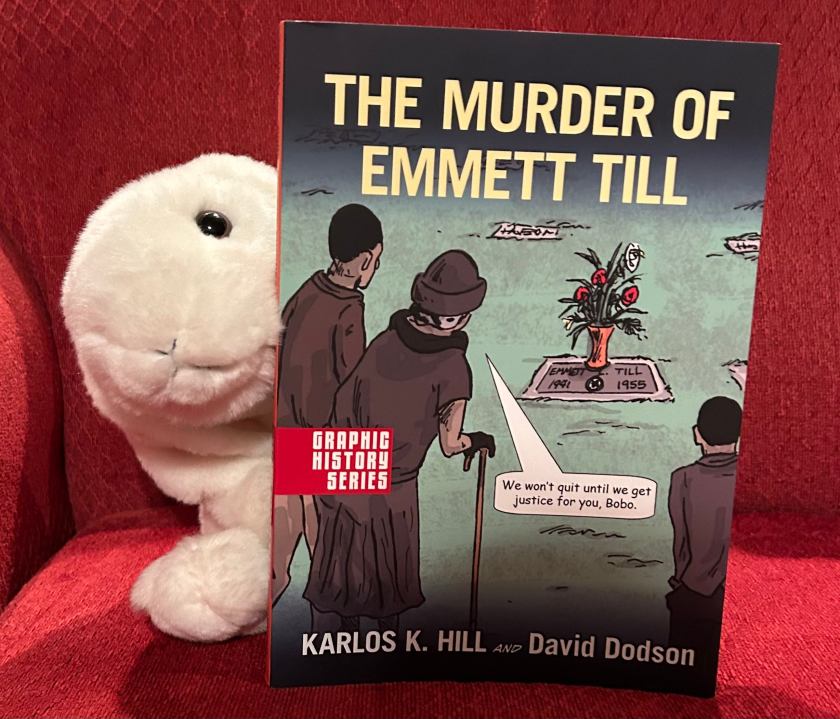
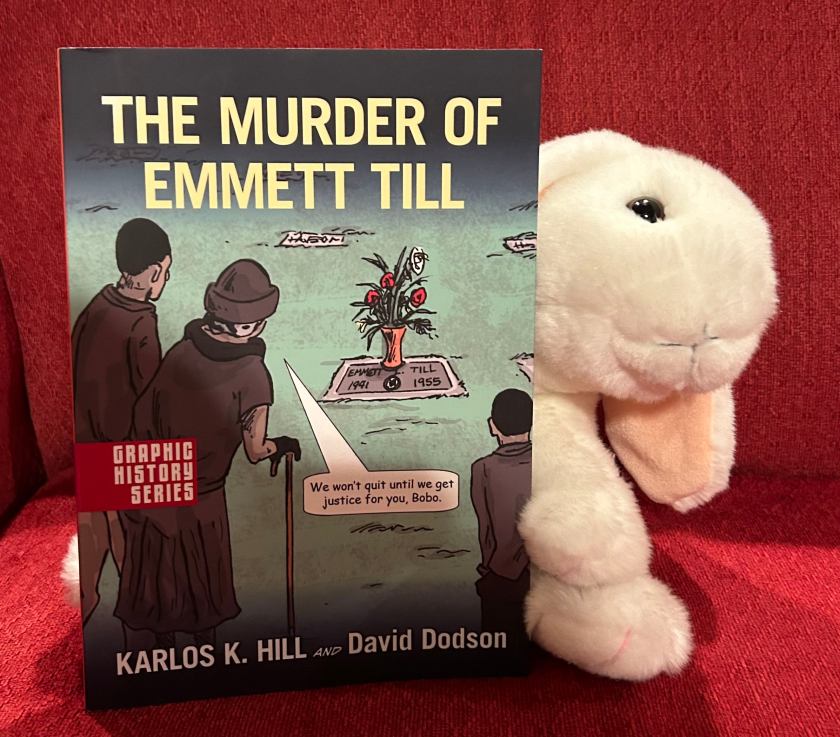
Marshmallow reviews The Murder of Emmett Till by Karlos K. Hill and David Dodson

After reviewing a handful of historically motivated graphic novels (They Called Us Enemy by George Takei, The English GI by Jonathan Sandler and Brian Bicknell, and Victory. Stand! Raising My Fist for Justice by Tommie Smith), this week Marshmallow takes on yet another historical graphic novel. Today she shares her thoughts on the book The Murder of Emmett Till by Karlos K. Hill and David Dodson, published in 2020.

The review below describes some of the events from the book, which are cruel and terrifying, and as such, might not be appropriate for very young bunnies.

Marshmallow reviews The Murder of Emmett Till by Karlos K. Hill and David Dodson.

Marshmallow’s Quick Take: If you would like to read a book about recent United States history or racial (in)justice, and if you appreciate graphic novels, then this might be the book for you. 

Marshmallow’s Summary (with Spoilers): On August 20, 1965, fourteen-year-old Emmett Till left his home to visit his mother’s uncle in Mississippi. There, Emmett was accused of whistling at and making lewd comments to a white woman. Emmett was kidnapped, tortured, and killed by the woman’s husband and his friends.

The murder of Emmett Till is a disgusting, horrible event that shows the evil act of lynching. In this book, historian Karlos K. Hill and illustrator David Dodson use the art of graphic novels to tell the story of Emmett Till. After the main story, the authors provide facts, dates, testimony, quotes, and images to teach about this tragic event.

Marshmallow is reading The Murder of Emmett Till by Karlos K. Hill and David Dodson.

Marshmallow’s Review: This book is a good way to teach and learn about Emmett Till’s murder. This is such a horrifying event that words cannot describe it. Emmett Till was a young boy who should not have been murdered; he should have lived a long, full life. His life was cut short so cruelly, and he was killed after being tortured. The torture and murder of Emmett Till must be taught to future generations to ensure that the disgust and horror we feel never goes away. Only if we remember such events can we hope to never repeat them again.

I liked how this book is both for reading and for learning. The first half of the book (“The Graphic History”, about 75 pages) is written in the format of a graphic novel that shows the events leading up to and after Emmett’s death. This part is divided into four chapters, one on the incident, the second on the kidnapping, the third on the murder, and the fourth on the trial and the aftermath.

The second half (another 75 pages or so) provides a broader context for the event, in three more sections, including a section titled “The Historical Context”, with subsections on lynchings and racial violence in the South, civil rights activism in Mississippi, and other similar topics. There is a whole section (“The Documents”) which includes photos and documents from the trial and beyond. Then there is a short “Conclusion” section which has some suggestions for further reading. Overall, there is a lot of evidence and even more background, which is educational and informational. In other words, the second half is almost similar to a textbook, while the first part is a graphic novel that describes the events in a chronological narrative.

I think this book offers a great way to teach older children and students about Emmett Till’s murder. The horror I felt when reading this book and the disgust of how a human being could do something so horrible to another person was real. This is a book about a dark topic and some of the worst facets of humanity. I would mostly recommend this to older bunnies, maybe 13-14 and up. However, since this is such a huge event in history, it is a valuable book to read and a good resource for knowledge. 

Marshmallow’s Rating: 100%.

Marshmallow rates The Murder of Emmett Till by Karlos K. Hill and David Dodson 100%.

Caramel reviews Glork Patrol and the Magic Robot by James Kochalka

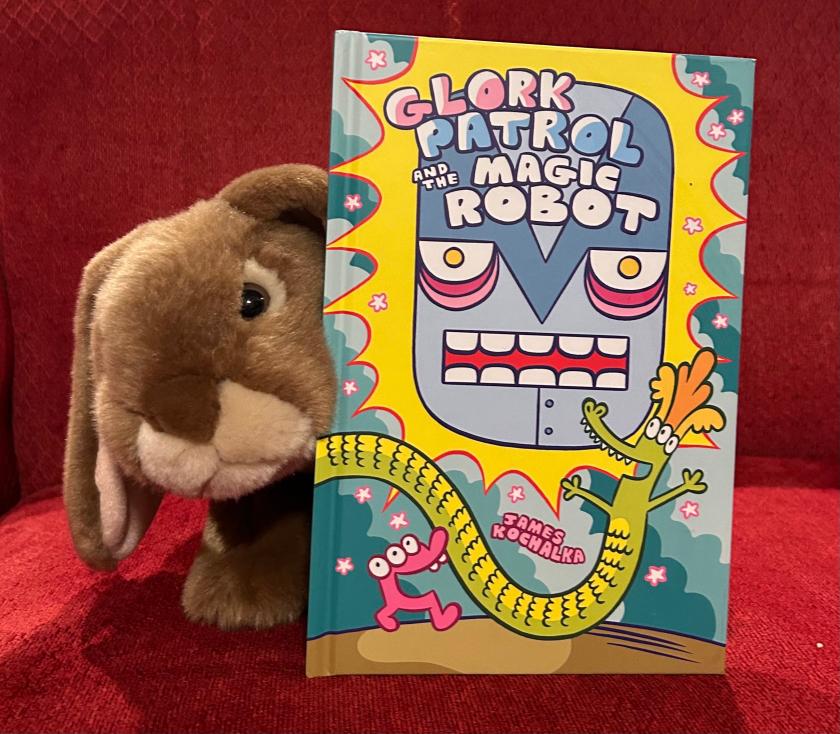
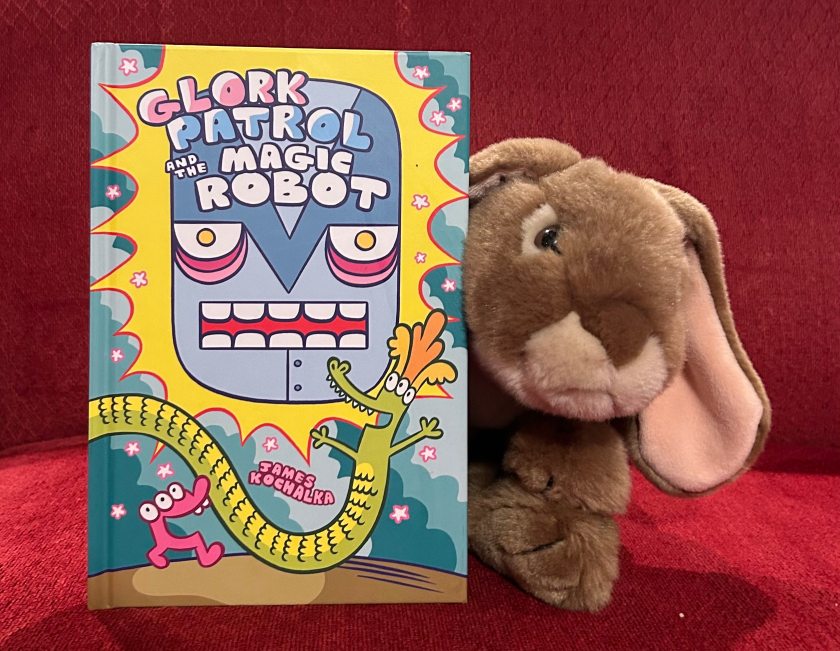
Today Caramel reviews Glork Patrol and the Magic Robot by James Kochalka, the third book in his Glork Patrol series, published in 2023. As usual, Sprinkles is asking questions and taking notes.

The book bunnies received this book as a review copy.

Caramel reviews Glork Patrol and the Magic Robot by James Kochalka.

Sprinkles: So Caramel, you found another book with a robot in it!

Caramel: Yes, I have.

S: Tell me a bit about it. What is this book about?

C: Gonk and Baby Quackaboodle find a box on their door steps, and it turns out to be a little robot. Then Gonk’s father says it is his robot, and names it Glorkbot.

S: Those are some weird names.

C: The creatures with those names are even weirder. Each of them has three eyes. And Baby Quackaboodle is a very long snake with two arms and some funny hairdo which kind of looks like those flowers called birds of paradise.

S: Yes, and Gonk seems to be a pink walking mouth with three eyes and two teeth basically.

C: Yes. And he does not speak with correct English always. He says things like “Him don’t care about little robots”. So he is probably really young. His dad looks more humanoid, but he also has three eyes and three teeth. And he has a backpack who talks, named Super Backpack.

S: Dora the Explorer also had a talking backpack. It can be useful to have a talking backpack, no?

C: Yes. I could use it to help tell me exactly where my pencil box is. And if it has eyes, then it could tell me what is going on behind me.

S: Makes sense to me! So in this book, tell me, what happens with this little robot and the other characters?

C: Gonk and Baby Quackaboodle take Glockbot for a walk and then Gonk realizes it will do whatever it is told to do. So they tell him to dance, so fast that its battery runs out. Well at first they are not sure what happened, because the bot just falls down, but then the Magic Robot tells them that its battery is out.

S: Wait. What is the Magic Robot?

C: It is this big giant robot head that also has magic. Though I am not sure why a robot, which is mechanical, would need to use magic. And inside it is another! It’s kind of weird.

S: Well, the whole story is quite wacky, I’d say.

C: Yep.

S: But you love wacky, don’t you?

C: Yep, that’s me.

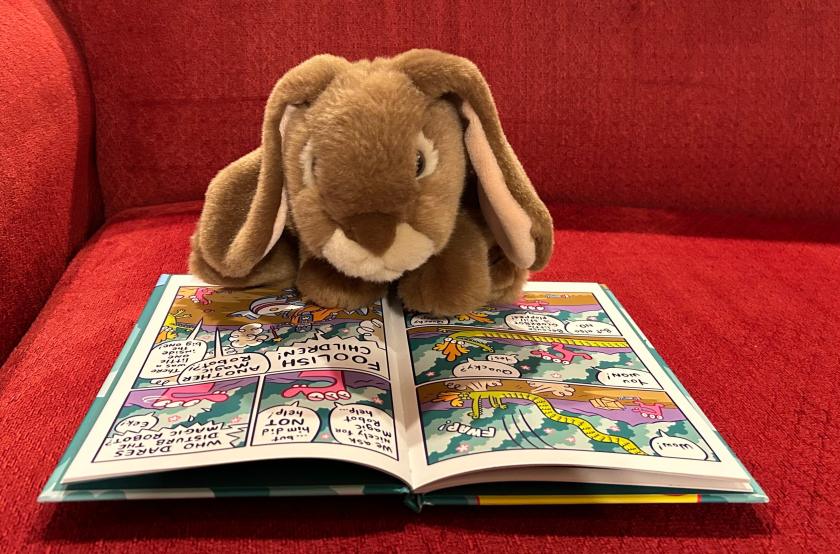
Caramel is reading Glork Patrol and the Magic Robot by James Kochalka.

S: It turns out that this is actually the third story in the Glork Patrol series. And before those two books, there was another series called the Glorkian Warrior series, and even a video game. They all seem to feature Gonk’s dad. Apparently he is the Glorkian Warrior.

C: I want to read all those books too!

S: Why?

C: Because I liked these weirdos. And they have robots and space travel and all kinds of funky things. At least that is what it looks like when we read their descriptions.

S: Okay Caramel, we might look into some of these other books. I agree that these look right up your alley.

C: Yes, exactly.

S: So if you were to describe Glork Patrol and the Magic Robot by James Kochalka in three words, what would you say?

C: Colorful, hilarious, wacky.

S: Those describe this book well Caramel. It is really very colorful, isn’t it?

C: Yes, there is a lot of yellow, green, blue, pink, a little bit of brown for the ground, but the writing is very large and easy to read, and there is a lot of motion and some explosions! Glorkbot really looks like it is dancing!

S: You’re right. It actually does.

C: So yes, I liked this book a lot, and I want to read more about these weirdos.

S: Understood Caramel, I’m glad you enjoyed it so much. So let us wrap this review up then. What do you want to tell our readers?

C: Stay tuned for more book bunny reviews!

Caramel had a lot of fun reading Glork Patrol and the Magic Robot by James Kochalka and is curious to read more about these wacky characters.

Marshmallow reviews Victory. Stand! Raising My Fist for Justice by Tommie Smith

Readers probably already know that Marshmallow enjoys reading graphic novels which are fictional, but she has occasionally also read memoirs or biographies written in graphic novel format and reviewed them for the book bunnies blog. (See, for example, her reviews of They Called Us Enemy by George Takei and The English GI by Jonathan Sandler and Brian Bicknell.) Today she writes about a 2022 book in this genre: Victory. Stand! Raising My Fist for Justice, by Tommie Smith, co-written by Derrick Barnes and illustrated by Dawud Anyabwile.

Marshmallow reviews Victory. Stand! Raising My Fist for Justice, by Tommie Smith, written together with Derrick Barnes and illustrated by Dawud Anyabwile.

Marshmallow’s Quick Take: If you like autobiographies or books about recent history, or if you want to read specifically about one of the consequential events in the history of the Civil Rights and Black Power movements in the United States, then this might be the book for you. 

Marshmallow’s Summary (with Spoilers): Tommie Smith is an American athlete, who is the first person to run 200 meters in under 20 seconds. In this book, Smith shares his experiences and retells the events leading up to and after his famous 1968 Olympics Black Power salute.

The narrative starts by showing the beginning of Smith’s Olympic finals race. Then we are shown his earlier life. As a young child, Tommie and his family were sharecroppers, meaning that they worked on land owned by someone else. Tommie did chores and picked cotton with his family. Even at a young age, Tommie could see injustice. He watched his parents and siblings work so hard everyday, toiling in the sun, while the white family who owned the land had a better, bigger house and did not have to work as much. However, things soon got even worse, and mechanized equipment and the drop in cotton prices took jobs away from sharecroppers. As a result, Tommie and his family moved to a labor camp in Stratford, California. There Tommie began to attend school regularly and “had to make sense of something that made no sense at all”. The white children in his class had several privileges, and the teachers saw them raise their hands, but they never seemed to see Tommie’s.

Everything changed, however, after a momentous race with his sister. Tommie realized that he could achieve anything, and he joined his school’s track team. This led him to becoming a star, winning almost every single competition he entered. By the time he graduated high school, he had accolades in multiple sports and several scholarship offers.

Tommie became a star athlete, and eventually, he made it to the Olympics. But he never lost his sense of justice and equality. He raised his fist at the 1968 Games to protest the racism and the many injustices in the United States at the time. Afterwards, there was a lot of push-back, and Smith faced a lot of difficulties as a result, but also a lot of people felt seen and heard. The book ends in the present, mentioning a few other athletes who have made similar protests after Smith in the intervening years.

Marshmallow is reading Victory. Stand! Raising My Fist for Justice, by Tommie Smith, written together with Derrick Barnes and illustrated by Dawud Anyabwile.

Marshmallow’s Review: I really enjoyed reading Victory. Stand! Raising My Fist for Justice. It is very informative, and I learned a lot that I did not know before. I think it is very important to know and remember such acts of bravery and the people who committed them. 

The drawings are really good. I think that they show movement, especially running, very well. I have reviewed historical graphic novels before, and I appreciated them too, but the drawing style in this one was unique and enjoyable. I also enjoyed the writing style of the author. The writing paired with the drawings made this a really good book overall.

Victory. Stand! Raising My Fist for Justice mentions horrible things that some people have done and has one image that is disturbing. Additionally, it does have some derogatory words. But the message of the book is vital. I think this is a book that every young bunny should read at least once. The story of Tommie Smith’s courageous life and his raised fist is a touching story that gives us hope for the future. 

Marshmallow’s Rating: 100%.

Marshmallow rates Victory. Stand! Raising My Fist for Justice, by Tommie Smith, written together with Derrick Barnes and illustrated by Dawud Anyabwile, 100%.