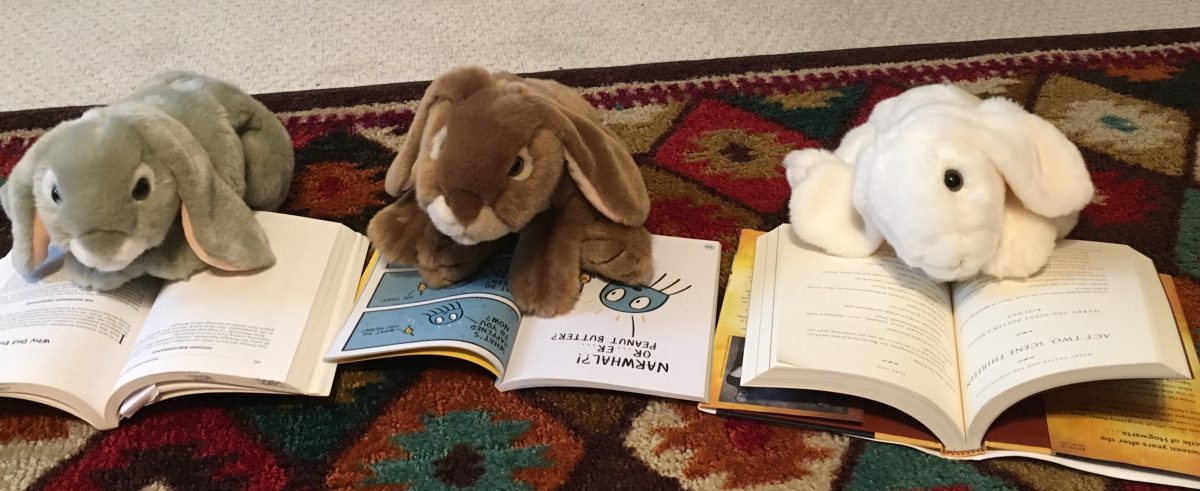
Caramel reviews Spy School: The Graphic Novel by Stuart Gibbs and Anjan Sarkar

Last week Caramel reviewed Spy School by Stuart Gibbs the first book in the author’s Spy School series. He liked it so much that he wanted to read more of the series. And when he learned that there were graphic novel versions of the first couple books, he had to start with those. So today he is talking to Sprinkles about the 2022 book, Spy School: The Graphic Novel, written by Stuart Gibbs and illustrated by Anjan Sarkar. Sprinkles is taking notes and asking questions.
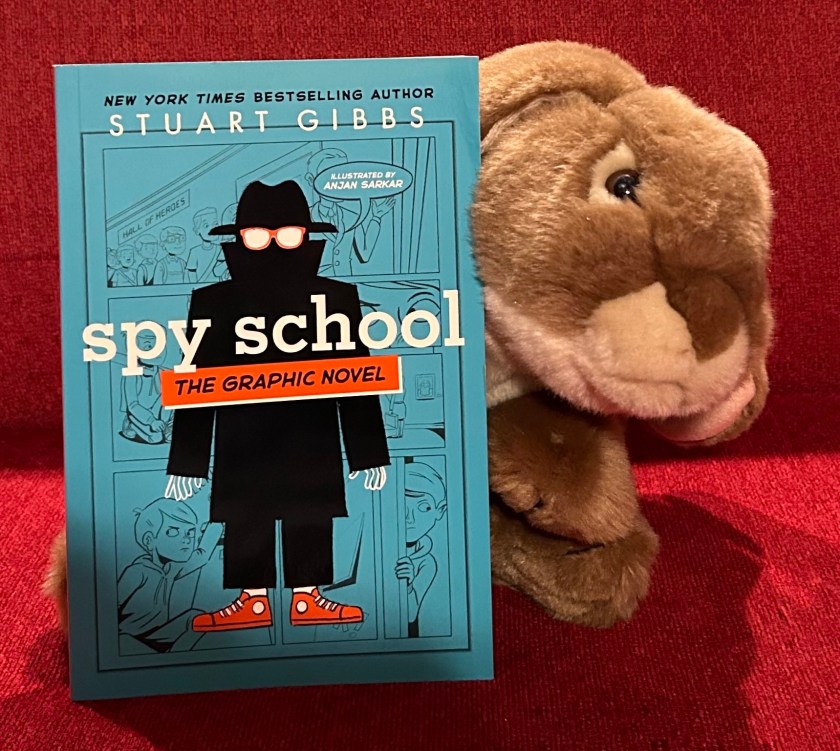
Caramel reviews Spy School: The Graphic Novel, written by Stuart Gibbs and illustrated by Anjan Sarkar.

Sprinkles: So Caramel, I know you like graphic novels, and especially graphic novelizations of books you have enjoyed before. What did you think of this book?

Caramel: I liked it!

S: You did read it quite fast.

C: Yes. And I am rereading it as we speak.

S: I can see that. But I do need you to talk to me, too.

C: Okay. What do you want me to say?

S: You can start by telling me a bit more about this book. So I am assuming the book is about the same kid Ben Ripley and how he goes to a spy school, just like in the original book Spy School that you reviewed last week.

C: Yup. It is basically the same story, except it is a bit different.

S: How so?

C: It is essentially the same plot line, but it is a graphic novel version so they made a couple differences. For example in the original book the dorm rooms do not have any heating. And in this book there is heating. And Murray, one of Ben’s friends, is supposed to be brown haired, but in the graphic novel version he is blondish.

S: I see. So it is almost like a movie version where sometimes the characters don’t quite look like how you imagined them.

C: Yes, exactly. But there is nothing missing really. The story is practically the same.
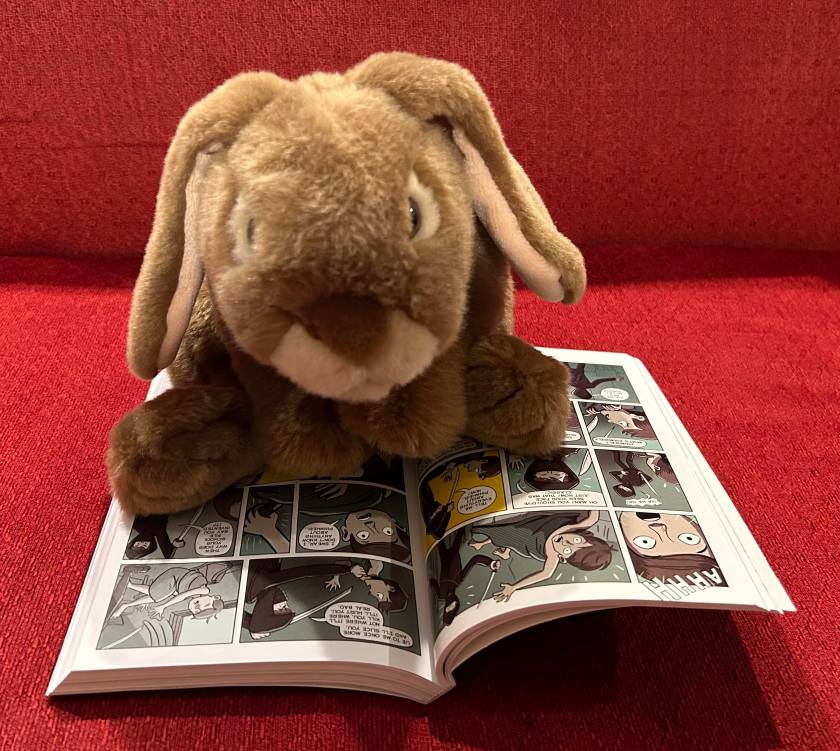
Caramel is reading Spy School: The Graphic Novel, written by Stuart Gibbs and illustrated by Anjan Sarkar.

S: So I am assuming that is a good thing, because you liked the original book.

C: Yes. I did.

S: How are the illustrations? Are they colorful? Realistic? Funny?

C: They are funny. Sometimes the characters make really goofy faces.

S: I think the color scheme is on the darker side though.

C: Yes, maybe because the story is supposed to be serious, because it is spy stuff after all.

S: So we watched a James Bond movie last week, because I wanted you to see the many spy film tropes. Did you recognize any of them in this book?

C: Not as much. The James Bond movie was kind of mushy. And there are girls in this book, too, and the boys talk a lot about them. But there is no really mushy stuff. Thankfully.

S: How about the trope of the main spy character trusting someone who turns out to be a bad guy?

C: Yes, actually. There is one such character.

S: And does the main character get out of hard situations in rather slick ways?

C: Yes. So I guess yes, there are some of the standard tropes. But this is written for young bunnies, and it is a lot of fun, and I really liked it. James Bond, not so much.

S: Well, James Bond was a creation of his times, and those times are now gone. And you are a little too young for his stuff. I have a feeling the Spy School books are just the right level for you, just the right amount of mystery, adventure, espionage, and stuff.

C: Yup. I agree.

S: Okay, so if you were to describe the book in three words, what would you say?

C: Hilarious, actionfull, and nerve-wracking. Things did get tense sometimes.

S: I think that is a good recap, thanks Caramel. I think you want to move on to the next book, so it is about time for us to wrap up this review. What would you like to tell our readers in closing?

C: Stay tuned for more book bunny reviews!
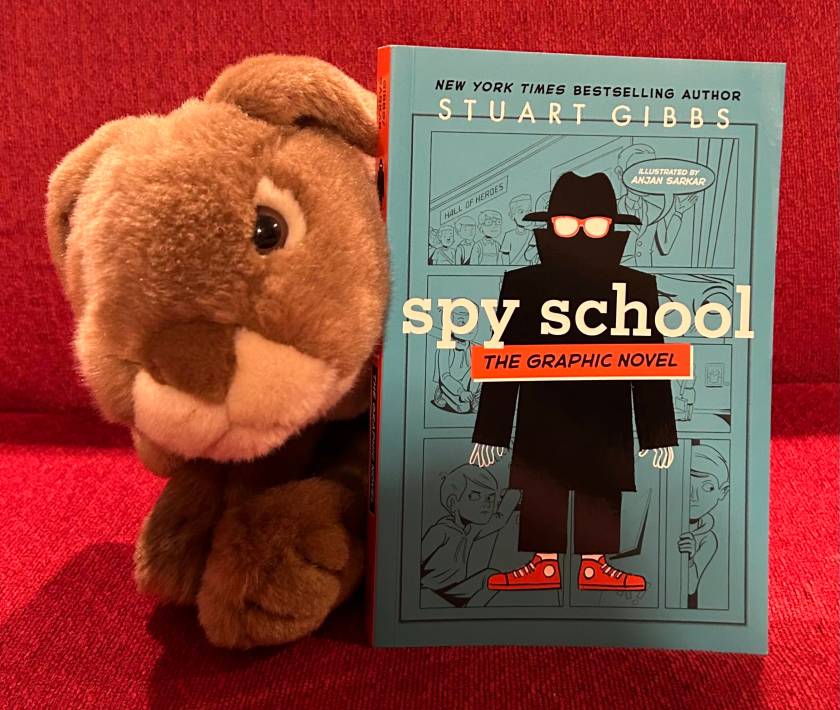
Caramel loved reading Spy School: The Graphic Novel, written by Stuart Gibbs and illustrated by Anjan Sarkar, and is eager to read more books from this fun and exciting series.

Marshmallow reviews Fun Home by Alison Bechdel

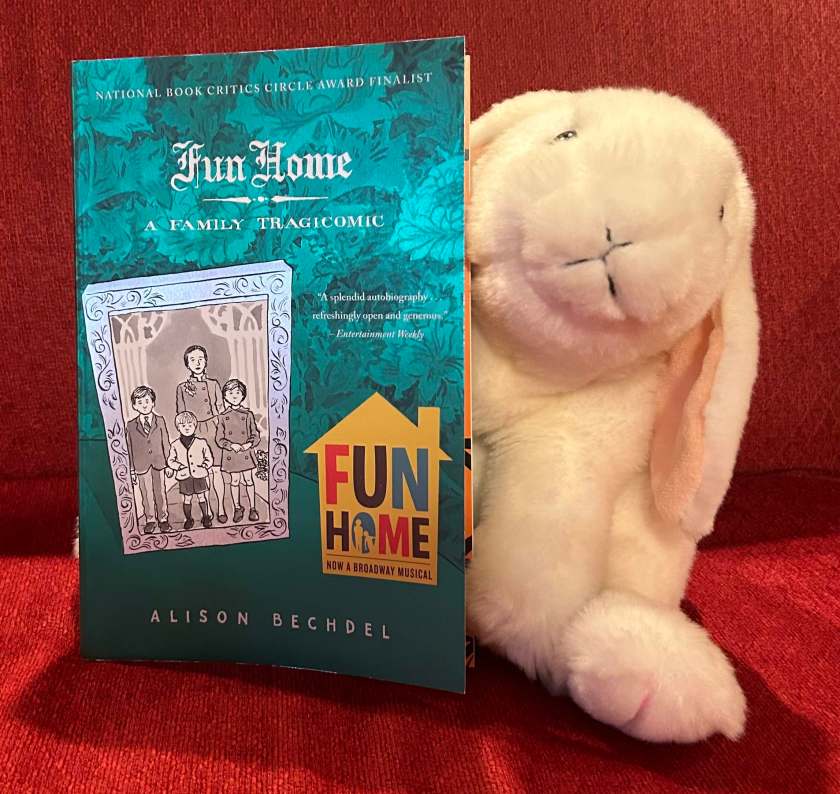
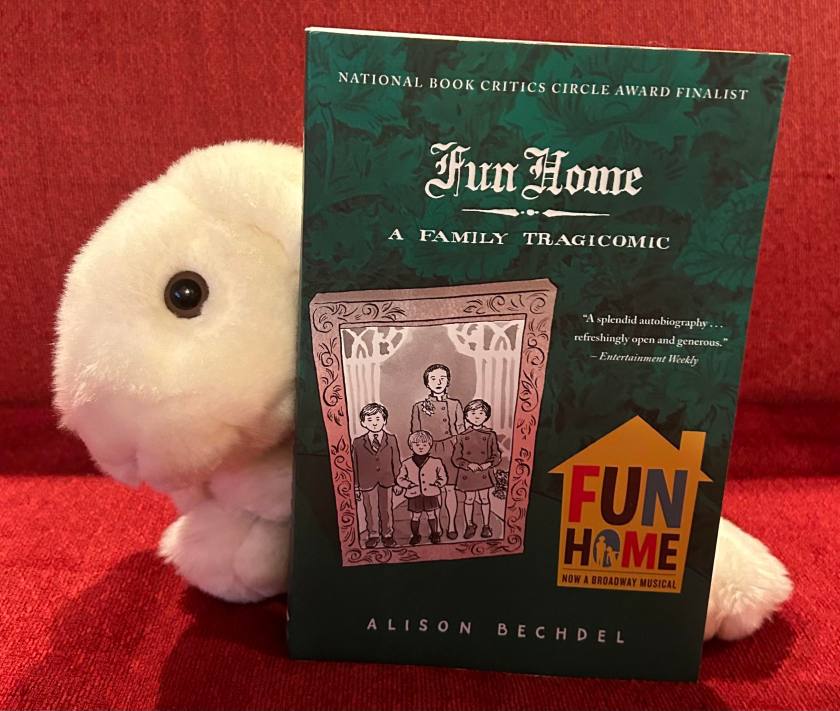
Today Marshmallow reviews Fun Home: A Family Tragicomic by Alison Bechdel, published first in 2006. Sprinkles is taking notes and asking questions.

Marshmallow reviews Fun Home: A Family Tragicomic by Alison Bechdel.

Sprinkles: I know you enjoy reading graphic novels, Marshmallow, so I thought this book might be right up your alley. Let us talk about it. Can you tell our readers first what the book is about?

Marshmallow: The book is about Alison Bechdel herself, who is a cartoon artist. The story is about her growing up and figuring out her sexual orientation and coming out to her parents.

S: That is a pretty serious topic.

M: It is. But it is not all. There is also the fact that her father is also gay, and she eventually figures this out and wants to feel close to him, similar to him.

S: So why is the book called Fun Home?

M: Because her family is running a funeral home, and when they talk of the business, they jokingly call their home the fun home.

S: Is the book funny?

M: I did not think that was the main point of the book. It is essentially a memoir, the artist coming to terms with her sexuality and her family.

S: So the themes seem to me to be more appropriate for older bunnies, would you agree?

M: Yes, probably high school or above. There is some somewhat explicit sexual content, and there is some mention of drug use as well. Caramel wanted to read it too, but I think he might not yet be ready for it.

S: Hmm, I see. Did you know that the book was banned in some places because it was deemed to be immoral?

M: I could imagine. A lot of books about different sexual orientations seem to bother a lot of people.

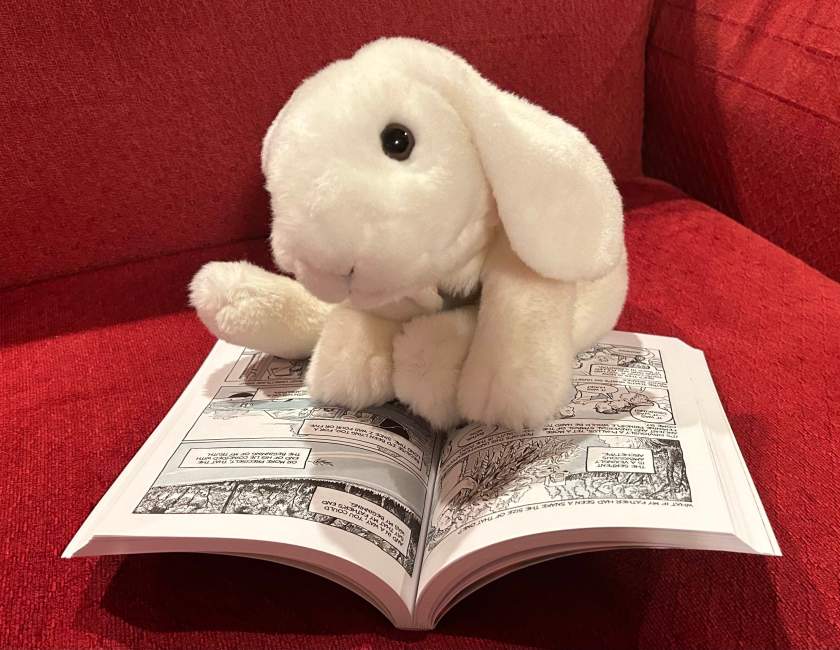
Marshmallow is reading Fun Home: A Family Tragicomic by Alison Bechdel.

S: Did you know this book was made into a Broadway musical?

M: It says so on the cover of the book. So we looked it up and found some of the songs. It apparently won lots of awards! I also remember that Alison Bechdel appeared in a Simpsons episode we saw recently, the one where Lisa and Marge write a graphic novel called Sad Girl.

S: Yes, that is true. And the Bechdel test was mentioned in that episode, too, do you remember? Do you know what the Bechdel test is?

M: Wikipedia says that it is “a measure of the representation of women in film and other fiction. The test asks whether a work features at least two women who talk to each other about something other than a man. The requirement that the two women be named is sometimes added.” That Simpsons episode talked about that too.

S: It is a neat idea, isn’t it?

M: And kind of sad that it is a thing actually.

S: Agreed. Anyways, back to Fun Home. All in all, I am glad you read this book, and we got to talk about it. It is an important book in many ways.

M: I can appreciate that. But I do think it is not very suitable for young bunnies.

S: I get it. So if you were to rate it what would you rate it as?

M: I’d rate it 90%. It is well written, well drawn, and tells an important story. But it is not quite appropriate for young bunnies, and parents and other adults responsible for young bunnies should read it before sharing with their young ones.

S: Fair enough. So let us wrap up this review. What would you like to tell our readers?

M: Stay tuned for more amazing reviews from the book bunnies!

Marshmallow rates Fun Home: A Family Tragicomic by Alison Bechdel 90%.

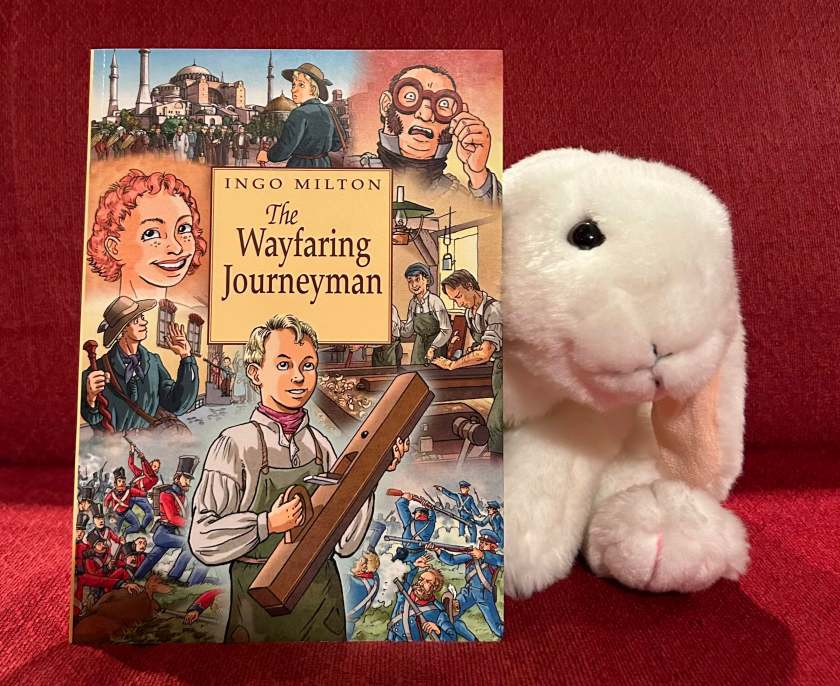
Marshmallow reviews The Wayfaring Journeyman by Ingo Milton

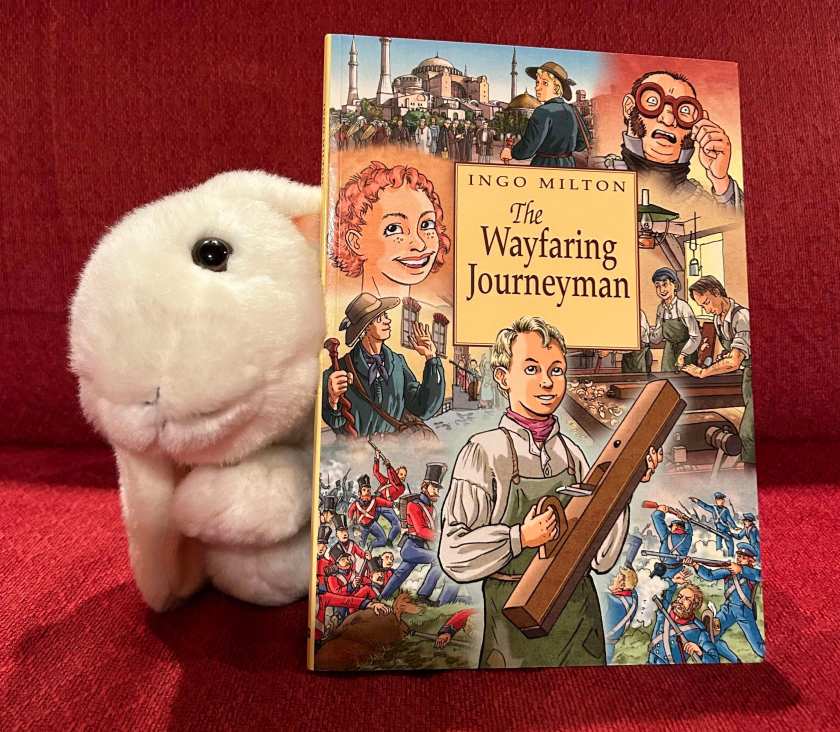
Today Marshmallow reviews The Wayfaring Journeyman: Oskar’s Story from Apprentice to Master, a short graphic novel by Ingo Milton and published in 2015 by Den Gamle By.

Marshmallow reviews The Wayfaring Journeyman: Oskar's Story from Apprentice to Master by Ingo Milton.
Marshmallow reviews The Wayfaring Journeyman: Oskar’s Story from Apprentice to Master by Ingo Milton.

Marshmallow’s Quick Take: If you like historical fiction or if you enjoy graphic novels, then this might be the book for you. 

Marshmallow’s Summary (with Spoilers): Born in 1827 and raised in Haderslev, Denmark, Oskar Larsen begins an apprenticeship in 1839. Apprenticeship is hard work: working under a master cabinet maker, he must endure physical hardship for five years as he toils and trains to become a journeyman. During this time, he must build a wide variety of items and work as a joiner (“a person who constructs the wooden components of a building, such as stairs, doors, and door and window frames”, according to Oxford Languages).

During the day, Oskar works and eats with his fellow apprentices and their master. The master has a wife and two daughters. After the death of the family cat, Oskar becomes close with Esther, one of the master’s daughters. Before he can finish his apprenticeship, he must build a test piece.

After his test piece is approved and he passes the hazing, Oskar becomes a journeyman. As a journeyman, he can work for other master craftsmen but cannot employ others to help him. He travels all around Europe looking for employment opportunities; he even goes to Constantinople, which is today Istanbul. Striving to build his own workshop, he must get approval from the Guild to get his Master’s Certificate.

Once he gets his Certificate, there are unexpected events and Oskar ends up getting married. Things get even more complicated.

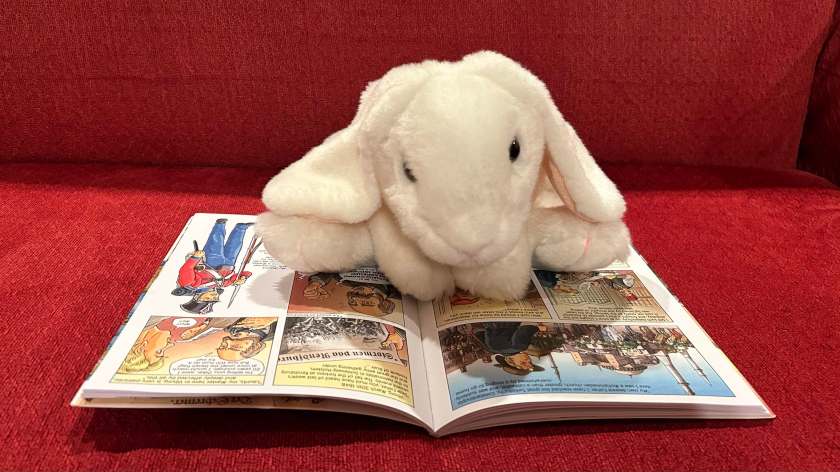
Marshmallow is reading The Wayfaring Journeyman: Oskar's Story from Apprentice to Master by Ingo Milton.
Marshmallow is reading The Wayfaring Journeyman: Oskar’s Story from Apprentice to Master by Ingo Milton.

Marshmallow’s Review: I liked reading The Wayfaring Journeyman: Oskar’s Story from Apprentice to Master. In less than 50 pages, this graphic novel offers a unique perspective on life as an apprentice, a journeyman, and, eventually, a master craftsman in the 1800s. This book taught me a lot that I didn’t know before, especially about trade guilds and their traditions from a couple centuries ago.

Though the story was overall interesting and engaging, I felt the ending was a bit abrupt. The illustrations are vivid and colorful, and overall, the book is easy to read.

According to the text on page 45 of the book, “Oskar is a fictitious character, but the storyline is historically correct, and information refers to actual facts.” He narrates the story, and it is interesting to hear from someone who is supposed to have lived about two hundred years ago.

The Wayfaring Journeyman is mostly kid-appropriate, and I think that the story would appeal to many young bunnies. However, there is a dead body shown pretty early on. There is also some nudity at the end of the book and some bad words here and there, so parents may want to read the book first and decide for themselves. 

Marshmallow’s Rating: 95%. 

Marshmallow rates The Wayfaring Journeyman: Oskar's Story from Apprentice to Master by Ingo Milton 95%.
Marshmallow rates The Wayfaring Journeyman: Oskar’s Story from Apprentice to Master by Ingo Milton 95%.

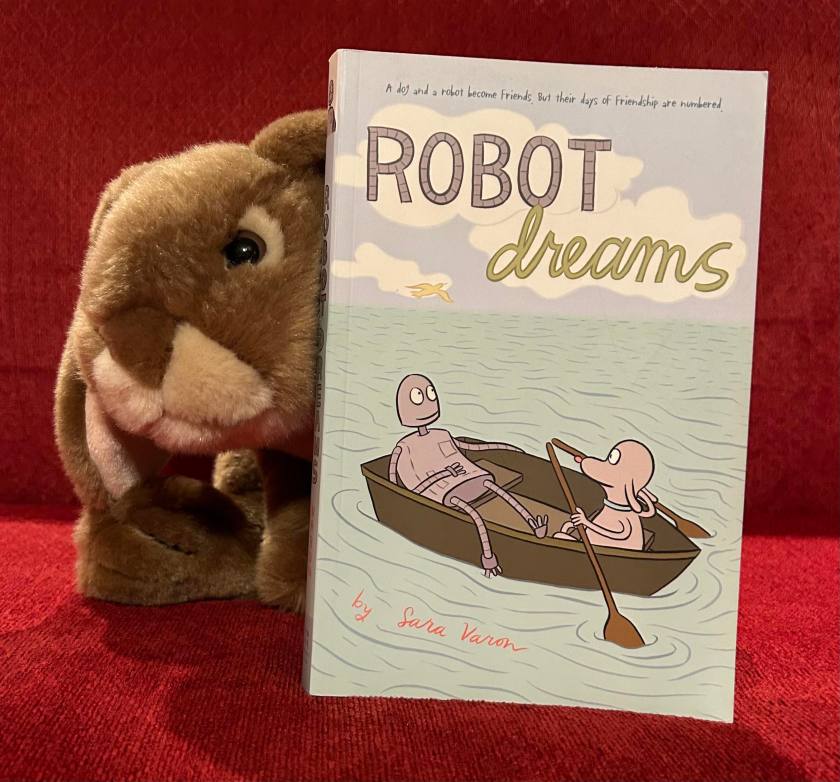
Caramel reviews Robot Dreams by Sara Varon

If it was not clear by now to the readers of this blog, Caramel loves robots. This week he got his paws on a graphic novel published first in 2007 about one particular robot: Robot Dreams by Sara Varon, and he had to review it for the book bunnies blog. As usual Sprinkles is taking notes and asking questions.

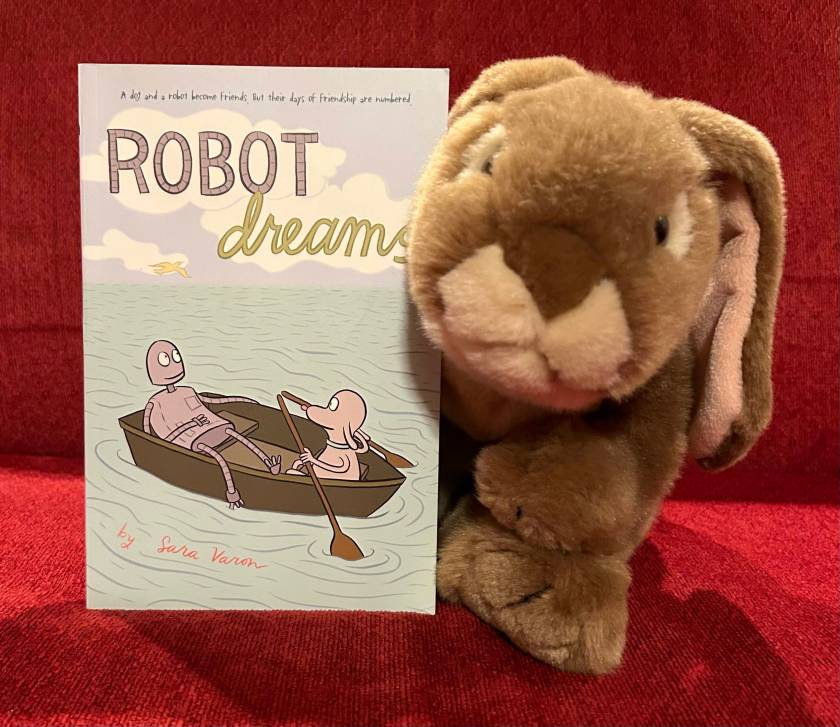
Caramel reviews Robot Dreams by Sara Varon.

Sprinkles: So Caramel, this book was perfect for you, with a robot as one of the main characters, and in a really neatly drawn graphic novel format. Don’t you think?

Caramel: Yes.

S: I knew it! So tell me a bit about the book then.

C: Robot Dreams is kind of sad because it is about a robot who is friends with a dog but then gets rusty and the dog has to leave him.

S: I know. It is pretty sad at times. But it is also really cute and sweet when the dog and the robot are friends and are enjoying each other’s company immensely, no?

C: Yes. I just wanted them to continue to be friends. Forever.

S: Unfortunately, Caramel, there are very few things that last forever.

C: Yes, but I did not need to be reminded of that annoying fact.

S: I understand of course.

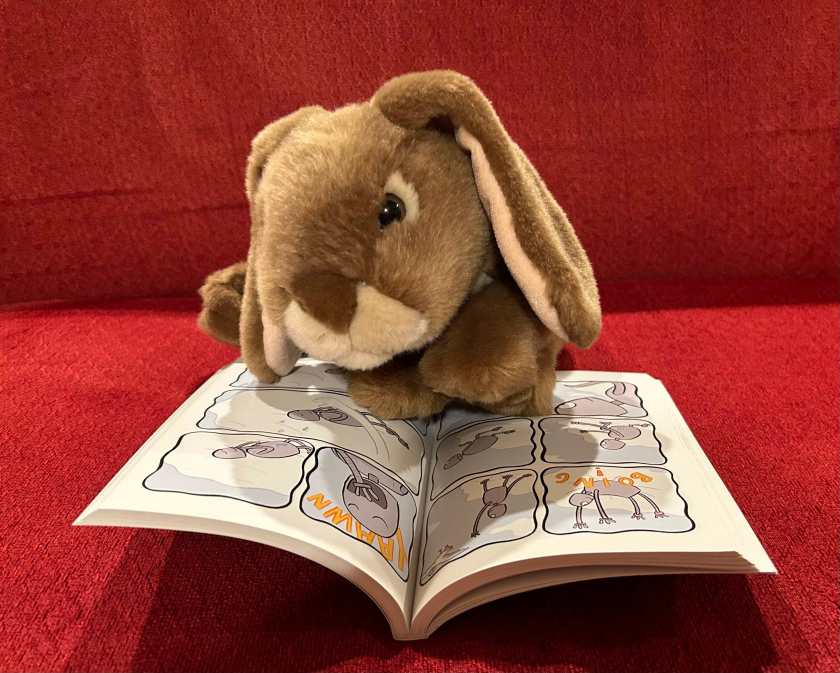
Caramel is reading Robot Dreams by Sara Varon.

S: So tell me a bit more about the book.

C: Well, nobody speaks in the whole book. There are only a few words, when the dog and the robot go to the library for example. And at the very beginning when the dog receives the box containing the robot from the mailman.

S: Hmm, why do you think there are no words?

C: The author said that she feels like she is not the most articulate person, but also that the story was one that could be told without words, because it could be told in actions.

S: And it is, isn’t it? We do see how the two are good friends, and how they enjoy each other’s company, and how they get sad when things go wrong, and so on.

C: Yes.

S: Okay, then tell me a bit about the title of the book. It is a neat title, no? It could have two meanings. The robot is dreaming or the dreams belongs to the robot or about the robot.

C: Yes, either the robot is dreaming or dreams of robots. I like it!

S: Which one is it do you think?

C: I’m guessing it is the first one. Because we see the robot dreaming of the dog coming back and saving him and they are together again, but it is only a dream, unfortunately.

S: I can see that.

C: And in the end both have new friends. The dog has a new robot friend, and the original robot has a new friend who is a raccoon.

S: I guess life goes on, right?

C: Yes, but …

S: I think you don’t like that kind of change.

C: Yes, that is correct. I’d be happier if the dog could have saved the robot.

S: So I know this is a sad book, but it is also very simply illustrated and just beautiful. And I think you actually really liked it. Is that correct?

C: Yes.

S: And so maybe we can add this to the very short list of sad books that you liked even so. (As far as I can tell, there are only two books on that list so far: Charlotte’s Web by E.B. White and Poppy and Ereth by Avi.)

C: Yes. But I would have preferred to add it to a longer list of happy books that I like.

S: I know. but sometimes sad books are good too.

C: I’m not going to comment on that.

S: So let us wrap this review up then. What three words would you use to describe this book?

C: Colorful, wordless, interesting. I only wish I could also say happy.

S: I know. But the three words you gave me work well enough. And what would you like to tell our reader Caramel?

C: Stay tuned for more book bunny reviews!
Caramel loved reading Robot Dreams by Sara Varon and is sure to spend a lot more time with it in the coming weeks and months.