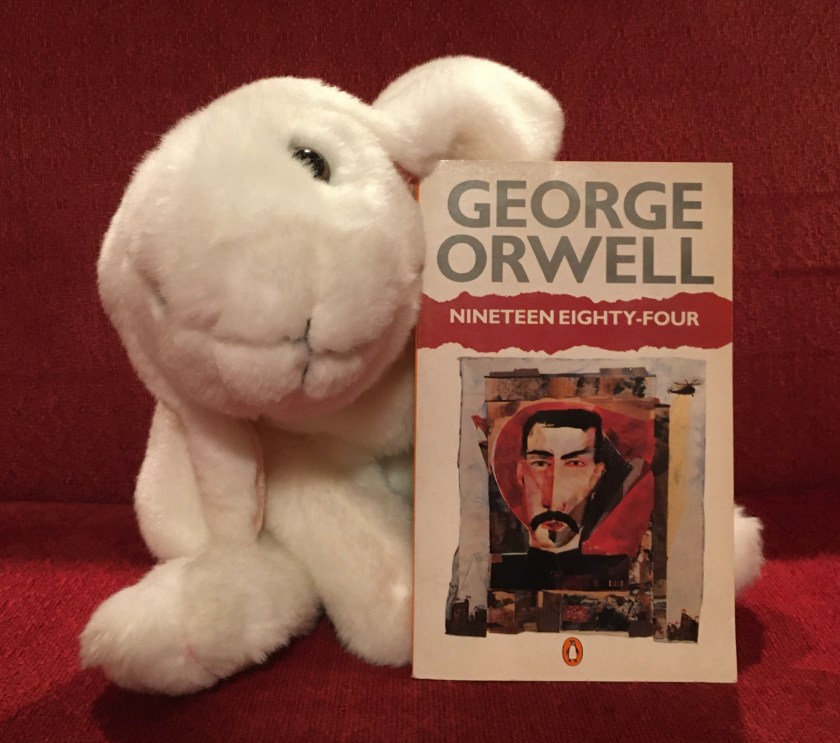
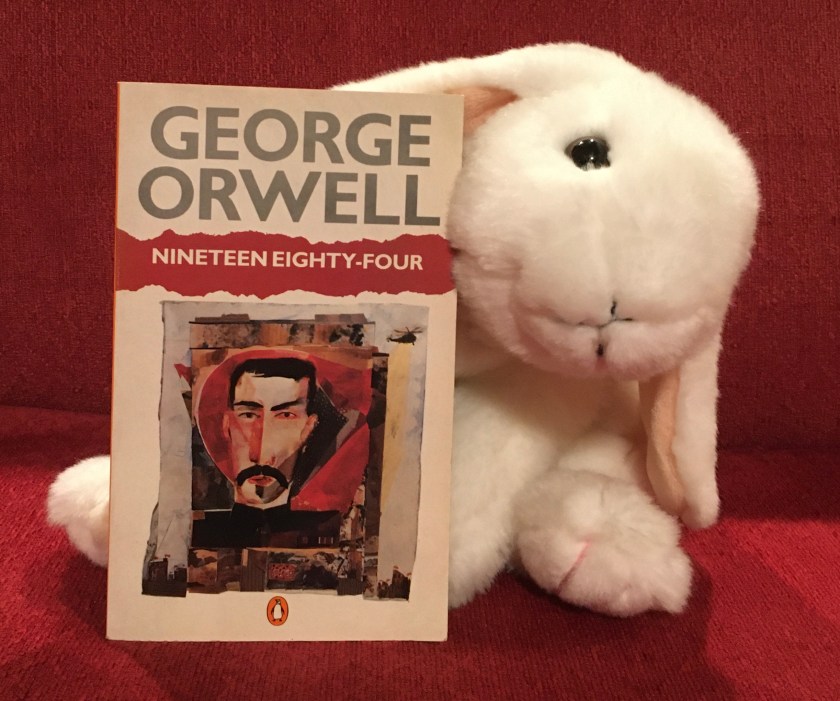
Last week while talking about Flowers for Algernon, Marshmallow and Sprinkles touched upon a book by George Orwell, Nineteen Eighty-Four, first published in 1949. This week, Marshmallow thought it might be a good idea if they picked up this book on its own and chatted a bit about it together.
Sprinkles: So Marshmallow let us start with a quick recap of the book.
Marshmallow: Okay. Winston Smith, the main character of the book, lives in this weird futuristic world. The year is 1984, but even though 1984 is a long time ago for us today, it was a long time in the future when the book was written. The world Smith lives in is controlled by a government, run by the Party, which has several departments with contradictory names. For example there is the Ministry of Peace which deals with war. The Ministry of Truth deals with information and basically propaganda and the brainwashing of the population. And there is a Ministry of Love and a Ministry of Plenty.
S: I remember the Ministry of Truth and the Ministry of Peace, but I did not remember the Ministry of Plenty and the Ministry of Love. What do they do?
M: Ministry of Plenty deals with economic affairs, and the Ministry of Love deals with law and order.
S: Oh, yes, now I remember the Ministry of Love, of course. It involves the citizens’ love of Big Brother.
M: Yes, it seems that is the main goal of all punishment. It is creepy; everywhere the people are reminded that the Big Brother is watching them.
S: That phrase has now taken on a life of its own; people use the Big Brother to talk about government surveillance, and sometimes even corporate surveillance.
M: Yes, you even have a poster that says “Big Brother Is Watching You” in your office.
S: I think it is a good reminder. Even though we are not living in Winston Smith’s world of Oceania, I think it is always a good idea to remember that everything you do can be tracked, especially these days, especially if you are doing anything online.
M: Sounds a bit paranoid, no?
S: Well, I don’t really mean it quite that way. I mean it is always a good idea to think about what bread crumbs you leave for people out there. And it can always be worse, of course. There are many places in the world today, and there have been many societies throughout the world in all its history, where saying things and doing things that the governing people did not approve of would be met with harsh retaliation. We are quite lucky that we are not living in such a system, but it is always good to keep in mind what could have been or what could eventually come to happen.
M: I guess that is why George Orwell wrote this book, right? To warn us?
S: I think so. He was very concerned about the rise of the totalitarian Soviet regime and wanted to describe what could be its ultimate end point.
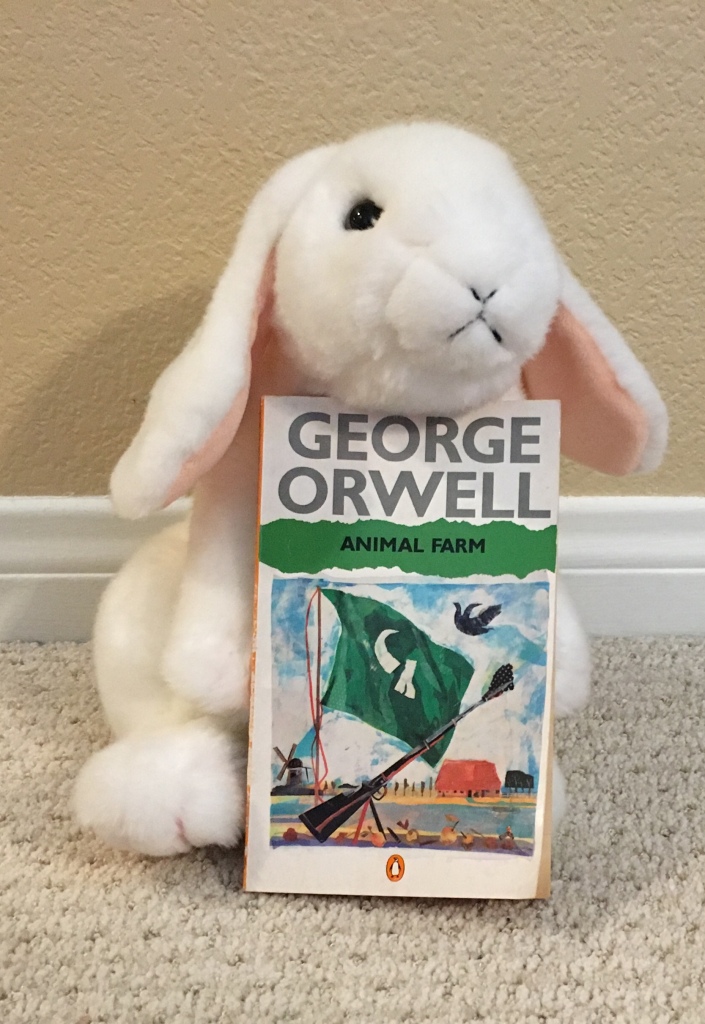
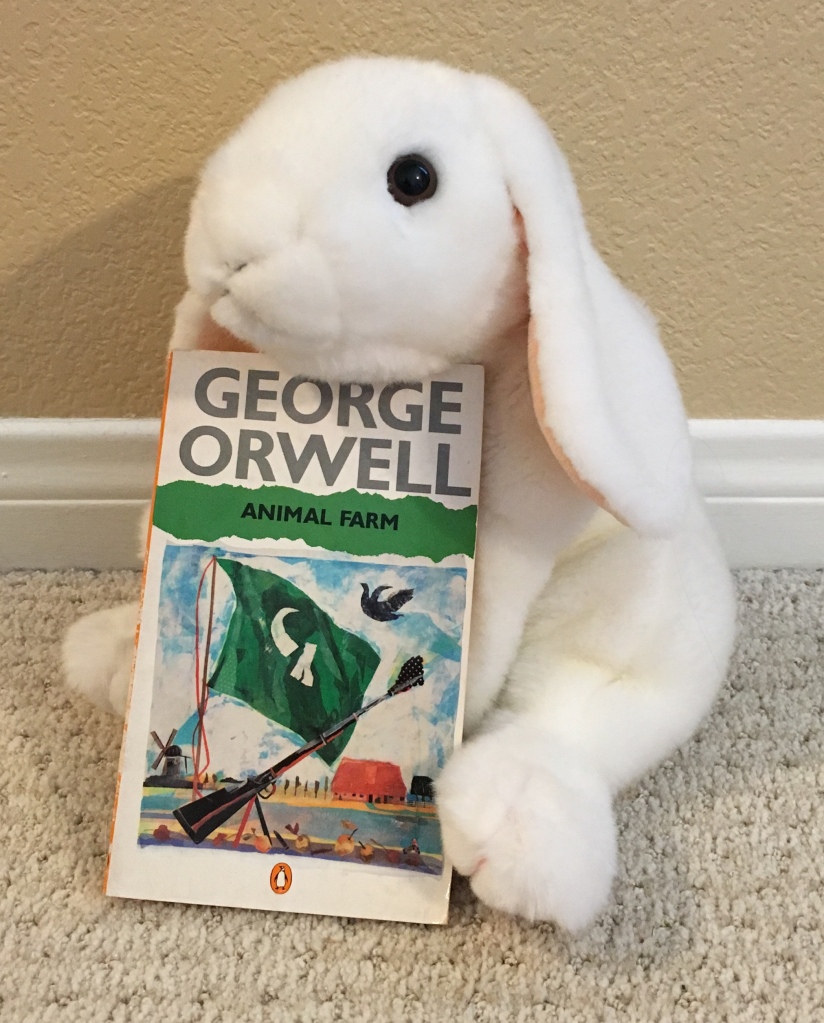
M: In that way, this book does relate to Orwell’s other book that I reviewed for the blog, Animal Farm. That book, too, was a warning in some ways.
S: I agree. But would you want to open that up a bit?
M: That book was about how power corrupts and how governments can fail to represent their constituents’ needs when they are overtaken by ambitious individuals who manipulate the public to their own advantage. Here, too, power shows up. The Party is very much interested in staying in power. In fact that is part of Winston Smith’s job. At the beginning of the book, he is working at the Ministry of Truth and his job is to change the history and the complete record of things when the Party decides to support an alternative interpretation of the facts or sometimes even alternative facts.
S: That phrase has become quite famous these days too. Right?
M: That’s true! But I am also intrigued by the Party. We don’t ever really know what the Party is. And it is not even clear if there is a rebellious faction or if there is any other country out there, or anything else, any other possibility for the people in this world.
S: The Party’s rule is so complete, isn’t it? When I read this book for the first time, I was flabbergasted by the very end. It shook me, and I could not get over it for a while. I guess the total in totalitarian is real.
M: The thing that really got to me is that everything all goes back to the Party, even the illegal activities seem to be led and facilitated and controlled and crushed by the Party as the Party finds fit. It is so weird.
S: No way out. That is how I felt.
M: Yes, it was pretty hopeless. The overwhelming feeling I got was that if you find yourself in this situation, there is no way of getting out.
S: I guess Orwell wanted to warn us that such a future could happen, and once it did, there would be no way out, so we’d better not get ourselves to that point.
M: Makes sense to me.
S: So having read two of his most famous books, which of Orwell’s two books do you like more?
M: I still like Animal Farm more. I especially liked the fable nature of it. It seems to be about these farm animals, but it is so clearly about humans! And it also showed how even though the animals had good intentions at the beginning, they slowly went astray, in small steps. You could see the development, and it was very depressing, too, but you could see the steps that led them astray and you could see the end result would be pretty terrible. Having read Nineteen Eighty-Four, I think it is basically the end result of Animal Farm.
S: It is also a lot shorter and perhaps a bit easier, right? So would you recommend other bunnies to read either of the books?
M: I think both of them are books everyone should read. They are both heavy, but they point to very important issues. So I’d say to all bunnies that they should read both of the books. Not to depress yourself, but to start seeing possibilities and to try and avoid them. There is some sexual relation stuff in Nineteen Eighty-Four, as we spoke about in my review of Flowers for Algernon (though not as much as there was in that book), so perhaps Animal Farm is more appropriate for younger bunnies. And as you say, that book is shorter than this one, so it would be easier to read for that reason, too.
S: I tend to agree with you Marshmallow. I think we have said enough for one review today. As we wrap it up, tell us how you would rate this book.
M: I’d rate it 95%. Very good book, left me quite disturbed in the end.
S: And what else would you like to say to our readers?
M: Stay tuned for more amazing reviews from the book bunnies!
 BookBunnies