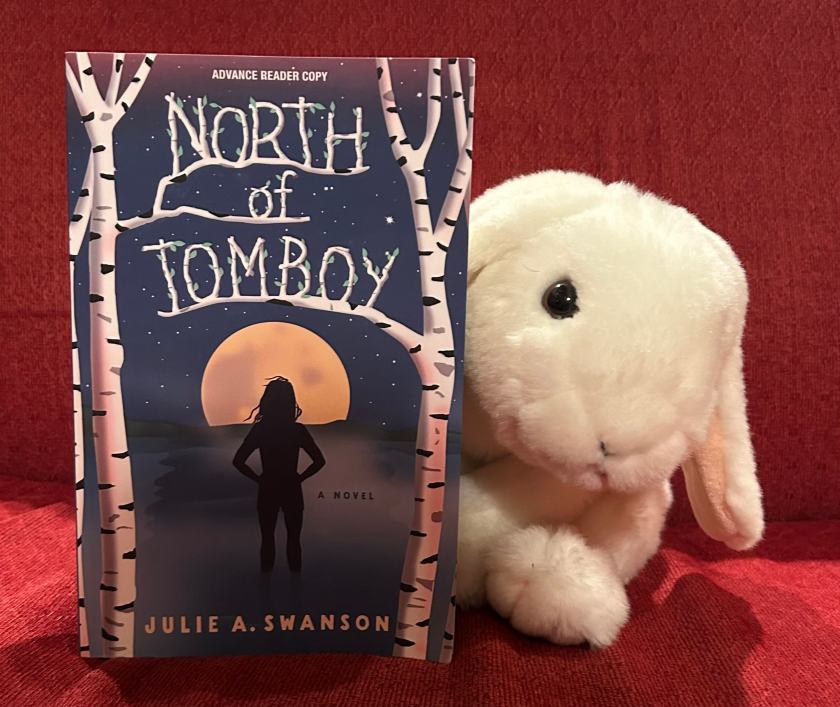
Today Marshmallow reviews North of Tomboy, a new book by Julie A Swanson, that is coming out this week.
The book bunnies received this book as an advance review copy.
Marshmallow reviews North of Tomboy by Julie A. Swanson.
Marshmallow’s Quick Take: If you like books about growing up and exploring your identity and gender, then this is the book for you!
Marshmallow’s Summary (with Spoilers): Jessica Jezowski is a nine-year-old girl, but she definitely doesn’t feel like one. She believes that God must have made her with both girl and boy parts, except for the defining part which he made with only girl parts. Jess lives in Leelanau County in Michigan with her parents, two brothers, and little sister in the very early 1970s. Her mother is very enthusiastic about things Jess feels are only for “girly girls.” She doesn’t like having long hair or wearing dresses because she feels like that prevents her from having any fun and it seems to actually cause her physical and emotional distress.
Jess loves her family, but she sometimes wishes they would stop treating her differently from her older brothers just because she is a girl. For example, she wishes they’d stop giving her baby girl dolls every year for Christmas. However, one year, she can’t bring herself to ignore or destroy the doll she is given (it is insinuated that the previous ones suffered unfortunate fates). She ends up feeling a sort of connection to the doll and cutting its hair. She names it Mickey and announces that it is a boy. She pretends that he is the family’s newly adopted son and animates him, giving him a charming Southern drawl. Using Mickey as a transparent veil of protection, Jess finds that she can be funnier, more confident, and more herself. Mickey, she finds, seems to be more loved than she is. Eventually though, she starts to feel like Mickey is taking over. Jess realizes that she needs to find who she is without hiding behind a doll.
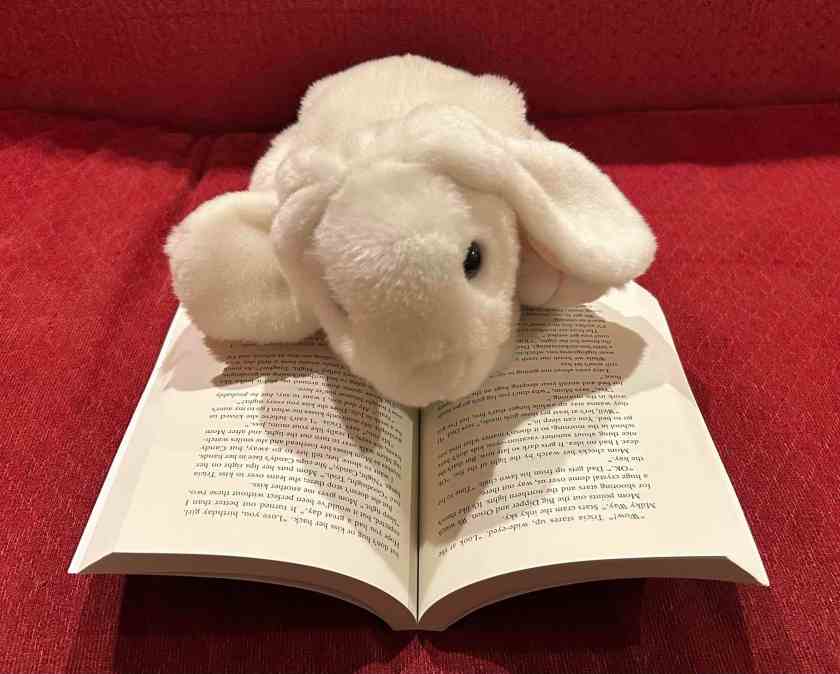
Marshmallow is reading North of Tomboy by Julie A. Swanson.
Marshmallow’s Review: This was a very interesting and eye-opening book. It introduced me to a way of life in a different time period in a different location that I had never experienced before. Swanson does a very good job immersing the reader in Michigan’s nature and scenery, and I really enjoyed learning about what it would be like to live in a place like Jess’s home in the past.
In the beginning of the book, I felt like the writing was a little different from most books I have read. The dialogue felt a little bit off. But then again Jess is supposed to be just nine years old and I have not been nine for quite some time now. (Yes, I am pretty mature for a bunny!) In any case, over time, the prose fell into place and the picture of Jess’s world felt more whole and realistic. Later on, the dialogue was exceptionally good and the characters in Jess’s family became extremely human.
I like how the book both romanticizes the Jezowski’s way of life, but also shows its dark parts. Jess’s father often loses his temper and ends up blaming his wife for things that are not her fault. I thought the way Swanson handled the dialogue concerning his behavior and the family’s responses felt extraordinarily real and nuanced.
North of Tomboy as a whole got progressively more and more nuanced as I read on. I was originally confused by Jess’s feelings in the beginning. It seemed like she just did not like girls or women and so did not want to be one. But I liked how, in the end, Jess realizes that she isn’t necessarily against being female; she just wants to be her own type of girl. This is a take that I found very interesting. At the start, I was confused about whether Jess would have wanted to transition to a different gender or not if this were possible during her time. But soon enough, I noticed that Jess herself is very sexist. She hates being a girl because she thinks girls are all stupid and weak and whiny. This is a result of her upbringing. I think, in other words, that the main character definitely has a lot of internalized misogyny which parent bunnies might wish to discuss with their children if they are reading the book together.
I liked how Jess found who she wanted to be in the end, but I would have preferred it if the book were more explicit in affirming that women do not have to be stupid and weak and whiny. I also liked that we also got to learn a lot about how Jess’s faith shaped her thoughts. It was very interesting to hear her internal dialogue, and the growth of her faith as she was trying to figure herself out was definitely a critical part of the story.
I would highly recommend North of Tomboy to all readers because it really shows the workings of people that many do not understand. Some might say this is a good book about people thinking about their gender, and I think that it is. But I would also say that this is a good book for a lot of other people to read, too, and not for reasons related to gender. I think this shows the way many families work and how some people are raised. It shows a way of life many are not familiar with. Learning about how Jess and her family live was eye-opening. North of Tomboy offers one perspective of what it’s like to be from a very rural, very religious, and rather conservative background. This is not something everyone understands, something I have never experienced. Of course, one book obviously does not and cannot represent the complete picture. But it shows that people whom some vilify are still very human. It is always important to remember that. Understanding where everyone comes from is crucial to making this world a better place for everyone.
Marshmallow’s Rating: 95%.
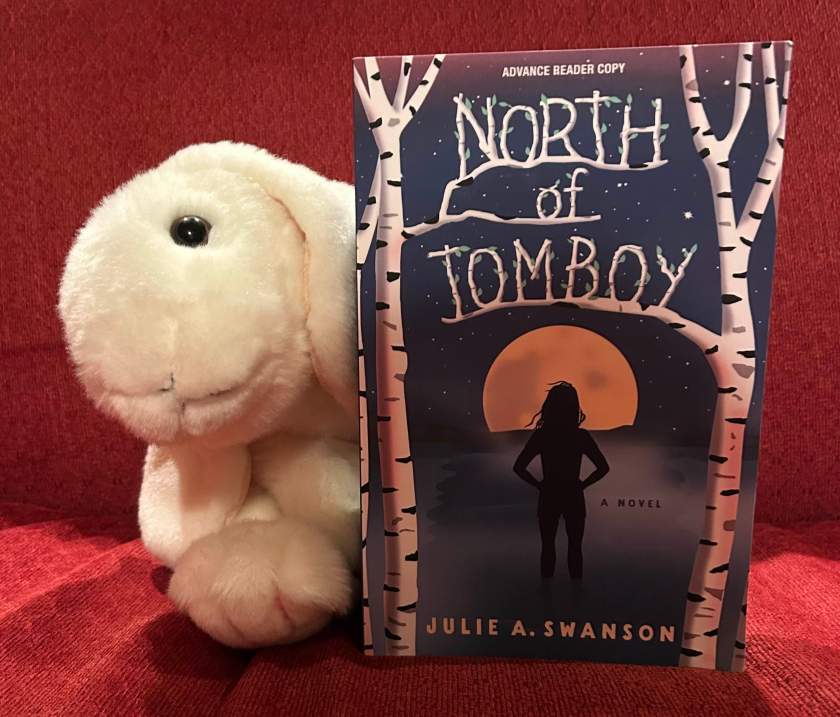
Marshmallow rates North of Tomboy by Julie A. Swanson 95%.
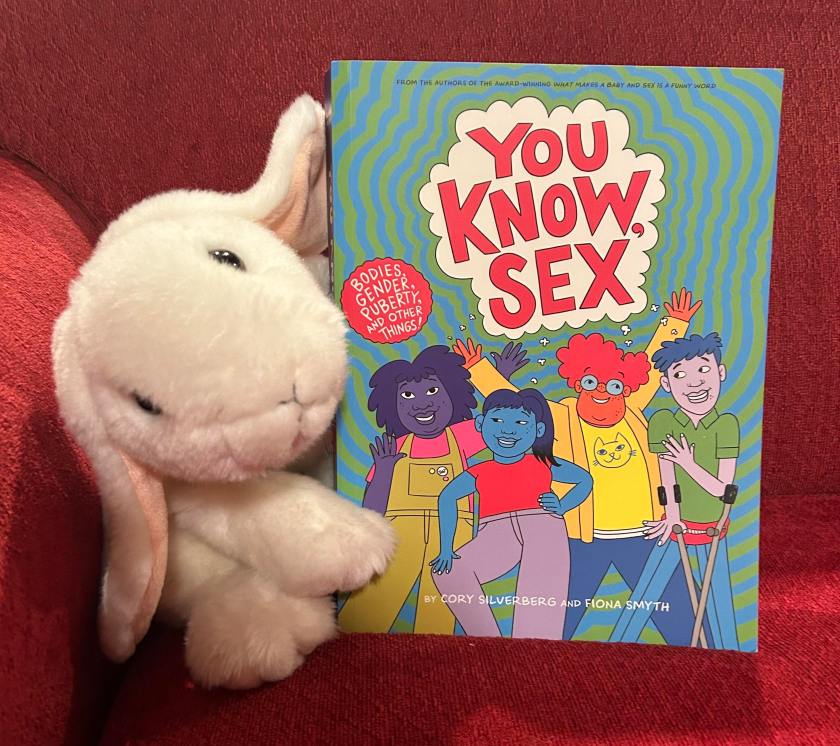
Marshmallow is reading about growing up and this week she wanted to talk about a recent book she read about puberty, growing up, and sex written for young people who are around her age: You Know, Sex: Bodies, Gender, Puberty, and Other Things by Cory Silverberg and Fiona Smyth. Sprinkles is taking notes and asking questions.
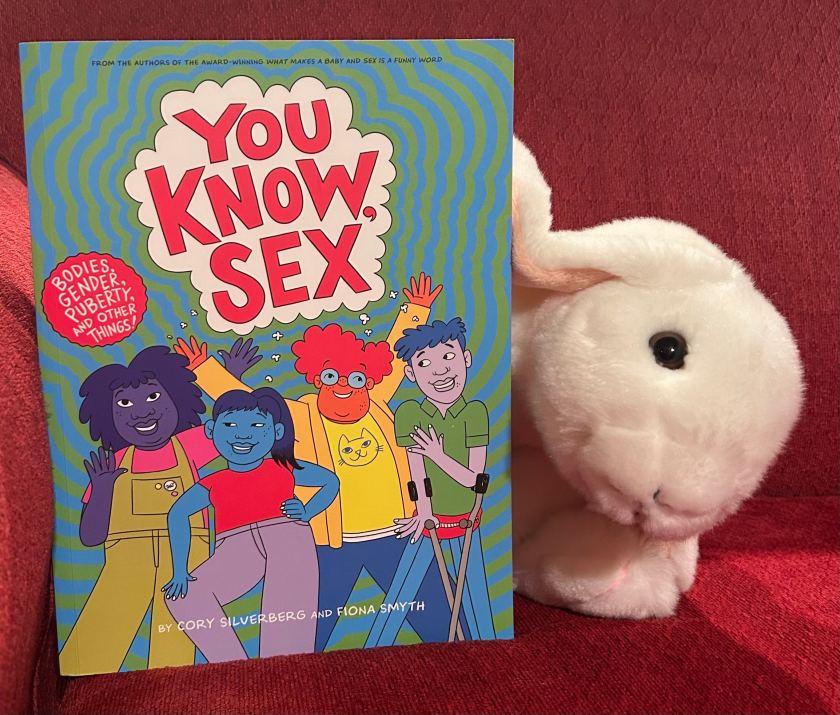
Marshmallow reviews You Know, Sex: Bodies, Gender, Puberty, and Other Things by Cory Silverberg and Fiona Smyth.
Sprinkles: First of all, as we begin this review, I want to thank you for reading this book, Marshmallow. After reviewing a collection of books about where babies come from, I had intended to write a post about a handful of books about puberty next. And one of the books I chose was this one, a huge, 432-page tome written in graphic novel form. But when I began to read it, I realized that my personal discomfort with the form (due to my poor eyesight) would mean I would probably not be able to give it its full due. So thank you for helping me out and checking the book out on your own.
Marshmallow: Well, that’s alright, Sprinkles. It was an interesting read.
S: That’s good to know. Can you tell us a bit about the specifics of the book?
M: Sure. You already said it is big, and has 432 pages. And you said it is written as a graphic novel.
S: The two who wrote this book also were the writer and the illustrator of What Makes A Baby?, one of the books I read for that review of books about where babies come from. And the pictures have the exact same style.
M: Yes, there are people with many different skin colors, like orange and purple and green and blue, and many different shapes and sizes.
S: Does that work well?
M: Yes, it is interesting. I think the people all look quite unique.
S: Well, I guess that makes the book more realistic, right? We are all quite different from one another.
M: Yes.
S: So tell us more about the book.
M: There are eleven chapters. They are titled: What is Sex? Bodies, Gender, Puberty, Feelings, Consent, Talking, Relationships, Reproduction, Touching, and Safety.
S: So the book covers a lot of ground.
M: Yup. It is also very contemporary.
S: What do you mean by that?
M: It has some ideas which I think are contemporary. They talk about gender identity and sexual orientation, transgender and non-binary people, and people having relationships with multiple partners.
S: The last one does not sound too contemporary to me. Polygamy and polyamory have been around for a long time. They have not always been accepted or legal though. I guess the authors are trying to teach the reader to be open minded about different arrangements.
M: I am not sure all readers would be too open to all of these ideas at this point.
S: I agree with that. Actually I too find some of these ideas challenging, especially polygamy. Though rabbits are typically not monogamous, according to Wikipedia, “scientific studies classify the human mating system as primarily monogamous, with the cultural practice of polygamy in the minority”. In any case, it is good to learn about how different people can relate with others.
M: Well, the book does not talk so much about polygamy as polyamory. But yes, it is good to learn about these different things.
Marshmallow is reading You Know, Sex: Bodies, Gender, Puberty, and Other Things by Cory Silverberg and Fiona Smyth.
S: They also talk about the changes a young bunny goes through in puberty, and more generally about biology and mechanics of sexual reproduction, right?
M: Well, yes. There are also very vivid depictions of things. They make an effort to show all kinds of things, so that the reader does not end up assuming that a body part has to look in one specific way. And they show people doing all kinds of different things together or alone.
S: I did look through the pages a lot, too, and I’d say there really are a lot of illustrations that some parents may not be comfortable with.
M: The self-discovery and self-exploration parts might also be kind of touchy topics for some folks, I’d imagine.
S: I did see a section on pornography, and that too is a very challenging topic. Perhaps grownup bunnies should read this book together with their young ones when they feel like the conversations about the various themes and issues that come up will be constructive.
M: I’d agree with that.
S: What were some of the other topics in the book? What topics did you find were most important?
M: They talk a lot about relationships, and I thought it was useful to learn about that. They talk about consent and power in relationships, and sometimes how people talk about being with people as a competition.
S: Yes, I did see that page about how sometimes people talk about “scoring” and the book instead encourages young people to think about “trust, respect, justice, joy, and choice”.
M: Yes, I did find those parts useful. All in all, it is an interesting and useful book, but I think grownups should probably check it out before sharing with their little ones.
S: Agreed. So what would you tell our readers as we wrap up this review?
M: Stay tuned for more amazing book bunny reviews!
Marshmallow appreciated reading You Know, Sex: Bodies, Gender, Puberty, and Other Things by Cory Silverberg and Fiona Smyth, and she thinks all growing bunnies should read a book along these lines; she also suggests grownups check it out before sharing with their little ones.
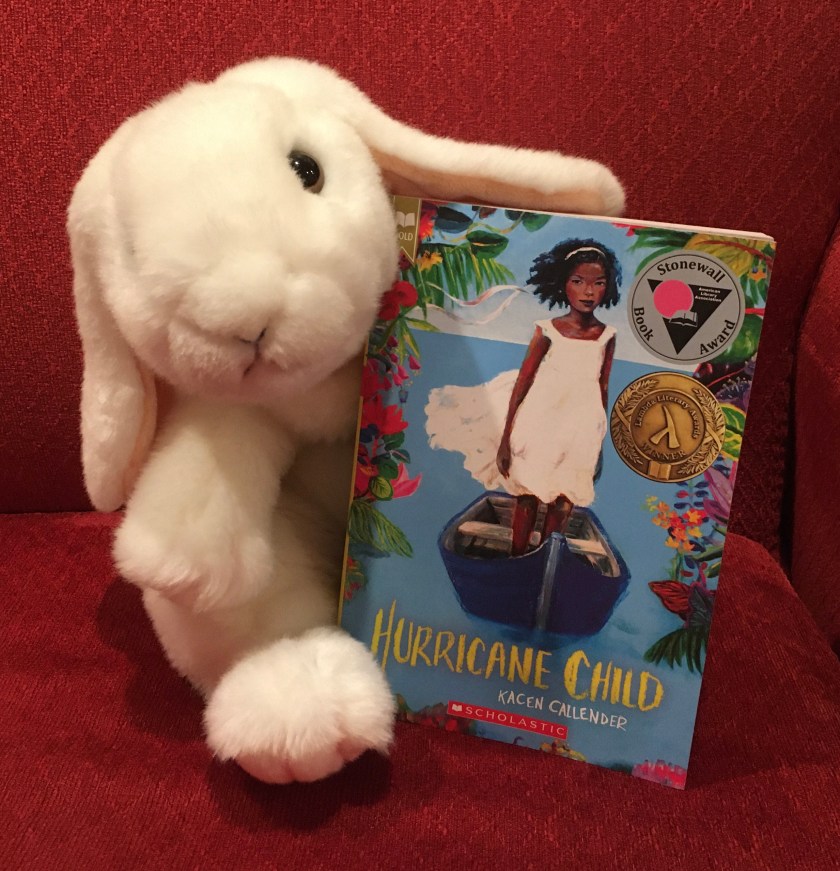
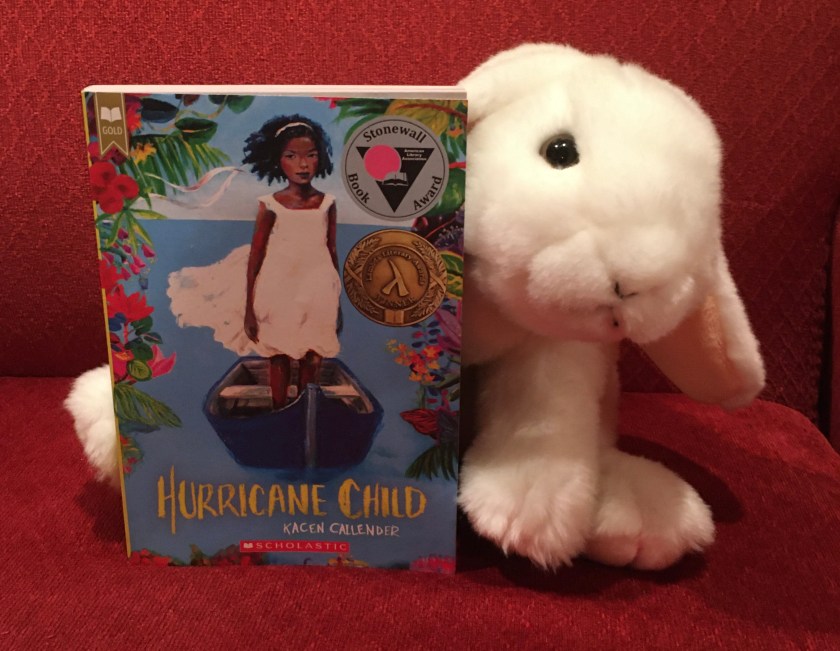
Today Marshmallow reviews Hurricane Child, a novel by Kacen Callender published in 2018.
Marshmallow reviews Hurricane Child by Kacen Callender.
Marshmallow’s Quick Take: If you like books about family, then this might be the book for you.
Marshmallow’s Summary (with Spoilers): Caroline Murphy was born during a hurricane in the U.S. Virgin Islands. This means that she is a hurricane child. But hurricane children are supposed to be unlucky and Caroline has many reasons to feel unlucky. Her mother has disappeared, the children in her school all dislike her, and a woman in black whom no one else is able to see has been following her, ever since she almost drowned on her father’s boat. This woman is everywhere, watching her in school and at home.
Caroline’s life takes an unexpected turn when a new student starts attending her Catholic school. The new student, Kalinda, immediately becomes someone who everyone wants to be friends with. Another popular girl in the school, named Anise who bullies Caroline, asks Kalinda to sit with her group at lunch. Eventually, it seems that Kalinda is now Anise’s friend. However, when Caroline asks Kalinda to sit with her at lunch, Kalinda agrees and they become good friends. In fact, Caroline starts to develop deeper feelings for Kalinda. Unfortunately, Kalinda believes that two women cannot be in love and Caroline hides her feelings.
Eventually Caroline figures out that Kalinda can see the woman in black, too. Caroline believes that the woman in black is related to her mother’s disappearance. When Caroline confides her suspicions with her friend, Kalinda explains that the woman is black is likely a spirit from the spirit world. Caroline begins to worry that the woman in black has stolen her mother and taken her to the spirit world forever.
Marshmallow is reading Hurricane Child by Kacen Callender.
Marshmallow’s Review: I think that Hurricane Child is a beautiful book that was written very well. The author’s writing style is detailed and poetic. The author presented Caroline’s feelings, her hate, her love, and her sadness, very well. The characters are well written, are realistic, and are relatable.
On the other hand, the plot had so many elements that I found it slightly hard to keep up. I had trouble occasionally following all the plotlines and I did not understand everything during my first reading. However, all loose threads of the plot were eventually tied up with satisfying endings.
As a literary fiction style, magic realism paints a realistic view of the modern world while also adding magical elements, often dealing with the blurring of the lines between fantasy and reality. Magical realism, perhaps the most common term, often refers to literature in particular, with magical or supernatural phenomena presented in an otherwise real-world or mundane setting, commonly found in novels and dramatic performances. Despite including certain magic elements, it is generally considered to be a different genre from fantasy because magical realism uses a substantial amount of realistic detail and employs magical elements to make a point about reality, while fantasy stories are often separated from reality. Magical realism is often seen as an amalgamation of real and magical elements that produces a more inclusive writing form than either literary realism or fantasy.
Reading this, I think Hurricane Child is definitely magic realism, as the woman in black somehow blends into the realist plotlines of the story. (Ikenga, the book I reviewed last week, is probably also in this genre.) Maybe this aspect of the book was a reason why I had some difficulty first understanding what was real and what was actually going on.
Marshmallow’s Rating: 90%.
Marshmallow rates Hurricane Child by Kacen Callender 90%.
This week Sprinkles reviews a few books about gender identity written for children.
Marshmallow and Caramel have been complaining that Sprinkles has not written a post since last Halloween (when she had reviewed a handful of children’s books about zombies). So she decided to write another one before the anniversary of that post came around. This is the post that resulted.
This week Sprinkles reviews a few books about gender identity written for children, with a nod to the International Pronouns Day, which was just this past Wednesday.
Sprinkles reviews children’s books on gender identity.
There have been a range of children’s books about gender identity written recently. In this post I would like to share some of my thoughts about eight of them: Julián Is A Mermaid by Jessica Love; Red: A Crayon’s Story by Michael Hall; Neither by Airlie Anderson; Pink Is For Boys written by Robb Pearlman and illustrated by Eda Kaban; The Gender Wheel by Maya Gonzalez; Who Are You? The Kid’s Guide to Gender Identity, written by Brook Pessin-Whedbee and illustrated by Naomi Bardoff; It Feels Good To Be Yourself, written by Theresa Thorn and illustrated by Noah Grigni; and They, She, He, Me: Free To Be! by Maya Gonzalez and Matthew Smith-Gonzalez.
I begin with a review of a handful of them that aim to emphasize the point that being different is alright, and there is a place for all of us in this world.
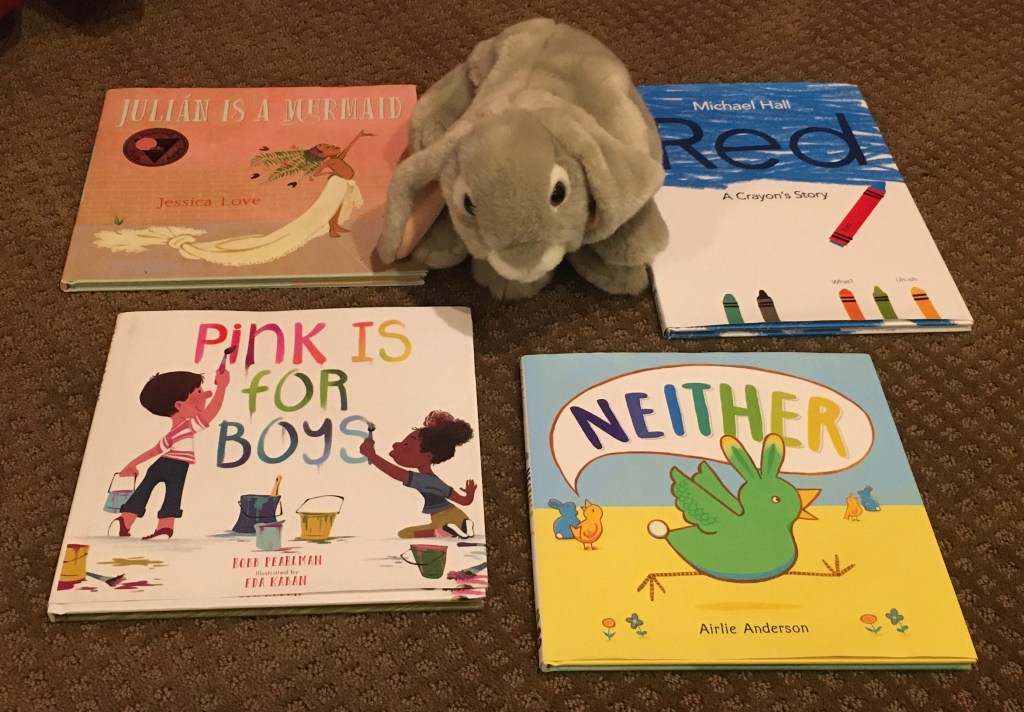
Sprinkles is posing with four books that emphasize that being different is okay: Julián Is A Mermaid by Jessica Love, Red: A Crayon’s Story by Michael Hall, Neither by Airlie Anderson, and Pink Is For Boys written by Robb Pearlman and illustrated by Eda Kaban.
In Julián Is A Mermaid by Jessica Love we meet a little boy named Julián who wants to dress up as a mermaid. He finds acceptance in an unexpected place. The book ends as a celebration of differences. The colors of the book are pastel and lively at the same time, inviting us to Julián’s beautiful world.
Sprinkles is reading Julián Is A Mermaid by Jessica Love.
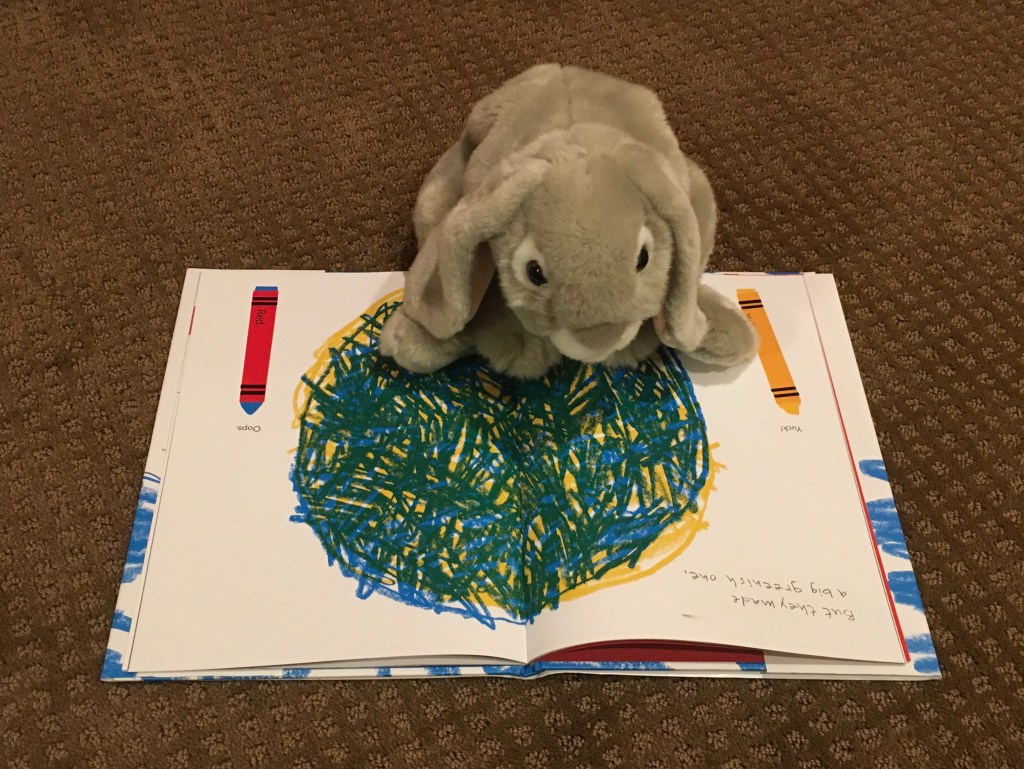
In Red: A Crayon’s Story by Michael Hall, we meet a little crayon who is blue but is in a red covering paper. He has a difficult time at the start trying to fit in. But in the end he finds that he can be who he is, and life is good again. The color scheme used is simple and reminded me a bit of the book series about crayons by Drew Daywalt. (Caramel reviewed The Crayons’ Christmas, the third book of that series, for our blog.) The illustrations are not intricate but they do exactly what they are meant to and give us a sense of this crayon’s inner world and the world around him as well.
Sprinkles is reading Red: A Crayon’s Story by Michael Hall.
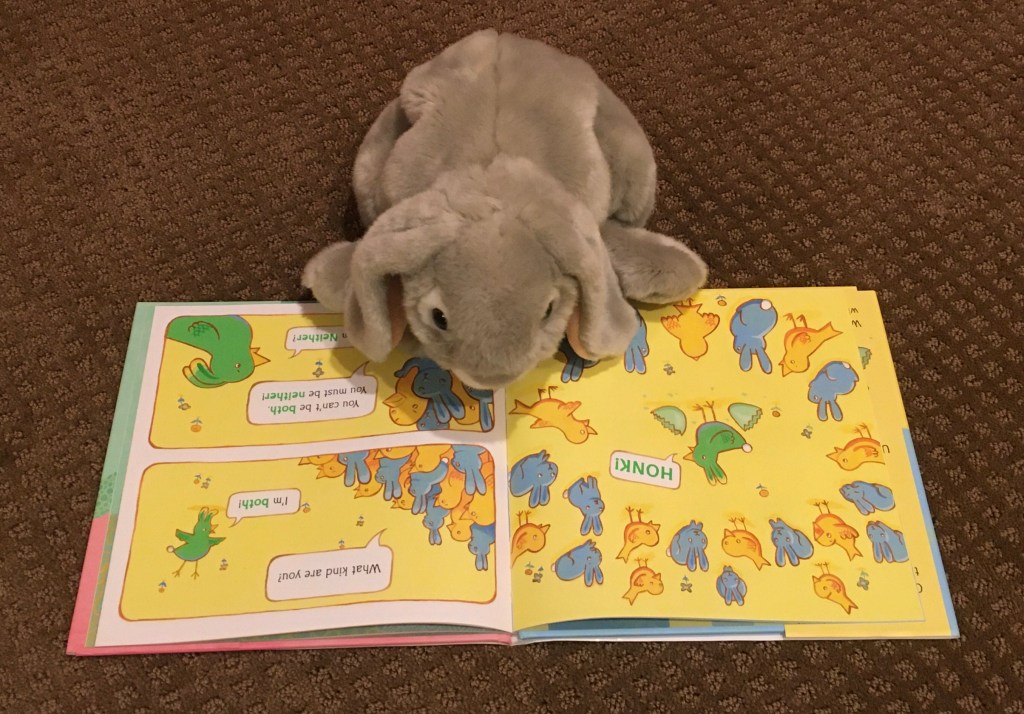
In Neither by Airlie Anderson, we learn of a land of This or That, where every creature has to be this or that, and when there is an individual who does not fit either, they are mocked and excluded from the two groups formed around being This and being That. Eventually we see our outcast, who sees themself as a Both but is called Neither by the two groups, finds themself in a land where they are accepted, along with everyone else. The colors are bright and cheery, and the little creatures are simply drawn but pretty cute.
Sprinkles is reading Neither by Airlie Anderson.
All three books remind me a bit of a fascinating little book Caramel reviewed a while ago for this blog: From the Stars in the Sky to the Fish in the Sea by Kai Cheng Thom. That book had a dreamy atmosphere, and the main character was a child though magically different from others. Julián from Julián Is A Mermaid is also a little child, and I can see a little boy being comforted by reading about him and his dream of being a mermaid coming true. In some ways though, Neither and Red: A Crayon’s Story might be easier for parents who want to broach the subject of being different without explicitly bringing up gender identity. It is easy to identify the perceived and assumed boy-girl gender binary underlying the stratification of the land of This and That in Neither, though it is never explicitly stated. Similarly, the Blue Crayon in Red: A Crayon’s Story is also suffering from his peers’ expectations about how he should behave given what he looks like, but there is no explicit discussion of boyhood or girlhood.
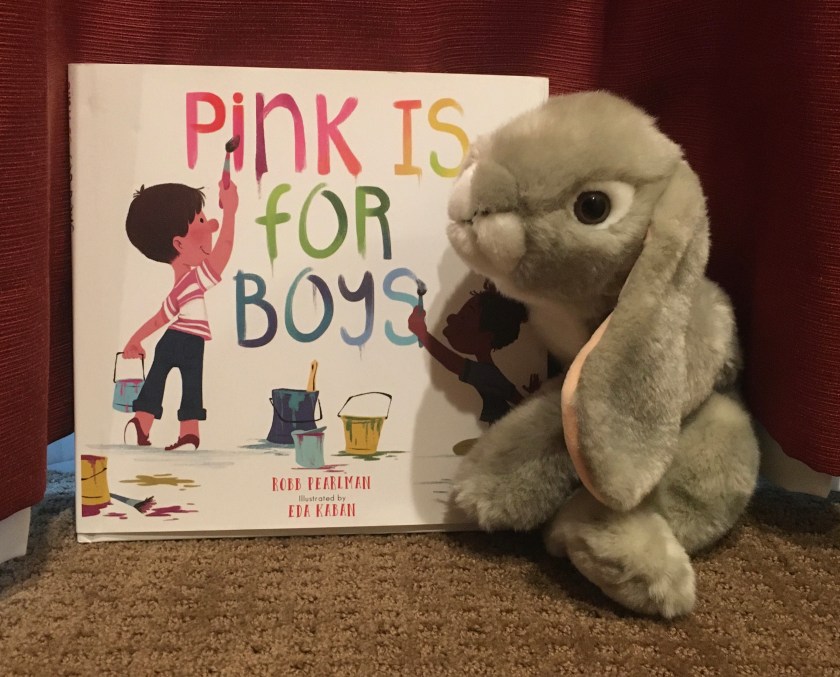
On the other hand, Pink Is For Boys, written by Robb Pearlman and illustrated by Eda Kaban, brings up the boy-girl binary right up front. The main point here is that boys can like pink just like girls can like blue. Similarly boys can enjoy bows on dresses and girls can like baseball. The binary is not really questioned here, but instead, children are told that the boundaries of the two categories are porous in many ways, that boys and girls can enjoy all sorts of things and still be themselves.
Sprinkles poses with Pink Is For Boys, written by Robb Pearlman and illustrated by Eda Kaban.
The first three books I described above were stories and could easily be viewed as fictional, though obviously the authors were writing with a particular goal and an intended moral. The fourth book was more an advice book, a nonfiction text that openly tells the child reading it (or being read to) what to think about the topic.
The next four books fit this mold as well. They are more like an adult talking to a child who is maybe a bit concerned about being different or simply curious about gender identity, even if they may not be asking explicitly to talk about the topic.
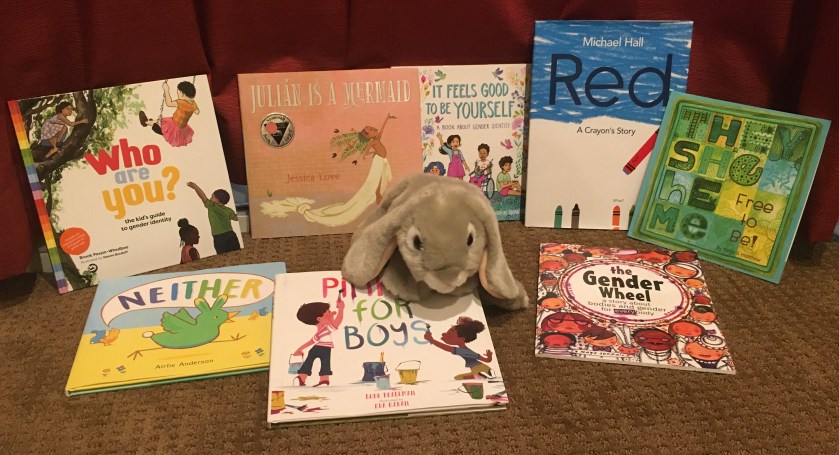
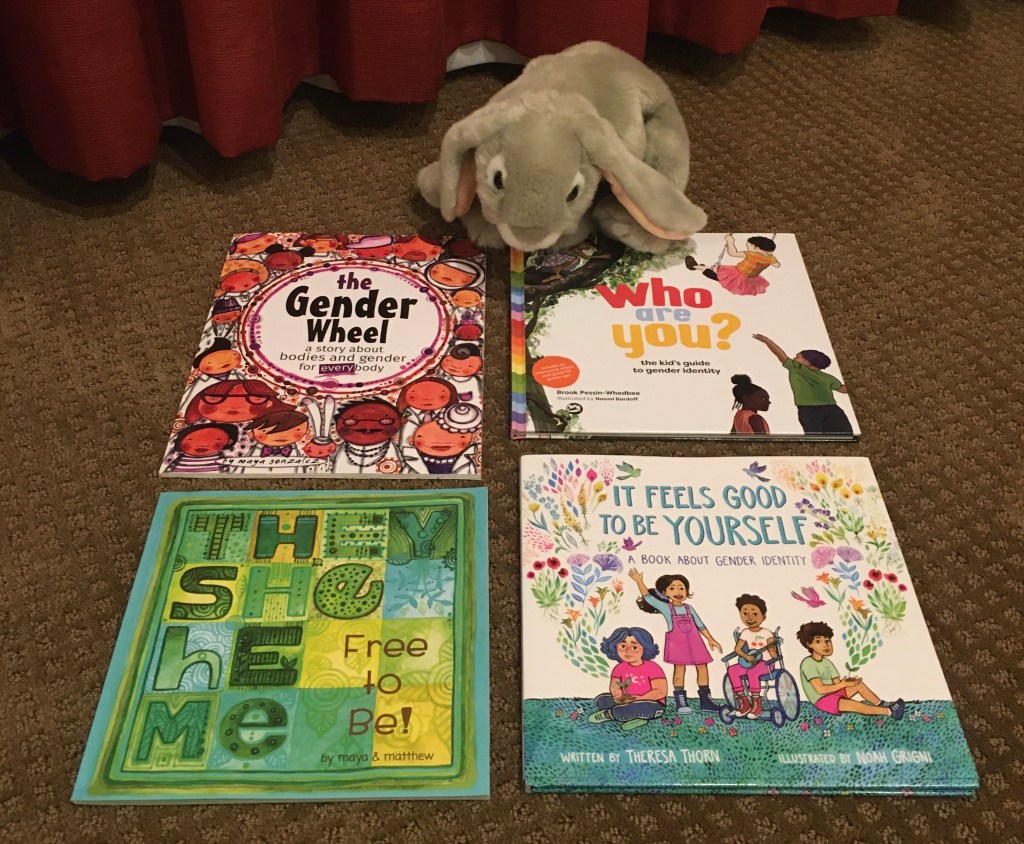
Sprinkles is posing with four books that explain pronouns and gender identity to children (and possibly also the adults who are reading with them): The Gender Wheel by Maya Gonzalez, Who Are You? The Kid’s Guide to Gender Identity, written by Brook Pessin-Whedbee and illustrated by Naomi Bardoff, It Feels Good To Be Yourself, written by Theresa Thorn and illustrated by Noah Grigni, and They, She, He, Me: Free To Be! by Maya Gonzalez and Matthew Smith-Gonzalez.
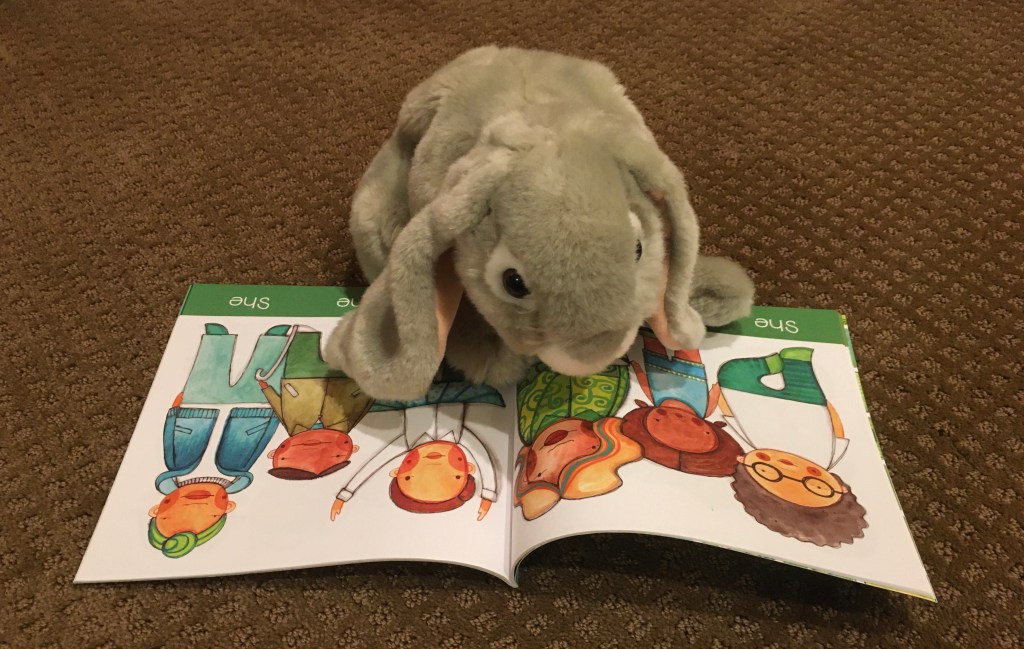
Let me start with They, She, He, Me: Free To Be! by Maya Gonzalez and Matthew Smith-Gonzalez. Among the four books explicitly about gender identity, this one is perhaps the simplest though definitely not oversimplified. The book starts with page after page of pronouns and pictures of people, and the pictures are pretty amazing.
Sprinkles is reading the pages in They, She, He, Me: Free To Be! by Maya Gonzalez and Matthew Smith-Gonzalez that display various ways of being a “she”.
The emphasis of the book is on pronouns, but the main text that starts after the pronoun depictions is quite extensive. Though organized under headings of Pronouns, Freeing Pronouns, Claiming Pronouns, Creating Pronouns, Using Pronouns, and Playing With Pronouns, the text touches upon the uniqueness of each individual, the creative possibilities of pronouns, and the freedom to be who you want to be. Creators of this book share a bit about themselves too and then have a few words for the grownups. They summarize the main goal of this book really well in their personal introduction:
As parents we want our kids to feel fully free to blossom into their maximum magnificence.
They, She, He, Me: Free To Be! by Maya Gonzalez and Matthew Smith-Gonzalez
The Gender Wheel is written and illustrated by Maya Gonzalez, too. This book is a bit broader in its coverage of gender identity, and is beautifully illustrated, with lyrical language that explores the implications of thinking of the world and our identities as parts of a circle. I loved how the author kept coming back to the circle as a metaphor and a reflection of the world as well as our own inner lives.
However, the book is very U.S. centric, and explicitly asserts that the boy-girl gender binary was brought to North America by European settlers, who had “linear and rigid” beliefs and so they “boxed people in and kept nature out”. Though I sympathize with the author’s perspective, I see it as quite limited in the global context, as the gender binary is alive and well all around the world, without direct need for any seventeenth-century European influences. And though some native peoples of this continent may have had more fluid perceptions of gender than the ones we are living with these days (according to this Berkeley website for example, “more than 150 different pre-colonial Native American tribes acknowledged third genders in their communities”), this was definitely not always as freeing as some might imagine, and may not have meant what we might think it does. (The same website asserts that “By no means did all pre-colonial Native American communities accept or celebrate gender and sexual orientation diversity.”) So I saw this pass at colonialism as an unnecessary distraction.
Sprinkles is reading The Gender Wheel by Maya Gonzalez.
The gender wheel in the title of the book is extremely useful as a tool however. It is a beautiful way to visualize and understand the complexities of the construct of gender and it allows the reader to be able to distinguish between physical and biological bodies, how one feels inside their body, and how one chooses or needs to engage with the outside world. While scholars of gender studies dig deep into the nuances of their constructs and appreciate all their complexities, for the rest of us these very same intricacies might be barriers in understanding ourselves and our loved ones. Gonzalez and her wheel make the ideas quite transparent and very much easier to understand (and even discuss with young ones in our lives).
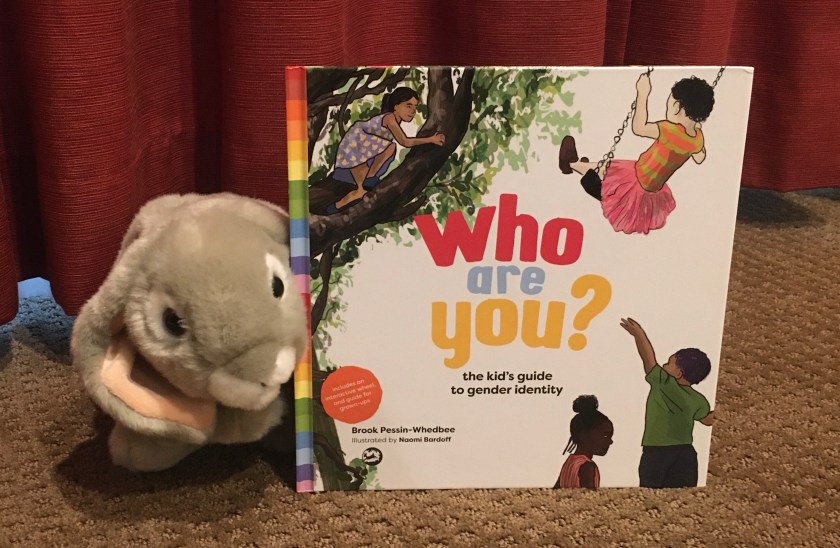
A similar idea is used and offered as a tool in Who Are You? The Kid’s Guide to Gender Identity, written by Brook Pessin-Whedbee and illustrated by Naomi Bardoff. This book, too, explicitly describes gender as made up of three layers; these are called Body, Identity, and Expression. (In The Gender Wheel, Gonzalez labels the layers as the body circle, the inside circle, and the pronoun circle.) Having read the two books together, I now find both sets of labels making a lot more sense to me. Unfortunately it seems that the latter book (Who Are You?) does not acknowledge the source of their own wheel construction, and as a result, it is highly likely that this is a case of plagiarism (see Maya Gonzalez’s blog post about the issue here.)
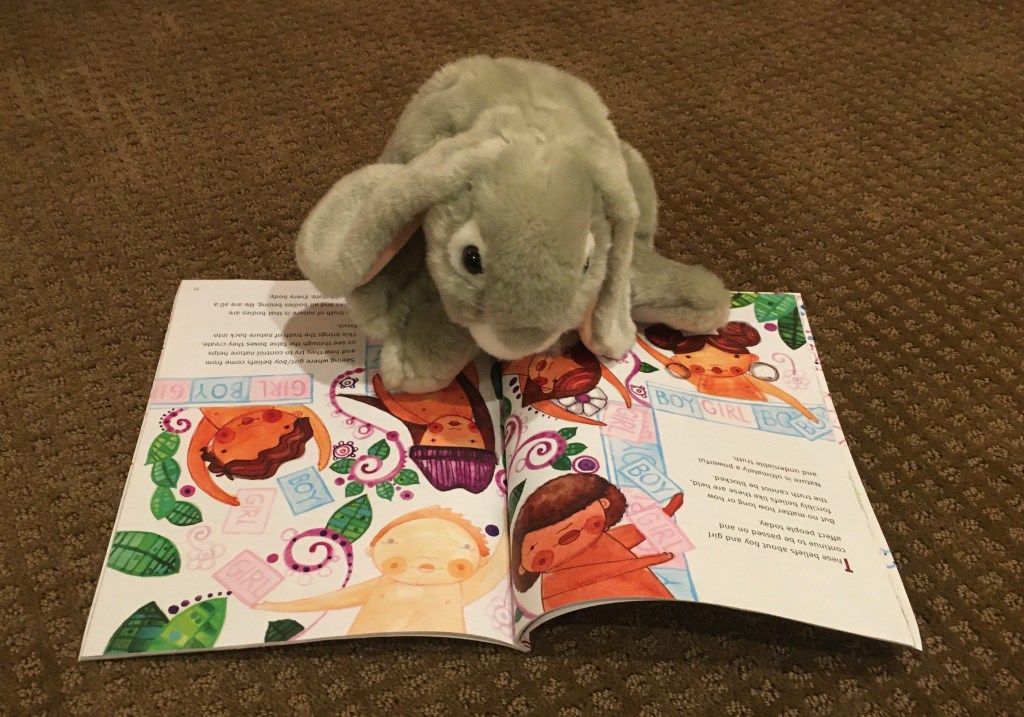
The illustrations in Who Are You? are in some ways a bit less whimsical than those in The Gender Wheel, which definitely reflects its creator’s particular style (as also seen in her book with Matthew Smith-Gonzalez, They, She, He, Me: Free To Be!). But they are definitely not boring or unattractive. Actually they occasionally reminded me very much of the style of the If You Give … series written by Laura Numeroff and illustrated by Felicia Bond, and could sufficiently capture a young reader’s attention.
Sprinkles poses with a copy of Who Are You? The Kid’s Guide to Gender Identity, written by Brook Pessin-Whedbee and illustrated by Naomi Bardoff.
Who Are You? also comes with a few pages of advice for the adult reader. I think the author makes the (probably correct) assumption that an adult who shares this book with a young person will likely want to have as much support and ideas for resources as they can. So there are resources about how to use the wheel tool provided, how to engage with particular parts of the book with a young person, and where to find other resources (books and films) that can help support a conversation with a young person exploring these issues.
Finally let me say a few words about It Feels Good To Be Yourself: A Book About Gender Identity, written by Theresa Thorn and illustrated by Noah Grigni.
Sprinkles is posing with It Feels Good To Be Yourself: A Book About Gender Identity, written by Theresa Thorn and illustrated by Noah Grigni.
It Feels Good To Be Yourself introduces the reader to a few different children who have different gender identities and sexual expressions. Terms like “transgender” and “non-binary” are explicitly defined in child-friendly language, and the book depicts all gender identity-related difference positively and ends with the main moral:
No matter what your gender identity is, you are okay exactly the way you are. And you are loved.
It Feels Good To Be Yourself: A Book About Gender Identity, written by Theresa Thorn and illustrated by Noah Grigni.
Having read these eight books, what can I tell the reader who probably already regrets diving into such a long blog post?
First I have to admit I am grateful. I am grateful that our children today have these types of books. I am also grateful that we the parents, too, have access to these types of resources to help support our kids in finding and growing into the people they want to be, despite prejudices and oppressive social models of being a boy / man or a girl / woman in the world. I have found each and every one of the books I mentioned in this post to be helpful, and I think there are little people out there that could very much benefit from reading any of them.
Secondly I think these books would be great conversation starters, with all young people. If your child is not comfortable with the gender binary and its impositions on their life, then pick up one or more of these books and let them read it and then discuss. Or why not curl onto a couch or into a bed together and read them together? Depending on how you usually choose to broach various issues with your little one, there is definitely a book out there that will open the right communication channels for you.
Even if your child is already comfortable in their gender identity, it makes sense to bring these books and topics up for conversation. Sometimes children can be rigid adopters of social assumptions without questioning, and their reactions and comments can be hurtful to other people. If you want to raise children who are open-minded and flexible, and who can respect and love people of all ways of being, then these topics do belong, if not at your dining table (and then again why not there?) then definitely somewhere.
Finally I will add that Caramel told me his two favorites among these were Red: A Crayon’s Story, by Michael Hall, and Neither, by Airlie Anderson. I can see how the less openly didactic texts might be easier to share with young ones. At some point, though, especially for the slightly older crowd, the books with more explicit discussion of gender identity might be more appropriate. These books can easily introduce these growing readers to the correct terms and constructs to think about, understand, and express their own gender identities as well as to learn about other people around them.
Sprinkles enjoyed and very much appreciated reading each one of these eight books (Julián Is A Mermaid by Jessica Love; Red: A Crayon’s Story by Michael Hall; Neither by Airlie Anderson; Pink Is For Boys written by Robb Pearlman and illustrated by Eda Kaban; The Gender Wheel by Maya Gonzalez; Who Are You? The Kid’s Guide to Gender Identity, written by Brook Pessin-Whedbee and illustrated by Naomi Bardoff; It Feels Good To Be Yourself, written by Theresa Thorn and illustrated by Noah Grigni; and They, She, He, Me: Free To Be! by Maya Gonzalez and Matthew Smith-Gonzalez), and thinks that there is definitely at least one book among these that will work for you and your little one.



 BookBunnies