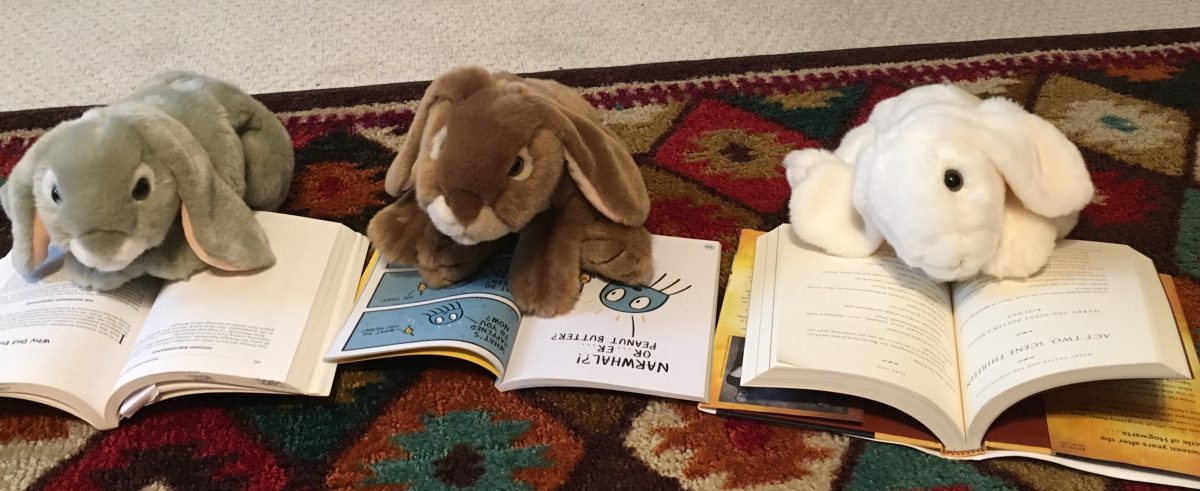
Marshmallow reviews Scythe by Neal Shusterman

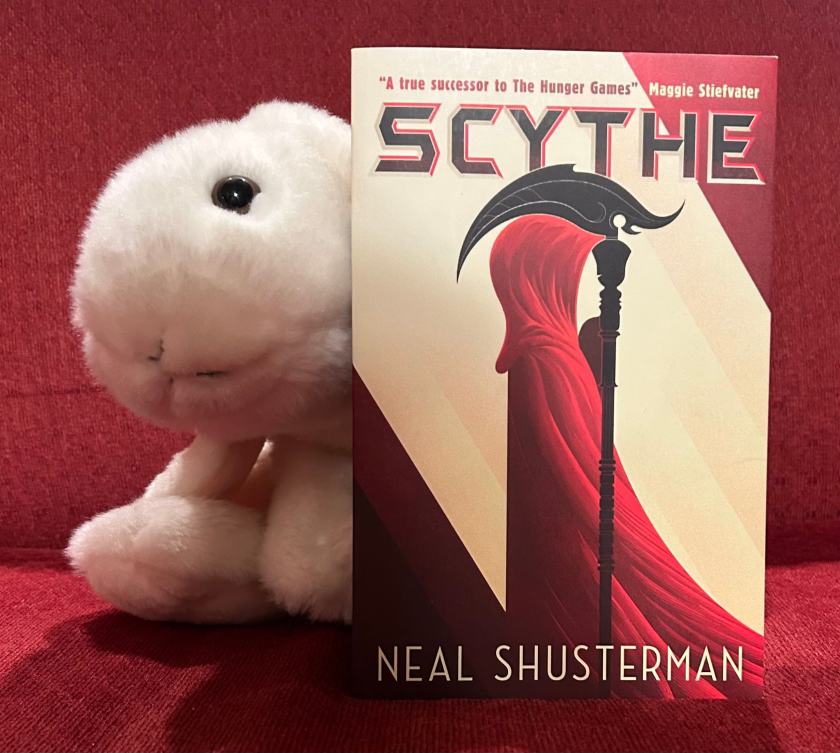
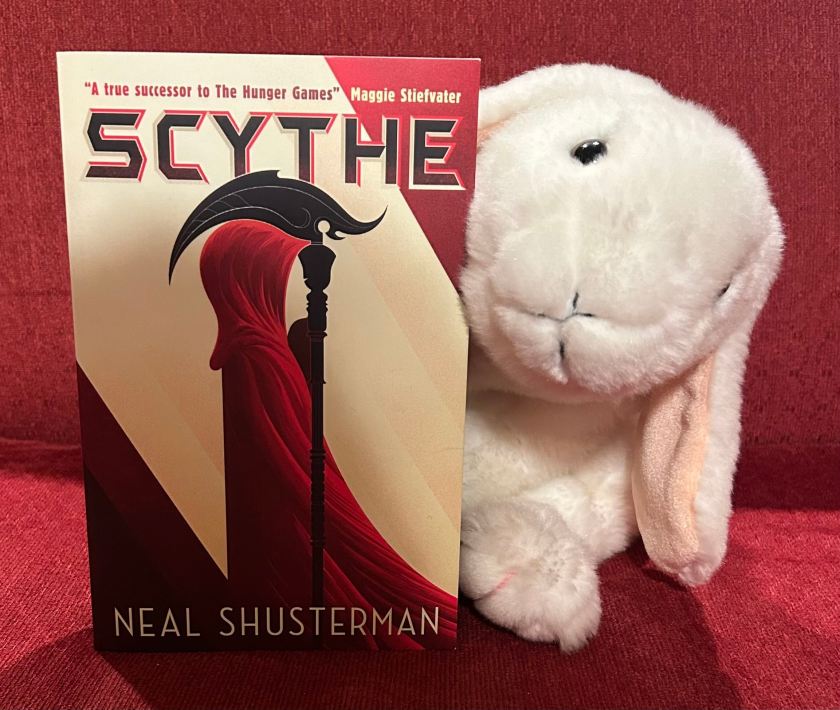
Marshmallow starts off the new year for the book bunnies blog with a review of Scythe, a 2016 book by Neal Shusterman that she read during the winter break.

(The book bunnies got a hold of this book after Caramel had read and reviewed an earlier book, Full Tilt, by Shusterman and wanted to read more from him.)

Marshmallow reviews Scythe by Neal Shusterman.

Marshmallow’s Quick Take: If you like sci-fi books about fascinating futuristic possibilities, then this is the book for you!

Marshmallow’s Summary (with Spoilers): Now, in this new future world, death no longer exists. The Thunderhead, an omniscient AI consciousness, runs the world; however, this is not a typically dystopian situation. The Thunderhead has a “purer” soul than any human and society is managed perfectly with everything running smoothly. Without death but with technology, humans are able to “turn the corner” (reverse their aging) whenever they wish. Revival centers are everywhere, so if there ever is a fatal accident, it is never truly fatal.

However, there is a catch. Without death, a population would grow unchecked; scythes serve in death’s place and must glean (accepted euphemism for taking the life of someone) a certain quota in the time between each Scythe Conclave (meeting). This keeps the fear of death alive to an extent, but in most people there is little more than a distant memory and a feeling of vague danger. At this point:

“The growth of civilization was complete […] there was no more left to learn. Nothing about our own existence to decipher. Which meant that no one person was more important than any other. In fact, in the grand scheme of things, everyone was equally useless.”

Most humans go through life, turning corners and reliving life yet again. Citra is at the actual beginning of her life, around sixteen. When Scythe Faraday (Scythes choose new names for themselves based on a ‘patron historic’) comes to Citra’s house and stays for dinner, she and her family presume he is there to glean someone. While most people try to kiss up to Scythes (hoping to avoid being gleaned), Citra doesn’t care. She thinks he will glean someone so he might as well make it clear without playing games with them. Her angry outburst impresses him and he reveals that he was just hungry and their neighbor—who wasn’t home yet—is the one he intends to glean. He leaves Citra’s family, but not without saying that Citra would make a good Scythe because she can “see through the facades of the world.” 

Rowan is also like Citra. He was in proximity to one of Scythe Faraday’s gleanings. The victim this time was a popular football player, Kohl, at his high school, but no one was brave enough to stay with him when the end came…except for Rowan. Scythe Faraday notes that Rowan was the only one who was brave enough to face death in order to be there to comfort Kohl. That is not what other people think though. They think he was there so he could watch Kohl’s gleaning and perhaps was even the cause. Gleanings are supposed to be random, but Rowan knew there must be something else. Indeed, Scythe Faraday reveals during Kohl’s last moments that he was chosen because he is a teenager with a car who likes to drink and Scythe Faraday then chose randomly from that demographic. But no one else knows this and, by association with this morbid event, Rowan becomes a social pariah.

In other words, both Rowan and Citra find themselves in the wake of Scythe Faraday’s reaping, and eventually they are both selected by him to be mentored as Scythes in training. As they become more and more immersed in the Scythedom, they learn that there is politics in play everywhere. A new movement—led by a Scythe Goddard—of younger Scythes who commit massacres almost for fun and material enrichment begin pushing against the “old guard” Scythes, those who believe in mercy and dignity for those gleaned.

Scythe Faraday teaches Citra and Rowan his philosophies and ideals, those of the “old guard.” But eventually, through the orchestration of Scythe Goddard, it is declared that only one of Scythe Faraday’s apprentices will be allowed to join the Scythedom. The one selected will have to kill the one who is not. This was never Scythe Faraday’s intent when he selected them, but it seems that there is only one way out and someone’s blood will be spilled. 

Marshmallow is reading Scythe by Neal Shusterman.

Marshmallow’s Review: Scythe is an amazing book! The philosophical nature of it made it extremely intellectually stimulating and the plot was engrossing. I read this at the same time that Sprinkles and Caramel were reading it and we kept fighting who got to the read first. When we all finished, we immediately wanted to read the second book!

The world imagined by Schusterman is a bit of a utopian version of our world, with things running more smoothly. Yet life has become rather artificial and everyone is essentially immortal. Purpose is rather absent from humans’ lives, except for the Scythes who have to take on a traumatizing role that shapes them forever. Once a Scythe, always a Scythe. Citra and Rowan learn that Scythes all glean in different ways, yet as Scythe Faraday says: there is no right way to glean, but there are definitely wrong ways. In this imaginary world, Schusterman sets up a struggle for power between Scythes and places Citra and Rowan in the midst of the chaos.

Honestly, Scythe was one of the most fascinating and engrossing books I have read. I really want to read the next book! The ending was very satisfying but it also leaves some things untold. The story does continue (I think there are three books in total in the series, Arc of a Scythe) and I am excited to read more!

Scythe is a really well written book and I think it is amazingly stimulating. It does force one to consider what life without purpose would be like and how mortality affects humanity. It also makes you appreciate life a lot more and makes you look for purpose in your own life. I would highly recommend reading this book. There is some violence, so I would not share it with bunnies younger than twelve. But this is an amazing book and I would completely recommend reading it for anyone else!

Marshmallow’s Rating: 100%.

Marshmallow rates Scythe by Neal Shusterman 100%.

Marshmallow reviews The Ballad of Songbirds and Snakes by Suzanne Collins

Today Marshmallow reviews the very first prequel to The Hunger Games trilogy by Suzanne Collins, The Ballad of Songbirds and Snakes, originally published in 2020.

[Marshmallow also reviewed The Hunger Games, Catching Fire, Mockingjay, The Hunger Games: The Illustrated Edition, and Sunrise on the Reaping.]

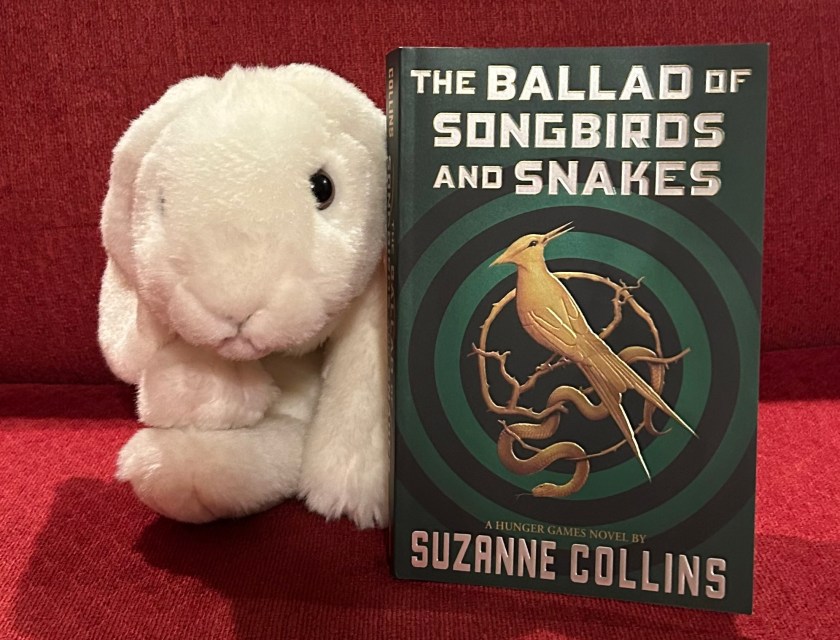
Marshmallow reviews The Ballad of Songbirds and Snakes by Suzanne Collins.

Marshmallow’s Quick Take: If you liked the previous Hunger Games books or are interested in beginning the series, then this is the book for you!

Marshmallow’s Summary (with Spoilers): Coriolanus Snow is better known as President Snow of Panem to most, but in this book he is little more than a student at the Academy. Though he comes from one of the most prestigious families in the Capitol, he struggles to make ends meet after the recent war.

During those Dark Days, the thirteen districts surrounding the Capitol rebelled against it—cutting off its resources to starve it into submission—and citizens of the Capitol experienced hardships that scarred all and killed many; Even though Coriolanus and his cousin Tigris survived the Dark Days (barely), they both witnessed horrific things that haunt them throughout the book.

At the beginning of the book, Coriolanus and Tigris are living with their Grandma’am in their once-luxurious apartment. Coriolanus’s parents died during the Dark Days, and their family’s lucrative munitions manufacturing business located in District 13 was destroyed when that district was obliterated by the Capitol as punishment. Even after the war ended (with a Capitol victory), the Snow family suffered. Without parents and their income, Tigris and Coriolanus are left to uphold the Snow reputation—even though they are no longer the rich family they were. Grandma’am trains Coriolanus and Tigris to maintain their dignity and they keep their economic struggles a secret, so the Snow family still seems powerful.

At his school, Coriolanus excels and hopes to be assigned as mentor to the tribute who will win the Hunger Games. One of the professors, a Professor Gaul, wants to make the Games into a spectacle and has a student paired with each tribute in an effort to help them survive or, at least, entertain Panem. Professor Gaul wants all of Panem to remember the war in this way, and she is hoping to make more people watch the Games (because many, of course, don’t love the idea of little kids killing each other).

At this time there have only been nine Hunger Games so far because the war was so recent. The Games have yet to become the extravagant extravaganzas seen in Sunrise on the Reaping or the trilogy with Katniss starting with The Hunger Games. The Capitol simply places the twenty-four children in an arena with a pile of weapons and watches them kill one another until only one remains.

While the Snow name is respected, Coriolanus does not have parents to bribe the school (while the other students do) and is assigned the worst possible tribute: the girl from District 12. This seems like an automatic loss because District 12 is full of weak, starving people, and the girls are presumed to be even weaker than the boys. However, when the Reaping occurs, Coriolanus realizes that this curse might have been a blessing in disguise; the girl, Lucy Gray Baird, becomes the most memorable tribute after some surprising events. While not physically threatening, Lucy Gray is charming and popular, both things Coriolanus can use to get her to victory. Her singing fascinates all of Panem and Coriolanus, who begins to fall for her. Luckily for him, the feeling is reciprocated. Unluckily for him and her, she is soon to be sent into the arena. And Professor Gaul is determined to make this year’s Games one that Panem will never forget. 

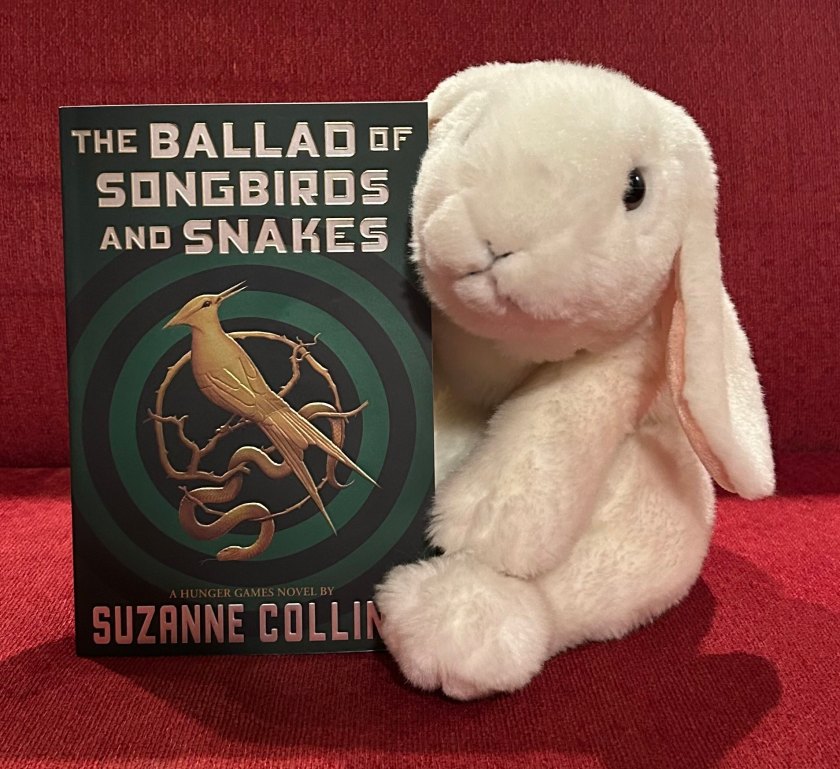
Marshmallow is reading The Ballad of Songbirds and Snakes by Suzanne Collins.

Marshmallow’s Review: I think that The Hunger Games trilogy and specifically this book should be made required reading for high school students. This book continues Collins’ trend of examining human instinct, morality, violence, and more.

I think The Ballad of Songbirds and Snakes can be a stand-alone if necessary or could be a great way to start reading the Hunger Games books. I wonder what it would have been like to read this book first and go through the series chronologically. Having read the other books first, I think both ways work well. However, this book stands out in its analysis of humanity because Coriolanus’s Academy setting facilitates discussions on these topics. For example, Professor Gaul has him and his classmates write essays about what they love about war. Such analyses make this a very deep and profound piece of work, something I believe could rival the works of Orwell and Huxley.

I think Collins also did an amazing job of writing this book from the perspective of a control-obsessed, self-promoting, yet initially well-intentioned young man. I knew that Snow was going to turn evil (because I knew his role in the other books), but watching the transformation was fascinatingly disturbing. He was manipulative and a bit narcissistic from the start, but watching the worst parts of him take over—especially at the end—was very strange.

The whole book is written in third person, but I read it in a flow state in which it felt in first person … until around halfway through when I felt a sense of disconnection from the character because I realized that something about him was no longer quite right. I am not sure how to explain this.

I would strongly suggest reading The Ballad of Songbirds and Snakes. I will say that it might be too dark for younger bunnies though, so I wouldn’t read it until around twelve years old—appropriately, the age when children are entered into the Reaping. I was a bit confused on the ending, but the epilogue tied everything up with a link foreshadowing what is to come in Snow’s future. 

Marshmallow’s Rating: 100%.

Marshmallow rates The Ballad of Songbirds and Snakes by Suzanne Collins 100%.

Marshmallow reviews Sunrise on the Reaping by Suzanne Collins

Marshmallow has already read and reviewed the three main books of The Hunger Games trilogy by Suzanne Collins: The Hunger Games, Catching Fire, Mockingjay. Then last October she reviewed The Hunger Games: The Illustrated Edition, a visually striking adaptation of the first book. Today she reviews Sunrise on the Reaping, a prequel to the trilogy, published in March 2025.

Marshmallow reviews Sunrise on the Reaping by Suzanne Collins.

Marshmallow’s Quick Take: If you liked the Hunger Games books or are interested in reading them, then this is the book for you!

Marshmallow’s Summary (with Spoilers): Haymitch Abernathy has one of the worst birthdays that one could get in Panem; he was born on Reaping Day—the day when the tributes from each district are selected and sent off to their deaths in the Arena. On his sixteenth birthday, he mentally prepares for the worst but refuses to show his fear on the outside. His name is in the drawing twenty times because he has had to enter it in extra to get food for his mother and brother. This is especially inopportune because twice as many tributes are being chosen because it is the Second Quarter Quell: the fiftieth Hunger Games that marks the remembrance of the Dark Days and the failed Rebellion. With these horrific events, the Capitol reminds its twelve districts that their past uprising will continually be remembered and they will be continually punished by the loss of their children on livestream.

Luckily, neither Haymitch nor his brother are pulled from the bowl of names. Haymitch’s girl Lenore Dove is also not selected. The odds seem to have favored them, until the second male tribute Woodbine Chance runs away and is killed by the Capitol’s Peacekeepers. Drusilla—the selfish, careless woman who draws the names—scrambles to find a replacement for him and chooses Haymitch when he tries to protect Lenore from the Peacekeepers during a struggle for Woodbine’s body (she was trying to help his mother have a few last moments with her son before they took his body away). All of a sudden, Haymitch is made a tribute even though he was not actually selected the right way. It does not matter though because the broadcasters rearrange the production so that Woodbine’s death is erased and it seems that he was never selected at all. In his place, Haymitch has to step up to the stage and prepare to leave to the Capitol to compete.

Haymitch knows that the Games are essentially a death sentence and, as a competitor from District 12 (a coal-mining district described as “nothing but coal dust and miners soaked in rotgut liquor”), he realizes the odds are stacked against them. (Other districts like 1, 2, and 4 prepare their children and often have less poverty and starvation, meaning their tributes are stronger and more likely to win; these tributes are called Careers.) However, he promises to his brother he will try and he also self-assigns himself as the protector of Louella McCoy, a little girl he thinks of as a sister who is also sent as a tribute for District 12.

The other two District 12 tributes are Wyatt, whose father orchestrates the gambling for the Hunger Games in District 12, and Maysilee, who comes from a richer family and seems very snobbish. Wyatt’s family’s disregard for the violence in the Games and Maysilee’s better-than-thou behavior makes Haymitch disgusted. But eventually, the four grow closer and start to ally with tributes from other districts that, like them, seem to be equally disadvantaged in comparison to the Careers. Their alliance is called the Newcomers and, for the first time, Haymitch (blissfully and perhaps willingly forgetting that they might eventually have to kill one another) begins to feel hopeful. But he is not an ordinary tribute because he is not just there to survive, he is there to fight the Capitol and everything they have done. Tragically, the Games themselves serve as foreshadowing that no resistance comes without punishing loss. 

Marshmallow is reading Sunrise on the Reaping by Suzanne Collins.

Marshmallow’s Review: Sunrise on the Reaping is a very good book. It is set around twenty four years before the Hunger Games that Katniss Everdeen first competes in. I read the original Hunger Games series a while ago, but I recalled the name Haymitch as he was the alcoholic mentor of the District 12 tributes. This made me guess that the story in Sunrise on the Reaping was unlikely to end well, and unfortunately I was proven correct. However, the book is very well written and holds up to Collins’ previous standards of success. It is touching and disturbingly realistic, painting a world that I hope never comes to pass.

Sunrise on the Reaping returns the reader to Panem and reveals links to the original series that I only just caught. The subtlety in the connections is both annoying and simultaneously awe-inspiring. I think that Sunrise on the Reaping could be read either before or after reading the original Hunger Games trilogy. It provides good context for the character of Haymitch and sets up the world shown later on. So if there are any bunnies out there who have not yet read the original three books, they could really begin with this one; it would work well.

I did find that Sunrise on the Reaping greatly deepened my view of Haymitch and I think this is a piece of heart-rending art for showing the exact process in which he was broken as a person and in such a perfectly-executed manner (both his torture and the way Collins describes the plot). His transformation is very thought-provoking and shows how he became the lonely drunk we are introduced to alongside Katniss in The Hunger Games.

This book, like Collins’ others, is violent and is not appropriate for younger bunnies (say eleven and younger). Collins’ use of verse and song is remarkable and I thought that set this book apart from most other violent books because it highlighted the depth and meaning of the violence, giving the reader time to pause and reflect on the implications of such pain. I liked how Collins used Edgar Allen Poe’s “The Raven” and how stanzas were woven throughout the book showing how Haymitch’s story aligned with the poem in more ways than one.

Overall, this was a very well written book. I am now looking forward to reading The Ballad of Songbirds and Snakes, another prequel to the series that was published about five years ago and retells the backstory of Coriolanus Snow, who was the president of Panem in the original trilogy. I hope that it, like this book, will be a meaningful addition to the Hunger Games series. 

Marshmallow’s Rating: 100%.

Marshmallow rates Sunrise on the Reaping by Suzanne Collins 100%.

Caramel reviews Zombie and Brain Are Friends by Stephanie V.W. Lucianovic and Laan Cham

It is that most spooky time of the year, and here in the book bunnies house, we are getting ready for Halloween. So Caramel thought it would be appropriate to talk about a book with zombies in it which just got published this past month: Zombie and Brain Are Friends, written by Stephanie V.W. Lucianovic and illustrated by Laan Cham. As usual, Sprinkles is taking notes and asking questions.

Caramel reviews Zombie and Brain Are Friends, written by Stephanie V.W. Lucianovic and illustrated by Laan Cham.

Sprinkles: So it is almost Halloween and we are just in time to talk about this picture book about a zombie and a brain that become friends. 

Caramel: Yep.

S: Can you tell us a bit about the book?

C: Sure, the story happens in a world in which there are only zombies (at least we don’t see any other people, humans or bunnies), and this one zombie family farms brains. And in this book brains grow in fields. 

S: So kind of like cabbage?

C: Yeah, kinda.

S: Okay, that will take some getting used to, but let us continue. 

C: Yeah, so in this family there is a boy zombie, whose name is Zeb. And one day, Zeb finds a baby brain while walking around, and he realizes that it’s alive. And they become friends.

S: But the brain is food basically, right?

C: I guess it’s like when people have a pet pig and they still eat pork. Kind of confusing but seems to happen all the time. 

S: I see. Okay so the brain is foodstuff, but Zeb becomes friends with it. The back of the book was talking about the thing a lot of parents say to their little ones: “Don’t play with your food”. One could imagine then that this causes some trouble in the household?

C: Not really. But there is some confusion, and things get out of hand a bit. At least for a while.

S: Hmm, but hopefully all ends well? 

C: Of course! It is a picture book, Sprinkles! Nothing too bad could happen. 

S: Of course you are right, Caramel.

Caramel is reading Zombie and Brain Are Friends, written by Stephanie V.W. Lucianovic and illustrated by Laan Cham.

S: Okay, so what did you think about the book? 

C: It is quite weird actually. You know I actually don’t like zombies, they kind of scare me, but this book was not scary at all. It was in fact good. And weird. You know, brains growing in bushes! Zombie farmers farming brains! And brains making friends with zombies! All so weird! But in a good way. 

S: I do know you don’t really love zombies. Remember the time I reviewed a whole lot of children’s books about zombies

C: Yeah, I didn’t like those books too much.

S: I know you did not like several of them. But I think you found one of them a lot of fun: Zombies Hate Stuff. It was quite funny, like Penguins Hate Stuff, which you had reviewed a bit earlier. 

C: Yeah, penguins do hate a lot of stuff.

S: Apparently so do zombies! But from this book we learn that they also love brains! 

C: Everyone already knows that, Sprinkles! Don’t they always go around saying “Brainzzz!”?

S: Yeah, but they can love brains, not just to eat, but also for friendship!

C: Yes, it is true that we learn that in this book. But again, it is not a real thing. Zombies being friends with brains, and brains growing in fields, and so on. 

S: Of course the brain-eating zombies themselves are not real, either. 

C: And I am so happy about that! 

S: I agree, Caramel. So this book was quite absurd in some sense, right? Things did not make too much sense in our world. There was some weird logic within the story world, but it did require ignoring a lot of what we are supposed to know about brains and zombies to get into the story. 

C: Yes, but then again, I prefer not to know much about zombies. I decided to read this book because it had a very friendly-looking pink brain and a smiling green-faced boy on the cover, and it said they were friends. I always like stories about good friends. 

S: True, your very first review was about the beginning of one of those legendary friendships, when Narwhal met Jelly! 

C: Yes! I love Narwhal and Jelly! Anyways, Zombie and Brain Are Friends was a lot of fun to read. 

S: We, in fact, read it out loud together, right? 

C: And we laughed out loud together, too!

S: Yes! Okay, maybe this is a good time to end this review. We need our sleep before Friday, so that night we can do all sorts of spooky things–

C: Yes! And eat lots and lots of candy! 

S: Of course! What would you like to tell our readers then?

C: Stay tuned for more book bunny reviews! And I hope you, too, will get lots and lots of candy on Halloween!

Caramel enjoyed reading Zombie and Brain Are Friends, written by Stephanie V.W. Lucianovic and illustrated by Laan Cham, and recommends it to young bunnies who wish to meet some friendly zombies this Halloween season.