Caramel reviews Robot Dreams by Sara Varon

If it was not clear by now to the readers of this blog, Caramel loves robots. This week he got his paws on a graphic novel published first in 2007 about one particular robot: Robot Dreams by Sara Varon, and he had to review it for the book bunnies blog. As usual Sprinkles is taking notes and asking questions.
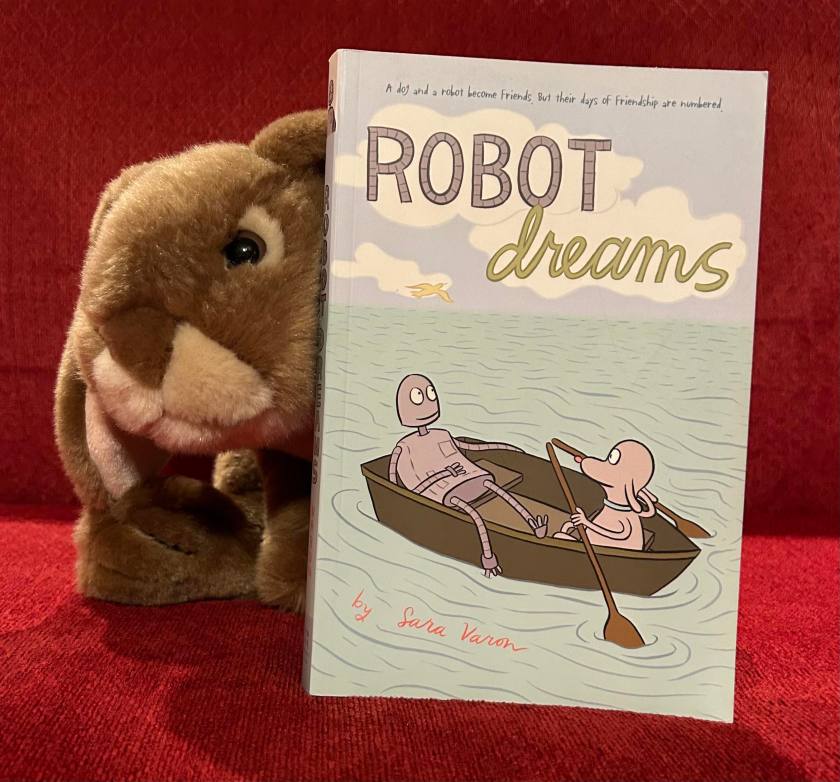
Caramel reviews Robot Dreams by Sara Varon.

Sprinkles: So Caramel, this book was perfect for you, with a robot as one of the main characters, and in a really neatly drawn graphic novel format. Don’t you think?

Caramel: Yes.

S: I knew it! So tell me a bit about the book then.

C: Robot Dreams is kind of sad because it is about a robot who is friends with a dog but then gets rusty and the dog has to leave him.

S: I know. It is pretty sad at times. But it is also really cute and sweet when the dog and the robot are friends and are enjoying each other’s company immensely, no?

C: Yes. I just wanted them to continue to be friends. Forever.

S: Unfortunately, Caramel, there are very few things that last forever.

C: Yes, but I did not need to be reminded of that annoying fact.

S: I understand of course.
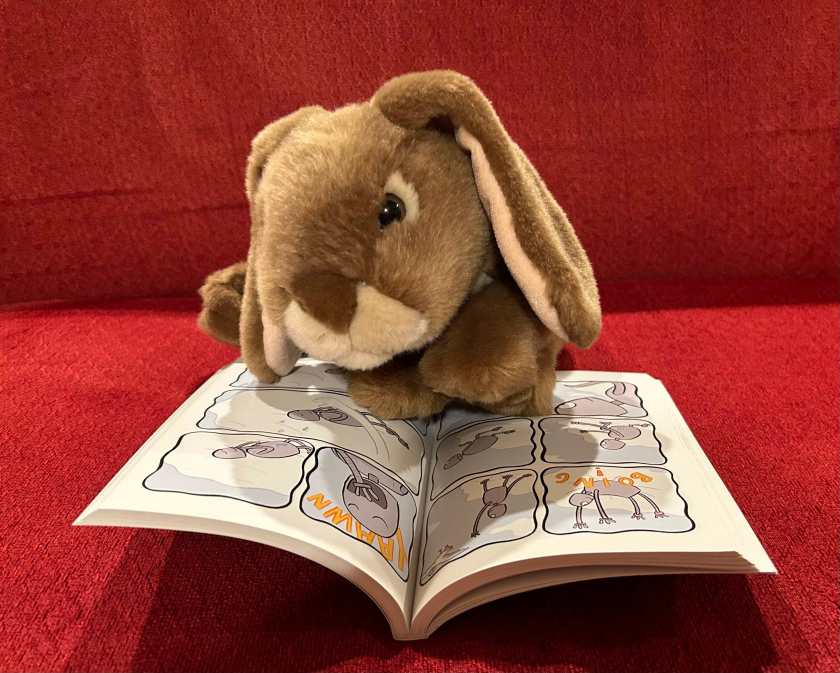
Caramel is reading Robot Dreams by Sara Varon.

S: So tell me a bit more about the book.

C: Well, nobody speaks in the whole book. There are only a few words, when the dog and the robot go to the library for example. And at the very beginning when the dog receives the box containing the robot from the mailman.

S: Hmm, why do you think there are no words?

C: The author said that she feels like she is not the most articulate person, but also that the story was one that could be told without words, because it could be told in actions.

S: And it is, isn’t it? We do see how the two are good friends, and how they enjoy each other’s company, and how they get sad when things go wrong, and so on.

C: Yes.

S: Okay, then tell me a bit about the title of the book. It is a neat title, no? It could have two meanings. The robot is dreaming or the dreams belongs to the robot or about the robot.

C: Yes, either the robot is dreaming or dreams of robots. I like it!

S: Which one is it do you think?

C: I’m guessing it is the first one. Because we see the robot dreaming of the dog coming back and saving him and they are together again, but it is only a dream, unfortunately.

S: I can see that.

C: And in the end both have new friends. The dog has a new robot friend, and the original robot has a new friend who is a raccoon.

S: I guess life goes on, right?

C: Yes, but …

S: I think you don’t like that kind of change.

C: Yes, that is correct. I’d be happier if the dog could have saved the robot.

S: So I know this is a sad book, but it is also very simply illustrated and just beautiful. And I think you actually really liked it. Is that correct?

C: Yes.

S: And so maybe we can add this to the very short list of sad books that you liked even so. (As far as I can tell, there are only two books on that list so far: Charlotte’s Web by E.B. White and Poppy and Ereth by Avi.)

C: Yes. But I would have preferred to add it to a longer list of happy books that I like.

S: I know. but sometimes sad books are good too.

C: I’m not going to comment on that.

S: So let us wrap this review up then. What three words would you use to describe this book?

C: Colorful, wordless, interesting. I only wish I could also say happy.

S: I know. But the three words you gave me work well enough. And what would you like to tell our reader Caramel?

C: Stay tuned for more book bunny reviews!
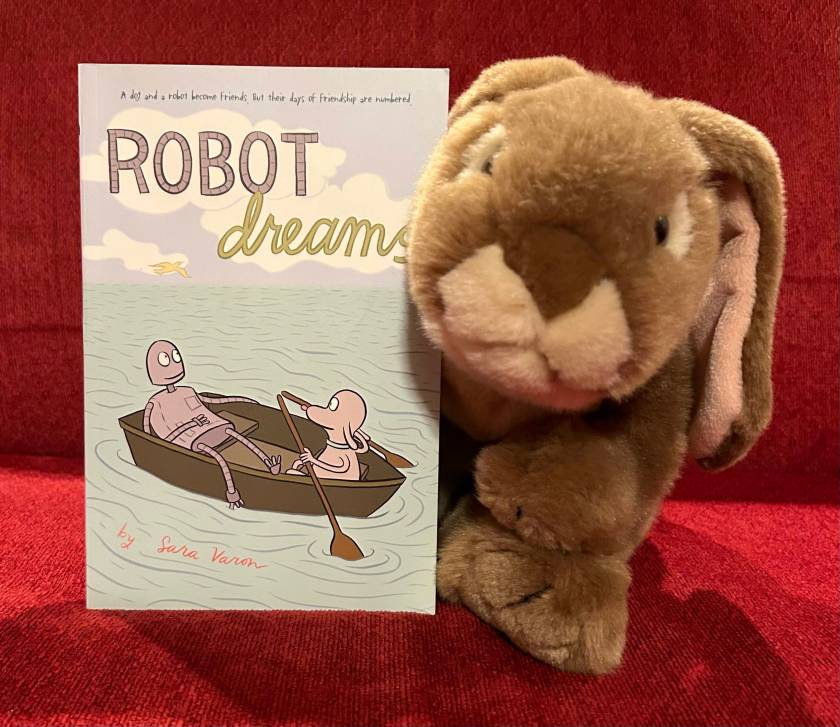
Caramel loved reading Robot Dreams by Sara Varon and is sure to spend a lot more time with it in the coming weeks and months.

Marshmallow reviews Are You There God? It’s Me, Margaret by Judy Blume

A while back Marshmallow reviewed Blubber by Judy Blume. Today she reviews another classic by Blume: Are You There God? It’s Me, Margaret, first published in 1970. Sprinkles is asking questions and taking notes.

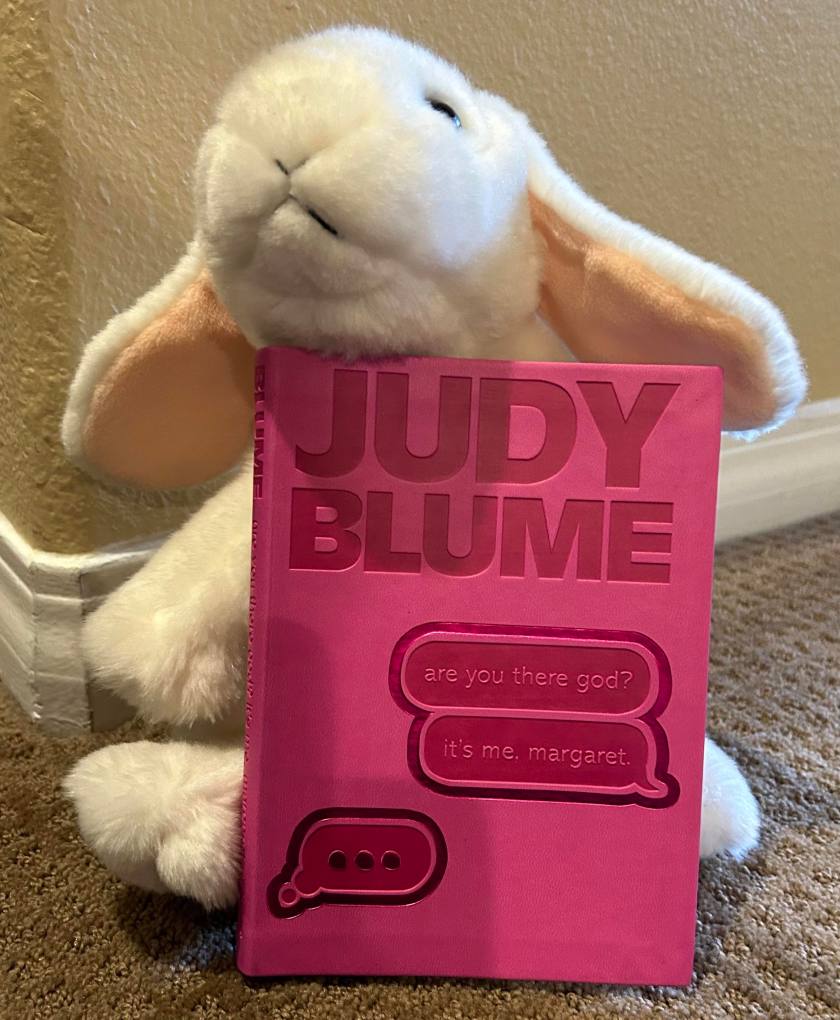
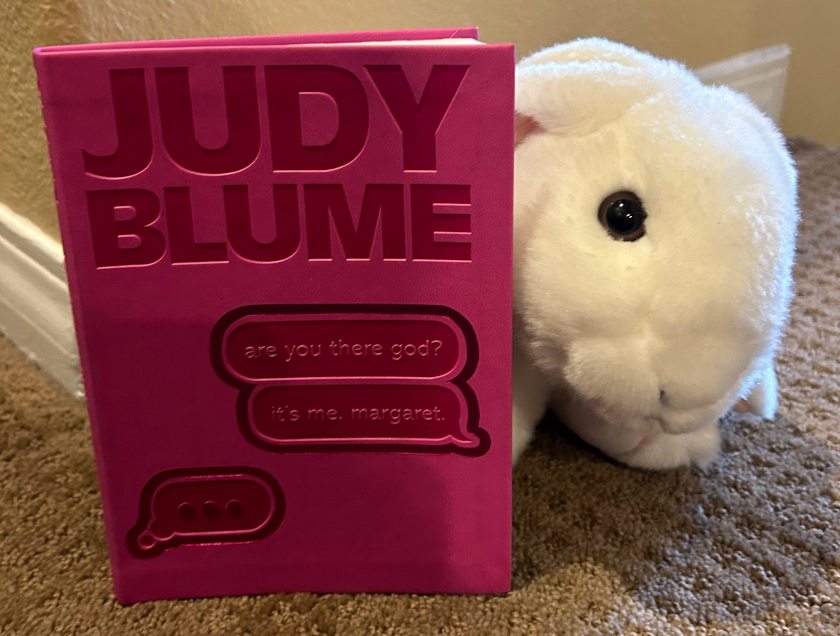
Marshmallow reviews Are You There God? It's Me, Margaret by Judy Blume.
Marshmallow reviews Are You There God? It’s Me, Margaret by Judy Blume.

Sprinkles: So Marshmallow, let us start at the beginning. Who do you think would appreciate this book?

Marshmallow: I think girls who are approaching adolescence and may have some concerns about growing up might find this book relatable. Also if you liked other books by Judy Blume, I think you would definitely like this too.

S: That is a good start. Okay, more specifically, tell us now about the plot.

M: Margaret is this girl who just moved to New Jersey. And she is starting a new school and she makes a new friend named Nancy Wheeler —

S: This Nancy Wheeler?

M: Yeah, no. Not the Nancy from Stranger Things. Though she is also a girl who is living in a suburb with her family and wants to fit in and so on.

S: Okay, so let us get back to Margaret.

M: Yes, so Margaret’s dad was raised Jewish and her mom was raised Christian, but their families did not approve so they eloped and did not dictate a religion on their daughter. And when she lived in New York, nobody seemed to be perplexed by this, but here in her new school, her friends seem to want her to choose to belong to one or the other community.

S: And she is talking to God all through the book, right? Which God is this one?

M: Well, it is definitely a personal God, and Margaret shares her concerns, fears, hopes, and desires with Him. but through the book, we see her not making a specific choice. Her new teacher, Mr. Benedict, wants each student in her sixth grade class to pick a topic that is personally important to them and spend time that whole year to research it. Margaret chooses religion, hoping that through the year, she will try to figure out whether she should be Christian or Jewish. Remember both her grandparents are religious, but the Christian ones, her maternal grandparents cut off their relationship with them. Margaret does have a close relationship with her father’s mother, Sylvia, who encourages her to explore her Jewish heritage.

S: So the book is partially about Margaret exploring religion. But it is also a lot about growing up, right?

M: Right. Margaret’s new friends are obsessed with their growing bodies, and wearing bras, and boys, and so on, and Margaret does not yet feel like she is that interested in any of these things, but she wants to fit in, and so she ends up sharing their obsessions. Which was kind of weird to me, actually, because this is not quite how the girls in my school have been acting.

S: But maybe some of the girls in your school, too, might be interested in these kinds of things. Not all bunnies are like you and your friends, Marshmallow.

M: Well, I did not mean to sound like I am all so much more mature…

S: You are a pretty mature young bunny. But when I was growing up, there were a lot of girls like Nancy and her friends, and I feel like a lot of girls must have sympathized with the characters of the book for this book to have become such an iconic book.

M: Yes. It might also be that they felt like they should act like Nancy but they were actually feeling like Margaret who is not quite there. And eventually she does start obsessing about similar things.

S: The desire to fit in is often very strong. Especially among teens and tweens, but more generally it seems to be pretty common.

M: Yes.

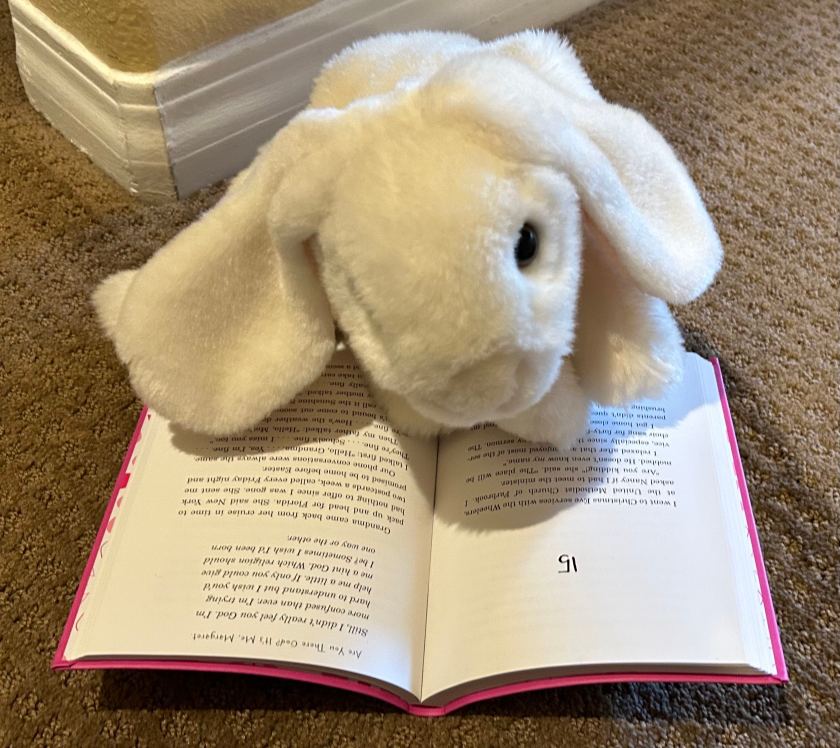
Marshmallow is reading Are You There God? It's Me, Margaret by Judy Blume.
Marshmallow is reading Are You There God? It’s Me, Margaret by Judy Blume.

S: So this book was iconic, but it was also banned in many places. Did you know that?

M: Yes, I did. It talks about menstruation and so on, which some people claimed were not appropriate. But also it talks about religion and how it is okay if you do not pick between Christianity or Judaism, and how there might be other ways to finding spirituality in your life. This probably came across as anti-religion to some very religious folks.

S: Well, maybe today we are a bit more open-minded about these things. And the United States is a lot more diverse today in terms of people’s religious affiliations.

M: Yes, Margaret said, for example, that she was not considering Islam or Buddhism because she did not know anyone from those religions.

S: But there are people from a few other religions in your class, right?

M: Yep.

S: So we have come a long way from the 70s in that regard.

M: I hope so!

S: Okay, did you like Margaret as a character?

M: She is okay, she is very genuine, and kind of bland, she does not have a very big and sharp personality, and maybe that is intentional because the reader can fill in the gaps and more easily identify with her.

S: That makes sense to me.

M: There is also a girl in the school who has already grown up in terms of her body, and all the other people think she is sticking out. They make up rumors about her, they gossip about her, and they are pretty mean.

S: That is not good.

M: I think they are jealous. And I don’t think the girl does anything to deserve it.

S: Middle school can be a cruel place.

M: Well, they are in sixth grade but I guess that is middle school in some places.

S: Yep. So we got a hold of this book because there is a new movie about it. Do you think we should see it?

M: Yes. The trailer looks fun. Can we put a link to it here?

S: Sure, let us embed it right now:

Are You There God? It’s Me, Margaret. (2023) Official Trailer, from YouTube.

S: Do the characters look the way you visualized them?

M: Not quite, but I think they are close enough.

S: So we should try and watch it then. Okay, how would you rate this book?

M: I’d rate it 95%.

S: Sounds good. And what do you want to tell our readers as we wrap things up?

M: Stay tuned for more amazing book reviews from the book bunnies!

Marshmallow rates Are You There God? It's Me, Margaret by Judy Blume 95%.
Marshmallow rates Are You There God? It’s Me, Margaret by Judy Blume 95%.

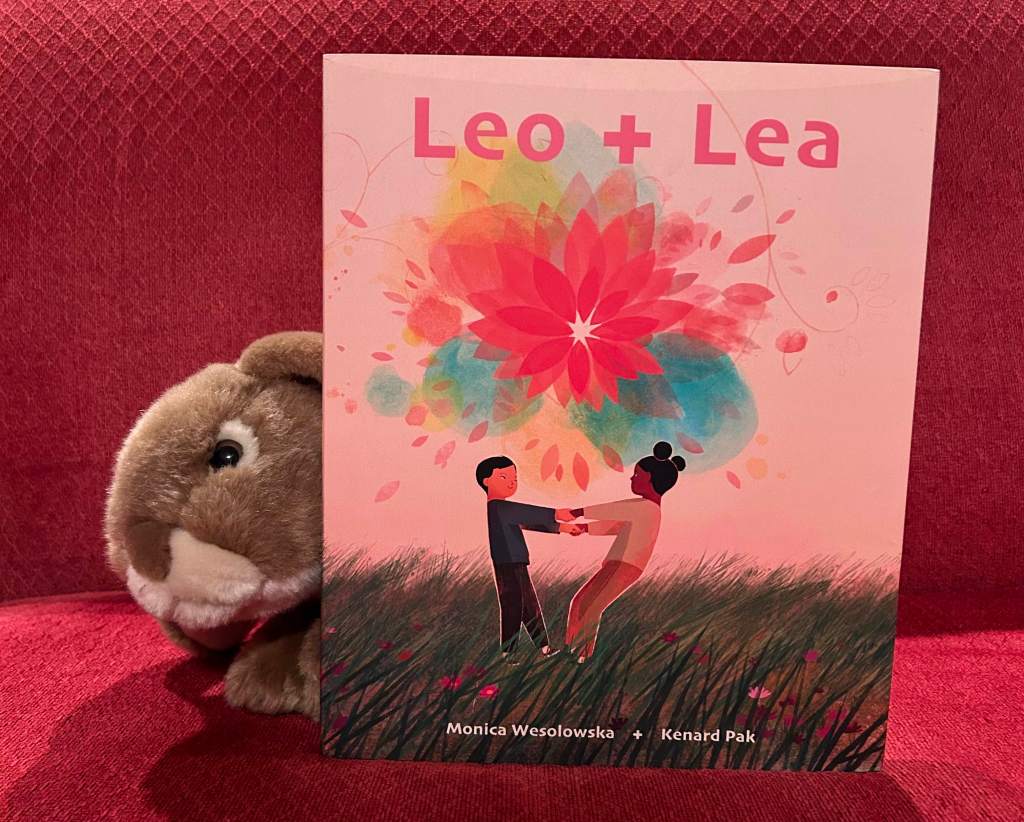
Caramel reviews Leo + Lea by Monica Wesolowska and Kenard Pak

Today Caramel reviews a beautiful picture book titled Leo + Lea, written by Monica Wesolowska and illustrated by Kenard Pak. As always, Sprinkles is taking notes and asking questions.

The book bunnies received this book as a review copy.

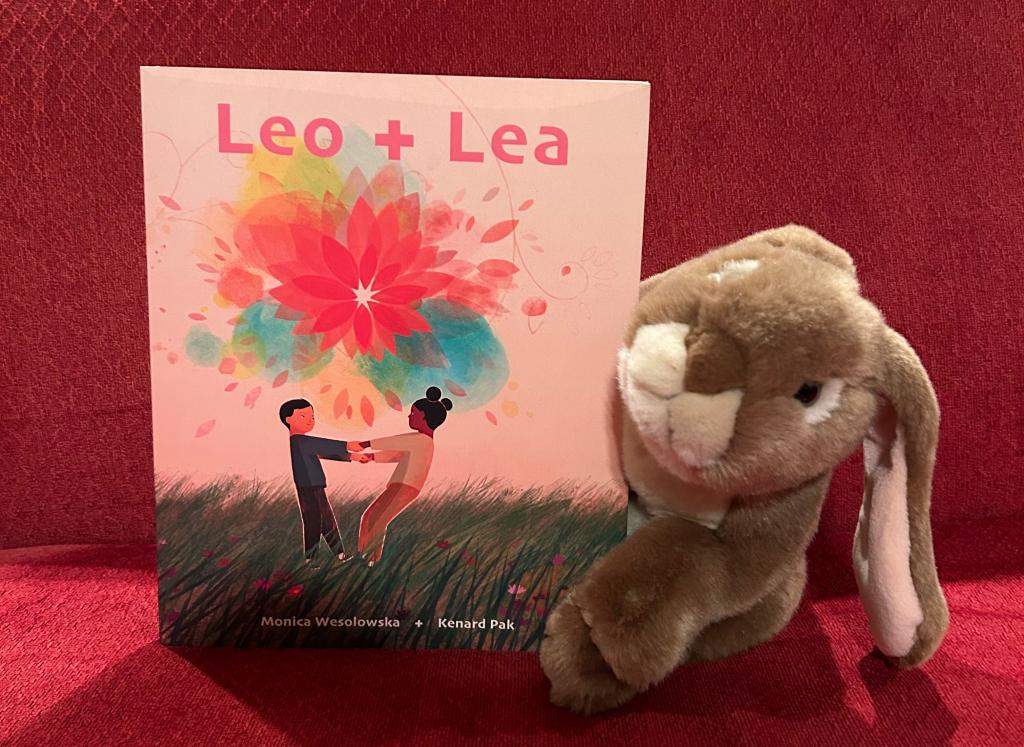
Caramel reviews Leo + Lea, written by Monica Wesolowska and illustrated by Kenard Pak.

Sprinkles: So Caramel, can you tell us a bit about this book?

Caramel: Maybe I can read you the description on the back cover?

S: Sure, let us start with that.

C: “This beautiful friendship story, inspired by the Fibonacci sequence and cleverly constructed using its mathematical pattern, celebrates different ways of seeing and being in the world, as well as how math connects us to one another.” That’s it.

S: I guess that is a good summary.

C: Yes.

S: So who are the friends in the book?

C: Leo and Lea. You should know that from the title!

S: You are right of course. So tell me about Leo and Lea.

C: Well, Leo is a boy who likes counting things. And Lea is a different person. She likes drawing and coloring patterns.

S: The book starts with Leo counting, right?

C: Yes. And he counts two trees, three squirrels, and five steps, and so on.

S: Oh, yes, I can see the Fibonacci sequence showing itself: Leo is 1, counting is 1, then the two trees is 2, and then the three squirrels is 3, and the five steps are 5.

C: Yes, and the words about them are the same number too. So The three squirrels are not just three squirrels, but they are “three noisy squirrels” so it makes three words. Then the five steps are “five big steps to school” and that is five words. And then comes 8 and then 13, and 21.

S: Yes, when we were reading this, at this point you realized the numbers had a pattern.

C: Yes, each number is the sum of the two numbers right before it. So 8 is 3 plus 5, and 13 is 5 plus 8, and so on.

S: And then you could guess that the next page would have 34 words.

C: Yes, and then there is a page with fifty-five words. I think. I am not sure. I did not count that one. That is a lot of words and I am sure I will lose track.

S: I can imagine. So that is kind of neat, no? The words and the numbers match the same pattern!

C: Yes, I did not notice that before we began rereading the book together. I thought it was just a love story.

S: Well, it is not quite a love story. It is a friendship story. and Leo and Lea become friends because they both like patterns and so can understand each other.

C: Yes, I know that now, and so I like the book more.

S: I know. Neither you nor Marshmallow like things to get too mushy. But this is not at all mushy. It is about two kids finding that they like patterns in different ways.

C: Yes, Leo likes patterns in numbers and Lea likes to draw patterns. So they can understand each other.

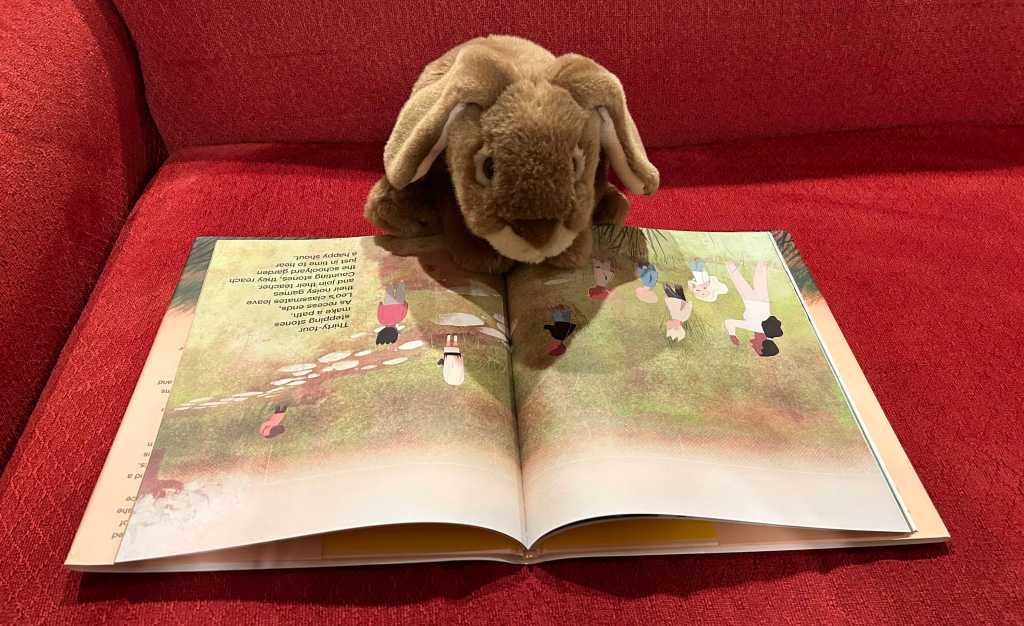
Caramel is reading Leo + Lea, written by Monica Wesolowska and illustrated by Kenard Pak.

S: So let us look at the pictures a bit. Can you describe them?

C: They are colorful.

S: They reminded me a bit of some of the books illustrated by Isabelle Arsenault that you have read a while back. Do you remember those?

C: Yes, I can see that. But this book is a lot more colorful. And I did count the kids on the page for fifty-five and there are fifty-five people on it including Leo and the teacher.

S: How about the other pages?

C: Yes, just like on each page for a number there are that many words, there are that many pictures of some thing about that page. Like on the page for thirteen there are thirteen blossoms that Lea drew on her paper.

S: That is cool. So do you think this could be fun for a little bunny to read together with a big bunny and count things together?

C: Yes. Lots of little bunnies like counting things.

S: You do.

C: Yep.

S: So how would you describe the book in three words?

C: Colorful, numberful, and fun.

S: Totally! Okay, so it is time to wrap this review up then. What would you like to tell our readers?

C: Stay tuned for more book bunny reviews!
Caramel is reading Leo + Lea, written by Monica Wesolowska and illustrated by Kenard Pak.
Caramel enjoyed reading Leo + Lea, written by Monica Wesolowska and illustrated by Kenard Pak, and finding the many Fibonacci numbers sprinkled through its pages.

Marshmallow reviews The Outsiders by S. E. Hinton

Marshmallow has been reading S. E. Hinton’s classic novel The Outsiders, first published in 1967. Today she shares some of her thoughts on the book with the blog readers. Sprinkles is taking notes and asking questions.

Marshmallow reviews The Outsiders by S. E. Hinton.

Sprinkles: So Marshmallow, can you introduce us to this book?

Marshmallow: If you like books about belonging, growing up, and facing challenges as a young person, you might like this book.

S: That’s a good start. So now let us move into the book. Can you tell us a bit about the plot?

M: There are two gangs, or maybe groups of friends, who hang out and occasionally clash, sometimes pretty violently. They call these things rumbles, they are basically fights.

S: Okay, so two groups. Made up of young people, and our main characters belong to one or the other. What are the names of the two groups?

M: One of them is made up of richer kids and they are called the Soc, short for “social”. The other group has poorer kids in it, and they are called the greasers, because they put grease in their hair. Mostly boys but there are girls that hang out with one or the other group.

S: Okay, that gives us a good idea of the setting. So tell us now about what happens in the book.

M: The main character is this boy named Ponyboy. And that is his real name. And his middle brother’s name is Sodapop.

S: Those are some creative names!

M: I know, right? The oldest brother has a much more typical name, Darrel, but people call him Darry.

S: Alright.

M: So these three boys’ parents are dead. And the oldest brother Darry is taking care of the younger ones. Ponyboy is the youngest of the greasers. The other greasers are Steve, Johnny, Dally, Two-Bit, and I think that is mainly it.

S: Okay.

M: One day Ponyboy, Dally, and Johnny go to the movies and meet two Soc girls named Cherry and Marcia. Dally is rude to the girls, but Ponyboy and Johnny become closer to them. Then some Soc boys come and there is some trouble. Eventually, another day, there is a fight, and Johnny ends up killing one of the Soc boys while trying to save Ponyboy from getting hurt. So Johnny and Ponyboy run away and hide, with the help of Dally, who has gotten into trouble with the law before.

S: That sounds kind of big, killing someone. These are still only kids, aren’t they?

M: Well, they are more or less. Ponyboy is 14 and Johnny is 16.

S: Alright, then what happens?

M: Well, I cannot tell you everything, but there is a big fire, and the boys try to help save some children who have been trapped in the fire, so they become heroes of some sort, but Johnny still has killed someone, so he needs to be punished. But he is also pretty injured during the fire. So I will stop here because we are already talking about stuff way into the book.

S: Alright, that makes total sense. We already got the gist of the story I think.

Marshmallow is reading The Outsiders by S. E. Hinton.

S: So you began reading this book because your class is reading it at school, right?

M: Yep. We are still reading and discussing it in class.

S: We read it at school, too, I think, but it was many many years ago. I do not remember the story very well. I also did not remember the author’s name.

M: Well, she is using only initials. It is because she was very young when she wrote the book, and they thought a book by a young woman who is a total unknown would not sell. There is an interview with the author at the back of the copy of the book I read where she says this.

S: I did not remember that at all, but the Wikipedia article about the book says that she was only 15 when she started writing the story and was 18 when it was published. That is pretty young!

M: Yes, it is impressive.

S: And maybe that really was the right thing to do, because the book did get really famous and they made a movie of it, too.

M: I know! In fact we are going to watch it at school. Can we put the trailer of the movie here?

S: Sure. Here it is:

The Outsiders (1983) Official Trailer, from YouTube.

S: I remember that we did watch this movie in class too, and it was all very exciting. A lot of the actors became really famous after this.

M: I’m excited to watch it too.

S: So maybe we should slowly wrap this up. Before that, would you mind telling me what you thought of the characters?

M: I thought they were good. Ponyboy narrates the story, and you get to really empathize with him. He does smoke a lot though. Still he is very thoughtful and cares about people.

S: Anything else?

M: I thought the book did a good job of pointing towards social economic inequalities. The rich kids all also have problems with their families and such, but when the poor kids get into trouble, their lives get so much more difficult. And these kinds of differences make it harder for people to empathize with others. Ponyboy thinks that he and the greasers are all outsiders and nobody else, none of the Socs, can ever understand their lives. And he does have a point, I think.

S: But after some of the events of the book, he realizes that Socs are also human, according to the book description in one of the versions of the book.

M: Yes, I guess so. But the class differences still remain, and that is also there till the end. The consequences are so much tougher for the greasers.

S: Thank you for this review Marshmallow. I think I might want to revisit this book, or at least the movie! You always rate the books you review. So what would you rate this one?

M: I’d rate it 100%.

S: Sounds like it! Okay, and to wrap up, what do you want to tell our readers?

M: Stay tuned for more amazing book reviews from the book bunnies!

Marshmallow rates The Outsiders by S. E. Hinton 100%.