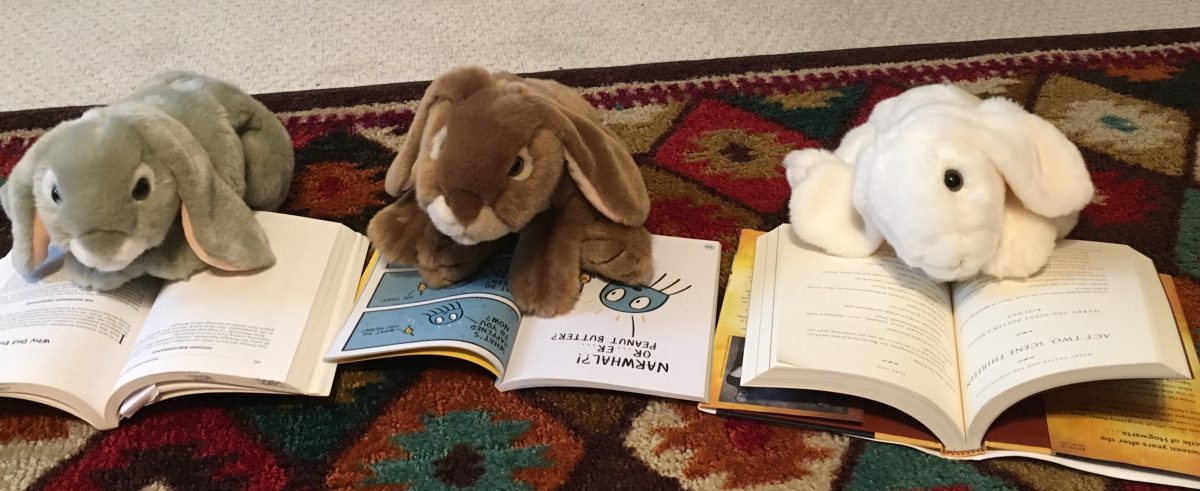
Marshmallow reviews Sweet Valley Twins: The Graphic Novel (Best Friends and Teacher’s Pet) by Nicole Andelfinger and Claudia Aguirre

A few years ago, Marshmallow read and reviewed Kristy’s Great Idea (The Baby-Sitters Club Graphic Novels #1) written by Ann M. Martin in the 1980s and 1990s and adapted into a graphic novel by Raina Telgemeier in 2006. Today she is reviewing Sweet Valley Twins: The Graphic Novel by Nicole Andelfinger and Claudia Aguirre, another book whose origins lie in a beloved book series from the 1980s written by Francine Pascal. The edition she is writing about combines the first two books, Best Friends and Teacher’s Pet, in one volume and was published just this year, in 2025. Other artists who contributed to the book include Sara Hagstrom, Andrea Bell, and Warren Montgomery.

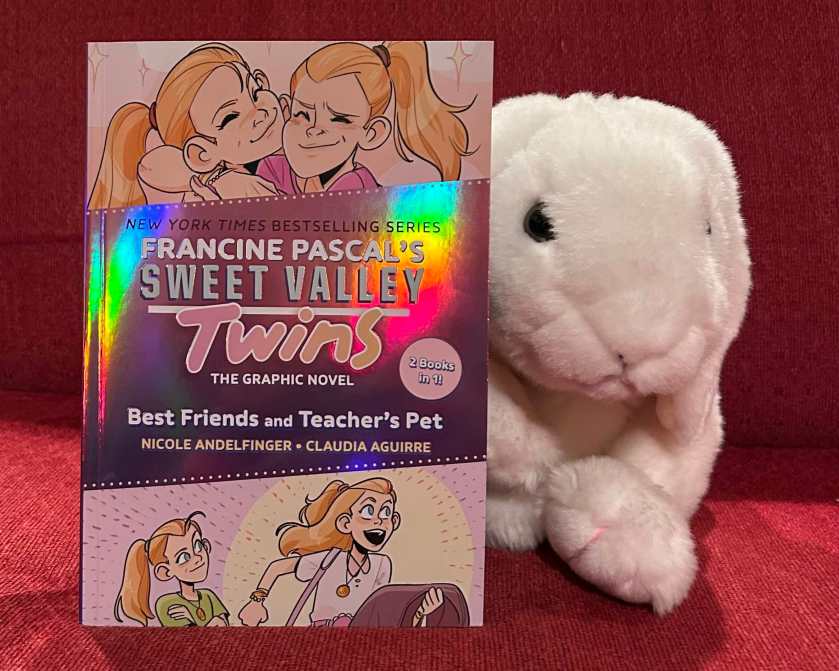
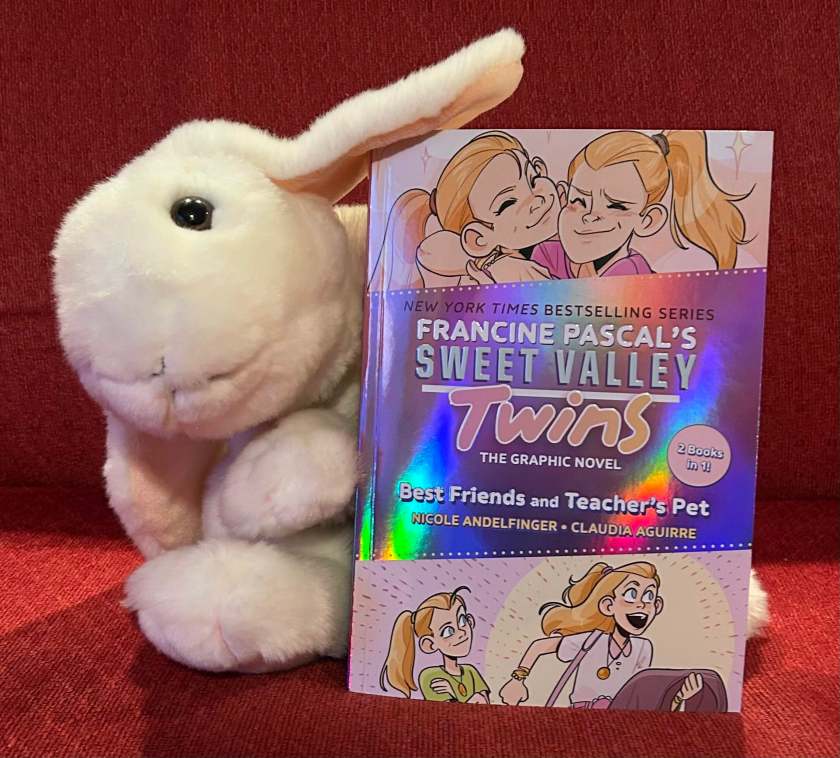
Marshmallow reviews Sweet Valley Twins: The Graphic Novel (Best Friends and Teacher’s Pet) by Nicole Andelfinger and Claudia Aguirre.

Marshmallow’s Quick Take: If you like books about friendship, sisters, family, and drama, then this is the book for you!

Marshmallow’s Summary (with Spoilers): Elizabeth and Jessica Wakefield are identical twins. In Best Friends, they start off as each other’s best friend. But like all middle-school aged girls and all book characters of that age, the two have started changing. In my opinion though, the one who is changing more is Jessica. Jessica has become increasingly more interested in boys and popularity, which is natural to an extent. Unfortunately, she has been recruited to join the Unicorns (which is a lot like the Plastics from Mean Girls). In order to get in, Jessica has to prove herself by completing three dares. Elizabeth is more interested in the Sweet Valley Sixers, the school newspaper she founded with her other friends Amy Sutton and Julie Porter. Both Elizabeth and Jessica thought they would be closer than ever in middle school, but they are growing apart instead.

In Teacher’s Pet, the focus is on their shared ballet classes. Jessica dresses to impress the first day, only to discover that their strict teacher Madame André is not a fan of her style. It is on that day that Jessica decides the teacher hates her. On the other hand, Elizabeth has no problem with the teacher, who actually really likes her. Jessica—who believes she is the best ballet dancer in the class—decides that Madame André picks favorites and that Elizabeth is a teacher’s pet. So when Elizabeth gets the solo for the rehearsal, Jessica is pretty jealous. Can the sisters overcome their differences? (Spoiler: The answer is predictably yes, but in a way that I was not too pleased with.)

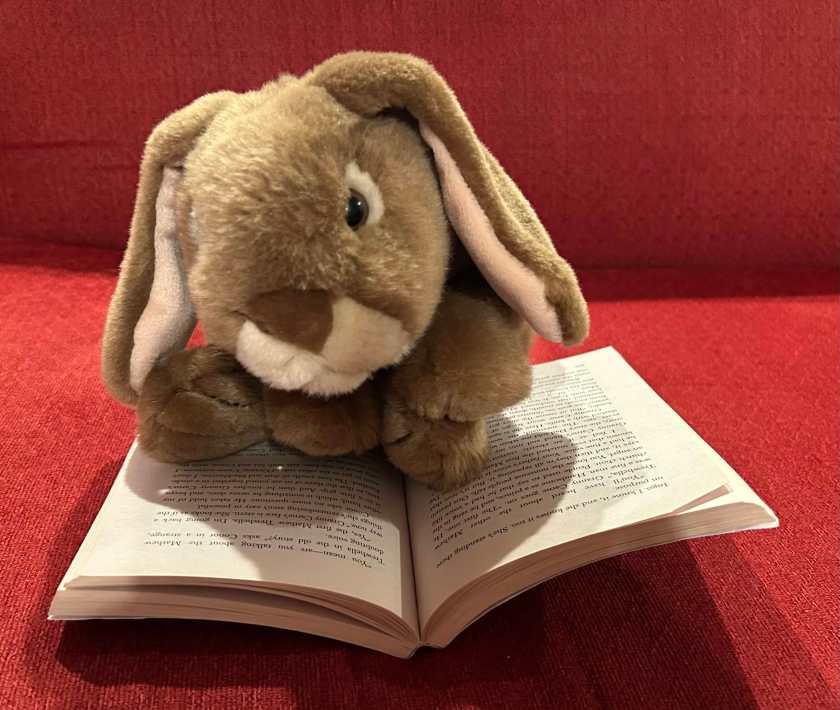
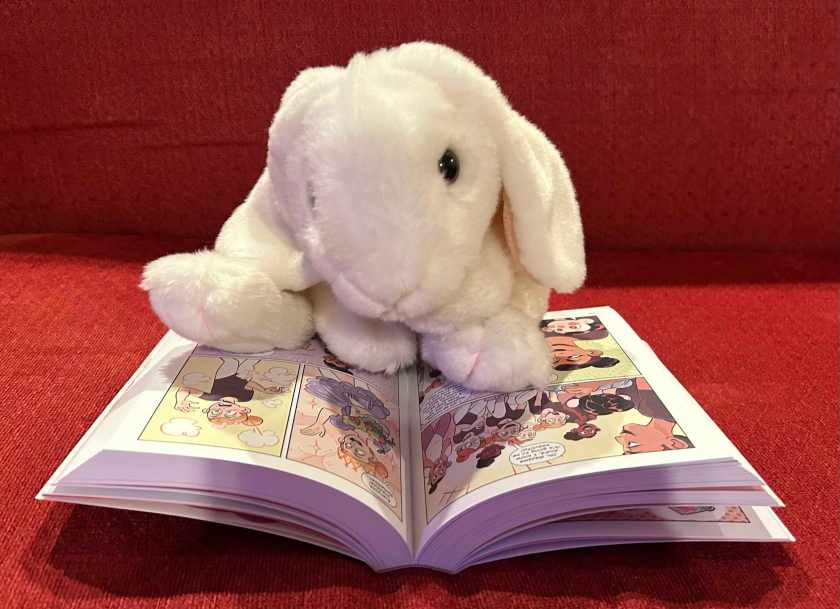
Marshmallow is reading Sweet Valley Twins: The Graphic Novel (Best Friends and Teacher’s Pet) by Nicole Andelfinger and Claudia Aguirre.

Marshmallow’s Review: I think these books are really good, especially for young girls in middle school who are noticing behavioral changes in themselves or others. This book is a graphic novel and has two of the Sweet Valley Twins books in one. The Sweet Valley Twins books were originally written in 1986. I think it’s worth noting that there are no discussions about changing bodies in these books so the focus is more on how people’s personalities and interests change. That said, I was a little unhappy with the dynamic between Elizabeth and Jessica. I’ll preface this by saying I liked Elizabeth more due to her sweet, smart personality. I think the way Jessica changes is definitely normal and understandable too. But Jessica also changes in ways that are less excusable: she bullies other girls, pulls pranks on others, and is extremely self-centered. Jessica literally says she is the best dancer to her sister’s face—several times. I think this shows that she is a worse person, or at least doesn’t care so much about others. Yet, at the end of the second book (SPOILER), Jessica is the one given the solo lead role because Elizabeth fakes being injured. Why does Elizabeth give Jessica the role? Because Jessica complains about how she deserves it more and how she is better at ballet than everyone else until Elizabeth gives in and starts thinking she doesn’t deserve it either. I think it’s really good to have an accurate representation of sibling relationships in books, but I don’t like how the authors had the book end in a way that shows one of the sisters giving something they really wanted to the other just because the other one is jealous. I think that was a pretty messed-up ending and I don’t find that fair. I think Jessica definitely needs support, especially since she is so desperate to be viewed as popular and get validation. But the fact that she consistently bullies others and tears her sister down to get that is not okay. I think Jessica is portrayed too well in the book. So I definitely think this book is good to read for young girls. But I think parents and the readers should have a discussion about what a healthy relationship should be like, because Jessica’s behavior is not what should be normalized or idealized.

After I wrote the paragraphs above, I read this review of the second book in its original, which seems to imply that Jessica is clearly the better dancer and the teacher is really playing favorites and has poor judgment. That is not quite the impression one gets in the graphic novel version. Even if Jessica is more naturally inclined, Elizabeth is just as good though possibly with more instruction and practice. So to me, the teacher choosing one over the other does not seem like a big unfair thing. Jessica on the other hand does not handle things well and really comes across as a spoiled brat.

The graphic novel is otherwise a lot of fun to read. The colors and the characters’ depictions work really well. I did keep thinking back to all my favorite books by Raina Telgemeier, especially Drama. If you are up for a solid couple hours of fun reading about middle school blues, this book can be a good choice.

Marshmallow’s Rating: 92%.

Marshmallow rates Sweet Valley Twins: The Graphic Novel (Best Friends and Teacher’s Pet) by Nicole Andelfinger and Claudia Aguirre 92%.

Marshmallow reviews The Handmaid’s Tale by Margaret Atwood

This week, Marshmallow decided to take on Margaret Atwood’s The Handmaid’s Tale. Originally published in 1985, this book is about a dystopian near-future where women’s lives are extremely constrained and their rights are almost nonexistent, and it might be a bit more challenging for some of our young readers than our usual fare.

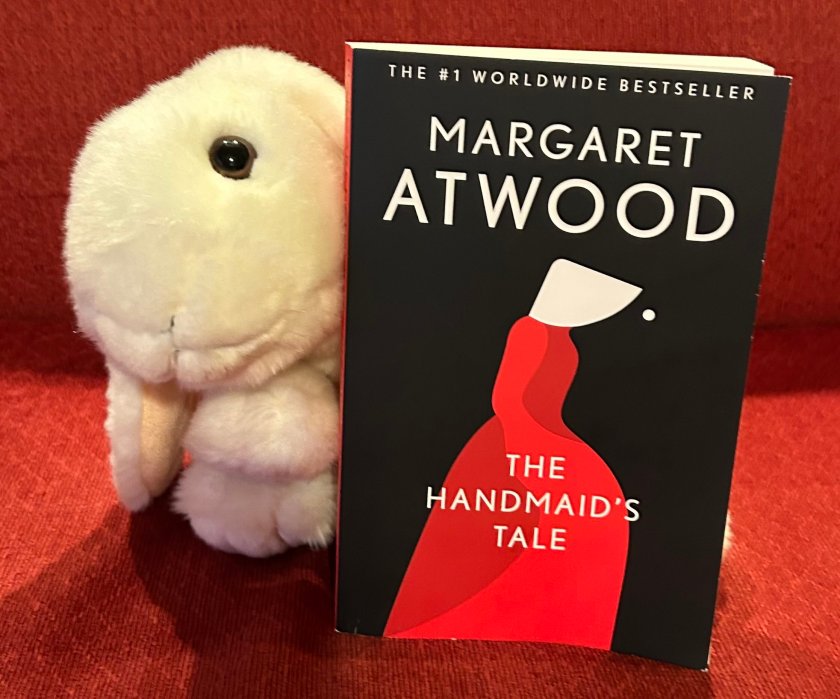
Marshmallow reviews The Handmaid's Tale by Margaret Atwood.
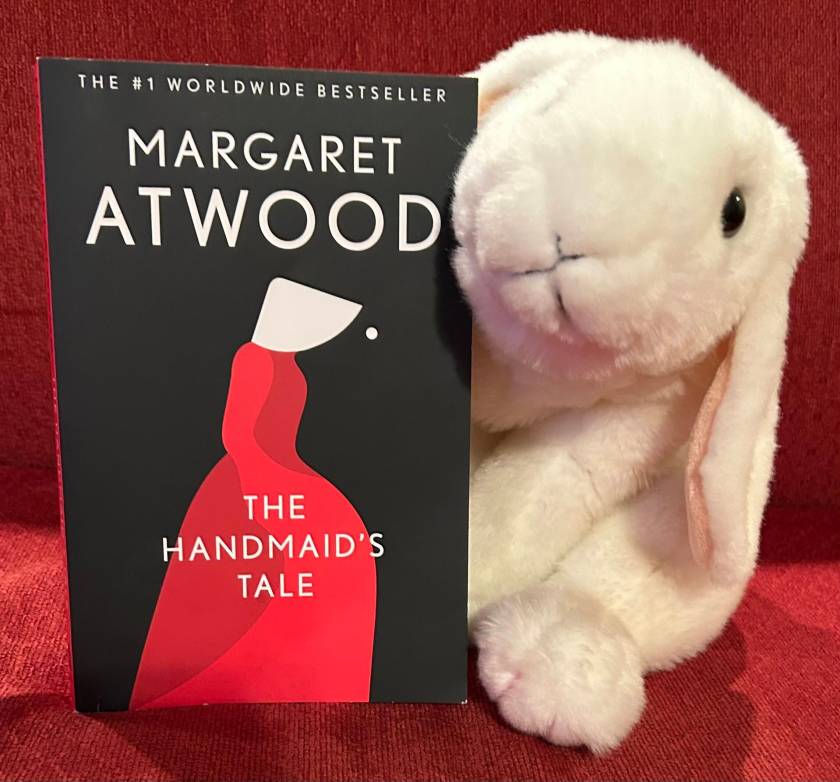
Marshmallow reviews The Handmaid’s Tale by Margaret Atwood.

Marshmallow’s Quick Take: If you like books about terrifying dystopian futures, then this is the book for you!

Marshmallow’s Summary (with Spoilers): Offred is a handmaiden in Gilead who has been given to a Commander to conceive his child. Gilead is set in the north east of what used to be the United States and was established after the President, Congress, and the U.S. government were violently overthrown by the Sons of Jacob, a radical political group. The rebels set up a system that puts women as second-class citizens with no rights. This happens gradually. Early on, the Sons and the army say some of the measures are for security purposes, such as closing down roads and increasing surveillance. But eventually, women’s bank accounts are shut off and they are let go from their jobs.

Reading the signs, Offred (who had an unknown name before), her husband Luke, and her daughter attempt to flee to Canada. But Luke’s divorce with a previous wife is not valid according to Gilead’s new laws, making Offred an adulteress. They try to run away, but Offred is caught and taken away from her family. Her husband’s fate remains unknown, but her daughter is confirmed to be given to parents that firmly believe in Gilead’s ideals. Offred is taken to the Rachel and Leah Re-education Center or Red Center, in which she is taught to be a handmaiden. Amidst declining birth rates, increased infertility, and climate disasters, Gilead’s new system of birth is forcing fertile women to conceive. Handmaidens are forcibly impregnated by the leading elite—Commanders—in Ceremonies.

More generally, all people in Gilead are sorted into a structure, and power is concentrated solely at the top in the hands of certain white men. (The fate of non-white people is not described in the book.) Women are sorted into several categories: Wives who wear blue (who are married to the Commanders but have no physical or emotional bond with them), Aunts who wear brown (who re-educate Handmaids), Handmaids who wear red (who are forced to procreate with their assigned Commander, but have no relationship with anyone), Marthas who wear green (cooks, servants, etc.), Econowives who wear striped clothing (wives of lower ranking men), and so on.

The government watches its people with Eyes, who are like a secret police so that no one knows who to trust. Everyone lives in fear, but some truly believe that this is an improvement.

Offred is assigned to a Commander to bear him a child, and she is renamed Offred presumably because his name is Fred (Of Fred; all the Handmaids are named like that, like Ofwarren, Ofglen, etc.) The Commander’s Wife is Serena Joy, a former televangelist who pushed for Gilead’s extreme take of the Bible—which is used to justify the new way of life. Now, confined to home with a husband who does not love her, she realizes that the whole thing might have been a bad idea.

This Commander feels that Serena Joy does not understand him, so he invites Offred to play Scrabble with him. In this manner, they develop a peculiar bond, a sort of mutated friendship. However, Offred knows that she can never truly be friends with the man who literally has the power of life or death over her.

The Commander argues that life is much better now, and tries to convince Offred of this. At the same time, Offred’s assigned partner (for getting groceries in a very formal, terse manner) Ofglen reveals herself to be a member of a resistance group. Offred yearns for a way out, but at the same time finds herself becoming attached to the Commander’s personal servant.

What will happen to Offred? And what about Gilead?

Marshmallow is reading The Handmaid's Tale by Margaret Atwood.
Marshmallow is reading The Handmaid’s Tale by Margaret Atwood.

Marshmallow’s Review: The Handmaid’s Tale is a hard book to read, especially for a female bunny. It is definitely not appropriate for young bunnies. The book progresses in a very disturbing way. The ending is not definite, but it leaves a mark.

I read this book initially because I’d started hearing a lot more about it recently. Many people have begun to compare Gilead to the present United States of America, especially after the recent TV series adaptation of it. Some parallels do exist and are becoming more apparent, which is very saddening and truly terrifying. This book shows a distorted version of the United States, one which will hopefully never come to pass. But the geography certainly makes the book feel more urgent and too close for comfort. (Other books that depict possible dystopian futures for the United States, like Our Missing Hearts by Celeste Ng and The Hunger Games series, come to mind.)

I must say that The Handmaid’s Tale is definitely not a children’s book. Sex and sexual activity are frequently discussed—especially since Offred’s very existence is due to her fertility and ability to conceive. The world of Gilead is also in itself extremely harrowing. Political prisoners are killed by mobs at Prayvaganzas, hangings are regularly showcased at the Wall, women are ceremoniously raped, and there’s a lot of discourse about suicide. It’s a very dark book.

However, reading The Handmaid’s Tale makes one more motivated to fight for equal rights. While books like We Should All Be Feminists by Chimamanda Ngozi Adichie make clear-eyed arguments, this book depicts the chilling effects of what a world with no rights for women could be like. Offred’s mother was an activist who fought for those rights, which Offred remembers during several flashbacks. Those flashbacks are instrumental to the nuance of this book. They show the subtle ways in which the world changed, until it had transformed into a monstrous beast that couldn’t be cured.

The Handmaid’s Tale should also serve as a warning and as a reminder that democracy must be protected. Once again, as I mentioned in my review of On Tyranny: Graphic Edition by Timothy Snyder and Nora Krug, freedom is not free. This is a resounding message that has been echoed by so many people, in so many books, throughout so many different times.

It is interesting that the author does say that other countries have not changed like Gilead. In fact, it is implied that some of the states did not submit to the Sons of Jacob. There are references to war every now and then. But the way in which the narrative flows is really a testament to the author’s prowess. It leaves the reader with an understanding of how Offred feels because of how confused and disturbed and angry and anxious and traumatized the plot leaves one.

I would definitely recommend The Handmaid’s Tale to everyone, but once they can handle it and they can understand the reason for reading such a book: to understand why equal rights for all are so important. 

Marshmallow’s Rating: 100%

Marshmallow rates The Handmaid's Tale by Margaret Atwood 100%.
Marshmallow rates The Handmaid’s Tale by Margaret Atwood 100%.

Marshmallow reviews All Ears by Stuart Gibbs

It must be obvious to the book bunnies blog readers that the book bunnies are huge fans of Stuart Gibbs and his books. While Caramel has read and reviewed all his Spy School books, Marshmallow has mostly read and reviewed his FunJungle books. Gibbs is a prolific author, and the most recent FunJungle book, All Ears, just came out a couple weeks ago on May 13. This week, Marshmallow was finally able to read this ninth book in the series and is ready to share her thoughts with our readers today.

Before starting reading this review, you might like to check out Marshmallow’s reviews of the first eight books of FunJungle: Belly Up, PoachedBig GamePanda-moniumLion Down, Tyrannosaurus Wrecks, Bear Bottom, and Whale Done.

Marshmallow reviews All Ears by Stuart Gibbs.

Marshmallow’s Quick Take: If you liked the previous FunJungle books, like animals, reading about mysteries, or want to read a really entertaining novel, then this is the book for you!

Marshmallow’s Summary (with Spoilers): Teddy Fitzroy has proven himself as a remarkable detective. His parents both work at FunJungle, the largest zoo in America (if not the world). During his time living next to it, he has solved several high-profile and low-profile cases regarding the zoo or related to the surrounding Texan area. Since the first book in the series, Teddy has been good friends with Summer McCracken—the daughter of billionaire J.J. McCracken who owns FunJungle—and the two recently started dating . Teddy is also good friends with Xavier Gonzalez, a fellow animal-lover and student at his high school.

Sadly, Xavier gets arrested! He normally likes to look around for reptiles he can capture and examine (ethically and caringly, of course) but is found at a crime scene under suspicious circumstances. Being an ardent advocate for the environment, him being in an area that seemingly was vandalized by “eco-warriors” makes him look pretty guilty. So Xavier’s best course of action is to call in Teddy to prove him innocent.

Unfortunately, the call comes at a very inconvenient time. Teddy has been hired to solve another crime regarding a lost elephant. In Texas (and many other places), some ranch owners have taken to raising exotic animals either with the purpose of sheltering them or creating an area in which hunters can kill unusual creatures for an extravagant price. The Sinclairs have created a sanctuary for elephants that they aptly named The Sanctuary. But during a massive power outage in Texas, their herd escapes or is led out of their ranch. This causes some mayhem on a football field later, but eventually Tanzy, the sole African elephant (the rest are Asian), is discovered to be missing. Aside from the fact that rural Texas is not the native habitat of an African elephant, Tanzy could also be under threat from whomever took her.

Teddy now faces two mysteries to solve: where is Tanzy and who took her, and who really committed the crime Xavier’s accused of? Can he find the answer before time runs out … for Tanzy and Xavier?

Marshmallow is reading All Ears by Stuart Gibbs.

Marshmallow’s Review: All Ears is a really good book! I’ve been waiting for the new FunJungle book to come out and for Stuart Gibbs to continue this series! I really, really, really love this series! All of the books have fascinating, interesting, and most importantly confounding mysteries that are perfect for readers of all ages. The characters are lively, intelligent, funny, and lovable—and the lack of cursing (except possibly in Tyrannosaurus Wrecks) makes them appropriate for everyone. And this book is no exception!

I really like how the FunJungle books tackle environmental issues and address the nuance of every topic. Even though he clearly finds these issues very important and harshly critiques greedy corporations, Gibbs never portrays them as completely evil. In particular, we often learn about a CEO’s perspective through a more human lens via J.J.’s character. Gibbs also doesn’t make the activists seem like saints. He explains how many hunters are good people too and really humanizes everyone. However, he does show the facts, many of which are truly disturbing. Gibbs doesn’t omit nuance; rather, he conveys a wide range of conflicting perspectives in a way that is palatable, comprehensive, and comprehensible to a wide audience, while still sending the message that action must be taken to protect the environment. All this makes All Ears worth reading: its message and its explanation and dialogue about the environment and the battle about how we should treat it.

But you should also read this book for fun! It is really funny and entertaining; there are so many twists and turns! Once I picked up this book, I could not put it down—literally. The emotional tension is also really well done throughout, and one can really feel the realness in Teddy’s situation, in which he is caught between a rock and a hard place as he tries to solve two mysteries at the same time.

I love the FunJungle series, the characters and the plot and the writing and everything about these books! They are really special to me! But I think they can be great for many new readers too! I would recommend reading the first couple of books in the series first, but honestly, one could just start here with All Ears, too. Whatever your age or background knowledge though, this book is definitely an amazing one to read for its message, style, and content! I can’t recommend it enough!

Marshmallow’s Rating: 101%

Marshmallow rates All Ears by Stuart Gibbs 101%.

Marshmallow reviews Fearless by Lauren Roberts

Last year Marshmallow reviewed Powerless and Reckless by Lauren Roberts, the first two books of her Powerless trilogy. Then earlier this year, she reviewed Powerful, a novella that recounts events taking place in the same story world as the trilogy, involving some of the same characters that we met in those first two books. Today she is finally ready to talk about Fearless, the third and last book of the trilogy that was published just this April.

Marshmallow reviews Fearless by Lauren Roberts.

Marshmallow’s Quick Take: If you liked Lauren Roberts’ previous books in her Powerless series, then this is definitely the book for you—though probably you had already been waiting for it!

Marshmallow’s Summary (with Spoilers): [For most of the background, readers should probably begin with my review of the first book, Powerless, and my review of the second book, Reckless.]

At the end of Reckless, Paedyn Gray returns to Ilya as a prisoner believing she is approaching her own execution. Her captor is none other than her beloved Kai, who is bound by duty to bring her to his brother Kitt. However, it turns out that Kitt wanted Paedyn brought back to Ilya so he could propose to her. This is a shocking turn of events since she had killed their father—the king of Ilya—in the first book. (She did have a valid justification of self-defense.) After a while though, Kai has forgiven her. Kitt, on the other hand, seems to be stuck somewhere entirely different from the spectrum of forgiveness and hate.

Paedyn accepts Kitt’s proposal because she believes it will help bring equality in Ilya between the Ordinaries and the Elites. But even though she is now engaged to Kitt, Paedyn finds herself still pining for Kai. Once again, their love seems impossible. But they separately start to realize two things: first, Kitt has changed and no longer seems like himself, and secondly, they cannot be apart. Luckily for them, Kitt has arranged new Trials for Paedyn in order for her to prove herself as an Ordinary to the Elites of Ilya. She must retrieve ancient artifacts, gain the trust of foreign kingdoms, and make the ultimate sacrifice.

I won’t spoil more. But if you thought Roberts’ plot was complex in the first two books, you will be happy to know that the story ends in a most satisfactory way, though with many twists and turns along the way that I never saw coming. Will Paedyn, Kai, and Kitt all make it to their happy ending? Or will one or more get lost along the way?

Marshmallow is reading Fearless by Lauren Roberts.

Marshmallow’s Review: Fearless is a really complicated book that adds a lot of depth to the original story, the fictional world, Ilya’s history, the characters, and the series. Ultimately, the ending is bittersweet, but I can say that things are resolved pretty well. I was not disappointed with the end and I felt like this is probably the best way for the series to end without leaving a majority of the readers bawling with tears in their eyes. That said, it is still touching and emotional. In Fearless, Roberts reveals many layers of Ilya and the entire world that had been previously unseen. These revelations make the end an even more satisfying one because the story becomes a lot richer with detail.

I will say though that I did notice some things were a little too similar to the Hunger Games series to be coincidental. The Purging Trials of Ilya are almost carbon copies of Panem’s Hunger Games, and Paedyn in many aspects seems like a reflection of Katniss. I know a lot of readers are disappointed by these striking parallels. Many have pointed to several other books that Roberts seems to have “taken inspiration from.” I haven’t read all of the books they list, but I can see why some say that some aspects of Roberts’ work are a little suspiciously close to other peoples’ work. However, I found the plot twists in this book unique and these make all the difference. The twists in this third installment were so unexpected yet so well-executed that I could not put the book down till it was done.

I’m a little sad the series is over, and I do wonder if this emotional journey with Paedyn has been beneficial to me. (The series is rough on the tear ducts!) But overall, this was a very well-done conclusion for a very well-done series! Not all fans will be happy, but when have we readers ever agreed on an ending? Overall, I would recommend this third book because I really appreciate how, despite all the darkness in the previous books, it ends on a hopeful note.

Marshmallow’s Rating: 100%.

Marshmallow rates Fearless by Lauren Roberts 100%.