Marshmallow reviews Smile by Raina Telgemeier

Marshmallow has reviewed three books by Raina Telgemeier before: Ghost (2006), the graphic novel version of Ann N. Martin’s Kristy’s Great Idea (The Baby-Sitters Club Graphic Novels #1) (2006), and Drama (2012). For her first review after her summer break she chose to write about a fourth Telgemeier book: Smile (2010).

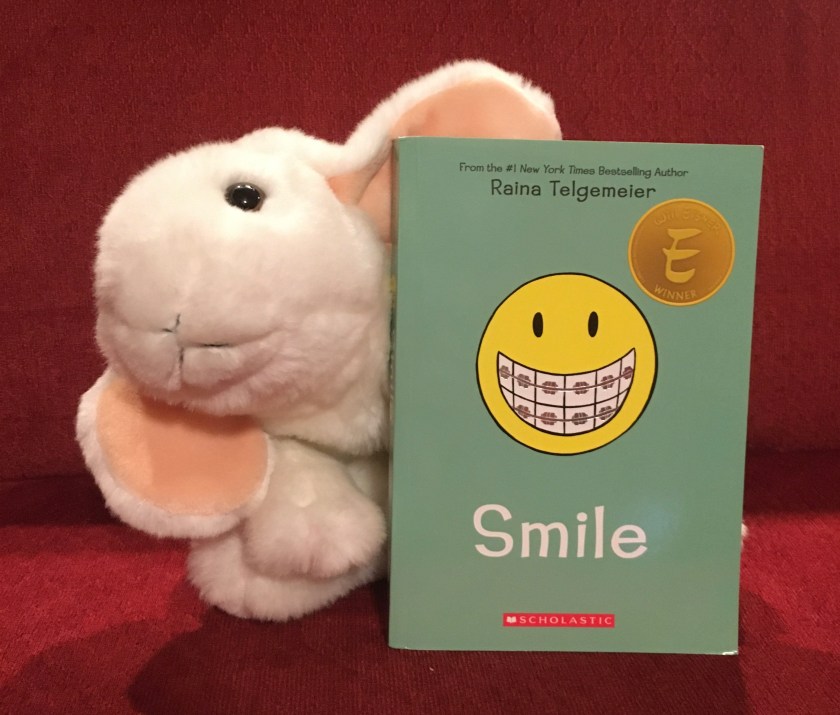
Marshmallow reviews Smile by Raina Telgemeier.

Marshmallow’s Quick Take: If you like books about friends, friendship, and school, or if you enjoyed any of Raina Telgemeier’s other graphic novels, then this might be the book for you. 

Marshmallow’s Summary (with Spoilers): When Raina Telgemeier fell after her Girl Scouts meeting, her front teeth fell too. Unfortunately, they were her adult teeth and they weren’t going to grow back. This leads to a long process that continues for years. Her teeth must be fixed through braces, headgear (only during the night), and more. Raina is extremely self conscious of her image at school, and fears that her braces will make her look like a “dork” or a “nerd”; her friend group doesn’t help at all. In fact, several of her friends tell her that, “cool just isn’t the word to describe you.” In addition to all this, Raina has, what the book cover calls, “boy confusion”. ’nuff said.

Raina feels overwhelmed by middle school, and eventually high school. She is frustrated by the teeth issue, and struggling to find out what real, true friendship really is. I can’t spoil too much, but I can say that by the end, Raina can finally smile. 

Marshmallow is reading Smile by Raina Telgemeier.

Marshmallow’s Review: I thought that this was a very interesting insight into the author’s childhood, and her experiences with middle and high school. This book is about the author, Raina Telgemeier, herself, and spans several years of her teenage experience. 

Though I couldn’t associate myself with all of the feelings the main character had, I can still sympathize with her problems, because the character is shown in such a real way. She is almost like a real person. (Oh, wait, she is.)

This is a graphic novel, and one of a series. However, despite the fact that there are two other books, this can definitely be read as a stand-alone book. But it doesn’t take too long to read, so you can probably read the books all at once and it makes a nice story all together. (I might even review the other books for the blog some day.) However, as I said, this could be a stand-alone, because the story ends at a satisfactory point. (Furthermore, the story arcs of the other two books are all different and the plots are all unconnected. I would of course say more if I do end up reviewing them, too.)

All in all, Smile is a good book that can be enjoyed by all. But I would say that probably a middle school / middle grades reader would find it more exciting than younger or older bunnies.  

Marshmallow’s Rating: 95%.

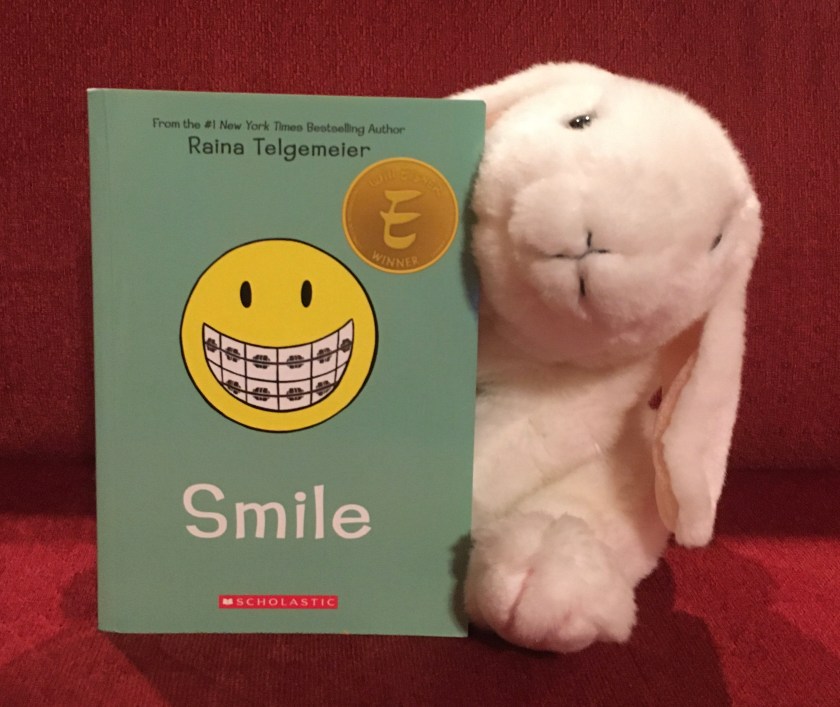
Marshmallow rates Smile by Raina Telgemeier 95%.

Marshmallow reviews Rise of the School for Good and Evil by Soman Chainani

Marshmallow loved Soman Chainani’s School for Good and Evil series, and reviewed three of the six books for the book bunnies blog. So she was delighted to get her paws on Rise of the School for Good and Evil, the much anticipated prequel to this fascinating hexalogy. Below she shares her thoughts on this book, just published in May 2022.

You might like to check out Marshmallow’s reviews of Quests for Glory, the fourth book, A Crystal of Time, the fifth book, and One True King, the sixth book, before moving further.

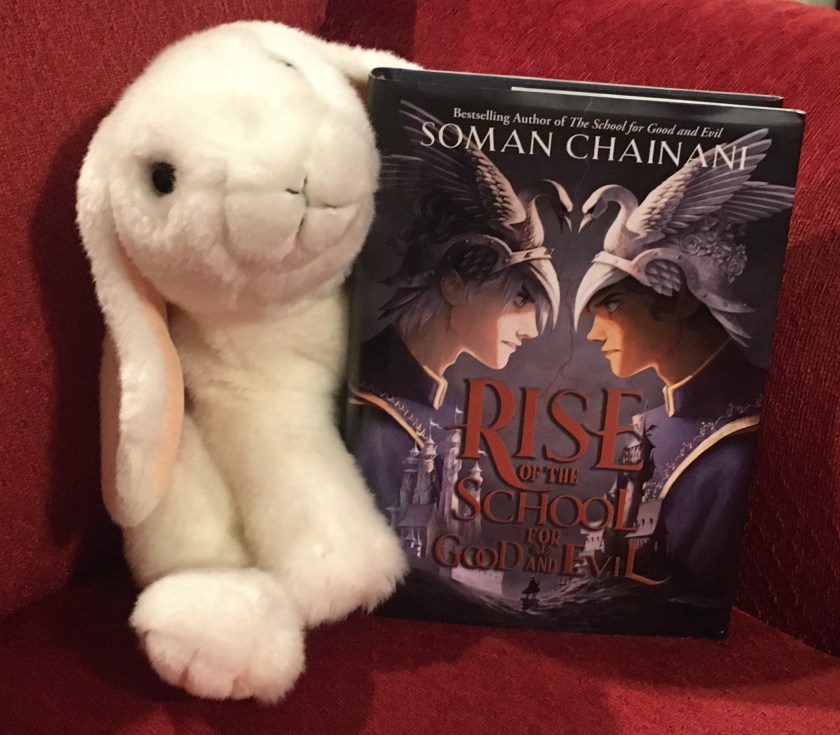
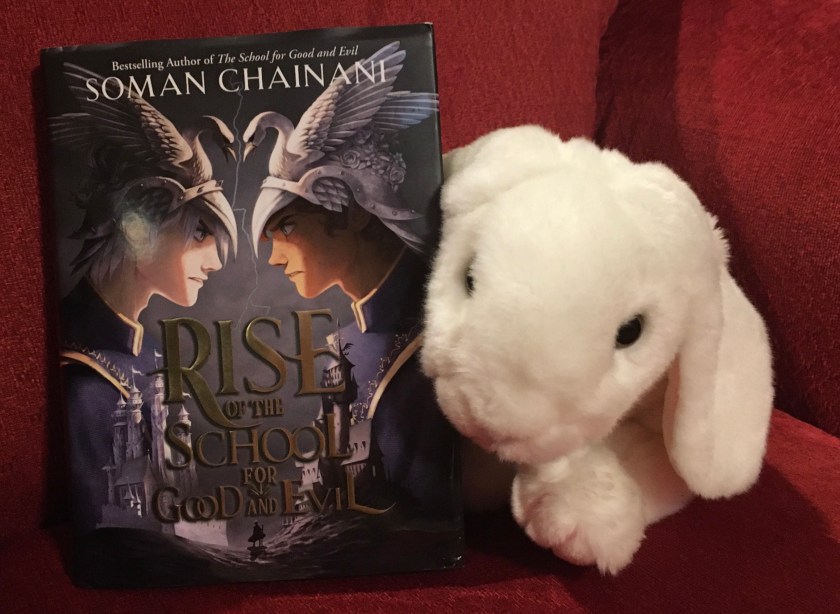
Marshmallow reviews Rise of the School for Good and Evil by Soman Chainani.

Marshmallow’s Quick Take: If you like books about family, fairy tales, and magic, then this might be the book for you. This will be even more of a joy to read if you have already read and enjoyed the six School for Good and Evil books.

Marshmallow’s Summary (with Spoilers): Rhian and Rafal have been ruling the School for Good and Evil as School Masters for years. Both twins are immortal as long as they can uphold the balance between Good and Evil and that they both love each other, despite the fact that one is Good and the other is Evil. The Storian (the pen that writes all of the fairy tales happening in the Woods) selected them to be the next School Masters. The School for Good and Evil is where all of the people in fairy tales are trained. Heroes, princes, princesses, fairies, and other Good people/creatures are trained at the School for Good. Witches, warlocks, giants, and other Evil people/creatures are trained at the School for Evil. Students at this school train in the hope that the Storian will one day write their stories. 

The Pen never specified which brother was the Good one and which one was the Evil one, but the twins were sure they already knew. Rhian was the Good one (described as tan with golden, wild hair), and Rafal was the Evil one (described as pale with white, spiky hair). Still the two brothers get along well and love each other.

Unfortunately, the arrival of one student turns their dynamic upside down. What starts out as a joke between Rhian and Rafal creates a rift between them. Challenge after challenge threatens to tear them apart. Will their love for each other be enough or will the rift between them eventually tear the School apart? 

Marshmallow is reading Rise of the School for Good and Evil by Soman Chainani.

Marshmallow’s Review: WARNING! DO NOT READ THIS BOOK UNLESS YOU HAVE READ THE OTHER BOOKS IN THIS SERIES! I generally don’t recommend reading books in any certain order, but in this case, reading this book before the others would be a mistake. I think that Rise of the School for Good and Evil is a book meant to be read after the others. The story fits in well with a lot of things that we saw in the other books, and fills some gaps, but you wouldn’t understand it unless you read the other books. Let me also add, without spoiling anything, that the ending of this book is not definite and would definitely not be satisfying unless the reader had already read the other books. One does not have to have read the entire series, probably just the first three books. However, I feel that this would definitely be better as an addition to the series, not an introduction. 

However, this is a great book that is a great addition to the series. It doesn’t go fully into some of the details discussed in the previous books, but it definitely shows the events that led up to the hexalogy. I especially liked how we saw characters who were completely Evil in the previous books in a different light. I also enjoyed how we saw the ancestors of some of the characters in the previous books, as this book is set much before the rest of them. 

Marshmallow’s Rating: 95%

Marshmallow rates Rise of the School for Good and Evil by Soman Chainani 95%.

Marshmallow reviews How to Find What You’re Not Looking For by Veera Hiranandani

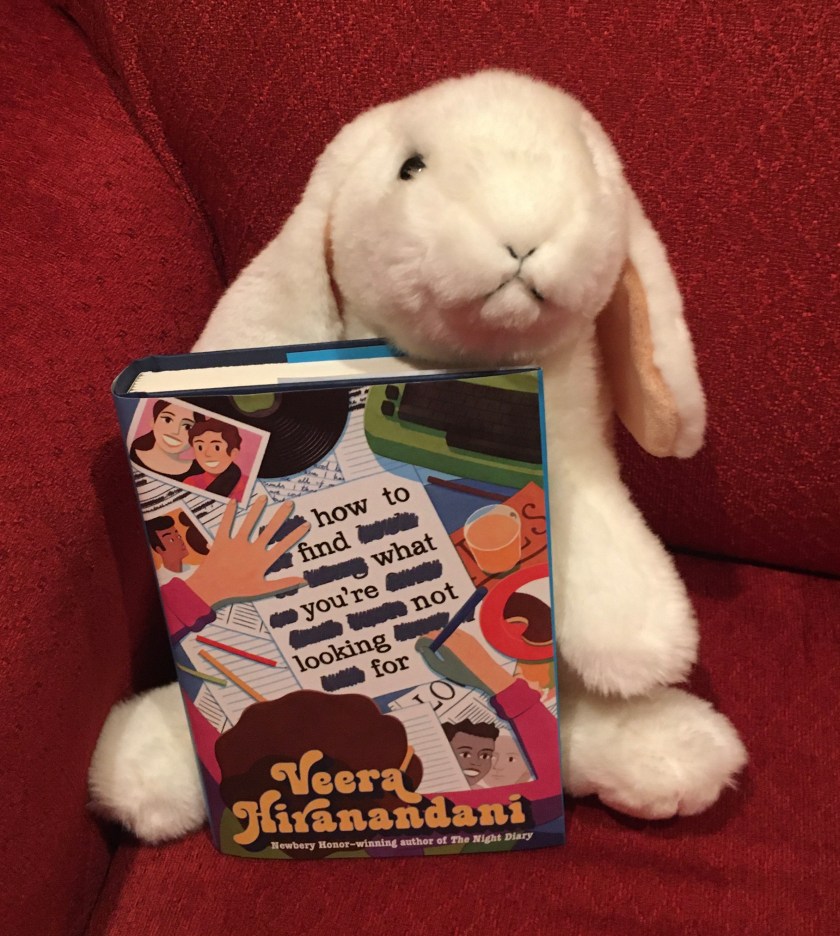
Today Marshmallow reviews How to Find What You’re Not Looking For, a 2021 novel by Veera Hiranandani.

Marshmallow reviews How to Find What You're Not Looking For by Veera Hiranandani.
Marshmallow reviews How to Find What You’re Not Looking For by Veera Hiranandani.

Marshmallow’s Quick Take: If you like books about family, friends, or historical fiction, then this might be the book for you. 

Marshmallow’s Summary (with Spoilers): Ariel Goldberg’s life is drastically changed forever when her older sister Leah elopes with a man from India.

The book starts in the summer of 1967. Interracial marriage is now legal, however, stigma and bias remain, even in Ariel’s parents. Leah tells Ariel about her relationship with Raj, an Indian college student, and says that they have plans for the future, which greatly worries Ariel. When the girls’ parents meet Raj, they don’t like him. This is mainly because Ariel’s family is Jewish, and Raj is not; they don’t want their daughter to marry a person who is not Jewish. Ariel likes Raj, but she definitely doesn’t want her sister to marry anyone yet. But then one day, Leah and Raj elope, and Ariel’s life is forever changed. 

Besides all that is going on in her home life, Ariel has been having problems at school. There seems to be a new rift between her and her best friend, Jane. Ariel is also bullied by a boy who hates Jewish people. On top of all this, Ariel also has trouble writing. Her new teacher, Miss Field, believes that she has dysgraphia. Miss Field brings a typewriter for her to use and asks Ariel to write short poems to practice writing. 

Ever since Leah left, Ariel’s life seems to be falling apart. Can Ariel put it back together?

Marshmallow is reading How to Find What You're Not Looking For by Veera Hiranandani.
Marshmallow is reading How to Find What You’re Not Looking For by Veera Hiranandani.

Marshmallow’s Review: How to Find What You’re Not Looking For raises many complex issues such as racial and religious bias in a way that teaches but also gives hope. It shows that bias is not just in other people but everywhere. It also shows that there might be reasons for behavior that looks excluding, such as people wanting to sustain their family culture and identity, but it does clearly show that stigma and bias are not okay. 

I found it interesting how the main character wrote poems to express what is happening in the book. I found it to be a good way for the author to tell the reader how the main character, Ariel, is feeling. The poems really add something to the book. 

The story is set in 1967; the author uses words like “groovy” to show how the narrator is living in the past. The narrator is also always using the second person “you” and everything is told in the present tense. This gives the story a more urgent tone somehow and like everything is happening all at once, as you read the book.

This book includes information about the Loving vs. Virginia case from 1967 and the ideas around interracial marriage play a significant role in its plot. Martin Luther Jr.’s murder from 1968 is also mentioned. In other words, How to Find What You’re Not Looking For talks about racial and religious injustice very openly. This makes me think that this book would be more appropriate for older bunnies, from 10 and up. There isn’t really any inappropriate content for younger bunnies, so younger readers could also enjoy it, but I think 10 and up would be able to understand the context better and so get the most out of this book. 

Marshmallow’s Rating: 95%.

Marshmallow rates How to Find What You're Not Looking For by Veera Hiranandani 95%.
Marshmallow rates How to Find What You’re Not Looking For by Veera Hiranandani 95%.

Marshmallow reviews The Magician’s Elephant by Kate DiCamillo

Marshmallow has reviewed two books by Kate DiCamillo before: Flora and Ulysses and The Miraculous Journey of Edward Tulane. Today she reviews a third book of hers, The Magician’s Elephant.

Marshmallow reviews The Magician's Elephant by Kate DiCamillo.
Marshmallow reviews The Magician’s Elephant by Kate DiCamillo.

Marshmallow’s Quick Take: If you like books about family, animals, or magic, then this might be the book for you. 

Marshmallow’s Summary (with Spoilers): Peter Augustus Duchene lives in Baltese with his guardian, an elderly soldier named Vilna Lutz. Vilna Lutz is not particularly bad, but he is extremely obsessed with making Peter into a good soldier. Thus, Vilna Lutz is extremely strict. One day, when Vilna Lutz sends Peter to buy fish and bread, Peter meets a fortune teller. Instead of buying the fish and bread he was supposed to, he uses the money to ask the fortune teller a single question. (Since he is honorable, he decides that he will tell Vilna what he has done, which is very honorable.) Peter knows exactly what he will ask. His little sister, Adele, according to Vilna, was stillborn but Peter has his doubts. When he starts to ask the fortune teller his question, the fortune teller tells him that his sister is still alive. Extremely excited, Peter asks how to find her. The fortune teller mysteriously says, “Follow the elephant.” Puzzled over these words, Peter realizes that this means that Vilna or the fortune teller is lying, which shakes his foundations, because Lutz is a soldier, “good and true”. 

Not very far away, a magician is performing at the Bliffendorf Opera House. He intends to summon a bouquet of lilies. Instead, this magician performs his greatest trick yet: he summons an elephant that crashes through the ceiling. This elephant lands on the legs of the woman the magician was trying to present the lilies to. She is crippled from that and the magician is arrested. The elephant is placed in a cage and then later bought by a rich noble woman to be displayed at her house. 

The elephant is the talk of the town, and Peter hears about it and believes that it will lead him to his sister, Adele. When Peter questions Vilna about his sister’s supposed death, Vilna admits that she didn’t die. Vilna was a good friend of Peter’s father. Adele was not placed in his care because she was just a newborn when she was orphaned. This makes Peter more determined to find her. 

Marshmallow is reading The Magician's Elephant by Kate DiCamillo.
Marshmallow is reading The Magician’s Elephant by Kate DiCamillo.

Marshmallow’s Review: I think that The Magician’s Elephant is an amazing book. I always enjoy reading Kate DiCamillo’s books; all of her books are touching and elegant. And this one is especially good. I specifically like how DiCamillo goes into the backstories of all the characters and ties them all together at the end.

The Magician’s Elephant is also a great family book. The main message is simple and perhaps not surprising: even during hard times, family should stick together. But the way DiCamillo tells the story makes all the difference. I listened to this book with my family as an audiobook, besides reading the paper version, too. In both versions, I really enjoyed reading this book. All in all, I think it is a necessary addition to the library of anyone who likes reading children’s literature.

Kate DiCamillo also inserts a bit of a magical touch into this book. The summoning of the elephant and the fortuneteller’s ability to see are both interesting additions of inserting magic into an otherwise realistic storyline, and they make up a major part of this book. All together these make The Magician’s Elephant a touching book that is both realistic and magical, somewhere between fairy tales and realistic fiction.

The version of the book I read was illustrated by Yoko Tanaka. Tanaka’s full-page illustrations were black and white and simple, but contributed to the general magical atmosphere of the story.

I will read this book again.

Marshmallow’s Rating: 100%.

Marshmallow rates The Magician's Elephant by Kate DiCamillo 100%.
Marshmallow rates The Magician’s Elephant by Kate DiCamillo 100%.