Marshmallow reviews Victory. Stand! Raising My Fist for Justice by Tommie Smith

Readers probably already know that Marshmallow enjoys reading graphic novels which are fictional, but she has occasionally also read memoirs or biographies written in graphic novel format and reviewed them for the book bunnies blog. (See, for example, her reviews of They Called Us Enemy by George Takei and The English GI by Jonathan Sandler and Brian Bicknell.) Today she writes about a 2022 book in this genre: Victory. Stand! Raising My Fist for Justice, by Tommie Smith, co-written by Derrick Barnes and illustrated by Dawud Anyabwile.
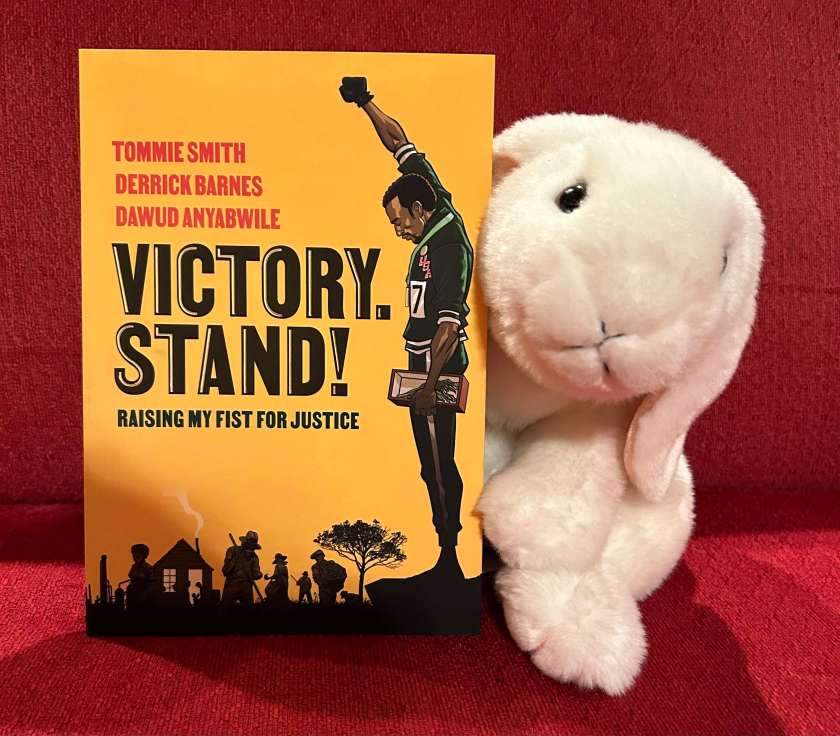
Marshmallow reviews Victory. Stand! Raising My Fist for Justice, by Tommie Smith, written together with Derrick Barnes and illustrated by Dawud Anyabwile.

Marshmallow’s Quick Take: If you like autobiographies or books about recent history, or if you want to read specifically about one of the consequential events in the history of the Civil Rights and Black Power movements in the United States, then this might be the book for you. 

Marshmallow’s Summary (with Spoilers): Tommie Smith is an American athlete, who is the first person to run 200 meters in under 20 seconds. In this book, Smith shares his experiences and retells the events leading up to and after his famous 1968 Olympics Black Power salute.

The narrative starts by showing the beginning of Smith’s Olympic finals race. Then we are shown his earlier life. As a young child, Tommie and his family were sharecroppers, meaning that they worked on land owned by someone else. Tommie did chores and picked cotton with his family. Even at a young age, Tommie could see injustice. He watched his parents and siblings work so hard everyday, toiling in the sun, while the white family who owned the land had a better, bigger house and did not have to work as much. However, things soon got even worse, and mechanized equipment and the drop in cotton prices took jobs away from sharecroppers. As a result, Tommie and his family moved to a labor camp in Stratford, California. There Tommie began to attend school regularly and “had to make sense of something that made no sense at all”. The white children in his class had several privileges, and the teachers saw them raise their hands, but they never seemed to see Tommie’s.

Everything changed, however, after a momentous race with his sister. Tommie realized that he could achieve anything, and he joined his school’s track team. This led him to becoming a star, winning almost every single competition he entered. By the time he graduated high school, he had accolades in multiple sports and several scholarship offers.

Tommie became a star athlete, and eventually, he made it to the Olympics. But he never lost his sense of justice and equality. He raised his fist at the 1968 Games to protest the racism and the many injustices in the United States at the time. Afterwards, there was a lot of push-back, and Smith faced a lot of difficulties as a result, but also a lot of people felt seen and heard. The book ends in the present, mentioning a few other athletes who have made similar protests after Smith in the intervening years.
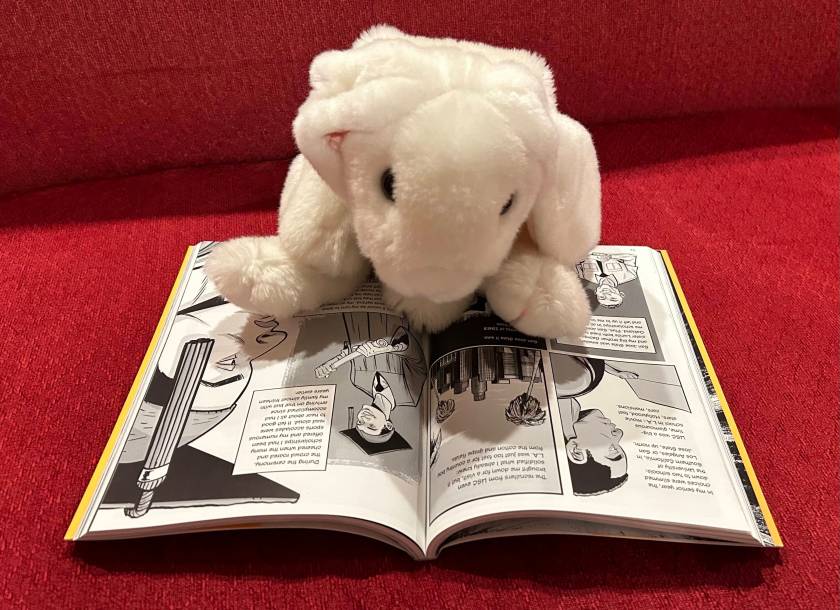
Marshmallow is reading Victory. Stand! Raising My Fist for Justice, by Tommie Smith, written together with Derrick Barnes and illustrated by Dawud Anyabwile.

Marshmallow’s Review: I really enjoyed reading Victory. Stand! Raising My Fist for Justice. It is very informative, and I learned a lot that I did not know before. I think it is very important to know and remember such acts of bravery and the people who committed them. 

The drawings are really good. I think that they show movement, especially running, very well. I have reviewed historical graphic novels before, and I appreciated them too, but the drawing style in this one was unique and enjoyable. I also enjoyed the writing style of the author. The writing paired with the drawings made this a really good book overall.

Victory. Stand! Raising My Fist for Justice mentions horrible things that some people have done and has one image that is disturbing. Additionally, it does have some derogatory words. But the message of the book is vital. I think this is a book that every young bunny should read at least once. The story of Tommie Smith’s courageous life and his raised fist is a touching story that gives us hope for the future. 

Marshmallow’s Rating: 100%.
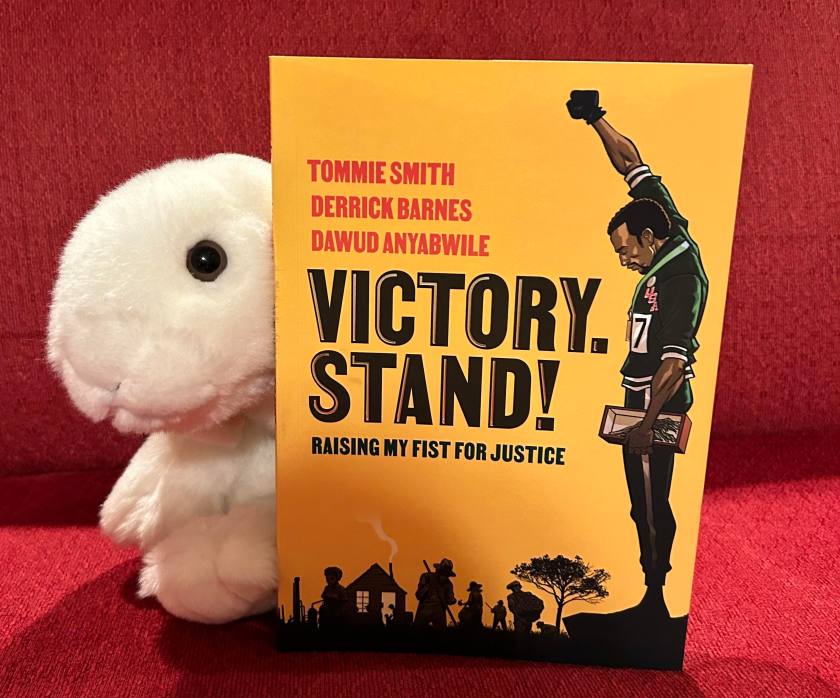
Marshmallow rates Victory. Stand! Raising My Fist for Justice, by Tommie Smith, written together with Derrick Barnes and illustrated by Dawud Anyabwile, 100%.

Marshmallow reviews Echo by Pam Muñoz Ryan

In the past weeks and months, Marshmallow has reviewed several books by Pam Muñoz Ryan. This week she went back and reread the very first book she had read by her, Echo. This book was published in 2015 and won Muñoz Ryan a Newberry Honor in 2016. Marshmallow originally read it for school a couple years ago, and she very much enjoyed revisiting it this week. Below she shares her thoughts on this 600-page page-turner.

(You might also like to check out Marshmallow’s reviews of Esperanza Rising (2000), Paint the Wind (2007), and Solimar: The Sword of the Monarchs (2022).)

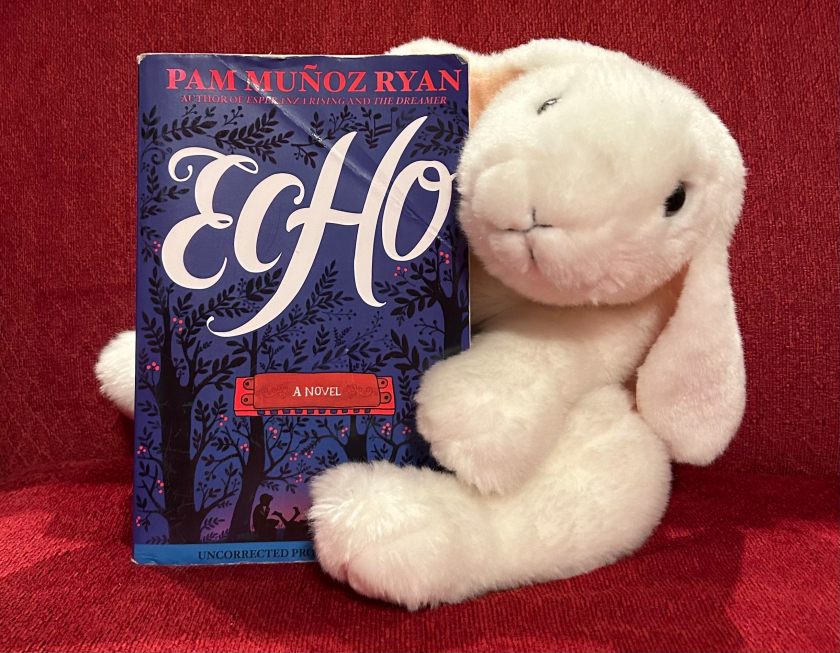
Marshmallow reviews Echo by Pam Muñoz Ryan.

Marshmallow’s Quick Take: If you like books based on historical events or if you have enjoyed reading some of Pam Muñoz Ryan’s other books, then this might be the book for you. 

Marshmallow’s Summary (with Spoilers): “Fifty years before the war to end all wars”, a little boy named Otto goes into the forest to hide while playing hide-and-seek and gets lost. Having recently bought a book and a harmonica from a Gypsy, he gets so intrigued by the story in the book that he does not realize how long he had stayed hidden.

The tale is about three sisters who were raised by a witch. The three sisters were in fact the daughters of a king who desperately wanted a son. Upon their birth, the king ordered the midwife to leave them in a forest. The midwife took pity on the babies and brought them to a witch, who named them Eins, Zwei, and Drei in the order they were brought to her. These girls grew up unaware of their royal origins. Years later, when the king died, his son (the sisters’ brother) learned of them. He and his mother were overwhelmed with happiness and sent the midwife to bring them to the kingdom. The midwife came and told the sisters the good news. However, the witch did not want to lose the girls, who had become useful servants to do all the work. She cursed them, saying that they could never leave the forest unless they saved someone’s life. 

After tripping and hitting his head, the little boy, Otto, wakes up and discovers the sisters in the forest. The sisters, Eins, Zwei, and Drei, help Otto find his way home but ask for a favor. They each take a turn playing the harmonica, and it appears that they store their spirits in the harmonica. He promises to pass on the harmonica when the time is right. 

Seventy years later, Friedrich Schmidt discovers the harmonica in Nazi Germany. Born with an unusual birthmark and a father who dislikes the new regime, Friedrich is not safe. When his father is taken to Dachau, Friedrich’s life turns upside down. 

Years later, in Philadelphia, Mike Flannery is living in The Bishop’s Home for Friendless and Destitute Children. His brother, Frankie, is a fountain of enthusiasm. Mike and Frankie must stick together. When a rich woman named Mrs. Sturbridge adopts them both, it seems like all their dreams have come true. Mike soon gets his hands on a harmonica that has an unusually magical sound (and yes, of course, this is the same one Otto and Friedrich had). However, Mike eventually discovers that Mrs. Sturbridge is planning to “unadopt” them and he must figure out a way for him and Frankie to stay together. 

Much later, Ivy Maria Lopez in California is excited to play a harmonica solo on the radio. The United States just joined World War II, and Ivy’s brother is off fighting in the army. Ivy soon learns that her family is moving again and she won’t be able to perform her solo. Upon moving, she faces segregation. The Hispanic children are put in a different school from everyone else. Prejudice and hate seem to be everywhere during the war. Can Ivy adjust to her new home?

Marshmallow is reading Echo by Pam Muñoz Ryan.

Marshmallow’s Review: Echo is perhaps my favorite book by Pam Muñoz Ryan, and I really enjoyed (re)reading it. I especially love the end, and I really love how the separate stories are all tied up in the end. All storylines are set in different time periods, with different characters, and different plots, but they are all connected by the harmonica and wrapped together in the end. Some themes that are started in the beginning are repeated in the end, which makes it feel even more like a conclusion. It is impressive that the author could distinguish all the stories and make each a separate line but put them together in a fashion that was not clunky or confusing.

The characters are all unique, and you come to really care about them by the end of the story. They each have strong connections to music which brings them joy and empowers them to face challenges. The tragedies they face and the events that occur are all based on real history. (For example, while writing the book, Pam Muñoz Ryan researched Roberto Alvarez v. the Board of Trustees of the Lemon Grove School District (1931), a desegregation case from California with connections to Ivy’s story. The internment of Japanese Americans during World War II also plays a significant role.)

I think another strong point of this book is the fact that it tackles several challenging issues in one place successfully. The author weaves a tale spanning from Nazi Germany to a negligent, abusive orphanage to a war-torn California. The hate, neglect, mistreatment, prejudice, and unfairness the characters face and eventually overcome all make this an even more touching story. 

The only flaw with Echo one may find is the contradictory tones of the different parts of the book. The prologue is a major part of the overall plot but has a more fantasy-like, magical atmosphere. Then the vibe of the book changes significantly. The realistic, down-to-earth, historical fiction aspect of the rest of the story does not really follow naturally from the fantastic, magical, surrealist tones at the beginning.

However, I still loved Echo. I would recommend it to all readers. The writing is not particularly difficult to read but the topics and plot make it intriguing to older readers as well.

In short, Echo is a touching, majestic piece of literature that should hold a place on everyone’s bookshelf and everyone’s heart. 

Marshmallow’s Rating: 100%.

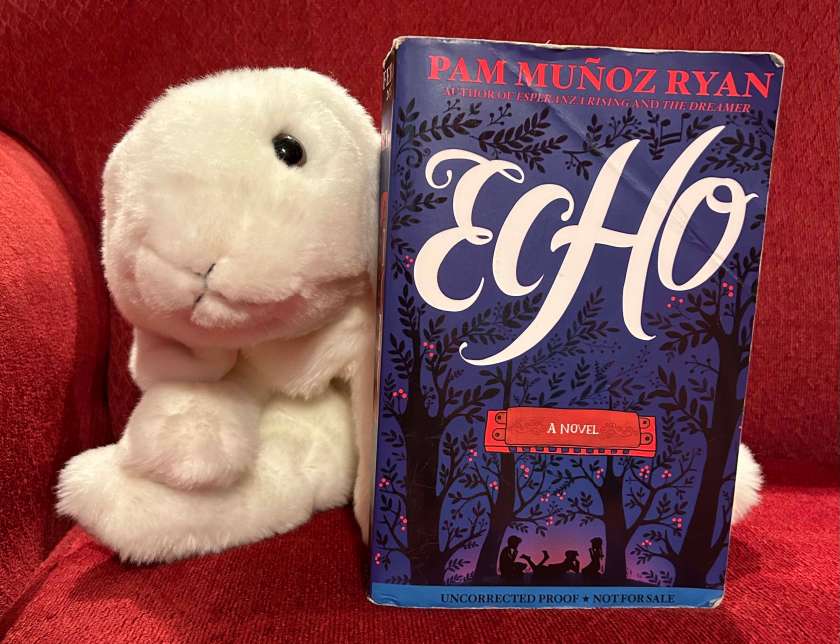
Marshmallow rates Echo by Pam Muñoz Ryan 100%.

Marshmallow reviews Solimar: The Sword of the Monarchs by Pam Muñoz Ryan

Marshmallow first read Pam Muñoz Ryan’s Esperanza Rising (2000) for school and liked the book so much that she wanted to review it for the book bunnies blog. About a year ago, she enjoyed reading and reviewing her Paint the Wind (2007). Today she talks about her most recent book, Solimar: The Sword of the Monarchs, published in 2022.

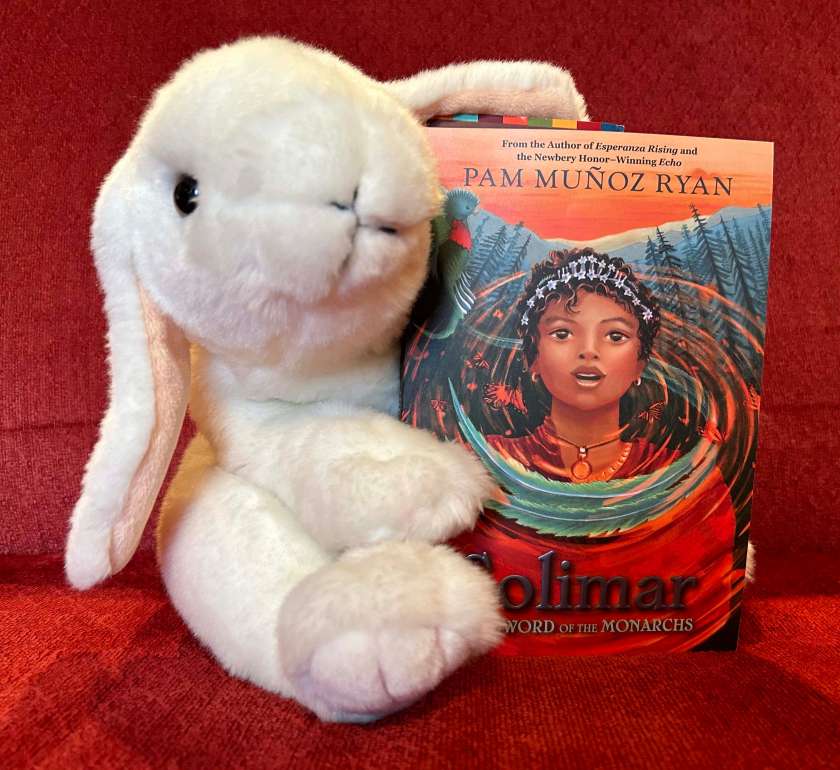
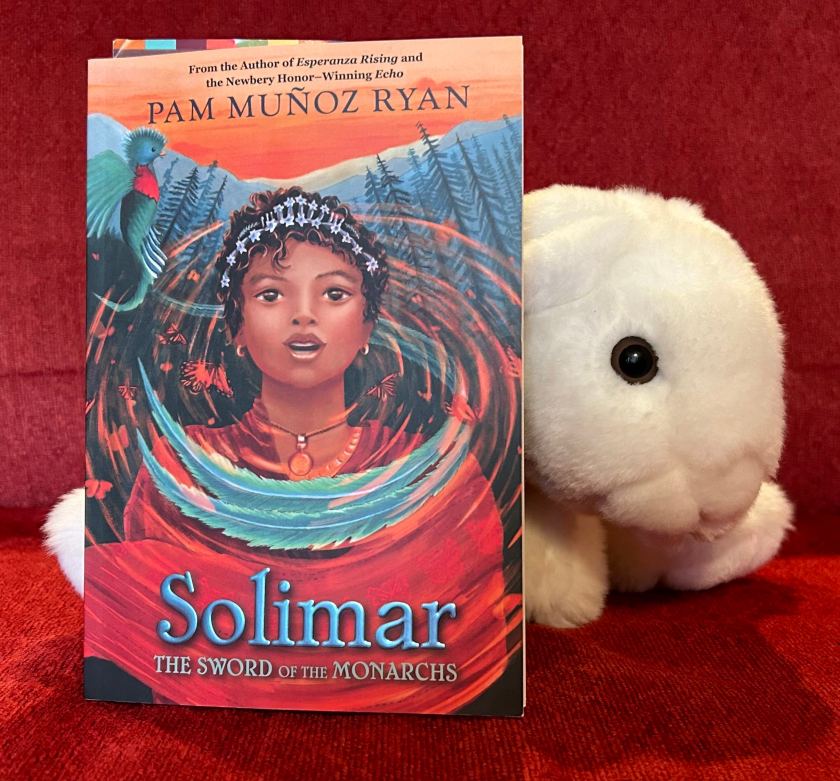
Marshmallow reviews Solimar: The Sword of the Monarchs by Pam Muñoz Ryan.

Marshmallow’s Quick Take: If you like books about magic and fantastical events, then this might be the book for you.

Marshmallow’s Summary (with Spoilers): Solimar, daughter of the king of the land of San Gregorio, has watched the monarch migration since she was a little girl. However, in previous years, she would go to the oyamel forests and watch the monarch butterflies come in to hibernate from a distance. This year, before her quinceañera, she crosses the creek and sits among the butterflies when they come home. But then something mystical happens, and she finds herself with a peculiar gift.

Solimar discovers that she can correctly answer questions about the future, but she soon figures out that this ability only functions in the sunlight. Additionally, her rebozo (her silk shawl, see Wikipedia for more) gains a peculiar, shiny side. Solimar tries to tell her best friend about her new gift, but the friend, Maria, dismisses it as a combination of great intuition and clever guessing. Then Solimar tells her abuela (grandmother), who takes her to the curandera, whom Solimar believes is a witch. This woman tells Solimar that the ancestors appointed her as a guardian to protect the monarch butterflies on their way home. She must protect the young and weak butterflies with her magical rebozo.

Then Solimar’s father and brother leave on an expedition. Taking advantage of their absence, a neighboring king invades their kingdom and holds everybody hostage. This invader king plans to cut down the oyamel forest in which the butterflies live. Solimar escapes, but now she has a tough mission. Can she save her kingdom, her family, and the monarch butterflies? 

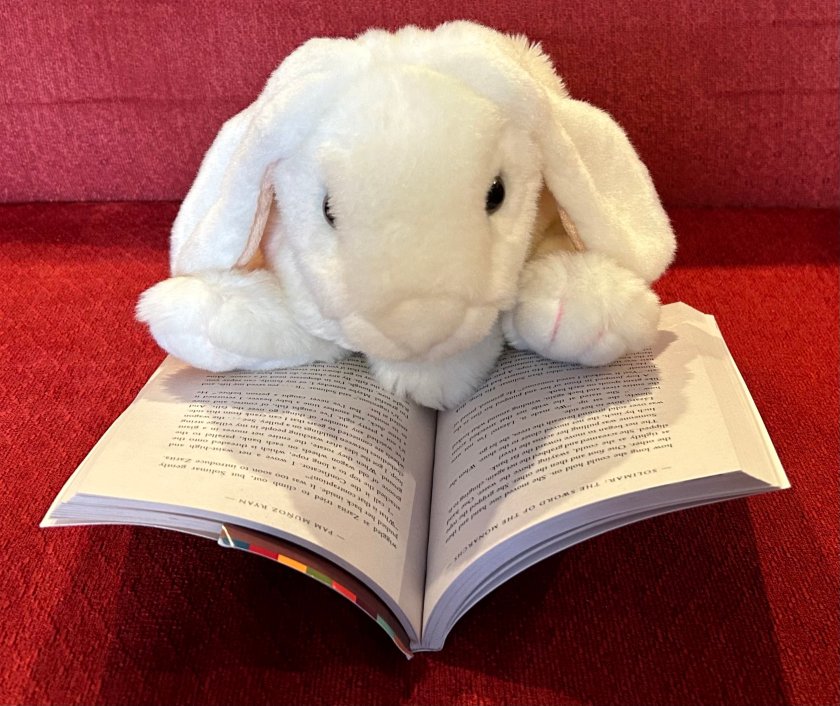
Marshmallow is reading Solimar: The Sword of the Monarchs by Pam Muñoz Ryan.

Marshmallow’s Review: I’ve read several books written by Pam Muñoz Ryan before and really liked them. I like her poetic writing style and the mystical aspects of her books. This book displays the same lyrical style and magic is threaded neatly into the story line.

The mission Solimar must embark upon was exciting to read about, and the descriptions throughout the book were lovely. The characters were all interesting and unique. They all stood out as separate individuals. I also liked how Pam Muñoz Ryan wove some parts of Mexican culture into the book. Some examples would include the usage of Spanish words and Solimar’s quinceañera.

I would recommend this book for bunnies of any age. There isn’t really anything that would make this book scary or inappropriate for younger bunnies.

I did feel like the book was a little short. I would have liked it a little more if the adventure was a little longer or more complicated. Also I think that the main character could have used a little bit more depth. However, Solimar: The Sword of the Monarchs is a beautiful story overall, and I appreciated reading another book from an author whose writing I really enjoy.

Marshmallow’s Rating: 90%.

Marshmallow rates Solimar: The Sword of the Monarchs by Pam Muñoz Ryan 90%.

Marshmallow reviews The List of Things That Will Not Change by Rebecca Stead

Marshmallow has already reviewed When You Reach Me (2009) and Goodbye Stranger (2015) by Rebecca Stead. Today she reviews Stead’s newest novel, published in 2020: The List of Things That Will Not Change.

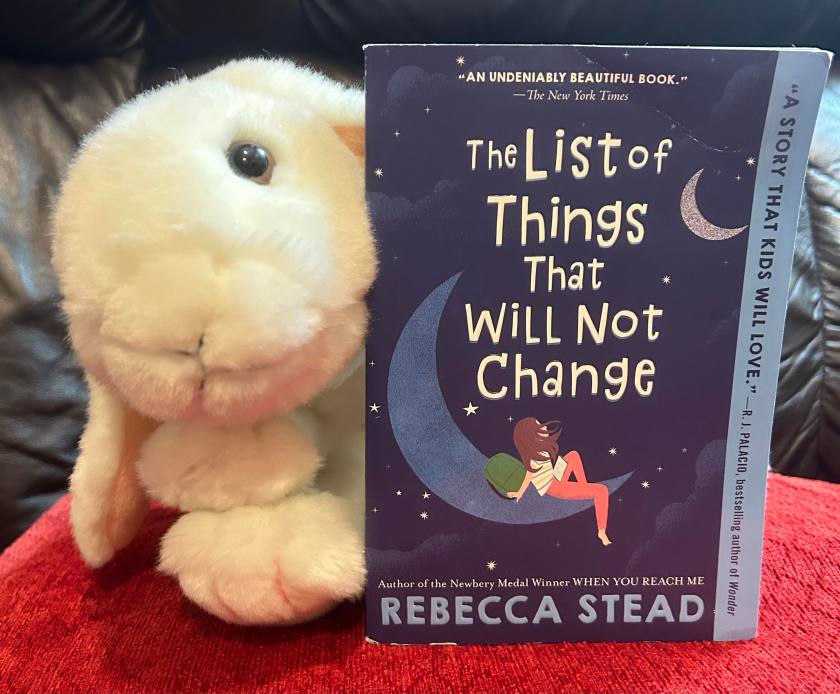
Marshmallow reviews The List of Things That Will Not Change by Rebecca Stead.

Marshmallow’s Quick Take: If you like books about family and you want to read about how different characters tackle change, then this might be the book for you. 

Marshmallow’s Summary (with Spoilers): When Bea’s parents tell her that they are getting divorced, they give her a green notebook. In it is a list of things that won’t change, even though almost everything else might:

  1. Mom loves you more than anything, always.
  2. Dad loves you more than anything, always.
  3. Mom and Dad love each other but in a different way.
  4. You will always have a home with each of us.
  5. Your homes will never be far apart.
  6. We are still a family but in a different way.

Her parents’ divorce is amicable; the reason for the divorce is that Bea’s father is gay.

After the divorce, Bea’s life splits in two different parts, sometimes living with her mother and sometimes with her father. Later, her father gets engaged with another man, Jesse. Bea really likes Jesse and looks forward to him becoming a part of the family. Not to mention that Jesse has a daughter Bea’s age named Sonia, and Bea has always wanted a sister.

But Bea has other issues to face. She has eczema which is annoying to her, and she goes to therapy to deal with her stress. Everything is now different, but Bea keeps herself up by talking with her friends and family, who are always there to support her. Bea and her family will struggle to reach their happy ending. 

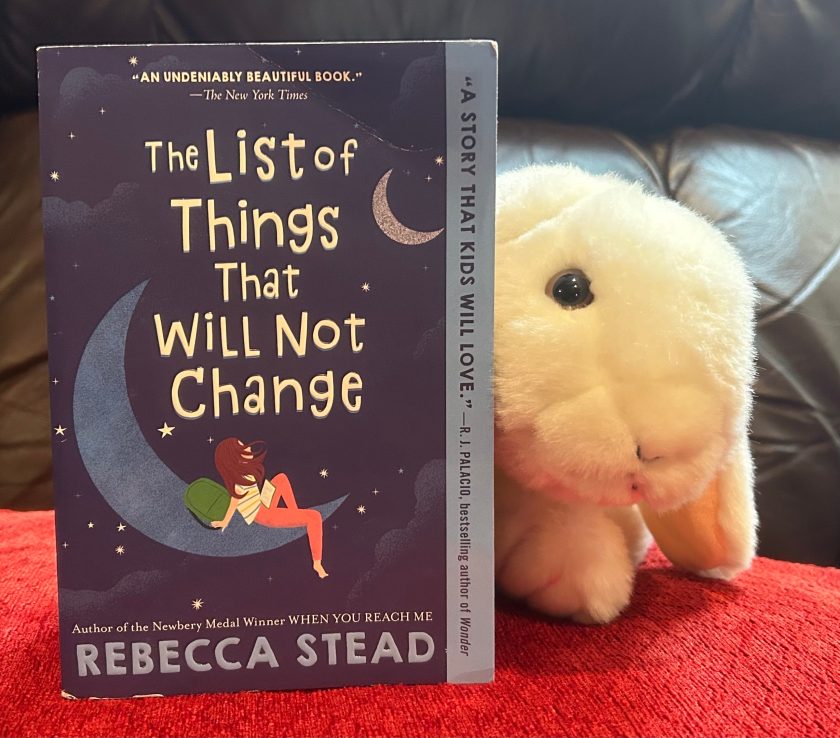
Marshmallow is reading The List of Things That Will Not Change by Rebecca Stead.

Marshmallow’s Review: I found this a touching book. Bea is very thoughtful, and this book really highlights and goes into her thoughts and feelings. It was sad to see how some of the folks in the book mistreated Bea’s father and his new partner because of their sexual orientation.

The List of Things That Will Not Change was extremely realistic and felt very down to earth when I was reading it. Every character was unique and well thought-out, and the narrative and tone of the book felt very genuine. That said, I don’t quite think the end was one hundred percent fulfilling, but it was definitely satisfactory. However, I did like how all the loose parts were tied up in the end. I also found it interesting how not everything was perfect in the end but it was realistic. (I’m not going to say much more!)

The List of Things That Will Not Change would be appropriate for all ages, presuming that the person would understand the plot, which I felt was easy enough to understand, though it had some extra nuances for an older reader who would see all the threads from beginning to end.

Bea’s relationship with Sonia might remind some readers of a book I reviewed a while ago: To Night Owl From Dogfish by Holly Goldberg Sloan and Meg Wolitzer. There are indeed some similarities but also a lot of differences. Bea’s health issues reminded me a bit of Guts by Raina Telgemeier, another book I reviewed for the blog. And compared with the other books I have read of Rebecca Stead, the tone and voice of this book was very similar. The setting and tone were more reminiscent of When You Reach Me, but the realism was quite like that of Goodbye Stranger. But The List of Things That Will Not Change has definitely a unique and original story, and I really enjoyed reading it; I think most bunnies would, too. 

Marshmallow’s Rating: 95%.

Marshmallow rates The List of Things That Will Not Change by Rebecca Stead 95%.