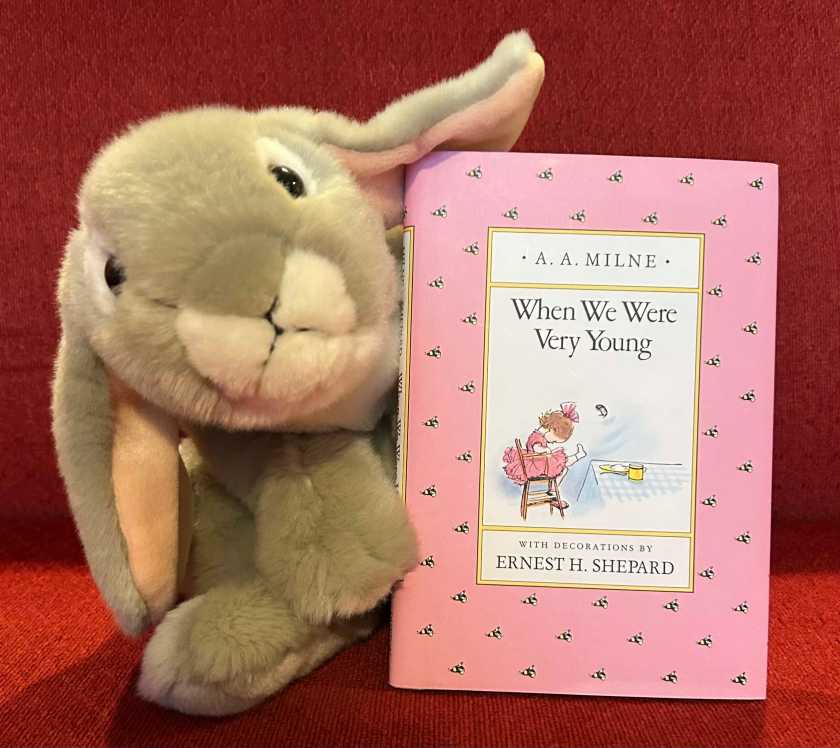
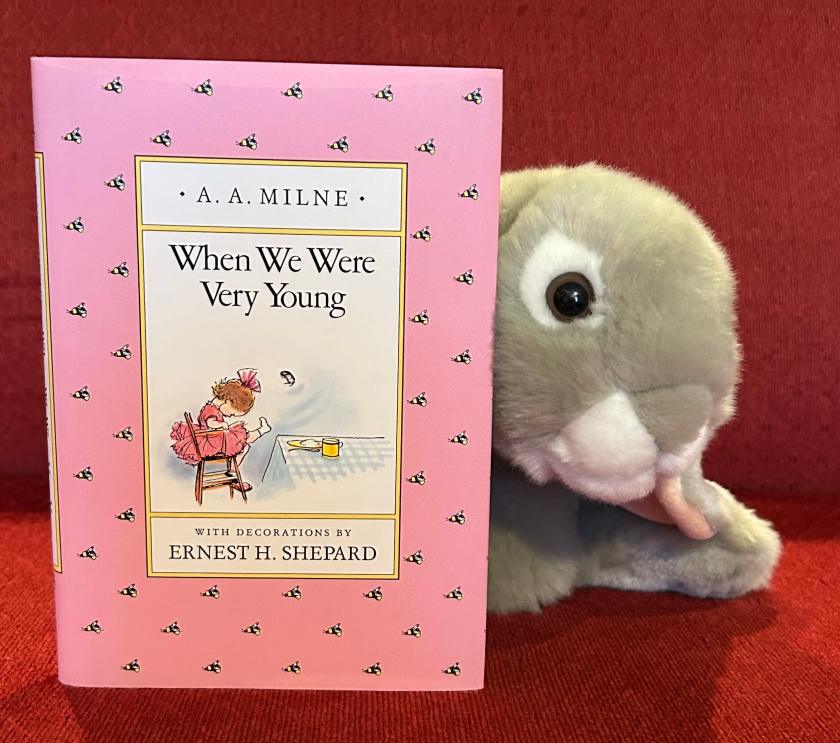
Last week Sprinkles reviewed a sweet little poetry book written by A.A. Milne: When We Were Very Young. Today she reviews Now We Are Six, a sequel if there could be one for a poetry book. First published in 1927, this book was also illustrated by Ernest H. Shepard.
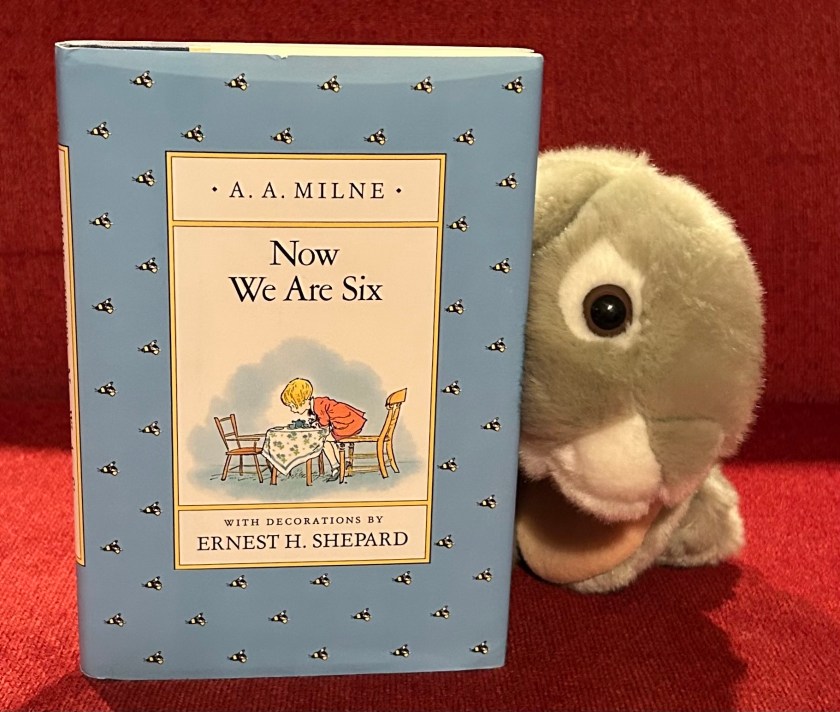
Last week I reviewed When We Were Very Young, written over a hundred years ago by A.A. Milne. Today I share with you some thoughts on another little poetry book by Milne that is almost a century old: Now We Are Six.
Now We Are Six is a perfect sequel to When We Were Very Young, and young bunnies who have enjoyed that book would definitely enjoy this book, too. In fact both Marshmallow and Caramel were gifted this book for their sixth birthdays. (Yes it was the same copy, which I think is fine. After all, Marshmallow had already graduated from being six years old when Caramel entered that age…) If you want to see what the book is like, you can see the contents in the Project Gutenberg page for the book here. But once again, I will say that the experience of holding a real copy of the book in your own hands (or paws!) is a lot more pleasant.
Before diving into the poems in the book, let me tell you that Milne’s introductions are really interesting. I am not sure the younger readers would appreciate them, but the adults reading the books definitely will. So please do not skip these; they are so fun to read!) In this introduction, we are also warned that Winnie the Pooh shows up in several of the poems. It is really neat to see Pooh’s evolution from the germ of an idea in one little poem in When We Were Very Little to a fully developed independent character who “walked through [the book] one day, looking for his friend Piglet, and sat down on some of the pages by mistake.”
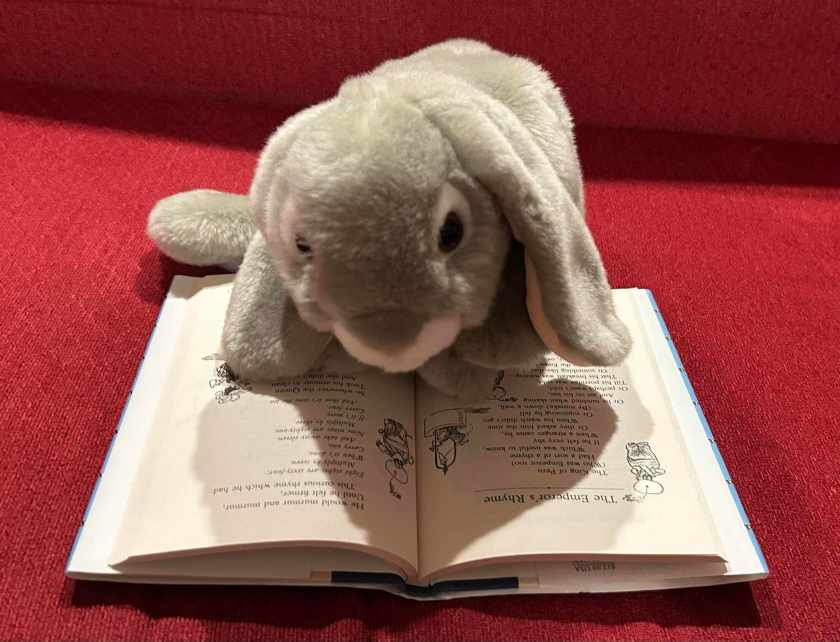
Now the poems! There are thirty five in total. And some are indeed about Winnie the Pooh, or at least they include Pooh as one of the main actors. For example, the poem “Us Two” is about a little boy narrating his adventures and conversations with Pooh. But pooh also just happens to show up in the illustrations of poems that do not explicitly mention his name. For example “The Engineer” is about a train the narrator is trying to play with, and Pooh shows up in the illustrations waiting for a ticket and then the train itself. The little bear makes a similar appearance, that is, only in the illustrations, for the last poem of the book, “The End”, where the narrating child is excited to be six years old:
But now I am Six, I'm as clever as clever
So I think I'll be six now for ever and ever.
Another one of my favorite poems in this book is “Explained” where a little girl named Elizabeth Ann goes around trying to find out just “how God began”. the question remains unanswered for all those who are reading the poem, even though in the end Elizabeth Ann gets an answer that satisfies her.
Unlike When We Were Very Young, which seemed to be almost exclusively written for a little boy, there are quite a few little girls in this book, or possibly a single little girl, who is sometimes named Elizabeth Ann and sometimes Anne. This makes a lot of sense if you read that the book is dedicated to Anne Darlington, who was a friend of Christopher Robin, Milne’s son. The Darlingtons and the Milnes were family friends, and they seem to have hoped that their two children would perhaps eventually marry each another. But in any case, I believe that the book does benefit from having a little girl in it.
The poems are once more about play and daily life and friendship and big questions. There is also room for big feelings. For example, the very first poem, “Solitude”, reminds the reader that all children are persons of their own rights, and sometimes they too will need some space. And there are a handful of poems which are more fantastical. For example “The Knight Whose Armour Didn’t Squeak” tells the story of a knight, you guessed it, whose armor did not squeak. One day, this knight spots another one whose armor does not squeak and figures out a way to eliminate him from this competition.
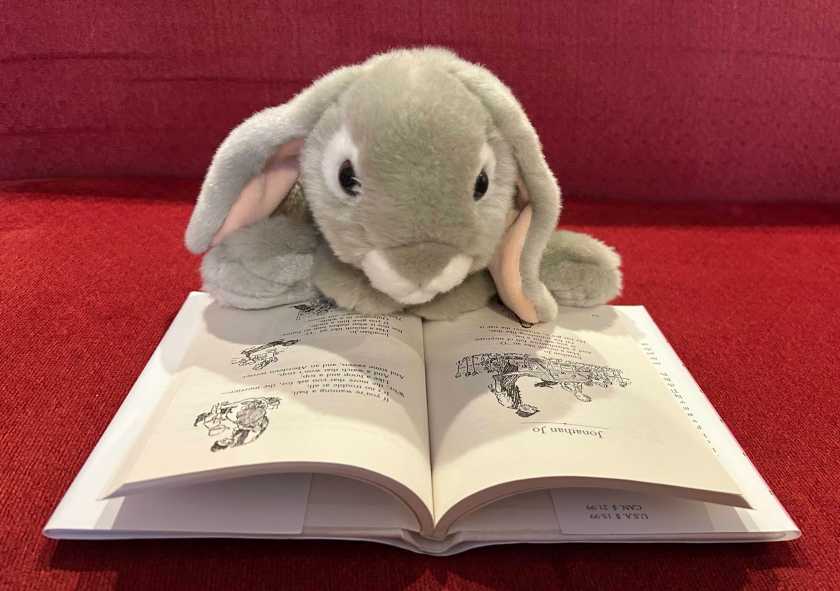
The illustrations in the book are once more by Ernest Shepard and complement the book’s quirky and fun feel. All in all, this book is a joy to behold and a joy to read. I recommend it with much enthusiasm to anyone looking to find a poetry book to read or share with a young bunny!
 BookBunnies