Marshmallow reviews The Light Eaters by Zoë Schlanger

Today Marshmallow reviews The Light Eaters: How the Unseen World of Plant Intelligence Offers a New Understanding of Life on Earth, a 2024 book by Zoë Schlanger.
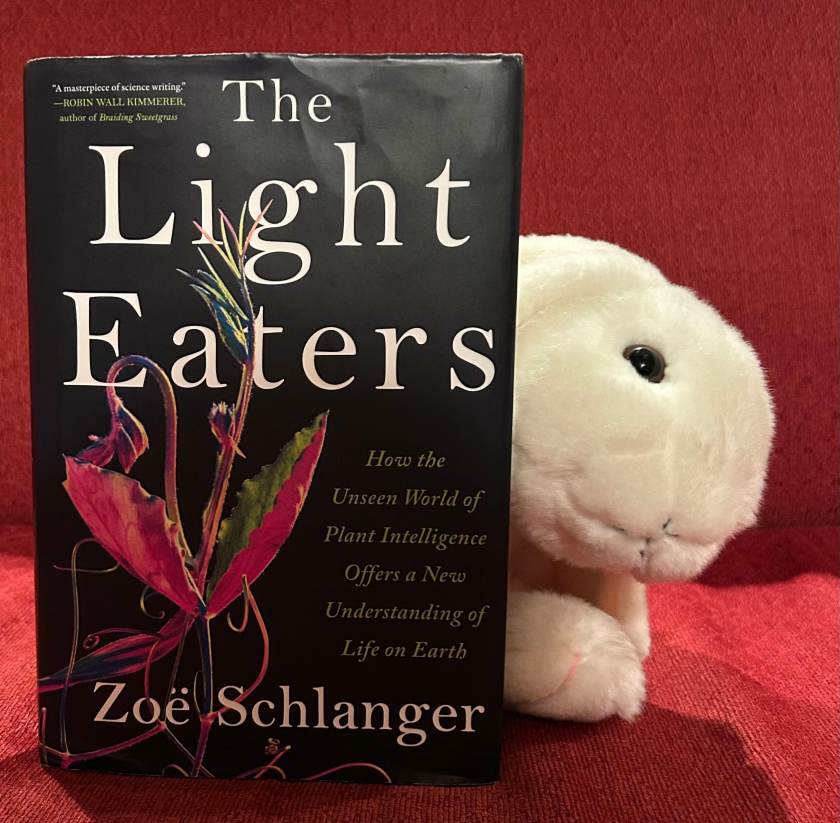
Marshmallow reviews The Light Eaters by Zoë Schlanger.

Marshmallow’s Quick Take: If you like reading, then this is the book for you!

Marshmallow’s Summary: Generally, I tend to read fiction. As a result, most of the books I review here are fiction. However, this book was uniquely written and exists somewhere between the two. While it is completely centered on science and factual reality, some of the things I learned from it were so wonderful that I wonder whether we need fiction at all when nature has already provided us with such beautiful truths. (Sprinkles told me that this made her think of something the famous physicist Richard Feynman said: “I think nature’s imagination is so much greater than man’s, she’s never going to let us relax.”)

The book starts off with a modest introduction of the central question—are plants conscious? As such, the title of the first chapter is “The Question of Plant Consciousness.” The other chapters are as follows: “How Science Changes Its Mind,” “The Communicating Plant,” “Alive to Feeling,” “An Ear to the Ground,” “The (Plant) Body Keeps the Score,” “Conversations with Animals,” “The Scientist and the Chameleon Vine,” “The Social Life of Plants,” “Inheritance,” and “Plant Futures.” In each one, Schlanger focuses on a different aspect of plant life and delves into how it relates to the central question.

I’ve already been one to tend towards animism, and I did not have a difficult time considering the idea of plant consciousness; on the contrary, I found it enthralling. I loved how each example was so fantastic yet grounded in solid fact. One particularly striking example case Schlanger described was the emerald green sea slug. Ever since I read about it in this book, I have brought up this sea slug at every single opportunity I get (you’d be surprised by how many ways you can relate daily conversation to sea slugs and I’ve done them all). The slug is born brown and red, but immediately seeks out bright green micro-alga (basically, big and visible algae). It drinks up the chloroplasts, which are smooth and round circles, filling its body and turning it green. This process—with the slug’s transparent, tubelike tongue—looks just like drinking boba; this comparison delights me to this day! Then the sea slug somehow, wondrously begins to photosynthesize. While the sea slug is not a plant, Schlanger uses this creature to illustrate how the borders between animal and plant are not quite as defined as we might have once thought. This story was one of many fascinating facts I learned from this book. (It feels insufficient to say “facts” because they are more like revelations to me.)

Towards the end, Schlanger debates the nuances of what societal acceptance of plant consciousness would look like. She examines the wordings that botanists have used and would like to use. Perhaps new words and definitions will have to be made to help the public better understand that plant intelligence and / or consciousness is completely unlike those of humans or bunnies. The book ends in a rather abstract yet equally profound manner, leaving the reader wishing Schlanger had continued her marvelous writing.
Marshmallow is reading The Light Eaters by Zoë Schlanger.

Marshmallow’s Review: I think this might just be my favorite book. I did not finish it for the longest time because I didn’t want it to end. Each chapter revealed another beautiful part of nature and I felt constant awe, like one does when watching well-made documentaries.

I found Schlanger’s prose very different from what I’ve read from other writers. She writes the way that I feel she probably speaks. I don’t think she always used semicolons or other punctuation the way the standards of the English language demand; she used them more as tools to convey what she wanted. I know that this usage might bother some readers, and I was a bit taken aback initially. However, it did not counteract or undermine her words and her meaning.

I loved learning about what the world of plant and plant studies is like. Some recent events have made me start thinking about entering STEM a lot more. This book made me realize that science and the natural world has so much to explore and learn about. Regardless, I think everyone should read this book—even bunnies who don’t particularly like science. I think it raises and explores some very interesting and important questions about plants, their place on this planet, and ours. As concern for the climate becomes more and more critical, books that enlighten the public about the complexities of ecology are increasingly vital for social discussion. So, like I said at the beginning of this review, if you like reading or if you can read, then I would recommend reading this book with all of my heart.

Marshmallow’s Rating: 121%.
Marshmallow rates The Light Eaters by Zoë Schlanger 121%.

Marshmallow reviews There’s A Hair In My Dirt! A Worm’s Story by Gary Larson

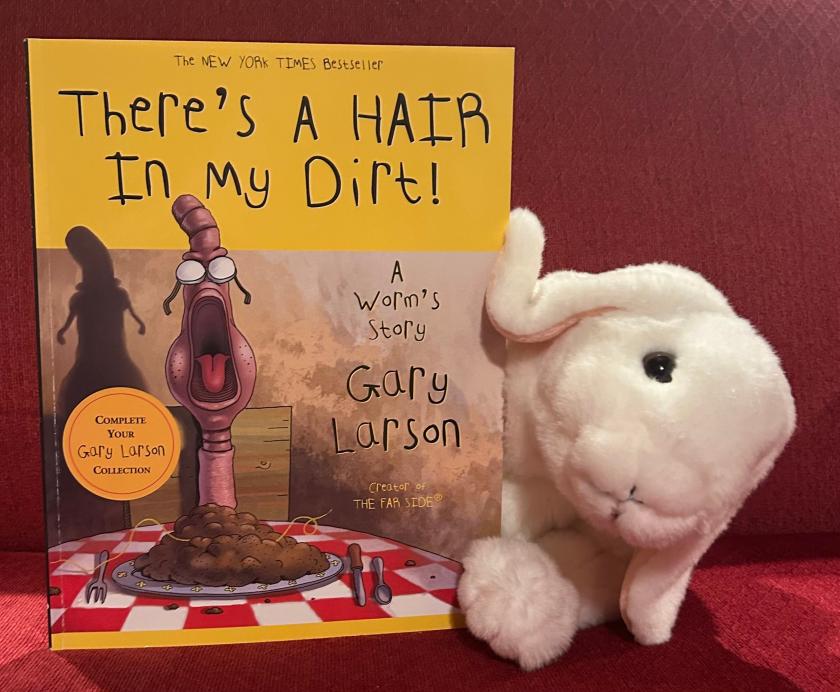
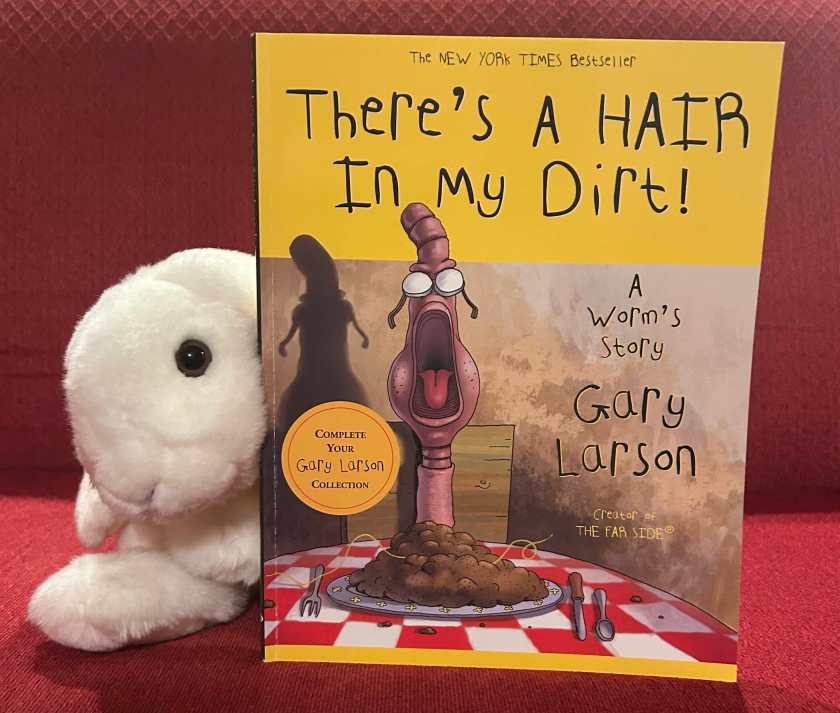
Today Marshmallow is reviewing There’s A Hair In My Dirt! A Worm’s Story by Gary Larson, first published in 1998. A fan of Larson’s The Far Side, Sprinkles is asking questions and taking notes.

Marshmallow reviews There's A Hair In My Dirt! A Worm's Story by Gary Larson.
Marshmallow reviews There’s A Hair In My Dirt! A Worm’s Story by Gary Larson.

Sprinkles: So Marshmallow, tell us a bit about what you thought when you first saw this book.

Marshmallow: I felt very surprised that Gary Larson had written a children’s book. I really like his Far Side comics, and we have a collection of them at home –and maybe we should review them some time!

S: Yes, maybe we should some day. But you are right. Larson is most well-known for his Far Side cartoons. But then you read this book and realized that maybe it is not quite a children’s book, right?

M: Nope. Do not have your children read this book!

S: Wait! Really? I mean, it is a bit rough for younger bunnies, and it is quite long for them, too, at 64 page, but older bunnies like yourself can appreciate it, I thought.

M: Yeah, I guess so. But it is kind of dark and even morbid. Then again, it is kind of a fable, with some underlying messages, which are thought-provoking. You are right, I guess bunnies my age and the like might appreciate the book. But I was definitely surprised and was not expecting how dark it would get.

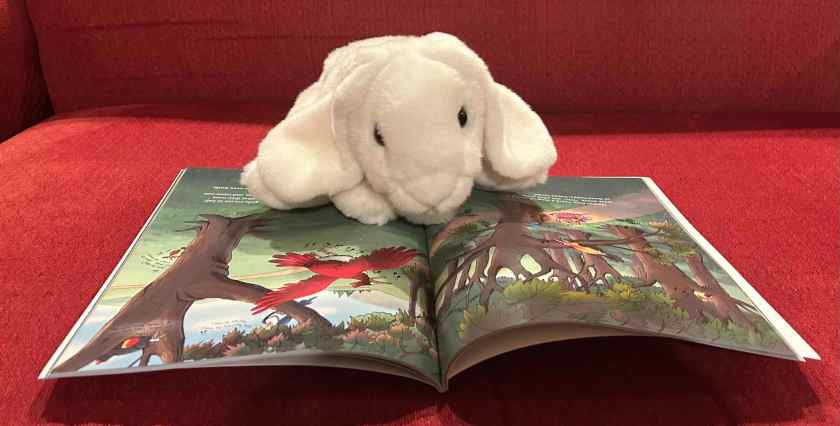
Marshmallow is reading There's A Hair In My Dirt! A Worm's Story by Gary Larson.
Marshmallow is reading There’s A Hair In My Dirt! A Worm’s Story by Gary Larson.

S: Okay, so maybe we should start from the beginning and tell our readers what the book is about.

M: Sure. This book is about a little earthworm who is eating his dirt dinner in his family’s hole in the ground. And he finds a hair in his dirt and starts complaining to his earthworm parents. He hates being an earthworm, he hates living underground. He hates not having legs and having to eat dirt. And so on.

S: Totally understandable of course.

M: Of course. But then his father starts to tell him a story about a girl named Harriet. And then the rest of the book is basically Harriet’s story. Harriet lives near a forest and goes through the forest one day, seeing all sorts of animals interacting with one another, and she always has a positive outlook, thinking about Nature admiringly and yet not really comprehending what is really going on around her.

S: Yes, the foreword for the book is written by the famous biologist Edward O. Wilson and he writes “The maiden, as you will see as the narrative unfolds, might have enjoyed her saunter better if she understood.”

M: And it is not just a matter of enjoying; it costs her dearly that she does not understand. It is a little disturbing actually, because Harriet loves Nature, or what she thinks it is. And she wants to help and she is trying to be a good steward of living things, but since she does not know how things are all connected, she ends up harming the forest and herself.

S: This reminds me of this song “We Are All Connected” which some people made by putting together a few words from four outstanding science communicators:

M: Yeah, I like that song!

S: But let us not go further into the story because I think we might be getting too close to giving away some of the plot. Tell me, Marshmallow, what did you think about the illustrations?

M: It is in full color, and obviously it is Gary Larson, so all characters are distinctive, and they have very evocative expressions. It is very amusing to study them actually. The topic is complicated and nuanced, that we are all connected, and that, as Edward O. Wilson puts it, “Life is tough!” But Gary Larson’s drawings are often hilarious and you can’t help but laugh on almost every single page. Or raise your eyebrows in a shocked and yet amused manner. The mother earthworm is wearing those cat-eye glasses!

S: I know, right? Each page is itself a Far Side comic, almost. But they are all telling a coherent story, and it is an important one.

M: I agree. I do not really love the last page, but I agree. The message is important. And no, if you get a hold of this book, please do not just turn it to the last page to see what I mean! It will work much better if you read the book in the proper way.

S: And I agree with you, Marshmallow. This is a thought provoking book, not as light reading as one might imagine, but definitely amusing to look at, too. So maybe this is a good place to wrap up our review. What do you think?

M: Sure. Let’s.

S: What would you like to tell our readers?

M: Stay tuned for more amazing reviews from the book bunnies!

Marshmallow rates There's A Hair In My Dirt! A Worm's Story by Gary Larson 100%.
Marshmallow rates There’s A Hair In My Dirt! A Worm’s Story by Gary Larson 100%.