Marshmallow reviews Our Missing Hearts by Celeste Ng

Today Marshmallow reviews Our Missing Hearts, a novel by Celeste Ng, first published in 2022. Sprinkles has also read the book and is asking her questions, while also taking notes.
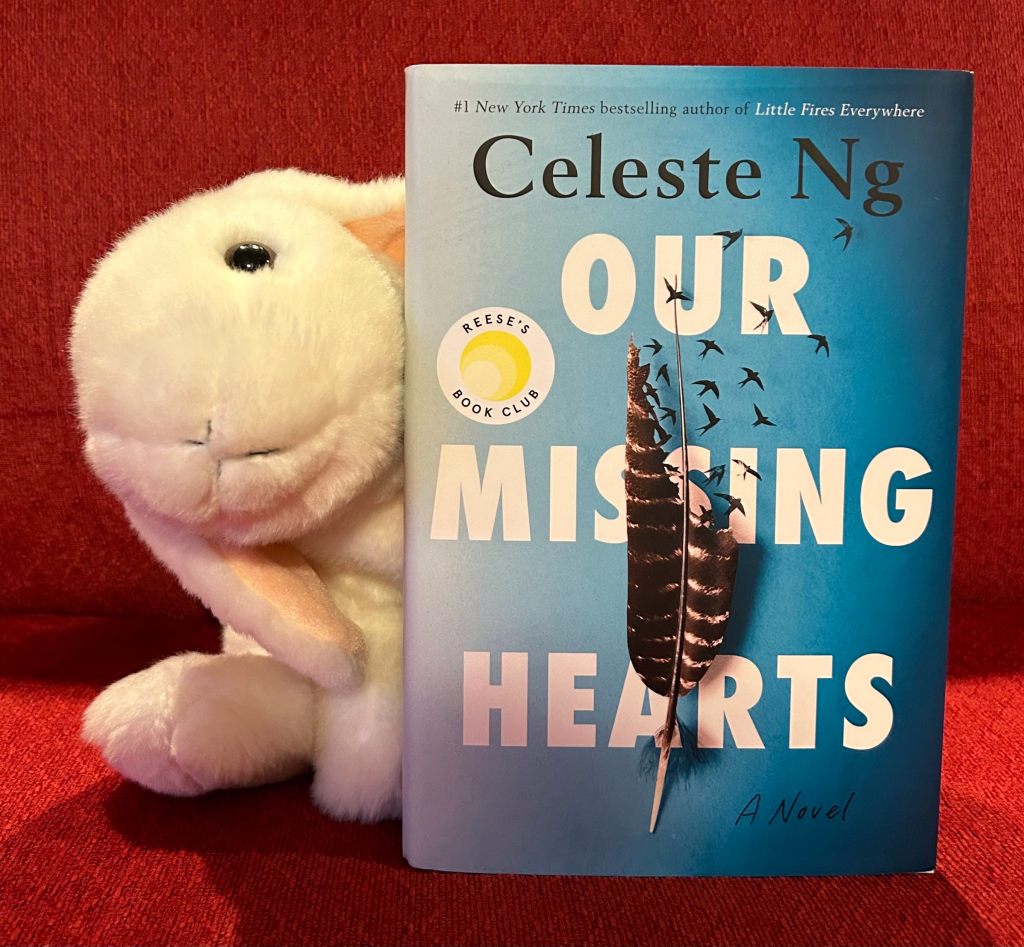
Marshmallow reviews Our Missing Hearts by Celeste Ng.

Sprinkles: So Marshmallow let us start at the beginning. In your reviews, you always start by telling us who this book would be good for. So go ahead.

Marshmallow: This book would be a good choice for readers who enjoy realistic fiction. Or if you are interested in possible near-futures in the United States, especially dystopian ones, this might be the book for you.

S: Okay, I think that is a good start. Can you give us a brief summary of the plot?

M: Sure. So there is this kid whose mother ran away after her poem was used in controversial protests about this law called PACT.

S: Okay, so maybe let us stop there a bit. Tell us about the setting, and of course, PACT.

M: PACT stands for Protecting American Culture and Traditions Act. This law was, in the book, passed about ten years before the story starts. And it essentially allows the government to do things that are supposedly in the interest of preserving American culture. In reality, it is used to take children away from their families, if the families are not “American” enough. In this world, the law specifically targets Asian Americans, due to a fear of China.

S: The author may have been somewhat inspired by the USA PATRIOT Act that was passed after 9/11, and it was very controversial too, because many argue that it cut into people’s civil liberties. This PACT Act was passed after a different but very impactful crisis, right?

M: Yes, and in fact, in the book that crisis was called The Crisis. That left everyone very susceptible to xenophobia, and some people blamed China for all that went wrong, and then of course that distrust of China translated into a distrust of Chinese Americans and then spread all over to a distrust of all Asian Americans. So when the government began to remove children from the homes of some Asian American families, most of the other people remained quiet, believing that there should be a reason for the removal. And most people did not even know how many children were being taken away. The numbers and the full impact of the removals were downplayed by the media, and the families who dared to speak out were demonized.

S: But still there were some protests against the law and these removals, right?

M: Yes, and those are my favorite part of the book actually.

S: So tell us about them.

M: I liked the protests because they were so creative. For example, one involved a bunch of trees which were wrapped up with red yarn and small dolls representing the stolen children. And they were mainly emotional and only subtly political, so people would be more intrigued by them rather than immediately dismiss the message.

S: And that is where the title of the book comes in, right?

M: Yes. The poem that the main character’s mom wrote is called “Our Missing Hearts,” and the protestors took that as their motto, that they wanted their missing hearts to be brought back.

S: Okay, so let us get back to the main character and the plot then.

M: Yes, the main character is a twelve-year-old boy named Bird. Actually his legal name is Noah Gardner, but his mom Margaret Miu always called him Bird, but since she left, people are calling him Noah again. And she left because her poem became too visible with the protests, and Bird’s parents were worried that the government would take Bird away. The mother left so that Bird would at least be able to continue to live with his dad.

S: So the book starts with Bird getting a message which he believes is from his mom.

M: And it is full of cat drawings. And it triggers some memories, Bird is not sure why he knows it is from his mom, but he is sure it is from her. And that part is also very neat. but I cannot say more without spoilers.

S: I guess that is fair. Let us stop with the plot then.
Marshmallow is reading Our Missing Hearts by Celeste Ng.

S: Tell us a bit about the characters.

M: Well, there is Bird, who is the boy who is looking for his mom. And there is Sadie, a half-black girl who was removed from her family because they spoke out against PACT. The law is mainly targeting Asian Americans, but anyone who speaks up against it is also in danger. So Bird meets her at school, where she is sort of an outcast. Sadie is braver than Bird, and she becomes his friend. And then we also meet Bird’s parents. Margaret plays a big role in a large part of the book; she tells her story and we learn about the Crisis a bit more from her. But anyways, Margaret is maybe more timid than Sadie and her parents, and she ran away instead of fighting, but then again, running away meant that maybe her child would be able to stay with his dad, and it could also be seen as a brave sacrifice.

S: Agreed. So did you feel like you connected with these characters? Did you like any of them a lot? Did any of them make you angry or feel something strongly? Did they feel like real people?

M: I think they were all pretty well developed. I thought reading Bird’s perspective felt like I was seeing the world through his eyes, it was a pretty bad place, but anyways, very realistic. And when Margaret told her story, you could also hear her voice very clearly. So I think the author was very successful in creating very compelling and very realistic characters.

S: I agree with you, again. Okay, so I am guessing you liked this book? I certainly did, and that is why I suggested you read it, too.

M: Yea. I really liked it. I’d rate it 100%.

S: That is high praise coming from you, Marshmallow.

M: Yes, I think Our Missing Hearts is a really good book.

S: Okay, so how do we finish this review? What would you like to tell our readers?

M: Stay tuned for more amazing book reviews from the book bunnies!

Marshmallow rates Our Missing Hearts by Celeste Ng 100%.

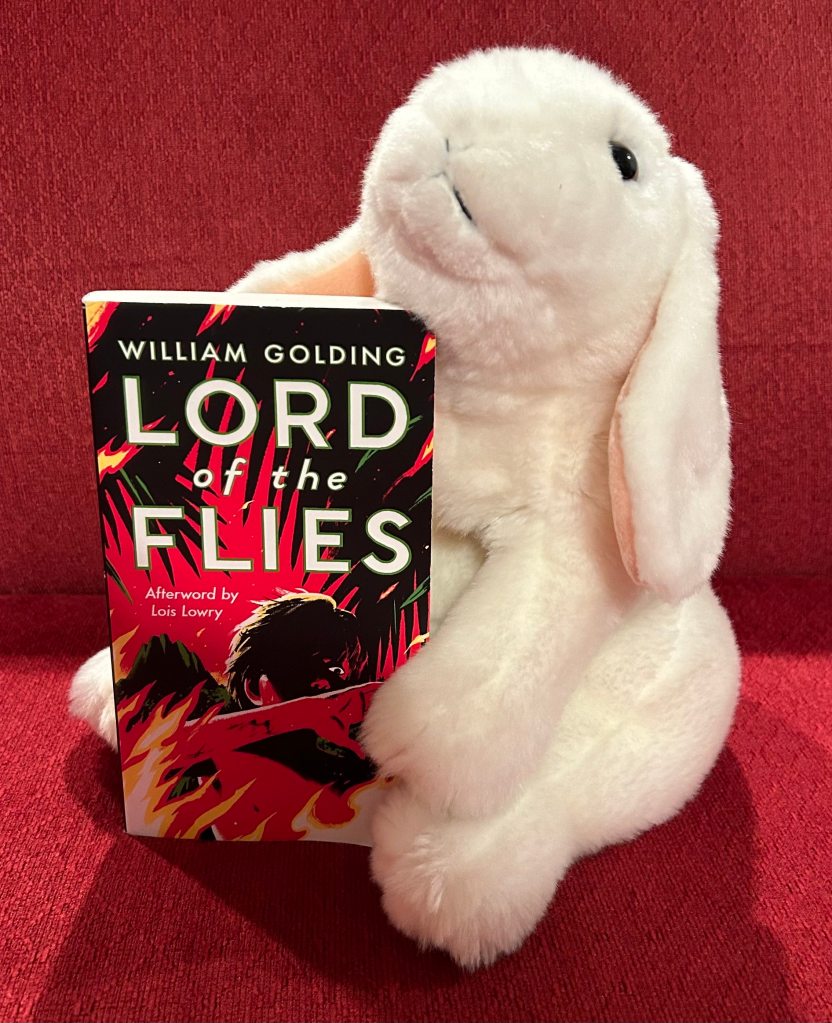
Marshmallow reviews Lord of the Flies by William Golding

Marshmallow has been reading some classics on and off. Today she talks to Sprinkles about Lord of the Flies by William Golding, first published in 1954.

Marshmallow reviews Lord of the Flies by William Golding.

Sprinkles: So Marshmallow, it’s been years since I have read this book. So can you tell me a bit about what it’s about?

Marshmallow: Sure. This book is about a couple dozen British school boys whose plane crashlands on a deserted island. The boys try to set some rules and they use a conch that sort of represents order and civility. One of the boys named Ralph is elected leader, and another boy named Jack takes on hunting duties. The boys start a fire so that there will be smoke for ships to see.

As the story progresses, Ralph tries to encourage the boys to make shelter and keep the fire going. So basically what is essentially logical to do given the circumstances. But most of the other boys do not obey him and start to act like feral animals. At some point they start thinking that there is a beast in the island and they are terrified. Jack promises to hunt it down. And hunting and killing animals makes the boys become wilder and more violent and bloodthirsty, and eventually most of the boys join Jack and his hunters, which becomes a separate tribe than Ralph’s group. And they come into conflict, and things escalate very quickly after that.

S: Okay, I think this is a good summary of the plot and some of what happens in the book. Before saying much about what happens in the end, can you tell me if you thought it was tied up well?

M: I am not sure I’d say it was tied up, but the message of the book was well delivered and the moral is conveyed. The story is probably not really finalized. But it ends in a way that is still satisfying.

S: Though not quite happy, right?

M: Well, I can’t say too much without spoiling everything. But some things happen in the book that make it kind of impossible for a fully happy ending.

S: I do remember some of the book and definitely agree with you there. So what is this message or the moral you are talking about? Can you tell us that?

M: I think the moral of the book is that when humans are left to their devices there is potential for great evil. The children represent untouched innocence, but they eventually go feral and become morally corrupt. I think the author was probably trying to depict the violent side of humans and that it can lead them towards evil. The boys’ hunting leads to further violence and bloodthirst.

S: But how come do human societies ever go beyond violence then if humans left to their devices can easily go feral? There had to be some time that some humans decided to do things differently.

M: I think that the author is not claiming this always happens. I think that he is trying to show that there is a potential in humans for this kind of darkness, that there is a dark side of human nature.

Marshmallow is reading Lord of the Flies by William Golding.

S: Okay, that is heavy stuff. Tell me about the writing a bit. Did you think the author made the island visually come alive? Could you see the locations? How about the boys and how they looked and behaved? Could you visualize them?

M: Yes, but I think he focused a lot more on how they felt and their emotions and their transformation through the story. It is more psychological than physical descriptions, I’d say.

S: So would you say the characters were vividly created? Or were they more like archetypes, like Jack representing the violent tendencies and Ralph perhaps representing the inclination for law and order?

M: Well, I am not sure individual characters represented specific characteristics. In fact I think nobody represented a specific vice or virtue, because they all were pretty fleshed out as real people, who were basically mixed in virtue and vice. But you could see some changed in different ways than others.

S: Alright. That makes sense. So how did this book make you feel after you read it? It is a bit of a dark book, don’t you think?

M: Yes. Just as a narrative, just as a story, it is good, maybe like an adventure that has gone bad. But when you think about the ideas behind it, it enhances the reading experience. It definitely made me think about human nature. And I like that. And it is a classic so that is another reason why people should read it.

S: Did you know that about a decade after this book was published, a similar thing actually happened and a bunch of boys were stranded in an island by themselves? They did not become feral however, and they actually built a functioning mini-society.

M: I did not know that before we checked out the Wikipedia article for the book. But again, I think the book is not claiming this has to happen this way, but that there is a possibility that humans might give in to their violent and dark tendencies.

S: I guess so. The story of the Tongan boys makes me a lot more optimistic, but Golding’s book, even though I know it is fiction, is always a reminder for me that civil behavior or a safe and functioning society are not automatic or natural.

M: I’d agree.

S: Okay Marshmallow. Let us wrap this up. How would you rate this book?

M: 100%.

S: Wow! You liked it that much! Cool. I do recall it being one of my favorite books from high school, too, though I cannot bring myself to read it again, because I worry I’d get too depressed.

M: Well, then you can always reread the real story of what happened to those Tongan boys.

S: You are right! Anyways, what do you want to tell our readers?

M: Stay tuned for more amazing book reviews from the book bunnies!

Marshmallow rates Lord of the Flies by William Golding 100%.

Marshmallow reviews Brave New World by Aldous Huxley

As many young bunnies her age do, Marshmallow has been reading some dystopian novels. In these past few months, she has read and reviewed the recent Shatter Me and Unravel Me by Tahereh Mafi, as well as the classic Nineteen Eighty-Four by George Orwell. Today she reviews another classic dystopian novel: Aldous Huxley’s Brave New World, first published in 1932. Sprinkles is asking questions and taking notes.

Marshmallow reviews Brave New World by Aldous Huxley.

Sprinkles: So Marshmallow, I’m so glad you have read this book. It was one of my favorites when I read it, and I was only a bit older than you I think.

Marshmallow: I enjoyed reading it too! I found it fascinating.

S: That’s big endorsement from you! Okay, tell us a bit about the book.

M: Okay, let me set the stage: The year is AF (After Ford) 632. Technology is so advanced that humans who are citizens of the World State reproduce solely in artificial wombs, and everyone is conditioned to perfection. That is, if you’re in the right caste. Even before you are born, you are assigned a caste. If you are an Alpha or Alpha Plus, you will receive the most attention and care while in the incubator machines. If you are of a lower caste, say a Delta or an Epsilon, you will get less space, and your growth will be intentionally stunted by alcohol infusions. No matter how hard you work, you will always be working the job you were assigned at birth. Despite this inequality, no one ever complains because complacency and contentment with the system are essentially brainwashed into citizens while they are children. In this sea of conformity, individuality is diluted. On the one hand, everyone is happy, but on the other, this happiness is attained only at the cost of their humanity. 

S: Okay, that is pretty dismal as a setting. Go on.

M: So in short, when the story begins, the society is in harmony, but a couple people start to realize that the things that make us human are being lost. Two citizens, Bernard Marx, an Alpha Plus, and Lenina Crowne, a Beta, are vacationing in a reservation where humans still reproduce the natural way. Such societies are rare, and their residents are regarded by basically everyone else as savages. Here they meet John, a man whose mother Linda came from the “brave new world”. When they bring him back to their world, he is horrified by what he sees.

S: That is a good summary of the plot, Marshmallow. I know you thought a lot about this book and even prepared a report of sorts for your English class. So maybe you can tell us a bit more about the three main characters.

M: Sure. Bernard is an Alpha Plus who is at the top of the society. But he is different from others because he isn’t very cheery whereas everyone else is always happy. This is probably because he doesn’t take soma, the drug that everyone else does. Soma gives people a sense of euphoria and makes them unconcerned and joyful. Bernard’s refusal to take it is one example of his peculiarity. Bernard is a bit shorter than other Alpha Plus males, and he feels a bit bad about this.

Then there is Lenina, a very typical member of the World State. An average Beta, she is content with her status and is very disturbed by the comments made by Bernard and John that vilify the World State. 

Finally there is John. John’s mother Linda came from the World State, or the “developed” world. Linda actually got pregnant at some point and gave birth to John. This is highly unusual in the World State, as biological reproduction is regarded as a taboo in the brave new world. However, in the reservation, natural birth is just natural. Still, the tribe does not completely accept Linda and John, and so they feel like outcasts. When Bernard gets the permission to bring John to “the civilized world”, he is called the Savage, and people treat him almost like a celebrity. However, as an outsider with beliefs completely orthogonal to those of others, he finds this brave new world repulsive. 

Marshmallow is reading Brave New World by Aldous Huxley.

S: Thank you Marshmallow. I think you summarized the main features of these characters well. So I can see that Bernard might not be too happy because he does not feel confident about his stature, and I can see John finding it difficult to adjust. But tell me more about what is wrong with this world. Why do you think this book is so important? What is its main message?

M: I think that the main problem is that everything is supposedly perfect, and the fundamental struggles that make people human are long gone. John the Savage argues that people need to have problems to live properly like humans. Without them, they are not fully human. They become passive, complacent, and no longer crave for progress, creativity, new ideas.

S: When I was in school, we read this book in tandem with Orwell’s Nineteen Eighty-Four. You read and reviewed that book, too. Did you see any parallels or significant differences between the two books?

M: Well, I did like both books a lot. But both books had a little bit of adult content, a bit more than I like to engage with in the books I read. Other than that, they are both dystopian, telling us about a possible future where life as we know it is replaced by some very unpleasant and almost hopeless system. But when I was reading about Huxley and Brave New World for my class report, I found a very insightful quote by Neil Postman, who wrote in a 1985 book titled Amusing Ourselves to Death the following:

Orwell feared that the truth would be concealed from us. Huxley feared the truth would be drowned in a sea of irrelevance. Orwell feared we would become a captive culture. Huxley feared we would become a trivial culture […] In 1984, Huxley added, people are controlled by inflicting pain. In Brave New World, they are controlled by inflicting pleasure. In short, Orwell feared that what we hate will ruin us. Huxley feared that what we love will ruin us.

Neil Postman

The Wikipedia article on Brave New World has this quote, in its context, and the full quote is also very good. But this part is enough for me here. I especially like the last two sentences. Aldous Huxley delves into the psyche of humans to look at how easily they can be reduced to passivity and complacency.

S: Are there other themes that show up in the book?

M: According to Britannica, Huxley was always preoccupied “with the negative and positive impacts of science and technology on 20th-century life”. So there is that of course.

S: I see. The technology that allows the World State to govern one of the most fundamental processes of human life is awesome and scary, and the government, or any other entity, having such a power is bound to be dangerous.

M: Yes.

S: Any other themes that you would like to bring up?

M: Yes, the book is really rich. In Brave New World, humans have become passive and complacent under the eye of the World State. Brave New World presents a different type among the many terrifying futures that could occur. Most dystopian books have governments that are feared, but in this book the government rules by giving citizens everything that they could ever want. 

S: What could be wrong with that?

M: As I said before, I think one of the central messages of the book is that people are not fully human if they are not striving to be better; they are not fully human if they are completely satisfied and complacent.

S: How about bunnies? Would you not be a happy bunny if you got all the nice food and all the books and friends you wanted and so on and never needed anything?

M: Given all the terrible things happening in our world today, this kind of a possible world actually sounds nice initially, but I think I’d eventually get bored. I’d probably want to do something different, something new. I’d want a purpose in my life.

S: I can see that.

M: I do wonder if a lot of people would be better off or happier in that world. But they would all be pawns of the establishment. They would not have a purpose or even a choice in this way of living. I don’t think either of those is good.

S: I agree. So what would your rating be for this book?

M: I think I’d rate it 97%. I think this is a very provocative book, made me think a lot, but again, I don’t like too much adult stuff in a book.

S: I agree that there is some of that stuff in the book and some of it is truly disturbing. There is even a scene where they expect children as young as seven to engage in what they call “erotic play”.

M: Those kinds of things make me think that younger bunnies should probably not read this book.

S: Agreed. So a very good book, very thought-provoking, but definitely for older bunnies.

M: Yep.

S: Then we are done. Let us wrap this up. What would you like to tell our readers Marshmallow?

M: Stay tuned for more amazing book reviews from the book bunnies!

Marshmallow rates Brave New World by Aldous Huxley 97%.

Marshmallow reviews Unravel Me by Tahereh Mafi

One of the last books Marshmallow reviewed for 2022 was Tahereh Mafi’s novel Shatter Me. As her first book for 2023, she chose the second book in the series: Unravel Me, published first in 2013. As Sprinkles is curious to hear more about this book, she is asking questions and taking notes.

Marshmallow reviews Unravel Me by Tahereh Mafi.

Sprinkles: So Marshmallow, here we are; it’s a new year, and there are lots of new books to read and write and talk about. Today we are talking about the second book in Tahereh Mafi’s Shatter Me series: Unravel Me. Your review of the first book made me so curious that I went ahead and read it myself. And I enjoyed it a lot. So now I want to ask you about this second book. Should I read it?

Marshmallow: It depends. The plot of the second book is very interesting. Just like the plot of the first book.

S: That sounds enticing.

M: Yes, the plot is really neat.

S: Tell me a bit about that.

M: Well, maybe I should first summarize the first book a bit. There is this girl named Juliette, whose touch is fatal to most people. She has been living in solitary confinement for many years because many people, including her parents, are scared of her. Then we learn that there are some people who can actually touch her and not die. And one of these is a rebel, and he helps her run away, and we end the first book on a high note, with Juliette and her new friends ready to fight an oppressive regime.

S: Yes, I remember all this. And the world is pretty dismal, right? There are no birds, there is a total environmental collapse, and people are living under the control of a faceless dystopian government.

M: Well, not quite faceless, because we meet one of its faces, Warner, in the first book, and he is one of the leaders of this new regime.

S: True. Do we see Warner in this second book as well?

M: Yes, and he is attracted to Juliette, and somehow Juliette is very confused, and she is not sure if she is attracted right back, even though Warner is a pretty terrible human being.

S: Hmm, here we are getting too close to the mushy stuff you didn’t like in the first book. I’m assuming that there is a lot of mushy stuff in this one, too?

M: Yes, this one has more actually.

S: Hmm, okay, I know it bothers you, so let us move on and talk about the actual plot a bit.

M: Sure. First off, we learned at the end of the last book that Juliette’s killing touch is kind of like a superpower, and she is not the only one with these kinds of powers. There are many others who have superpowers, and they are living together, working to bring down the oppressive regime. And in this book, they are continuing to do that, with Juliette and Adam, the person who saved her, joining them.

S: I see.

Marshmallow is reading Unravel Me by Tahereh Mafi.

S: So would you say, at this point, that the book becomes more like a typical heroic adventure book where our heroes are fighting an evil empire and will surely overcome against all odds?

M: Well, not quite. For two reasons. One is the mushy part, the book is more romance than adventure. And two, the “surely they will overcome” is definitely not a sure thing. Things are pretty desperate, I mean, they make some progress in this book, but the world is still a terrible place.

S: Do we ever see a bird?

M: I don’t think so. The world is still pretty bad, as I said. And there is still very little hope.

S: So I am guessing you might just have to read the next book?

M: I just might.

S: And from what you are telling me, I guess I do have to read this second book myself.

M: Yup. I think you have a higher tolerance for mushy stuff.

S: Well, they call me a grownup. I guess I can handle a little bit of that.

M: I guess.

S: So how would you rate the book then?

M: 93% I think. The plot is still very original and engrossing, but the mushiness is still not terribly exciting to me.

S: Alright, given what you told us already, this makes sense. So what do you want to tell our readers as we are wrapping things up?

M: Stay tuned for more amazing reviews from the book bunnies!

Marshmallow rates Unravel Me by Tahereh Mafi 93%.