Marshmallow reviews The Rabbits’ Rebellion by Ariel Dorfman and Chris Riddell

Today Marshmallow reviews a little book with a big message, first published in 2020: The Rabbits’ Rebellion, written by Ariel Dorfman and illustrated by Chris Riddell.
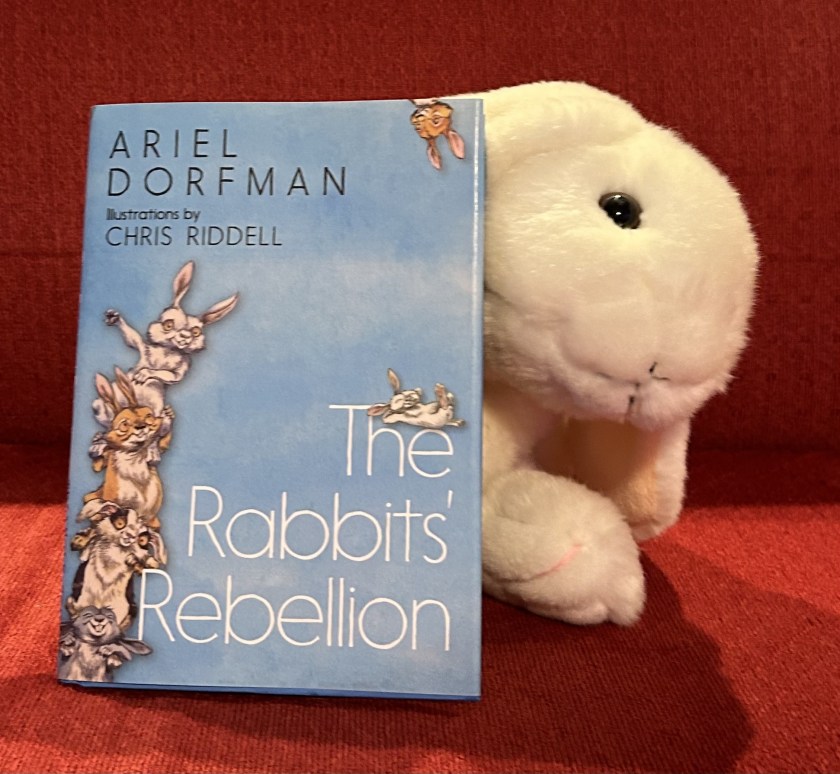
Marshmallow reviews The Rabbits' Rebellion, written by Ariel Dorfman and illustrated by Chris Riddell.
Marshmallow reviews The Rabbits’ Rebellion, written by Ariel Dorfman and illustrated by Chris Riddell.

Marshmallow’s Quick Take: If you like children’s books about animals and clever political commentary, then this is the book for you!

Marshmallow’s Summary (with Spoilers): When the wolves invade the land of the rabbits, the Wolf of all Wolves crowns himself king and begins to make some wild claims. First of all, he—feeling quite omnipotent that day—declares that rabbits don’t exist. He bans any reference to them in books (by personally crossing them all out) or in conversation. Unfortunately, birds can fly and report seeing some, which spread rumors that perhaps rabbits do exist.

The king then decides then, if (as his fox advisor says) “seeing is believing,” he’ll make his subjects see exactly what type of a ruler he is. So he commands an old monkey to take regal photos of him to be put up in every town square, every neighborhood, and in every house. He forces the birds to carry these posters, tying their feet to an “endless” cord to make sure they can’t escape. Naturally, the old monkey is terrified of the king and bends to his every whim and want. In other words, he says, too, that rabbits don’t exist. On the other hand (or paw!), the monkey’s daughter—with the fearlessness of innocence—knows that rabbits do exist even though her parents make sure to censor her whenever it becomes necessary.

But that’s just the beginning of the old monkey’s struggles. Every time he takes a photo of the wolf king, there is some hint of a rabbit in the background. When the king shatters the beavers’ dam (which took them three years to build), there are two rabbits sitting on the grass in front of the camera. When the king snarls in the most ‘majestic’ manner, a long, fuzzy ear shows up in the corner. This is most problematic because the monkey can’t show the king photos that go against his rule that rabbits don’t exist. So he doctors his photos after they develop, erasing any and every trace of rabbit hair, ears, or tails.

As the king becomes increasingly more controlling, more egotistical, and more tyrannical, the monkey must keep taking photos and editing them. Despite the king’s advisor tightening security around the photo shoots (he doesn’t want the king to know about the rabbits either—it would look bad on him), the rabbits persistently keep up their rebellious photo-bombing. But how could they, when they don’t exist?
Marshmallow is reading The Rabbits' Rebellion, written by Ariel Dorfman and illustrated by Chris Riddell.
Marshmallow is reading The Rabbits’ Rebellion, written by Ariel Dorfman and illustrated by Chris Riddell.

Marshmallow’s Review: The Rabbits’ Rebellion is a really good book! It is written as a book for little children, and it reminds me of some Roald Dahl books I read earlier. Roald Dahl was unique in a way because his books could be read as childish tales, but they also touched on deeper topics. Likewise, the meaning of Dorfman’s book might not be understood by very young readers even though they would still enjoy reading about these mischievous rabbits who insist on existing! (Go, bunnies! Of course I cannot be too impartial here.)

At its core, The Rabbits’ Rebellion is about authoritarianism and dictatorship. The king’s suppression of truth, especially a truth that is so obvious, is in a way an almost comically extreme example of an Orwellian dystopia. In a way, this book is like Animal Farm or Nineteen Eighty-Four for young children. Except—spoiler alert—this one ends better than both of those books.

The Rabbits’ Rebellion is entertaining even if you don’t catch this theme. It is kind of like how one might enjoy reading parts of Animal Farm even without digging into the allegory. But Animal Farm ends at a quite depressing place for young bunnies to really enjoy it all the way to the end. Similarly, I learned that some parents have complained that the ending of The Rabbits’ Rebellion is too graphic to make it appropriate for a calm bedtime. So readers beware!

I found it interesting that the world of this book is so different yet also very similar to ours. There is no magic, but they do have cameras and books. Remember how in Maus the whole story only involved mice and a few other types of animals, but we could see our own world in it? Just in the same way, the differences and the similarities despite those differences help convey Dorfman’s message very clearly.

All in all, The Rabbits’ Rebellion has a really poignant yet simple plot and is a very thought-provoking book even though it is extremely short (only 63 pages). Written in large font and with really beautiful illustrations that evoke a serious, fairy-tale feel, it is quite easy to read, too. I think it could be a great way to introduce children to political thought and discussion. (I might reread Nineteen Eighty-Four as a result of reading The Rabbits’ Rebellion, because this book really reminded me of it.) Overall, I would definitely recommend this book to bunnies young and old, who both will find it entertaining (perhaps intellectually) and thought provoking. 

Marshmallow’s Rating: 100%.
Marshmallow rates The Rabbits' Rebellion, written by Ariel Dorfman and illustrated by Chris Riddell 100%.
Marshmallow rates The Rabbits’ Rebellion, written by Ariel Dorfman and illustrated by Chris Riddell 100%.

Marshmallow reviews The Hunger Games: The Illustrated Edition by Suzanne Collins and Nico Delort

Marshmallow has read and reviewed all three books making up the Hunger Games trilogy by Suzanne Collins. This week she was excited to get her paws on the new and illustrated edition of the first book: The Hunger Games: The Illustrated Edition. Sprinkles is taking notes and asking questions.

[You can check out Marshmallow’s reviews of the three Hunger Games books here: The Hunger Games, Catching Fire, Mockingjay.]

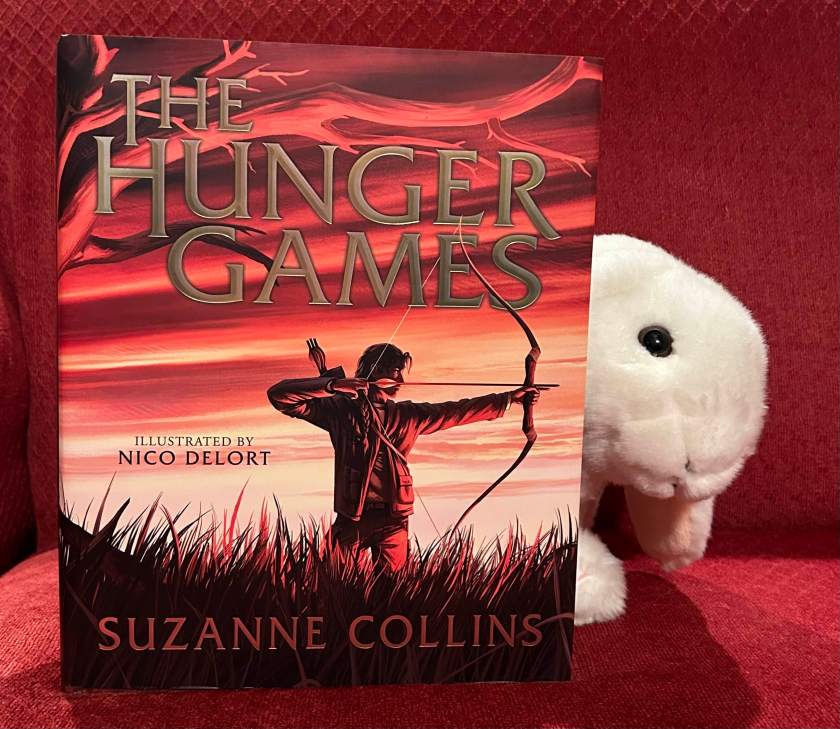
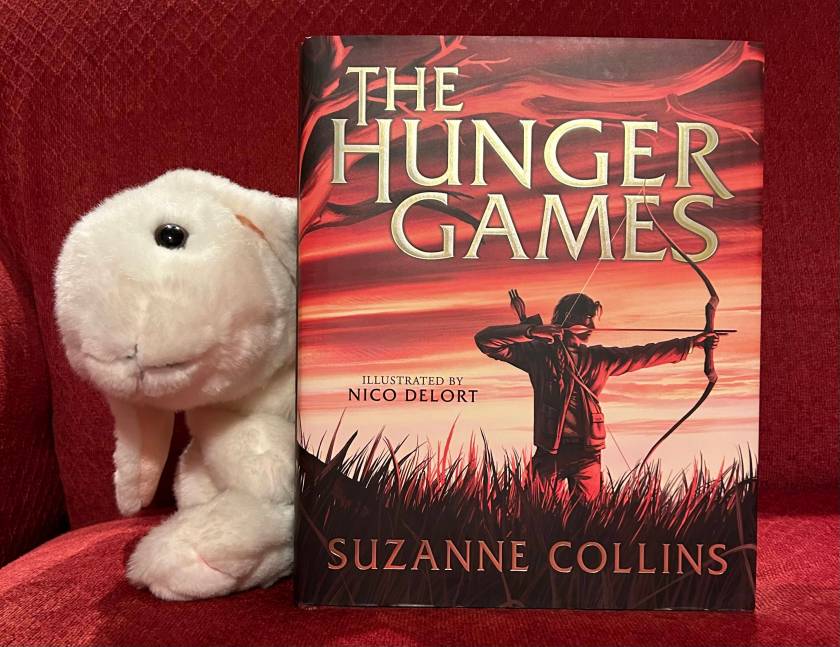
Marshmallow reviews The Hunger Games: The Illustrated Edition written by Suzanne Collins and illustrated by Nico Delort.

Sprinkles: So Marshmallow you read the original book and then watched the movie. How did this illustrated edition work for you?

Marshmallow: As far as I could tell, the text was the same as in the original book. But the illustrator added images every now and then, giving the book a fancy fairy tale feel.

S: I saw the illustrations. They look realistic but are all in black and white. I felt like maybe that matches the overall gloomy nature of the world the story is taking place in.

M: I think you might be right. The cover illustrations have other colors, too, but the illustrations inside the book are all in black and white, like you said. And the world of Katniss Everdeen is really gloomy.

S: Okay, maybe it makes sense for us to give our readers a quick recap of the main plot lines of the book. We cannot assume everyone has already read the original book or seen the movie version.

M: Well, I could just repeat what I said earlier: The book is set in a dystopian future, in North America. There are twelve districts and a Capitol city that make up a country named Panem. Katniss Everdeen, the main character, lives in District 12 with her mother and younger sister Prim. Everyone is very poor, except for the people of the Capitol, which hosts the Hunger Games every year. The Hunger Games are a big spectacle: Two children ages 12 to 18 are selected from each district. And they are brought to the Capitol and are to fight to the death in these Hunger Games. Katniss ends up being the girl representing her district in that year’s Games, along with a boy named Peeta. The book is about their trip to the Capitol and their time during the Games.

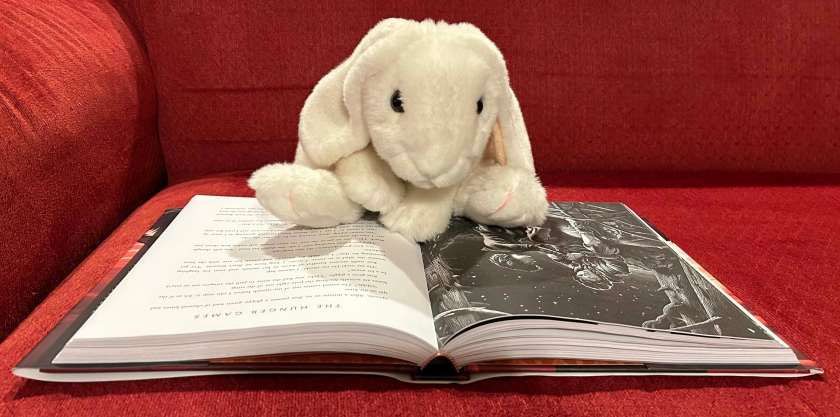
Marshmallow is reading The Hunger Games: The Illustrated Edition written by Suzanne Collins and illustrated by Nico Delort.

S: Okay, so the book is basically the same but there are illustrations in this version, right?

M: Yes. The format of the book is also bigger and the paper the pages are made of is much heavier, thicker paper. And there are a lot more words on a page. I think.

S: How many pages is it overall?

M: 357.

S: Comparing with the original paperback edition you read, which is 374 pages, do you think it is abridged?

M: I don’t think so. It seems that the large format allows more words on each page.

S: I see. So if the text is the same, then one could simply read this one instead of the original paperback you read.

M: Yes, and that could be a different kind of experience, I am sure. I mean, when you read the book, especially if you read it before having seen the movie, you completely are free when you are imagining Katniss and visualizing Panem. The illustrations would change that experience a bit. But I do not think it would be in a bad way.

S: So did you think the imagery was consistent with the book and how you imagined things to look like?

M: Yes. They match the movie images too. I mean Katniss is not Jennifer Lawrence in the illustrations, but the world and how every scene looks really resemble the movie images. But I am not saying the illustrations sort of simply copy the images form the movie. I thought the movie imagery was very faithful to the book, and only made the world seem richer and crisper. The illustrator of this book is very faithful to the book too, and the images just fit the mood of the book very well. Even, like you say, the fact that the illustrations are all in black and white adds to the general heaviness of the story.

S: Okay, that sounds like the illustrator did a really good job then.

M: Yes. I think if you want to read The Hunger Games series, this illustrated edition could be a good book to start your journey with.

S: So I am guessing you would rate this book rather highly?

M: Yes. Great story as before and very evocative imagery, so I’d rate it 100% for sure.

S: Thanks Marshmallow, this is all good to know. So maybe this would be a good time to wrap up this review. What would you like to tell our readers?

M: Stay tuned for more amazing reviews from the book bunnies!

Marshmallow rates The Hunger Games: The Illustrated Edition written by Suzanne Collins and illustrated by Nico Delort 100%.

Marshmallow reviews Mockingjay by Suzanne Collins

Marshmallow has already reviewed the first two books of the Hunger Games trilogy by Suzanne Collins: The Hunger Games and Catching Fire. Today she reviews the third and last book: Mockingjay, first published in 2010. Sprinkles is taking notes and asking questions.

(Marshmallow wants to warn readers that there may be some spoilers in what follows.)

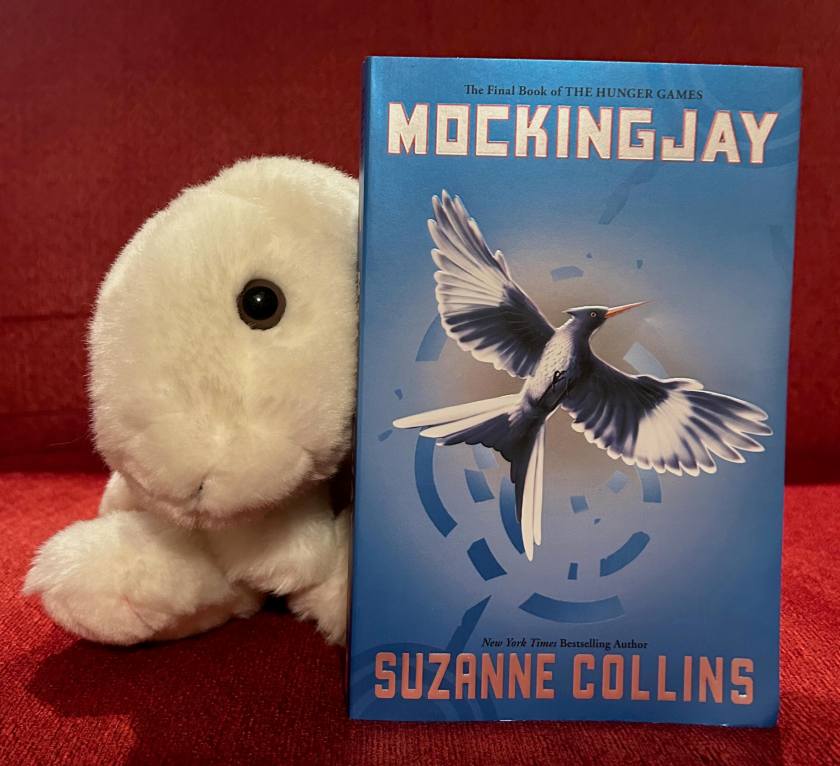
Marshmallow reviews Mockingjay by Suzanne Collins.

Sprinkles: So Marshmallow, as your first post post-summer break, you chose to tell us a bit about Mockingjay. Let’s get started.

Marshmallow: Sure. Mockingjay is the third and final book in Suzanne Collins’s Hunger Games series. And I think it wraps up the story really realistically. It does not simplify or dismiss the bloodiness and complications of revolutions.

S: Okay, let us step back. So being the third book in a series, readers should probably have read the first two books, right?

M: Yes. So they should definitely have read The Hunger Games and Catching Fire. The story begins more or less when the second book ends. So Katniss Everdeen is the champion of District 12 in the seventy-fourth Hunger Games at the end of the first book, and then in the second book, she is forced to take part in the seventy-fifth one. And she and Peeta, her partner from District 12, survive that game too. But at the end of the second book, we are kind of left at a cliffhanger, because it seems that Katniss is taken by rebels, and Peeta is taken by the forces from the Capitol. So when the third book starts, Katniss is with the rebels from District 13. Oh, we should say there may be some spoilers here.

S: Okay, I will add a note to the beginning of the post about that. So wait, District 13. Wasn’t that destroyed in the rebellion against the Capitol seventy-five years ago, before the Games began?

M: So that is what everyone thought, but in reality they had survived and they went underground. Literally they began to live under the ground, and they are pretty strong because they have nuclear power. And they support the rebels. So Katniss learns about all this at the very end of the second book.

S: I see.

M: Then this book is about the rebels trying to take down the Capitol and President Snow, while Katniss has a lot of mixed feelings about being involved.

S: How come?

M: Well, she has suffered a lot of trauma, her entire District was destroyed, and she is seriously injured. She has healed but has many permanent scars, physical and emotional. Also Peeta is in the hands of the Capitol, and she is scared of how they might be torturing him.

S: I see.

Marshmallow is reading Mockingjay by Suzanne Collins.

S: So the narrative is still first person, right? We still see the world and the events through Katniss’ eyes?

M: Yes. And that was one of the reasons why the book shook me so much. The reader is going through all the emotional stuff together with Katniss.

S: I know. I saw how shaken you were by the end of the book.

M: Yes. Even though in some ways the end can be called a happy end, I was very unsettled about everything. Because Collins, the author, does not spare any details. She makes things so realistic. Both sides do terrible things, and there is really no winner. Lots of losers, but even those one could say won have so many permanent scars inside and out…

S: I understand. So all in all, it was a very powerful read it seems like.

M: Yes, I was emotionally very moved. The series, I think, is very important for all bunnies to read, at some point, because it shows how horrific all human suffering is and how violence is never, should never, be the answer. And it also shows how trauma, pain, and violence can shape others to become like the ones who hurt them.

S: Those are some tough lessons Marshmallow. I am guessing you think this book is not very suitable for very young bunnies.

M: I don’t know. I have friends who read this when they were twelve and they loved it. But personally I was affected very strongly by this book, and I think that maybe it is better suited to older bunnies than twelve.

S: That makes sense to me. It is also possible that people of different ages can read the book at different levels. But all in all, did you like this book as the end of the series? Having read all three, are you going to recommend people to do so themselves?

M: Yes. I definitely think so. I’d rate Mockingjay 100%, but also I think this whole series is very important. Not just a good book series to read, but as I said before, it is important for young people to be aware of the horrors of war, violence, human suffering.

S: Thank you, that works for me. So let us wrap up this review then. What would you like to tell our readers?

M: We are back! And stay tuned for more amazing reviews from the book bunnies!

Marshmallow rates Mockingjay by Suzanne Collins 100%.

Marshmallow reviews Catching Fire by Suzanne Collins

A few weeks ago Marshmallow reviewed The Hunger Games by Suzanne Collins, the first of the famous Hunger Games trilogy. Today she talks to Sprinkles about the second book in the series, Catching Fire, first published in 2009.

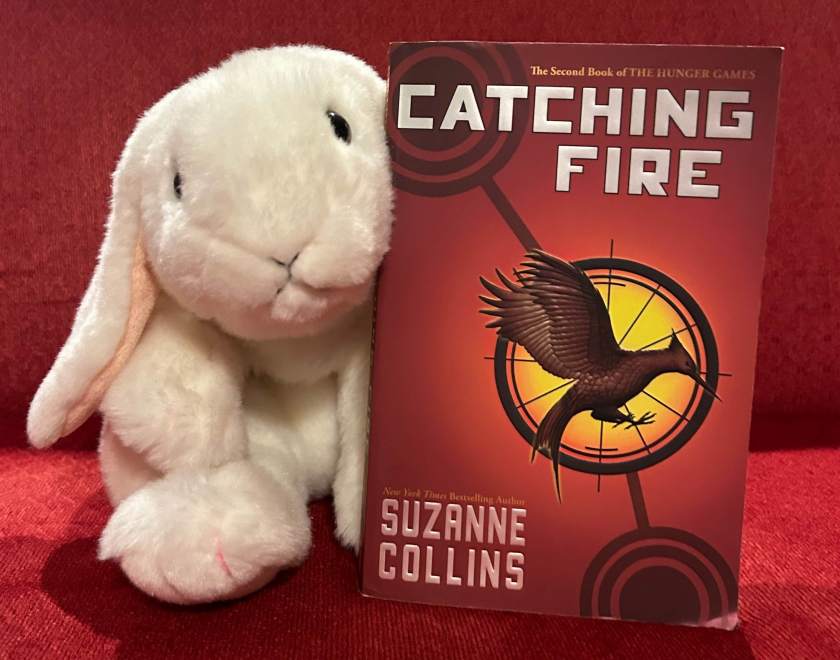
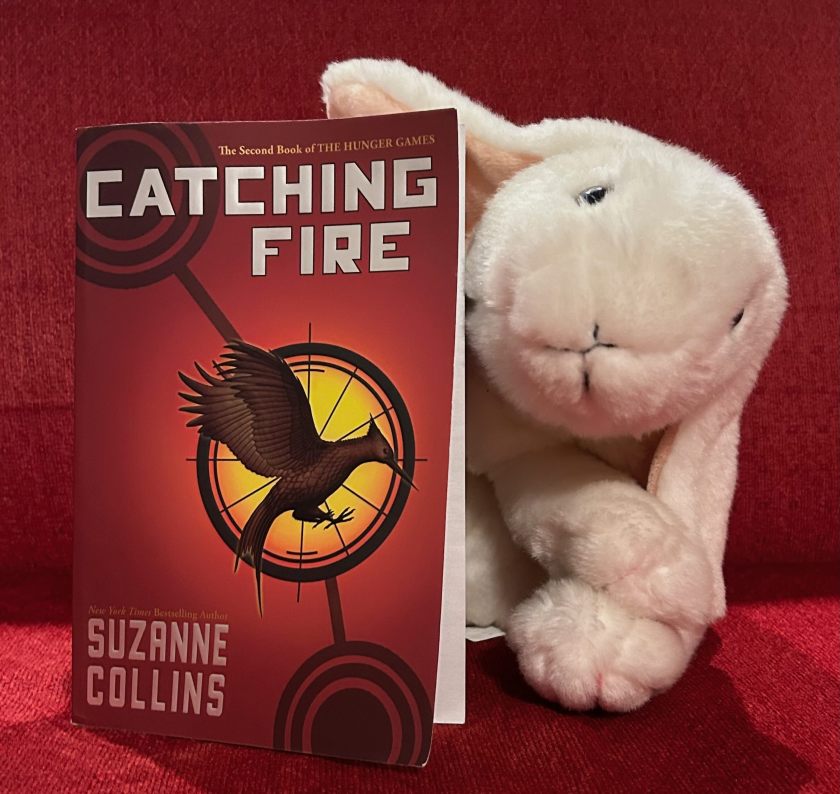
Marshmallow reviews Catching Fire by Suzanne Collins.

Sprinkles: So Marshmallow, tell us a bit about this second book.

Marshmallow: Well, it starts more or less where the first book ended. So Katniss and Peeta won that year’s Hunger Games, and they go on a victory tour. But it is not really a real victory, because they are being coerced into performing like they are proud and also in love for the masses.

S: So it is really like a reality TV show.

M: Yes, but it is also based off the Roman gladiator games, like we said the last time. This became apparent to me when we see rich people who make themselves throw up so they can continue to gorge themselves with more food. Roman aristocrats also did this.

S: Such a waste of food.

M: Yes, but also keep in mind that there is real poverty in other parts of the country. So it is especially disturbing that they have too much to eat while others are almost starving.

S: I agree. Okay, so tell me more about the victory tour that is not a real victory tour bur rather a fancy photo op.

M: When Katniss and Peeta both survive, this is kind of against the wishes of the Capitol, and this leads to people having some rebellious ideas. So President Snow coerces Katniss to act as if she is really in love with Peeta and did not intend to start a rebellion. But still, they become the symbols of a rebellion against the Capitol.

S: That sounds like they might be in danger then.

M: Yes, eventually there is a new Hunger Game announced and this time they do not choose new champions. Instead teams of two from among the earlier victors will be put together. And of course since Katniss is the only female victor from her district, she has to play. Peeta joins her and they face an even more challenging game this time, because this time President Snow wants her dead.

Marshmallow is reading Catching Fire by Suzanne Collins.

S: Okay, I think that sums up the plot of this second book quite well.

M: But wait there is a love triangle as well.

S: How so? Tell me.

M: Well, Katniss is developing feelings for Peeta, but also she has some lingering feelings for Gale, who was her friend from before the Games in the first book. So there is that, too.

S: I see. But I am guessing that it does not get too mushy, or you would not really love the book so much.

M: Yes, that is correct, so no, it does not get too mushy. Thankfully. There is some kissing and stuff, but it is not as central to the book as in some other books.

S: Okay, I know you want to move to the next book immediately, so does that mean you liked this one?

M: Yes! I’d rate it 100%, if only it did not end in a cliffhanger…

S: I guess you will just have to read the third book soon.

M: But first we have to watch the movie for this book!

S: Maybe.

M: At least maybe we can put the trailer here?

S: We can do that! Here it is:

Hunger Games: Catching Fire – official trailer (YouTube).

M: Thank you. I think that looks really good!

S: I agree. So maybe we should see it some time.

M: Yes!

S: But for now, it is time to wrap up this review.

M: Yes!

S: What do you want to tell our readers?

M: Stay tuned for more amazing reviews from the book bunnies!

Marshmallow would rate Catching Fire by Suzanne Collins 100% if it did not end in a cliffhanger.