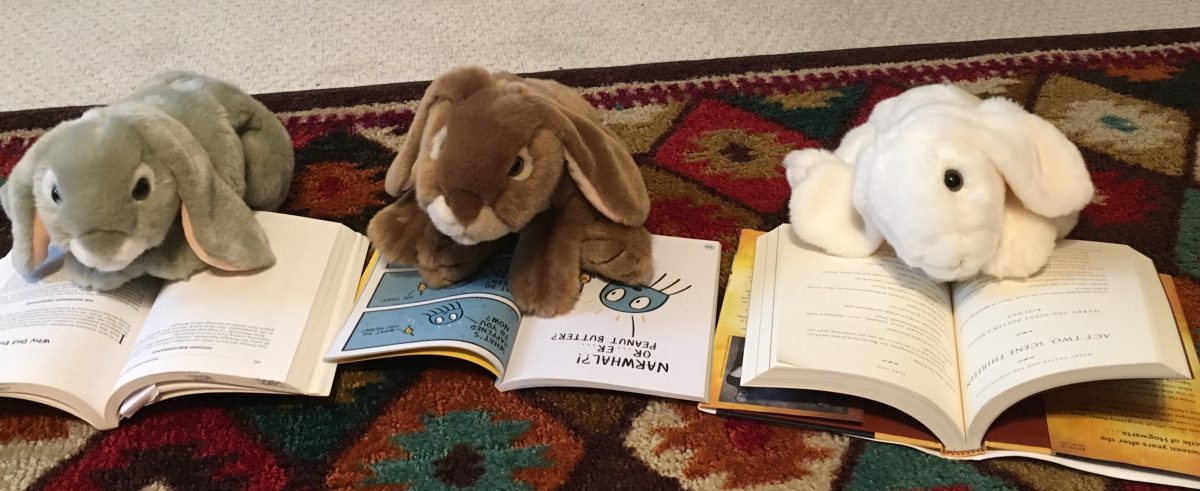
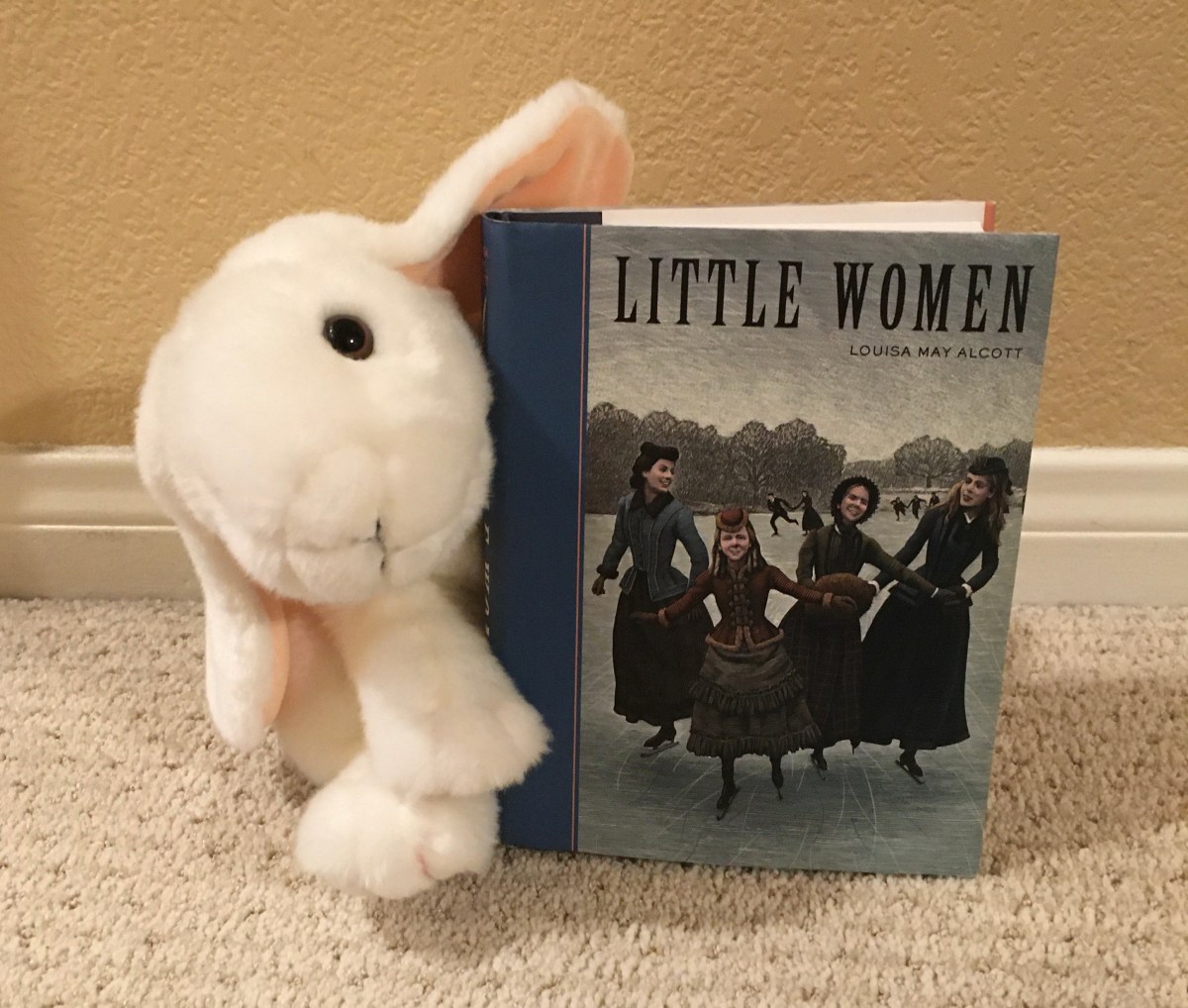
Marshmallow reviews Little Women by Louisa May Alcott

Marshmallow reviews Little Women by Louisa May Alcott, first published in 1868.

Marshmallow occasionally picks up classic children’s books. This time she wanted to talk about Little Women by Louisa May Alcott, first published in 1868. Sprinkles is asking questions and taking notes. There are some spoilers in the discussion so reader beware!
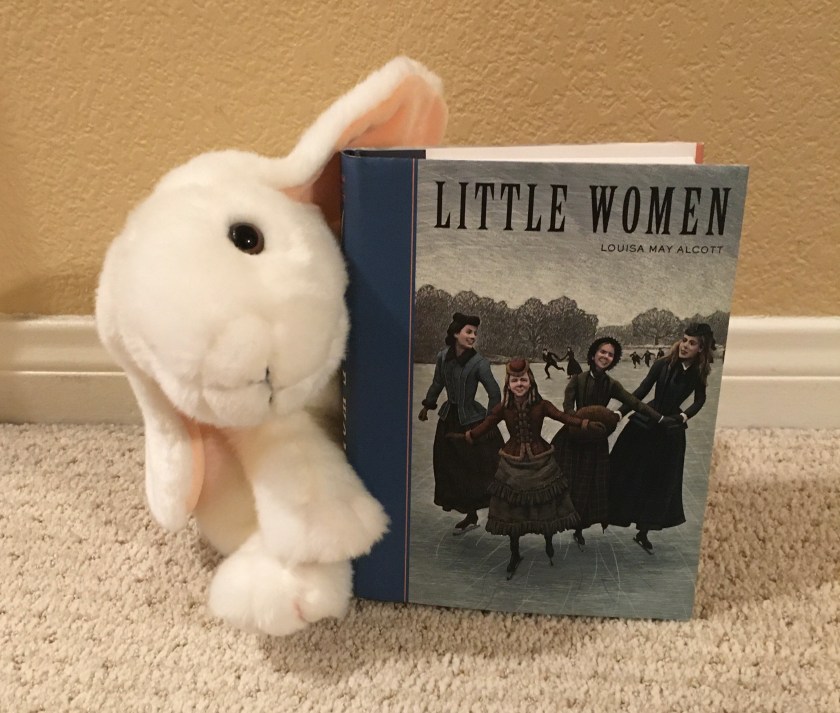
Marshmallow reviews Little Women by Louisa May Alcott.

Sprinkles: A lot of people have read Little Women before you. It is a classic from 1868, and now it will be the oldest book you have reviewed. We had not gone into the nineteenth century before this. The oldest book you reviewed before this was from 1902.

Marshmallow: Pippi Longstocking was also kind of old. But you are right, this book is old.

S: Does its age show?

M: Yeah. All sisters get married and even the tomboy of the family, Jo, ends up wanting to get married. It seems like they cannot just have a girl who doesn’t want to marry.

S: It does seem a little constraining, that is true. But of course at the time this book was written, women did not really have too many options.

M: I understand but I still wish the author could have offered other alternatives, at least to one of them (Jo).

S: That is true. The author seems to have modeled Jo after herself to an extent, and she, the author that is, was never married.

M: Yes, I did wish Jo had not gotten married. And it seemed that they all got married so early!
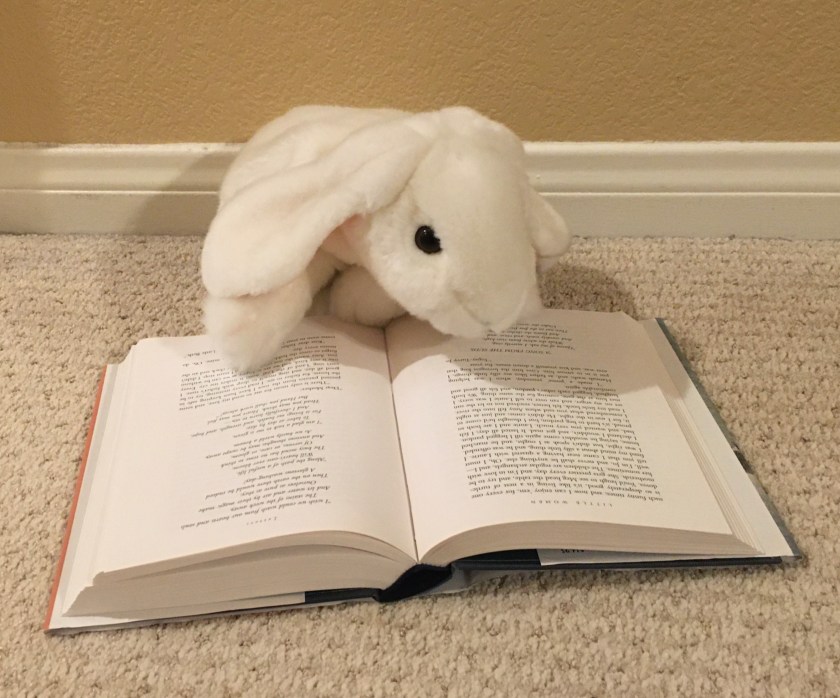
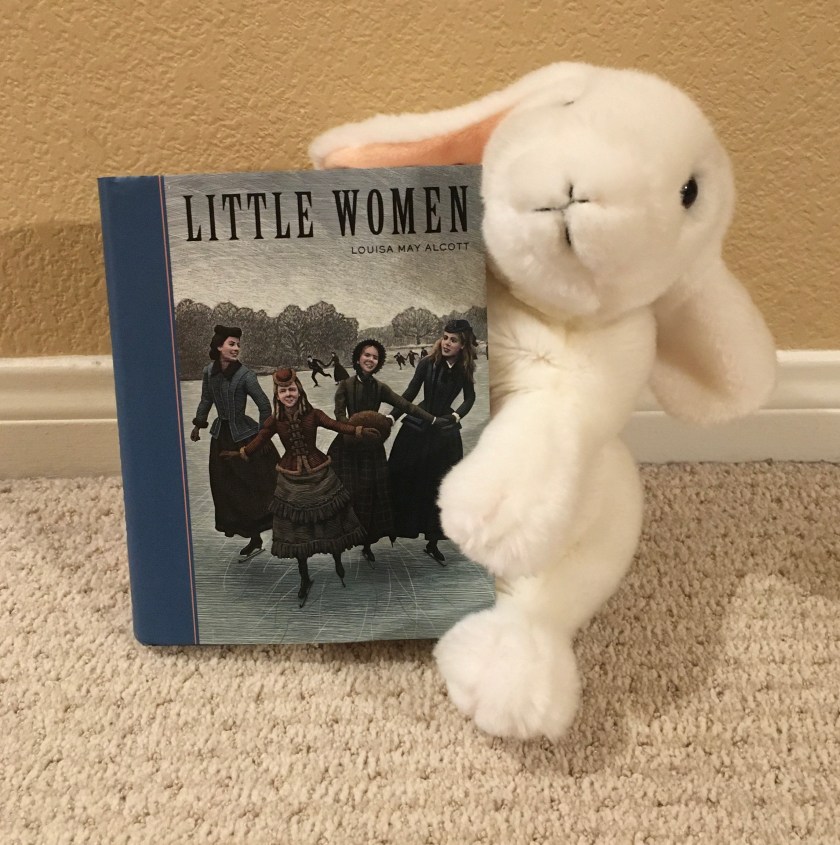
Marshmallow is reading  Little Women by Louisa May Alcott.
Marshmallow is reading Little Women by Louisa May Alcott.

S: Ok, maybe it will make sense for us to try and piece together a timeline of sorts for what happens when. So at the beginning …

M: There are four sisters, Meg March, Jo March, Beth March, and Amy March.

S: At the start of the book their ages are 16, 15, 13, and 12. And they all have very distinct personalities, right? Can you tell us a bit about them?

M: Let me read to you the synopsis from the book jacket:

There’s Meg, at 16 the oldest, who longs for a rich life full of beautiful things and free from material want. Next comes Jo, the willful and headstrong tomboy, who plans to become a writer and who retires to the attic when “genius burns.” Gentle, music-loving Beth, “the pet of the family,” is delicate and sweet. And fashionable Amy, the youngest of the four, is artistic, beautiful, spoiled, and in a hurry to grow up.

S: And the first part of the book (the first twenty-three chapters), which was published as a stand-alone book on itself in 1868, ends a year later, when the girls are 17, 16, 14, and 13. So they are still pretty young, but they are looking towards great things.

M: And the next part of the book is actually three years later. In Chapter 24 the author writes: “The three years that have passed have brought but few changes to the quiet family.”

S: According to Wikipedia, this second part was initially published separately under the title “Good Wives”, a title picked by the publisher. Then starting in 1880, the two books were published as one, under the title Little Women. But in any case, now how old are the sisters at the beginning of this part?

M: Meg is 20, Jo is 19, Beth is 17, and Amy is 16. It is sad though. Beth dies in this book! And she is so young!

S: Yes, a lot of the main events in this story are related to the author’s own life. Louisa May Alcott apparently had a sister Elizabeth, who died around the age that Beth in the book dies. And Jo seems to be modeled after the author herself.

M: Yes, Jo is the writer of the family after all! But it is still so sad that Beth dies. And it is even sadder that there was a real Beth who died so young too.

S: That is true. Life can be cruel sometimes. But there are happy parts of the book, too, no?

M: Yes. The book is not all about sad things. Meg has twins and she loves them and enjoys her time with them. And they are really funny kids.

S: So maybe this is a good place to stop the review, on a note of joy and hope. Do you have some last words for our readers?

M: This book is interesting and its plot is detailed and complex. Even though it is an old book, I can see why it is still a classic. I would definitely recommend other bunnies to check it out!
Marshmallow rates  Little Women by Louisa May Alcott 95%.
Marshmallow rates Little Women by Louisa May Alcott 95%.

Marshmallow reviews Beezus and Ramona by Beverly Cleary

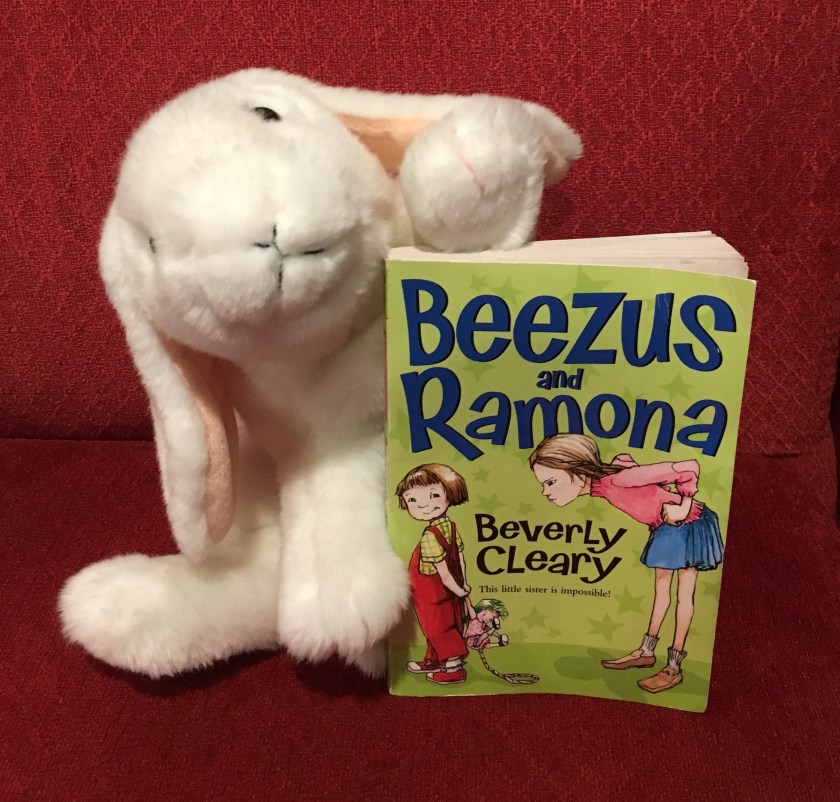
Marshmallow reviews Beezus and Ramona by Beverly Cleary.

Through the years, Marshmallow has enjoyed reading several books by Beverly Cleary, the prolific writer of children’s books. Below she writes about Beezus and Ramona, the first book of Cleary featuring Ramona Quimby written in 1955.

Marshmallow reviews Beezus and Ramona by Beverly Cleary.

Marshmallow’s quick take: If you like books that are about siblings or have enjoyed reading some of Beverly Cleary’s other books before, then this book might be for you.

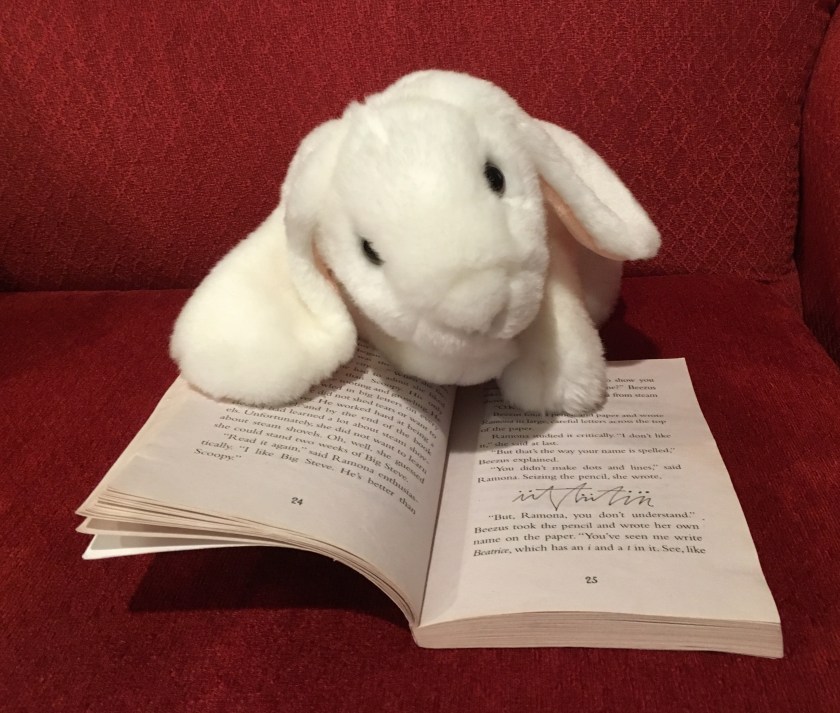
Marshmallow’s Summary (with spoilers): Beezus (or Beatrice really, but everyone calls her Beezus) and Ramona Quimby are two sisters who are sometimes nice to each other and sometimes not. Four-year-old Ramona annoys her big sister Beezus a lot. For example when Beezus’s friend comes over, Ramona knocks their checker game over. Then she sticks her doll into Beezus’s birthday cake while pretending to be Gretel. After Ramona writes her name on every page on a library book that Beezus checked out for Ramona, Beezus is really very annoyed. As you can see Ramona is not a very nice little sibling.

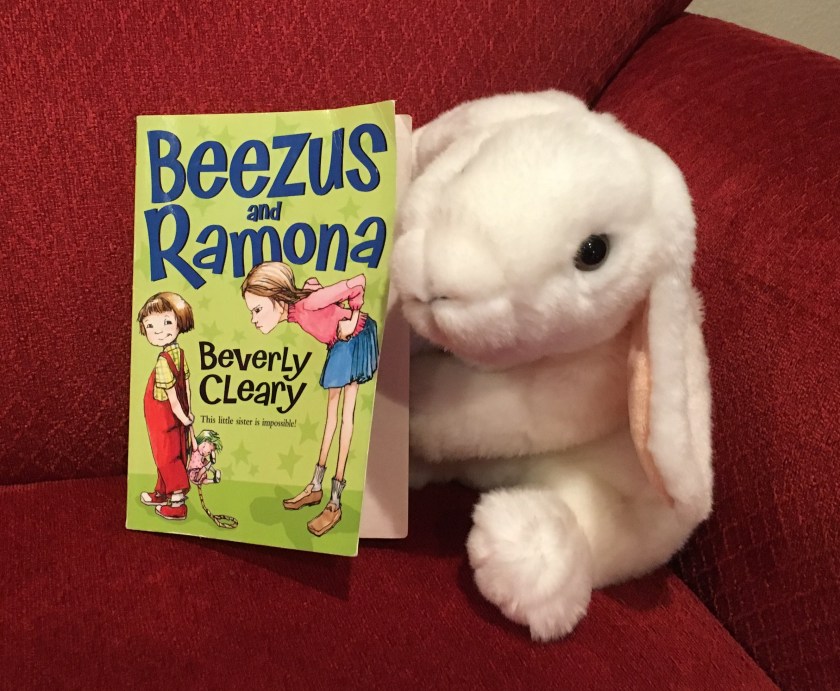
Marshmallow is pointing at the page where we see some of Ramona's scribbles.
Marshmallow is pointing at the page where we see some of Ramona’s scribbles.

Ramona is a very realistic annoying sibling. For example, when she finds a lot of apples in the basement, she takes one bite out of each apple and then starts another one. The Quimby family has some exciting times, like when Ramona invites her whole nursery school class to a party without asking her parents if she could.

The author, Beverly Cleary, wrote this book as part as a series featuring Ramona, Beezus, and her friends. In fact Ramona did not come to be a central character till about ten years later when she wrote Ramona the Pest, in 1968.

Marshmallow’s review: I thoroughly enjoyed this book. It is an old book, published even before my parents were born, but it is still a good read for readers who like books about sibling problems.

Beezus and Ramona is a classic like some other books that I have reviewed earlier, such as Half Magic and Five Children and It. It is also very funny and will make a lot of people laugh, like when Ramona powders her nose with marshmallows she calls “powder puffs”.

This is the first of a series of books by Beverly Cleary featuring Ramona Quimby. It is also one of my favorite books from the author. Ramona is very funny in this book. Some of my other favorite books by Beverly Cleary include Ramona the Pest, Ramona the Brave, The Mouse and the Motorcycle, Henry and Ribsy, Ellen Tebbits, Henry and Beezus, and Ramona’s World. I like these books because they are funny, well written, and realistic.

The drawings in the book add to the story’s description.

One thing I really enjoy about Beverly Cleary’s books is that they end well. In Beezus and Ramona the story ends… well I don’t want to spoil the end but let’s just say it ends well.

Marshmallow’s rating: 95%.

Marshmallow rates Beezus and Ramona by Beverly Cleary 95%.

Marshmallow reviews Five Children and It by E. Nesbit

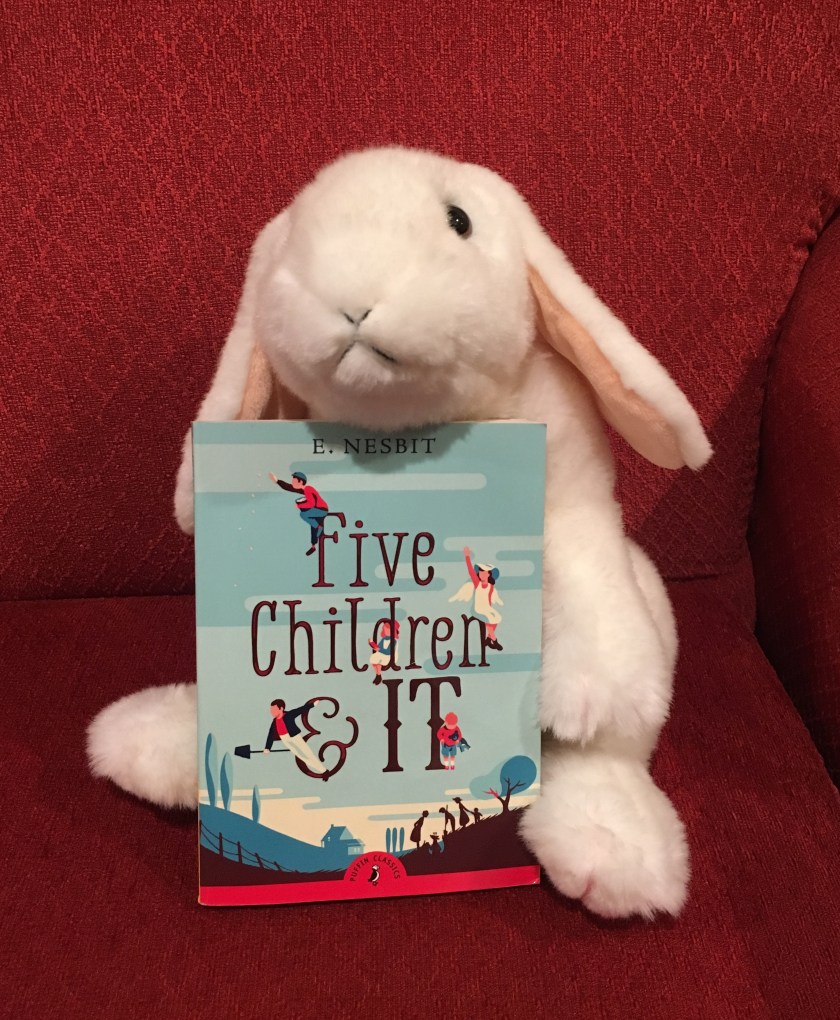
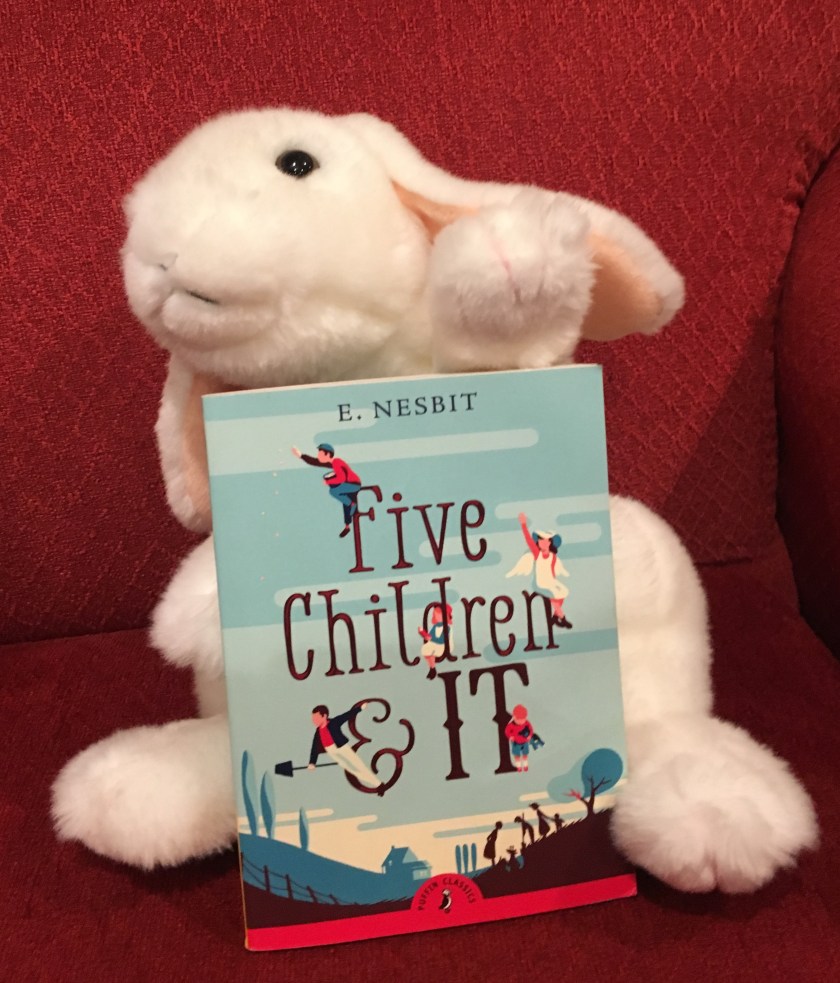
Marshmallow reviews Five Children and It, a novel by Edith Nesbit first published in 1902.

Marshmallow wanted to talk about E. Nesbit’s book Five Children and It today. Sprinkles is asking questions and taking notes.

Marshmallow reviews Five Children and It by E. Nesbit.

Sprinkles: So Marshmallow can you tell us a bit about this book?

Marshmallow: Cyril, Anthea, Robert, Jane, and Lamb the baby dig a hole to reach Australia. While they are digging, they find a strange creature called Psammead (a sand-fairy) that can grant wishes. At the beginning, the children wish to be as beautiful as the day and to have a lot of gold but then they realize that they must be more careful when they are making wishes. Whenever they make a wish, they always end up in trouble.

S: Oh, does this book remind you of another?

M: It’s kind of similar to Half Magic by Edward Eager. Just like in that book, the children find this object or fairy that grants them wishes and they eventually find that they need to think carefully about what they will wish for.

S: So what more can you tell us?

M: This is an interesting book that will beg the question, “If you could wish for anything. what would you wish for?”

I thoroughly enjoyed reading it because it was interesting how when the children wished for something like to be beautiful or when they wished to have wings, there was a problem. For example, when they wished to be “as beautiful as the day” after they tried to interact with their baby brother Lamb (whose real and full name is Hilary St. Maul Devereux). They then change and Lamb does not recognize them because they look different. Also when they try to go to their house their nursemaid does not let them in because they look different and not like their old selves. They get very hungry and thirsty and they realize that it was not a great idea to have wished to be “as beautiful as the day.”

S: What more do you want to say?

M: This is a very entertaining book, and very well written. It will make you want to read on to learn what wish the children make next.

S: Yes, they do make some strange wishes, don’t they? What did you think of the illustrations?

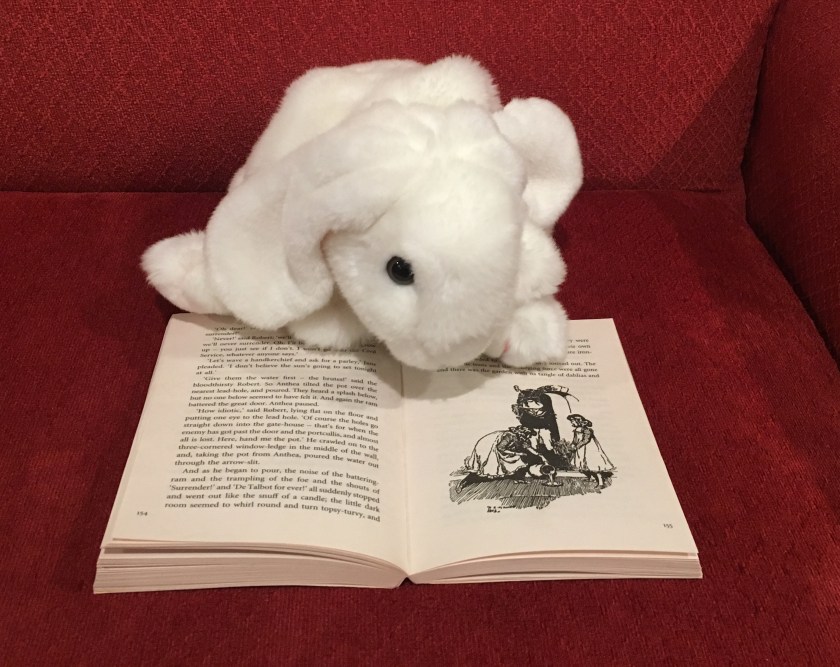
M: I thought the pictures were very successful.

Marshmallow is pointing out one of the many illustrations in Five Children and It by E. Nesbit.

S: And you have some thoughts on the characters?

M: Yes! Especially I liked the fact that the children act like children. Kind of like in the Ivy + Bean books!

S: This is a very old book. It could be the oldest book you have read. What do you think of that?

M: It is an old book. It does have some stereotypes, like girls always cry, and boys never do. But overall it is a good book.

S: Ok, so what would you have wished for if you had met Psammead?

M: I don’t know. What would you wish for?

S: I don’t know, either. It is a hard question, without all the challenges this particular sand-fairy brings. Maybe I’d wish for some good meal, or a good night’s sleep. Something simple like that… Or I could wish for a good book to read. This was one, you say?

M: Yes! I’d rate it 95%. And I really want to add this last sentence: Stay tuned for more book bunnies reviews!

Marshmallow rates Five Children and It by E. Nesbit 95%.

Marshmallow reviews The Silver Chair (Book 4 of the Chronicles of Narnia) by C. S. Lewis

The book bunny family has spent several happy hours listening to C. S. Lewis’ Chronicles of Narnia books in the publishing order these last few months. Marshmallow was ahead of us of course, and she had already read them all before we had even begun listening. Below she writes about the fourth book (sixth in the chronological order): The Silver Chair.

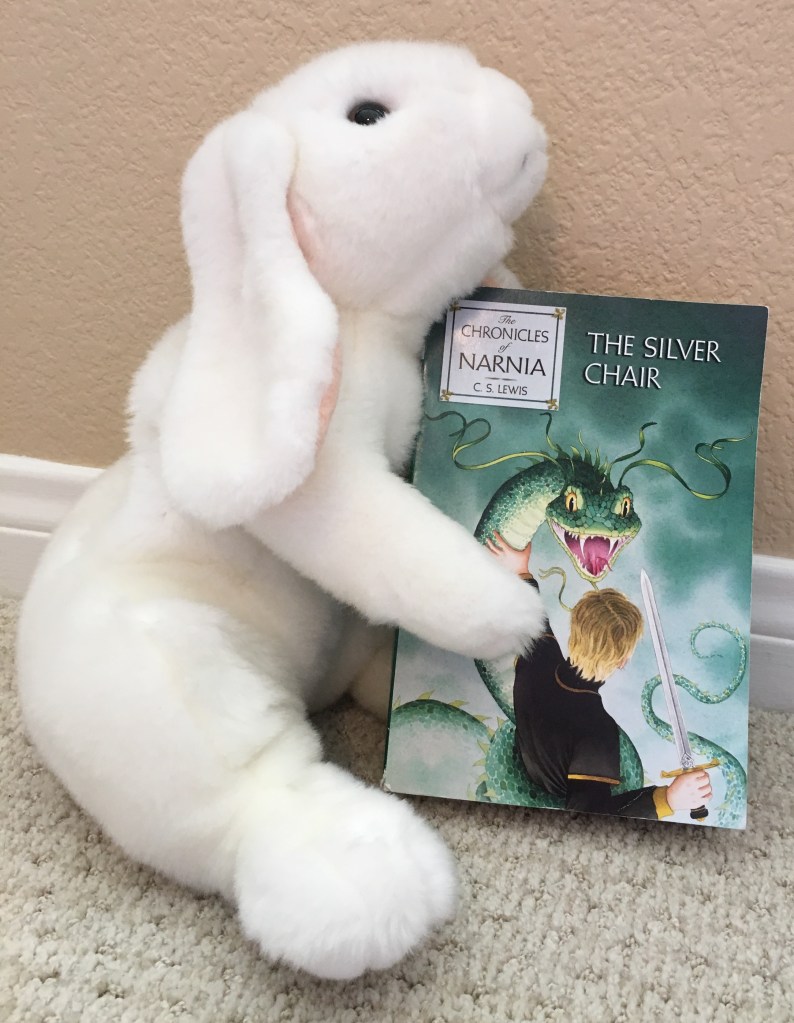
Marshmallow reviews The Silver Chair by C. S. Lewis.

Marshmallow’s quick take: If you liked the first three Narnia books (or five, depending on which order you’re reading them in), then this might be the book for you.

Marshmallow’s Summary (with spoilers): While at school, Eustace Scrubb describes to Jill Pole the magical land of Narnia, which he had visited in The Voyage of the Dawn Treader (book 3 in the publishing order). When bullies at school start to chase them, Eustace and Jill run into a shed to escape them. They open the shed door and inside the shed there is a beautiful land. They find themselves on the top of a very, very, VERY tall cliff. It is so high that the clouds are way below it. Eustace is scared of being so high up. (I would be scared too.) Jill, though, cannot see the bottom, so she scoffs at Eustace and says that he is a scaredy-rabbit. She then goes to the edge of the cliff to show off that she is not scared and looks down. Eustace tries to pull her away from the edge of the cliff, but she shoves him away and accidentally pushes him off the cliff. Immediately a lion comes and starts blowing at him so Eustace’s flight is smoother. The lion later tells Jill that he has blown him to Narnia.

When the lion leaves, Jill starts crying. Then she realizes that she is very thirsty. She finds a stream, but next to the stream there is a lion again. She is scared that the lion will eat her, but she is very thirsty. The lion then says that if she is thirsty then she should come and drink. She asks if he will promise not to eat her. The lion says that he makes no promises. Then she asks if he will move away while she is drinking from the stream. He says nothing but Jill thinks that he will not. In the end, Jill still decides that she has to drink water and she drinks from the spring. Then the lion explains their quest to Jill.

The lion explains that Prince Rilian of Narnia, the one and only son and heir to the throne of Caspian the Tenth or Caspian the Seafarer, disappeared while hunting for the giant snake that stung and killed his mother, the queen. Their mission is to find the prince and bring him to his father. Can they succeed?

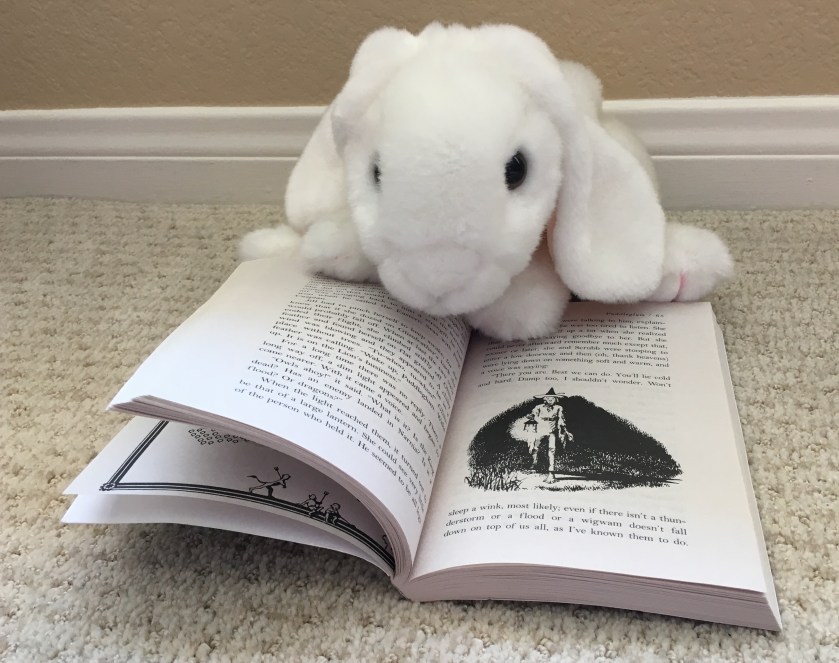
Marshmallow is pointing at Pauline Baynes' illustration of Puddleglum the Marsh-wiggle, a character from The Silver Chair.
Marshmallow is pointing at Pauline Baynes’ illustration of Puddleglum the Marsh-wiggle, a character from The Silver Chair.

Marshmallow’s review: This is my favorite Narnia book. It is an old classic and its age shows a bit. For example, Jill cries a little bit too much; I just didn’t like how she was portrayed. But she at least does know a lot of stuff; I liked her more than Lucy and Susan, the other main female characters in the Narnia books. 

Otherwise, this is a good book overall. The story is well told and well written. The plot is very successful and intriguing. I think someone who has not read any of the other Narnia books might still enjoy reading this book, but of course the back stories of the main characters add to one’s understanding of the whole story.

Marshmallow’s rating: 90%.

Marshmallow rates C. S. Lewis' The Silver Chair 90%.
Marshmallow rates C. S. Lewis’ The Silver Chair 90%.