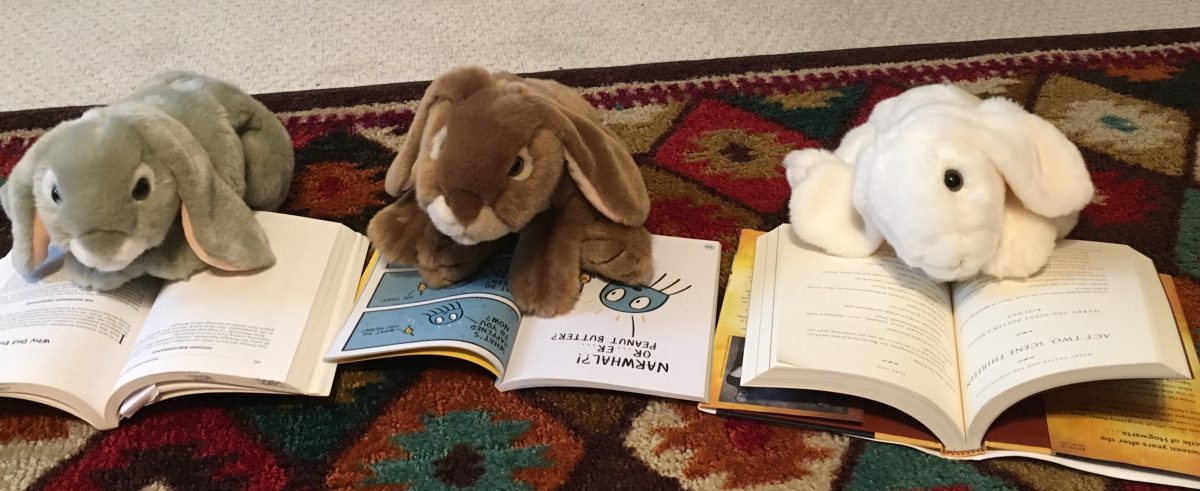
Marshmallow reviews Flowers for Algernon by Daniel Keyes

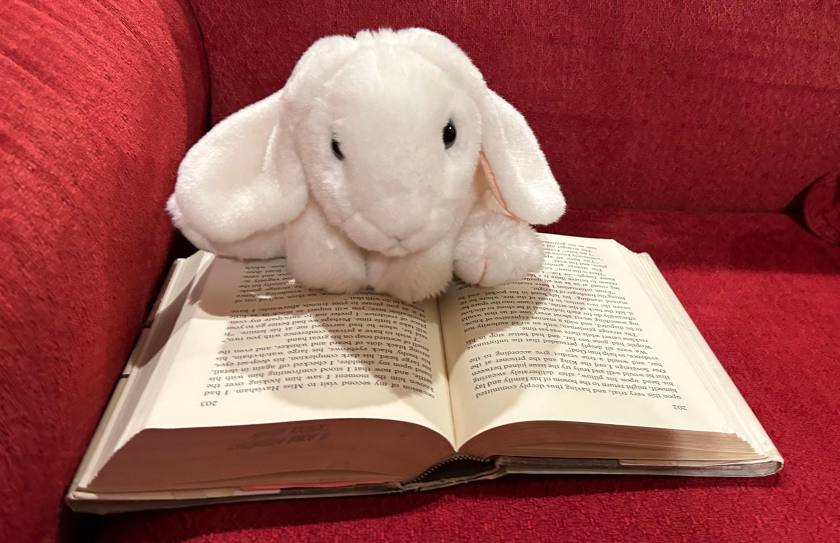
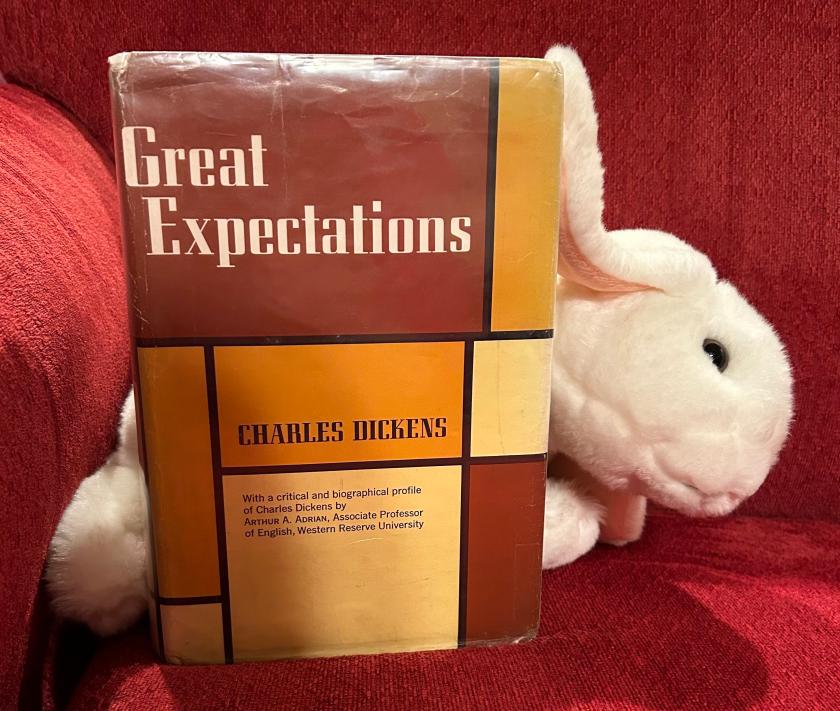
In the last few weeks, Marshmallow and her English class have been reading a version of the classic novel Flowers for Algernon by Daniel Keyes, first published as a short story in 1959 and then expanded by its author to be published as a full novel in 1966. Sprinkles was excited to see Marshmallow getting into the story because she remembers it fondly from her own time reading the same book in school decades ago. In the blog post below, the two bunnies discuss the full book.

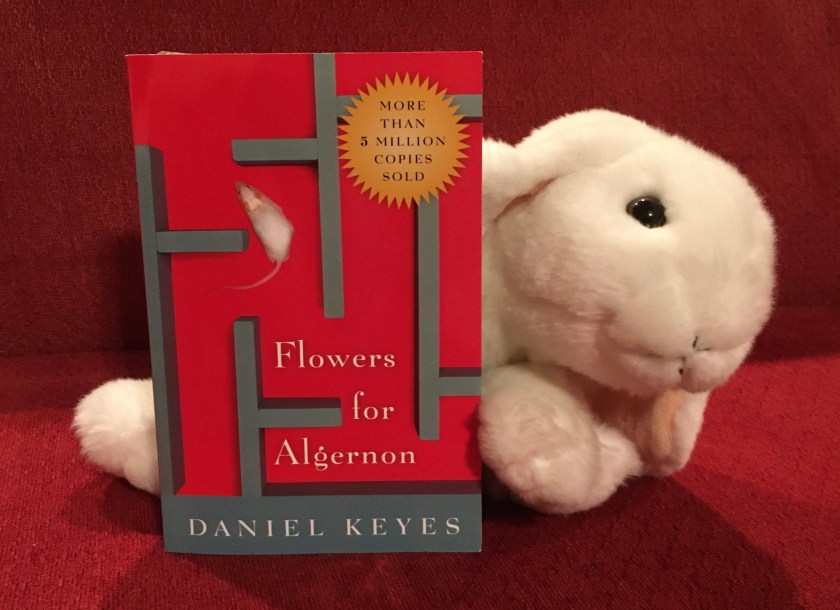
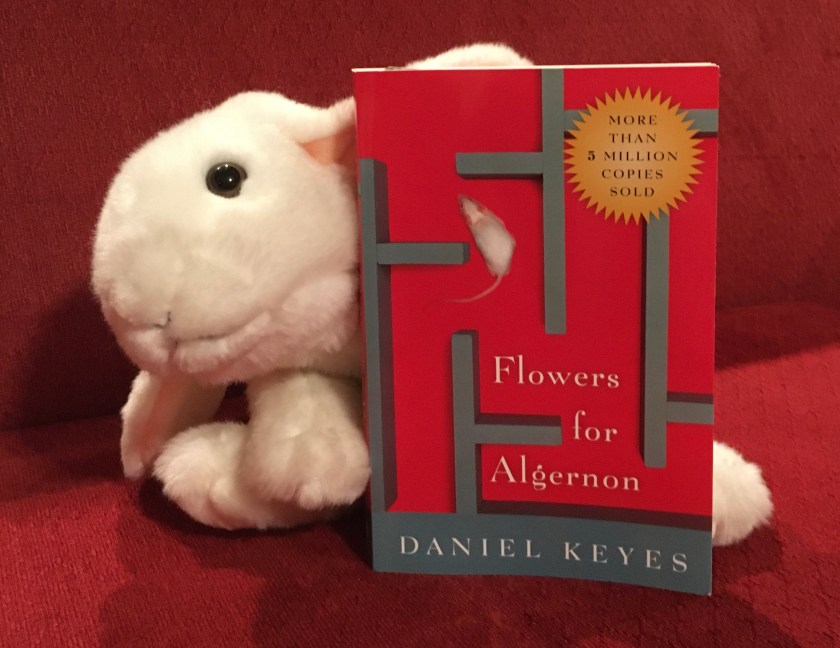
Marshmallow reviews Flowers for Algernon by Daniel Keyes.

Sprinkles: So Marshmallow, why don’t we start with your usual short overview of the book?

Marshmallow: Why not? If you like books about growing up or living through a big change, this might be the book for you.

S: I think that is a good way to describe the book. The main character is originally a mentally challenged adult, so he is not really growing up, but he undergoes an experimental treatment which enhances his mental capabilities immensely, and so he is going through a big change.

M: Yes. The main character is Charlie Gordon, and he is the one narrating the story. The book is written as a series of progress reports, all through his perspective.

S: Yes, the entries are like diary entries, right?

M: Yes, most of them. And at the beginning he is using very simple sentences and basic words and sometimes has very poor spelling. As the treatment takes effect, he begins to write more complex sentences and use bigger words. He also starts to write about more personal and complicated things and has to confront some past emotional trauma. So, for example, I should warn all bunnies that the book does have some explicit descriptions of certain sexual feelings and acts. As Charlie gets more and more mentally capable, he begins to notice his attraction to women.

S: Even before the operation, he might have felt some such feelings, but would perhaps not write about them?

M: I’m not sure. It seems to me that Charlie had the mind of a three year old before the operation, and so he did not have any sexual impulses.

S: Hmm, that sounds somewhat unrealistic to me, given that he has the body of a full-grown man; his hormones and related needs and desires would probably be quite typical.

M: Well, I don’t know, but he seems to become more interested in things like that, and that was quite a bit different from the version we have been reading at school. In that version, we do not see any of this stuff. Which is in some ways easier to read.

S: I can understand that. Perhaps that is why a lot of school districts have had discussions about this book, and apparently some have even removed it from their libraries. The sexual content might be a lot for some younger bunnies to handle, even though I was not bothered by them when I was a young bunny reading the book. Then again, I might have been a little older than you… Or who knows? Maybe I read an abridged version, too, and I do not recall very well.

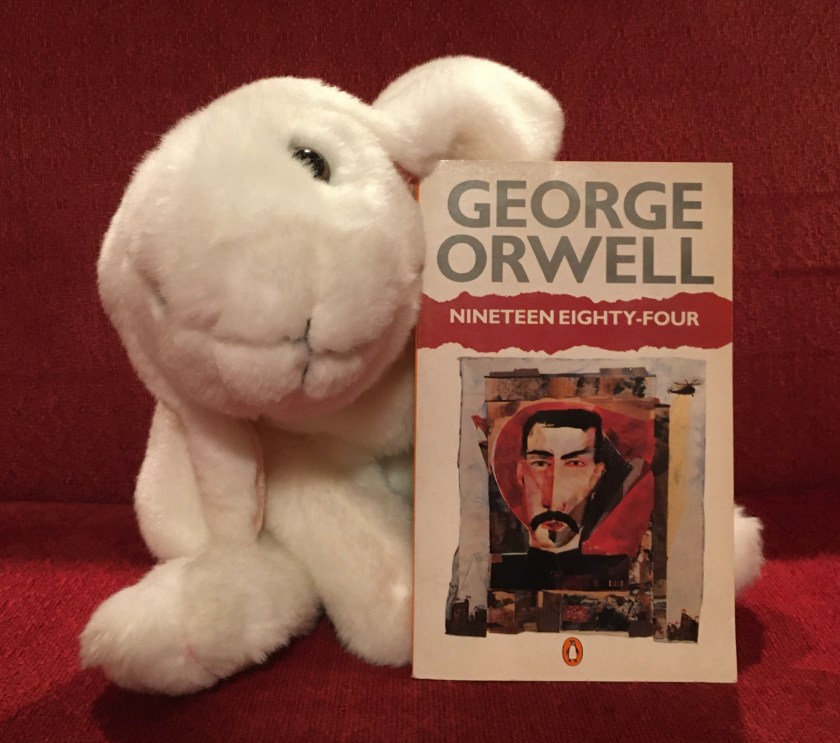
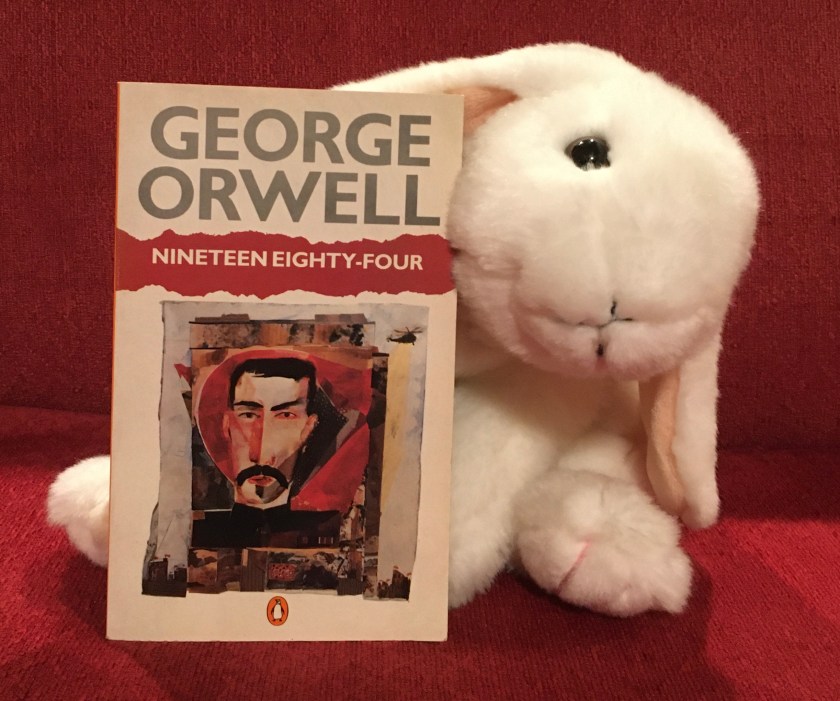
M: Maybe. I don’t know. But the full book is a bit more adult than my usual reading fare. The only other book I have read that is kind of like this one is 1984 by George Orwell, which also had some explicit scenes.

S: I understand. I’d say that both books have very serious messages, and the sexually explicit scenes in both books play significant roles in clarifying those messages. So for example in 1984, the sexual scenes show us the main character’s difficulties with intimacy and the oppressiveness of the general climate. In this book, I think the sexual scenes are a part of Charlie becoming more aware of his body, his personality, his needs and desires, as well as how the outside world views him.

M: I can see that.

Marshmallow is reading Flowers for Algernon by Daniel Keyes.

S: So who or what is Algernon? Why is the book titled Flowers for Algernon?

M: Algernon is a mouse. He has gone through the same operation that Charlie has, and in some ways, the changes he goes through are similar to what happens to Charlie. So Charlie begins to really like and care for Algernon, because Algernon is more or less the only other creature in the world who is going through the same thing that Charlie is. And then —

S: Wait, don’t give everything away!

M: Okay, no more spoilers. But things do get pretty sad, and the title of the book is in the very last sentence of the book.

S: Yes, that is true. What did you think of Charlie? Did you like him or sympathize with him?

M: I liked him, more at some times and less at others. He is a childlike and kind person at the beginning, and that I really liked. But then as the operation takes effect and he begins to get more and more intelligent, he becomes more arrogant and he does not even realize that. I did not like him that much then. But eventually he does begin to understand other people better, and he remembers and tries to process some of the emotional trauma from his childhood. He justifiably gets angry at some people who mistreated him when he did not know they were being mean. And there I could of course sympathize with him. And he wants to be accepted most of all.

S: I guess that is a very understandable need. We are social creatures and we want to belong.

M: Yes. I think so. So when he becomes too intelligent, that is also isolating. Certain people used to feel better about themselves by putting him down, but now they feel inferior to him and begin to fear and avoid him. In some ways, those people were not good people to have as friends anyways, but Charlie did not know. In any case, in the end —

S: Wait, remember, we don’t want to be giving away too much…

M: Hmm, okay, I guess I should stop here.

S: Alright. Let us do that. Would you recommend this book to other young bunnies? Or perhaps, you’d recommend the abridged version?

M: I think young bunnies might really like the abridged version. Charlie’s story is a lot simpler in it and it is a lot easier to read. And you get to really like him and feel for him, and and the story is still sad but beautiful.

S: Okay. That makes sense to me. Full-blown people are all pretty complex, and I think the original book captures that really well. Charlie is a complex person with a complex story, and the book does give us a lot more to chew on. But the main message can come through quite clearly in the abridged version, too, without the distractions of the sex dimension and the emotional trauma. So how do you want to end this review?

M: I can say my usual: Stay tuned for more amazing reviews from the book bunnies!

Marshmallow appreciated reading Flowers for Algernon by Daniel Keyes and recommends it to her peers but emphasizes that perhaps some might prefer an abridged version.

Caramel reviews Three Tales of My Father’s Dragon by Ruth Stiles Gannett

Today Caramel reviews Three Tales of My Father’s Dragon, that brings together the 1948 classic My Father’s Dragon, a Newberry Honor recipient, and its two sequels, Elmer and the Dragon (1950) and The Dragons of Blueland (1951), all written by Ruth Stiles Gannett and illustrated by Ruth Chrisman Gannett. As usual, Sprinkles is taking notes and asking questions.

Caramel reviews Three Tales of My Father's Dragon, written by Ruth Stiles Gannett and illustrated by Ruth Chrisman Gannett.
Caramel reviews Three Tales of My Father’s Dragon, written by Ruth Stiles Gannett and illustrated by Ruth Chrisman Gannett.

Sprinkles: So Caramel, tell me about this book.

Caramel: This book is nice if you like happy books and dragons.

S: Oh, so it is a happy book about dragons?

C: Yes and no. It’s also about Elmer Elevator, who meets a cat, who tells him about a dragon. Then Elmer goes and finds this dragon.

S: So is Elmer the father in the title?

C: Yes. The first part of the book is told by someone who calls Elmer “my father”. It makes it sound like it is a true story that happened to someone’s dad.

S: Hmm, so the narrator of the first book, My Father’s Dragon, is Elmer’s child, right?

C: Yes. And Elmer is a nine year old boy when things are happening.

S: So it really reads like you are hearing a tale that Elmer told his child and that child grew up and is telling you the story. And then the remaining two books are told in the third person, right?

C: Yes. There is no narrator calling Elmer “my father” anymore. Elmer is only a boy in those two parts.

S: I see. So then Elmer finds this dragon and they get to be friends?

C: Yes. The dragon has blue and yellow stripes and has a long tail and has red eyes and red feet.

S: That’s a very colorful dragon!

C: Yup. The cat helps Elmer devise a plan to help the dragon and Elmer goes and saves the dragon. The first part of the book is all about Elmer finding the dragon. Then they become friends, and in the second book, they are stuck in an island. Then the dragon takes Elmer home, and in the third part of the book he goes to his own home, Blueland. And then there is some trouble there, and Elmer helps him.

S: That sounds like a sweet story.

C: Yes, I think so.

Caramel is reading Three Tales of My Father's Dragon, written by Ruth Stiles Gannett and illustrated by Ruth Chrisman Gannett.
Caramel is reading Three Tales of My Father’s Dragon, written by Ruth Stiles Gannett and illustrated by Ruth Chrisman Gannett.

S: So you have read a lot of books about dragons. Does the dragon in this book resemble any dragons you know of?

C: Not really. This dragon is completely different. He does talk, and he is very colorful, like he is wearing striped PJs, dragon-sized and shaped of course. And I don’t think he can breathe fire or anything.

S: Do any one of Elmer’s family or friends meet this dragon?

C: No.

S: So is Elmer the only human involved in the stories?

C: Yes. There are canaries, there is the cat, there is an adult gorilla, and six baby gorillas, but there are not any other humans in the story. I mean, some show up, but they don’t really play a role in the story.

S: That is interesting. Somehow a lot of the things you are telling me about this book remind me of another classic Marshmallow had reviewed way back: Mr. Popper’s Penguins by Richard and Florence Atwater, There were humans in that story, but the tone of the book and the happiness you are talking about reminded me of that one. Anyways, did you enjoy reading this book?

C: Yes. I especially liked the pictures.

S: Oh, tell me more.

C: They are all black and white, but they are very detailed and I could see exactly what Elmer and his dragon look like.

S: That sounds great Caramel. Would you have enjoyed being friends with Elmer and the dragon?

C: Yep. They are both fun and nice.

S: So did you know that there is apparently a 1997 animated movie version of this story?

C: Yes, we just found it, but it is in Japanese!

S: Yes, so we could not really watch it and understand it fully, but it was nice to look at, wasn’t it?

C: Yes. Let’s put it in here!

S: Sure. We can put a link to it. Here it is: https://youtu.be/5obEfjUyr6k. We might still watch it some day.

C: Especially if we learn to speak Japanese.

S: True. Okay, let us wrap up our review. What are your three words to describe this book?

C: Adventure, happy, friendship.

S: Hmm, those are not quite descriptive words, but I get your point. Thank you. So what do you want to tell our readers as we wrap things up?

C: Stay tuned for more book bunny reviews!

Caramel really enjoyed reading Three Tales of My Father's Dragon, written by Ruth Stiles Gannett and illustrated by Ruth Chrisman Gannett.
Caramel really enjoyed reading Three Tales of My Father’s Dragon, written by Ruth Stiles Gannett and illustrated by Ruth Chrisman Gannett.

Marshmallow reviews Silver on the Tree by Susan Cooper

This year Marshmallow has reviewed the first four books of Susan Cooper’s classic The Dark Is Rising series. Today she is finally ready to discuss the fifth and last book, Silver on the Tree, for the book bunnies blog. Sprinkles, who has also read the series recently, is taking notes and asking questions.

You can see Marshmallow’s reviews of the first four books here:  Over Sea, Under StoneThe Dark is Rising, Greenwitch, and The Grey King.

Marshmallow reviews Silver on the Tree by Susan Cooper.

Sprinkles: So Marshmallow, tell me about this book.

Marshmallow: Silver on the Tree is the fifth and the last book in the series The Dark Is Rising. The series is about the ultimate battle between the Light and the Dark. The Light represents good and the Dark is evil.

S: So what happens in this fifth book?

M: Bran and Will, two of the characters we met in some of the earlier books, go to a different realm, the Lost Land, to obtain the last magic item the Light needs in its war against the Dark. The magical item is a sword made by the king of the Lost Land, and after some challenges, they manage to get it. Eventually though, the Dark does rise, and things look pretty bad for a while. There is an unexpected villain, someone we trust who turns out to be one of the Dark Lords. Pretty strange turn of events, and kind of confusing at times…

S: I know you had some difficulty following some of the plot at times, and you did not always enjoy the book.

M: Yes, I found it a little difficult sometimes, but overall the plot is actually quite interesting. One of the main issues I had with this book was that the style of writing felt unfamiliar to me.

S: What do you mean? Do you think the language was a bit old fashioned?

M: No, not that, but somehow the story-telling was very fluid, going from one location and time to another, and it was not always clear who was doing what. Some of the plot occasionally went over my head until a bit later, when something else happened and I had to go back to reread.

S: You are a very good and experienced reader, so this is interesting to hear. So I can say for myself that I really enjoyed reading each of the books in this series, but I can also see how sometimes things got a bit confusing. There were spots where the transitions between different times and actors were hinted at and not made very explicit, and the actual extent and implications of the threat of the Dark rising were vague, to say the least.

M: Yes, that is exactly what I think. It was not always clear what the Dark rising actually meant because the Dark was evil, but evil in humans was not always caused by the Dark. But I think it meant that once the Dark rose, there would be no more hope of good. Though they could never destroy the other side, so there would always be the Light, and some chance of good, but if the Dark did rise and win it all, humanity would be lost. They would be all slaves to evil. Which sounds kind of vague, honestly, but definitely also pretty terrifying.

S: But you were not really scared reading the books themselves right?

M: No, that was not what I meant. I was only really a bit scared while reading the first book Over Sea, Under Stone. But the Dark rising is a serious threat, I could get that.

S: I see.

Marshmallow is reading Silver on the Tree by Susan Cooper.

S: So overall, now that you are done with the whole series, what would you like to say to our readers about it?

M: I would recommend this book to people who like myths, because it blends Welsh mythology with King Arthur stories, and then adds some. There is magic, there is a big scary war between good and evil, and some quite ordinary kids having a role to play.

S: That sounds about right to me. If you could talk to the author, what would you say?

M: Well, I would say that the plots of all the books were very interesting though a bit confusing. I did love how she brought together different mythologies. But I really wished that she would have added some more female characters. The ones in the books were alright, I mean, Jane turned out to be useful in Greenwitch. And the Lady was one of the most powerful among those who fought for the Light, but more women and more girls could have made this story more captivating for me as a female bunny.

S: I cannot disagree with that! And I think you were quite disappointed by what happened to the main characters at the very end.

M: I think that is fair to say.

S: I know. But it also makes sense, no? That humans now have to make their own decisions, they cannot depend on the Light to save them nor can they blame the Dark for things that go wrong?

M: Hmm, I think you are now in spoiler territory!

S: You are right, I’m sorry. Let us stop here then. But in the end, I’d say that these are interesting books and this last one wraps things up in an overall satisfactory way…

M: Sure, I am happy to agree with that.

S: Okay, then how would you like to end the review?

M: I’ll adapt Caramel’s famous closing line to myself and say: “Stay tuned for more amazing reviews from the book bunnies!”

Marshmallow enjoyed reading Silver on the Tree by Susan Cooper, and though she found it a bit confusing at times, she is happy to recommend the books in the series to readers who enjoy stories that blend fantasy, magic, and ancient myths.

Marshmallow reviews The Hobbit by J.R.R. Tolkien

Today Marshmallow reviews a classic: The Hobbit: or There and Back Again, by J.R.R. Tolkien, first published in 1937.

Marshmallow reviews The Hobbit by J.R.R. Tolkien.

Marshmallow’s Quick Take: If you like fantasy, magic, or quests that take place in a fantastic alternative world, then this might be the book for you.

Marshmallow’s Summary (with Spoilers): Bilbo Baggins is a respectable hobbit who never goes on any adventures, until now. One day, an elderly traveler comes to Bilbo’s hobbit hole, and says that he is looking for someone to share an adventure with. Bilbo thinks lowly of adventures, saying that they are “Nasty disturbing uncomfortable things! Make you late for dinner!”

Bilbo at the time does not know that this man is Gandalf, who is a family friend, so he says that he doesn’t want any adventures, trying to imply that their conversation is at an end. Gandalf says that he won’t leave, and so Bilbo asks him his name. When Bilbo learns that he is Gandalf, he invites him to tea. Then he rushes in to his home, and closes his door. Gandalf scratches a sign on Bilbo’s door, and leaves.

The next day, a little before tea time, someone rings the door bell. Bilbo, thinking it is Gandalf, opens the door and finds a dwarf. The dwarf says his name is Dwalin. Soon more dwarves start arriving, until there is a total of thirteen dwarves. Their leader is Thorin Oakenshield, the heir of the King Under the Mountain. The dwarves are on a quest to reclaim their mountain home of Erebor. Of course, now we know that this is the quest Gandalf was talking about

Erebor was the most successful dwarf kingdom. The dwarves of Erebor mined many treasures, which is where their wealth was from. The human city next to it was prosperous and rich, as well.. Unfortunately, Erebor’s wealth attracted the attention of a dragon, Smaug, who took over Erebor and killed almost all of the dwarves (and destroyed the human city nearby, too). Now Thorin and his company are trying to take back their home. And they want Bilbo to be their burglar, though in the beginning it is not obvious why they require a burglar.

Bilbo finds the idea of himself joining the quest as a hired burglar distasteful but eventually agrees. So the company of fourteen (Bilbo and the thirteen dwarves together) sets out to defeat Smaug and reclaim Erebor.

Marshmallow is reading The Hobbit by J.R.R. Tolkien.

Marshmallow’s Review: I think that this is a great book! It is not only a classic but really is in its own world. In this world of Middle Earth, there are different races of creatures: dwarves, elves, Hobbits, and humans (as well as wizards and orcs and goblins, too). J.R.R. Tolkien came up with songs and whole language systems for this book, which is really impressive. The characters’ names also make the book a lot more realistic, as they are not typical names; each name fits the particular race of its character.

Tolkien writes with long sentences and gives a lot of descriptions, but I found the story interesting enough to read the whole book easily. The plot of The Hobbit is very well written and the characters are all very interesting. It is unusual to read about a character like Bilbo, who is not necessarily the typical hero. Early on, Bilbo has a nervous breakdown, or panic attack, when the dwarves tell him there is a chance of him dying in this quest. So Bilbo seems to be nothing like a hero going on a quest: he is scared, he is not given to action and adventure, and he prefers to simply have his tea in a calm and relaxed manner. But he takes on this quest and we see him being brave and most honorable in his own way through the voyage.

I watched the 2012-2014 Hobbit movie series before I read the book, and I think that the book goes very well with the movies even though there are some differences between the two.

The trailer of the 2012 movie: An Unexpected Journey.

You can definitely watch the movies first and then read the book (like I did), or vice versa.

The trailer of the 2013 movie: The Desolation of Smaug.

The original is the one book, but Peter Jackson, the director of the movies, wanted to make the Hobbit story into a trilogy.

The trailer of the 2014 movie: The Battle of the Five Armies.

As you can probably already tell from the trailers, the movies can get scary at times and there are some violent scenes, so younger bunnies should definitely not watch them unsupervised. Caramel and I often covered our eyes when we were watching those types of scenes. They are really good movies for sure, but it might be a good idea for adult bunnies to watch them before showing them to a younger bunny.

Marshmallow’s Rating: 97%.

Marshmallow rates The Hobbit by J.R.R. Tolkien 97%.