Marshmallow has been reading A Tale of Two Cities by Charles Dickens at school and so thought it would be a good idea to review it for the blog. Below are her thoughts on this classic from 1859.
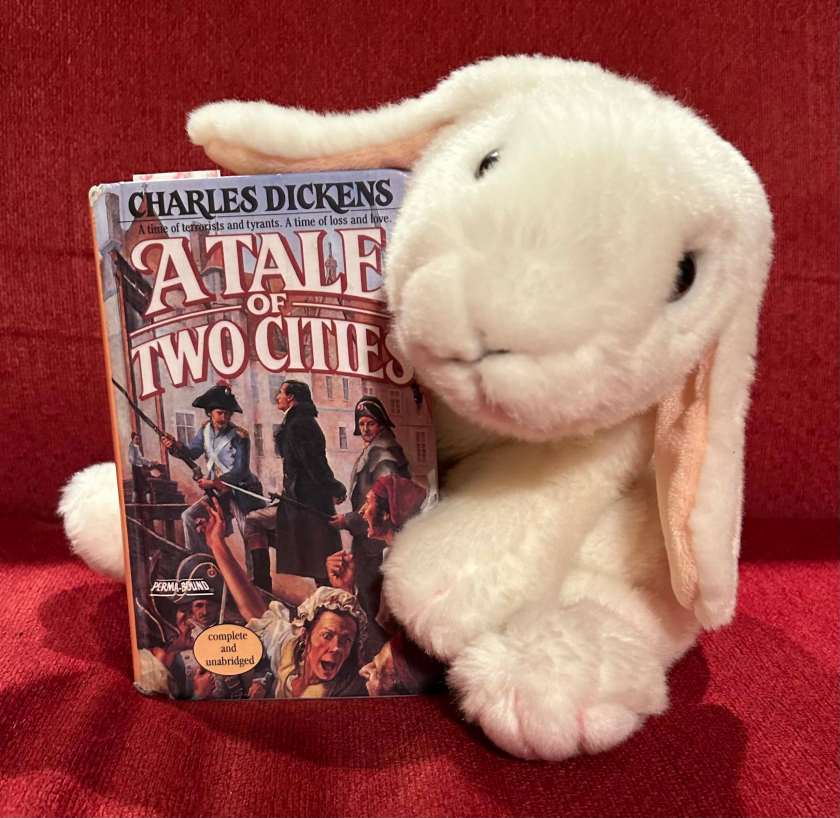
Marshmallow’s Quick Take: If you like historical fiction, famous books about the French Revolution, family, and fate, then this is the book for you!
Marshmallow’s Summary (with Spoilers): Set during the years 1775-1792 in London and Paris, this really is a tale of two cities. The book travels between London and Paris, with the French Revolution developing throughout and playing a major role in the storyline.
The book begins with the introduction of both places and the presentation of the plot: Lucie Manette, a seventeen year old French girl living in London, learns from a banker named Mr. Jarvis Lorry that her father Dr. Manette is alive after being imprisoned for eighteen years in the Bastille. She believed him to be dead, but after this shocking revelation, sets out with Mr. Lorry to Paris to find him. They discover that, upon his release, Dr. Manette was taken in by his old servant Monsieur Defarge and his wife Madame Defarge. We learn that Dr. Manette has been driven insane by his time in the Bastille, obsessively making shoes to cope. But Lucie’s love and faithful devotion begins to heal him back to himself. They all travel back to London, and he recovers over the next five years.
Then, in 1780 in London, another character named Charles Darnay is put on trial for treason against England (being a spy). Lucie and her father are called to testify against him. Two witnesses (both English spies) testify against him as well, but Lucie’s pity for Charles begins to sway the jury in his favor. After Sydney Carton, one of Charles’ defense lawyers, points out the striking resemblance between himself and his client, the verdict of not guilty is declared and Charles Darnay and both of his defense lawyers become close family friends of the Manettes and Mr. Lorry.
Sydney Carton is a drunken, unstable man who is subservient to the other defense lawyer. For reasons unknown, he seems to have given up on himself and his potential, wasting away his talents, believing that he is worthless and lacks any ability to be good. The other defense lawyer is Mr. Stryver, an overly-ambitious man whose only goal is furthering his own status in the world.
Mr. Stryver, Carton, and Charles Darnay all begin to fall in love with Lucie, but all in different ways and for different reasons. Mr. Stryver believes that she fulfills his social expectations for a wife and would be beneficial for his life goals, while Carton loves her for being the only person who believes that he has the possibility of good within him (when he himself doesn’t believe so). Mr. Stryver plans to propose, but decides not to after Mr. Lorry (in a very passive-aggressive fashion) tells him that he would be rejected. Carton confesses his love to Lucie (who cares for him in a motherly way), but tells her that he knows she cannot and should not love a man like him who has given up on everything: life, love, himself, and the world; he swears to protect her and everyone she loves when the time comes. But in the end, it is Charles Darnay who wins Lucie’s hand in marriage. He fell for her because of her compassion for him while on trial, her deep love and dedication to her father, and her beauty. After getting her father’s blessing, the two get married.
Charles wants to tell Dr. Manette his real last name before the marriage, but is told by Dr. Manette himself to wait till the wedding day. On that day, Charles in true honesty informs Dr. Manette that he is an Evrémonde, an aristocratic family from France. As a result, Dr. Manette relapses back into his old insanity right after the couple leaves for their honeymoon. Mr. Lorry helps Dr. Manette return to himself before the couple return and the breakdown is kept secret from Lucie.
In 1789, in France, the Defarges lead the famous Storming of the Bastille, and Monsieur Defarge finds a note written by Dr. Manette hidden in his old cell. The French Revolution is becoming increasingly bloody and aristocrats like Marquis St. Evrémonde (Charles’ uncle) are being slaughtered for their past insensitivity and cruelty towards the impoverished. One of the Marquis’ servants is put on trial and sends a letter to Charles (in London), asking for his help. After leaving letters of explanation, Charles secretly leaves his family in London to return to France. He is captured and put on trial, essentially for being an aristocrat, despite the fact that he denounced his family’s immoral behavior and fled from France to London to escape his name Evrémonde.
Mr. Lorry, on business in Paris, unexpectedly meets Lucie and Dr. Manette who came to France right when they read Charles’ letters. Dr. Manette, a former Bastille prisoner and thus a hero of the Revolution, uses his influence to get Charles a trial. But with the revolutionary bloodlust unquenchable, nothing can save Charles from La Guillotine, except for an act of true love.
Marshmallow’s Review: A Tale of Two Cities is an amazing book. It’s really hard to read in the beginning, but after the first couple of chapters, it gets pretty easy to understand. Dickens uses a lot of old language so it is difficult by today’s standards. But I’ve never read a book that has completely changed my view of the world to such an extent.
This book is amazingly written because its plot is touching and exciting, but it also shows the development and the impacts of the French Revolution, a chilling period of human history. Dickens shows us our fragility, through Dr. Manette’s insanity, and the violence that we create when others have wronged us. But Dickens also shows our graces: Lucie’s never-ending compassion, faith, love, kindness, and devotion to others.
I chose to read this book for an English unit, and I’m so glad I did because this book is absolutely beautiful; it is truly a masterpiece. The world the author shows us immerses you as you read and shows you glimmers of a past far behind. However, the past is sometimes the clearest mirror. Throughout this book, the most poignant message I uncovered was this: when destiny mercilessly takes what one loves, those who were hurt can lose their mercy too. This is how the frenzied violence of the French Revolution occurred: the horrific treatment of the lower classes by the elites made the Revolutionaries utterly empty of empathy for the aristocrats when La Guillotine (as they referred to it) descended. The world’s harshness hardens humanity which turns into (perhaps righteous) hatred, something we still see today.
This disturbing reality of human nature is so profoundly portrayed by Dickens that this story is uniquely compelling in a way like no other. A Tale of Two Cities really made me reflect on us and our society as a whole. When we break one another, the broken become capable of breaking others without feeling empathy and perhaps it’s not completely their fault. But if humanity is to become better, if we are to avoid another bloodbath like the French Revolution, if our world is to become brighter and more prosperous for all, we need to learn to fix each other’s humanity, not break one another apart till we become capable of inhumanity. I might just be a bunny, but this book makes it obvious for all.
Marshmallow’s Rating: 110%.
 BookBunnies