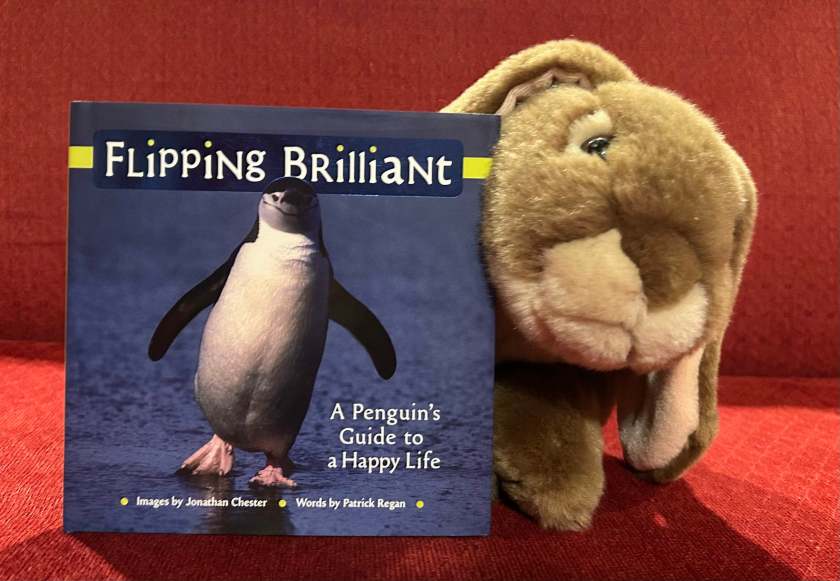
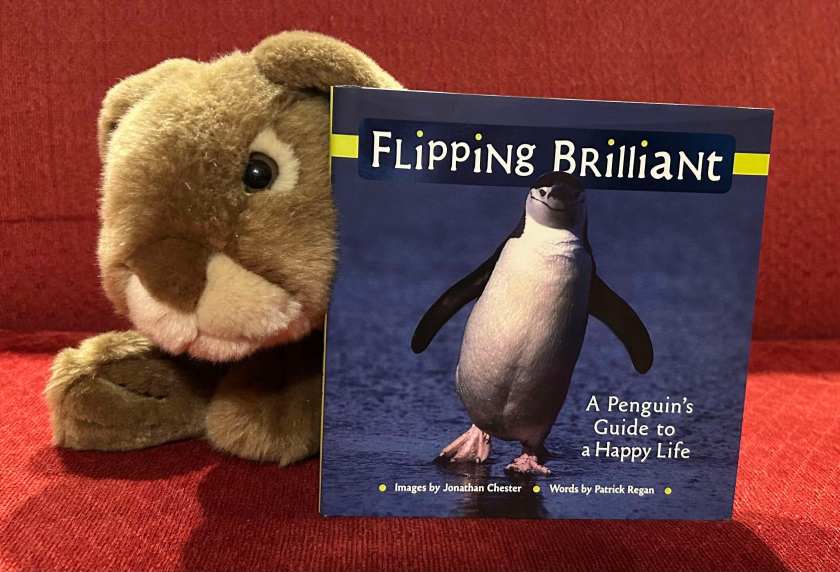
Inspired by Marshmallow’s first book for the new season, Caramel decided to start his reviews with Flipping Brilliant: A Penguin’s Guide to a Happy Life, first published in 2008. The book brings together nature photographer Jonathan Chester’s images with accompanying text by Patrick Regan. As usual, Sprinkles is taking notes and asking followup questions.
Caramel reviews Flipping Brilliant: A Penguin’s Guide to a Happy Life by Jonathan Chester and Patrick Regan.
Sprinkles: So Caramel, I am glad you chose to talk about this book today, even though it may not be completely targeting a young audience.
Caramel: Yes, Marshmallow talked about an advice book, so I thought this would work well to follow it. And also because it is a really short book. Only fifty-nine pages!
S: That is short! And actually the book does not have much text in it.
C: Yep. Basically 39 out of 59 are all just photos of penguins.
S: Did you just count that?
C: No. But I am approximating. A lot of the pages are full of penguin photos and there are some words sprinkled here and there that match them.
S: I see. So there are some cool photos by the photographer, Jonathan Chester, and then the other person, Patrick Regan adds some pithy statement to each photo that makes sense.
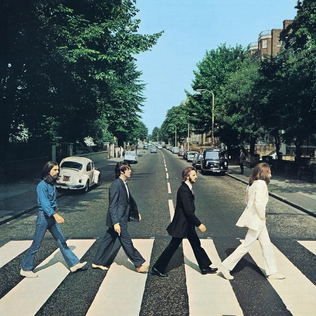
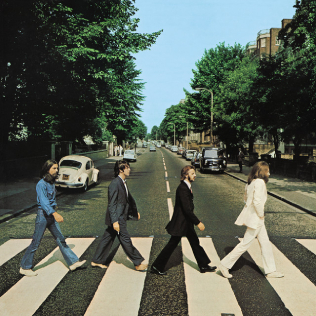
C: Yes for example one of my favorites is a photo of four penguins walking in a line. This is on page 57. They look really funny. They look like the Beatles. Remember how they were crossing the street?
S: Yes, here it is:
Image from Beatles album Abbey Road, obtained from Wikipedia, under fair use conditions.
C: Yes, so the four penguins look just like that! And the words next to the penguins say:
“Be an original. There have been countless imitators, but there is a reason the Beatles will never be forgotten. Find your own road.”
S: That is cool Caramel!
C: Yes I agree!
Caramel is reading Flipping Brilliant: A Penguin’s Guide to a Happy Life by Jonathan Chester and Patrick Regan.
S: I think there are some notes about each of the photos in the back of the book. Right?
C: Yep. For my four penguins it says: “King penguins, Falkland Islands. King penguins, true to their name, comport themselves in a regal fashion. Their stateliness, beautiful mating ritual, and gregariousness make them a delight to observe.”
S: That is neat! So you get to learn the type of penguin in the picture and also where the photo was actually taken.
C: Yes. And a little fact about the penguins too. And you know I love my facts!
S: I do! But when I first saw you read this book, I thought it was going to be something like Penguins Hate Stuff, which you reviewed a long time ago.
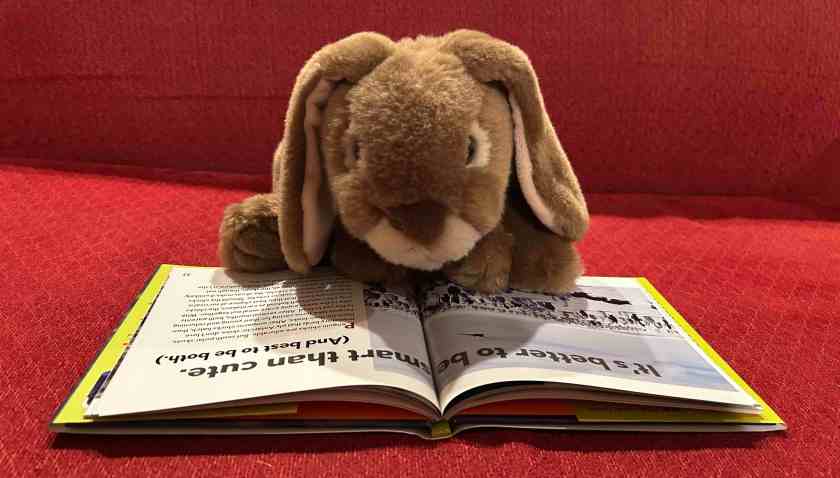
C: Yeah, that was a good book, too. But that was mostly funny. And the images were hand-drawn. Here the images are real, and the words say meaningful stuff. But of course I can laugh at them too. For example, there is one which says “It’s better to be smart than cute. (And best to be both.)” And that is kind of funny!
S: But it is also true. You are both smart and cute. So it applies to you!
C: Hmm, I don’t know how to respond to that without sounding too full of myself or too humble.
S: Okay, you do not have to say anything.
C: Okay, so maybe we can say we are done with the post?
S: Sure. Let us wrap it up then. What would you like to say to our readers?
C: Stay tuned for more book bunny reviews!
Caramel enjoyed reading Flipping Brilliant: A Penguin’s Guide to a Happy Life by Jonathan Chester and Patrick Regan and recommends it to all little bunnies who love penguins. (After all, penguins are among the cutest animals, besides bunnies.)
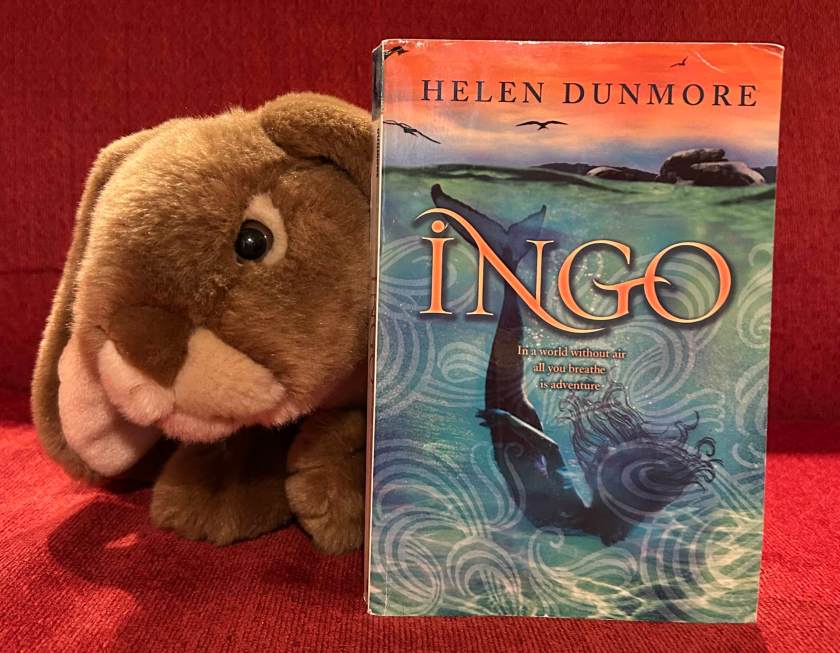
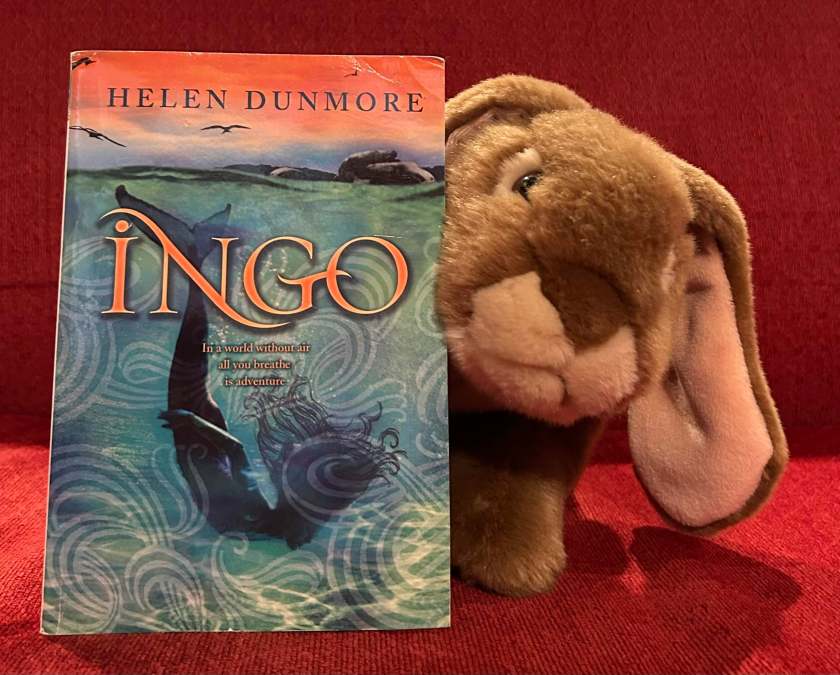
As his last review before the book bunnies take off for the summer, Caramel chose Ingo by Helen Dunmore, originally published in 2005. As usual, Sprinkles is taking notes and asking questions.
Caramel reviews Ingo by Helen Dunmore.
Sprinkles: So Caramel, as we are getting ready to take off for the summer, you chose to talk about a book about the ocean.
Caramel: Yes. Ingo is about the ocean, that is true. But it is also about a lot more.
S: Tell me.
C: It is about a girl named Sapphire. Her father “mysteriously vanishes into the waves off the Cornwall coast where her family has always lived.” At least that is what the back of the book says.
S: Hmm, I thought you read the book.
C: I did. I thought it would be quicker to use the book’s own summary.
S: I guess that makes sense. But so her father disappears into the waves, does that mean he goes off swimming and does not come back?
C: Yes, almost. He goes sailing and does not come back. But before he disappears, he tells Sapphire about these people of the sea called the mer.
S: Like mermaids?
C: Yes, but they are called the mer, and they hate being called mermaids. They think the humans’ way of thinking about mermaids is silly.
S: That is interesting. I think there were some wild merpeople in one of the Harry Potter books.
C: Yeah I think you are right. In Harry Potter and the Goblet of Fire, there were merpeople too. But those were kind of vicious and almost evil. These mer are a lot less vicious and evil.
S: There were also some mer people in another book, one that you read, I think?
C: Yes. She goes looking for her dad and meets some mer. Before that, her brother Conor disappears for hours and does not remember what happened, or so he claims. It turns out that he was meeting with the mer. Conor and Sapphire make friends with two mer children, Faro and Elvira, who help them when some people get into trouble.
S: So the book is about Sapphire discovering the world of the mer and maybe finding her dad?
C: Well, she does not find her dad in this book. Apparently there are four other books after this one, and maybe she will find him, but in this book, she does learn about the mer and their world. It is called Ingo.
S: Oh, that is why the book is titled Ingo!
C: Yup. Ingo is the name of the underwater world that the mer live in.
S: That is interesting Caramel. So did you enjoy this book?
C: Yes. I even want to read the next four books.
S: I see. That is a good sign.
C: Yep, I’d say so!
S: Okay, so would you recommend this book to other young bunnies?
C: Yes! It is fun to imagine other worlds under the sea!
S: Cool! Okay, maybe this is a good time to wrap up this review, which is your last one before our summer break. What would you like to tell our readers Caramel?
C: Have a great summer and stay tuned for more book bunny reviews! We will be back in August with new books!
Caramel enjoyed reading Ingo by Helen Dunmore and recommends it to all little bunnies looking for an intriguing summer read.
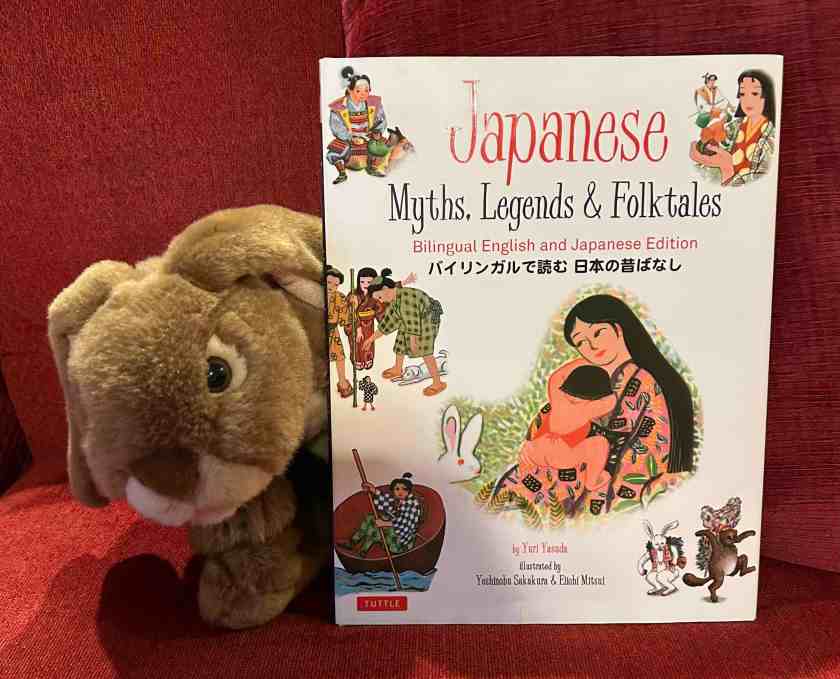
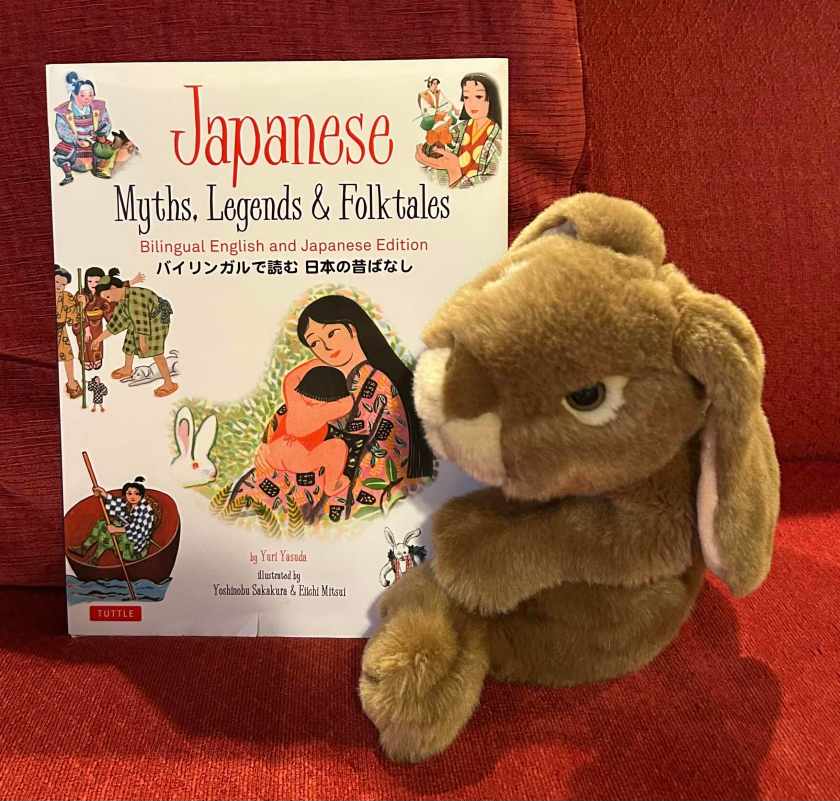
Last summer Caramel read several books on Asian myths and legends. Today he is talking to Sprinkles about one of these: Japanese Myths, Legends and Folktales: Bilingual English and Japanese Edition, written by Yuri Yasuda, illustrated by Yoshinobu Sakakura and Eiichi Mitsui, and published in 2019.
Caramel reviews Japanese Myths, Legends, and Folktales by Yuri Yasuda.
Sprinkles: So Caramel, this is one of your last reviews before we take off for the summer. What do you want to talk about today?
Caramel: It’s this book on Japanese myths and legends. I like all of the nice stories, and the pictures. The colors are nice.
S: You are right, there are a lot of illustrations in this book. Each page has at least one. And they are very stylized. That is, they all kind of fit in one style, they resemble one another in some ways.
C: That makes sense though. It is all the same people who drew them. So it makes sense they would look like one another.
S: True.
C: And they are all very colorful and they use some really cool drawing techniques!
S: That is a good observation Caramel! I agree with you! Now tell me a bit more about the stories.
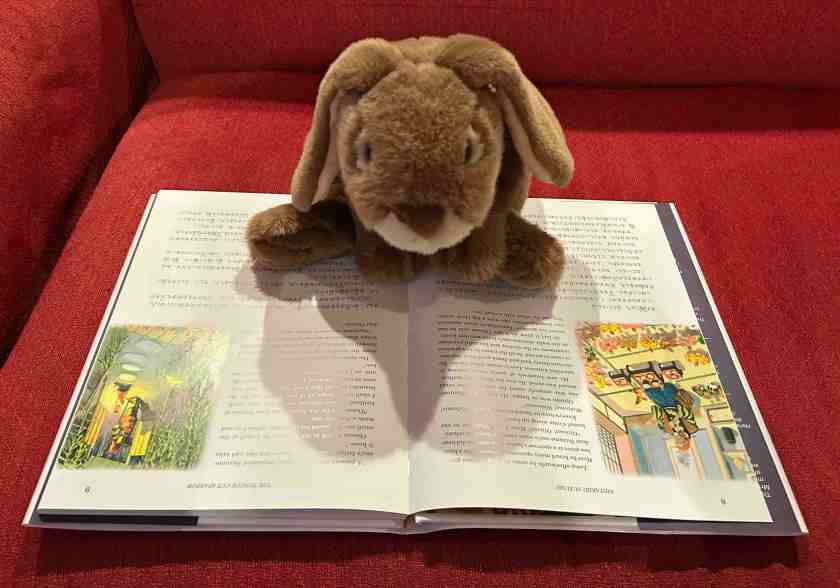
C: There are twelve stories. Each of them takes about three to five pages, usually below ten. On each page there is a picture or two, and then the top of the page is in English. And in the second half of the page the story is in Japanese.
S: Oh, part of the book is in Japanese then! I guess it makes sense: the book is subtitled “The Bilingual Edition” after all.
C: Well, actually, it’s called, “Bilingual English and Japanese Edition”.
S: Thank you for the correction Caramel. That makes total sense. But you don’t know how to read in Japanese. Was that okay?
C: Well, I don’t know how to read in Japanese YET. But yes, it was more than okay. It was cool to see the difference in the writing. Japanese people use a different alphabet than us. Or rather three different writing systems. I looked it up. There is a long Wikipedia article about it. And we tried to learn a bit of Japanese last summer. It is hard but it is also a lot of fun. I loved using the brush pens!
S: Yes, that was a lot of fun! And you are so right in saying that you don’t know it YET. You are still such a young bunny, maybe you will learn it at some point.
C: I hope so. I especially want to play more with the brush pens, mostly the pens.
S: Sounds like a plan to me!
Caramel is reading Japanese Myths, Legends, and Folktales by Yuri Yasuda.
S: Okay, so let us get back to the stories. You said there are twelve of them. So tell us a bit about a couple of them. Maybe your favorites?
C: I liked the first one, “The Tongue-Cut Sparrow”. It’s about a kind old man who finds an injured sparrow and saves it. One day as he is out doing something, the sparrow eats the house flour, so the old man’s wife cuts the sparrow’s tongue off as punishment, and the sparrow flies off. Then on another day, the old man goes walking, and he meets the sparrow again. The old man was always kind to the bird, so the sparrow offers him some gifts. The old man takes the smaller gift and walks home to find that it has money. But his wife is not a nice person and she is greedy too so she gets upset that her husband did not get the bigger gift. So the next day she takes off to find the sparrow and asks for the bigger gift. The sparrow gives her the bigger gift and tells her not to open it until she is home. But she does open it before she gets home, and the demons inside the box attack her. Finally the old kind man finds her and saves her and the wife apologizes for being mean and unkind and they all forgive each other and live happily ever after.
S: Hmm. What do you think the story means?
C: I think the moral of the story is that if you are given a gift, and told not to open it till home, then you should not open it till home.
S: I can see how that could be one of the messages you get. Anything else?
C: You should not be selfish or greedy? And ask for the bigger gift? Bigger is not always better.
S: That too could be a good lesson.
C: Yes, and maybe being kind is always a good thing? The old man was kind to the bird and he was rewarded for it even though he was not being kind to get a reward.
S: All true. Very good Caramel! I like these messages! And apparently this is a well-known story. There is even a Wikipedia article on it.
C: I am not surprised. The book is supposed to be about myths and legends, and those are probably all well known.
S: You do have a good point there Caramel. Can you tell us the names of some of the other stories?
C: Here is the full list: The Strong Boy, The Marriage of a Mouse, The Fisherman and the Tortoise, The Luminous Princess, The Peach Boy, The Kachi Kachi Mountain, The Old Man With Wens, The Old Man Who Made Trees Blossom, The One-Inch Boy, The Lucky Cauldron, and The Monkey-and-Crab Fight.
S: What is that last one about?
C: There is a crab who wants some peaches and asks for help from a monkey but the monkey cheats him and steals all the peaches.
S: So these stories are somewhat different from the fairy tales you grew up with, right?
C: Yes very much so. There are lessons to learn in these too, but sometimes the lessons are a bit harder to see.
S: Maybe because we did not grow up in Japan, the cultural context is not as transparent to us.
C: Maybe. But I really liked these stories. They are all somewhat different but also very interesting. Kind of surprising and definitely fun to read.
S: So I am guessing you would not mind it if other young bunnies read this book too?
C: Mind it? Of course not. In fact I would say they should read it. And maybe also look at the pictures and also the Japanese text below. I will learn how to read it one day, hopefully.
S: Sounds like a good goal, Caramel. Okay, this is a good time to wrap up this review. What do you want to tell our readers?
C: Stay tuned for more book bunny reviews!
Caramel enjoyed reading Japanese Myths, Legends, and Folktales by Yuri Yasuda and recommends it to all curious little bunnies who want to learn about the many different stories young bunnies around the world grow up with.
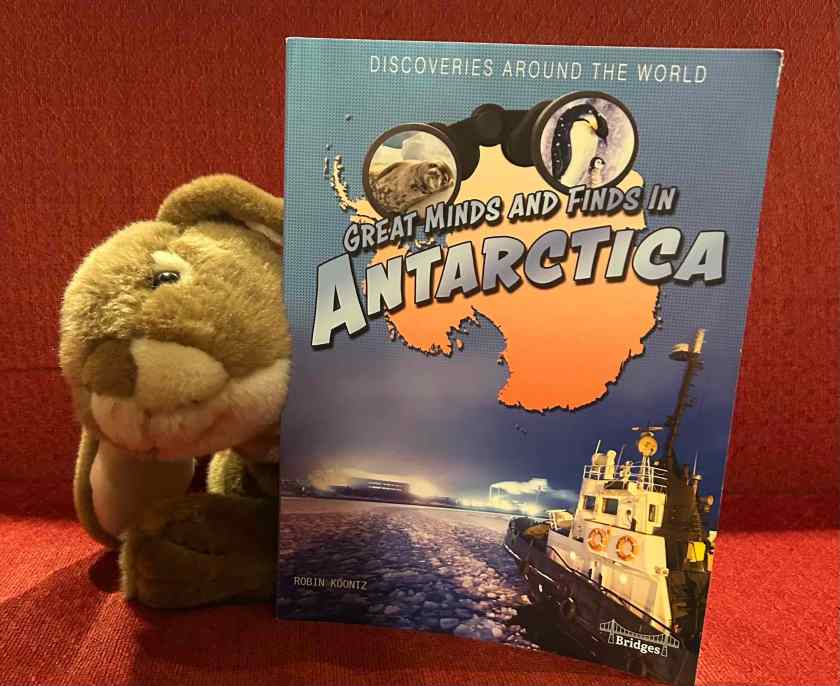
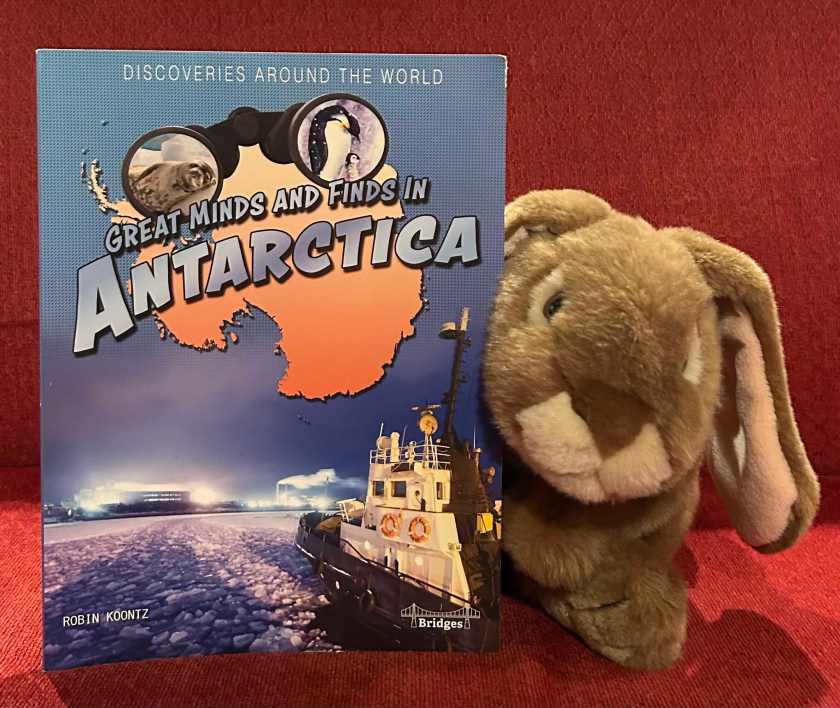
Today Caramel is talking to Sprinkles about Great Minds and Finds in Antarctica by Robin Koontz, first published in 2021.
Caramel reviews Great Minds and Finds in Antarctica by Robin Koontz.
Sprinkles: So Caramel, what do you have for us today?
Caramel: We have a book about the coolest place in the world.
S: And where would that be?
C: Antarctica!
S: Oh I think you were being a bit punny, weren’t you?
C: Yep, I was. Antarctica is cool because it is interesting, but also it is very very very cold, so doubly cool!
S: I like that! So okay, the book is about Antarctica. So it is a book of facts, right?
C: Yep, it’s mostly facts, my favorite.
S: Yay! So what was a fun fact you learned in this book?
C: I learned that in Antarctica, they have this thing called the Antarctic hair grass.
S: What’s that?
C: It’s a type of grass, and I find it cool because they look like a person’s hair if it was green..
S: I guess that is why they are called hair grass. Wikipedia says they are one of only two species of flowering plants native to Antarctica.
C: That is cool too!
S: What else did you learn from the book?
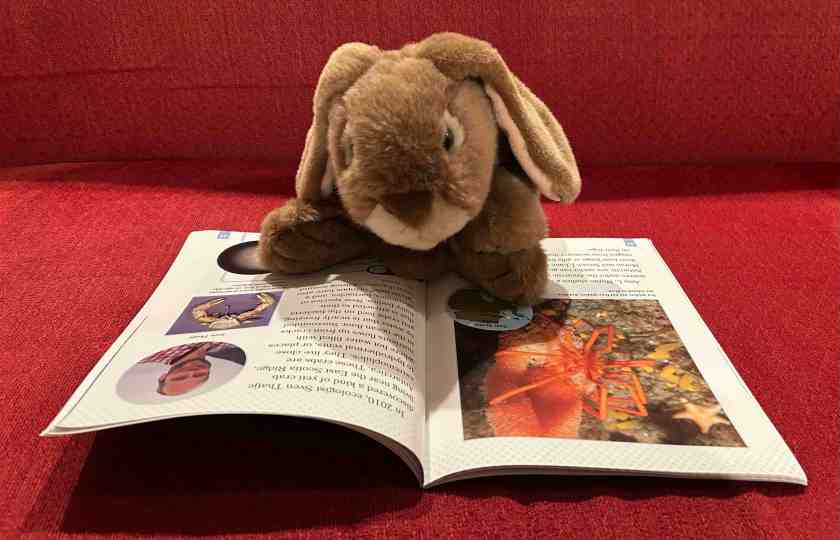
C: Many many things. For example, some really cool animals live in Antarctica, like the yeti crab, which has hairy arms.
S: I knew that some penguins lived there, but I did not know about the yeti crabs. They do look weird!
C: A lot of other weird things live there, too. Another one is the skua. It is a bird, looks kind of like a pigeon.
S: I did not know about the skua either! Apparently, it is kind of a vicious bird. It kills penguin babies.
C: Oh, yeah, that’s not cool. They are predators and so are very aggressive. But they too have their own predators. It is a wild world out there.
Caramel is reading Great Minds and Finds in Antarctica by Robin Koontz.
S: Agreed. So let us get back to the book itself. Is the book a random collection of facts about Antarctica or is there some sort of an organization?
C: Well, there are chapters, and many of them are really cool. For example, the first one is: “Where in the World is Antarctica?”
S: That makes sense, to start with the geographic location.
C: Yes. Then there is the second chapter, called “Giant Ice and Extreme Life”. There is a chapter on “Ancient Remains”, a chapter called “A Mysterious Continent”, another called “Protecting Icy Life”. The others are called “Life Underwater”, “Changing Climate”, and “Amazing Antarctica”.
S: That sounds like a good spread of topics. But I am curious. What is “A Mysterious Continent” about?
C: It is about how the first European people to explore Antarctica thought it was haunted, because of the cold.
S: That is interesting. So kind of like a brief history of its discovery. Is the chapter “Ancient Remains” also about history then?
C: Yes, but it is even more ancient history, like the animals frozen in the ice from many centuries ago.
S: That is cool! Okay so it seems like this was a good book for you, with so many facts. Did you know that the same author has several other books in this same series called “Discoveries Around the World”, and the whole series has one book for each continent?
C: Oh, I didn’t know that! Maybe we can read some of those other books, too.
S: Yeah, I will see if we can get a hold of any of the others. It is kind of nice to think about the world in terms of its continents. Not countries and national borders and such but purely geographical and physical borders.
C: Yep, isn’t it cool? That is how we bunnies see the world. Maybe humans could too, one day.
S: Oh Caramel! How I wish! Okay, so last question about the book. It looks like a very colorful one with lots of pictures. Can you tell us a bit about the pictures? Are they hand-drawn illustrations or photographs or maps?
C: They are mostly pictures, but they have some drawings, too. They are, as you said, all very colorful. And I thought they were informative. I learned a lot.
S: What more could one ask of a book? Thanks Caramel. I think we have enough for a post. Let us wrap this up.
C: Okay. I can always go and read another book.
S: Sure. So what do you want to tell our readers as we wrap it up?
C: Stay tuned for more book bunny reviews!
Caramel enjoyed reading Great Minds and Finds in Antarctica by Robin Koontz and recommends it to all little bunnies who are curious about the world.
 BookBunnies