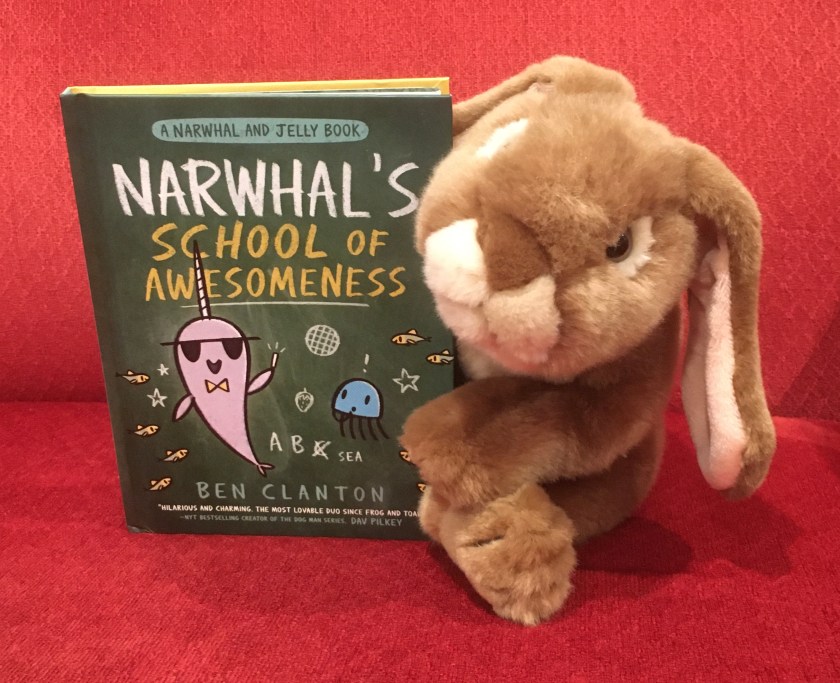
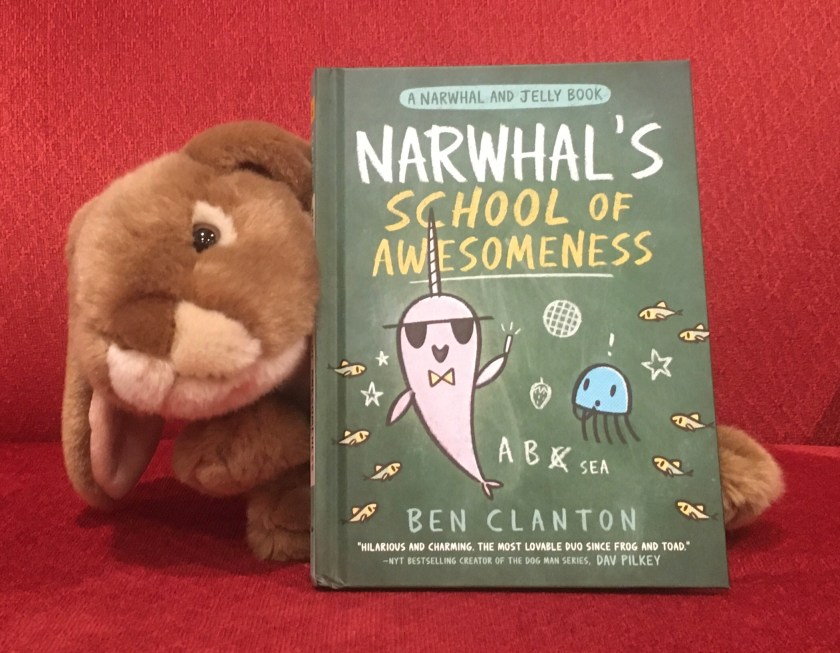
Caramel reviews Narwhal’s School of Awesomeness by Ben Clanton.
Sprinkles: So you must be feeling pretty good having gotten your paws on yet another Narwhal and Jelly adventure!
Caramel: Yup! It is fin-tastic to be reading about these two once again.
S: I see what you did there! Fin-tastic is one of those words Clanton uses, created by slightly changing a word to have ocean-life connotations.
C: Yep yep yep.
S: So will you tell us anything about the book?
C: Narwhal and Jelly are back and Narwhal becomes a teacher.
S: How does he do that?
C: Well, one of the fish school teachers is sick, and so he goes home, and then Narwhal takes over the school. He’s not told to do it, but he just does it himself.
S: So he just decides to be a teacher and gets going, right? That’s interesting.
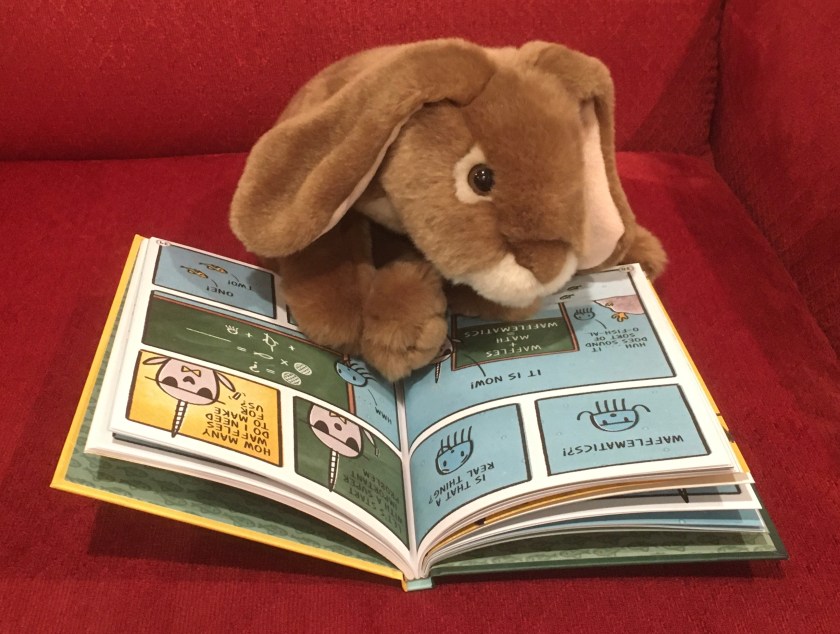
C: Yes. And what’s more interesting is what he teaches. He teaches wafflematics, which is math + waffles.
S: That sounds deliciously nerdy!
C: Yes. And there are other classes, mostly fake classes of course. Narwhal does not know a lot, because I think he is young, kind of like me, so he is making things up as he goes along.
Caramel is reading Narwhal’s School of Awesomeness by Ben Clanton, when Narwhal is explaining what wafflematics is.
S: But there are still a lot of real facts in the book, right? Like in the earlier Narwhal and Jelly books?
C: Yes, and you know I love my facts.
S: I know you do. So did you learn anything new from this book?
C: Yes. Did you know what a group of snails is called?
S: No.
C: It’s called a walk. And a group of sharks is called a shiver.
S: I did not know any of those.
C: Yes, and then there is a picture of a hammerhead shark and he is really funny, talking like a pirate…
S: So the books are factful and funny again, right?
C: Yes! At some point Narwhal says “This is what I’m chalking about!” You see, talking becomes chalking because he is now a teacher?
S: Yes, I see. I’m glad you are enjoying this book just as much as you did the earlier ones.
C: <giggles> Wait, what? Sorry, I was reading the book again.
S: Okay, maybe we will end the review so you can get back to the book once more. But before that, tell me a third word to describe the book. You already have factful and funny.
C: Colorful. Because the book is very colorful. They are adorable fishies and I love them!
S: That is so cool that you liked this book so much!
C: Yes. It is o-fish-ally awesome!
S: Okay, then why don’t we wrap it up? What do you want to tell our readers?
C: Stay tuned for more book bunny reviews!
Caramel loved reading Narwhal’s School of Awesomeness by Ben Clanton, and reconnecting with old friends Narwhal and Jelly.
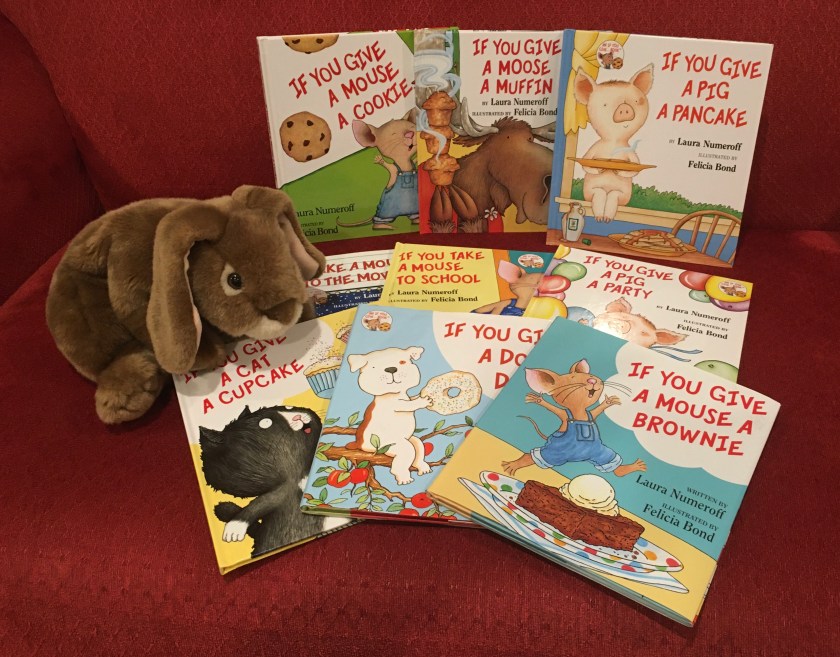
Caramel reviews If You Give a Mouse a Cookie (1985), If You Give a Moose a Muffin (1991), If You Give a Pig a Pancake (1998), If You Take a Mouse to the Movies (2000), If You Take a Mouse to School (2002), If You Give a Pig a Party (2004), If You Give a Cat a Cupcake (2008), If You Give a Dog a Donut (2011), and If You Give a Mouse a Brownie (2016), all written by Laura Numeroff and illustrated by Felicia Bond.
Sprinkles: So Caramel you wanted to talk about some of your old favorites again.
Caramel: Yup.
S: So how would you like to start this review?
C: From the beginning. With the first book. This is called If You Give A Mouse A Cookie. It’s about a mouse, a cookie, and a boy who is really nice and gives the mouse a cookie. Then the mouse asks for a glass of milk, then a straw, then a napkin, then a look in the mirror to see if he has a milk mustache…
S: Okay, I get it. So the boy gives the mouse something, and then that leads to another wish, and then pretty soon …
C: It goes all the way from a cookie to a lot of mess and lots of action, and in the end the mouse will get thirsty and want milk, and then another cookie. And you are back to the beginning of the story.
S: Ooh, that is neat. Kind of a circular story, but also seeing all sorts of consequences of just one little action.
C: Yep.
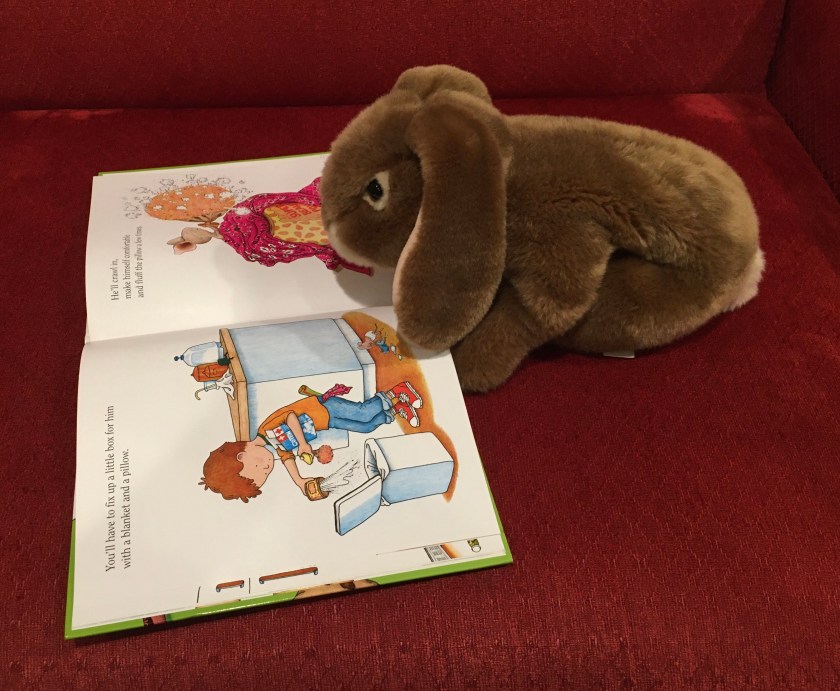
Caramel is reading If You Give a Mouse a Cookie (1985), written by Laura Numeroff and illustrated by Felicia Bond.
S: So tell me more. What do you like about this book?
C: The illustrations are great! The mouse is sitting beside the milk glass in one picture, and he is so full, with a ginormous tummy. The cookie and the milk must be bigger than him all together, so no wonder he is exhausted.
S: That is funny!
C: The whole story is hilarious. I love it! And it all starts with a little boy giving a little mouse a little cookie.
S: That is really cool. Okay, so there are several other books in this series. You have read nine of them, right?
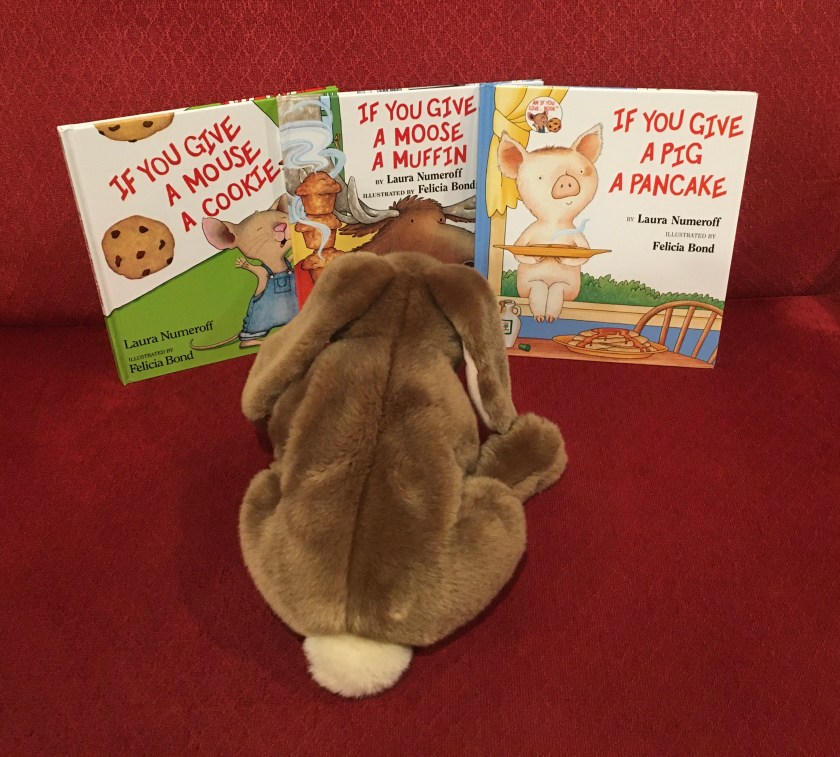
C: Yes. The second book I read is called If You Give A Moose A Muffin, and the third is If You Give A Pig A Pancake. And those books are about what the titles say. In the one about the moose, a boy gives the moose a muffin, and then a lot of things happen, including a puppet show, and blackberry jam, and so on. The one about the pig involves a girl giving a pancake to a pig, and then pancakes, a dancing pig, building a tree house, putting up wallpaper on that tree house, and many other things.
S: So a lot happens in each of the stories, when the child in question gives the animal in question something they want?
C: Yes. And in the end somehow we always come back to the beginning. So the moose ends up wanting a muffin again and the pig wants a pancake once more.
S: That is really cool. The author must be thinking very carefully and creatively about how to build that chain of events in a way that brings us all back to the beginning somehow.
C: Yes. No matter what, the books always end at the place they started. That is neat!
S: I agree.
Caramel is looking at If You Give a Mouse a Cookie (1985), If You Give a Moose a Muffin (1991), and If You Give a Pig a Pancake (1998), all written by Laura Numeroff and illustrated by Felicia Bond.
S: Tell me about some of the other books.
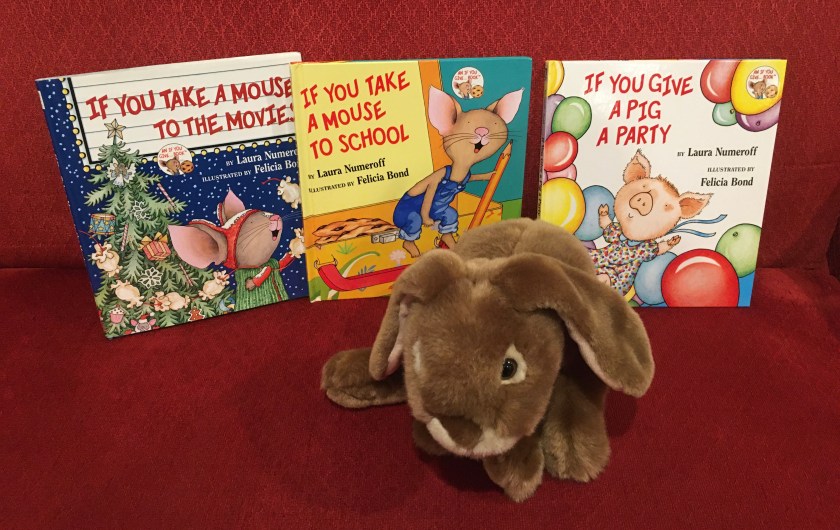
C: The next thee books are If You Take a Mouse to the Movies, If You Take a Mouse to School, and If You Give a Pig a Party. So you can already tell that one of them is about a boy taking a mouse to the movies, and it is probably the same boy from the first book, and the same mouse. And in the next book the same boy takes the same mouse to school. And a lot of fun and messy things happen at school because of that. The pig and the girl in the last book, If You Give a Pig a Party, are also the same pig and the girl from If You Give A Pig A Pancake. I like that we see the same characters.
S: Well, you couldn’t really tell they are the same if you did not have the illustrations.
C: Yes, but the pictures are the same. And so I know they are the same people and same animals. And so the pictures tell a lot of the story. I like that too.
Caramel poses in front of If You Take a Mouse to the Movies (2000), If You Take a Mouse to School (2002), and If You Give a Pig a Party (2004), all written by Laura Numeroff and illustrated by Felicia Bond.
S: But then the seventh and the eighth books introduce new animals, right?
C: Right. The seventh book is If You Give A Cat A Cupcake, and it has a cat in it. There is a girl who gives the cat a cupcake and then the cat takes off and takes a karate class, and goes on a merry-go-round and visits a science museum, and so on.
S: You like doing those things!
C: Yes. I love going to the science museum, but we have not done it for a while. And we have not been to the beach for a while either.
S: That is true. So these animals are all doing all sorts of active and fun things, right?
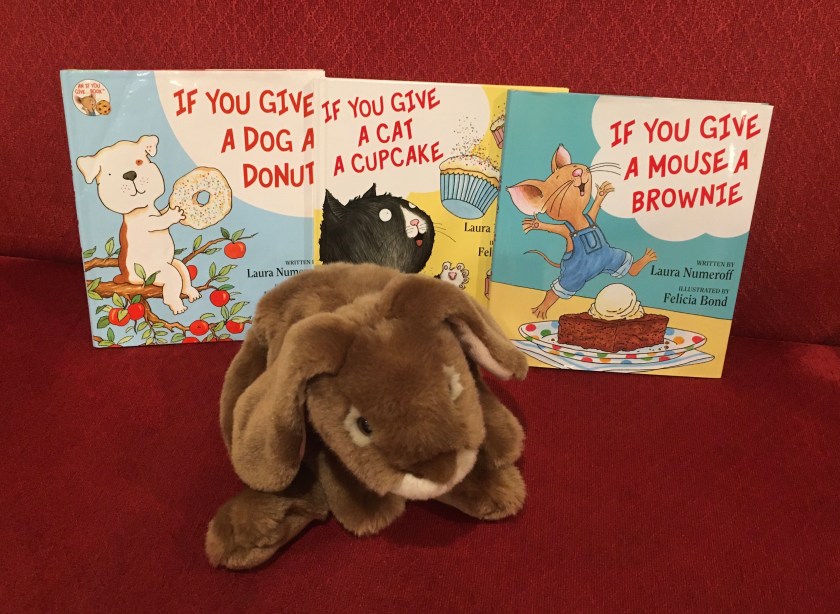
C: Yes, in the next book, called If You Give A Dog A Donut, there is a dog who wants a donut, and then he gets one from a boy, who is not the boy from any of the other books I think. Then the dog goes picking apples, playing baseball, doing a happy dance, and having a water fight.
S: All fun!
C: Yep. And finally the last book is the mouse again, and he wants a brownie.
S: And let me guess, it is titled If You Give A Mouse A Brownie.
C: Yep. And it starts and ends with the brownie. And it is again hilarious.
Caramel is showing the readers If You Give a Cat a Cupcake (2008), If You Give a Dog a Donut (2011), and If You Give a Mouse a Brownie (2016), all written by Laura Numeroff and illustrated by Felicia Bond.
S: So I think I know one of your three words to describe this series would be hilarious. What would be your remaining two words?
C: Circular, because they all end where they start, and great illustrations, because I love the pictures.
S: That sounds good. So apparently there are a few other books in this series, but we never read those. They do not start with “If You Give …” or “If You Take …” but the same mouse has adventures in each.
C: Oh well. At least we read all the “If You Give …” and “If You Take …” ones.
S: That’s true. And I think nine books are enough for this one review.
C: I agree.
S: So what do you want to tell our readers?
C: Stay tuned for more book bunny reviews!
Caramel has loved reading If You Give a Mouse a Cookie (1985), If You Give a Moose a Muffin (1991), If You Give a Pig a Pancake (1998), If You Take a Mouse to the Movies (2000), If You Take a Mouse to School (2002), If You Give a Pig a Party (2004), If You Give a Cat a Cupcake (2008), If You Give a Dog a Donut (2011), and If You Give a Mouse a Brownie (2016), all written by Laura Numeroff and illustrated by Felicia Bond, through the years, and recommends them to all little bunnies and their grownups who love reading with them.
Today Caramel wanted to review a book he discovered in his classroom library: N.E.R.D.S.: National Espionage, Rescue, and Defense Society, written by Michael Buckley. As usual Sprinkles is taking notes and asking questions.
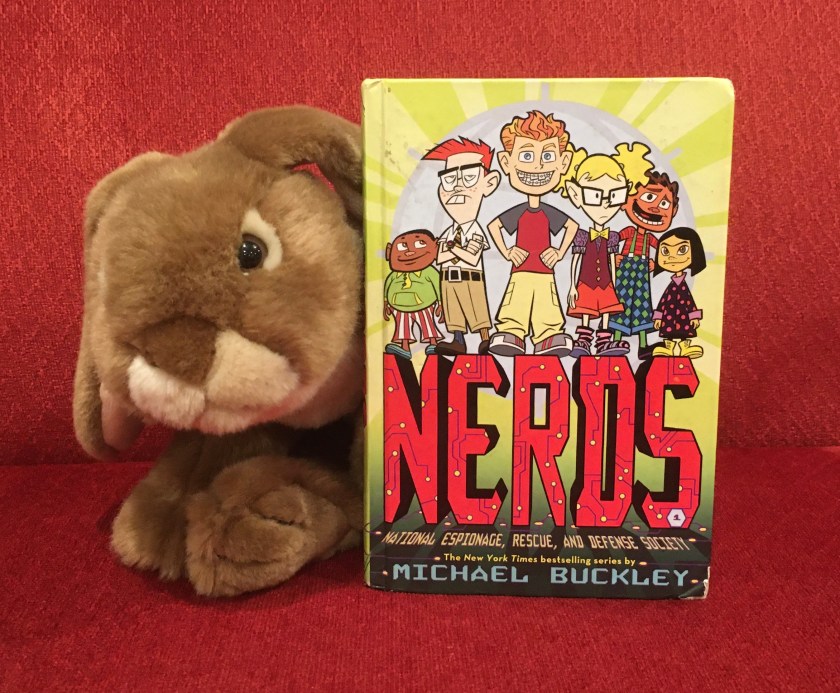
Caramel reviews N.E.R.D.S.: National Espionage, Rescue, and Defense Society, by Michael Buckley.
Sprinkles: So Caramel, tell me a bit about this book.
Caramel:The book is about a secret organization called N.E.R.D.S. It is an acronym, for National Espionage, Rescue, and Defense Society.
S: That’s a funny way to open up the word “nerds”. So this secret society, is it made up of children?
C: Yes, and they are all nerds.
S: What does that mean?
C: I think it means someone who is super-smart.
S: And sometimes it comes with connotations of socially awkward and inept, because people occasionally use the term in a derogatory way.
C: But the nerds in this book are pretty cool. They have super cool gadgets.
S: Ooh, that sounds interesting. Tell me more.
C: For example there is a character called Jackson Jones, who is wearing braces, but the braces can change into weapons and anything else he needs at the time. Then there is Duncan Dewey who can shoot glue out of his hands. He can also stick to walls and so can climb walls. He can also climb on the ceiling.
S: Those are some super cool tools and gadgets really. The characters seem to be nerdy but also kind of like superheroes, right?
C: Yes. And they solve crimes together.
S: But they are school children, aren’t they? How does this crime-fighting fit into their school lives?
C: There is a fire alarm that they set off and they sneak away without anyone noticing they are gone.
S: Hmm, not a very respectable thing to do, setting off an alarm like that, but maybe they are doing very important work. So tell me, what kinds of crimes do they fight?
C: They are fighting evil people, like people who kidnap scientists and so on. So in this book a few scientists have been kidnapped, and they try to get the scientists back.
S: Oooh, that sounds serious!
C: Yes it is.
Caramel is reading N.E.R.D.S.: National Espionage, Rescue, and Defense Society, by Michael Buckley.
S: So I saw you read this book really fast. There are lots of pictures in it, and I could see that the book could be appealing to you from how it started. Can you read the dedication page to our readers?
C: Okay, here it is:
For dorks, dweebs, geeks, spazzes, waste cases, and nerds everywhere. Some day you too will change the world.
S: So this book is written to inspire kids who see themselves as outcasts in a way.
C: I guess it could be. But it is also really really funny. And the mystery is very interesting.
S: I can tell you really enjoyed the book. Do you think you will read the next one in the series? Apparently there are a total of five books.
C: Yes. I want to read them all!
S: That’s very good. So tell me your three words to describe the book then, and we can wrap up this review.
C: Fun, funny, and adventurous.
S: That sounds neat! And what else do you want to tell our readers?
C: Stay tuned for more book bunny reviews!
Caramel enjoyed reading N.E.R.D.S.: National Espionage, Rescue, and Defense Society, by Michael Buckley, and is looking forward to reading the next book in the series.
A while back, Caramel inherited Marshmallow’s collection of Magic Tree House books and he has been going through them. (For his reviews of books in the series, see Night of the Ninjas (Magic Tree House #5), Afternoon on the Amazon (Magic Tree House #6), Sunset of the Sabertooth (Magic Tree House #7), Midnight on the Moon (Magic Tree House #8), Dolphins at Daybreak (Magic Tree House #9), Ghost Town at Sundown (Magic Tree House #10), and Lions at Lunchtime (Magic Tree House #11).) He has also been revisiting the accompanying Fact Tracker books. (For his reviews of some of the Fact Tracker books, see Knights and Castles (Magic Tree House Fact Tracker #2) and Sea Monsters (Magic Tree House Fact Tracker #17).) Today he decided to discuss the first ever Fact Tracker book in the series: Dinosaurs. As usual, Sprinkles is asking questions and taking notes.
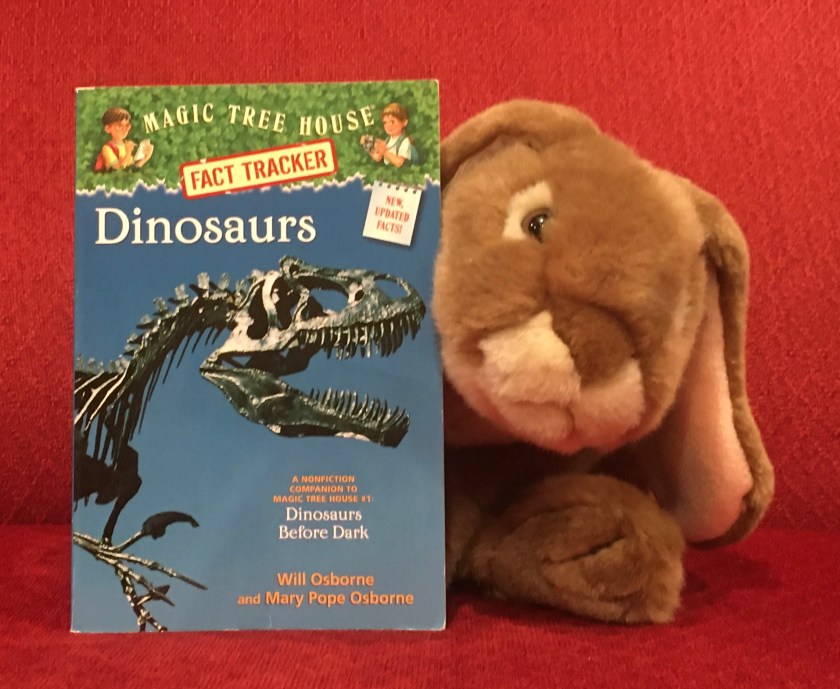
Caramel reviews Dinosaurs (Magic Tree House Fact Tracker #1) by Will Osborne and Mary Pope Osborne.
Sprinkles: Okay Caramel, tell me about this book.
Caramel: This is the first Fact Tracker book for the Magic Tree House books. It is supposed to be paired up with the first Magic Tree House book, Dinosaurs Before Dark.
S: Hmm, you did not review that book, but you did read it of course. Right?
C: Right. That was where we first met Jack and Annie, and learned about the magic tree house. In that book, Jack and Annie went back to the time of the dinosaurs.
S: And so this book is written to accompany that one for young bunnies like you who like to learn more facts about the topic of the book.
C: Yes, I always want to know more about dinosaurs and things.
S: Of course those latter ones were not really about dinosaurs though they did have a lot of pretty precise drawings. But let us get back to this Fact Tracker book.
the biggest C: Yeah. This book tells us everything humans know about dinosaurs. There are pages for Tyrannosaurus rex, and other meat eaters, and then there are pages and pages of information on plant eating dinosaurs like sauropods, triceratops, and ankylosauruses. Then there is a Hall of Fame. There are lists of the fastest, the biggest, and the ones with the biggest heads, biggest eyes, and the longest necks, and the longest names, and so on.
Caramel is reading about Tyrannosaurus Rex in Dinosaurs (Magic Tree House Fact Tracker #1) by Will Osborne and Mary Pope Osborne.
S: So even though you are a little bunny who already knew a lot about dinosaurs, you found new things to learn in this book, right?
C: Yep. For example, I learned more about the ankylosauruses. And I learned that the stegosaurus has a brain the size of a hot dog, so small for a dinosaur of that size.
S: So I know you often reread books you have read before. Do you think you will come back to this one again?
C: Yes. I love this book because it is about dinosaurs and I love dinosaurs. And I like the pictures! And sometimes, I forget some facts and then I can remember them when I read the book again.
S: So tell me more about the pictures?
C: They are black and white but very realistic. They are almost 3D, and there are some photographs. I love looking at them. My favorite is the ankylosaurus!
S: That is great Caramel. Tell me your three word summary of this book. Which three words would you use to describe it?
C: Informative, helpful, neat facts, and cool drawings.
S: Hmm, again that is a little bit more than three words, but it’s alright. So let us wrap up our review then. What do you want to tell our readers?
C: Stay tuned for more book bunny reviews!
Caramel enjoyed reading Dinosaurs (Magic Tree House Fact Tracker #1) by Will Osborne and Mary Pope Osborne, and expects he will be coming back to it for tidbits on dinosaurs many more times in the future.