Caramel reviews Glow Animals by K.C. Kelley

A few weeks ago, Caramel visited the book fair held in his school campus and picked a handful of nonfiction books for himself. A couple weeks ago, he reviewed two of them: Sea Bunnies by Kelly Hargrave and Hot Lava! Fiery Facts About Volcanoes by Alice Fewery. Today he talks about the third book he got from the book fair: Glow Animals by K.C. Kelley. As usual, Sprinkles is taking notes and asking questions.

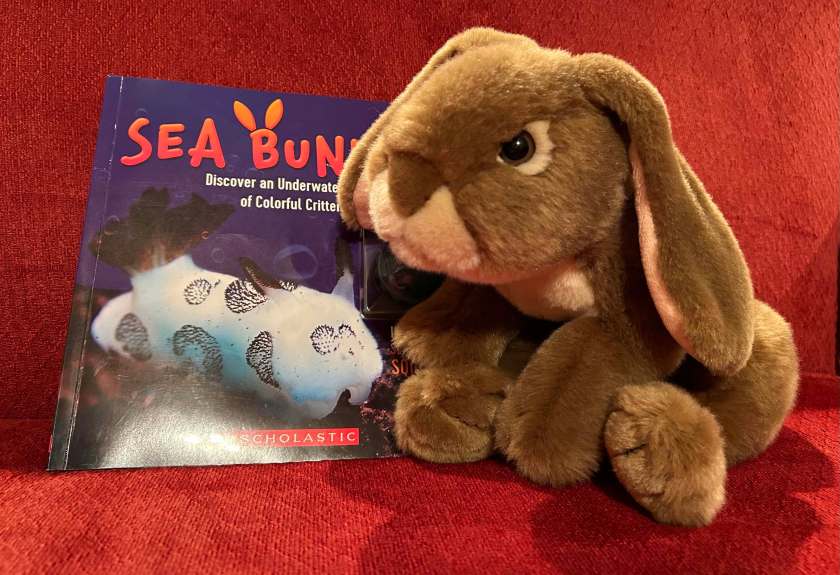
Caramel reviews Glow Animals by K.C. Kelley.

Sprinkles: Okay, Caramel. This is the third book from the book fair. Are you still happy you managed to get your paws in this one?

Caramel: Yes.

S: So tell us a bit about this book.

C: This book is about all sorts of animals that glow.

S: What does that mean?

C: It’s called bioluminescence.

S: That’s a big word for a little bunny.

C: Yep. I have all the words!

S: Okay, so tell me what bioluminescence means.

C: It’s animals and other living beings creating light somehow.

S: That is pretty fascinating stuff.

C: It is.

S: So what kinds of animals do we meet in this book?

C: For one, my new amazing squishy friend Jellyfish. He is bioluminescent. Like about 50% of all jellyfish. I learned that from this website of a lab at the University of California San Diego.

S: That’s interesting! Do you know how jellyfish make their light?

C: Bioluminescence.

S: I get that, but what is the mechanism?

C: There is a segment in their body that holds a bunch of chemicals and the jellyfish mixes them to make light. Well, actually I am making that up because the book does not really talk about how they make their light.

S: Okay, I thought your explanation was plausible, you could have fooled me. But so the book did not tell you about the mechanism of how a jellyfish can make light? I’m thinking they should have!

C: Well, they do explain things more generally. Most animals which glow have some chemical, luciferin, in a part of their body, and when they mix it with oxygen, it glows.

S: Hmm, I did not know that! And I did not know what luciferin was till now. So Wikipedia tells me that “luciferin (from the Latin lucifer, “light-bearer”) is a generic term for the light-emitting compound found in organisms that generate bioluminescence”. So some mechanisms are explained then.

C: Yes.

S: And fireflies and jellyfish are pretty different animals! What other animals do we meet in this book?

C: Lantern fish, click beetle, dragon fish, lantern shark. Which is different from the lantern fish.

S: Hmm, I did not know there were sharks that could make light!

C: Yes, there are!

S: Apparently they are rather small. At most three feet or so.

C: Well, for a bunny, that is not really small. I’d not want to meet one if I could help it.

S: I understand Caramel.

C: At least the dwarf lantern shark is really small. It is about four inches. Now I would not mind meeting one of those.

S: Makes sense to me.

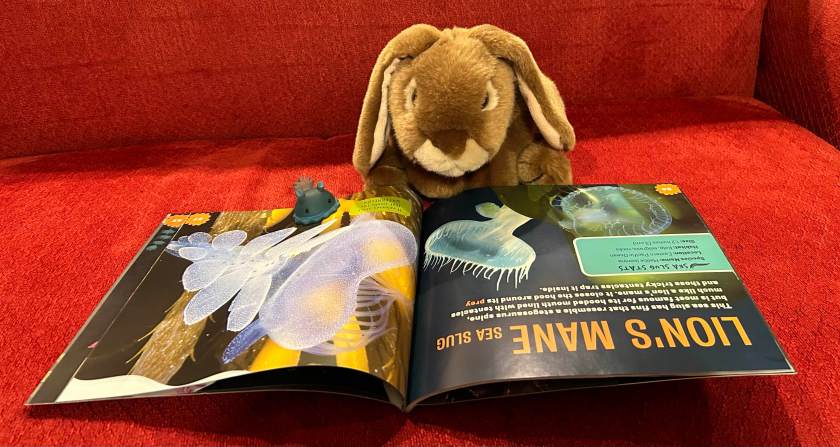
Caramel and his new squishy friend Jellyfish are reading Glow Animals by K.C. Kelley.

S: What else is in the book?

C: There are more animals with bioluminescence. And then there are other animals which don’t make their own light, but their skin or fur reacts to UV light. That is called fluorescence.

S: Oh that’s cool too. What are some examples of fluorescent animals?

C: Glowing sea slug and pyrosome.

S: Hmm, I know about sea slugs because you told me all about them when you were reviewing that book Sea Bunnies, but what are pyrosome?

C: According to the book, they are actually colonies of tiny animals called zooids, and they look like purple fuzzy cucumbers.

S: Wikipedia says they are also called sea pickles. That’s interesting too, Caramel. I learned a lot today. So did you like this book then? It seems to have a lot of facts.

C: Yes. And it has lots of colorful pictures of weird animals. So I like the book. And my new friend Jellyfish, of course.

S: Of course. So how about describing the book to me in three words?

C: Colorful weird animal facts. Well, that’s four words.

S: It will do, Caramel. Let us wrap this up then. What do you want to tell our readers?

C: Stay tuned for more book bunny reviews!

Caramel loved reading Glow Animals by K.C. Kelley and playing with his new squishy friend Jellyfish (who eventually went back to his little room to rest). He expects he will look over these pages many times in the coming weeks and months.

Caramel reviews Kepler’s Intergalactic Guide to Spaceships by Jake Parker

A few months ago Sprinkles heard about a Kickstarter project initiated by Jake Parker for a book about spaceships. Knowing how much Caramel loves spaceships (see, for example, his review of Star Trek: Ships of the Line by Doug Drexler, Margaret Clark, and Michael Okuda), Sprinkles decided that they would back the project. Just last week, the book finally arrived in the mail, and Caramel was delighted. Below, he shares his thoughts about Kepler’s Intergalactic Guide to Spaceships. As usual, Sprinkles is taking notes and asking followup questions.

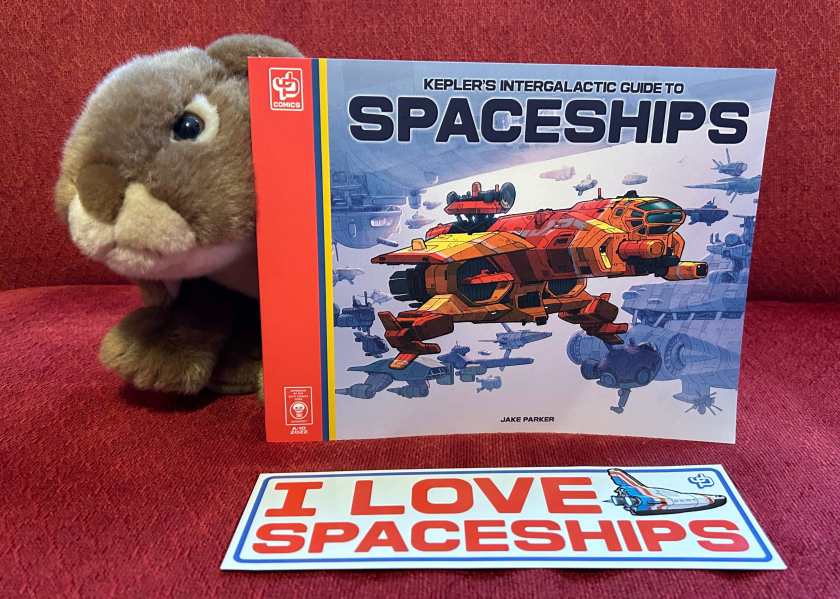
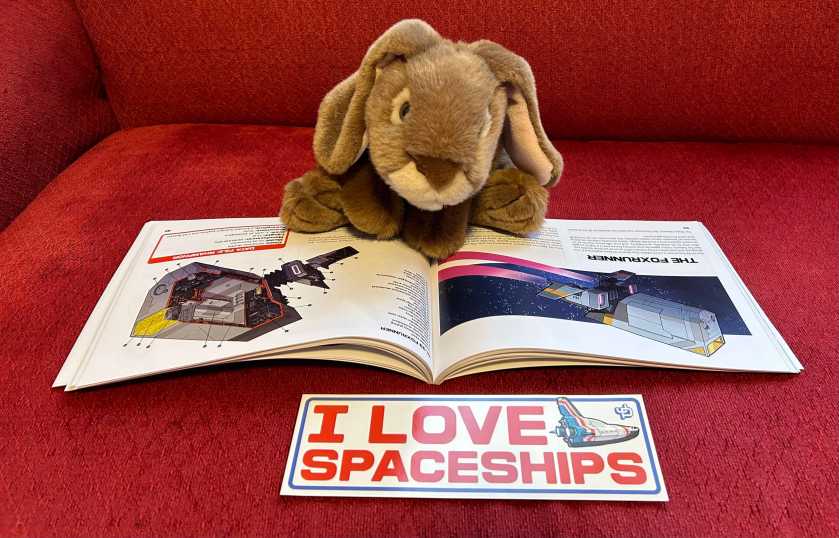
Caramel reviews Kepler's Intergalactic Guide to Spaceships by Jake Parker.
Caramel reviews Kepler’s Intergalactic Guide to Spaceships by Jake Parker.

Sprinkles: So Caramel, after months of waiting, you finally have Kepler’s Intergalactic Guide to Spaceships under your paws! How does it feel?

Caramel: Great!

S: So tell me about the book. What is in it?

C: Spaceships, spaceships, spaceships! (I’m trying to sound like the spaceship guy in The Lego Movie.)

S: I see. And I of course know the book has spaceships in it, because I know its title, but I wanted to know what kinds of spaceships.

C: All kinds.

S: Real spaceships?

C: No. Fake ones, obviously.

S: So they are all inventions of the creator, Jake Parker, right?

C: Yes. And they are all very cool. My favorite one is Zahhak; I think it looks the best.

S: Tell me more.

C: The Zahhak is an attack fighter. The full model is called XAF-9 Zahhak. It’s 13 meters long and has a crew of two pilots. It can have a variety of weapons, and it is powered by two Thrasos Engines. And it was created by the Xovax system.

S: Wait! All of those are made up, right? I mean, there is no real thing called a Thrasos Engine, or a star or planet system named Xovax, right?

C: True, but that is also why this is an awesome book! There are so many spaceships Jake Parker thought up and drew, and they are all so cool!

S: So let me see if I get it right: there are many many fictional ships the author / illustrator created, and it is kind of a guide book of these.

C: Yes. But I think some of the guide is incomplete. The ship Alastor is supposed to be a heavy weapons fighter, but the entry for its armament is empty. Which can’t be, because it is a fighter, and is supposed to have weapons of some sort.

S: Hmm, maybe the guide is created by this Kepler guy and he does not have full information.

C: Yes, Kepler does seem to have full information on all the enemy ships, even though he has not seen all of them. But maybe he does not know the Alastor very well.

S: Okay. So tell me a bit more about Kepler. What or who is he?

C: He is a ship repair person, working in Spartha’s North Quadrant, probably a made-up place, but sounds cool. And he knows a lot about ships.

S: He is named after a famous scientist; did you know about Johannes Kepler?

C: No.

S: Well, Kepler is one of the fathers of modern astronomy. He lived around the same time as Galileo and developed the laws of planetary motion. He also did some work in optics, and that was useful for telescopes. And his work led to Isaac Newton‘s development of the laws of gravitation and all that good stuff.

C: That’s cool! But I don’t think the Kepler in the book is a human, or even a bunny. He looks more like an alien.

S: I thought he also looked a bit like some of the characters in the Beast Academy books.

C: Yes, kind of. The book is very colorful, also like those books. But those books have a definite disadvantage against this one. They have no spaceships!

S: Totally agreed, Caramel. Though I do like the Beast Academy books, they are mainly for math learning fun. They are not for learning about amazing spaceships like this one.

C: Exactly.

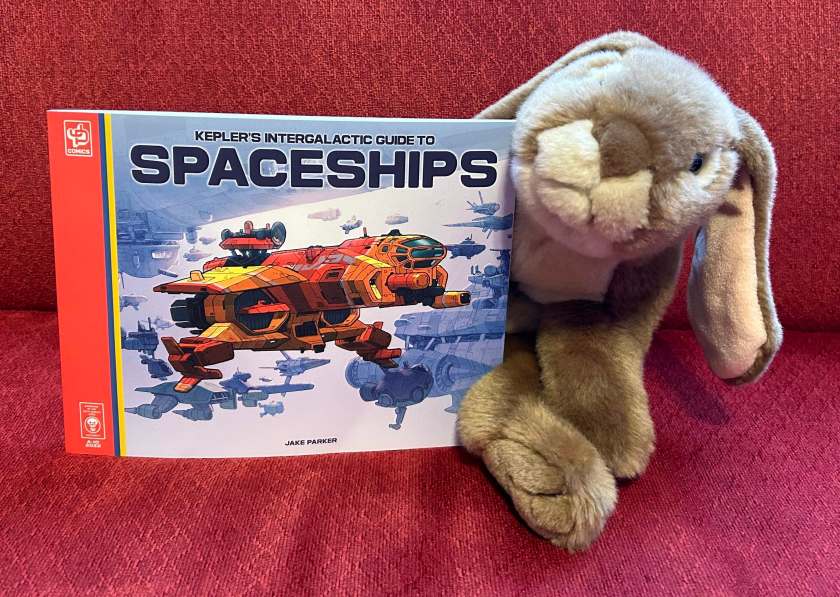
Caramel is reading Kepler's Intergalactic Guide to Spaceships by Jake Parker.
Caramel is reading Kepler’s Intergalactic Guide to Spaceships by Jake Parker.

S: Before looking over this book, I really did not know much about Jake Parker. But I think you would actually enjoy some of his other work too. He wrote a really sweet book about a little robot who makes friends with a sparrow.

C: Yes, we found a librarian reading it on YouTube; it is a neat book. Maybe we can put a link to it here?

S: Sure. Here it is:

OML Story Time: Little Bot and Sparrow by Jake Parker, read by Hadassah (YouTube video).

C: I really like this story. You know I like robots, too, maybe as much as I like spaceships.

S: Do you like robots or spaceships more?

C: Hmm, I can’t choose. I love them both.

S: I know. It is a hard choice. And this little robot is very cute. Jake Parker says he was influenced in his art a lot by Bill Watterson, the creator of Calvin and Hobbes, and you can see it a bit in the pages of the book, right?

C: Yes, not at all in the Spaceships book, but I can definitely see some of it in Little Bot and Sparrow. And maybe after this review I can go and reread some Calvin and Hobbes.

S: Yes, of course. Marshmallow has already reviewed our copy of The Authoritative Calvin and Hobbes: A Calvin and Hobbes Treasury. And you can definitely read it again.

C: I might. But then again, maybe I will continue to look over the spaceships in this book.

S: I know, right? I think you won’t get tired of this book for a while.

C: True. One can never get tired of spaceships, and one can never have too many spaceships. So no, I won’t get tired of this book at all.

S: That’s great Caramel. So let us wrap up this review. Can you describe the book in three words before we do that?

C: Colorful spaceship fun.

S: I like that description! Okay, what do you want to tell our readers then?

C: Stay tuned for more book bunny reviews!
Caramel loved reading Kepler's Intergalactic Guide to Spaceships by Jake Parker and will surely spend many many more hours looking at the pictures of this book in the coming weeks and months.
Caramel loved reading Kepler’s Intergalactic Guide to Spaceships by Jake Parker and will surely spend many many more hours looking at the pictures of this book in the coming weeks and months.

Caramel reviews Hot Lava! Fiery Facts About Volcanoes by Alice Fewery

A couple of weeks ago, Caramel visited the book fair held in his school campus and picked a handful of nonfiction books for himself. Last week he reviewed one of them: Sea Bunnies by Kelly Hargrave. Today he talks about a second book: Hot Lava! Fiery Facts About Volcanoes, written by Alice Fewery and published in 2021. As usual, Sprinkles is asking questions and taking notes.

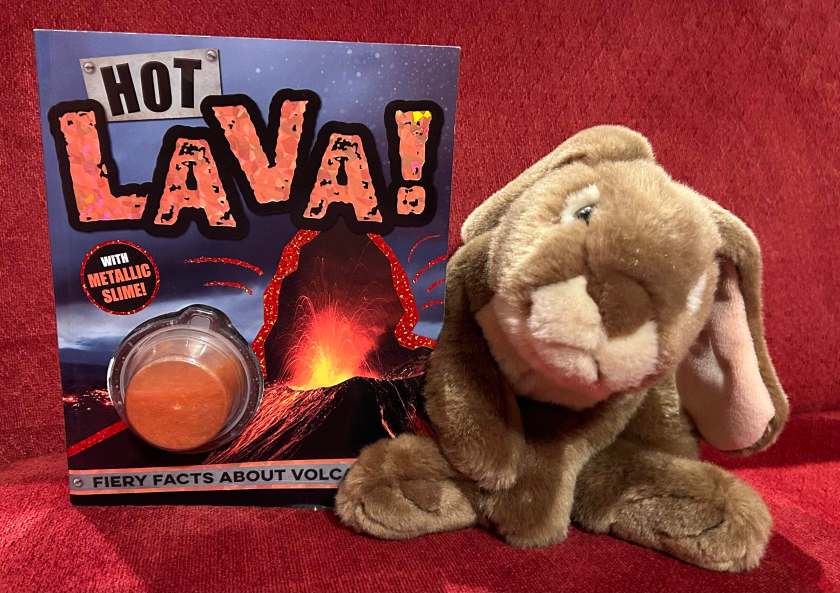
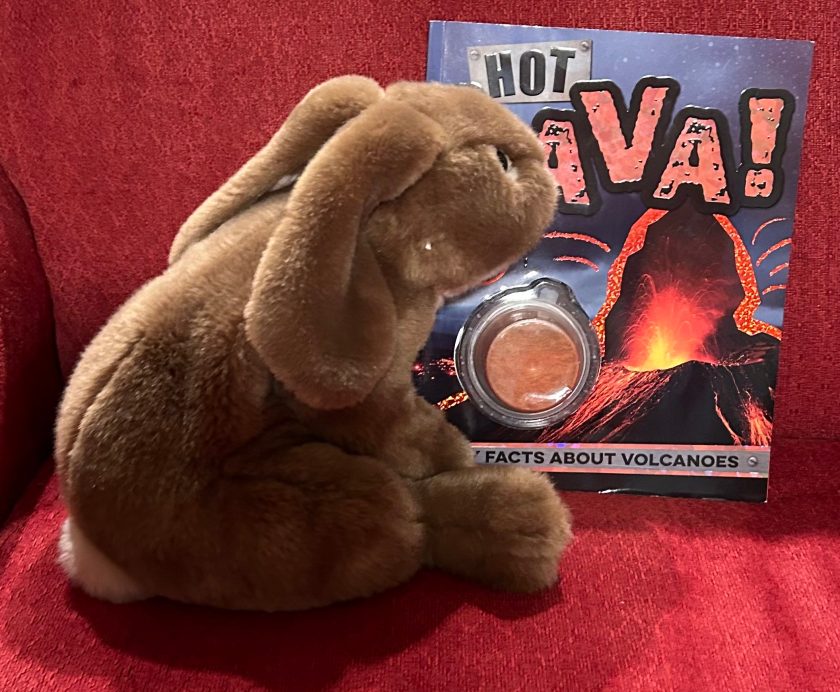
Caramel reviews Hot Lava! Fiery Facts About Volcanoes by Alice Fewery.

Sprinkles: So Caramel, this was the second book you got from the school book fair. Tell us about it. Why did you want to read it?

Caramel: Because I wanted to know more about volcanoes! And of course, the slime!! It comes with slime!

S: I can see that the book combined two things you like: slime and facts!

C: Exactly. I like books full of facts, and this book is full of facts. And I like playing with slime, and this book came with metallic slime.

S: What’s metallic slime?

C: It’s just regular slime but its color is metallic.

S: Hmm, I see. Did you know that you could make magnetic slime?

C: Not until you showed me that page you found. Can we link to it so we can make some of our own some time? We have to!

S: Okay, maybe we can. Here is the link: How to make magnetic slime.

C: Cool.

S: Okay, can we get back to the book now?

C: No. Of course, I’m kidding! Yes let us talk about the book.

S: You got me there. Okay, now tell me about the book.

C: It is forty pages full of “fiery” facts about volcanoes. For example, did you k know that when a volcano in the Krakatoa island blew up in 1883, it changed the climate of the whole world? The temperatures fell by 0.72 degrees Fahrenheit all around!

S: No, I had heard of the Krakatoa explosion, but I did not know that its climate effects were so significant. So the book talks about famous volcanic explosions, right?

C: Yes. It has two-page spreads on three other “famous eruptions”: Mount Vesuvius in Pompeii, Italy, which blew up in 79 CE, Mount St. Helens in Washington, USA, which blew up in 1980, and Mount Pelée in Martinique, which blew up in 1902.

S: Did you know about these disasters before, Caramel?

C: I had heard about Pompeii and Mt Vesuvius. And I am not sure but I think I might have heard about that one person who survived because he was in a windowless jail cell during the explosion of Mount Pelée. But I did not know about the others.

S: So you learned some things from this book.

C: Yes of course. I also learned a lot about the mechanism of volcanoes and a lot of new words about them. For example, apparently magma is called “magma” under the crust, but when it gets out we call it “lava”. So I knew both were molten rock, but I did not know they were exactly the same thing, just one is inside and one is outside.

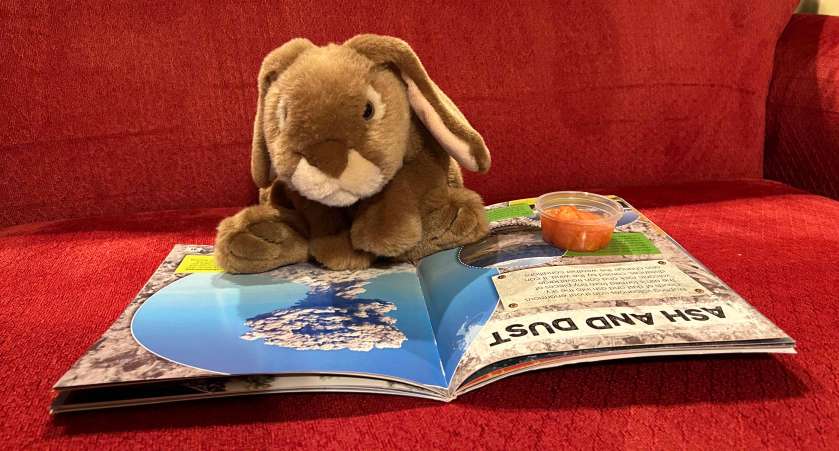
Caramel is reading Hot Lava! Fiery Facts About Volcanoes by Alice Fewery, accompanied by the metallic slime that came along with the book.

S: So the book was “factful”, right?

C: Yes, that would definitely be one of my three words.

S: What other words would you use?

C: Colorful, and maybe slimy. But not in a bad way; I call the book slimy because it comes with slime. Really nice metallic orange color.

S: I understand. So tell me what other facts there are in the book before we wrap up this review and you go back to playing with that cool slime.

C: Okay. Maybe I can read to you some of the section titles.

S: Sure.

C: I’ll skip the famous eruptions because I already listed them. Then there are sections titled “What is a volcano?”, “Volcano varieties”, “Why do volcanoes erupt?”, “Life cycle of a volcano”, “Liquid rock”, “Hot water”, “Ash and dust”, “Gas and lightning”, “Weather warning”, “Supervolcanoes”, “Volcanoes in space”, “Living on a volcano”, “Visit a volcano”, “Make your own volcano”. And there is the glossary and an index.

S: Some of those sound really interesting! I’d love to know more about volcanoes in space and making your own volcano.

C: We can try making one at home some day, maybe?

S: Maybe.

C: And space volcanoes are really neat too. You should read this book Sprinkles.

S: Maybe I will.

C: But I’m not sharing my slime!

S: Hmm, we’ll see about that. Okay, let us wrap this up. What do you want to tell our readers?

C: Stay tuned for more book bunny reviews!
Caramel enjoyed reading Hot Lava! Fiery Facts About Volcanoes by Alice Fewery, and playing with the metallic slime that came along with the book, though it did get into his fur a little.

Caramel reviews Sea Bunnies by Kelly Hargrave

Caramel loves books with facts. He also loves soft squishy toys. So he could not help but get exceptionally excited when he visited the book fair in his school and he saw Sea Bunnies, a 2021 book by Kelly Hargrave. The book was colorful and full of interesting facts, and on top of all that goodness, it came with a new squishy friend! So of course today Caramel is talking about Sea Bunnies. As usual, Sprinkles is taking notes and asking questions.

Caramel reviews Sea Bunnies by Kelly Hargrave.

Sprinkles: So Caramel, you saw this book and had to read it!

Caramel: Yes! Can you imagine me passing by a book about our distant relatives? They are called sea bunnies, so they must be related to us somehow, right?

S: Hmm, i’m not so sure. Guinea pigs are not really related to pigs. So what are these sea bunnies? Are they mammals like regular bunnies are?

C: Well, not really. They are sea slugs.

S: Hmm, so they are not really bunnies after all.

C: No, but they have antennas that look like bunny ears, so people call them sea bunnies. And they are cute! Though maybe not as cute as most bunnies. Still they can be our friends.

S: Especially your new squishy friend, right?

C: Yes! My squishy friend is very cute. He might actually be cuter than the real sea bunnies, but that’s alright I think.

Caramel and his new squishy friend are reading Sea Bunnies by Kelly Hargrave.

S: So let us get back to the book. Tell us a bit about it please.

C: The book has fifty pages. On each two-page spread, you learn about a new type of sea slug or sea bunny. There are about thirty different types they talk about. For example, there is one they call a Ninja Sea Slug. Then there is a sea angel. There is a leaf sheep. And so on.

S: So they all have interesting names!

C: Yes, in the beginning the author says “each sea slug featured in this book has been given an awesome nickname.” And they are awesome nicknames!

S: I agree. They are all pretty imaginative and evocative nanes.

C: Those would be some words I could use to describe the book!

S: I guess so. But I’d also assume you would want to say “colorful” and “fact-full”, right?

C: Yes! The book is very colorful and full of facts!

S: Any facts that were new for you?

C: Of course! I didn’t even know that there was an animal called a sea bunny, to start with. So yes.

S: True, the name was new, but what else did you learn about these creatures?

C: They have tentacles, and some have wing-like extensions. Some glow in the dark. Some are pink and have toxins. They can be all sorts of colors. There are over two thousand different types of sea slugs!

S: Those are all very interesting facts Caramel! I’m glad you read this book.

C: Me, too! And I’m glad I have a new squishy friend!

S: I know. Okay, this is probably a good time to wrap up the review so you can continue to play with him. What would you like to tell our readers?

C: Stay tuned for more book bunny adventures!

Caramel and his new squishy friend strongly recommend reading Sea Bunnies by Kelly Hargrave and learning more about these amazing creatures. And of course who doesn't want another squishy friend?
Caramel and his new squishy friend strongly recommend reading Sea Bunnies by Kelly Hargrave and learning more about these amazing creatures. And of course who doesn’t want another squishy friend?